In this article
TL;DR
Journey-stage research usually fails on timing: the findings arrive after the decision has already been made.
Inherited five-stage templates describe a generic category buyer. They miss the specific decision moments your customers move through.
Derive stage structure from behavioral segments and experience reconstruction prompts. Demographic screeners and opinion questions rarely surface the moments that matter.
Method fit changes by stage: depth interviews early, group validation mid, preference ranking paired with the reasoning behind it at the decision point, continuous programs after purchase.
Stage claims survive a stakeholder review only when each one traces to a real participant, with a timestamp, a verbatim quote, and a clip.
Most journey-stage research arrives late.
A campaign brief locks four to six weeks out, sprint planning runs on two- to three-week cycles, and roadmap reviews happen on a fixed calendar. When qualitative findings arrive outside those windows, they document what was already decided on instinct. The study might as well never have happened, and the cost shows up in every roadmap, every brief, and every set of marketing efforts built on assumptions, across the entire customer journey.
The credibility problem sits atop the timing one. When a stakeholder asks "who actually said this?" and the answer is a framework slide rather than a real participant clip, the finding loses its authority before the meeting ends. Most journey maps inherit their structure from marketing funnels, and the resulting customer journey mapping process looks nothing like how purchase decisions actually unfold.
Deriving stage structure from the customer's perspective, in their own language, on video, changes the credibility of every downstream decision that relies on it. Themes emerge from what people actually said, which is what makes it possible to identify patterns that are really there.
What customer journey stages actually measure
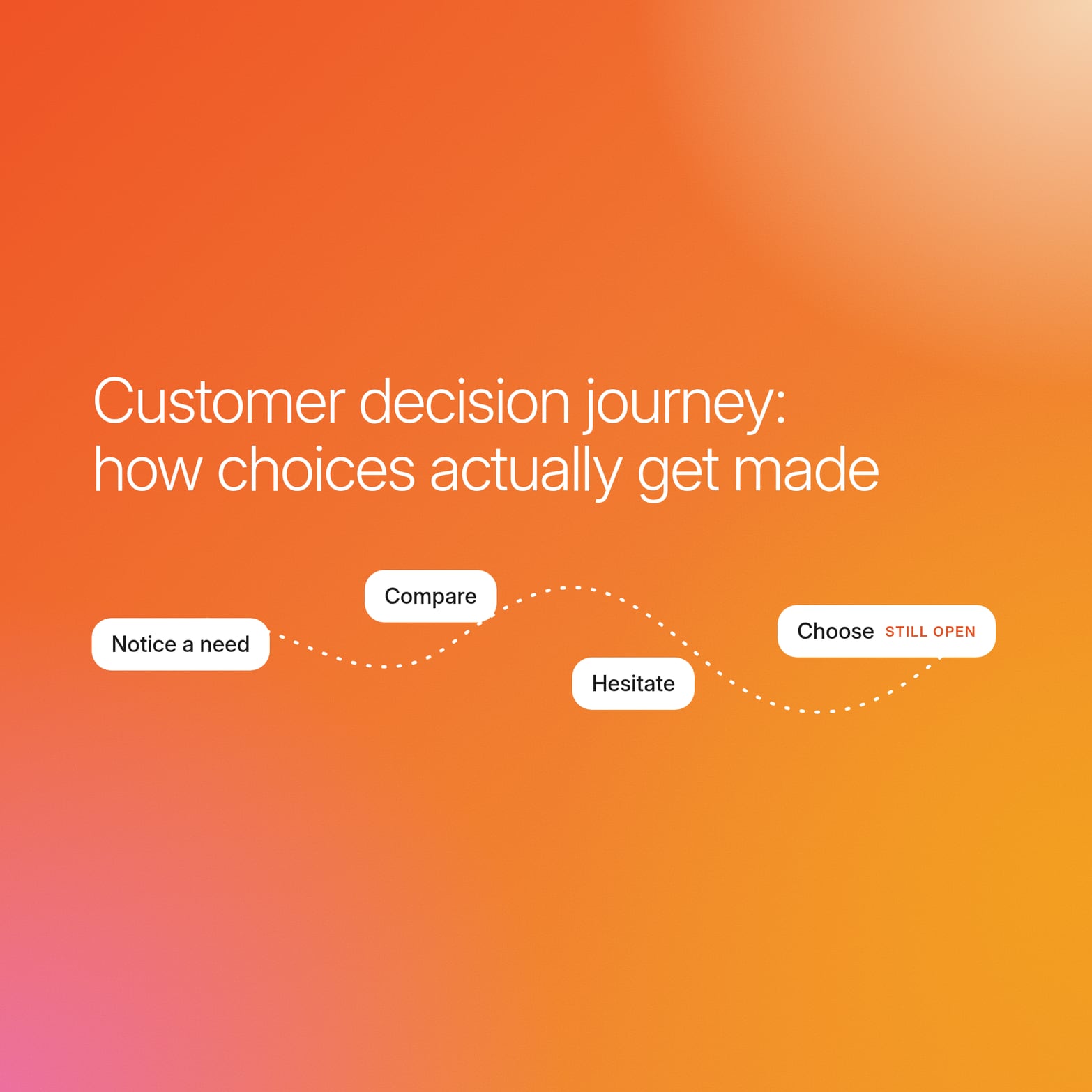
Customer journey stages are the sequence of decision moments a customer moves through from problem recognition to post-purchase behavior. The real work is building evidence on what triggers movement between them, what creates hesitation at each, and what customer behavior actually looks like before someone stalls or moves forward. The path a customer takes to that next step is rarely a straight line, and it says something about the entire customer experience beyond the moment being studied.
A five-stage framework, awareness through advocacy, is a starting hypothesis about a typical customer, and it needs evidence before it becomes a finding. It describes a generic category buyer. Your customers buy your product under your competitive conditions, and the template says nothing specific about them. The customer decision journey rarely fits a universal template: an impulse purchase might have three meaningful stages in the buying process, while a complex B2B procurement can run to nine or more.
Mapping either onto the same five-stage model produces a visual representation that looks complete and explains nothing. Participant-derived models surface the stages that matter for your category, turning a diagram into actionable insights.
Stakeholders in product, brand, and strategy reviews routinely dismiss journey-stage insights when the claims read like generic customer feedback rather than traceable evidence. Without traceability, journey maps become opinion documents that cannot withstand scrutiny by a skeptical CMO. Journey-stage research needs to be designed around real decision windows and business objectives from the start.
3 reasons most journey stage models fail in practice
Teams build buyer personas in internal workshops, populate journey maps from sales call notes and survey aggregates, then apply a five-stage or seven-stage template because it fits the slide format. When someone asks "who actually said this?" the answer is usually a composite or a paraphrase. That is the foundational problem: internal consensus dressed up as customer evidence.
Applying a template without category-specific validation produces three predictable failure patterns.
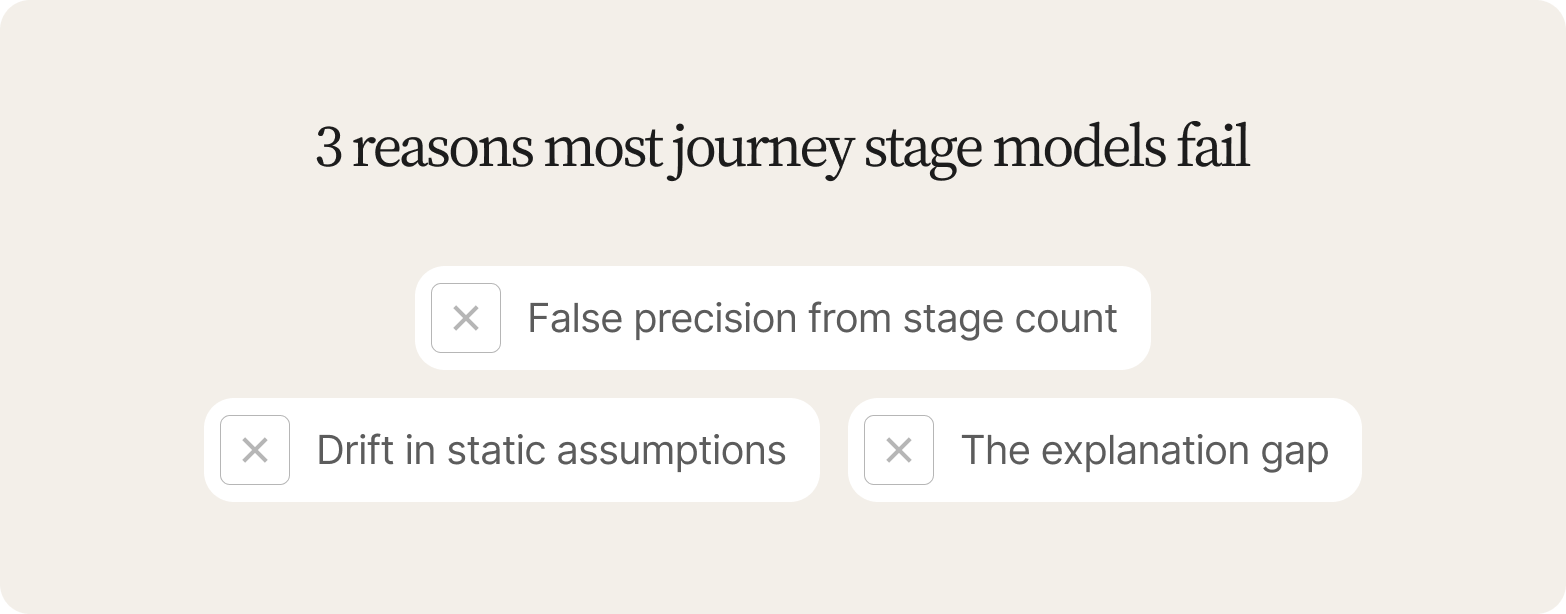
1. False precision from stage count
A seven-stage model applied to a target audience that only moves through three real decision moments creates the appearance of rigor without the substance. The moments that genuinely drive or stall decisions get split across artificial phases and addressed by none of them.
2. Drift in static assumptions
Static buyer personas have a shelf life of roughly six months before the triggers and workarounds they describe no longer reflect current behavior. Teams keep acting on those assumptions long past that point, often because marketing practices moved on before the research did, and because refreshing them means commissioning a new study.
3. The explanation gap
Survey data can show where customers drop off across customer journey touchpoints, but it cannot explain why they stall. Buyers may have stalled on a pricing concern they could not voice, a competitor comparison they could not resolve, or a risk they could not articulate. Those pain points never show up in an aggregate drop-off number.
Traditional agency qualitative cycles routinely run into months from brief to findings, and research that lands after the decision window is operationally irrelevant regardless of its methodological quality. That is how teams end up running on inherited frameworks baked into internal processes no one revisits. Journey-stage diagnosis needs hesitation captured mid-conversation, tone shifts when a risk surfaces, and contradictions between what a buyer says and what they describe doing. None of that appears in a structured survey response, because surveys give participants neither the space nor the prompting to surface it.
How to derive customer journey stages from customer evidence
Stage structure that holds up in a roadmap review has one thing in common: it came from customers. The most common mistake in customer journey mapping is reaching for a pre-built framework, then fitting participant data into it after the fact.
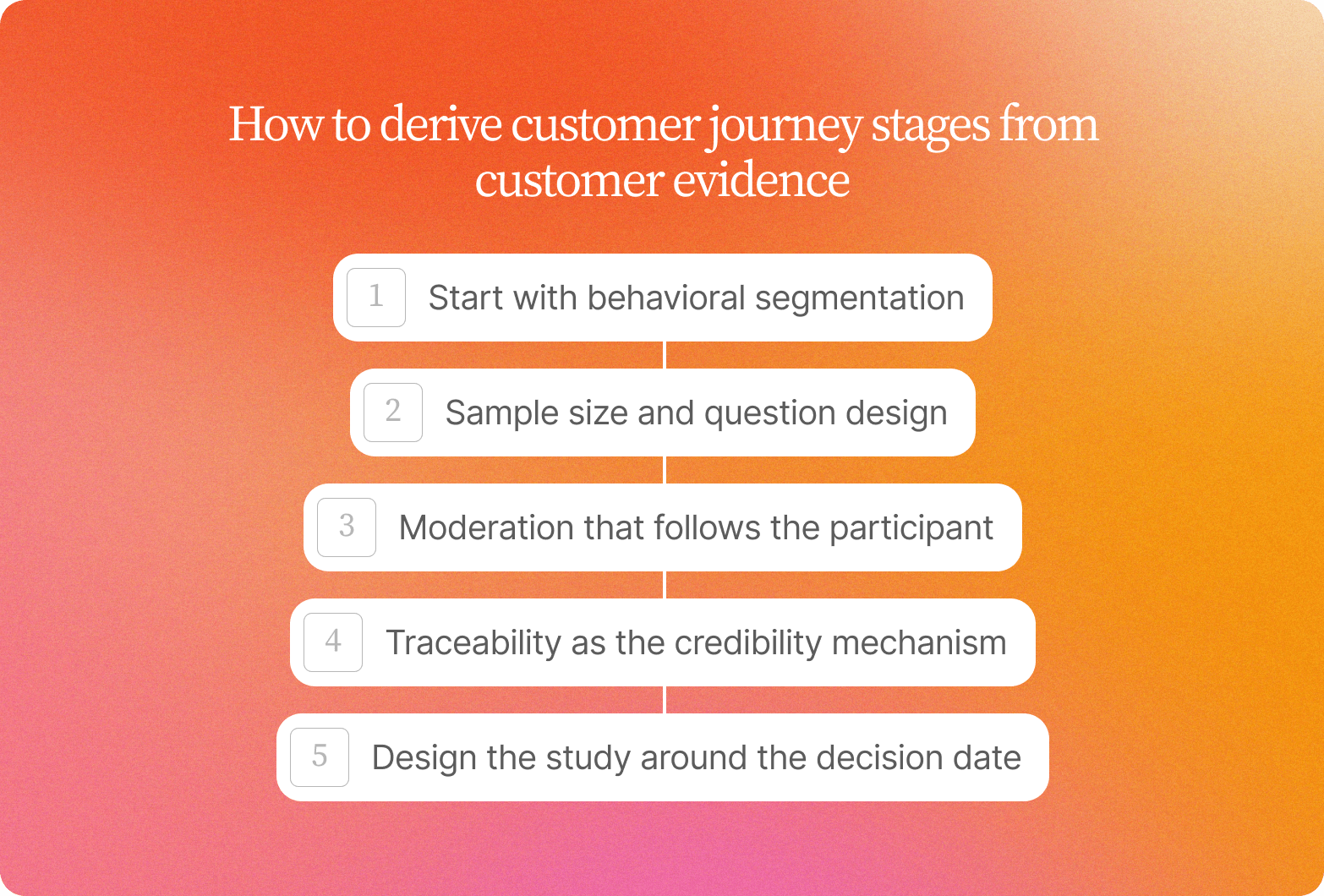
1. Start with behavioral segmentation
Segment by triggers, risks weighed, channels used, and workarounds rather than by age, income, or job title. Two customers who look identical on a demographic screener can be at completely different stages of the journey if one is responding to a compliance deadline and the other is conducting a proactive evaluation. Define segment criteria before recruiting: the screener is the research design, and post-hoc sorting is where generalization creeps in.
2. Sample size and question design
Recruiting 5 to 15 participants per segment typically reaches thematic saturation when the screener is behavior-specific. Experience reconstruction prompts outperform opinion prompts every time. Asking a participant to "walk through the last time you evaluated a new vendor" elicits a chronological sequence of real moments, whereas asking "what do you value in a vendor?" elicits socially acceptable answers that rarely reflect what happened. Experience reconstruction prompts are designed to close exactly that gap between stated customer expectations and lived experience, the same gap that lets a team believe it can exceed customer expectations at the point of sale while missing what happens afterward.
3. Moderation that follows the participant
A fixed script moves participants from question to question regardless of what they just said. Researchers using Conveo's AI research assistant probe the moment instead: who picked it back up, what changed, what made it safe to proceed again. It is a small window into how customers interact with a process once it stalls and restarts, and those are the real reasons a journey stage advances or stalls.
"You see them physically doing it. Testing the product for the first time, being probed right there. That unfiltered, in-the-moment reaction is possibly the most powerful thing you can see as a researcher."
Dafydd Jones, Associate Director, Ninth Seat
4. Traceability as the credibility mechanism
Customer journey analysis earns its place in a strategic review when every theme traces back to a specific person who said it. That turns a workshop artifact into a defensible evidence base that keeps providing valuable insights well beyond the original study. A brand director who was not in the research debrief can watch the clip of a participant describing the moment they decided to shortlist. That is a different level of stakeholder confidence than a slide reading "customers feel uncertain at the consideration stage."
5. Design the study around the decision date
Start from the date the decision closes and work backward. Async interviews run in parallel rather than in sequence, which makes a tight window feasible without reducing the sample to anecdote.
Stage-specific research method fit
Choosing the wrong method at a given stage does not make a study slower. It produces findings that answer the wrong question entirely.
| Journey stage | Method that fits | What it answers |
|---|---|---|
| Early exploration | Depth interviews | How a potential customer thinks before a category mental model is assumed |
| Mid-stage validation | Focus groups | Which messaging and concepts hold up, in the words customers actually use |
| Late-stage adoption | Ethnography and in-context observation | Where reported behavior and actual behavior diverge during use |
| Decision | MaxDiff and Kano | Which features and messages move people to purchase, and why |
| Post-purchase and retention | Continuous programs | Which shifts in satisfaction and loyalty signal churn before it happens |
Depth interviews: early-stage exploration
When the goal is to understand the customer decision journey before a category mental model has been assumed, depth interviews capture how a potential customer actually thinks, starting from initial awareness. Each conversation runs independently, so diverse paths surface rather than getting averaged out. A single well-designed interview guide can also populate personas, jobs-to-be-done frameworks, and mental models at once.
Focus groups: mid-stage validation
Group sessions earn their place once the early-stage picture is clear. Testing messaging or feature concepts benefits from the friction of a group setting, where the target audience pushes back on each other's language and surfaces the words they actually use, the raw material for campaign briefs that marketing teams rely on. The risk is running groups too early and reaching social consensus rather than individual truth.
Ethnography and in-context observation: late-stage adoption
Reported behavior and actual behavior diverge most sharply at the usage stage, and that gap is where real user experiences differ from what a debrief slide claims. Participants describe a product experience as smooth in interviews, but demonstrate workarounds when observed in their own kitchens or workspaces. Live in-home and in-store observation, including brick-and-mortar store visits, sits outside Conveo's own method set. Conveo runs async AI-moderated interviews, pairing preference ranking with the reasoning behind it in the same session, and ethnographic fieldwork is commissioned separately.
MaxDiff and Kano: decision-stage prioritization
At the decision stage, teams need to rank which features and messages will move people through the purchasing process to an initial purchase. MaxDiff tells you what people prefer. Conveo's MaxDiff also tells you why, because the preference ranking and the reasoning come from the same person in the same session.
Continuous programs: post-purchase and retention
Teams often over-invest in the moments that win new customers and under-invest in the moments that keep existing customers, even though retaining customers costs less than acquiring new ones. This is where customer success teams and researchers overlap most. Customer satisfaction drivers shift after purchase, and the onboarding process is often the first real signal of satisfaction. Continuous programs surface shifts in advocacy, brand loyalty, and customer loyalty before a friction point becomes a churn trigger, which is what should drive customer satisfaction work at this stage rather than a one-time renewal check.
Conveo StoryLines is the continuous, wave-based, AI-moderated research program behind that read, running signal detection across the wave time series so that the movements that matter surface while there is still time to act on them.
The integration advantage
Running separate studies for each stage is the default, and it is expensive, delaying the business outcomes those studies are meant to inform. Commissioning discrete projects for personas, jobs-to-be-done, and mental models costs materially more than designing one interview set to serve all of them, because the same conversations can be analyzed against several frameworks without repeating the recruiting or fielding effort. Because all of it derives from the same conversations, the outputs stop contradicting each other, whether the audience is product, marketing, or sales teams. Start from what needs to be known and what evidence would change the decision, and let that question determine the method.
Making journey stage insights defensible
A journey-stage recommendation lands in the room, someone asks where it came from, and the answer is "themes from the interviews." Without a direct line from the claim to the person who said it, reviewers water down the finding or set it aside. Every stage-level claim needs a participant ID, a timestamp, a verbatim quote, and a clip reviewers can watch themselves.
Three visual formats make this evidence defensible in practice:
Participant video clips at customer touchpoints: hesitation or language changes at decision moments, evaluable directly rather than through a researcher's interpretation.
Timestamped quote cards traceable to participant IDs: letting stakeholders follow the chain from claim to source in seconds, especially at the important customer touchpoints where a deal was won or lost.
Side-by-side journey maps comparing inherited frameworks against customer-derived structures, making the gap between assumed and actual journeys visible without needing to audit all the customer touchpoints individually.
Every finding is grounded in a real participant who can be named in the record, timestamped, and watched. Participant quality checks keep the sample clean. Defensibility is what separates journey-stage insights that are acted on from claims that are revisited every quarter.
Keeping journey stage evidence alive
Journey-stage evidence has a shelf life, and in most organizations it is shorter than teams assume. A happy customer who mentioned a friction point in passing six months ago may be describing something already fixed or something that has just gotten worse. The triggers and decision criteria that define each stage, along with the customer loyalty they build or erode, can shift meaningfully within about six months across the customer lifecycle, driven by competitive moves or category changes. A deck presented at a quarterly debrief captures valuable data at that moment, then quietly expires in a shared drive, often pulled from data sources never designed to answer the next team's question.
Conveo's searchable insight library lives inside the platform, where every participant clip, quote, and theme is stored and connected across projects, turning one-off studies into reusable evidence the whole organization can draw on. Findings stay retrievable by topic or segment, so nothing gets researched twice, and a brand manager preparing a campaign brief for target customers can search what consideration-stage participants said about a specific hesitation instead of hunting through archived presentations.
Each new study connects to what already exists, so a team can see how advocacy drivers have shifted across multiple touchpoints since the last wave. Conveo StoryLines extends this into continuous, wave-based programs that run signal detection, surfacing movements relative to an existing baseline. When product, marketing, and CX teams pull evidence from the same library, they work from the same version of the truth.
How Conveo closes the journey-stage evidence gap
Journey-stage evidence is only useful while the decision is still open. Conveo is Consumer Understanding Infrastructure that maintains an always-on read of how consumers move through their decision-making across the entire customer lifecycle.
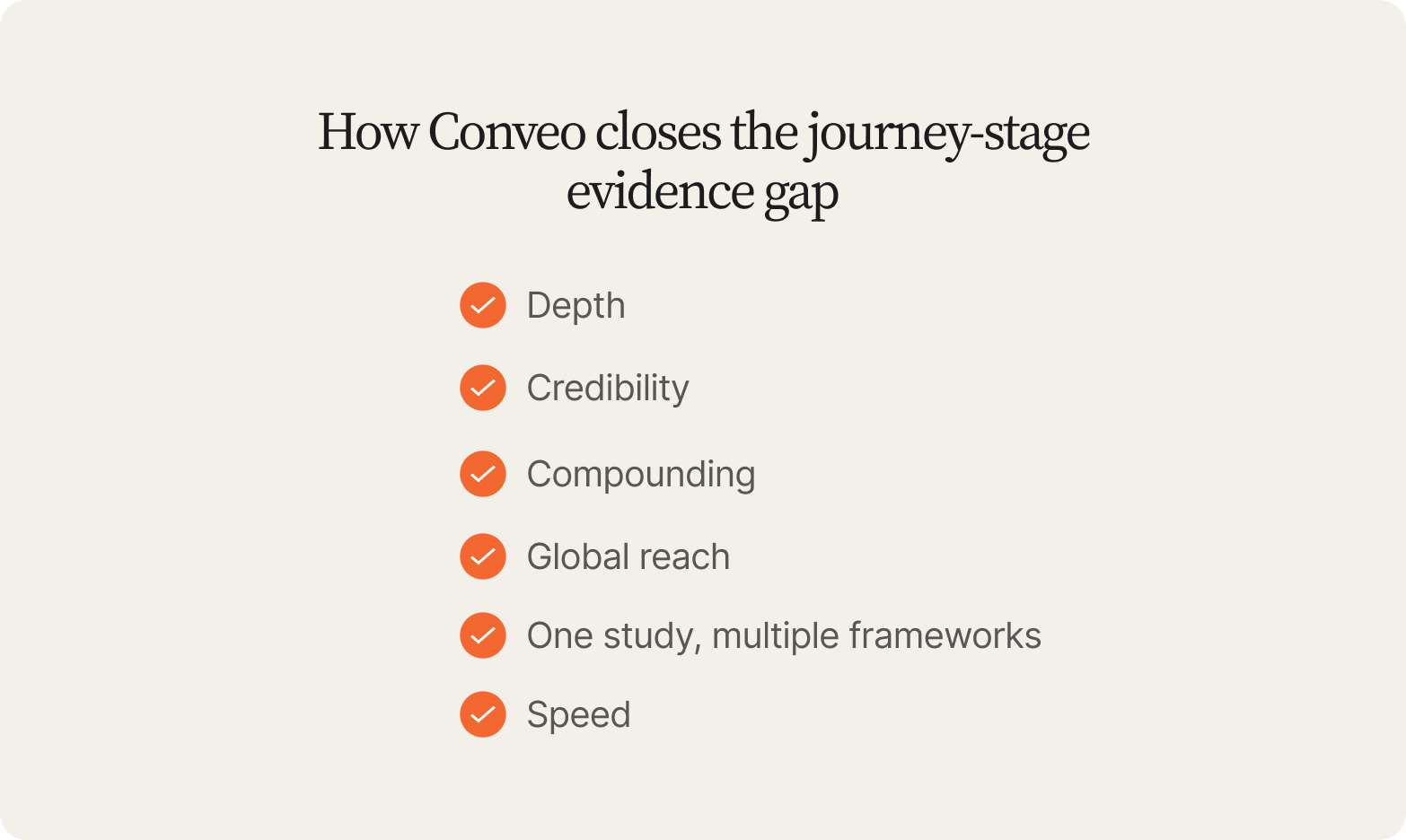
Depth
Researchers using Conveo's AI research assistant follow what participants just said, probing the drivers that explain why someone stalled or converted at a moment no one anticipated, making real consumer interactions legible instead of guessed at.
Credibility
Every finding is grounded in a real participant who can be named, timestamped, and observed, with the verbatim quote attached, so leadership can act on the research with confidence. Participant quality checks keep the sample defensible.
Compounding
Findings connect across projects in Conveo's searchable insight library, so a journey map built this quarter becomes the baseline for the next one.
Global reach
AI-moderated interviews in 50+ languages mean research runs across markets in a single study, without separate local fieldwork, translation lag, or a patchwork of regional analytics platforms.
One study, multiple frameworks
A single Conveo interview set can be analyzed against persona, JTBD, and mental-model frameworks, rather than running separate studies for each. For an insights leader defending a flat budget, that consolidation, and the lifetime value it protects, is where the line-item case gets made.
Speed
Interviews run in parallel across markets and time zones, sometimes fielding 100 interviews in 3 days, and findings arrive while the decision is still open.
Where Conveo is not the right fit
Teams that need live in-store or in-home ethnographic capture should commission that fieldwork separately, since Conveo produces recall through interviews rather than observation of the moment itself. A one-off, low-stakes question with no need for a durable evidence trail does not warrant it either.
Agencies bring deep expertise and human moderation, and Conveo works alongside that expertise. Survey platforms reach scale quickly, but a drop-off rate cannot explain itself, and platforms that generate outputs from synthetic personas produce findings that no one can trace to a person who said them.
A journey map is only as current as the last conversation behind it. Enterprise insights teams at Google, Unilever, AB InBev, and JDE Peet's use Conveo to understand their consumers.
Frequently Asked Questions
What are the 7 stages of the customer journey?
The 7 stages most commonly cited are awareness, interest, consideration, intent, evaluation, purchase, and post-purchase. These are templates that still need validation. A considered financial services purchase may genuinely move through six or seven distinct decision moments, while a habitual grocery repurchase may have three. Forcing a seven-stage model onto a category with three real decision moments produces false precision.
What are the 5 stages of the customer journey?
The 5 stages are awareness, consideration, decision, customer retention, and advocacy, ending with customers who become loyal customers or churn. The model is broadly accurate as a starting framework. The problem is applying it without validation, since most maps are assembled in internal workshops from job titles and assumptions. What separates a usable map from a presentable one is behavioral specificity at each stage.
What are the 4 stages of the customer journey?
Four-stage models usually collapse awareness and consideration into a single discovery phase, then move through purchase, retention, and advocacy. The configuration matters less than whether the sequence reflects how your customers genuinely progress. Survey data will show where volume drops between stages, but not whether customers stalled during a price comparison, lost confidence during the onboarding process, or simply lacked time due to unresolved pain points.
How do you analyze the customer journey?
Start with behavioral segmentation: group participants by purchase triggers, risk weights, and workarounds adopted, rather than by age, income, or job title. Use customer data that reflects what people actually did, and define those criteria before recruiting. Use experience reconstruction prompts and moderation that follows what a participant just said. Then link every theme back to participant IDs, timestamps, verbatim quotes, and video clips, because without that chain a stakeholder can reasonably question whether the insight reflects one loud voice, a handful of customer feedback forms, or a genuine pattern.
What are customer journey touchpoints?
Customer journey touchpoints are the specific interactions, channels, and moments when a customer engages with a brand during the decision-making process. They fall into three broad categories: owned channels, such as a website, app, or in-store experience; earned channels, such as online reviews, social media mentions, referral programs, and word of mouth; and paid channels, such as advertising. A single journey typically crosses multiple touchpoints across all three. Survey data can measure which touchpoints customers used, but explaining why those channels influenced them, from the initial touchpoints through to the final decision, requires a richer conversation than a survey can hold.

About the author
Alex de Hemptinne
Head of Customer Success
Alex is a Business Impact Lead at Conveo, partnering with enterprise teams to embed AI-led research into their workflows. From the first study to full-scale rollout, she helps customers shift from project-based research to continuous customer intelligence.
Meet Alex on film →Qualitative insights at the speed of your business.
Conveo runs AI-moderated video interviews and structures everything they say.