In this article
TL;DR
Static qualitative surveys are useful starting points for gathering qualitative data, but they cannot probe when participants give shallow answers. The insight that explains behavior is usually in the follow-up.
Three criteria separate effective qualitative research questions from noise generators: specificity, depth, and traceability.
This article includes complete enterprise templates for concept testing, messaging validation, and packaging research, plus structural principles for writing questions that produce actionable depth.
AI-moderated video interviews combine the structure of a questionnaire with the adaptive follow-up of a skilled moderator, delivering qualitative data in days rather than weeks.
Question design and data collection workflow are not separate decisions. Well-structured qualitative methods produce open-ended responses that are easier to code, synthesize, and defend to stakeholders.
Most qualitative surveys fail at the same point. A researcher builds a clean guide aligned to their research objectives, recruits participants, collects responses, and ends up with answers that are technically complete but practically useless. "It was fine" tells you nothing. "I liked it" tells you less. Static qualitative survey questions cannot follow up when a participant gives a shallow answer, and that gap between what was asked and what needed to be understood is where most questionnaire-based research falls apart.
This article gives you complete questionnaire templates for enterprise use cases: concept testing, messaging validation, and packaging research. Each is available as a downloadable PDF, so your team can adapt them to your specific research goals without starting from scratch. Alongside the templates, you will find structural principles for writing questions that produce depth rather than one-line deflections, and honest guidance on when a questionnaire is the right survey method and when it is not.
Whether you are gathering qualitative data to support a product decision, evaluating a particular service concept, or building a market research program around customer experience, the right question design is what separates valuable insights from a transcript full of noise. Good research design begins well before the data collection phase: it begins with the question.
What makes a qualitative research questionnaire effective?
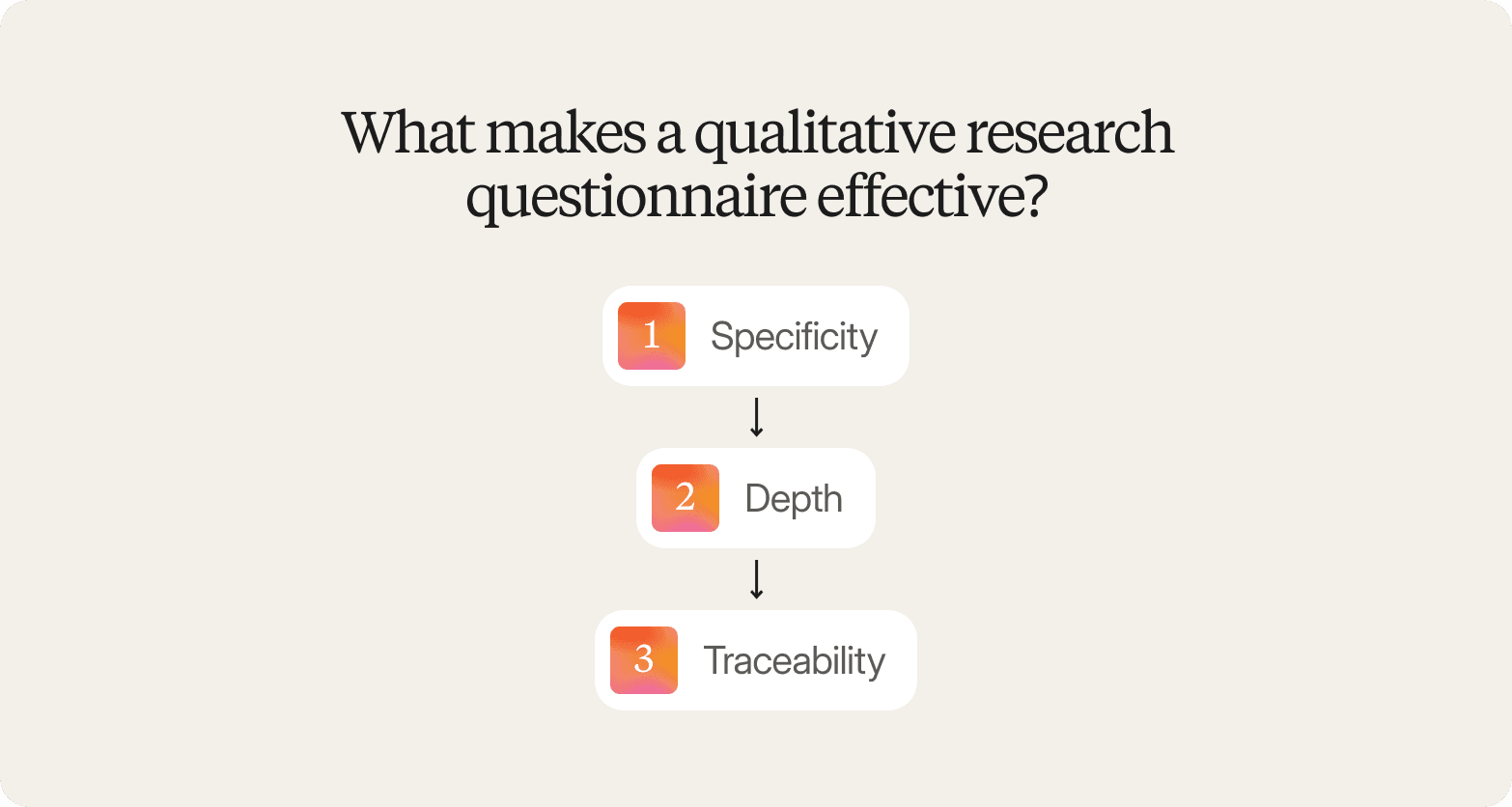
Three criteria separate a questionnaire that delivers meaningful insights from one that fills a transcript with noise.
Specificity
Effective qualitative research questions need to be clear enough that respondents understand exactly what is being asked. A vague scope produces vague answers, not detailed responses. "Tell us about your experience" invites participants to start in a safe, shallow place. A specific question anchors them in a real moment: "Walk me through the last time you had to choose between two options at the shelf." Using clear language from the outset prevents questions from inadvertently confusing participants and producing responses that cannot be coded or analyzed.
Depth
Questions that focus on behavior rather than abstract opinion are the foundation of a productive questionnaire. Good qualitative research questions invite participants to produce detailed narratives, accounts of what they actually did and why, rather than surface-level summaries of general feeling. "What did you do?" is an open-ended question. "What was going through your mind when you made that choice, and what almost made you decide differently?" produces layered, open-ended responses that explain behavior rather than recording it.
Traceability
This criterion matters more in enterprise research operations than most guides acknowledge. Responses need to be coded and themed without disputes over interpretation. Providing insights that stakeholders will act on means every finding must trace back to the gathering data phase: to specific questions, specific participants, and specific words they used. Well-structured questions elicit open-ended responses that naturally cluster into themes. Vague questions produce noise that requires the analyst to make judgment calls, which is where stakeholder trust erodes.
These three criteria address question design. But there is a structural problem that no static questionnaire fully solves: when a participant gives a shallow initial answer, the questionnaire cannot probe further. It moves on, leaving the insight buried. Conveo's AI moderator addresses this directly: it reads each response as it lands and asks dynamic follow-up questions based on what the participant actually said, not what the guide anticipated.
Complete qualitative questionnaire templates for enterprise use cases

The templates below are structured around the same core framework: an opening script to establish consent and context, a core question sequence, probe example questions for when responses stay surface-level, and a close. They are starting points for experienced researchers to adapt to a particular topic or research context, not scripts to follow verbatim.
All three templates are available as downloadable PDFs. Grab them before reading through so you have them ready to use.
How to write qualitative research questions that produce depth
The challenge in qualitative research question design is narrow but consequential: questions must be open enough to invite narratives, yet specific enough to yield useful responses. Too broad, and participants give vague paragraphs about abstract concepts. Too narrow, and you have written a closed question wearing an open-ended disguise.
Effective qualitative research questions also need to match the right question type to the research purpose.
Exploratory questions ("What has your experience been like with X?") work when research objectives are not yet tied to specific theoretical frameworks and the goal is in depth exploration of a particular phenomenon. Exploratory questions are especially useful when a team is mapping unfamiliar human experiences, such as how different groups cope with a particular challenge, how coping strategies differ across demographics, or how organizational culture shapes purchasing decisions.
Descriptive questions ("Walk me through what happens when...") establish the sequence of events without imposing structure.
Evaluative questions ("How well does X address the challenge you described?") test a specific claim once the participant has established their context.
Interpretive questions ("What do you think drove that outcome?") explore the meanings people attach to their experiences, the "why" beneath the behavior.
Process-oriented questions ("Take me through the steps you took...") are particularly effective for mapping customer journeys or understanding how a particular topic unfolds over time.
Comparative questions serve a distinct function: "How does this approach compare to how you currently handle it?" or "Which of these two options feels closer to what you'd want?" These work well in concept testing and messaging validation contexts, and they naturally follow exploratory or descriptive questions that have established baseline understanding.
A useful structural approach is the ladder structure: begin with a broad, exploratory question to orient the participant, then create sub-questions that progressively narrow toward the specific behavior or attitude you need to understand. This prevents the questionnaire from using a level of specificity that would confuse participants who are not yet ready for it, and it mirrors the natural way a skilled moderator builds toward depth in a live interview.
Four principles separate qualitative survey questions that generate depth from questions that generate noise.
Principle 1: Ask for stories, not opinions
Opinions are abstract. Stories are specific. "Do you like our product?" gets a thumbs-up and a sentence of justification. "Walk me through the last time you used our product" gets a sequence of events, friction points, and emotional reactions your team can act on. Designing your questionnaire around behavioral stories is the single highest-leverage change most researchers can make to their discussion guides.
Principle 2: Ground questions in recent behavior
"How do you generally feel about [category]?" asks participants to synthesize a lifetime of experiences into a single, coherent answer, which is usually a rationalization rather than a memory. "Tell me about the last time you purchased something in [category]" anchors the conversation in a specific, recent event. The concrete details that emerge: what triggered the purchase, what they compared, what almost stopped them, are the behavioral data that inform positioning, packaging, and product decisions.
Principle 3: Avoid leading or loaded language
"How much do you love our new feature?" tells participants what they are supposed to feel before they have said a word. It embeds preconceived notions into the question itself. "What's your reaction to [feature]?" invites them to bring their own frame. Use clear language that does not signal a preferred answer. Respondents understand when they are being led, and their responses reflect that guidance rather than their genuine experience.
Principle 4: Use "why" and "how" sparingly
Both words trigger justification mode. When asked, "Why did you choose that option?" participants construct a logical-sounding rationale that may have little to do with the actual decision. "Walk me through what led to that decision" shifts from explanation to narration, yielding far richer data. Rather than asking participants to explain abstract concepts, invite them to narrate a specific sequence of events that reveals the meanings people attach to their choices.
Watch the walkthrough: How to Build and Launch a Study in Conveo
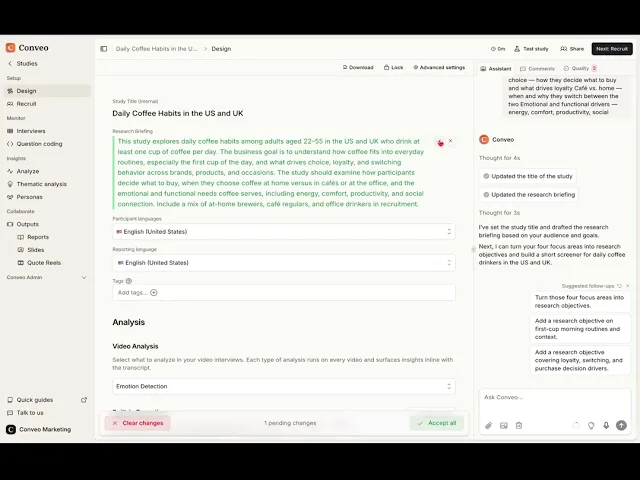
Even with well-formed questions, a static questionnaire cannot probe a shallow first answer. It cannot detect an incomplete response, nor can it catch the emotional undercurrent that a skilled moderator would. That is the structural limitation that no amount of question design can fully overcome, and where video-first AI moderation changes the outcome. Hesitation, tone shifts, and changes in affect are visible on video and invisible in a text response. Conveo captures these multimodal signals alongside the verbal answer, giving researchers and stakeholders evidence that static questionnaires cannot provide.
When to use questionnaires vs. interviews vs. mixed methods
Three factors determine which qualitative methods are appropriate for a given situation: the depth of understanding required, the timeline available, and the budget allocated. The right research design is not the one that gathers the most data: it is the one that produces decision-ready findings within your constraints.
Static questionnaires
Are right when research goals are already well-defined, and the team needs standardized qualitative survey questions delivered at scale across a defined target population. They deploy fast and produce data that is easy to aggregate. The limitation is structural: unlike quantitative research, which captures numerical data about specific variables, qualitative surveys are designed to explain the "why", and static forms only partially serve that purpose. They can capture open-ended responses and detailed responses at scale, but they cannot follow the unexpected thread that appears mid-response.
Human-moderated interviews
Address that gap directly. They are right for genuinely exploratory research when the research design requires in-depth exploration of a particular phenomenon, or when emotional nuance is central to the findings. Focus groups add a social dimension, useful for market research and customer experience work where different groups influence each other's perceptions, but they sacrifice the individual depth of one-on-one interviews. Unlike focus groups, online surveys enable broad data collection at scale but cannot capture the qualitative richness of moderated conversations. The tradeoff for interviews is time and cost: a fully recruited and moderated qualitative study typically runs six weeks or more from brief to report.
Mixed methods
Solve for breadth and depth simultaneously: quantitative research establishes scale and tests specific variables, while qualitative methods explain the patterns behind the numbers. Numerical data answers "how many" and "how often"; qualitative data answers "why" and "how." The operational challenge is coordination across multiple platforms. Meaningful insights require both types of data: quantitative questions establish what is happening; qualitative survey questions explore why. But combining them well demands a research design that treats them as complementary, not sequential.
AI-guided moderation
Changes the decision calculus for teams that need qualitative depth without the six-week wait. The AI asks dynamic follow-up questions based on what a participant says, not what the guide anticipated. Sessions run asynchronously, so hundreds of conversations run in parallel without adding moderator headcount. Teams report usable findings in days, with the kind of open-ended responses and detailed narratives that static questionnaires or quantitative questions alone cannot produce.
| Situation | Recommended method |
|---|---|
| Well-defined research question, 100+ participants, standardized responses needed | Static questionnaire |
| Exploratory research, emotional nuance critical, 6+ weeks available | Human-moderated interviews |
| Need quantitative validation and qualitative explanation, bandwidth for multi-platform coordination | Mixed methods |
| Qualitative depth required in days, large-scale conversations, no headcount to add | AI-guided moderation |
AI-guided moderation delivers depth at speed, and the primary consideration for teams evaluating it is the quality of probing. The AI must be research-grade, not conversational, to produce findings that hold up under stakeholder scrutiny. Conveo's AI moderator is built for this: it senses hesitation, mirrors participant language, and follows up in 50+ languages, across as many sessions as the study requires.
How to analyze qualitative questionnaire data for decision-making
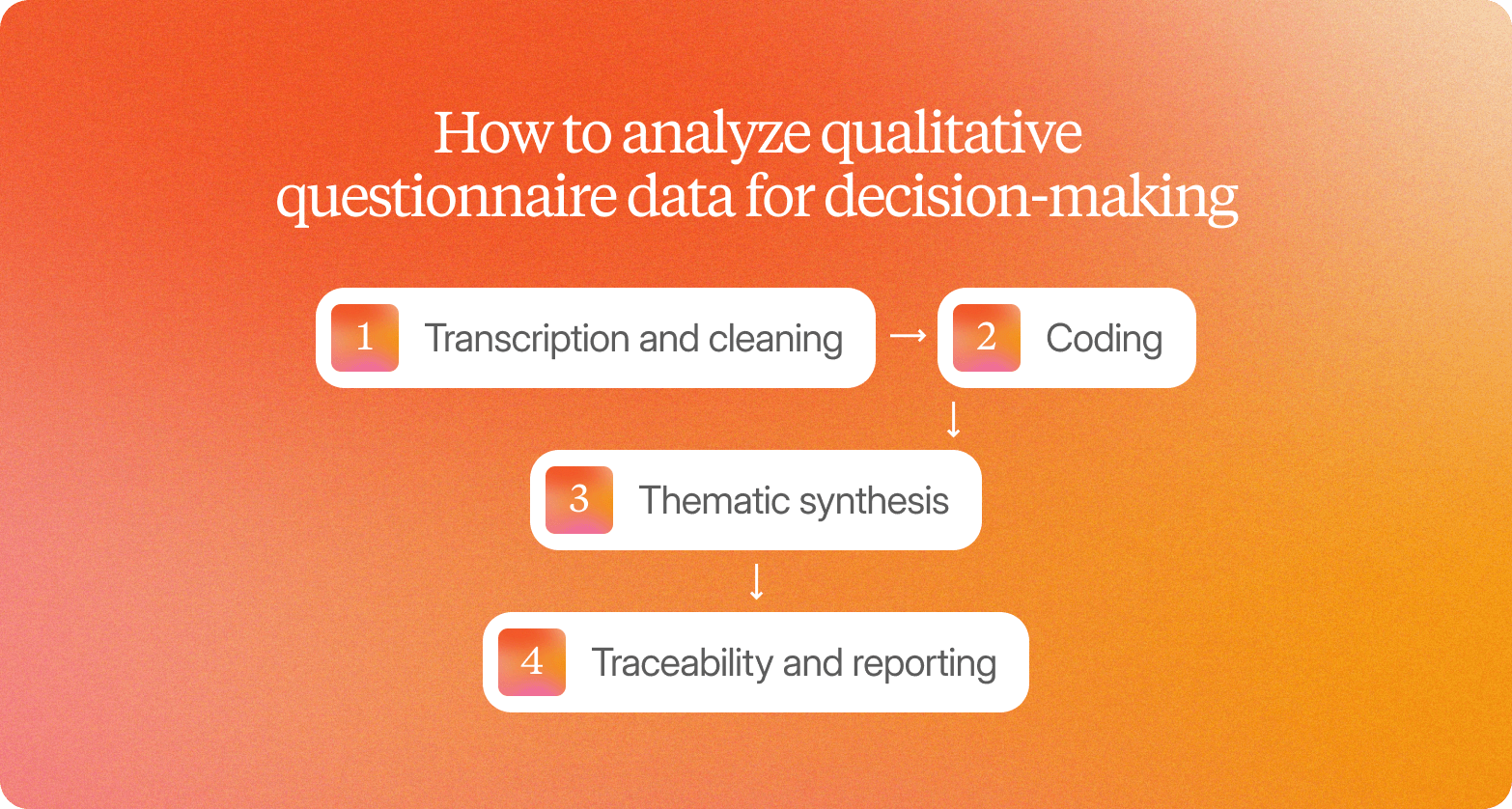
Raw qualitative data is not insights. Neither a transcript nor a set of open-ended responses becomes decision-ready until it has been coded, synthesized, and traced back to evidence a stakeholder can inspect. The analysis workflow has four steps, each with a compounding effect on what follows.
Step 1: Transcription and cleaning
Data collection ends, and analysis begins when recordings are converted to text, filler words are removed, participants are anonymized, and responses are aligned with the questionnaire structure. Automated transcription reduces manual work from hours to minutes, which matters when gathering data from 50 or 150 participants across multiple markets.
Step 2: Coding
Each response gets tagged with descriptive labels: "price sensitivity," "feature confusion," "skepticism about the brand claim." Good coding is interpretive, not mechanical. Manual coding typically runs two to three hours per interview; AI-assisted coding with human review compresses this to minutes, while preserving the researcher's ability to override any tag. Research design decisions made during the questionnaire phase become visible here: well-structured questions yield codes that cluster cleanly; poorly scoped questions introduce noise that requires judgment calls.
Step 3: Thematic synthesis
Codes are grouped into higher-order themes, and emerging trends are identified across participants. This is where providing insights transitions from labeling responses to building an argument. A clear understanding of what the qualitative data collectively show, not just a list of what individual participants said, is what makes a synthesis defensible in a stakeholder presentation.
Step 4: Traceability and reporting
Every theme gets linked to the verbatim quotes and video clips that produced it. This step is routinely skipped when no time remains after synthesis, and that omission creates a predictable problem. Stakeholders contest findings they cannot verify. When every theme traces back to a specific participant, in their own words, on video, that challenge has a concrete answer. Insight-to-source traceability is what makes findings credible enough to act on.
Conveo's knowledge library makes a further compounding benefit automatic: every study flows into a searchable library, so a brand team running packaging research in Q3 can surface what the Q1 consumer behavior study found about the same product line. Research stops being disposable and starts building on itself.
4 Common failure modes in qualitative questionnaire design
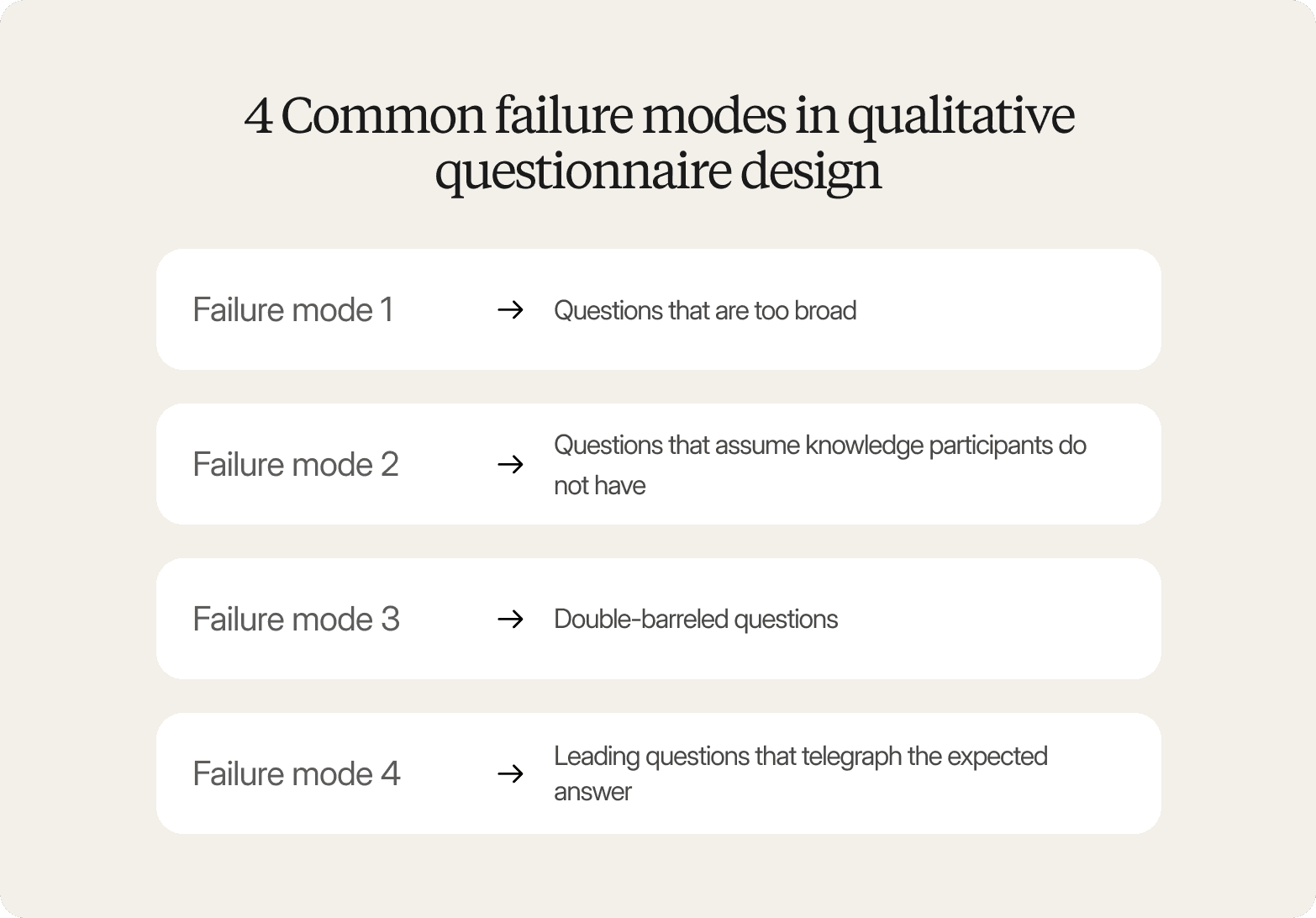
Even experienced researchers produce questionnaires that generate unusable data. Four failure modes appear repeatedly, and each is fixable before the first interview launches.
Failure mode 1: Questions that are too broad
"Tell us about your experience with [product]" gives participants no foothold. They default to something generic. Fix: anchor the question in a specific, recent behavior. "Walk me through the last time you used [product]. What prompted you to open it?" activates episodic memory rather than abstract opinion. Broad survey questions also make it harder to choose qualitative research questions that are right for your specific research objectives: they collapse too many distinct topics into one undifferentiated prompt.
Failure mode 2: Questions that assume knowledge participants do not have
"How does our value proposition compare to competitors?" is a question designed for a category analyst. Most participants in your target population have not conducted a formal competitive review. Ask about their decision process instead: "When you were choosing between options, what factors mattered most to you?" Ground the question in a particular phenomenon the participant has directly experienced, not in abstract concepts they have not been asked to think about before. Jargon-heavy phrasing and insider language confuse participants and elicit responses that reflect their attempts to interpret the question rather than their genuine experience. Questions focus on what the participant knows, not what the researcher assumes.
Failure mode 3: Double-barreled questions
"What do you like and dislike about [feature]?" sounds efficient but produces incomplete data: participants answer whichever half feels easier and skip the other. Split it: "What works well about [feature]?" followed by "What would you change about it?" You can also create sub-questions from a broader topic this way, breaking a complex theme into a ladder structure that produces cleaner, more codeable open-ended responses across different groups.
Failure mode 4: Leading questions that telegraph the expected answer
"How much do you love our new packaging?" is not a research question: it is a confirmation request. It embeds preconceived notions into the framing before participants have said a word. Respondents understand when they are being led; their responses reflect the guidance rather than their genuine experience. Neutral framing ("What is your reaction to this packaging?") removes the signal, allowing meaningful information to surface. Good qualitative research questions use clear language that respondents understand immediately, without encoding a preferred answer in the phrasing.
Conveo's AI moderator is designed to probe based on what participants say, not to follow a rigid script. That adaptive approach helps compensate for imperfect question wording.
How Conveo turns questionnaires into adaptive research
The gap between well-designed qualitative research questions and research that produces stakeholder-ready findings is the gap between asking and listening.
Static questionnaires ask. They cannot listen. When a participant says something unexpected, revealing, or incomplete, the questionnaire moves on. The meaningful insight stays buried.
Conveo, a video-first AI research platform, closes that gap in three ways:
AI-guided moderation that probes in real time
Conveo's AI moderator reads each response as it arrives, detects when an answer is vague or emotionally charged, and asks follow-up questions as an experienced researcher would, in 50+ languages. This is how you gather qualitative data that captures human experiences, explore concepts that written responses obscure, and surface the meanings people attach to their decisions at the scale that market research demands.
Multimodal signals that text cannot capture
Hesitation, tone shifts, changes in body language: these are visible on video and invisible in a written response. Conveo captures these signals alongside the verbal answer, giving researchers and stakeholders the evidence layer that static qualitative surveys cannot provide.
"Conveo's video-first approach is a real differentiating methodological advantage. The ability to distill insights from reactions and not just hear answers adds context you simply can't get from transcript-only tools - or any other tool in the market for that matter."
Senior Marketing Research & Insights Manager, Google
A knowledge library that compounds across studies
Every insight, code, theme, and video clip flows into a searchable library. Meaningful insights from past studies become discoverable. Research stops being disposable and starts compounding.
For insights teams and CMI directors who need qualitative methods that deliver depth without the six-week timeline, Conveo turns questionnaires into adaptive conversations, at a scale that human moderation cannot sustain.
Frequently Asked Questions
Can questionnaires be used for qualitative research?
Yes, qualitative surveys can be used for qualitative research when they are designed with open-ended, behavior-anchored questions aligned to clear research objectives. They work best as starting frameworks for well-defined research goals. Their limitation is structural: they cannot probe when a participant gives a vague or incomplete answer. For deeper qualitative insight, pair questionnaires with a moderation approach (human or AI) that can follow up in real time.
How do I write qualitative research questions effectively?
Focus on four principles: ask for stories rather than opinions, ground questions in recent behavior, avoid preconceived notions baked into the phrasing, and use "why" sparingly (prefer "walk me through" instead). Use clear language that respondents can understand immediately, and open questions that invite detailed narratives rather than one-line confirmations. Use exploratory or descriptive questions early in the guide, then create sub-questions that progressively narrow toward the specific behavior or attitude you need.
What is the difference between a qualitative questionnaire and an interview guide?
A qualitative questionnaire is a fixed set of survey questions delivered to participants, typically without real-time follow-up. An interview guide is a flexible framework used by a moderator (human or AI) to steer a conversation, enabling them to probe, redirect, and explore concepts in depth. The guide produces richer qualitative data and more detailed narratives; the questionnaire produces more standardized, comparable data across your target population.
How many questions should a qualitative research questionnaire have?
For most enterprise use cases, 5 to 8 core questions plus 2 to 3 probe prompts per question. A useful approach is the ladder structure: start with broad exploratory or descriptive questions, then create sub-questions that narrow toward the specific insight you need. Fewer well-designed questions with clear probes produce richer qualitative data and more open-ended responses than a long list of surface-level prompts.
How do I analyze data from a qualitative questionnaire?
Follow a four-step workflow: transcription and cleaning, coding (tagging open-ended responses with descriptive labels), thematic synthesis (grouping codes into patterns and identifying emerging trends), and traceability (linking every theme back to the verbatim quotes or video clips that produced it). Manual coding preserves interpretive nuance but is time-intensive; AI-assisted coding with human review compresses the timeline without removing researcher judgment.

About the author
Alex de Hemptinne
Business Impact Lead
Alex is a Business Impact Lead at Conveo, partnering with enterprise teams to embed AI-led research into their workflows. From the first study to full-scale rollout, she helps customers shift from project-based research to continuous customer intelligence.
Meet Alex on film →Qualitative insights at the speed of your business.
Conveo runs AI-moderated video interviews and structures everything they say.