
TL;DR
Most decisions don't wait for research. By the time a synthesized theme reaches a planning meeting, the roadmap has shipped, the campaign has launched, or the pricing call has already been made.
Voice of customer analytics compounds that problem when it's reduced to a single tracked score: the number moves, and the dashboard can't say why.
This article lays out a three-tier KPI hierarchy linking reported scores to behavioral signals and qualitative evidence, turning a single unexplainable number into actionable insights and specific customer pain points before the decision window closes.
This structure lets findings shape product and campaign decisions while they're still being made.
Conveo keeps that reasoning available across studies, so a movement in any voice of customer analytics score can be explained from real customer data instead of hypothesized in a slide deck.
Most teams already collect plenty of VoC data. Very little of it survives the moment a stakeholder asks "why did this number move?" This piece lays out the KPI hierarchy, the traceability standard, and the operating model that closes that gap.
Why the explanation usually arrives too late
The core problem in most VoC programs is timing. A score moves, research takes too long to answer why, and the decision gets made first, turning the research into a retrospective explanation for a call that's already locked in. Teams that repeat this cycle stop trusting the number, and eventually stop asking for it.
Voice of customer analytics, done well, closes that gap: it connects quantitative movements (an NPS drop, a CSAT dip, a shift in brand equity) to the qualitative evidence that explains them. Most analytics tools in this category are built for monitoring instead: aggregating feedback at scale, tagging themes across support tickets and survey responses, flagging statistical anomalies. That's useful for operational CX teams handling customer service interactions. For a brand, product, or strategy team, it reports how often a customer decision happens and leaves out the reasoning behind it.
Treating voice of customer analytics as a research-grade discipline means applying the same standards to continuous research as you would to a formal study: defined hypotheses, representative sampling, and findings traceable to real people who said specific things. The difference between a text-mined theme cluster and a research-grade insight is the depth of evidence underneath it. Programs that skip this step end up with plenty of raw customer data and very few customer insights a team can act on.
Why most VoC programs fail to influence decisions
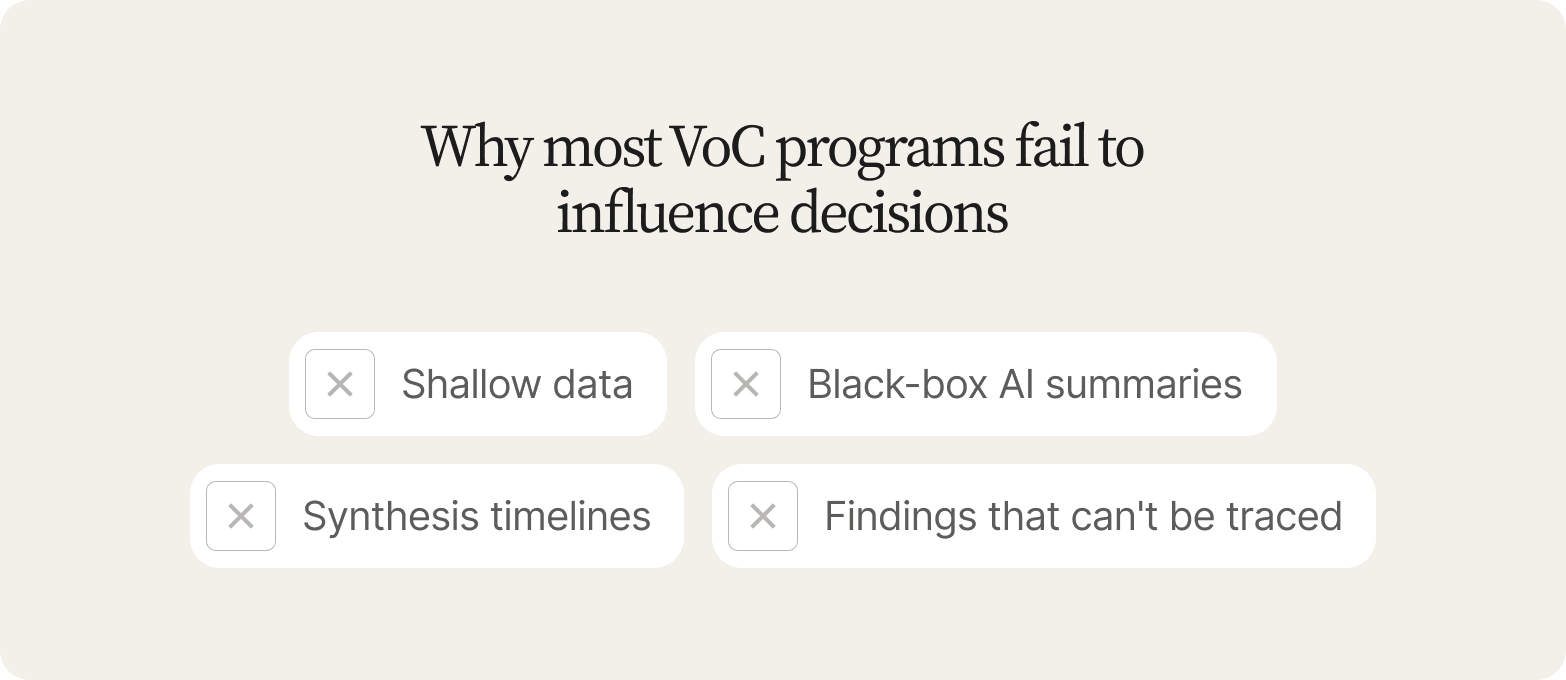
Most VoC programs succeed at collection. Surveys go out, scores come back, dashboards get built. The failure happens further down the chain, where findings should change a decision. Four structural problems explain the breakdown:
Shallow data that captures ratings without reasoning
Black-box AI summaries that stakeholders can't verify
Synthesis timelines that miss the decision window
Findings that can't be traced to real customer conversations
1. Shallow data that captures ratings without reasoning
Survey-style VoC is designed for scale, and depth is the tradeoff. A five-point scale tells you a customer was dissatisfied. It can't tell you whether that came from pricing confusion, unmet expectations, or a competitor comparison. Survey responses collected this way rarely include the context needed to explain the number, so customer satisfaction surveys generate a customer satisfaction score without the customer perspectives that would explain it.
2. Black-box AI summaries that stakeholders can't verify
When negative feedback gets compressed into a single synthesized theme, "customers feel the product lacks value," a stakeholder can't trace that claim back to a specific person who said something specific. AI-generated theme clusters are now standard across customer platforms, but a finding you can't source can't be defended in a product review or brand planning session. Skeptical stakeholders dismiss it, and the research loses its room to influence.
3. Synthesis timelines that miss the decision window
Traditional qualitative research commissioned to explain a VoC score often takes weeks through an agency. By the time findings arrive, the roadmap has been locked, the campaign has shipped, or the pricing decision has been made. The research ends up confirming what already happened, when it was meant to shape what happens next.
4. Findings that can't be traced to real customer conversations
This is the credibility floor. If a theme in a report can't be clicked through to a verbatim quote, a video clip, or a named participant record, it isn't traceable. Enterprise stakeholders now treat that traceability as a baseline. Without it, VoC programs produce decks that never change the decision.
The 3-tier KPI hierarchy for defensible VoC analytics
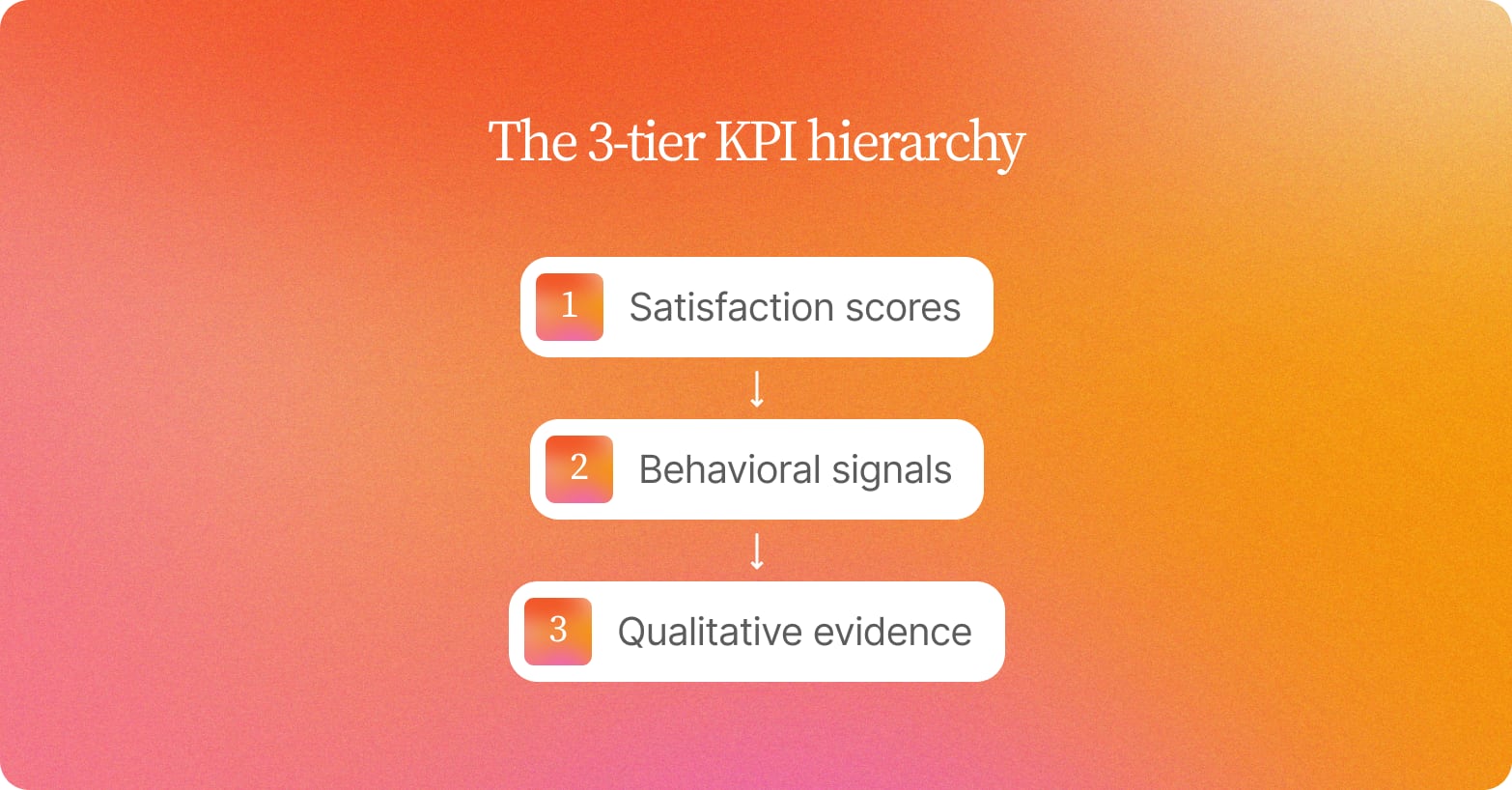
A three-tier KPI hierarchy assigns each measurement layer a specific question to answer, so the answer at one tier sharpens the question at the next.
Tier | Question answered | Output |
|---|---|---|
Tier 1: Satisfaction scores (NPS, CSAT, CES) | How do customers feel right now? | A number that flags where to look |
Tier 2: Behavioral signals (churn rate, repeat purchase rate, support contact volume, renewal rate) | Are customers acting on that feeling, and is it affecting the business? | Confirmation that the feeling is real |
Tier 3: Qualitative evidence (recurring themes, verbatim quotes, video-recorded participant sessions) | Why is this happening, and what specifically needs to change? | A decision stakeholders can act on |
Tier 1 is directional only. Net Promoter Score (NPS) tells you the relationship is degrading, CSAT tells you an interaction fell short, CES tells you friction is building, but none of them tell you why. A score alone reports customer sentiment and leaves out the reasoning underneath it.
Tier 2 turns that symptom into a business problem worth prioritizing: when NPS drops and customer churn rises in the same quarter, that's a signal worth acting on. Programs anchored only on Tier 1 routinely miss the customer retention risk sitting one layer down, and this is the layer most customer analytics programs skip.
Tier 3 is where the other two tiers become actionable, producing valuable insights the first two can't supply on their own. Recurring themes tell you what's driving customer behavior, verbatims give stakeholders language they can trace to a real person, and video closes the credibility gap that synthesized summaries leave open.
Without Tier 3, teams know satisfaction is slipping and customers are churning, but product, brand, and CX each have a different theory about why, with no evidence to resolve it. Most programs treat Tier 1 as the destination, mining customer satisfaction surveys for a headline number when it should be the first signal in a longer customer analysis.
Choosing the right VoC analytics approach for your business question
Approach | Best for this business question | Proof level required | Typical timeline |
|---|---|---|---|
Survey-first (NPS, CSAT, pulse surveys) | "How many customers feel this way?" / "Did satisfaction improve quarter over quarter?" | Directional signal; statistically significant at scale | Days to 2 weeks |
Text-mining-first (online reviews, support ticket mining, social media comments) | "What topics are customers mentioning most?" / "Where are complaints clustering?" | Pattern detection used to identify trends; not causal | 1 to 3 weeks depending on data readiness |
Digital journey analytics (clickstream, session replay, funnel analysis) | "Where are users dropping off?" / "Which step is losing conversions?" | Behavioral evidence; shows what happened, the why stays open | Real time to 1 week |
Interview-first (AI-moderated depth interviews with adaptive probing) | "Why did NPS drop 8 points?" / "What's driving that preference?" | Causal explanation; traceable to named participants with verbatim and video | Matches the decision window |
Survey-first and text-mining approaches share the same gap: they tell you that something changed and stop short of why. Sentiment analysis layered on top of either can flag that a number moved; it still can't explain why. That explanation requires a real conversation with adaptive follow-up, which static survey design can't deliver.
Digital journey analytics closes a different gap: it shows behavioral truth that self-reported data misses, delivering real-time customer feedback on drop-off points as they happen. But behavior without context is incomplete. Data analysis can describe the drop-off; it can't explain the hesitation behind it.
The most effective programs combine approaches:
Survey-first identifies where a metric moved.
Text-mining flags emerging topic clusters from online reviews and social media comments.
Journey analytics pinpoints the behavioral breakpoint.
Interview-first goes in with targeted questions to produce the causal explanation.
What changes the calculus for AI-moderated interviews is that the explanation arrives while the decision is still open, with analysis completing as each session closes, well before the whole fieldwork wave wraps.
How to make VoC findings defensible with traceability standards
"Defensible" in an enterprise research context means every theme presented to leadership traces back to a verbatim quote, a named participant ID, a timestamp, and the original video. What matters is whether a skeptical CMO or CFO can follow the evidence chain from a headline finding to the person who said it, regardless of confidence intervals or sample size.
This matters because the credibility gap in AI-moderated research is real: stakeholders who didn't sit in the sessions have no way to verify whether an AI-generated theme reflects what participants actually said or what the model inferred. Sentiment analysis, using natural language processing, can flag that something shifted; it can't show the moment it happened, which is why the traceability chain matters more than the scoring layer on top of it.
The traceability standard that holds up in practice runs four connected layers:
Theme: the pattern identified across sessions, e.g. "participants associate the new pack format with premium quality."
Verbatim: the specific quote behind it, e.g. "it feels more expensive, like something I'd see in a specialty store."
Participant: a named record and timestamp tied to that quote.
Video: a reviewable clip of the exact moment the quote was spoken.
The pack-format example above is an illustrative scenario that shows how the chain works.
Video-first interviewing preserves signals that transcripts flatten. A participant who says "yeah, I guess it's fine" while their tone flattens and they glance away is communicating something the words alone don't. Multimodal analysis across speech, tone, and facial cues in native Conveo interviews captures that divergence, which sentiment analysis on transcript text alone would miss.
"You see them physically doing it. Testing the product for the first time, being probed right there. That unfiltered, in-the-moment reaction is possibly the most powerful thing you can see as a researcher."
— Dafydd Jones, Associate Director, Ninth Seat
Signal tracking is the other piece that gets overlooked. When a new wave shows a significant shift from what earlier waves established, researchers need to know. This is what Conveo's searchable insight library is for: it connects findings across studies, surfaces significant shifts wave over wave, and keeps every claim linked to its source participant, quote, and timestamp, turning customer feedback from a one-time report into a compounding customer analytics program.
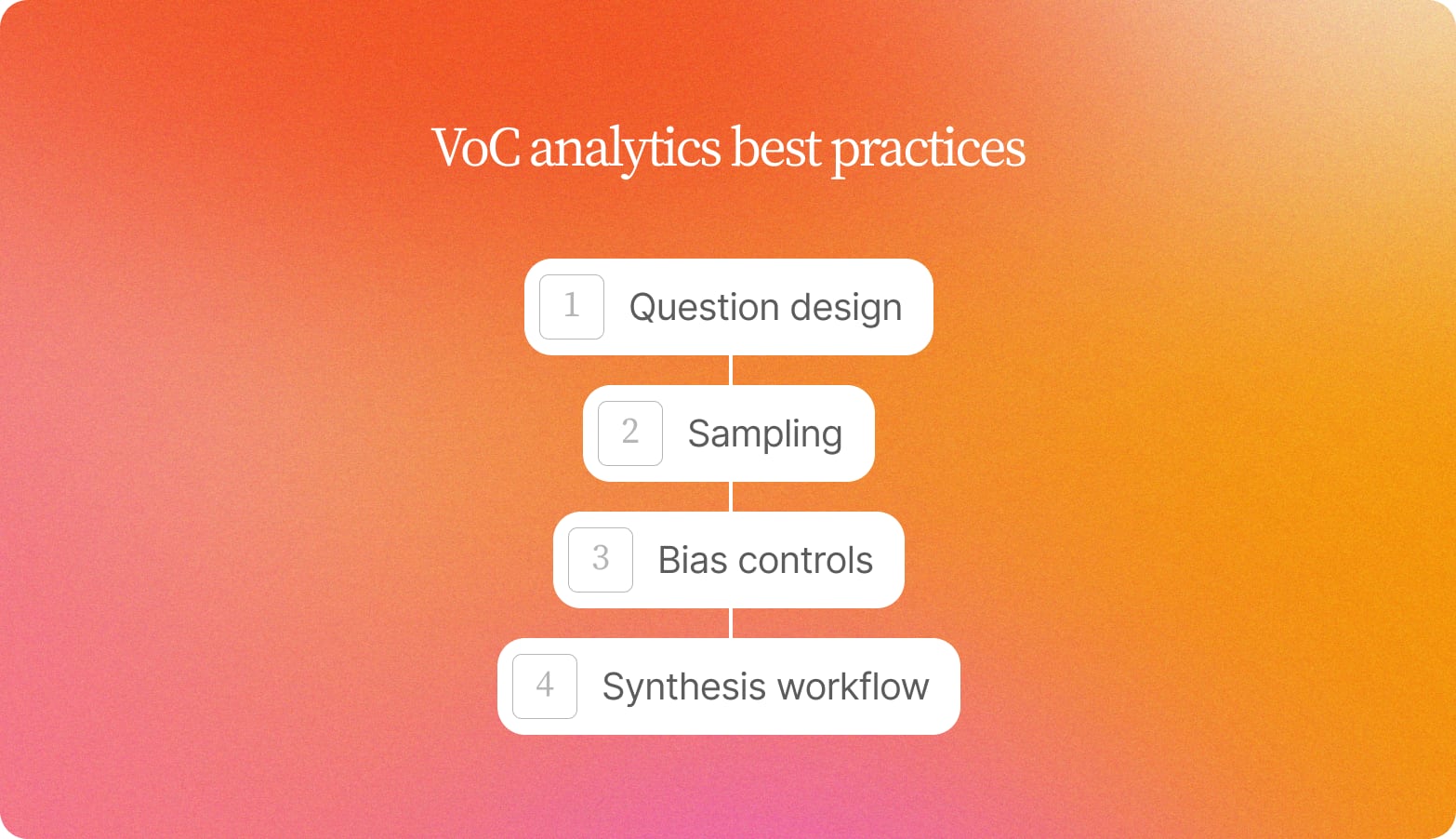
VoC analytics best practices for qualitative depth at scale
1. Question design: the three-layer probing structure
The most common failure in VoC interview guides is front-loading: ten primary questions, no time left, surface-level responses. Depth comes from the probing layer:
Primary question: open-ended, non-leading. "Tell me about the last time you switched brands in this category."
Clarifying probe: follows what the participant actually said. "You mentioned it felt like a risk. What made it feel that way?"
Evidence probe: grounds the response in a specific moment. "Can you walk me through exactly what happened that day?"
The AI research assistant picks the probe layer based on what the participant just said, instead of advancing on a timer. In practice, this surfaces customer pain points a scripted survey would never uncover.
2. Sampling: breadth versus depth
Segment representation matters more than raw participant count. In practice, 8 to 12 participants per segment surface most distinct themes; running 50 undifferentiated interviews mostly repeats the same segment. Define segments before recruiting, screen behaviorally rather than demographically, and weight the guide toward the widest understanding gaps.
3. Bias controls
Question neutrality is the first control. Avoid embedded assumptions:
Leading: "What did you dislike about the checkout experience?" presupposes dissatisfaction.
Neutral: "Walk me through your checkout experience." Does not.
For AI-moderated studies, moderator consistency is built into the setup: every participant receives the same primary questions in the same order, eliminating the variation that accumulates across a human moderation team over dozens of customer interactions.
4. Synthesis workflow
With sessions closing asynchronously, analysis can begin before fieldwork ends, in four phases:
Transcription and translation complete automatically as each session closes.
Theme surfacing. AI surfaces candidate themes using natural language processing, flagged by frequency and customer sentiment.
Researcher review. A researcher reviews the coded qualitative data, challenges AI-generated clusters, and adds interpretive context the machine can't supply.
Structuring findings. Findings are structured around the original research questions, with verbatim quotes and video attached.
The researcher's role in the last two phases isn't optional. Machine learning can surface a candidate cluster in minutes; deciding whether it represents a real customer need still takes a person who understands why the study was commissioned. That's the difference between a workflow that transforms raw feedback into decisions and one that just archives it.
Building an always-on VoC operating model
Most organizations have no shortage of data collection. NPS sits in one platform, support tickets and customer complaints in another, social media monitoring in a third, and the insights team is left stitching together a quarterly narrative that arrives long after the decisions it was meant to inform have closed.
An always-on operating model changes the architecture. Periodic collection followed by periodic synthesis gives way to AI-moderated interviews as the layer that answers why, running in waves (for example, every two weeks or monthly) in place of a one-off study. This is the model behind Conveo StoryLines: a standing decision input every wave, helping teams anticipate customer needs before the next wave runs.
What makes this sustainable is the searchable insight library underneath it: every interview, theme, and verbatim from every StoryLines wave flows into it, so a packaging concern in one study can link to a usability signal from months earlier. Teams check what is already known before they field the next study.
Wave-over-wave signal detection is where the model earns its keep: when a new wave diverges from what earlier waves established, that shows up automatically instead of sitting in a deck no one opens. That feedback loop separates a VoC program from a VoC archive, and turns a customer analytics program into an actual customer strategy input.
When to use AI-moderated interviews inside your VoC program
When scores shift without explanation
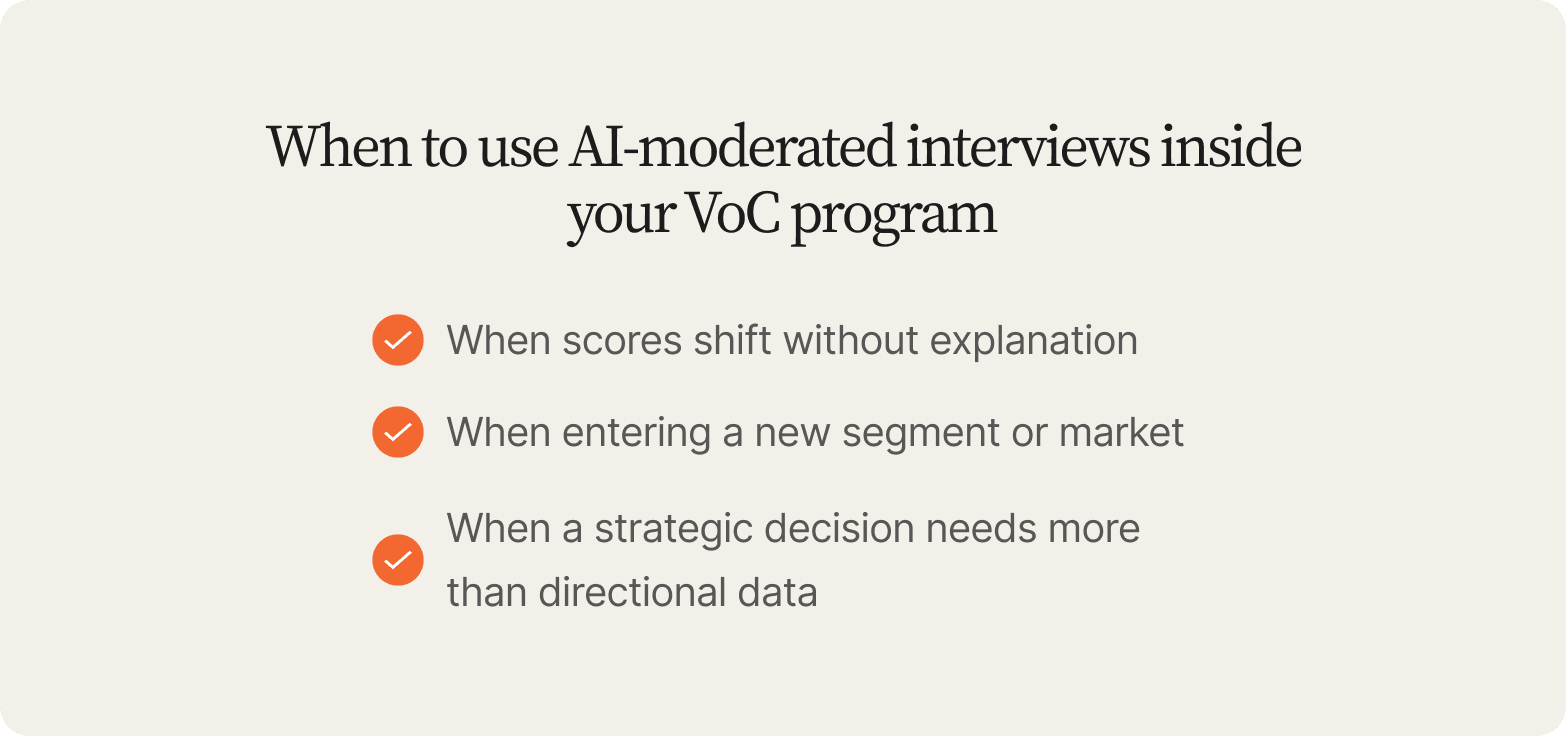
NPS drops four points, CSAT slides after a product update, brand equity moves in a direction no one predicted. A follow-up agency study typically takes weeks, long enough that the next quarter's decisions are already in motion. AI-moderated interviews close that gap while the decision is still open, with adaptive probing that follows what participants actually say.
"Within days we had insights that would've taken a traditional agency a month."
— Sarah Snudden, Head of US Consumer Insights, JDE Peet's
When entering a new segment or market
Existing VoC data reflects the customers you already have. When a team moves into a new geography, demographic, or category, the context is different and prior screening assumptions may not hold. Recruiting through Conveo's integrated panel network, plus your own lists, lets teams reach a wide range of markets and run sessions in 50+ languages before finalizing a decision.
When a strategic decision needs more than directional data
Pairing customer preference data with qualitative probing means the preference number and the reason behind it come from the same person in the same session, so teams skip running two separate studies. Conveo's MaxDiff tells you what people prefer and why, so a decision that once required a six-week sequenced research program can be grounded in traceable, research-grade evidence before the window closes.
Getting from a moving score to a traceable answer
The three-tier hierarchy and the traceability chain solve the same problem: closing the gap between when a score moves and when a decision needs to be made. Conveo's role starts with always-on understanding: AI-moderated interviews and StoryLines waves that reach the field before the decision closes, with every theme traceable to a named participant, a verbatim, and a video timestamp. Because every wave flows into the searchable insight library, the understanding compounds from wave to wave, so a pack-format signal like the one above stays linked to the brand, pricing, or concept it eventually informs.
That's what a defensible VoC program gives a brand or insights team: the reasoning behind a moving score, still attached to the person who gave it, in time for the pack, pricing, or launch decision it's meant to inform.
Frequently asked questions
What is voice of customer analytics?
How do you measure voice of the customer?
What is the difference between VoC and customer satisfaction?
How do you make VoC findings defensible for high-stakes decisions?
Can AI-moderated interviews provide the same depth as human moderators?
How do you ensure methodology standards when using AI for qualitative research?