

TL;DR
A voice of customer framework is a structured, repeatable system for collecting, analyzing, and acting on customer feedback, not just a survey or an occasional focus group.
Scores like NPS, CSAT, and CES tell you customer sentiment shifted; only real conversations explain customer behavior, why it changed, and what to do about it.
A usable framework needs three artifacts: a decision-focused interview guide, a consistent thematic coding framework, and a traceable, stakeholder-ready report template that turns raw data into actionable insights.
Most programs fail for three compounding reasons: shallow data collection, missed follow-up, and synthesis that arrives after the decision has shipped.
Conveo, a video-first AI research platform, closes those gaps- shallow data, missed follow-up, and slow synthesis- by running async AI-moderated interviews with real participants in parallel, preserving video evidence, and building findings into a compounding insight library that supports business growth.
Most VOC programs collect plenty of feedback and still can't tell leadership why customers behave the way they do. This guide breaks down the voice-of-customer best practices that actually close the gap, the three artifacts every framework needs, where most programs fail, and how to build a program that produces decision-ready findings instead of another dashboard nobody trusts.
Why Customer Satisfaction Scores Measure Sentiment, Not Behavior
Most voice-of-customer programs generate customer satisfaction scores. They tell leadership whether customers are happy, frustrated, or somewhere in between. What rarely surfaces is the underlying decision logic: why a customer chose a competitor or which customer expectations the product hasn't addressed. Scores measure customer sentiment. They don't explain customer behavior.
A voice of customer framework is a structured system for collecting, analyzing, and acting on customer feedback in a consistent, repeatable way across the organization. The emphasis on "structured" matters. A post-purchase survey, an occasional focus group, or support ticket themes pulled into a quarterly deck are all forms of feedback collection, but none constitute a framework unless the collection, analysis, and activation follow a defined process that produces comparable outputs over time and genuinely improves customer satisfaction.
That's also why net promoter score, customer satisfaction score, and customer effort score metrics fall short as the core deliverable: they're diagnostic at best. A declining NPS tells you customer sentiment changed, not what changed, for which segment, or why it matters enough to act on. Real conversations do. When a customer describes, in their own words, the moment a product stopped working or the comparison they made before switching, that explanation carries information no rating scale can capture.
This is the shift Conveo was built around. As a video-first AI research platform, Conveo runs real conversations with real participants, not synthetic respondents, at a scale surveys usually monopolize, and keeps the video evidence attached to every finding. Throughout this guide, the framework comes first, translated into the specific voice of customer best practices that keep findings decision-ready; where Conveo changes what the framework can do, that is called out directly.
"Real conversations, real emotions, that's what makes Conveo different from every survey tool"
— CMI Lead, Edgard & Cooper
The Three Core Artifacts for Customer Feedback
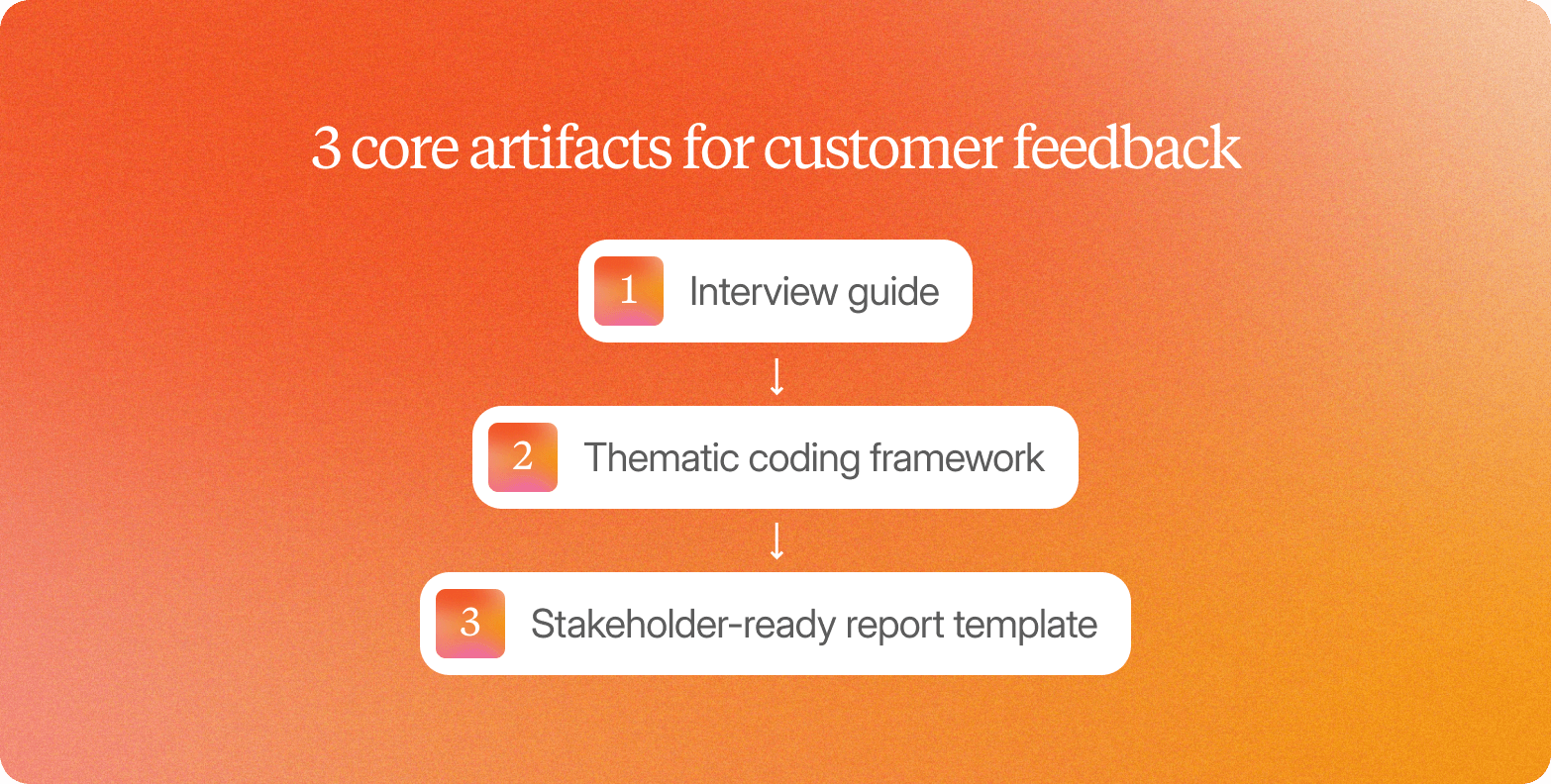
A usable voice of customer framework requires three core artifacts:
An interview guide that structures how conversations are conducted
A thematic coding framework that categorizes responses consistently
A stakeholder-ready report template that translates findings into decisions
Each serves a different stage of the process, and all three are required for insight to compound rather than evaporate.
Without this structure, the failure mode is predictable. When each study uses different question wording, probing sequences, or output formats, teams can't code responses consistently across studies, themes can't be compared with the previous quarter, and recurring customer concerns remain invisible rather than feeding a genuine feedback loop.
Interview guide design
A well-designed interview guide is not a list of topics. It is a set of questions built around a specific business decision. Guides written around broad themes tend to generate interesting quotes that never connect to action. This decision-focused voice-of-customer approach surfaces customer preferences and concerns rather than generic customer input.
The structure that works follows four phases:
Context setting establishes who the participant is and the circumstances around the experience you care about
Experience reconstruction asks them to narrate what actually happened, in sequence, without leading them toward an evaluation
Evaluation surfaces how they felt and why
Implications draw out what they did next and what would need to change for them to behave differently
This produces a fundamentally different output than customer satisfaction surveys: "How satisfied are you with onboarding?" generates a number, while "Walk me through the first time you tried to set up your account" generates a narrative that reveals decision drivers scores obscure entirely.
Thematic coding framework
Most teams reset their coding scheme with every new study. Question wording shifts, theme labels drift, and by the third or fourth project there's no reliable way to tell whether a concern from a concept test six months ago is the same one appearing in today's brand tracking.
A consistent question taxonomy solves this. When primary questions, clarifying probes, and evidence probes follow the same structure across studies, the resulting codes map cleanly and make it easier to identify trends. That consistency is what makes a voice-of-the-customer approach genuinely compounding: patterns become visible across studies, quarters, and markets. Conveo carries this further by feeding every coded finding into a searchable insight library, cross-referenced against each new study rather than filed and forgotten.
The three-layer probing structure is the engine underneath:
The primary question opens the topic in the participant's own language
The clarifying probe follows up on what was said
The evidence probe pushes for specifics
That third layer separates a quotable, traceable finding from a vague impression; with it, every coded response anchors to a real moment a stakeholder can inspect.
Stakeholder-Ready Reports: Presenting Valuable Feedback
The most common reason findings get dismissed in executive reviews isn't methodology. It's traceability. When a theme arrives with no path back to the conversation that produced it, stakeholders treat it as interpretation, not evidence, and that skepticism kills decisions.
Voice of customer best practices require every theme to be auditable: linked to verbatim quotes, participant IDs, timestamps, and the original recording, as the structural backbone of how findings are presented, not an optional appendix. When a CMI director can click directly from a thematic cluster to the video clip that anchors it, the finding becomes verifiable rather than assertable, and qualitative feedback starts to read like evidence rather than anecdote.
This is where video-first methodology carries real weight. Text transcripts flatten what actually happened: a participant who hesitates before a price question, or whose tone shifts when a competitor is mentioned, leaves a signal a transcript reduces to neutral words.
4 Reasons Most Voice of the Customer Programs Fail to Influence Decisions
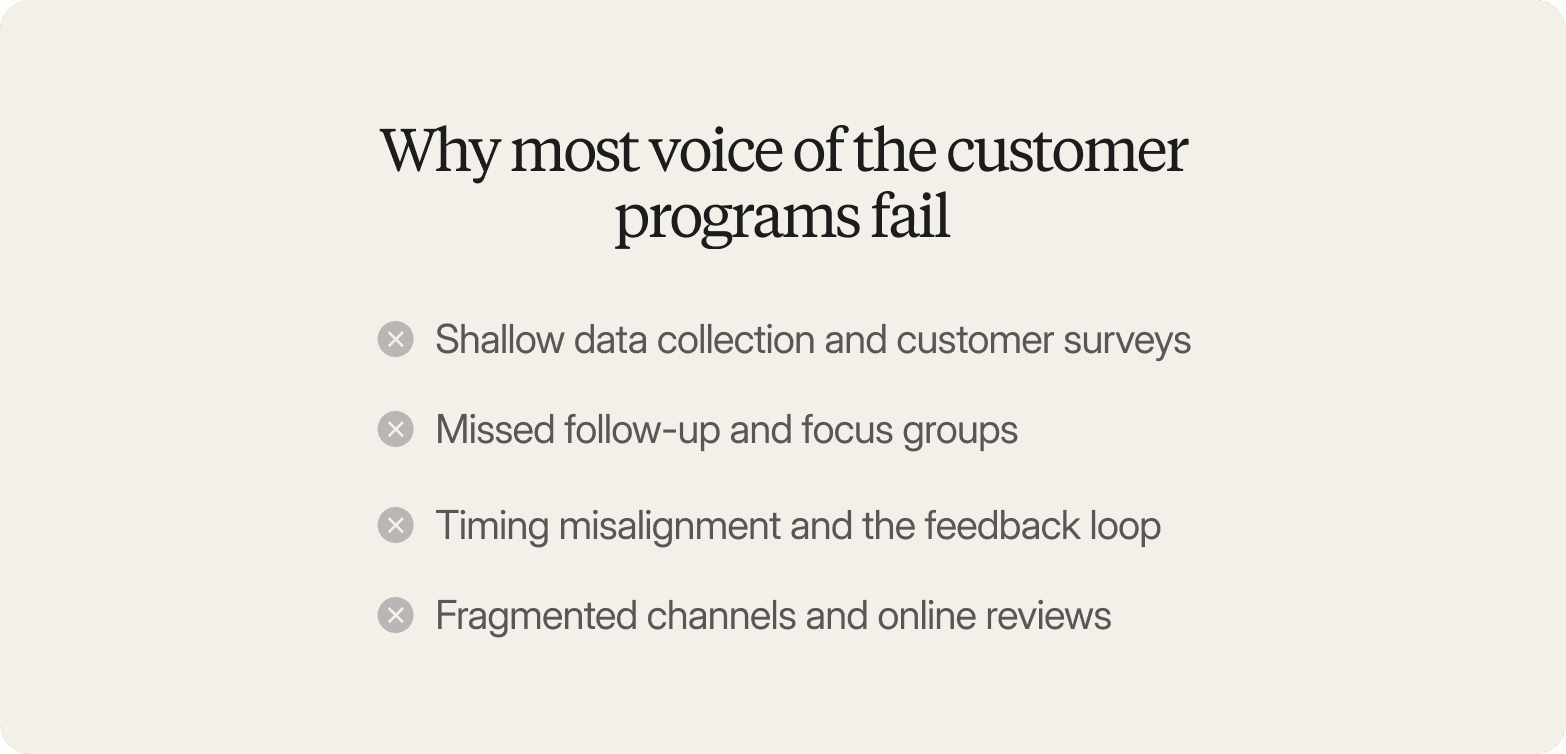
Shallow Data Collection and Customer Surveys
Rating scales and closed-ended questions are fast to deploy and easy to analyze, but incapable of capturing the context that explains customer behavior. A customer who gives a product a 6 out of 10 has told you almost nothing. What you need is the story behind the number.
Missed Follow-Up and Focus Groups
Even teams that run qualitative interviews hit a second wall: static discussion guides. A scripted sequence moves participants through predetermined questions, so the moments that matter most- hesitation before a pricing question, an unprompted competitor mention, an answer that contradicts something said three minutes earlier- go unexplored. A fixed guide can't respond to any of it.
Timing Misalignment and the Feedback Loop
The third failure makes the first two irrelevant even when they're partially solved. When synthesis takes four to six weeks, findings arrive after the sprint has shipped, undermining the broader voice-of-customer strategy the program was meant to serve. The findings aren't ignored; they simply no longer have a decision to attach to.
Fragmented Channels and Online Reviews
These failures don't stay contained. Support data sits in one system, marketing feedback in another, product discovery notes in a shared drive no one searches, and online reviews and social media monitoring add still more feedback data no one owns. No one synthesizes across these multiple channels, so the patterns that span the full customer journey stay invisible, a gap no VOC strategy can close without deliberately synthesizing across systems.
The resolution isn't more research volume. It's a change in the underlying workflow. When collection captures real episodes rather than ratings, moderation follows up on what participants actually say, and analysis compresses into days; periodic research becomes continuous customer understanding. That is the shift Conveo is built to deliver.
How to collect voice of customer data that actually explains behavior
Collecting voice of customer data effectively comes down to a fundamental tension: the methods that scale don't go deep enough, and the methods that go deep enough don't scale. Customer surveys and feedback forms reach thousands of customers in days, but a five-point scale and an open-text box can't capture hesitation, contradiction, or an unprompted competitor mention. Traditional depth interviews reach that depth, but run in small batches and take weeks, when the contrast to beat is 6–10 weeks compressed to 3–5 days.
The gap isn't in the questions researchers write. It's in what happens when a participant says something unexpected, and there's no mechanism to follow it, since static guides are designed before the conversation starts. The three-layer probing structure described earlier closes that gap, turning qualitative data into structured feedback rather than raw data, but only if the moderator can apply it live.
Why Teams Struggle to Collect VOC Data
Traditional agencies and in-house teams can't run that probing depth at scale. Scheduling 50 moderated interviews takes weeks, and running them through a single moderator compresses the sample size and introduces a risk of inconsistent results. The throughput ceiling is structural, which is why so few programs collect VOC data continuously rather than in occasional bursts.
How Conveo Helps Teams Collect Feedback Continuously
Conveo removes that ceiling. Running asynchronous AI-moderated interviews in parallel means a small insights team can field hundreds of conversations at once, with adaptive follow-up built into every session. There's no scheduling bottleneck because participants open a link at their convenience, and no moderation bottleneck because Conveo's AI moderator senses hesitation and probes based on what's actually said rather than what was scripted in advance. When studies can be designed, fielded, and analyzed in days, research stops being a periodic input and becomes a live layer of customer intelligence, beating proactive feedback requests that customers rarely answer. That answers what the voice of the customer VOC strategy for teams operating at this pace is: continuous signal, not a periodic snapshot.
Voice of customer best practices template: A step-by-step implementation guide
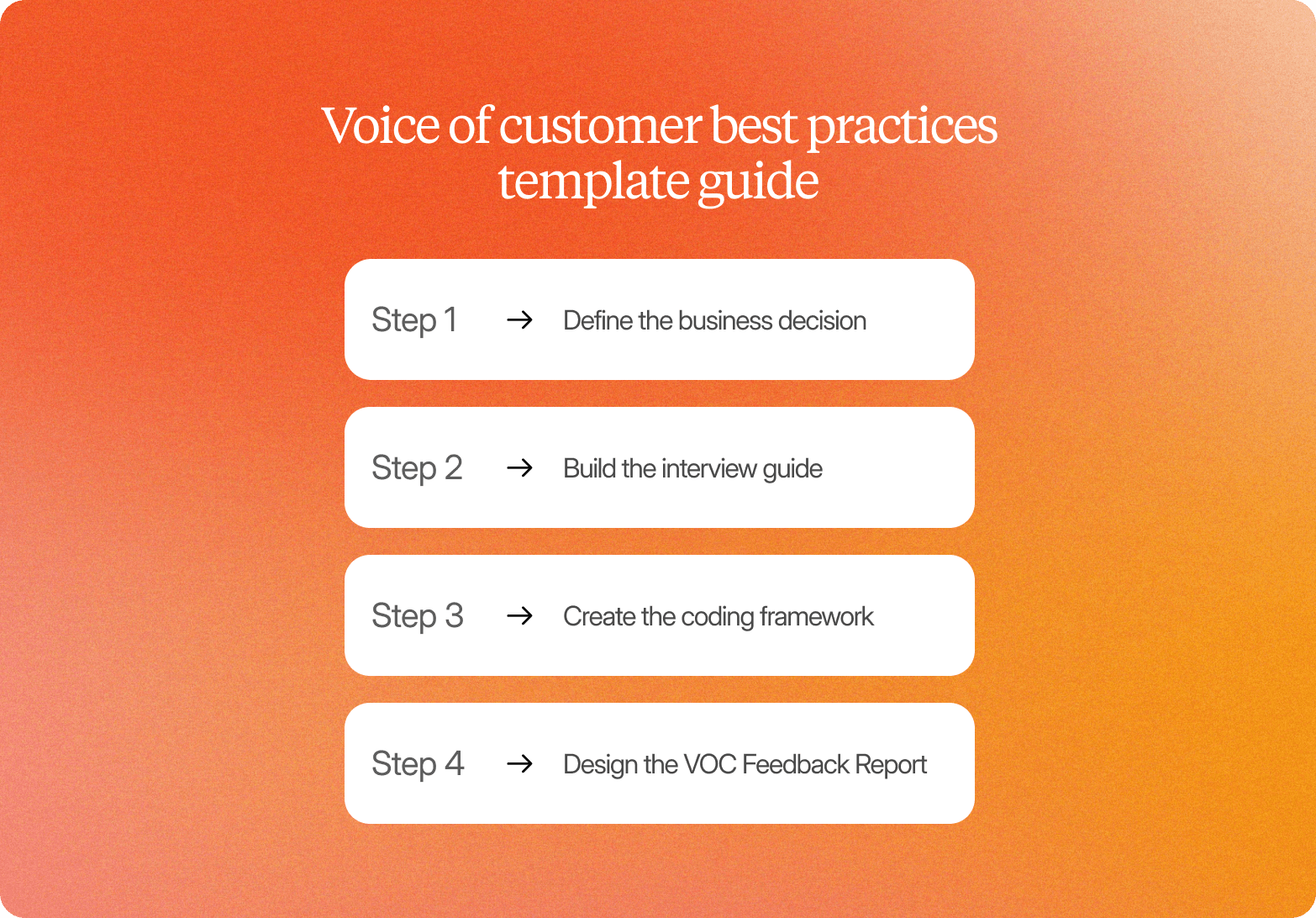
What follows is a structured template built around one specific failure mode: programs that generate plenty of compelling quotes but produce nothing that informs a decision. The four steps address that at the design stage, before a single interview is conducted.
Step 1: Define the business decision
Start with the decision, not the research question. "Should we redesign the onboarding flow?" is a decision to make. "What do customers think about onboarding?" is an example of ambient curiosity. Naming the decision upfront lets every question be evaluated against a single standard: does this help us decide?
Step 2: Build the interview guide
Build the interview guide using this voice of customer framework template, structured in four phases, in this order:
Context setting. Establish who the participant is and their relationship to the product. A first-week user's response means something different from a two-year customer's.
Experience reconstruction. Ask participants to walk through a specific recent experience in chronological detail. Specificity surfaces customer behavior; generality surfaces opinion.
Evaluation. Probe what worked, what didn't, and why. A skilled moderator, or Conveo's AI moderator, pursues the reasoning behind a response rather than accepting the surface answer.
Implications. Ask what participants would change or need to be successful. This converts experience into direction, which is what decision-makers act on.
Sequencing matters. Running these out of order produces opinions without evidence.
Step 3: Create the coding framework
Use a consistent question taxonomy across studies so themes can be compared over time rather than rebuilt from scratch. If Study 1 asks "What caused you to contact support?" and Study 2 asks "Why did you reach out to the team?", those responses can't be compared even if the customer behavior is identical. Consistent wording makes "reasons for support contact" a trackable theme across quarters and segments, turning scattered qualitative data into more structured feedback.
Step 4: Design the VOC Feedback Report
Every theme in the final report must link to verbatim quotes, participant IDs, timestamps, and video clips from the original interviews. This is non-negotiable at the enterprise level, and it's one of the clearest VOC best practices to enforce early: stakeholders who cannot trace a finding back to a real conversation will discount it.
This four-step structure is a starting point, not a rigid protocol. What doesn't change is the underlying logic: decisions before questions, evidence before conclusions, sources behind every theme.
Voice of Customer Examples and Customer Insights
The same framework structure adapts across business contexts without requiring a different research philosophy each time. The guide changes, the probing sequence shifts, but the evidence standard stays constant. These voice-of-customer examples, spanning product, marketing, and support, show what that looks like across the customer journey. Each is illustrative rather than a specific result from a Conveo client.
Example 1: Product team investigating churn
In this voice-of-customer framework example, a product team facing rising cancellations needs to know whether to improve a feature or fix onboarding upstream. The guide is built around experience reconstruction: participants walk through the last time they tried to use the feature, what they were trying to accomplish, what happened, and what they did afterward.
In one representative scenario, findings revealed that churn had little to do with feature gaps. Users were canceling because unclear onboarding left them unsure how to get value from existing features, redirecting investment from a feature rebuild to activation.
Example 2: Marketing team validating messaging
In another representative scenario, a marketing team needs to know which value proposition resonates with their ideal customer profile before committing to a campaign. The guide focuses on concept testing using real customer language: "When you first heard this concept, what did you think we were offering? How does that compare to what you actually need?"
That gap between perceived offer and actual need is where messaging breaks down. Aspirational language ("transform your workflow") tends to land as vague, while specific outcome language ("reduce report turnaround from weeks to days") reads as immediately credible, and with Conveo, the team can share video clips of the exact moments when messaging connected or collapsed.
Example 3: Support Team Diagnosing Recurring Pain Points
A support team deciding where to invest, self-service content or live capacity, needs to understand why users escalate. The guide reconstructs customer service interactions: "Before you contacted support, what did you try on your own?"
In one recurring illustrative pattern, findings showed users weren't finding help documentation because search indexed internal product terminology rather than the language customers used, a vocabulary mismatch that shifts the investment decision from headcount to specific service improvements.
In each case, the structure does the same work: a decision-focused guide anchors the study to a real question, adaptive probing surfaces the mechanism behind the customer behavior, and traceable evidence gives stakeholders something to inspect.
How to scale voice of customer programs without adding headcount
Most insights teams serving large organizations hit the same ceiling. Two or three researchers feed marketing, product, innovation, and executive stakeholders simultaneously, and by study five or six the team is already behind. The constraint isn't ambition; it's the operational structure of traditional qualitative research. Three bottlenecks account for most of the gap:
Scheduling. Coordinating live interviews across time zones, participant calendars, and moderator availability turns recruitment into a multi-week project.
Moderation. A human moderator conducts one interview at a time. Sixty conversations require sixty slots, each with a researcher present. Throughput is linear by design.
Synthesis. Manual coding and reconciling notes across sessions take days or weeks. By the time findings land in a deck, the decision has already shipped.
The resolution isn't hiring more researchers. It's changing the architecture of the workflow, turning what a periodic voice-of-customer strategy was into continuous infrastructure. Conveo compresses collection, moderation, and analysis by running them in parallel rather than sequentially. Async AI-moderated interviews run simultaneously across any number of participants, with no calendar coordination required, and Conveo's AI moderator probes based on what participants actually say. Synthesis accelerates the same way: AI-assisted thematic coding surfaces patterns across hundreds of sessions in hours, and researchers review and refine those themes rather than building them from raw transcripts. The analytical judgment stays in the process; the manual labor that rationed it to a handful of studies a year does not.
For enterprise teams operating across borders, the global dimension matters too. With 50+ languages supported for AI moderation and automated transcription and translation built in, multi-market VOC becomes a single coordinated VOC strategy rather than five sequential ones. Teams that previously ran four to six studies a year can, in a representative scenario, run several times that with the same headcount, the kind of successful VOC program that drives business growth.
5 Voice of Customer best practices for enterprise teams
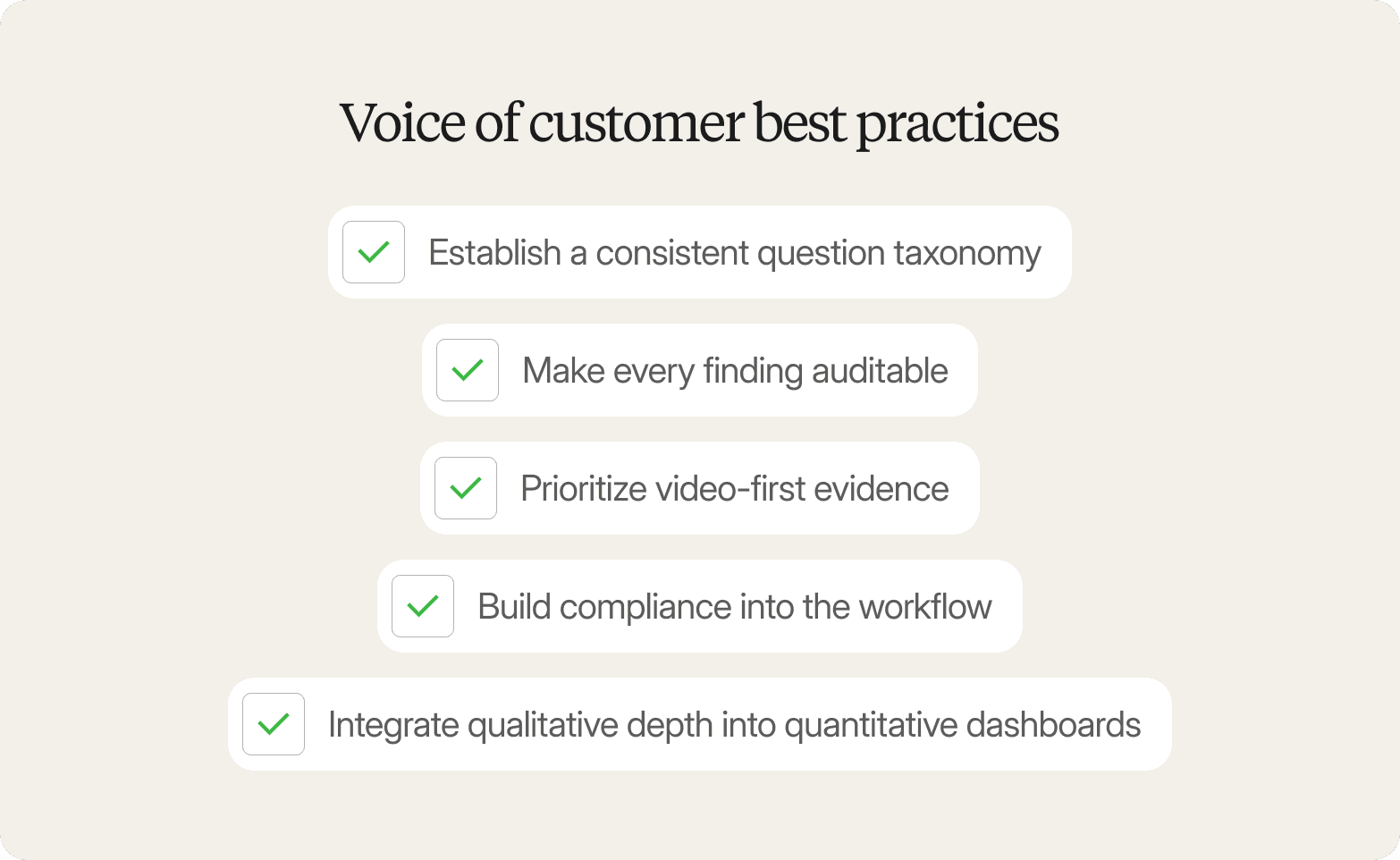
Running a framework at enterprise scale introduces challenges smaller programs never encounter: procurement gatekeepers; cross-functional stakeholders across product, marketing, and customer success with competing priorities; regional compliance; and executives who dismiss findings they can't trace. These voice-of-customer best practices are what building a genuinely customer-centric culture requires.
1. Establish a consistent question taxonomy
Consistent question structures turn each new study from a standalone project into a contribution to a growing body of evidence. When the same constructs appear in onboarding, churn, and brand-tracking research, patterns emerge that no single study could surface, such as friction at cancellation mirroring unmet expectations at sign-up. Analyzing customer feedback this way turns raw data into customer insights leadership can use.
2. Make every finding auditable
Stakeholders who weren't in the room will always question findings. The moment a theme can't be traced to a specific participant, it's easy to dismiss as "just a summary." Linking every insight to verbatim quotes, video timestamps, and participant IDs removes that objection before it surfaces.
3. Prioritize video-first evidence
For executive audiences in particular, seeing a participant's reaction carries more persuasive force than reading a summary of it. Video-first conversations preserve context a written quote cannot convey.
4. Build compliance into the workflow
Enterprise programs that skip compliance infrastructure tend to stall in procurement, not in research design, a gap that VOC best practices treat as foundational. Conveo closes it: SOC 2 certification, regional data hosting, and GDPR readiness are built in and designed to meet procurement requirements without slowing the research timeline.
5. Integrate qualitative depth into quantitative dashboards
Quantitative dashboards show that something changed; they rarely explain why. Qualitative interviews supply the mechanism: the specific friction, the unmet expectation, the language customers use to describe the gap. When qualitative findings annotate quantitative trends and key performance indicators, stakeholders stop asking "what happened" and start asking "what do we do about it," the difference between a customer-centric company and one that just collects feedback for an unused dashboard.
Choosing the right voice of customer model for your organization
The right model is not a universal choice. It depends on three factors teams underweight under pressure:
The kind of question they're asking
How much time they have before findings need to land
How mature their framework already is
Research question type
Question Type | Example | Structure Needed |
Diagnostic | "Why did repeat purchase rates drop?" | Qualitative depth with adaptive follow-up |
Exploratory | "What unmet needs exist?" | Minimal structure — over-scripting biases answers |
Validation | "Which concept resonates more?" | More structure tolerated, but probing still needed to understand why |
Timeline constraints
If findings need to influence a decision shipping in two to three weeks, a platform that closes the full cycle in 3–5 days rather than 6–10 weeks becomes a requirement, not a preference. If the research is exploratory with no immediate decision attached, slower methods remain viable.
Across all three dimensions, the throughline is the same set of voice-of-customer best practices: match the method to the question, the timeline, and the team's maturity. Get this right, and you have a successful VOC strategy; get it wrong, and you have plenty of qualitative data and quantitative data but very little anyone trusts.
Organizational maturity
Early-stage programs should resist scaling before they've built internal credibility. Starting with two or three high-impact use cases gives stakeholders something concrete to trust.
Mid-maturity programs can begin standardizing: shared taxonomies, repeatable templates, consistent output formats.
Advanced programs treat VOC as continuous infrastructure, in which every study feeds into a searchable library.
Run your voice of customer program on Conveo
A framework is only as strong as the workflow underneath it, and this is where Conveo turns the interview guide, coding framework, and report template into a running program. The decision-focused interview guide comes to life through async AI moderation that applies three-layer probing in real time, with real participants rather than synthetic respondents. The coding framework becomes a compounding library of insights, cross-referenced against every prior study. The report template becomes traceable by default: every theme links back to the verbatim quote, participant, timestamp, and video clip that produced it.
Because collection, moderation, and analysis run in parallel, studies close in days, landing inside decision windows a small team could never hit through sequential agency work. And because SOC 2 certification, regional data hosting, and GDPR readiness are built in, the program clears enterprise procurement without a compliance retrofit. That combination- trust and traceability first, then speed- is what lets voice of customer best practices actually change decisions and build customer loyalty and competitive advantage.
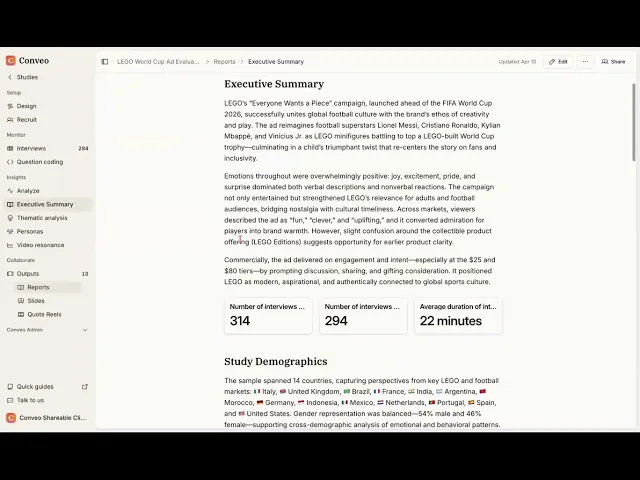
See how a report reads: Reading a Conveo Report →
Frequently Asked Questions
What is the difference between a voice of customer framework and a voice of customer program?
Why aren't NPS, CSAT, and CES enough on their own?
What are the three core artifacts every framework needs?
How does video-first research improve credibility with executives?
Can a small insights team run a voice-of-customer program at enterprise scale?
How fast can a voice-of-customer study realistically move?