
TL;DR
"AI focus group" encompasses three distinct components: simulated participants built from AI personas, AI-moderated interviews with real participants, and AI-assisted analysis of human-run sessions. Only one delivers auditable evidence and valuable insights a team can act on.
Traditional focus groups are slow by design: synchronous scheduling adds weeks before fieldwork, and manual coding adds 40 to 60 hours after.
AI-moderated asynchronous interviews remove the scheduling dependency: participants respond on their own time, sessions run in parallel, and key themes surface in days, not weeks.
One-on-one AI-moderated interviews reduce moderator bias and often surface more honest opinions than live group sessions, and every finding can be traced back to timestamped video.
Traditional moderation still wins for live multi-stage pivots, physical product testing, and ethnographic observation.
Conveo is a video-first market research platform covering recruitment, AI moderation, analysis, and reporting end-to-end, with real participants and traceable video, built to help teams refine concepts and messaging cost-effectively.
Your marketing team needs qualitative feedback on a new product idea this week. Coordinating a focus group means waiting weeks to find a shared time slot among participants, a moderator, and a facility that works for everyone.
Traditional focus groups require synchronous scheduling by design. Every participant, observer, and moderator must be available at the same time and in the same place. That bottleneck delays fieldwork by weeks before a single question gets asked, and manual transcription and coding add another 40 to 60 hours before findings reach the people who need to act on them.
The rise of AI focus groups is a direct response to this constraint. AI-moderated asynchronous interviews remove the scheduling dependency entirely: participants respond when it works for them, sessions run in parallel, and analysis runs continuously as recordings land. What used to take weeks now takes days, giving marketing teams a faster path from research plan to decision.
The operational model has changed for 2026. The question for market research teams is whether their current process has changed with it.
What AI Focus Groups Actually Are (And What They're Not)
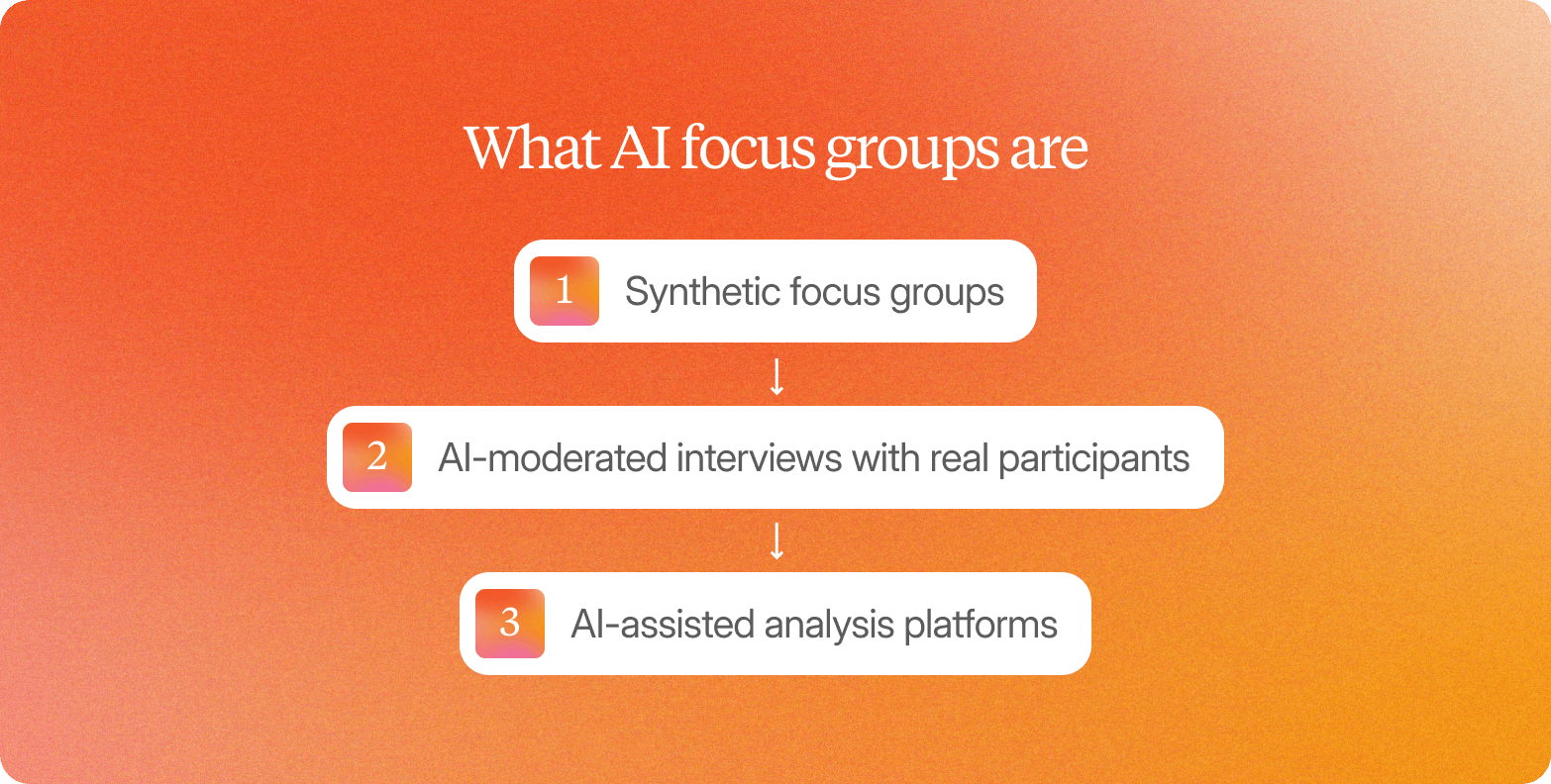
Three distinct approaches operate under the "AI focus group" label, and they differ fundamentally in participant authenticity, auditability, and the extent to which their outputs will advance in an enterprise stakeholder review. Before evaluating any platform, it is worth being precise about which category you are actually looking at.
Synthetic focus groups use AI personas or avatar-based responses to simulate what a target audience might say. No real participants are involved, so what you get is opinions generated by simulated participants rather than actual consumer preferences. The appeal is speed: outputs arrive in minutes. The problem is traceability. When a CMI director asks "who said this, and can I see the recording?" the answer is no. For teams that need findings their stakeholders will trust and act on, that is not a minor limitation. It is a structural one.
AI-moderated interviews with real participants are an entirely different methodology. Real people join asynchronous one-on-one video or voice sessions. An AI moderator guides the conversation, asks adaptive follow-up questions based on what participants actually say, and captures the full recording as verifiable evidence. This is what focus group AI looks like when participant authenticity is non-negotiable, and it is the approach best suited to market validation of products based on real consumer preferences.
AI-assisted analysis platforms sit at the other end of the workflow. They transcribe, tag, and code recordings from traditional focus groups or interviews run by human moderators. These platforms do not conduct research. They process it after the fact. AI for focus group analysis, in this sense, is useful, but it is a post hoc layer, not a research method.
This article focuses on AI-moderated interviews with real participants. That is the category where the most consequential tradeoffs live. Synthetic platforms prioritize speed over credibility. AI-moderated interviews with real participants are built to deliver both.
Why Traditional Focus Groups Create Research Bottlenecks
Traditional focus groups depend on a structural requirement that creates friction before the research even begins: everyone has to be in the same place at the same time. Finding a two-hour window that works across 6 to 10 participants, a moderator, and either a physical facility or a managed video platform typically takes two to three weeks of coordination. That scheduling overhead is not a failure of execution. It is a feature of the method.
The cascading effects compound quickly:
A single cancellation reschedules the entire session.
A multi-market study requires separate live sessions for each geography, each with its own coordination cycle.
A four-market study should not, in theory, take four times the coordination effort, but in practice, teams report it often does.
The timeline from kickoff to findings delivery typically runs weeks, not days:
Two to three weeks go to scheduling.
The rest disappears into fieldwork, manual transcription, coding, and thematic synthesis.
Teams report spending 40 to 60 hours per study on post-fieldwork analysis before a single stakeholder sees output.
The structural problem is that this timeline does not match the decisions it is meant to inform. Campaign launches move on two-to-three-week cycles. Product sprints close in days. In practice, teams often make the decision first and commission research to confirm it afterward, which inverts the method's purpose entirely. It also makes it harder to build a research plan around concept testing early enough to actually influence the outcome.
This is why teams are evaluating AI focus groups that eliminate synchronous scheduling requirements, allowing participants to respond on their own time while preserving the depth of one-on-one conversation. The constraint being removed is not qualitative rigor. It is the calendar.
How AI-Moderated Asynchronous Interviews Work
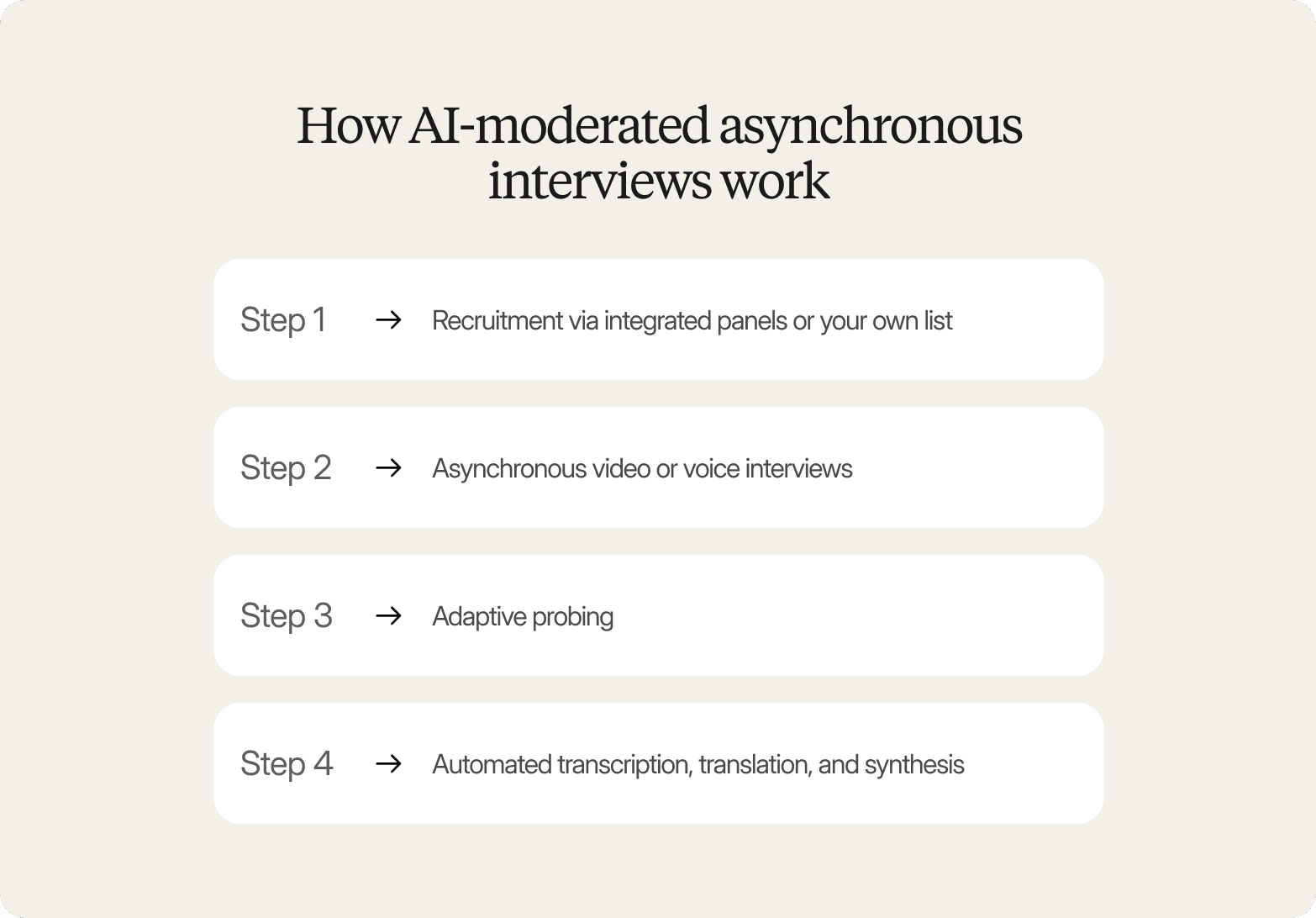
The workflow follows four connected steps, each removing a specific bottleneck that has historically slowed qualitative research for sprint-based teams.
Step 1: Recruitment via integrated panels or your own list
Studies launch with a defined profile of ideal participants and a custom behavioral screener. Conveo recruits through its integrated panel network, filters for quality and demographics, and handles incentives. Teams can also upload their own customer list or recruit via CSV, QR code, or WhatsApp, sending a direct link. The recruiting overhead that typically consumes days of a researcher's time is handled before the first interview begins.
Step 2: Asynchronous video or voice interviews
Participants receive a link they can open at their convenience. The interview takes 15 to 30 minutes, runs in the participant's own language, and requires no calendar coordination. Rather than queuing sessions one at a time across days or weeks, hundreds of conversations run in parallel within the same few-day field window, so no single session becomes a bottleneck for the whole study.
Step 3: Adaptive probing
This is the capability that separates AI-moderated interviews from open-text survey fields. When a participant says something vague, the AI moderator can probe deeper on that specific answer rather than advancing to the next scripted question. If a participant says "the pricing feels off," it asks "what specifically about the pricing feels off to you?" rather than moving on. That single follow-up is the difference between a data point and an insight, and it's often where real pain points around product concepts surface.
Asynchronous one-on-one interviews also reduce moderator bias and eliminate group dynamics. There are no dominant voices, no social pressure, and no anchoring effects that distort responses on sensitive topics like pricing or product failures.
See it in action: How AI-Moderated Interviews Actually Work →
Step 4: Automated transcription, translation, and synthesis
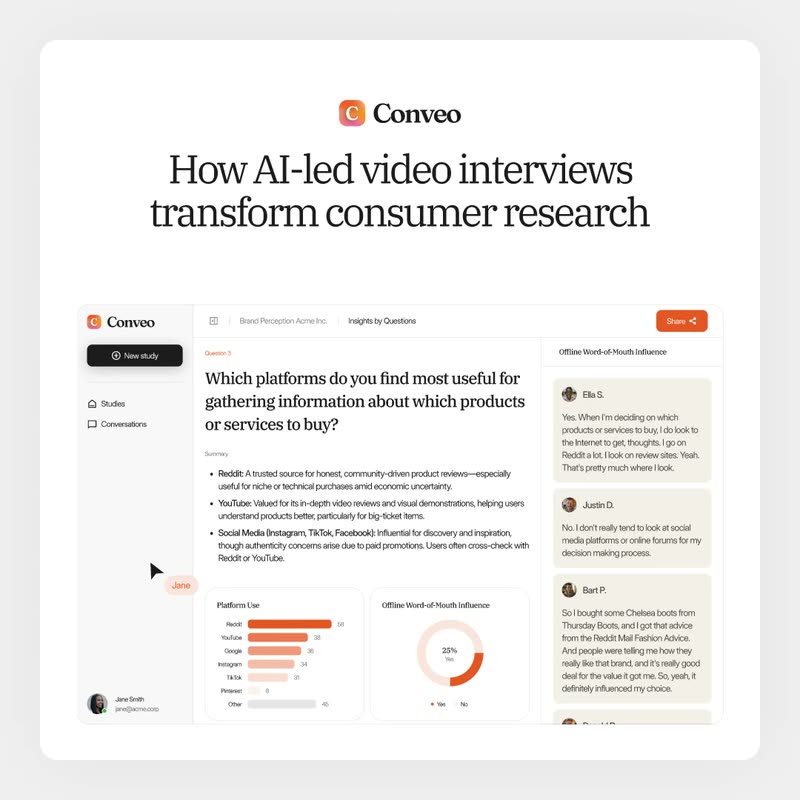
As recordings land, Conveo transcribes, translates, and codes every session, surfacing key themes across the full set of participants. Multimodal analysis goes beyond the transcript: a hesitation before a pricing question, a shift in tone when a competitor is mentioned, a facial expression that contradicts a positive verbal response. Every theme links back to timestamped video clips, so stakeholders can verify the evidence themselves rather than trusting a summary.
The cumulative effect on timeline is significant. Analysis that previously required weeks of manual coding can be compressed to a few days. The research cycle closes while the decision it was meant to inform is still open.
When AI Focus Groups Deliver More Credible Insight Than Traditional Methods
The credibility paradox in AI-moderated research is real: executive buyers approach AI focus groups with skepticism, only to discover that one-on-one video interviews with an AI moderator often elicit more honest responses than traditional live sessions ever did. In Conveo's research, 68% of participants said they were more open with Conveo's AI moderator than with a human interviewer, particularly on topics participants typically soften in front of a room: pricing sensitivity, product dissatisfaction, and preferences for competing brands.
The mechanism is straightforward. In a live focus group, social dynamics shape the conversation in ways that work against honest individual responses. Dominant voices establish a frame of reference early. Participants who hold a different view hesitate to contradict someone who sounds confident. This is moderator bias and group conformity working together, resulting in a consensus that doesn't reflect anyone's real opinions.
Asynchronous AI-moderated interviews remove those pressures entirely. Each participant speaks in their own time, without an audience, without a moderator whose approval feels implicit, and without the performance anxiety that live group settings create. What comes back is closer to what people actually think, which is what makes the resulting consumer preferences data useful for market validation rather than just directional.
The auditability question matters as much as the honesty question. Every session on Conveo produces a timestamped video recording, a full transcript, and a traceable chain of evidence that links each finding to its source. Stakeholders who question a conclusion can watch the clip themselves rather than accept a moderator's summary of how the room felt.
Synthetic focus groups cannot offer any of this. Avatar-based platforms generate responses from simulated participants rather than real ones, which means there is no recording to verify and no chain of evidence to audit. Enterprise buyers who have encountered these outputs report the same reaction: findings they cannot verify are findings they cannot act on.
Credibility in qualitative research has always come from traceability. Real participants, captured on video, with every insight linked back to the moment it emerged, is what makes findings defensible when a CMO or product lead pushes back, and what turns a finding into a genuine proof point rather than an assumption.
Multi-Market and Multilingual Research: Where AI Focus Groups Remove the Biggest Friction
Multi-market qualitative research is one of the most operationally expensive commitments an insights team can make. A study covering the US, UK, Germany, and Japan requires four separate sets of recruited participants, four moderated sessions, and coordination across four time zones. Because sessions run sequentially, teams report multi-market studies routinely take 10 to 12 weeks from brief to final synthesis. By the time findings land, the decision they were meant to inform has often already moved on.
The async model changes this at the structural level. When AI focus groups run asynchronously, participants in New York, London, Berlin, and Tokyo complete their interviews during the same few-day field window, with no scheduling dependency between markets.
The language barrier dissolves in the same workflow. Conveo supports AI moderation and automated analysis across 50+ languages and recruitment across 50+ markets, so synthesis does not require separate analysts per market. Themes, quotes, and sentiment patterns surface in a single unified output rather than four separate decks that someone has to reconcile by hand, giving marketing teams a single, consistent view of competitive positioning across regions.
This is capability that was not previously practical at agency scale: continuous, repeatable multi-market qualitative work run by a small internal team. Teams that shift to in-house async interviewing also report they can run more studies cost effectively, with research spend reductions of 50-80% on comparable work, but the more important shift is that the research becomes runnable at all, on the cadence the business actually moves at. This holds across industries, from CPG and retail to healthcare and financial services, wherever teams need to understand what real customers think before they commit budget.
What AI Focus Groups Cannot Replace (And When Traditional Methods Still Win)
AI-moderated asynchronous interviews are not the right fit for every research need. Three situations still favor traditional focus groups.
Three situations still favor traditional focus groups:
Complex multi-stage discussions, where a moderator needs to pivot based on what the group is doing in real time. No asynchronous format replicates that in-the-moment judgment.
Physical product testing, where participants need to handle prototypes, open packaging, or interact with a shelf set. The research question lives in the hands, not the words.
Ethnographic observation, in which the environment itself is part of the data: a kitchen, a retail aisle, or a clinical setting common in healthcare research.
Traditional focus groups deliver depth in these contexts, but they sacrifice speed and scale. AI focus groups close that gap for most standard research programs, but not for situations where live human judgment is non-negotiable. Conveo also runs focus groups for teams that want a group format, so the choice is about method fit, not hierarchy.
One additional boundary: platforms built entirely around AI personas and simulated participants cannot substitute for real conversations when stakeholders require traceable evidence. Procurement teams, legal reviewers, and senior decision-makers increasingly ask to see the source, not just a synthesized opinion.
Choose this method | When |
AI-moderated asynchronous interviews | Speed, scale, and participant honesty matter more than live group dynamics |
Traditional moderation | Real-time human judgment, physical interaction, or environmental context is central to what you need to learn |
How to Evaluate AI Focus Group Platforms (Buyer's Checklist)
Choosing between platforms requires looking past feature marketing and asking a more useful question: what does this platform actually cover, and where does it stop?
The market for AI focus groups has split into platforms that handle one part of the research workflow and those that handle the entire workflow. That fragmentation matters because every handoff between platforms reintroduces the manual coordination overhead that AI was supposed to remove.
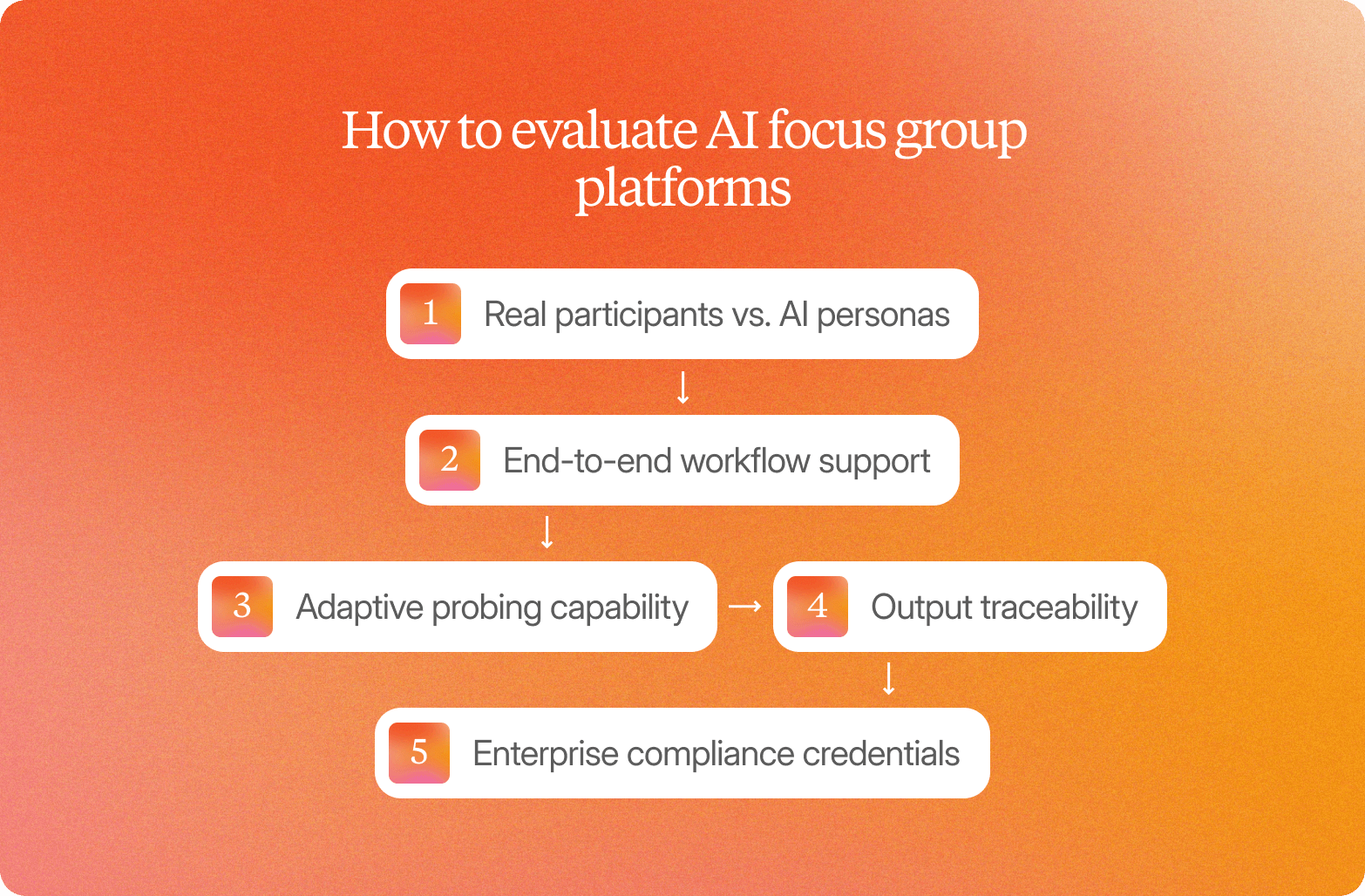
Five criteria separate platforms worth serious consideration from those that create new problems while solving old ones:
1. Real participants vs. AI personas
Some platforms generate consumer responses from AI-trained personas or other simulated participants rather than recruiting real people. The output arrives faster, but executive buyers distrust findings they cannot audit back to actual conversations, and no one can be sure the opinions reflect real consumer preferences.
2. End-to-end workflow support
A platform that covers recruitment, interviewing, analysis, and reporting in a single environment removes the coordination overhead that point solutions reintroduce.
3. Adaptive probing capability
Scripted interview guides produce scripted answers. Depth comes from the ability to probe further with follow-up questions that address what a participant actually said.
4. Output traceability
Stakeholders need to verify findings themselves. Timestamped video clips and verbatim quotes give decision-makers evidence, real proof points, to defend conclusions internally.
5. Enterprise compliance credentials
SOC 2 certification, GDPR compliance, and EU regional data hosting are procurement requirements, not optional features. Platforms without confirmed documentation stall in legal review, regardless of the premium capabilities they offer elsewhere.
The right platform depends on whether a team needs only interviewing, only analysis, or full workflow coverage from recruitment through reporting, and on how much market intelligence the organization needs to generate on an ongoing basis rather than for a single project.
How Conveo Approaches End-to-End AI-Moderated Research with Real Participants
Conveo is a video-first market research platform that covers the full qualitative workflow: participant recruitment through its integrated panel network or your own list; AI-moderated asynchronous one-on-one video interviews; automated transcription and translation across 50+ languages; and thematic synthesis with timestamped video clips tied directly to source recordings.
Three things separate this approach from what most teams encounter when evaluating AI focus groups and related platforms:
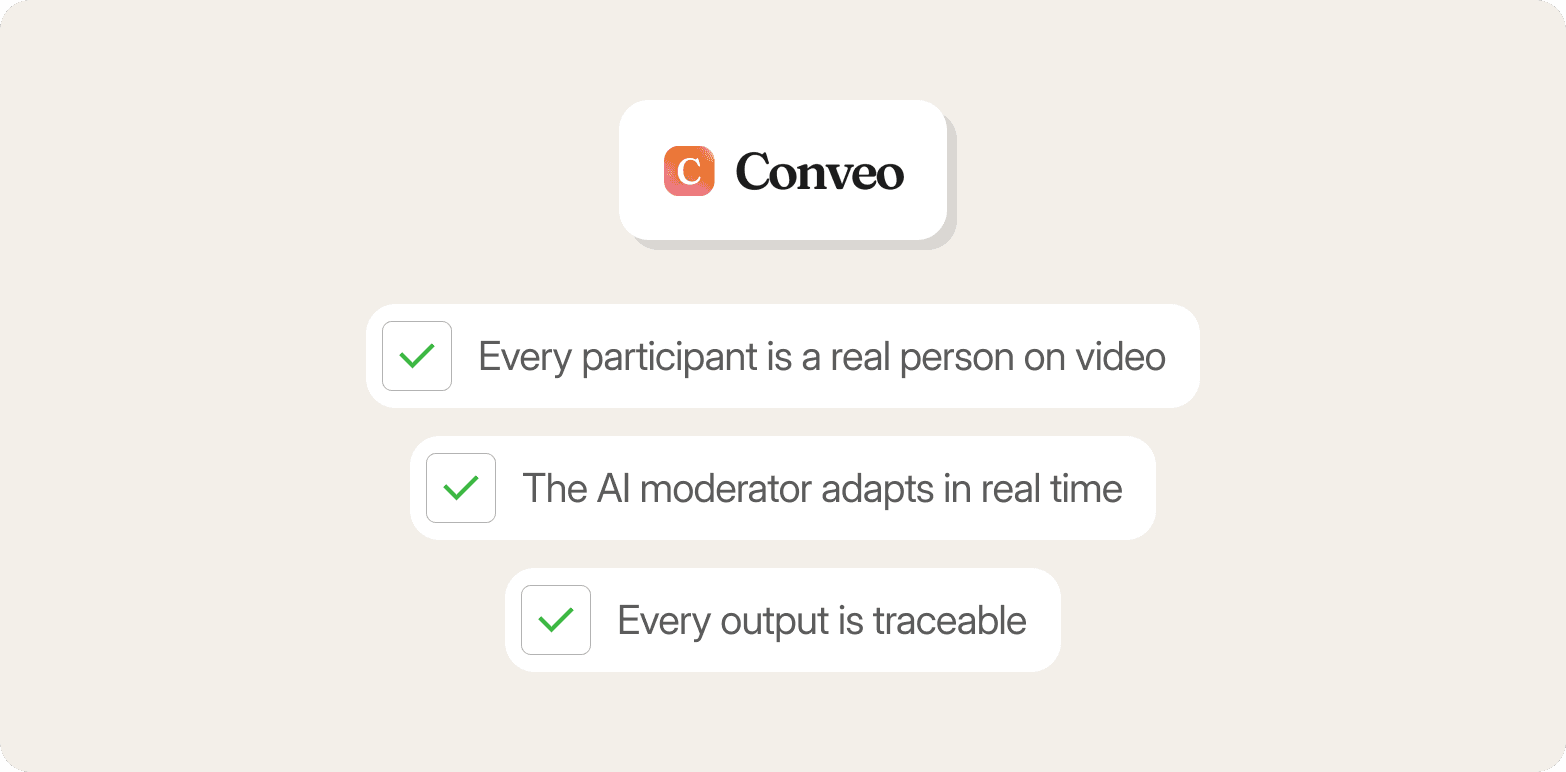
Every participant is a real person on video, not an AI persona or a simulated participant. There are no avatar-generated responses. What stakeholders see reflects what actual humans said, in their own words.
The AI moderator adapts in real time. When a participant hesitates, contradicts themselves, or introduces an unexpected angle, it follows up rather than moving to the next scripted question, effectively probing deeper the way a skilled human moderator would.
Every output is traceable. Each theme, pattern, and finding links back to the video clip that generated it. Stakeholders do not have to take the synthesis on faith.
Teams using Conveo report research timelines compressing from 6 to 12 weeks to 3 to 5 days, running studies more cost-effectively with reductions of up to 75% compared to agency-delivered qualitative work. For European enterprise buyers, Conveo is SOC 2-certified, GDPR-compliant, and offers EU-region data hosting.
Findings do not disappear after a study closes. The insight library keeps past research searchable and reusable across projects, so institutional knowledge and the market intelligence built from it compound rather than dying in a deck no one opens again.
Conveo is built for insights, CMI, brand, and research teams at enterprise and mid-market companies, across industries from consumer goods to healthcare, that need qualitative depth at a pace traditional research logistics cannot match. It is not the right fit for teams whose core need is live in-room moderation, hands-on product handling, or ethnographic fieldwork.
The same underlying workflow applies regardless of the goal:
Concept testing for a new product idea
Refining messaging before a landing page goes live
Tracking competitive positioning over time
In each case: recruit the right participants, ask better follow-up questions, and turn the resulting qualitative feedback into something the whole team can trust. The effectiveness of the approach doesn't depend on scale either. A study built around one persona can be just as rigorous as a hundred-participant program, which is part of why teams treat it as a genuine innovation in how research gets done rather than just a faster version of the old process. The core benefits- speed, honesty, and traceability- hold at either end.
"Really useful for creative testing. I don't think I've ever turned around a project in a week. So this is really, really helpful"
— Reneiloe Nteso, Google
Frequently Asked Questions
What Are AI Focus Groups?
How Do AI Focus Groups Differ from Traditional Focus Groups?
Are AI Focus Groups Free?
What Are the Best AI Focus Groups Platforms?
Can AI Focus Groups Replace Human Moderators?
How Do I Create a Free Focus Group with AI?