In this article
TL;DR
This article compares recommended AI solutions for user interview moderation using a consistent evaluation framework.
It's for UX research managers, product researchers, and Research Ops teams who want to scale beyond the human moderation bottleneck and choose an AI interview platform with confidence.
To make research findings easier to trust and act on, teams need enterprise compliance, genuine participants, and evidence linked to the original interview.
The right platform depends on how your team runs research today: how often you run studies, how many languages and markets you need, and how much you rely on findings from past research.
Research teams often need more user interviews than one moderator can realistically conduct. Recommended AI solutions for user interview moderation remove that limit by letting AI run hundreds of interviews in parallel and ask follow-up questions based on each participant's responses.
Where manual research methods often take four to eight weeks from recruitment to reporting, AI-moderated studies can deliver key themes in days. The challenge is choosing a platform that fits how your team conducts research. This guide compares leading AI-moderated user interview platforms, highlights their differences, and outlines the criteria to use when building a shortlist.
Why Teams Evaluate AI Moderation Platforms
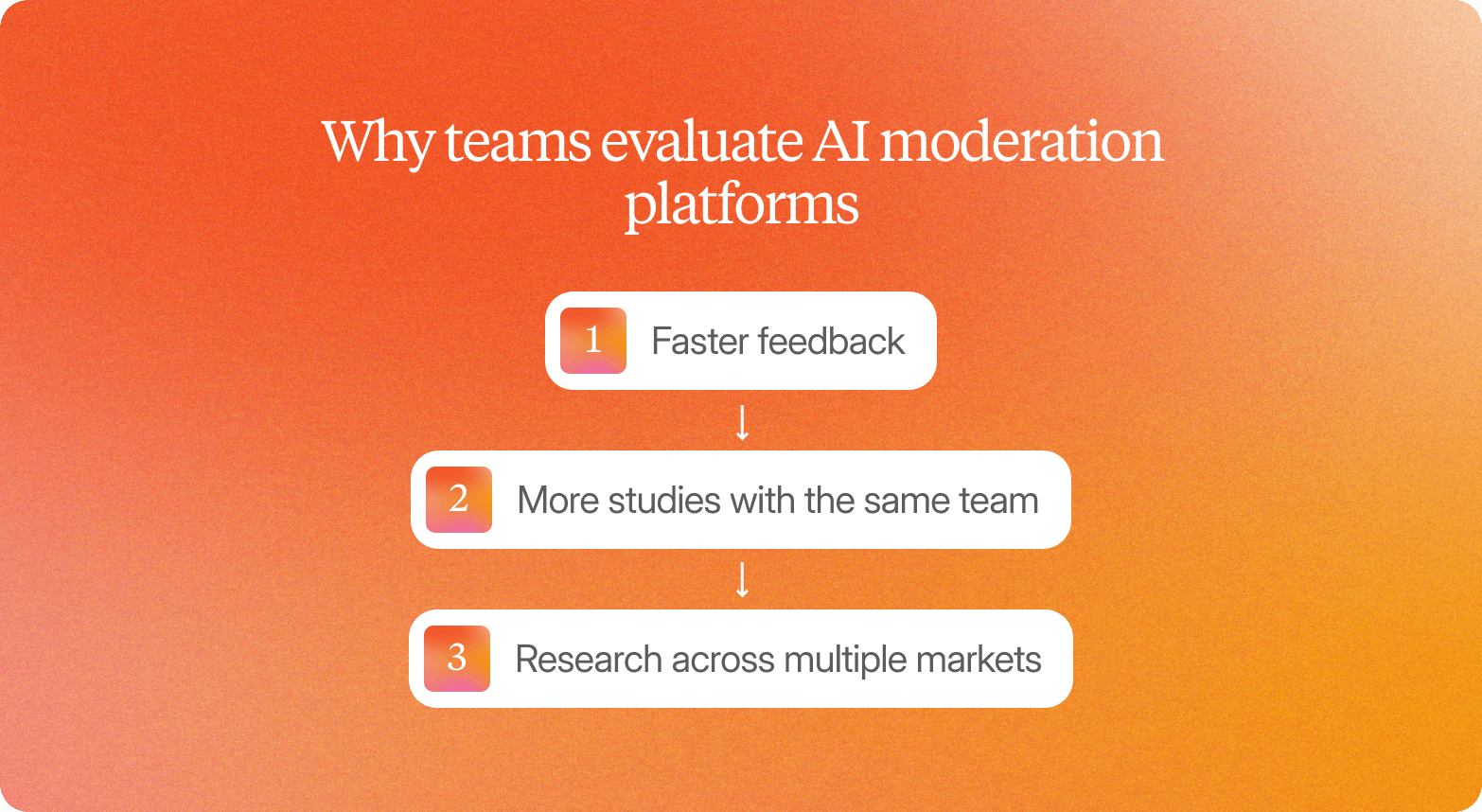
Teams evaluate AI research platforms for moderated interviews when their current research process no longer keeps pace with the volume or speed of research they need. AI moderation helps teams achieve:
Faster feedback. Product, design, and marketing teams often need interview findings before a release or campaign goes live. AI moderation can complete studies in days rather than weeks, giving teams time to use customer feedback before decisions are made.
More studies with the same team. Every traditional interview requires moderator time, limiting how many studies a research team can run at once. Interview AI moderation software can conduct many interviews in parallel, increasing research capacity and generating more customer insights without adding moderators.
Research across multiple markets. Global studies may require dozens of interviews in different languages and time zones. AI moderation lets teams run the interview process simultaneously across markets, making it practical to collect user feedback from more participants without manually coordinating every session.
AI moderation has expanded what's possible for research teams, but not every platform offers the same capabilities.
Comparison Table: AI Moderation Platforms
Use the table below to see how popular AI-moderated customer interview platforms compare across key criteria.
Compliance data reflects publicly available information as of July 2026. Verify directly with vendors.
| Feature | Conveo | Listen Labs | Outset | GetWhy | Voicepanel |
|---|---|---|---|---|---|
| Research workflow | Study setup | Study setup | Study setup | Study setup | Study setup |
| Enterprise security and compliance | SOC 2 certified, GDPR compliant. | SOC 2 Type II certified and GDPR compliant. | SOC 2 Type II certified and GDPR compliant. | SOC 2 certified and GDPR compliant. | SOC 2 certified and GDPR compliant. |
| Interview follow-up questions | AI moderator asks follow-up questions based on hesitation and unexpected responses during the interview for more meaningful insights. | Researchers set follow-up rules for each question: when to probe, how many follow-ups, and what to probe. | AI interviewer "Leo" asks follow-up questions based on each participant's answers. | AI moderator probes dynamically in real time, reading tone and hesitation to decide when to follow up. | Adaptive questioning probes on topics the researcher sets. |
| Languages and markets | Supports AI moderation in 48+ languages and markets. | Runs AI-moderated voice interviews in 40+ languages and recruits participants across 45+ countries. | Supports interviews in 40+ languages, with automatic transcript translation. | Supports live video interviews in more than 100 languages. | Automatically translates questions and responses in 35+ languages. |
| Knowledge across studies | Stores research in a knowledge library so findings can be searched and reused across studies. | Mission Control compounds findings from every study into a searchable knowledge base. | No built-in cross-study library. Requires a research repository integration to connect studies. | An AI agent lets teams query findings across all past studies in plain language. | No cross-study knowledge library appears in Voicepanel's published feature set. Its "chat with your data" tool works within a single project. |
Recommended AI Solutions for User Interview Moderation
The table above shows what each AI customer interview platform does. The profiles below cover which one fits your team, and where each hits a limit.
1. Conveo
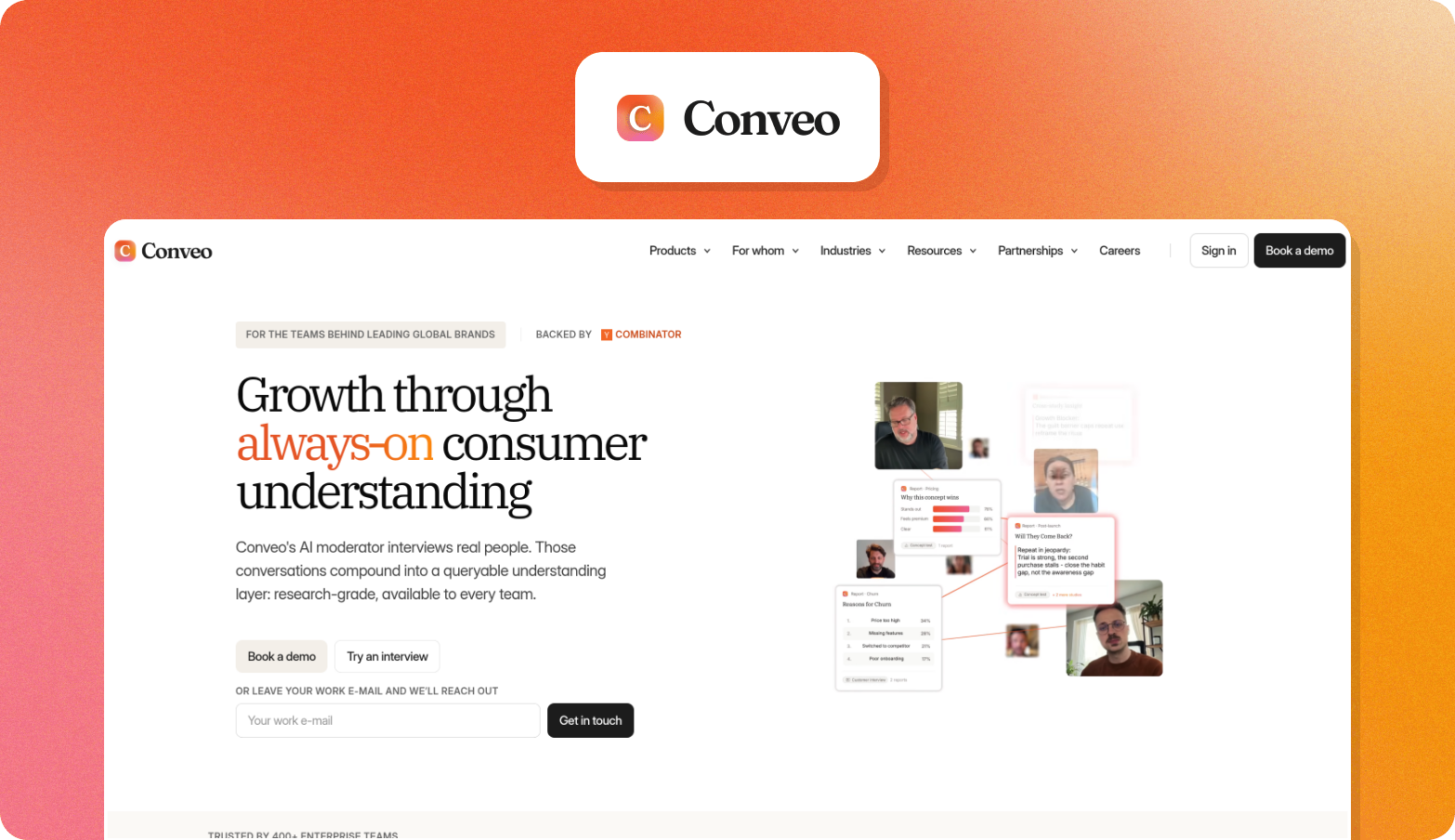
Conveo is a video-first AI research platform that runs AI-moderated interviews with real participants and keeps every stage of the research process in one place. From recruitment through reporting, every finding stays linked to the original interview.
See it in action: How AI-Moderated Interviews Work
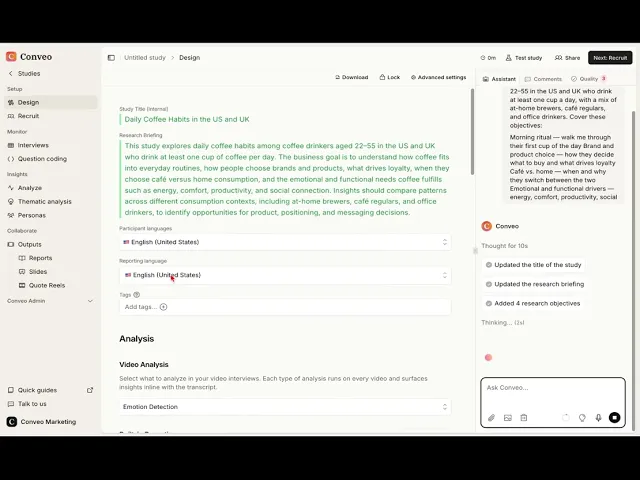
Best for: UX Research Managers and Research Ops running ongoing user research that needs to stand up to stakeholder and procurement review.
Core strengths:
Run the whole study in one place. Recruit participants across 48+ markets, run AI-moderated interviews, analyze responses, and share reports without moving data between different tools.
Show the evidence behind every finding. Every theme links back to the original video clip and participant quote, so anyone reviewing the research can see exactly how a conclusion was reached.
Built for enterprise teams. Conveo is SOC 2 certified, GDPR compliant, and offers regional data hosting.
Keep learning from every study. Completed studies are stored in a searchable knowledge library, making it easy to find past research instead of starting from scratch each time.
Proof point: More than 400 enterprise teams, including Google and Canva, use Conveo to scale qualitative research.
Key limitation: Conveo is built for enterprise teams carrying out continuous research, not one-off studies.
“The insights exceeded my expectations. Genuinely, the level of nuance the AI moderator was able to get to for fairly similar names was amazing, which made the learnings so actionable.”
Research Lead at a leading streaming service
2. Listen Labs
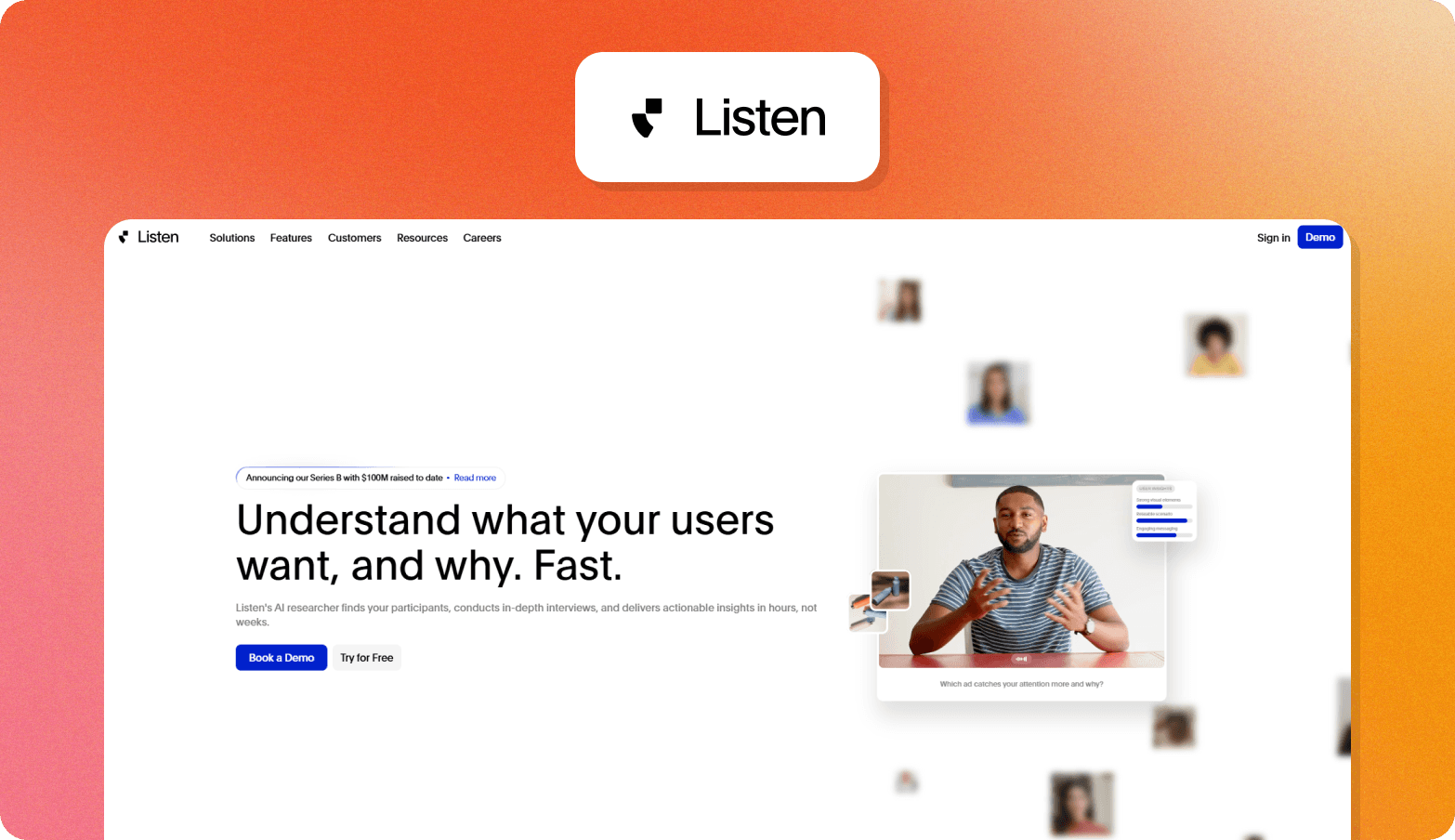
Listen Labs offers AI-moderated customer interviews and flags fraud or low-effort answers while the interview is still running.
Best for: Teams that want the user interviews AI to plan the study and run the interviews, not just one or the other.
Core strength: It picks up on tone and word choice in participant responses to score how they feel about a question, beyond what they say in words.
Key limitation: EU data hosting isn't publicly confirmed, which can be a blocker for teams whose procurement rules require data to stay physically in the EU.
3. Outset
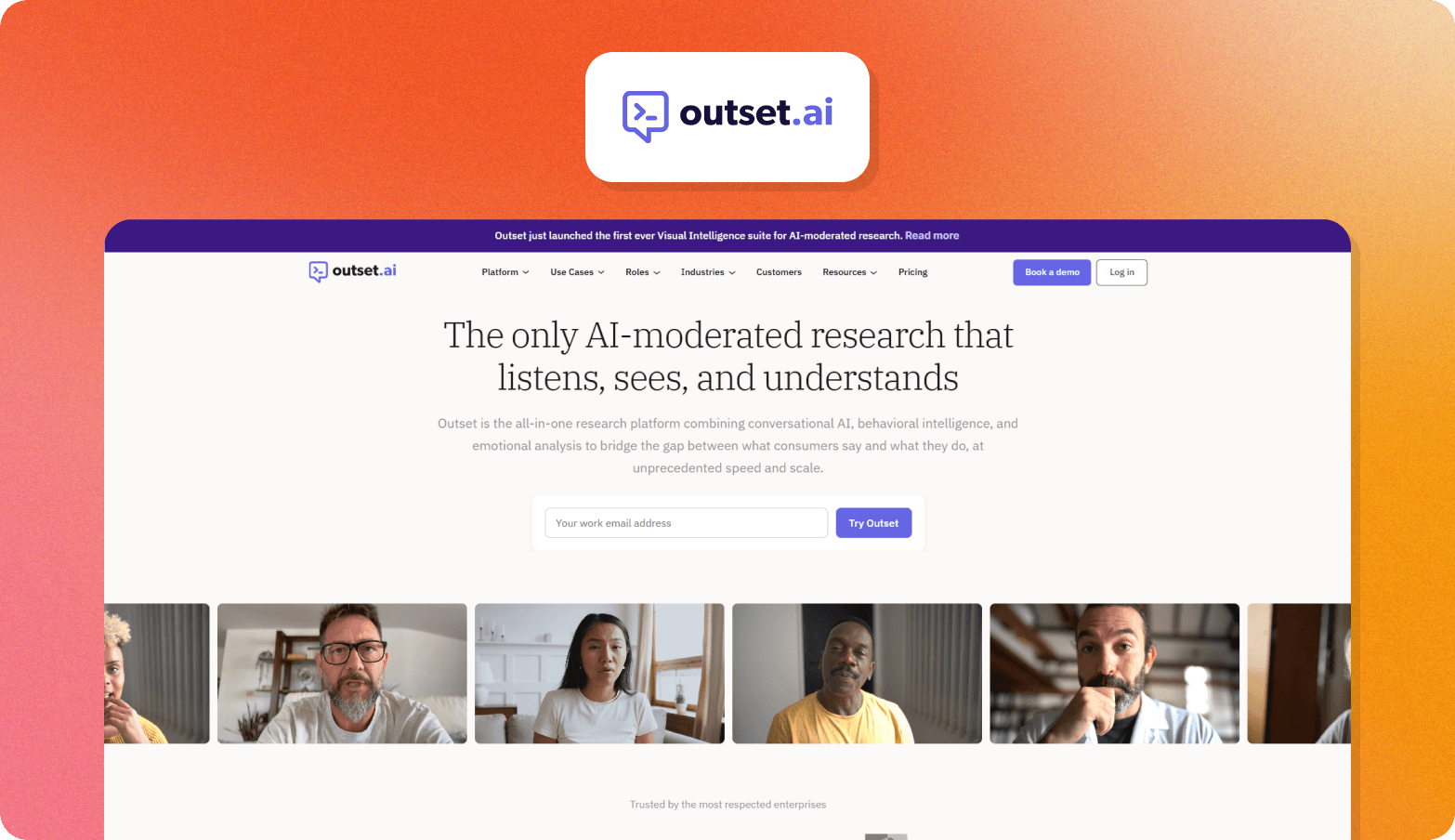
Outset uses an AI interviewer that detects vague answers and prompts the person to elaborate.
Best for: Teams that want to control exactly how the AI probes, since every follow-up comes from rules the researcher sets.
Core strength: It sorts answers into themes and picks up on sentiment during the interview, so results are ready as soon as the interview ends.
Key limitation: It can't read facial expressions or tone of voice. There's also no built-in place to store findings across studies; you'd need an additional Dovetail subscription for that.
4. GetWhy
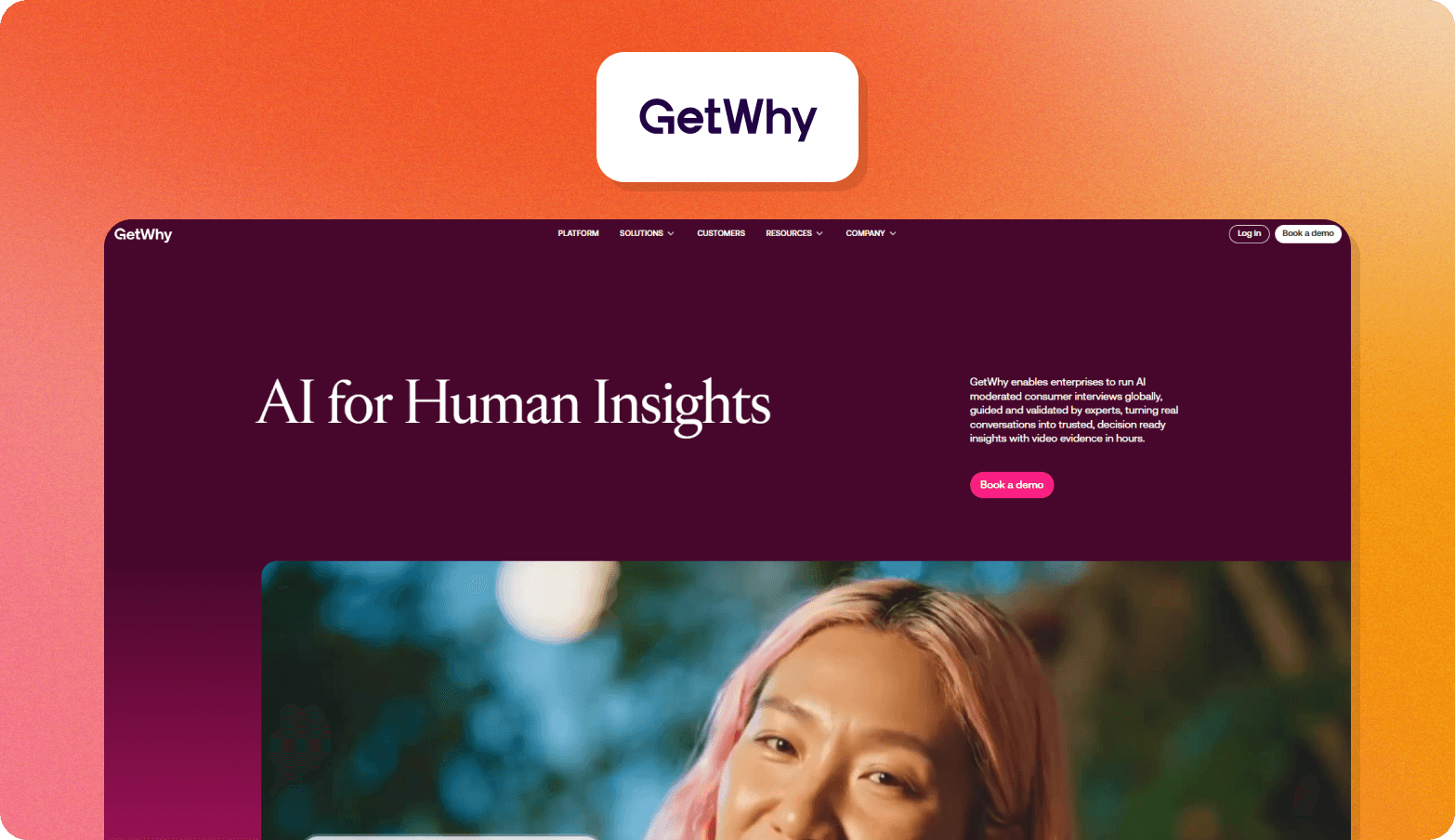
GetWhy checks every AI-moderated interview against a 17-point quality test before it counts toward your study.
Best for: Teams who'd rather trust a quality check than review interviews themselves, especially for concept testing and brand work.
Core strength: Interviews that don't pass the test get rerun or thrown out, so only the good ones make it into your results.
Key limitation: That extra checking step is more than some self-serve teams want. GetWhy also leans more toward CPG brand research than UX work.
5. Voicepanel
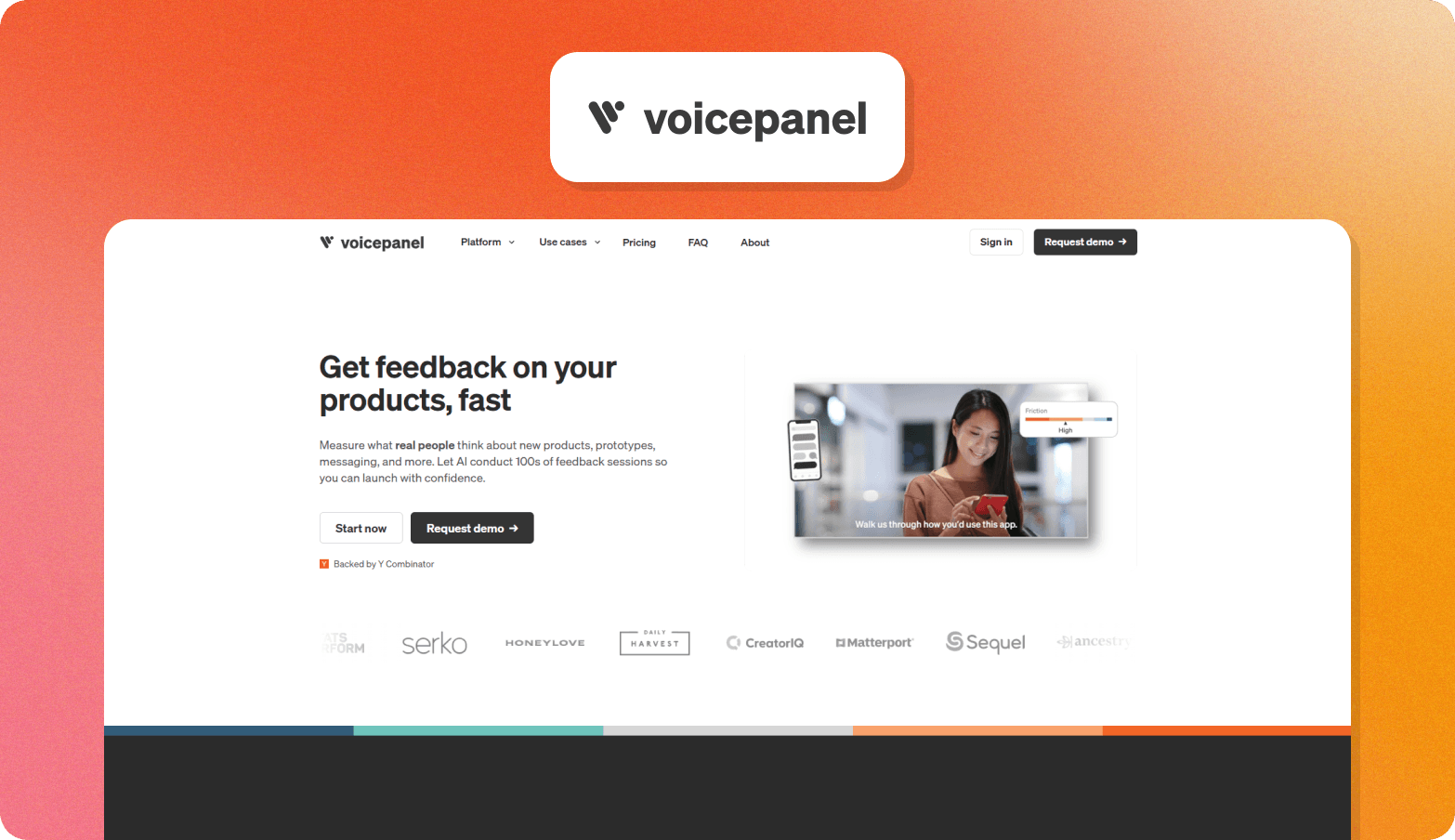
Voicepanel combines AI-moderated interviews with surveys and usability tests on a single platform.
Best for: Teams that want both quantitative and qualitative data methods without switching tools.
Core strength: Interviews are available in voice, video, or text and are automatically translated into 35+ languages.
Key limitation: Voicepanel doesn't say much about how deep its AI follow-ups go, or whether it can pull findings across studies.
If your team runs recurring user research and needs end-to-end workflow coverage with enterprise compliance, book a demo to see how Conveo handles study design through stakeholder reporting in one platform.
6 Criteria to Evaluate Before Choosing an AI Moderation Platform to Conduct Interviews
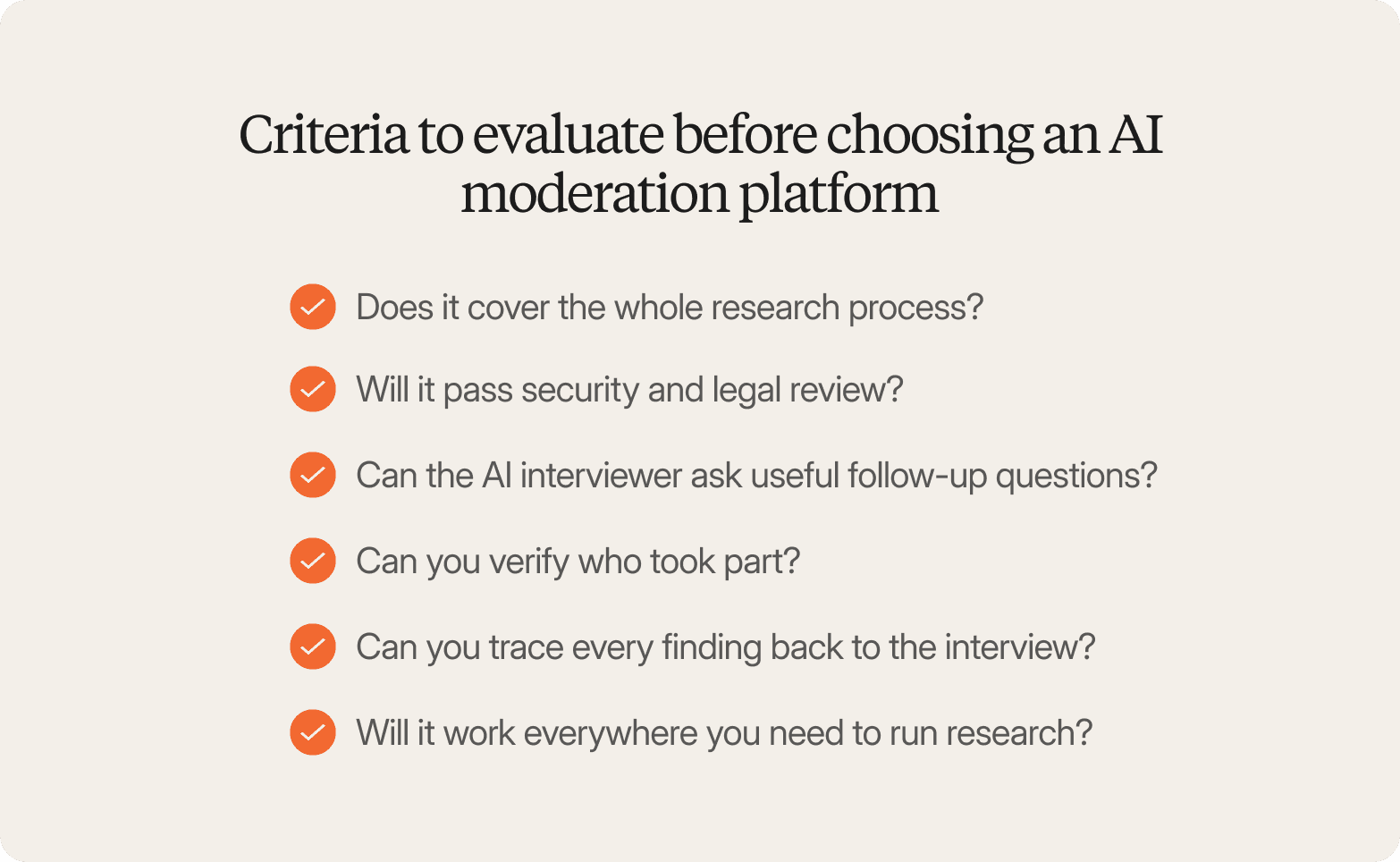
Ask these questions during the buying process to avoid surprises when you’re in the thick of a research project.
1. Does it cover the whole research process?
Watch out for platforms where steps like recruiting participants, analyzing responses, or building reports need a separate tool bolted on afterward. Every handoff between tools is a place where information can go missing. Studies also become harder to revisit later, since the pieces sit across separate logins instead of one system.
2. Will it pass security and legal review?
SOC 2 certification, GDPR compliance, and regional data hosting are common requirements for enterprise research software. Without them confirmed up front, a platform can meet every other evaluation criterion and still be blocked during legal review before it scales beyond a pilot research question.
3. Can the AI interviewer ask useful follow-up questions?
A participant's first answer is rarely the most useful one. "I don't love the new checkout flow" doesn't say much on its own. Asking "Which part didn't work, and what did you expect instead?" will yield higher-quality responses. A moderated session with adaptive probing asks that second interview question in the moment. One without it just carries on with the interview script instead, so the reasoning behind a behavior goes uncollected and has to be chased down in a follow-up study.
4. Can you verify who took part?
Some platforms use synthetic participants or personas created with artificial intelligence instead of real people. That can be useful for early-stage exploration, but it isn't evidence that holds up under stakeholder scrutiny. A finding without a real conversation and an identifiable participant behind it can't be verified, making it a weaker basis for a product or business decision, regardless of whether the underlying pattern turns out to be accurate.
5. Can you trace every finding back to the interview?
A finding backed by a video clip and the participant's exact words can be checked by anyone who reads it. A finding presented as a summary paragraph can't be checked at all, only trusted or not. When a finding can't be verified, it carries less weight in a decision, no matter how accurate it is.
6. Will it work everywhere you need to run research?
Language support and recruitment reach aren't always the same number. A platform might moderate interviews in 40 languages but only recruit participants in a fraction of those markets. Confirming both figures separately during evaluation avoids a multi-market study stalling on a market the platform can moderate in a participant’s preferred language but can't recruit for.
How Much of the Research Workflow Should Your Platform Cover?
AI moderation is only one part of a research project. The biggest difference between platforms is how much of the workflow they cover from the start to the end of the interviews. Some also handle recruitment, initial analysis, reporting, and storage of research across studies, while others expect those steps to occur in separate tools.
The right choice depends on how your team already runs research and what your research goals are. Use this table to help you pick the right tool category.
| If... | An end-to-end platform is likely to be a better fit | A platform with narrower workflow coverage may be enough |
|---|---|---|
| You run research... | Regularly throughout the year | Occasionally or for specific projects |
| Your current workflow... | Still relies on several platforms for recruitment, interviews, analysis tools, or reporting | Already has established tools you're happy with |
| You need to... | Keep studies, reports, and past findings together in one place | Add AI moderation without changing the rest of your workflow |
| You'll benefit most from... | Less manual work between tools and a single place to manage research | Keeping your existing research stack and adding interview automation |
Conveo covers participant recruitment, AI-moderated interviews, analysis, reporting, and a searchable research library on a single platform, making it well-suited to teams that want to manage the whole research process in one place.
How Conveo Supports Continuous Discovery at Scale
The questions throughout this guide help you identify which recommended AI solutions for user interview moderation best fit how your team runs research. For teams conducting ongoing research across products and markets, Conveo keeps the whole research process, recruitment through reporting, in one platform.
Its compliance credentials, including SOC 2 certification, GDPR compliance, and regional data hosting, help enterprise teams meet common procurement requirements.
Every finding links back to the original interview with a video clip and quote, so stakeholders can review the evidence behind each conclusion rather than relying on a summary alone.
As new studies are completed, they're added to a searchable knowledge library, making it easier to find previous research and build on what your team already knows.
“The pace, responsiveness, and research expertise of the Conveo team, on top of the top AI‑moderated qual platform, have been invaluable to us in scaling brand advertising internationally. “
Matt Harris, Research and Insights lead at Canva
Frequently Asked Questions
What are the best AI-moderated interviews for market research?
The best AI-moderated interviews for market research come from platforms that combine adaptive probing with verified compliance and evidence traceability, not just conversational AI. Top companies for AI interview moderation in 2026 recruit real participants for AI user interviews, tie every finding back to a video clip or verbatim quote, and hold SOC 2 certification, GDPR compliance, and confirmed regional data hosting.
How do AI-moderated user interviews compare to human-moderated interviews?
AI-moderated user interviews ask the same adaptive follow-up questions a skilled human moderator would, but they run in parallel across hundreds of participants instead of one conversation at a time. In Conveo's own research, 83% of participants reported being as open or more open with an AI moderator than with traditional research methods.
What is the ROI of AI-moderated interviews?
Reported outcomes of AI tools for moderating user interviews include delivery in days rather than the four to eight weeks traditional qualitative research takes. Conveo customers report up to 75% lower research spend compared to traditional qualitative research methods. The exact return depends on study volume and how many separate systems a team currently pays for.
Do AI-moderated interviews work for multi-market research?
Yes, when the platform supports enough languages and markets. Multilingual AI moderation lets a team run the same discussion guide across multiple regions simultaneously, rather than commissioning a separate study for each market. Confirm a platform's language coverage and its recruitment footprint before running a multi-market study, since the two don't always match.
Can AI moderation replace human researchers?
No. You can use AI moderation to replace the one-moderator-at-a-time bottleneck in fieldwork, not the researcher's judgment. A person still needs to design the study, interpret findings against business goals, and decide what to act on. AI moderation gives researchers more interviews to work with, not a reason to remove them from the process.

About the author
Alex de Hemptinne
Business Impact Lead
Alex is a Business Impact Lead at Conveo, partnering with enterprise teams to embed AI-led research into their workflows. From the first study to full-scale rollout, she helps customers shift from project-based research to continuous customer intelligence.
Meet Alex on film →Qualitative insights at the speed of your business.
Conveo runs AI-moderated video interviews and structures everything they say.