
TL;DR
AI-moderated research uses artificial intelligence to conduct one-to-one video interviews with real participants, then automatically transcribes, translates, and analyzes the interviews, delivering qualitative insights teams can act on.
It removes the sequencing bottleneck in traditional qual: hundreds of research sessions run in parallel across multiple time zones, and analysis begins as recordings land.
The result is qualitative depth in days, not weeks, without sacrificing rigor, and without adding headcount to the research workflow.
It is not synthetic research: participants are real people on camera, not AI avatars or simulated responses, and every finding traces back to timestamped video.
Conveo is a video-first AI research platform built for teams that need continuous, governance-ready qualitative research at enterprise scale.
Qualitative research is no longer something a team can only afford to run a few times a year. For most of its history, the value of qual came with a tax: weeks of scheduling, sequential moderation, and manual synthesis before anyone saw a finding. That tax is what AI-moderated research removes. It uses artificial intelligence to conduct, transcribe, and analyze real qualitative interviews at scale, so the depth stays intact while the calendar no longer dictates the pace, and human researchers get more research done.
The bottleneck in traditional qual has never been the questions. It is the sequencing: one moderator, one session, one transcript at a time. That model caps the number of studies a team can run in a quarter, no matter how skilled the researchers are. AI-moderated interviews break the constraint by running asynchronously and in parallel, with data collection, transcription, translation, and thematic analysis beginning as recordings land.
By 2026, AI-moderated research has moved from experimental to enterprise-standard for teams that need continuous customer understanding. Conveo, a video-first AI research platform, sits at the center of that shift: real participants on camera, findings that trace back to their sources, and built-in compliance from the first study. The technology behind it is enabling research that used to take a quarter to run every week.
What Is AI-Moderated Research?
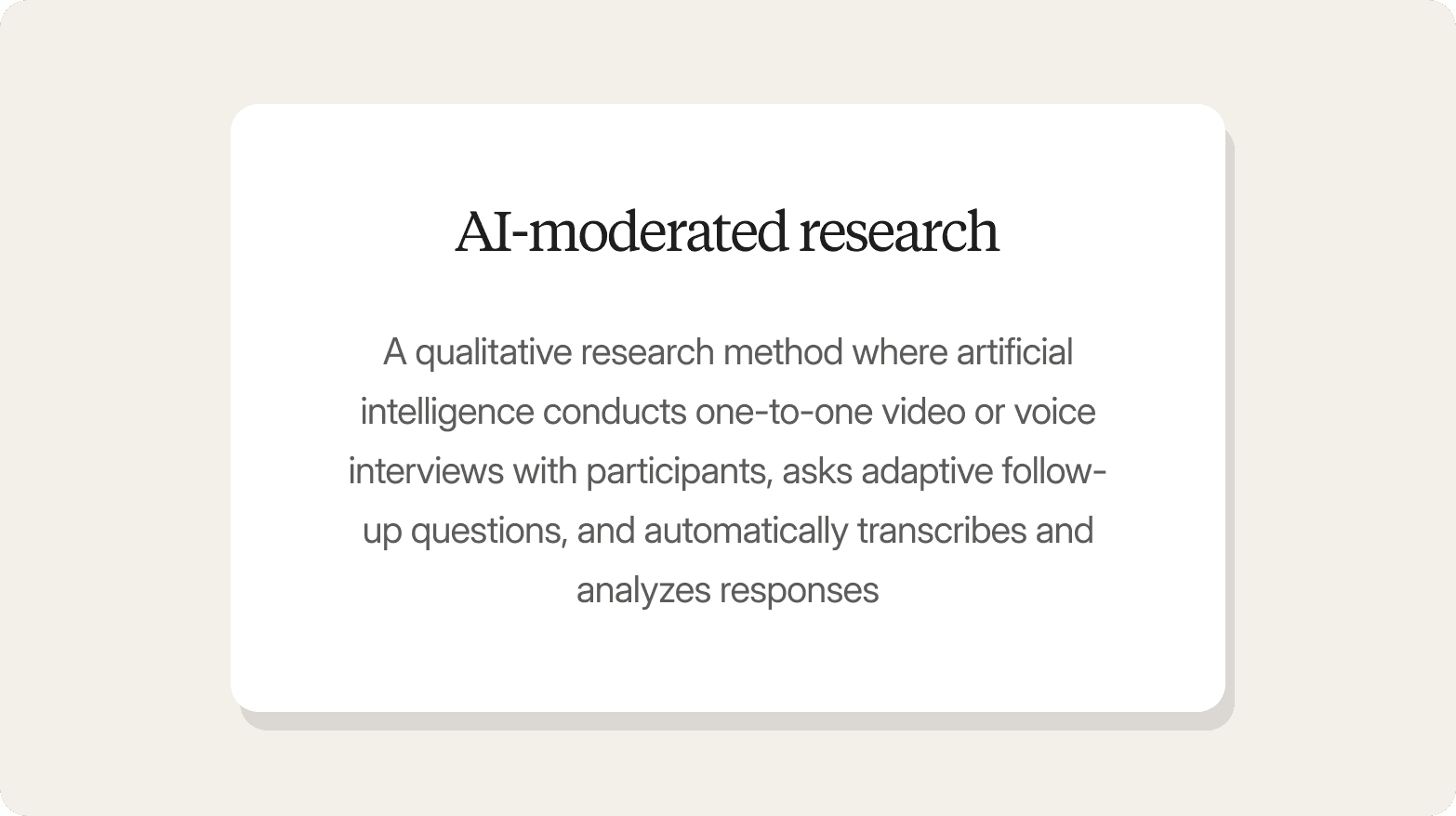
AI-moderated research is a qualitative research method where artificial intelligence conducts one-to-one video or voice interviews with participants, asks adaptive follow-up questions, and automatically transcribes and analyzes responses. It enables teams to run hundreds of research sessions in parallel rather than sequentially.
Traditional interview moderation works one conversation at a time. A human moderator schedules a session, runs it, and moves to the next. At scale, that breaks down fast: recruiting, coordinating, and moderating 200 interviews can take anywhere from 3 days to 6 weeks, depending on the method. AI-moderated research removes the sequencing constraint. Interviews run asynchronously across multiple time zones, so hundreds of participants complete their sessions on their own time while the platform processes every recording in parallel.
What makes this more than a scheduling fix is adaptive probing. The AI system does not follow a rigid script. When a participant hesitates before answering a pricing question, it notices and asks for more detail. When someone uses an unexpected word to describe a product, it prompts a question about what they mean, often surfacing insights a fixed question would never reach. That responsiveness surfaces the "why" that surveys miss: the context behind the answer, not just the answer itself.
One clarification worth making: AI-moderated research is not synthetic research. Participants are real people, speaking on camera, in their own words. There is no AI avatar, no simulated responses, no text-only chatbots standing in for human voices, and no AI assistant quietly filling gaps behind the scenes. On Conveo, the AI moderates the conversation; a real human always provides it.
How AI-Moderated Research Works
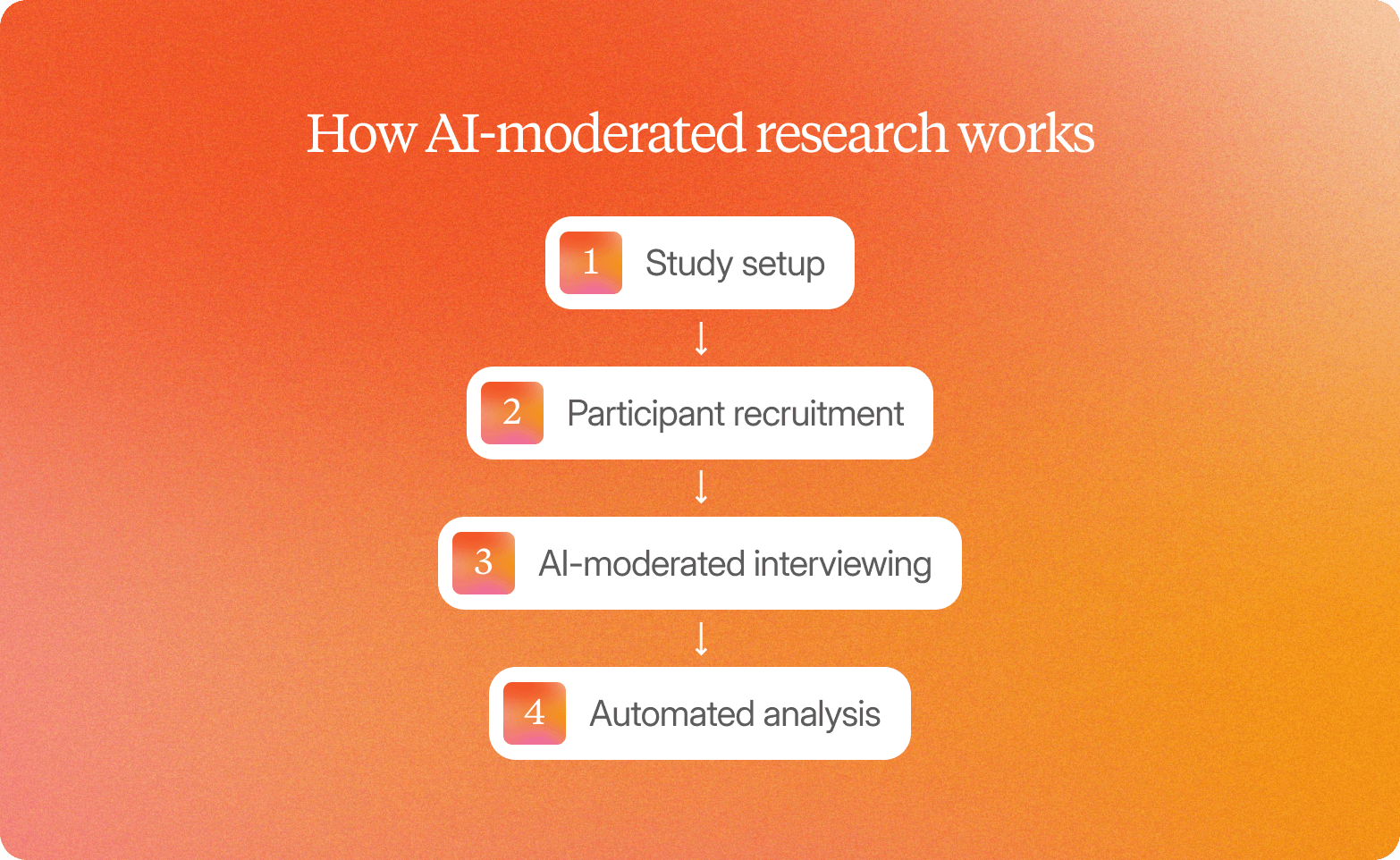
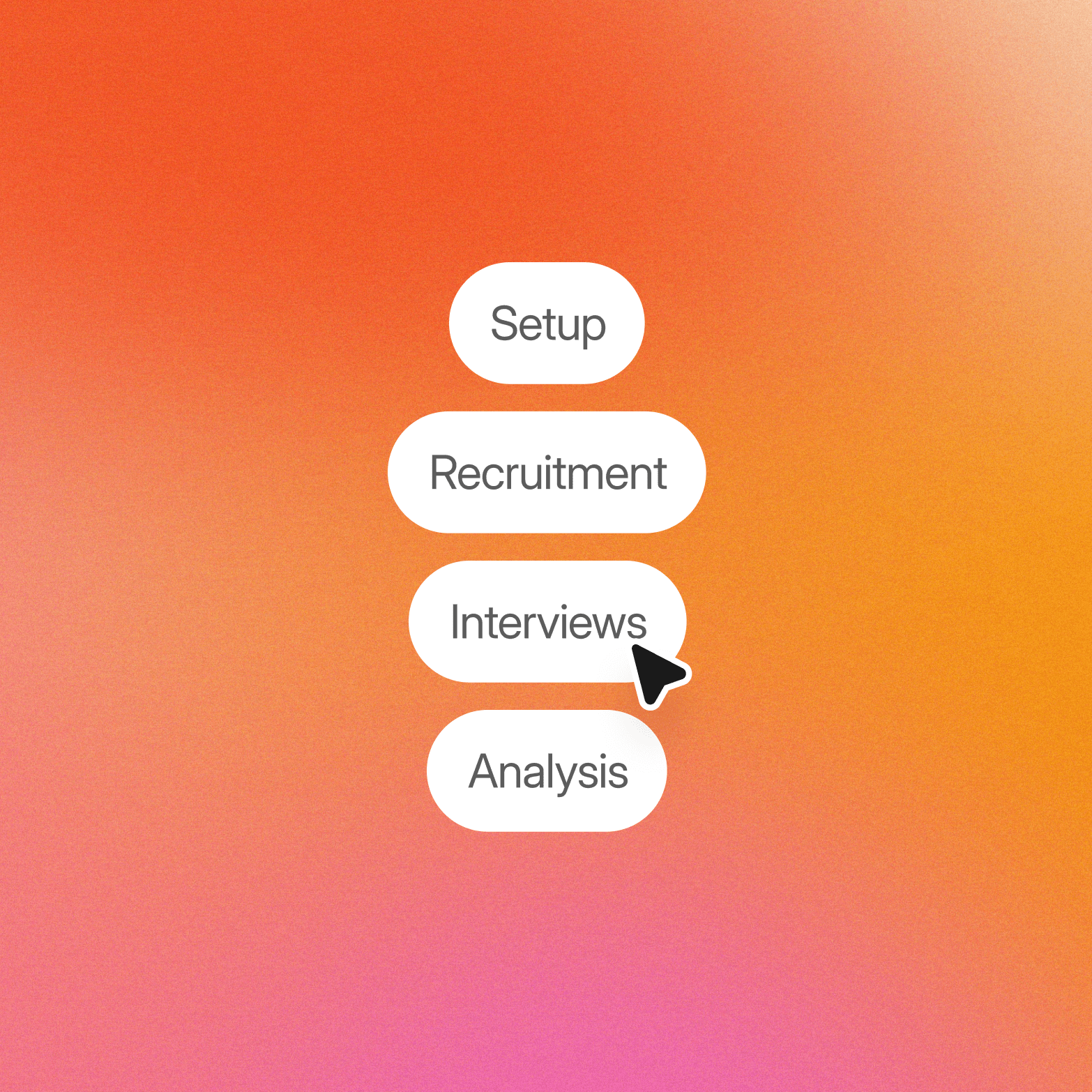
AI-moderated research compresses what traditionally takes weeks into a four-stage workflow that runs in days. Each stage removes a sequential dependency that previously required waiting. Here is how it runs on a platform like Conveo, built for end-to-end execution.
Stage 1: Study setup
Researchers define research goals and objectives, upload a discussion or interview guide, and configure the adaptive probing logic that tells the AI moderator when to follow up and how deeply to probe. Getting clear on the problem space up front is critical: the sharper the research goals, the better the AI system knows which specific questions to press on later. This takes hours, not days. There is no back-and-forth with a recruiter, no project kickoff meeting, and no agency briefing cycle.
Stage 2: Participant recruitment
Once configured, recruitment runs through Conveo's integrated panel network, with partners such as Respondent.io and User Interviews, or through your own participants via CSV, QR code, or WhatsApp. A behavioral screener filters for fit and fraud, and incentive management is handled in the platform. Participants join on their own time, so fieldwork can begin the same day a study launches, regardless of time zones.
Stage 3: AI-moderated interviewing
Each participant receives a link and meets an AI moderator who conducts a real video or voice conversation, not a survey, getting participants to talk in their own words. The AI mirrors language, senses hesitation, and probes based on what each participant actually says. Tone shifts, pauses, body language, and visible reactions are captured alongside spoken responses. Because research sessions run asynchronously, hundreds of conversations happen in parallel across multiple time zones: no scheduling bottleneck, no moderator capacity ceiling, no geographic constraint.
See Conveo's AI-moderation in action:
Stage 4: Automated analysis
As sessions complete, data collection, transcription, and translation begin immediately across 20+ languages. Thematic coding and synthesis run automatically, producing timestamped video clips, verbatim quotes, and thematic summaries researchers can interrogate and share. Every finding traces back to the original video source, which matters when stakeholders want to see the evidence behind the conclusions.
The cumulative effect is a research workflow that no longer depends on sequential handoffs. Every stage runs at the pace of the work, not the calendar.
Why Traditional Qualitative Research Takes So Long
The bottleneck in traditional qualitative research is not any single step. It is that every step runs in sequence, and each one still depends on trained researchers being available at the right moment.
Recruitment takes one to two weeks. Scheduling around the moderator's availability takes another 1 to 2 weeks. Fieldwork runs one interview at a time, adding another one to two. Transcription follows, then analysis and synthesis, the part requiring the most judgment, takes two to three weeks more. The total: 6 weeks to findings under favorable conditions.
That timeline was manageable when business decisions moved at the same pace. They no longer do. Campaign briefs get locked before consumer feedback can inform them. Product roadmaps get prioritized on untested assumptions. Pricing gets set on competitive instinct rather than customer response. By the time the deck arrives, the window it was meant to inform has closed.
AI-moderated research changes the structure, not just the speed: fieldwork runs in parallel across hundreds of participants, and analysis begins as recordings land rather than after transcription completes. The shift from weeks to days is not a marketing claim. It is a change in how the research workflow is built, and it is a big part of what is enabling research teams to answer questions on the timeline the business actually needs.
5 Key Benefits of AI-Moderated Research
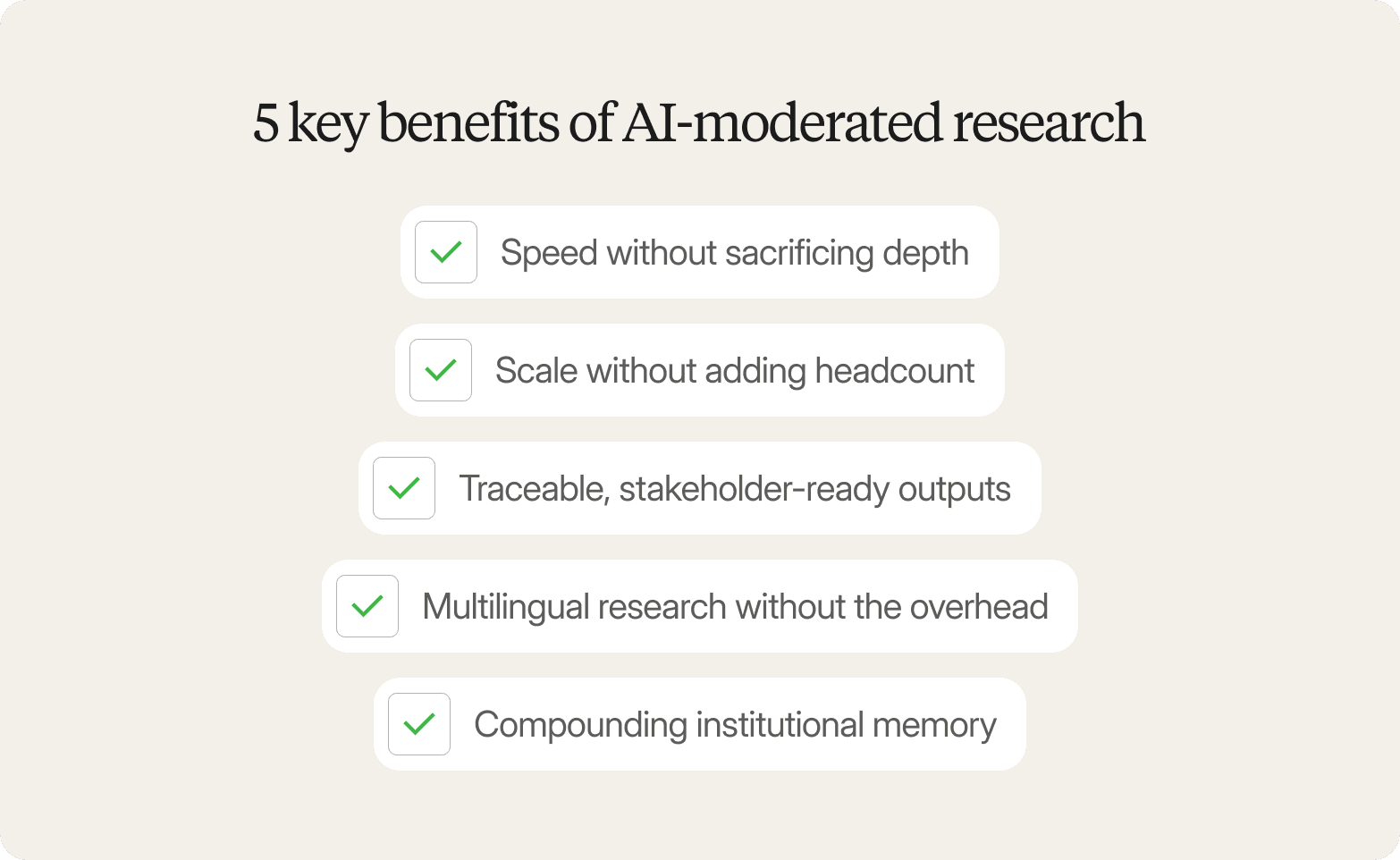
The case for AI-moderated research is not about cutting corners on methodology. It is about removing the operational constraints that force teams to choose between speed and rigor. These five outcomes show what changes when those constraints lift.
Speed without sacrificing depth
Parallel asynchronous interviews deliver concept and messaging findings in days, not weeks. The speed gain does not come from asking fewer questions or accepting shallower responses. It comes from removing scheduling dependencies and manual coordination. Conveo's video-first interviews preserve the signals that matter: tone shifts, visible hesitation, body language, the pause before a participant answers a pricing question. Those signals disappear in surveys. They stay intact here, and they are exactly what a skilled moderator would normally spend a session chasing.
Scale without adding headcount
AI-moderated research makes it possible to run hundreds of conversations in parallel, without adding moderators or expanding agency retainers. A small team of human researchers can run studies across multiple markets and stakeholder groups at once. The organization gets more research. The team does not burn out delivering it.
Traceable, stakeholder-ready outputs
Every finding links back to a timestamped video clip and verbatim quote. Stakeholders do not have to take the researcher's word for a conclusion; they can watch the evidence. Outputs include thematic clusters, sentiment arcs, highlight reels, and structured reports that non-research audiences can act on without a 40-slide briefing.
Multilingual research without the overhead
Automated transcription and translation across 20+ languages remove the cost and scheduling friction of multi-market qualitative programs, with recruitment reaching 50+ markets across multiple time zones. Teams run studies across regions in a single workflow rather than managing a separate vendor for each market.
Compounding institutional memory
Findings do not disappear into decks. On Conveo, every insight, clip, and theme flows into a searchable library that builds across studies over time. When a new question surfaces, teams can query what the organization already knows before commissioning another study from scratch. That compounding value is what separates a research platform from a research project and turns one-off qualitative insights into a durable research workflow.
AI-Moderated Research vs. Traditional Alternatives
Every approach in this category makes a real tradeoff. Understanding where each one creates friction, and where it performs well, is how experienced teams decide which method fits the decision at hand.
Approach | Depth | Timeline | Cost | Scalability | Best Fit |
Traditional agencies | High | 6 to 10 weeks | Tens of thousands per study | Low | High-stakes, board-level studies |
DIY survey platforms | Low to Medium | Days | Low per response | High | Quantitative validation, large-N tracking |
Manual video interview tools | High | Weeks (sequential) | Medium to High | Low | Small-n exploratory research |
AI-moderated research | High | Days, not weeks | Up to 50-80% lower than agencies | High | Continuous qual at enterprise scale |
Traditional agencies deliver genuine depth, courtesy of a skilled moderator and years of human expertise. For high-stakes, board-level studies where human judgment and relationship management are central, agency research remains a strong choice. The tradeoff is timeline and recurring cost: at 6 to 10 weeks per study and significant spend per engagement, agency research is hard to run continuously.
DIY survey platforms move fast and scale well, which suits large-N quantitative validation. The structural limit is depth: surveys collect what customers said, not why they said it, and they cannot pick up on pain points a participant never puts into words. AI-moderated interviews address that gap directly, using adaptive probing to follow up on what participants actually say rather than routing them through fixed options.
Manual video interview tools preserve the richness of real conversation and give trained researchers full control over interview moderation. The constraint is operational: every session needs a moderator, every recording needs data collection and transcription, and synthesis happens sequentially. For 10 or 15 interviews, that is manageable. For 100 interviews across five markets in a week, it becomes the bottleneck that video-first AI moderation is designed to solve.
When to Use AI-Moderated Research (and When Not To)
AI-moderated research performs best when teams need qualitative depth at a pace and scale traditional methods cannot support. The clearest fits: concept testing, ad testing, messaging validation, packaging research, brand tracking, customer satisfaction studies, UX research, generative research, and continuous discovery. Multi-market research is another strong fit: instead of coordinating separate agency engagements per region, teams run parallel interview waves across 50+ markets and multiple time zones from a single study setup.
For UX research specifically, adaptive probing is well-suited to early-stage generative research: understanding the problem space, mapping different user types, and surfacing pain points before a solution is even designed, then narrowing toward specific questions as a concept firms up.
The common thread is a recurring need for real consumer conversations, paired with decision timelines agency research cannot meet.
Where it is not the right fit
Some contexts require capabilities AI moderation is not designed to replicate. Highly sensitive topics involving trauma, grief, or abuse call for human connection, human touch, and clinical judgment. Physical product testing that depends on tactile feedback or shelf findability requires in-person observation. Deep ethnographic work, where contextual immersion over days or weeks is the methodology, remains human-led.
One-time, ad hoc projects with no recurring learning ambition are also a poor fit. The platform's value compounds across studies; a single isolated project does not capture that return.
These are context-dependent tradeoffs experienced researchers weigh against their study design. AI-moderated research augments researcher capacity. It does not replace human judgment or human expertise where that judgment is the method.
Trust and Governance in AI-Moderated Research
Stakeholders distrust findings they cannot inspect or trace back to real conversations, and that distrust is not irrational. For enterprise buyers, the question is not whether AI-moderated research produces interesting outputs. It is whether those outputs survive scrutiny from legal, procurement, and a CMO who wants to know exactly which participant said what and where the data lives. This is where Conveo leads, before speed enters the conversation.
Governance starts with infrastructure. Conveo is a SOC 2 certified, GDPR-compliant video-first AI research platform with regional data hosting in the EU, encryption at rest, SSO, and consent flows built into every study's data collection process. For procurement teams, these are not footnotes. They are the criteria that quietly eliminate most of the AI research market before a demo is booked, a compliance gap many competitors have not closed.
Participant authenticity is the second layer. Conveo conducts real video interviews with real people, never an AI avatar or synthetic stand-in. Every session is recorded on camera, so stakeholders can watch an expression shift, read body language when a price point lands the wrong way, or hear hesitation before a sensitive answer. There are no avatars, no synthetic responses, no simulated panels. The video record is the proof.
Traceability closes the loop. Every theme, every AI-generated summary, and every insight card links back to timestamped video clips and verbatim quotes. Stakeholders do not take findings on faith. They follow the evidence from conclusion to source in a few clicks.
How to Evaluate AI-Moderated Research Platforms
Most platforms in this category make similar marketing claims: adaptive probing, multilingual support, enterprise-grade security, fraud prevention. The six questions below cut through that surface parity and expose what each platform actually delivers. Conveo is built to answer all six without hedging.
1. Can every insight be traced to timestamped video clips and verbatim quotes?
This is the credibility test. An AI-generated theme that cannot be linked to a specific participant, moment, and statement is not a finding; it is a summary. Ask vendors to show the chain from output back to source. If it involves multiple exports or manual steps, that traceability does not exist in practice.
2. Are participants real humans in video-first interviews, or an AI avatar and synthetic stand-in?
The market is splitting on this. Synthetic respondent platforms generate responses at scale, but those responses reflect training data rather than real customer behavior. Enterprise stakeholders increasingly require video evidence of authenticity as a baseline for trust. Ask directly: where do participants come from, and can you see them?
3. How does the AI system decide when to probe deeper, and can researchers review that logic?
Adaptive probing quality varies widely. Some platforms use pre-built branching trees; others interpret responses in real time and follow genuine uncertainty or contradiction, pressing for more detail exactly where it matters. Ask to see a live example with an ambiguous or evasive response, and confirm whether researchers can review and adjust probing behavior.
4. Is the platform SOC 2 certified, GDPR compliant, and does it offer regional data hosting for EU buyers?
Compliance is a procurement gate, not a feature. Teams in regulated industries or European markets cannot proceed without confirmed certifications. Ask for documentation, not just a yes. Regional data hosting is a separate question from GDPR compliance and is relevant to data residency.
5. How accurate is transcription and translation across languages, and can researchers review and correct?
Multilingual claims are common; accuracy at scale is less so. Ask which languages are natively supported versus machine-translated, what quality assurance is in place for non-English sessions, and whether researchers can flag and correct errors before analysis runs.
6. How does the platform filter low-quality participants and prevent fraudulent responses?
Panel fraud is a known problem in online research. Ask what signals the platform uses to flag suspicious behavior, whether detection runs in real time or post-session, and what happens to flagged responses in the final analysis.
3 Real-World Applications of AI-Moderated Research
The scenarios below are representative examples of how teams apply AI-moderated research, not results from named Conveo customers. Three patterns show where new tools and a new research workflow consistently change business outcomes, not just timelines.
Concept testing at scale, without the wait
In a representative scenario, a CPG brand needs to validate three packaging concepts across five markets before a production deadline. Traditional agency research would run 6 weeks to 3 days. With AI-moderated research, the team completes 150 video interviews across all five markets and multiple time zones in days, not weeks, and the validated concept goes to production on schedule. The alternative was guessing.
Catching messaging problems before launch
A financial services company preparing two ad campaigns tests both campaigns with 200 participants each. Conventional channels would have needed four to six weeks, well past the creative revision window. With AI-moderated interviews, findings arrive in days, not weeks, revealing messaging confusion in one campaign clearly enough to fix before launch, not after.
Continuous discovery without a dedicated researcher
A SaaS product team wants monthly discovery interviews with 50 users across several user types. A traditional model requires a dedicated researcher and recurring agency support the team does not have. With an AI-moderated approach, product managers run studies independently each month, using the same platform for UX research and broader consumer intelligence work. Feature validation happens in the sprint cycle it belongs to, and the team directly expands the research capacity it can own.
Why Teams Choose Conveo for AI-Moderated Research
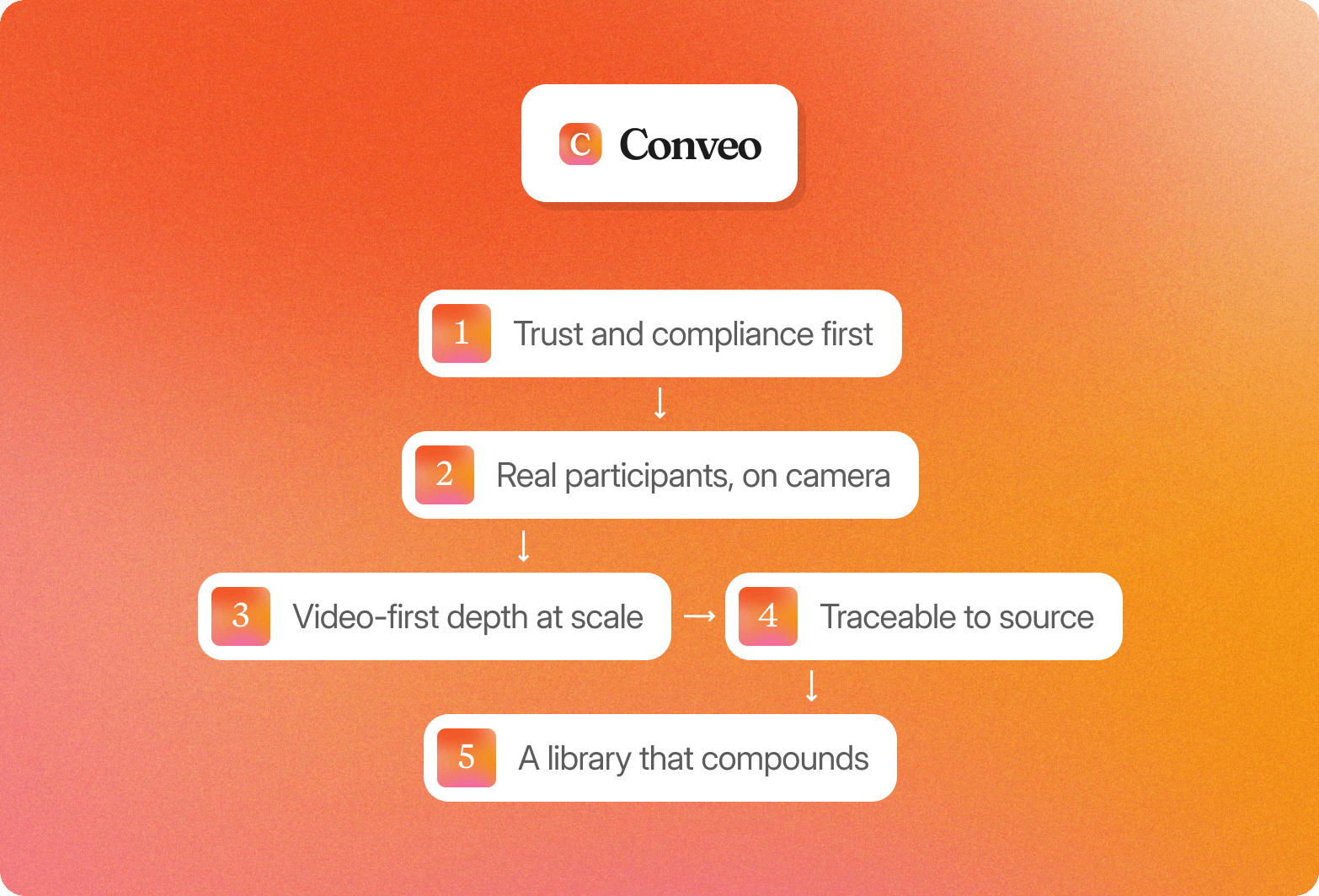
Everything above describes the category. Here is what makes Conveo the platform enterprise research teams standardize on, and why it keeps solving problems new tools in this space have not.
Trust and compliance first. SOC 2 certified, GDPR-compliant, with EU regional data hosting and consent built into every study, the criteria that eliminate most of the market before evaluation begins.
Real participants, on camera. No synthetic respondents and no AI avatar. Recruit through Conveo's integrated panel network or bring your own participants, screened with a behavioral screener that filters for fit and fraud.
Video-first depth at scale. Conveo's AI moderator runs hundreds of conversations in parallel across 20+ languages and multiple time zones, capturing tone, hesitation, body language, and reaction that surveys flatten away.
Traceable to source. Every theme and summary links back to timestamped clips and verbatim quotes, so findings survive scrutiny from legal, procurement, and the C-suite.
A library that compounds. Every study feeds into a searchable insight library, so the organization's knowledge grows rather than expiring in decks.
Frequently Asked Questions
What is AI-moderated research?
How does AI-moderated research differ from surveys?
Is AI-moderated research as credible as human-moderated research?
What are the limitations of AI-moderated research?
How much does AI-moderated research cost compared to traditional research?
Can AI-moderated research handle multilingual studies?