In this article
TL;DR
Most VOC programs have a collection problem and a memory problem. The memory problem is the one that costs decisions.
Findings that aren't cross-referenced against prior waves get re-discovered rather than compounded, so the same signal gets treated as new every time it resurfaces.
Three structural failures account for most breakdowns: siloed findings, synthesis that finishes after the decision ships, and findings that can't be traced back to the person who said them.
A working program needs a named decision, a four-channel mix covering direct and indirect feedback, a four-phase interview methodology, and a single synthesis taxonomy applied across all waves.
Measure utilization, meaning decision influence rate, time-to-stakeholder, and pattern recognition rate, rather than volume metrics like response counts or customer satisfaction scores alone.
Most voice-of-the-customer programs have a collection problem and an architecture problem. The collection problem gets the attention: which channels to monitor, how many customer surveys to run, whether Net Promoter Score captures what brand equity research misses.
The architecture problem is quieter and more damaging. By the time a finding is ready, the decision it was meant to inform has often closed. The same signal resurfaces in a later wave and gets logged as new. The pattern was always there. The infrastructure had no memory of it.
This is not a data shortage. Teams running a mature program typically have more customer feedback data than they can process: survey responses, support transcripts, review mining, social media monitoring, agency studies. The volume of customer data is not the constraint.
What breaks down is what happens to a finding once it exists. Most programs are designed around collection channels and under-designed for everything that comes after. Teams gather feedback at volume with no way to keep it retrievable, so the next study starts from scratch.
The cost shows up in decisions:
A product team tests a usability concern that a brand study surfaced eight months ago.
A CMI team commissions fresh qual to understand a behavior three prior waves already described.
A stakeholder asks why a trend wasn't flagged earlier. It was flagged. The customer insights just weren't connected to anything that would make them visible again.
When VOC infrastructure has cross-study memory, teams move from collecting feedback to building institutional understanding of customers. Questions get sharper because prior findings sit in context rather than in storage, so valuable insights compound rather than expire.
What is a voice of the customer program?
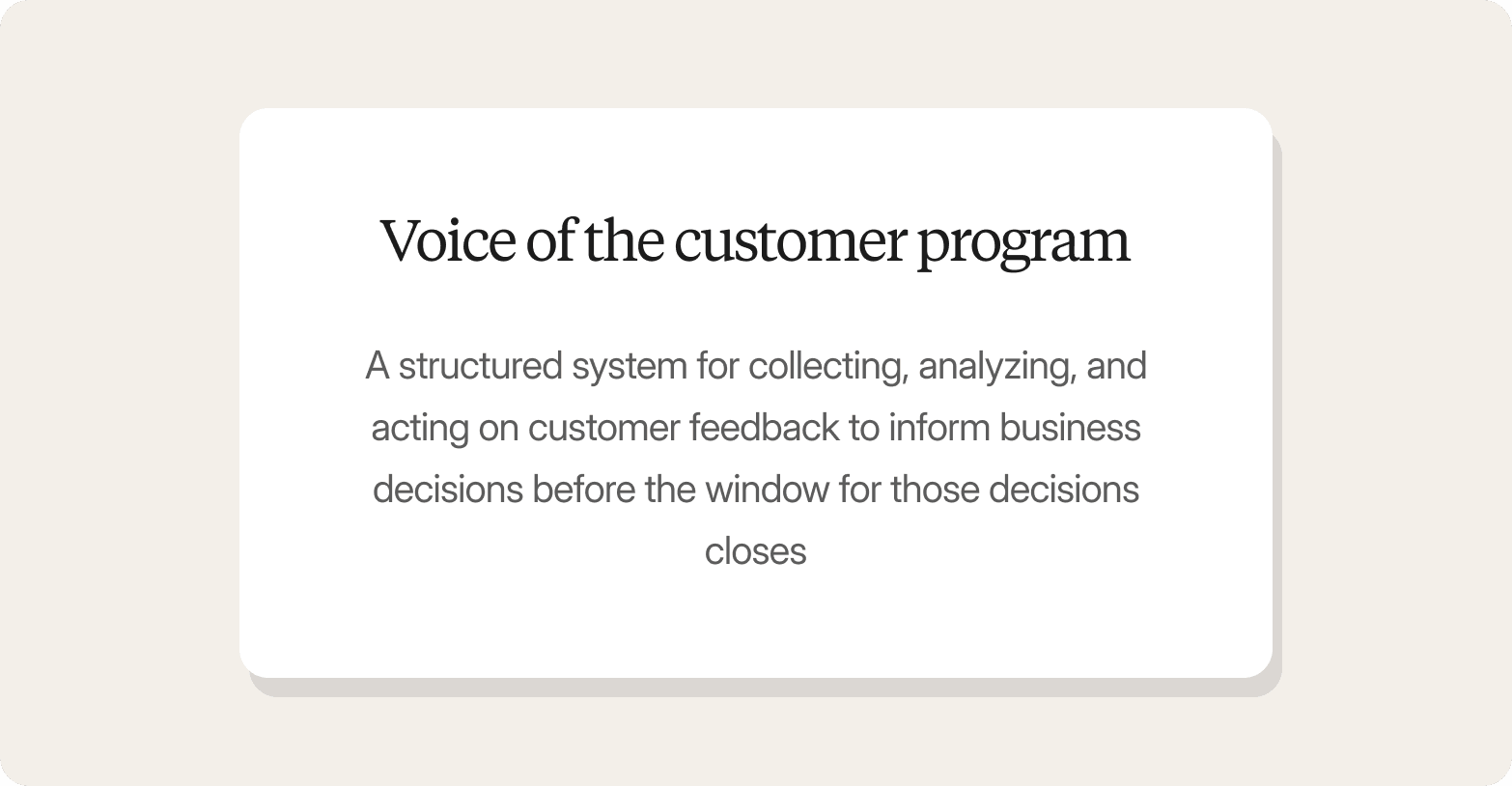
A voice of the customer program is a structured system for collecting, analyzing, and acting on customer feedback to inform business decisions before the window for those decisions closes.
Voice of the customer programs range from passive aggregation of existing signals, pulling from survey responses, customer service interactions, NPS scores, and online reviews, to active primary research that produces new evidence through structured interviews.
Both have a place and answer different questions. Aggregated signals tell you what is happening at scale. Primary research tells you why, in the customer's own words: the first gives you indirect feedback at volume; the second gives you direct feedback with the reasoning attached.
Most programs default toward collection. Teams build dashboards, route feedback to the right inboxes, and report volume metrics. What breaks down is the synthesis. Pattern recognition across channels requires a methodology, not a feed. Without one, a cluster of customers describing the same unmet customer needs in different words across different channels gets missed entirely. The gap becomes obvious the first time someone asks the program to analyze customer feedback across two years of waves, and nobody can answer without starting over.
A well-structured voice of customer program has four components working in sequence:
Collection channels define where evidence comes from, how consistently it arrives, and which stages of the customer journey it covers.
Synthesis methodology determines how raw feedback becomes a finding that holds up to scrutiny.
Stakeholder distribution governs which teams receive which findings, in what format, at what frequency.
Governance cadence sets the rhythm: when findings are reviewed, how they connect to in-flight decisions, and who is accountable for acting on them.
Run in sequence, those four turn scattered customer input into a system that can describe the customer experience as a whole rather than in fragments.
Why voice of the customer programs fail
Most voice-of-the-customer programs don't fail because teams aren't trying hard enough. They fail because the system was never designed to produce continuous, actionable insights. Any successful VOC program solves all three of the following; fixing one leaves the other two intact.
| Failure mode | What it looks like | What it costs |
|---|---|---|
| Siloed findings | Support, marketing, and product each log the same signal in their own system, against their own taxonomy | Patterns spanning the customer journey stay invisible |
| Late synthesis | A month or more from collection to stakeholder-ready output | The decision ships before the research lands |
| No traceability | Themes reach stakeholders without quotes, participant IDs, timestamps, or video | Confidence in the research function erodes study by study |
Findings stay siloed across departments
Feedback arrives through several channels at once: support tickets flag friction, onboarding interviews surface confusion, churn surveys capture regret, and social media monitoring picks up customer sentiment that never reaches a formal report.
Patterns spanning the entire customer journey then stay invisible even when the same issue appears in four places, because no single system holds the full record of customer interactions across them. Connections don't surface until someone goes looking, usually in a quarterly review that's already three decisions late.
Consider a pricing hesitation signal. It shows up in three places at once:
Support tickets log it as a barrier to upgrade, usually filed as customer complaints about billing clarity.
Onboarding interviews surface it as a reason participants disengage mid-session.
Churn surveys list it among the top three exit reasons.
Because each channel logs it independently, nobody recognizes the pattern until the quarterly synthesis lands, by which point the pricing decision has been made. Three channels captured the same customer pain points and none of them connected.
Synthesis arrives after the decision ships
The voice of the customer process runs collection, then handoff to analysis, then synthesis, then a report packaged for stakeholders. Each handoff adds time, and analyzing feedback by hand is the slowest link. That sequence can take a month or more. Most product and campaign decisions don't wait.
So research arrives as a retrospective document rather than a live input, and stakeholders draw the logical conclusion: if findings never arrive in time to influence the outcome, there's little point requesting them next time. Programs rarely get canceled. They get quietly deprioritized until they're running on inertia.
Findings can't be traced back to the moment that produced them
When a theme appears without a verbatim quote, a participant ID, a timestamp, or a video clip, it becomes an assertion stakeholders take on faith. The risk is highest with qualitative feedback, where the evidence is a person's words rather than a number.
The researcher knows where the theme came from. The person reading the deck three weeks later, in a different function, has no way to verify it. Every unsourced finding creates a small trust deficit, and, when accumulated across a program, those deficits erode confidence in the research function itself.
These are system design problems. The teams are capable, and their VOC data is usually sound. The structure they work inside isn't built for the speed, connectivity, or traceability that modern decision-making requires.
How to design a voice of the customer program
Every effective voice-of-the-customer program starts with the same question: which decision does this need to inform?
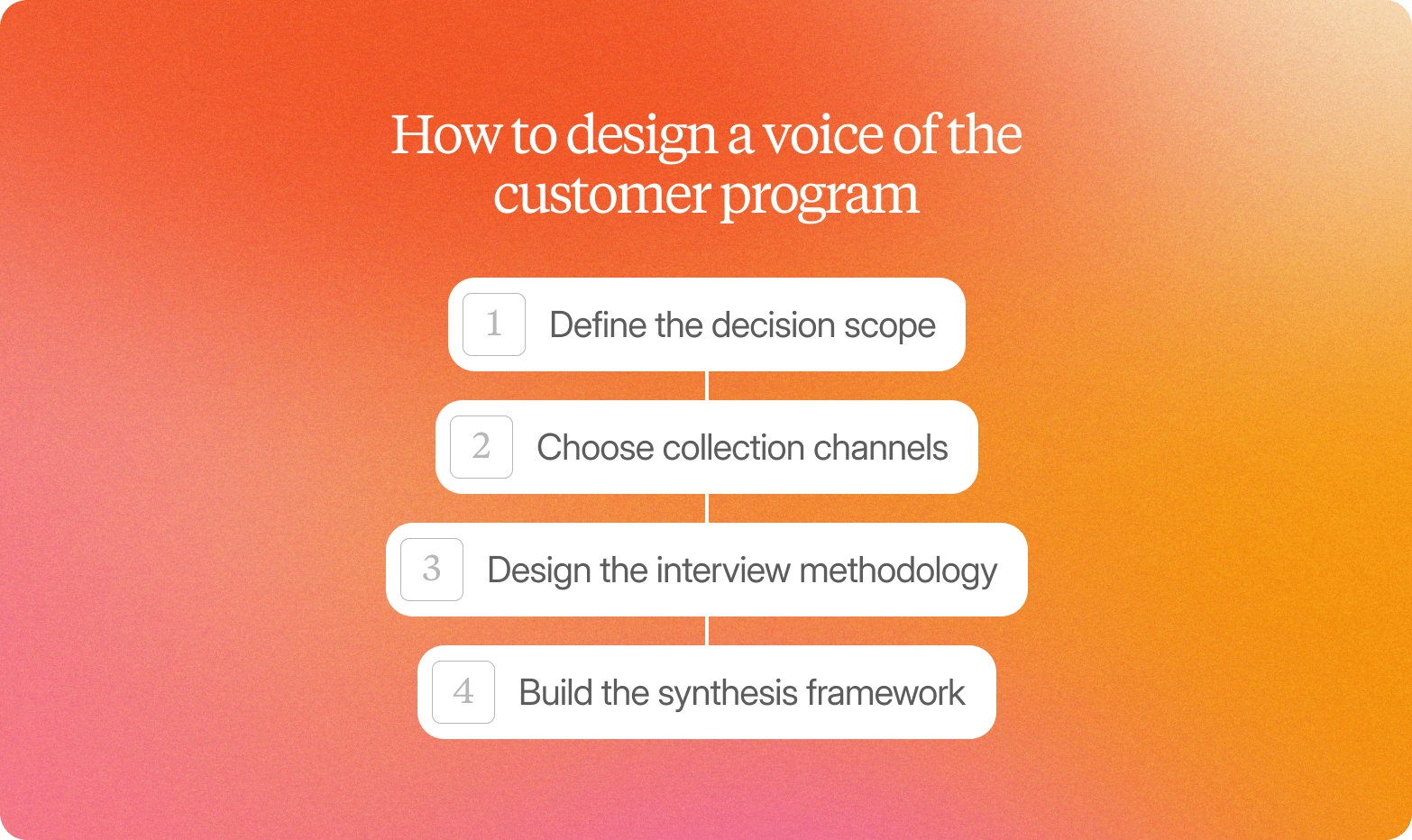
Define the decision scope
Most programs collect more than they need because nobody named a decision first. Name it: not a theme or a research area, but a specific choice with a deadline. "Should we redesign the onboarding flow before Q3 launch?" That sentence eliminates half the questions that would otherwise appear in your discussion guide.
Next, identify the key customer segments that actually hold the answer. The relevant population is defined by the decision, not by the size of your customer base. If the decision is whether to redesign onboarding, the participants who matter are new users who abandoned during setup, not satisfied customers on three-year contracts whose experience says nothing about the breakdown point.
Then design questions that surface the pain points where the experience breaks and what drives customer behavior. Every question should connect to specific business outcomes the decision-maker needs to act on. If you can't draw a line from a question to a business choice, cut it. Programs that collect valuable feedback do it by asking fewer, better-targeted questions.
Choose collection channels
Most voice-of-customer programs draw from four channels. The feedback collection methods you choose determine what evidence the program can produce, and they differ in how customers interact with them: a survey is a prompt, a review is a volunteer act, an interview is a conversation.
| Channel | What it tells you | What it cannot tell you |
|---|---|---|
| Customer surveys | What customers think, at scale, in numbers you can report upward | Anything you did not think to ask |
| Support tickets | Where the experience breaks operationally, and how often | Why someone tolerated it, or what they did next |
| Reviews | The unprompted language people use when something matters enough to write about | How representative that view is |
| Structured interviews | The reasoning, decision drivers, and context behind the behavior | Frequency across the whole customer base |
Customer surveys are bounded by the questions you thought to ask. Most teams automate feedback collection at this layer, triggering feedback forms after a ticket closes or an onboarding milestone is reached. Forms like these capture feedback at scale, though only about moments someone thought to instrument. Quality improves when teams personalize feedback requests to the moment at hand rather than sending a single generic form to the entire list.
Support tickets reveal operational breakdowns, and customer support interactions carry unprompted detail no survey field captures: the workaround someone built, the second question they asked, the tone they used. Feature requests logged in support are usually statements about unmet needs rather than roadmap instructions.
Your customer support team is often first to notice a pattern forming. What customer service teams rarely have is a route to feed it into research, so the same issue keeps getting resolved without reaching a study design or a list of planned service improvements.
Reviews capture what was salient enough to motivate the effort of writing. Customer sentiment expressed without prompting more closely reflects what a person actually believes.
Review volume is usually large enough that teams run sentiment analysis across it, and machine learning models sort thousands of reviews into themes faster than any manual pass. What scoring cannot do is explain why someone felt that way, which is also where negative feedback is most specific.
Structured interviews produce new evidence rather than aggregating what exists. They surface the underlying customer needs, decision drivers, and context no existing data set contains, because nobody has asked those questions in an open-ended, probing format. Focus groups sit adjacent: they generate discussion, though group dynamics flatten the individual reasoning one-to-one interviews preserve.
A program that draws on direct and indirect feedback together can capture customer feedback at scale and still explain it. For more on the interview layer, see AI-moderated interviews.
Design the interview methodology
Structure your VOC interview guide in four phases, in this order:
| Phase | What it does | Example prompt |
|---|---|---|
| Context | Establishes who the participant is and their relationship to the category | "How long have you been using this, and what for?" |
| Experience reconstruction | Recovers the sequence of what actually happened | "Walk me through the last time you tried to do X" |
| Evaluation | Surfaces what worked, what didn't, and the reasoning behind it | "What did you expect would happen at that point?" |
| Implications | Converts experience into direction | "What would need to change for you to keep going?" |
Experience reconstruction generates the sharpest material. Narration produces behavior; rating scales produce opinion. The breakdown point, the moment someone paused, hesitated, or went elsewhere, almost never surfaces in a rating. It surfaces when participants reconstruct the experience aloud, which is where customer behavior separates from customer opinion.
Evaluation is also where customer expectations become explicit, as participants first describe what they assumed would happen before what did. Implications turn a study into a feedback loop rather than a one-way collection exercise.
Within each phase, use a three-layer probing structure: the primary question, a clarifying probe ("Can you say more about that?"), then a push for evidence ("What specifically happened?"). The third layer is where pricing hesitation, unprompted competitor mentions, and contradictions appear.
Static guides fail because they're built around the questions you planned rather than the answers you receive. When a participant hesitates before naming a competitor, a fixed guide moves on. That hesitation is the finding.
Build the synthesis framework
Synthesis breaks down when every study rebuilds its own categories. A theme labeled "price sensitivity" in Q1 becomes "affordability concerns" in Q3, and the apparent shift is a taxonomy artifact. A consistent question taxonomy, applied across every wave of a voice-of-customer framework, is what makes genuine theme movement visible. Without a shared taxonomy, VOC insights across different waves cannot be compared.
The output standard matters as much. Every theme reaching a stakeholder should link to verbatim quotes, participant IDs, timestamps, and video clips. Traceability is what makes customer feedback data defensible: without that chain, findings are assertions; with it, a skeptical CFO can trace any claim back to its source.
Synthesis exists to turn coded findings into actionable insights while the decision is still open. When thematic analysis takes weeks, findings surface after the brief has closed. The research is accurate and no longer actionable, which is why the framework has to be designed around that window.
Voice of the customer program operating model
Two or three researchers cannot maintain an always-on voice-of-customer program when each wave requires a fresh agency brief, a new recruitment cycle, and weeks of coordination before a single participant speaks. The overhead consumes the capacity the program is supposed to free up.
Cadence and governance
The foundation of a robust VOC program is a fixed research rhythm that doesn't depend on a new procurement decision each time. Set waves in advance and assign ownership clearly: who approves the guide, who reviews findings, which stakeholder group receives which output. Researchers then spend their time on interpretation rather than logistics.
Fieldwork and synthesis cadences are separate decisions; conflating them causes programs to lag. Rather than batching findings into a quarterly report, run a biweekly or monthly synthesis pass where new data enters a shared, searchable library and stakeholders are notified when a pattern shifts or a new theme crosses a threshold. The library does the accumulation; the synthesis pass does the sense-making.
Cadence has a participant side too. Most customers expect some acknowledgment when they provide feedback, and collecting continuously without showing what changed trains people to stop responding. Closing the feedback loop, even with a short note on what the research informed, is what makes customers feel heard.
Governance works best as a decision-intake process rather than a research calendar. Stakeholders submit a specific request, such as "validate the pricing strategy before the board review," and the team designs a targeted set of interview questions around it. This prevents the omnibus study trap, where a single wave serves every function and none well.
Stakeholder intake
Vague requests are where voice-of-the-customer programs quietly lose credibility. When a stakeholder asks to "better understand our customers," there's no decision attached, no deadline, and no way to measure whether the research changed anything.
A three-question intake framework filters for stakes before a study gets scoped:
What decision are you making? A named, specific decision: which claim to lead with, whether to extend the product line, how to price the new tier. Not a topic area.
What would you do differently if you knew X? Forces the stakeholder to name the actual fork in the road. If the answer is "nothing, we just want to know," it's curiosity rather than a research need.
When does the decision close? The timeline determines whether a study is worth running at all.
This keeps the program oriented toward decisions with real business outcomes attached rather than becoming a general-purpose curiosity service. It also protects participants' time, since every piece of customer input collected under it has a place to go.
Multi-market and multilingual design
Global voice-of-customer program design runs into a tension most teams underestimate: the question set that works in Germany carries assumptions that don't translate to Brazil. Customer expectations vary by market, and so does willingness to file customer complaints at all. Standardize too aggressively, and you flatten the local signal. Localize too freely, and you lose comparability.
The approach that holds up is a two-layer architecture. A consistent core set covers what every market must answer: category drivers, brand perception, customer preferences, unmet needs. Region-specific probes sit beneath it, added for local competitive context or regulatory differences. The core enables synthesis; the probes preserve the nuance that makes findings actionable in-market.
Conveo's support for 50+ languages means participants are recruited and interviewed in their own language rather than a translated English guide. Analysis maps responses back to the shared taxonomy, so a category driver surfaced in Japan and one in Mexico are comparable at the theme level while the verbatims underneath stay in their original voice.
Voice of the customer program measurement
Most programs measure the wrong thing. Collection metrics dominate: customer surveys sent, response rates, completion counts. These tell you whether the program is running, not whether it's working. A program that generates 500 responses per quarter and influences zero decisions is an archive.
The useful question is utilization: how often do findings reach decision-makers while decisions are still open?
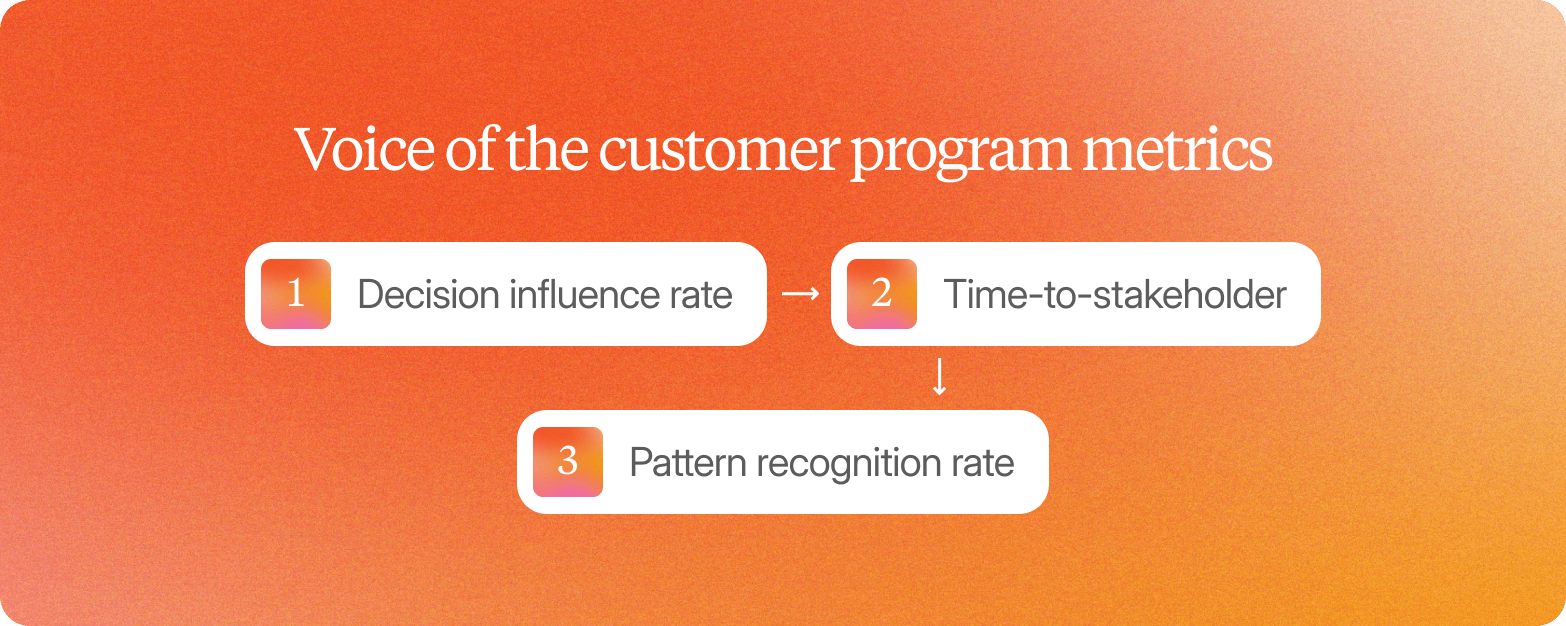
| Metric | What it measures | How to instrument it |
|---|---|---|
| Decision influence rate | Share of findings cited in formal decision documents | Tag findings on entry, then audit product briefs, campaign plans, pricing memos, and stage-gate reviews quarterly |
| Time-to-stakeholder | Days from interview completion to synthesis delivery | Timestamp both ends of every study and track the gap |
| Pattern recognition rate | Share of new findings that connect to themes already in the library | Search the library before synthesis is written, and log the matches |
The decision influence rate is the one most teams skip because it requires looking beyond the research function. A low rate doesn't necessarily mean the research is weak. It often means VOC insights arrive too late, land in the wrong format, or never reach the stakeholders who needed them.
Time-to-stakeholder matters because most decision windows in the voice-of-the-customer process are shorter than most research timelines. Tracking it reveals where the process slows: transcription, thematic coding, report formatting, stakeholder routing. Each bottleneck is addressable once the number is visible.
Pattern recognition rate is the memory test. A mature voice-of-the-customer process accumulates memory across waves, so when a new study surfaces the same pricing anxiety that appeared eight months ago, that connection is evidence that the program is compounding rather than repeating. A low rate suggests either the library isn't being searched before synthesis, or it isn't structured for cross-wave retrieval.
Net Promoter Score, CSAT, and Customer Effort Score appear in most VOC dashboards. They're lagging indicators: they measure how customers felt after an experience, not why, and they can't tell you whether the understanding behind the score reached anyone in time.
A rising customer satisfaction score tells you something improved without telling you what to do next, and a program built to improve customer satisfaction alone keeps optimizing the score rather than the customer experience underneath it.
Further downstream sit the commercial numbers: customer retention, customer loyalty, customer lifetime value. VOC programs influence all three, though the link is indirect and slow, which makes them better annual context than program KPIs. Teams that want to increase customer satisfaction and see it reflected in revenue still need utilization metrics to show the mechanism in between, because no program proves its contribution to business growth from a response-rate dashboard alone.
2 voice of the customer program examples
Two programs, same research, opposite outcomes. The difference is what happens to a finding after the study closes.
Example 1: Broken VOC program
Voice of the customer program examples often look healthy on paper: a regular cadence, a consistent methodology, and solid participant counts. The failure mode lives in how findings are stored and connected after the study closes.
Consider a SaaS company running quarterly onboarding interviews. Each wave surfaces pricing hesitation, participants describing the first billing cycle as confusing. The moderator captures it faithfully. The deck goes to the product team. The deck gets filed.
Next quarter, a new wave runs. Pricing hesitation appears again. Another deck, another filing. By the annual review, the signal has appeared in four consecutive waves across twelve months, and the product team treats it as new.
The research was executed correctly every time. It's a system design problem: when findings are delivered as standalone decks rather than into a shared, searchable knowledge base, recurrence cannot be detected. The program ran. The understanding didn't compound.
Example 2: Connected VOC program
An enterprise insights team runs onboarding interviews in quarterly waves, with 10 to 15 participants each, recruited through an integrated panel network, and each wave completes within days of launch.
In wave three, pricing hesitation surfaces as a recurring theme. Participants describe onboarding positively but hesitate to indicate renewal intent, citing uncertainty about what they're paying for relative to what they use. The pattern is clear enough to flag, but is it new?
It isn't. A shared, searchable library surfaces the same signal from waves one and two, with direct links to the original video clips. The AI research assistant had been configured to probe on value perception in earlier waves, and those moments were coded and stored. What looked like an emerging concern had been present from the start, below the threshold at which anyone acted.
The product team sees the full pattern within days. Three waves of connected, traceable evidence arrive before the roadmap locks, so the pricing decision gets informed by a compounding record of what customers have been saying all along.
Considerations before you start
Give the taxonomy an owner. It only holds up if someone enforces it across teams. Customer data governance belongs in the same remit: who views verbatims, how long recordings are retained, which markets impose stricter rules.
Resolve the standardize-and-localize split before wave one. Retrofitting it means the early waves never become comparable.
Audit downstream decision documents on a real cadence. Utilization metrics only work with that discipline, or they become another dashboard nobody checks.
A VOC program is often called the engine of a customer-centric culture. It earns that only when findings change decisions: an effective VOC program is legible from outside, because someone can name what it informed last quarter.
How Conveo closes the VOC memory gap
A program that names its decisions, runs a disciplined four-channel mix, and applies a single taxonomy across every wave solves both collection and synthesis. What it still needs is the thing Example 2 assumed: memory, so a wave-one finding stays visible when the same signal resurfaces in wave four.
Most voice-of-customer platforms share the same flaw: feedback comes in, gets categorized, and then moves into a deck. The next wave logs the same pricing-hesitation signal as a fresh finding because the prior wave lives in a slide file that nobody opens.
Better tagging doesn't fix this. Findings are stored as artifacts rather than living knowledge, so a new study has no mechanism to surface what was already known. Teams rediscover what they've already learned and present it as new. The customer insights were already in the building.
Conveo's searchable insight library is the capability built to close that gap: a repository where every coded finding is cross-referenced against the full study history, so a new wave's findings land next to everything already known about that signal.
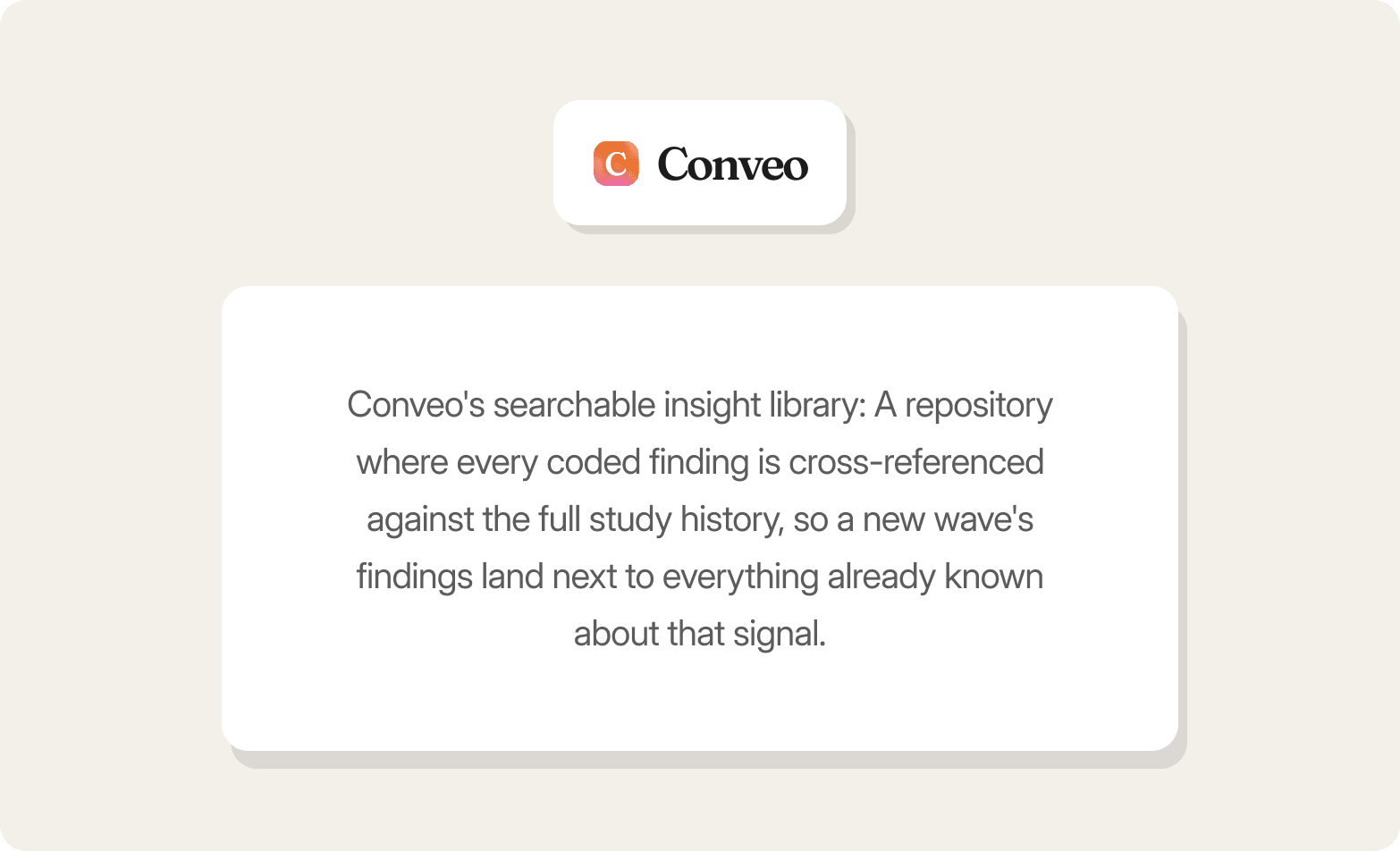
When a new wave surfaces a pricing hesitation signal, Conveo surfaces the same signal from three previous waves, with links to the original video clips, participant IDs, and timestamps. The pattern is visible the moment the finding lands, not months later when someone pulls the right deck.
Watch the walkthrough: How to build a study from scratch
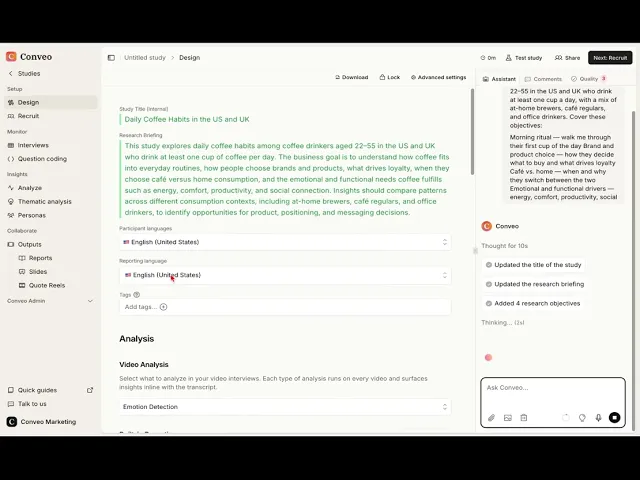
Research teams configure Conveo's AI research assistant to adapt in-session to what each participant says, so a hesitation about pricing doesn't get overlooked because the guide moved on. A rigid script produces a surface response. An adaptive probe produces the kind of coded finding that compounds across waves.
Traceability is what separates this from generic AI summaries. Every finding is auditable back to source video, so stakeholders move from a synthesized theme to the participant moment that produced it, preserving tone, hesitation, and visible emotion that transcripts flatten into neutral text. When leadership questions a finding, the answer is a timestamp and a face.
"Conveo's video-first approach is a real differentiating methodological advantage. The ability to distill insights from reactions, not just hear answers, adds context you simply can't get from transcript-only tools."
Senior Marketing Research & Insights Manager, Top-5 tech giant
Speed is real but secondary. Teams report compressing VOC synthesis from typical multi-week agency cycles to days, so findings reach the decision before the window closes. The durable advantage comes across cycles: each study makes the next one smarter, and the library becomes an organizational asset rather than a collection of expiring decks.
Enterprise teams at Google, Unilever, and AB InBev use Conveo for consumer research. Conveo StoryLines extends the same library into a continuous, wave-based program rather than a series of disconnected studies.
Frequently Asked Questions
What is the difference between a voice of the customer program and a voice of the customer process?
The program is the overall system: channels, governance, cadence, ownership. The process is the sequence a piece of feedback moves through, from collection to stakeholder delivery. A strong program depends on a fast, traceable process.
What is a voice of the customer framework?
The structural model a program follows: which channels feed it, how the interview methodology is phased, and what taxonomy synthesis uses to keep themes comparable across waves.
What are some voice of the customer program examples of failure and success?
A broken program collects consistently but stores findings as disconnected decks, so recurring signals are rediscovered rather than recognized. A connected program routes every finding into a searchable library, cross-referenced against prior waves, so a signal that reappears in wave three is traceable to waves one and two.
How often should a voice-of-the-customer program run?
Quarterly or monthly waves work for most enterprise programs. A continuous, wave-based cadence supports programs tracking shifting patterns over time. Weekly qual cadences are not realistic for producing traceable, well-probed findings.
What is the best way to collect customer feedback for a VOC program?
Use four channels together: customer surveys for quantification, support tickets for issue frequency, reviews for unprompted sentiment, structured interviews for reasoning. The first three give you indirect feedback at scale. Interviews are the only channel producing new evidence, so they carry most of the explanatory weight. Focus groups can supplement them, though group dynamics dilute individual reasoning.
How do you measure whether a voice-of-the-customer program is working?
Track utilization rather than volume: decision influence rate, time-to-stakeholder, and pattern recognition rate. Response counts and completion rates tell you the program is running, not whether it's working.

About the author
Alex de Hemptinne
Head of Customer Success
Alex is a Business Impact Lead at Conveo, partnering with enterprise teams to embed AI-led research into their workflows. From the first study to full-scale rollout, she helps customers shift from project-based research to continuous customer intelligence.
Meet Alex on film →Qualitative insights at the speed of your business.
Conveo runs AI-moderated video interviews and structures everything they say.