In this article
TL;DR
Automotive teams lock briefs, roadmaps, and positioning frameworks before research returns. The evidence gap in the automotive industry comes down to timing: the method holds up, the calendar defeats it.
Interview-based automotive customer intelligence surfaces the hesitation, trade-offs, and switching triggers that sit beyond the reach of surveys, CRM systems, and customer data.
Eight use cases show where traceable participant conversations close the gap: EV hesitation, feature value, persona validation, campaign briefs, automotive customer service diagnostics, conquest triggers, shopper segmentation, and concept testing.
Findings become actionable insights when every theme links back to a verbatim quote and video clip, which is what cross-functional stakeholder buy-in requires.
Teams report structured, data-driven insights in days rather than weeks when the analysis layer is built into the platform instead of commissioned through an agency after fieldwork closes.
Automotive teams making decisions about campaign briefs, feature roadmaps, and positioning frameworks routinely ship those decisions before automotive customer intelligence has had a chance to catch up. Traditional qualitative research cycles run for months through agencies. By the time findings land, the brief is locked, and the research meant to inform smarter decisions instead confirms what the team already chose.
The cost shows up later, across the customer journey. Personas built on workshop assumptions hold up fine in a deck, but break down the moment a stakeholder asks for traceable evidence from real driver conversations. Automotive customer insights gathered weeks after the fact, or customer data pulled from CRM systems after the fact, answer a question the team closed weeks ago.
This piece covers eight use cases in which interview-based automotive consumer intelligence closes the timing gap while preserving the methodological rigor that makes findings credible to stakeholders across the automotive industry.
What automotive customer intelligence means, and where teams get it wrong
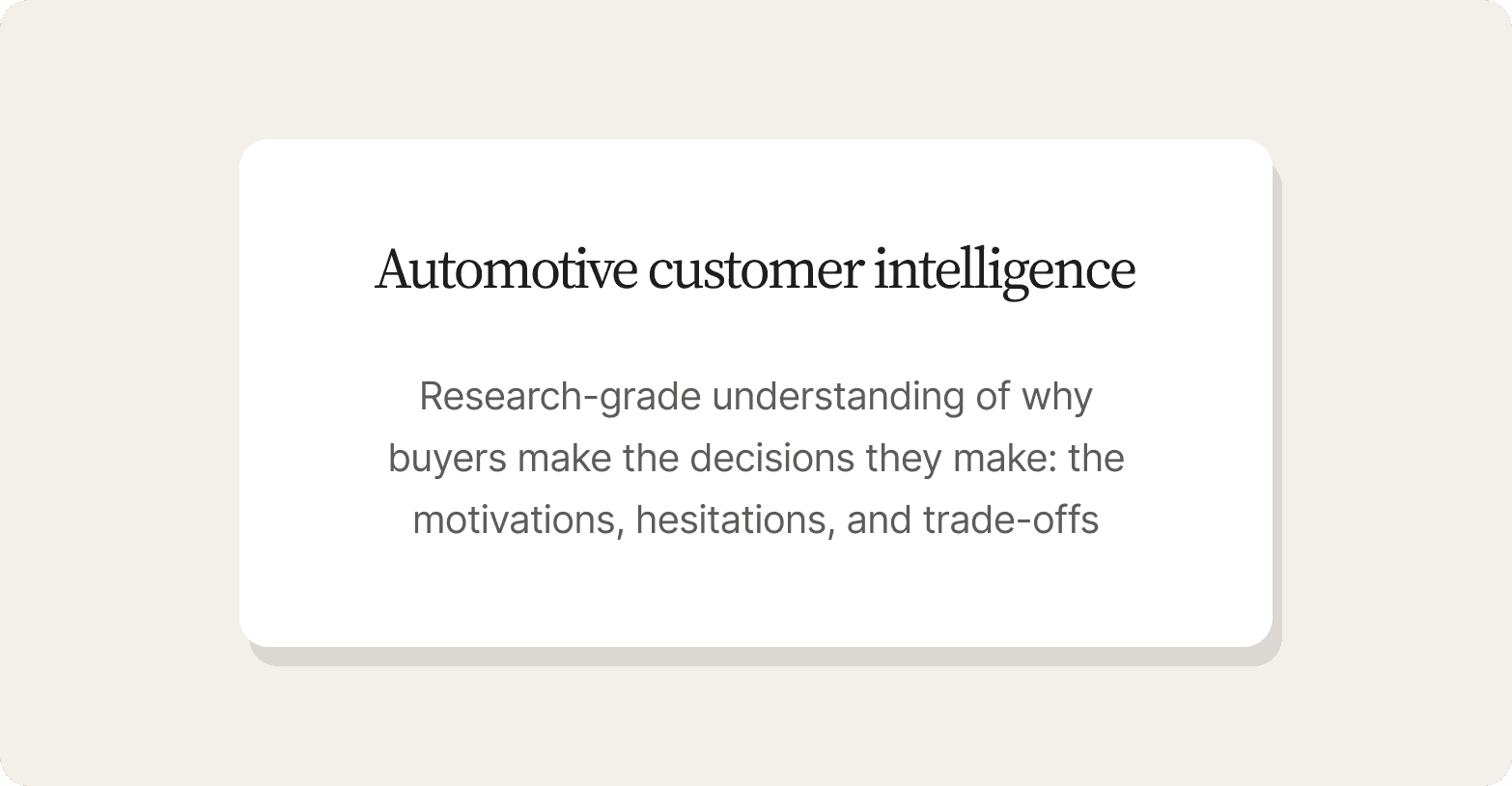
Automotive customer intelligence is research-grade understanding of why buyers make the decisions they make: the motivations, hesitations, and trade-offs behind a vehicle purchase. Demographic profiles and post-sale customer satisfaction scores sit one layer above that reasoning.
The term gets applied loosely across automotive retail and the wider auto industry. CRM systems and CDP intelligence tell you what a buyer did: what they configured, when they visited automotive dealers, which emails they opened. Experience feedback tells you how they felt after the purchase. Conversation intelligence pulled from inbound calls and call recordings at a dealership's call center tells you what objections came up in a sales call. Each of these captures a transactional or behavioral signal, is useful as interaction data, and is bounded in what it can explain. They record the outcome. Automotive customer intelligence explains the reasoning and captures the automotive customer experience the way the buyer actually lived it.
That distinction matters because demographic-only profiles leave purchase triggers and customer preferences unexplained. Knowing a buyer is 38, suburban, and in-market for an SUV leaves open the question of whether they chose one trim over another because of towing capacity, a financing offer, or a conversation with a friend. Automotive buyer intelligence closes that gap by connecting the number to the reasoning behind it, tracing it to a real person who said it, and building comprehensive customer profiles that teams can defend in a room.
Survey-first approaches compound the problem: a rating scale flattens hesitation, and a closed-ended question leaves buried the workaround a buyer invented to justify an uncomfortable price. Interview-based research, conducted on video, captures voice, tone, and the pauses that signal genuine uncertainty around pricing, feature value, or brand credibility. Customer data pulled from various sources and stitched together after the fact records the outcome; the interview records the reasoning.
8 use cases where automotive customer intelligence closes the evidence gap
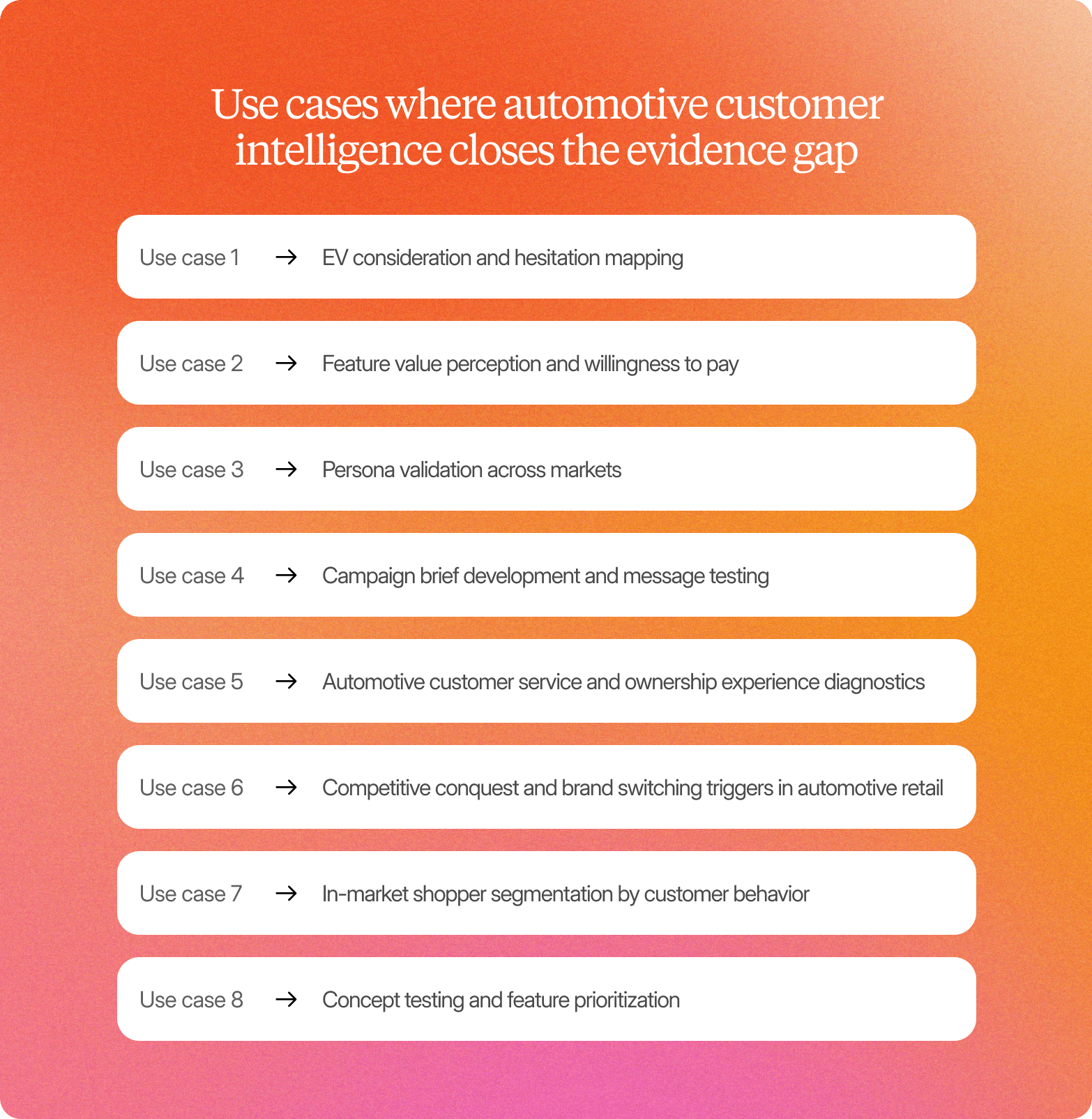
Each use case below names the decision, the gap that stalls it, and how traceable participant conversations turn stalled evidence into informed decisions grounded in real customer needs, in days rather than weeks.
Use case 1: EV consideration and hesitation mapping
The gap: Surveys show strong EV interest and leave unexplained why that interest stalls before a test drive is booked. Automotive customer insights break down when the method stops at a participant's stated preference and leaves the underlying pain points untouched.
The resolution: In a representative scenario, a shopper who answers "yes" to EV consideration reveals under AI-moderated probing that they rent their apartment and can't install a home charger, making the purchase of a new vehicle a non-starter regardless of price or marketing. Conveo's AI moderator probes based on what participants actually say, picking up hesitation patterns around charging access, resale uncertainty, and upfront cost in their own words. The output is traceable: leaders can watch the exact moment a buyer explains why they walked away, rather than reading a summary that flattens the nuance.
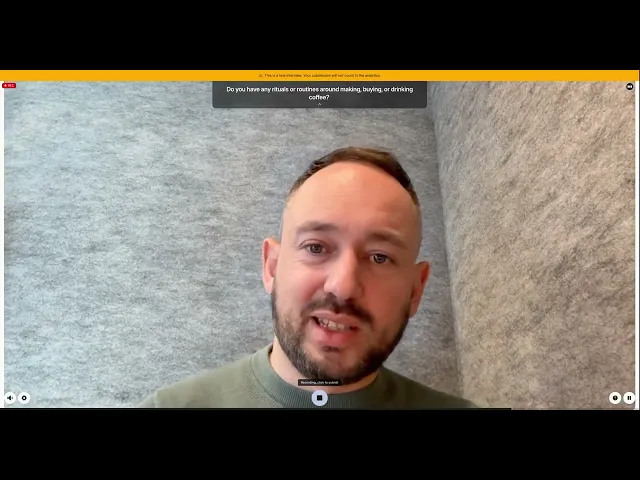
See it in action: How AI-Moderated Video Interviews Actually Work
Use case 2: Feature value perception and willingness to pay
The gap: Conjoint studies rank customer preferences and leave the job a feature is hired to do undefined. One buyer rates adaptive cruise control highly because it cuts fatigue on a long highway commute; another buys the same feature for stop-and-go convenience. Those two mental models produce different willingness-to-pay thresholds, different marketing strategies, and different bets on personalized experiences at the point of sale.
The resolution: Interview-based automotive consumer intelligence surfaces that distinction: participants describe what they compare a feature against, what problem it solves, and where the price ceiling sits, whether the feature is a proven staple or a new technology just reaching the trim lineup. Verbatim quotes tagged with segment, consideration set, and purchase timeline give pricing and product teams actionable insights they can price against.
Use case 3: Persona validation across markets
The gap: Personas age fast. A comprehensive customer profile built during one product cycle can misrepresent the actual buyer by the time a regional campaign goes live, and the standard 12–18 month refresh cadence keeps teams relying on customer behavior data they privately question.
The resolution: Interview-based persona validation studies launch on Conveo without a scheduling call and return structured findings within days. A "tech-forward early adopter" segment may behave nearly identically in the US and Germany while requiring different messaging in Japan, where loyalty dynamics among automotive brands shift how the persona responds to new launches. Studies run across 50+ languages, removing the localization delay that typically adds weeks to cross-regional validation.
Use case 4: Campaign brief development and message testing
The gap: Campaign briefs built on workshop assumptions carry real risk, and it's often a marketing problem before it becomes a research one. A brief positioning a vehicle as "family-safe" can reach production before interviews reveal that buyers actually prioritize weekend-adventure capability, wasting spend on personalized marketing campaigns built on the wrong premise.
The resolution: Asynchronous, AI-moderated interviews remove the scheduling overhead that creates that gap, running in parallel across time zones and compressing evidence collection from weeks to days. Automotive buyer intelligence gathered this way gives brand teams a brief grounded in what drivers actually said before a single asset goes into production.
Use case 5: Automotive customer service and ownership experience diagnostics
The gap: Post-purchase satisfaction scores tell retention teams that a customer is drifting, but leave the reason unstated. Interview-based research surfaces the customer pain points that sit outside the reach of surveys and customer feedback forms: appointment availability, pricing opacity, and the workarounds customers build around automotive customer service they no longer trust.
The resolution: A participant who rates service quality "7/10" may reveal under probing that they avoid the dealership entirely for routine maintenance, the kind of conflicting data that looks fine on a dashboard and wrong in a transcript. Traceable video clips give service teams the exact words and tone that surface when analyzing feedback about a customer's defection trigger.
Use case 6: Competitive conquest and brand switching triggers in automotive retail
The gap: Surveys ask "why did you switch?" and rarely surface the sequence of events: the first dissatisfaction, the alternatives considered, and the interaction that tipped the decision. That's where conquest strategies for automotive brands go wrong, and where competitors quietly stay ahead.
The resolution: Conveo's AI moderator probes the decision timeline, from "open to switching" to "signed." In one scenario, a buyer switched brands over the trade-in offer: a competing dealership's sales managers came in $2,000 higher, while the product itself rated fine either way. That single data point reframes the conquest strategy from product messaging to dealer incentive design. Verbatim quotes tied to participant metadata give automotive consumer intelligence teams evidence of the switching triggers that actually fired, replacing assumed product gaps with documented ones.
Use case 7: In-market shopper segmentation by customer behavior
The gap: Demographic profiles tell you who is in the market. Why one shopper chooses reliability, and another chooses prestige, stays out of view. Automotive customer intelligence built on behavioral criteria closes that gap at the point segments are defined, before fieldwork begins.
The resolution: When segments are anchored to decision-relevant customer behavior, such as how participants weigh resale value against feature innovation, they hold up under scrutiny because every criterion traces to something a real driver said. Two demographically identical segments can split sharply: one prioritizing reliability and resale value, the other prestige and the latest technology, a distinction that makes messaging and offer design decisions immediately visible.
Use case 8: Concept testing and feature prioritization
The gap: Survey-based concept testing ranks features but leaves unanswered why a feature made the list or at what price point enthusiasm dies.
The resolution: In AI-moderated interviews, buyers explain their mental model: what they compare a feature against and where cost reconsideration begins. Features rated "highly desirable" in surveys regularly surface in interviews as nice-to-haves that buyers will pass on at a premium, offering deeper insights than a ranked list and reshaping pricing strategy before it locks in. Conveo links every theme back to the original clip and quote, so a challenged prioritization claim is one click from evidence.
How to evaluate automotive customer intelligence platforms: 6 criteria that separate research-grade platforms from CRM add-ons
Most platforms labeled "automotive customer intelligence" are AI-powered tools bolted onto CRM systems: they track transactions and flag churn using customer data, while the reasoning behind a trim switch or a drop in EV consideration rate remains out of reach. The category confusion is real across automotive companies, and stakeholder reviews stall when a claim rests on something other than a verbatim quote or timestamped clip.
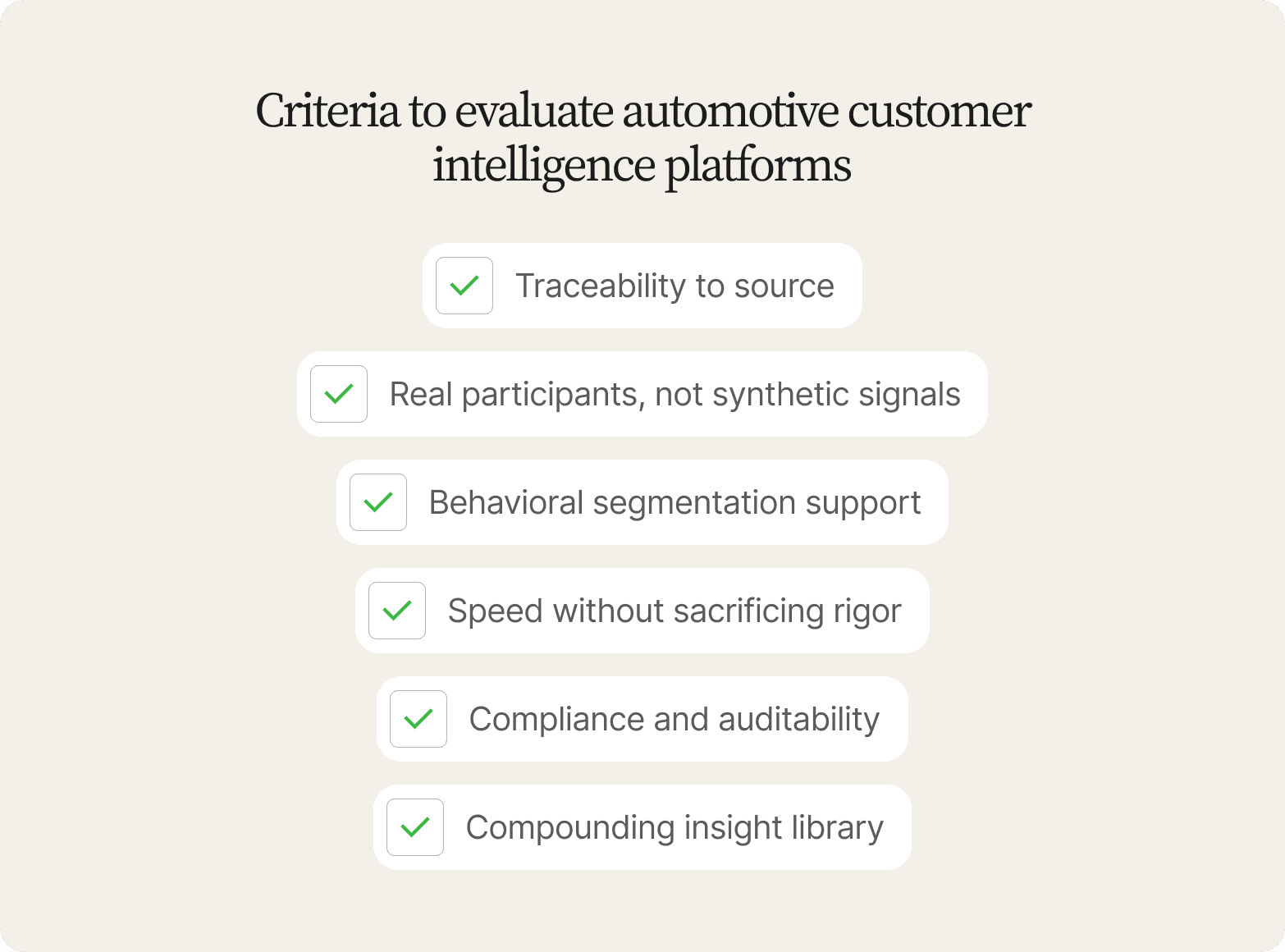
Six criteria separate research-grade capability from CRM add-on functionality:
Traceability to source. Does every theme link back to the original clip and quote, or stop at an aggregated summary?
Real participants. Are outputs grounded in actual conversations, or in modeled data that introduces governance risk?
Behavioral segmentation support. Can teams define behavioral segment criteria before recruiting, or is filtering limited to demographics?
Speed without sacrificing rigor. Does the platform return structured, data-driven insights within days, or does it require weeks of manual synthesis?
Compliance and auditability. Does the platform include the credentials procurement requests, including SOC 2 Type II certification, GDPR compliance, and EU hosting?
Compounding insight library. Are past automotive customer conversations searchable and reusable, or does each study restart from zero?
Why traditional research cycles in the automotive industry miss mid-funnel decision windows
Campaign brief development, feature prioritization, and in-market shopper segmentation for conquest campaigns all have internal deadlines that close weeks before a traditional agency study would return. When research arrives late, teams default to workshop assumptions, demographic-only profiles, or survey-first approaches that flatten hesitation and contradiction, and struggle to identify what's actually driving them. Those gaps compound into positioning that misses the decision moment, customer experiences the team never sees, and market trends read wrong by the time they're acted on.
"Within days we had insights that would've taken a traditional agency a month"
Head of Customer Insights, JDE Peet's
Running interview-based persona studies at the start of a decision cycle, rather than after a brief is drafted, yields structured findings while the decision is still open. That is what turns compressed timelines into better decisions instead of merely quicker ones.
Considerations: Where automotive customer intelligence fits real customer needs
This approach is built for decisions that need traceable, why-level evidence: campaign briefs, persona validation, pricing and feature prioritization, segmentation, and conquest strategy. Teams that need directional sentiment tracking at scale, with no requirement to trace a finding back to an individual participant, or decisions that call for a large-sample statistical read, are better served by quantitative methods.
Automotive customer intelligence built on traceable, researcher-grade evidence
Automotive customer intelligence has always forced a trade-off: move fast enough to influence a decision and sacrifice credibility, or go deep enough to satisfy stakeholders and miss the window. Conveo is built by researchers as infrastructure for always-on customer understanding, and Conveo StoryLines runs this kind of evidence-gathering as an ongoing, wave-based program rather than a one-off study.
Three mechanisms make this possible:
Traceability. Every theme and sentiment pattern links back to the original clip and a verbatim quote, turning findings into auditable, valuable insights that hold up as evidence in a stakeholder review.
Multimodal signal capture. Conveo's AI moderator, built on artificial intelligence tuned to probe rather than follow a script, captures voice, video, and tone, picking up the hesitation or skepticism that transcripts flatten, and building a deep understanding of what participants actually meant.
A compounding insight library. Every study flows into Conveo's searchable insight library, so past automotive customer conversations remain reusable across briefs and stay available beyond the slide deck, enabling teams to engage customers with confidence rather than restarting research each quarter.
Interviews run asynchronously, with 10 to 1,000 conversations running in parallel across time zones without a scheduling call. This compresses the timeline while preserving rigor and lets teams analyze data from meaningful conversations at a scale that surveys alone can't reach, as the future of automotive decision-making gets harder to call on instinct.
Frequently Asked Questions
What is automotive customer intelligence, and how does it differ from CRM data?
Automotive customer intelligence is research-grade understanding of why buyers make decisions, grounded in real conversations. CRM systems capture what a buyer did: configurations, dealership visits, email opens. Automotive customer intelligence captures the reasoning behind those actions, including the hesitations and switching triggers that stay invisible in behavioral data.
How long does it take to run an automotive customer intelligence study?
Teams report going from study launch to structured findings in days rather than weeks. Asynchronous AI-moderated interviews remove scheduling overhead and run in parallel across time zones, so evidence arrives while the decision is still open and before the brief is locked, giving automotive retailers and OEMs alike time to act.
Can AI-moderated interviews deliver the same depth as human-moderated sessions?
AI-moderated interviews capture voice, tone, and video, surfacing the hesitation and emotional signals that transcripts and surveys flatten. Conveo's AI moderator probes based on what participants actually say rather than following a rigid script, and every finding links back to the original clip, so depth stays traceable and auditable.
How does Conveo handle multi-market automotive research?
Studies run across 50+ languages, removing the localization delay that typically adds weeks to cross-regional validation. Findings from different markets flow into the same searchable insight library, enabling comparisons of customer behavior across regions before creative production begins.
What compliance credentials does Conveo carry for automotive and OEM procurement reviews?
Conveo is SOC 2 Type II certified, GDPR compliant, EU hosting (Belgium), with SSO and on-demand PII deletion. These credentials matter most for OEMs and Tier 1 suppliers with European operations, where data residency requirements can stall a platform evaluation.

About the author
Meg Gerli
Research Impact Lead
Meg is a Research Impact Lead at Conveo, working with insights and research teams on the studies they run with Conveo.
Meet Meg on film →Qualitative insights at the speed of your business.
Conveo runs AI-moderated video interviews and structures everything they say.