In this article
TL;DR
Build a testable brand messaging framework from participant language in every field, and connect each claim to a timestamped clip and a verbatim quote.
Pressure-test the brand messaging framework's positioning statement, value proposition, and audience variations with your target audience before rollout.
A brand strategy built on untested messaging is an expensive failure, because the correction arrives after the budget is spent.
Most brand messaging frameworks serve internal alignment across the organization, so no claim inside them can be proven wrong.
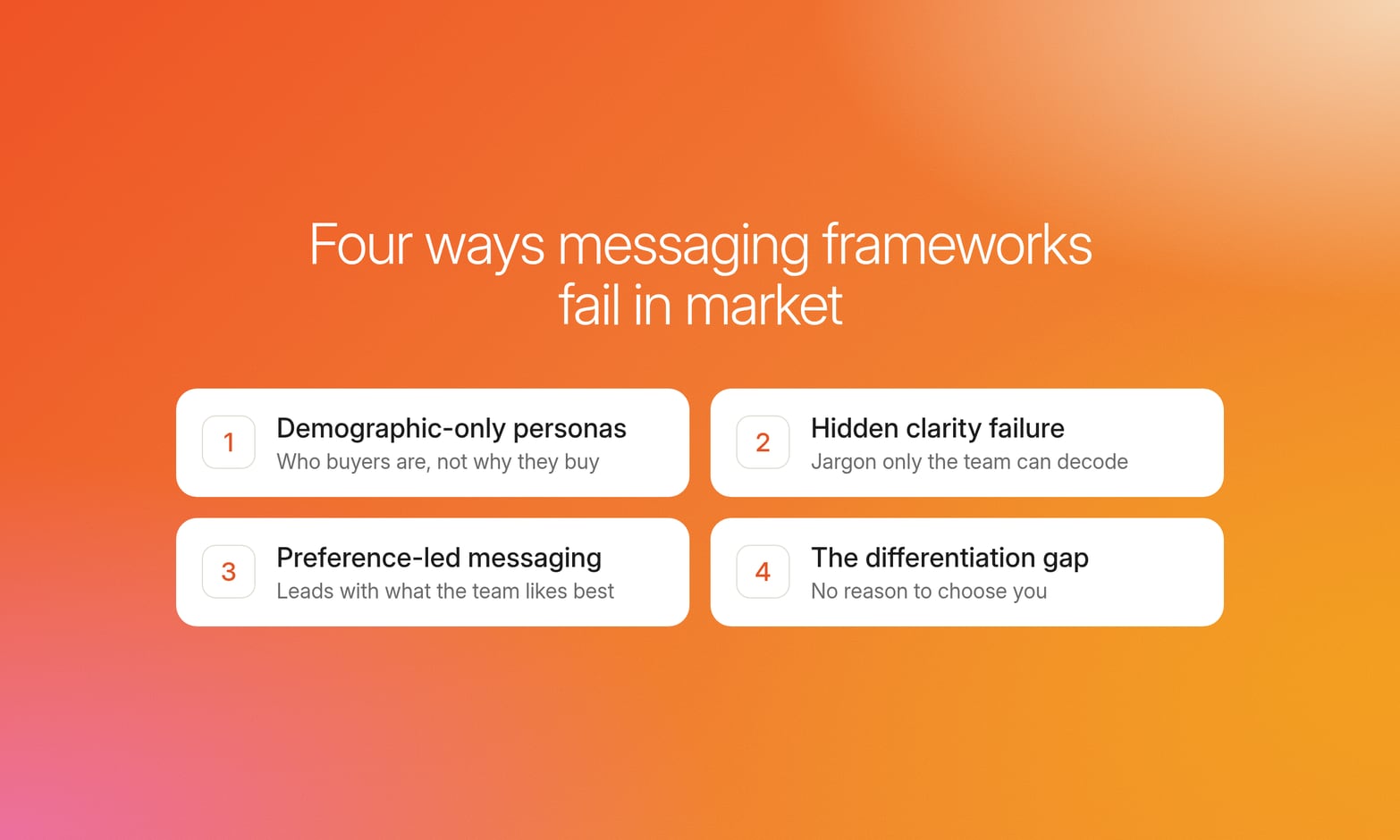
Four failure modes recur in brand messaging frameworks: demographic-only personas, hidden clarity failures, preference-led messaging, and the differentiation gap.
Revisit the brand messaging framework every six months under a named owner.
Introduction
A messaging decision closes, the framework goes live, and campaigns ship across all channels before a single claim has met a real buyer. The insight that would have changed the wording arrives after the spend is committed.
The lag starts in a room. A brand messaging framework built in an internal workshop tends to collapse when an executive or new employee asks where a claim came from and no participant quote or recording exists. Frameworks written for internal consensus contain claims nobody can falsify, so clarity failures stay hidden until the website and campaign pages go live. The cost then appears as:
Confused prospects
Stalled sales conversations
Flat conversion
This guide shows how marketers and brand teams can test each claim against the target audience it was written for, so the messaging hierarchy reflects what lands in market.
What Is a Brand Messaging Framework?
A brand messaging framework is a messaging hierarchy: a structured set of claims that explains what a brand is, who it serves, and why it matters, aligns internal teams, and guides external communications.
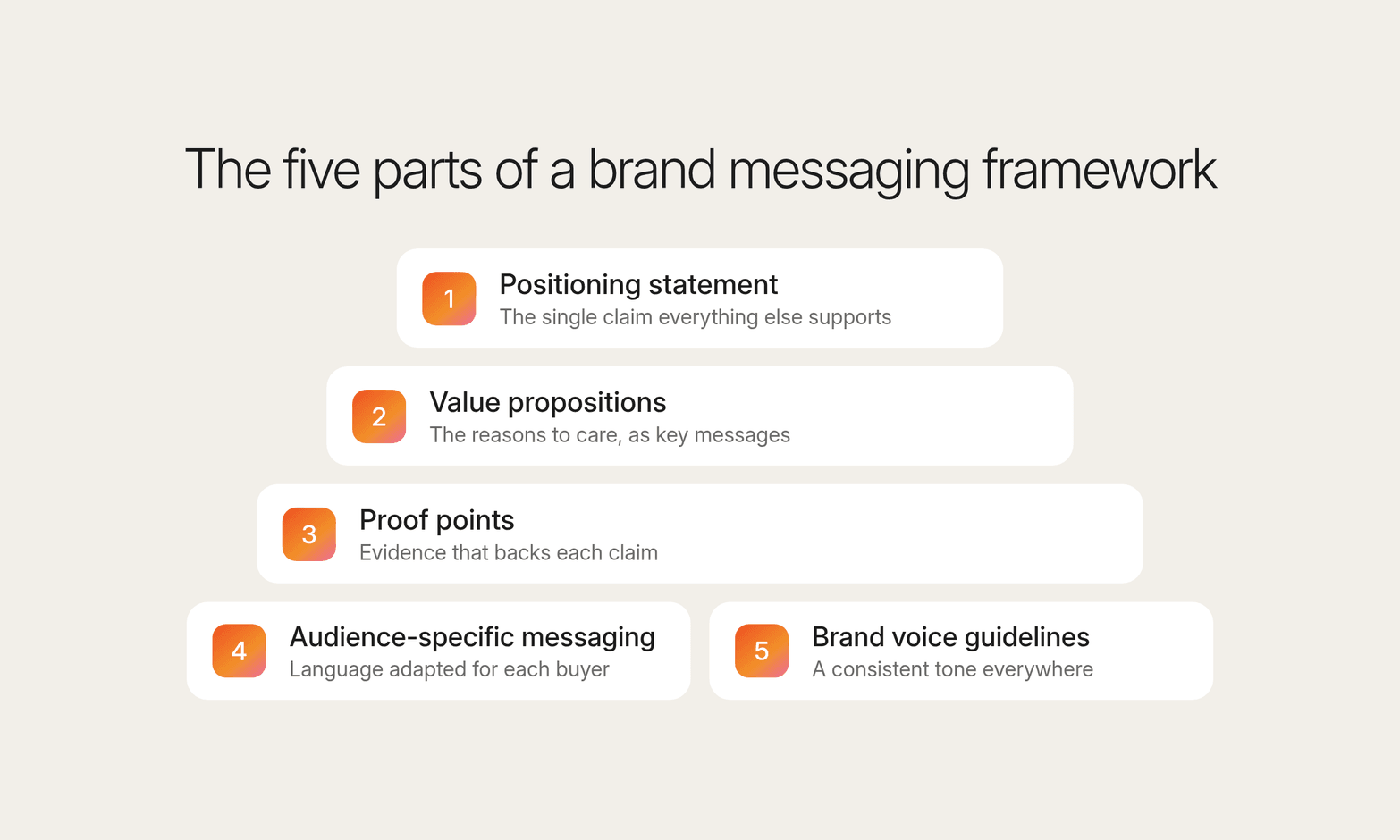
It usually includes:
Positioning statement: the single claim everything else supports.
Value propositions: the reasons to care, expressed as key messages.
Proof points: the evidence that substantiates each claim.
Audience-specific messaging: language adapted for each buyer.
Brand voice guidelines: the tone that stays consistent wherever messaging appears.
Together, these form the brand messaging architecture.
The framework sits within a company's wider brand strategy. Brand architecture organizes its offerings, brand identity covers the logo and the look and feel, and the framework organizes what gets said about each. It also works as an internal compass for employees learning how the company talks about itself.
The failure mode is built in. Language agreed in a workshop sounds confident in the boardroom but confuses buyers in the market, because nobody checked whether it speaks to the pain points buyers actually feel.
Why Most Brand Messaging Frameworks Fail in Market
Most frameworks are built for internal alignment, so nothing in a brand messaging framework can be proven wrong. A closer look at the four recurring failure modes reveals the same root cause: the framework was validated by opinion, and buyers never saw it.
Demographic-only personas. Age, income, and job title describe who a buyer is. They say nothing about what triggers a purchase, what causes hesitation, or which words buyers use. Messaging built on them fails to account for real decision criteria and pain points.
Hidden clarity failure. Employees share a vocabulary, so internal language reads clearly. Real prospects and end users meet jargon once the website and campaigns are live.
Preference-led messaging. Copy that leads with the features the team likes best, often ease of use, misses the criteria buyers evaluate on, and conversion stays soft.
The differentiation gap. Messaging describes the category but gives no reason to choose you over direct competitors, the agency, the survey tool, or the good-enough option buyers already use.
When a stakeholder asks months after launch where a claim came from, and no participant quote or recording exists, the brand messaging framework loses credibility.
The framework gets rewritten in the next workshop cycle, and the business pays for the cycle twice.
Evidence and Examples
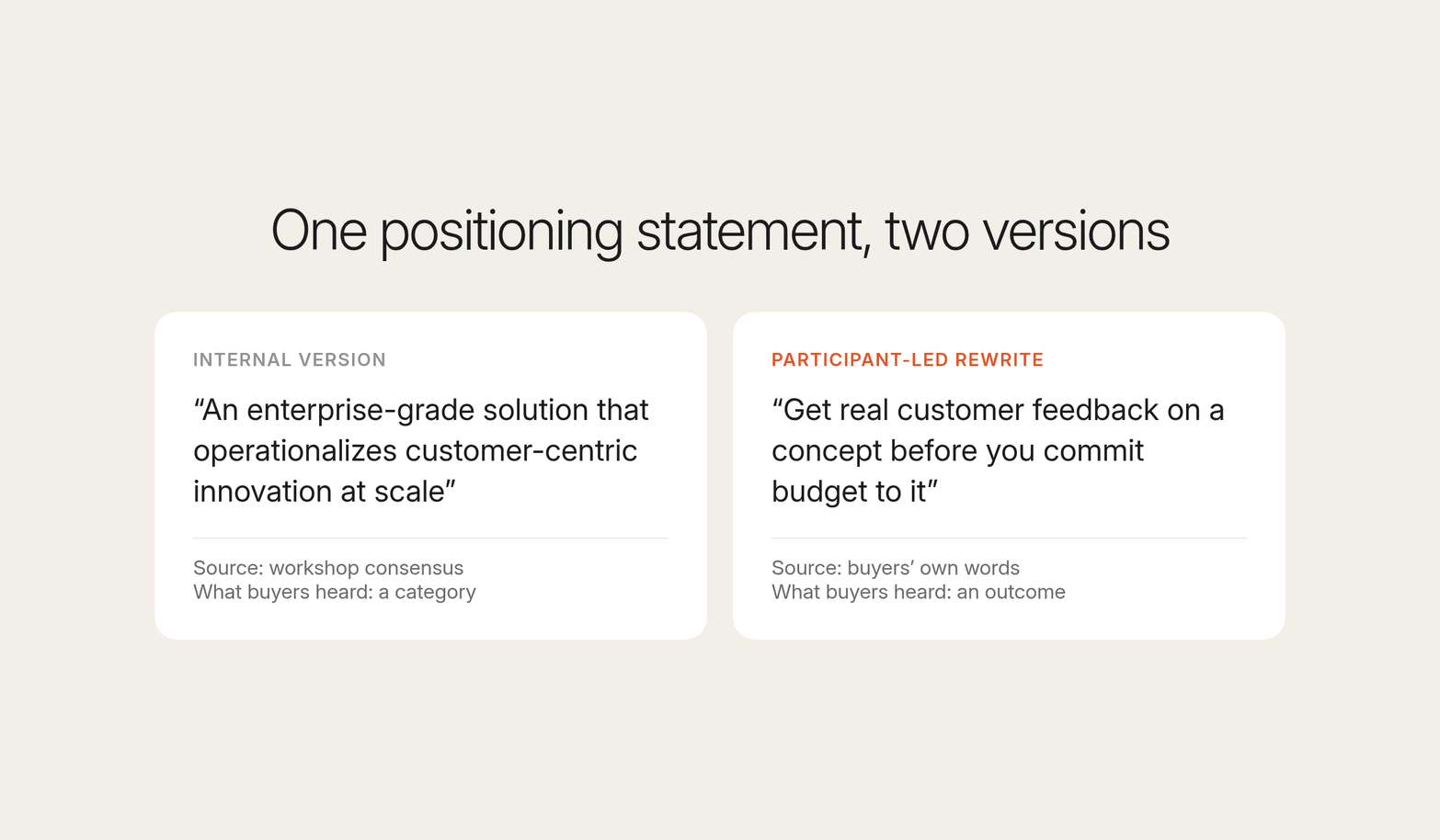
Imagine two versions of one positioning statement, drawn from a representative, illustrative scenario and not a specific client engagement.
| Internal version | Participant-led rewrite | |
|---|---|---|
| Positioning statement | "an enterprise-grade solution that operationalizes customer-centric innovation at scale" | "get real customer feedback on a concept before you commit budget to it" |
| Source | Workshop consensus | Buyers' own words |
Buyers described a category instead of an outcome when shown the internal version. A participant restated the participant-led rewrite unaided, and a stakeholder can review that moment later.
In a second illustrative scenario, a team of marketers led with ease of use. Interviews showed buyers ranked another criterion first: whether the output survives review with their own stakeholders. It became the lead message the sales team carries into buyer conversations.
How to Build a Brand Messaging Framework That Holds Up
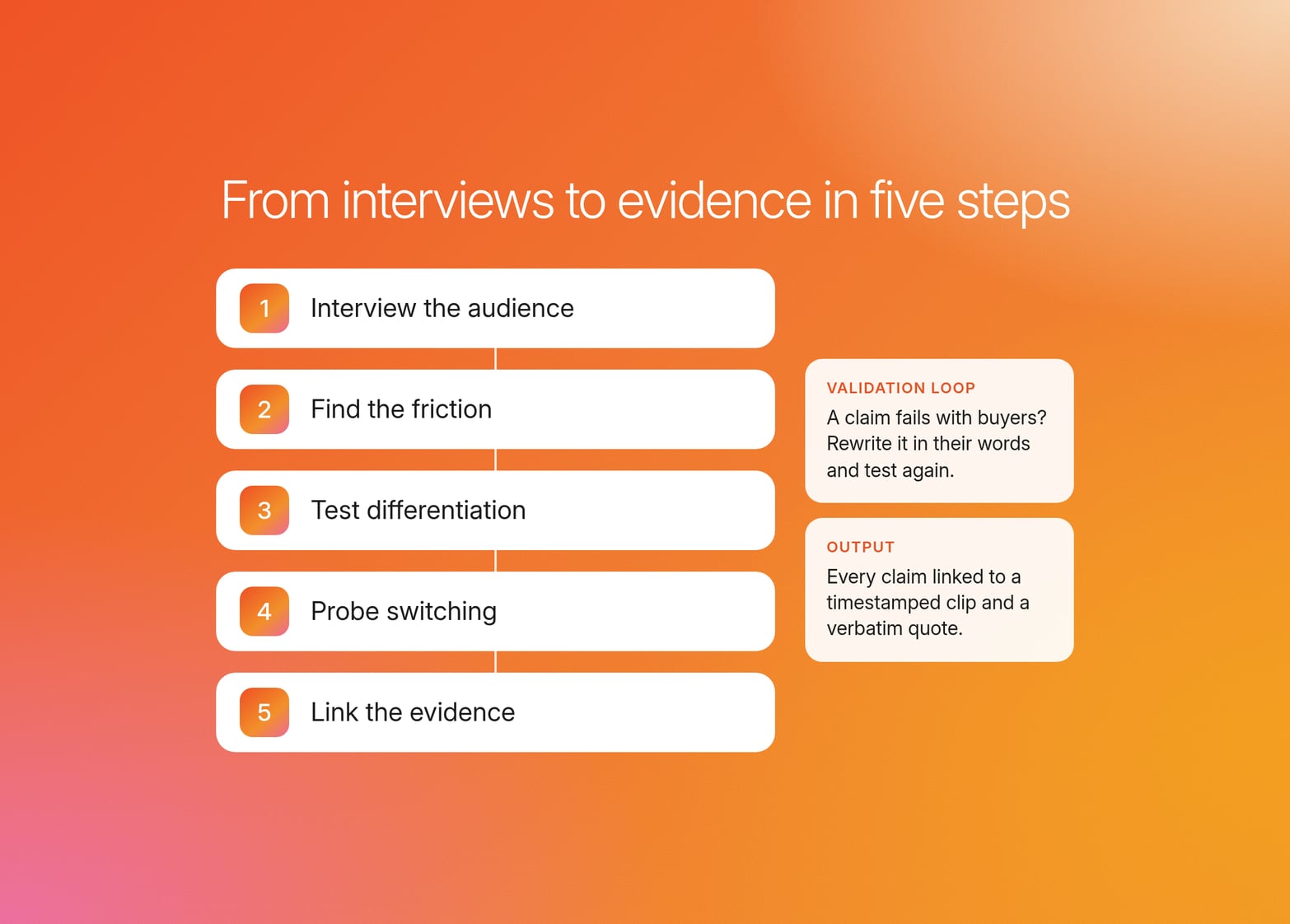
Create the brand messaging framework from real participants verified by video, with every finding traceable to the person who said it. As this guide shows, the workflow moves from interviews to synthesis to validation, looping back when a claim fails. Keep each study to a single focus: one buyer segment, one set of claims, one decision.
Interview the audience. Run 30- to 45-minute depth interviews with the audience the framework targets. Ask "What do you think this message is trying to say?" to surface how buyers decode the language.
Find the friction. Ask "Which words felt unclear or unexpected?" to pinpoint confusing phrases and replace competing opinions with evidence.
Test differentiation. Ask "How does this compare to what you already use?" so the framework addresses the competitors and alternatives buyers actually weigh.
Probe switching. Apply displacement questions in your brand message framework work: "What would you stop using?" and "What would need to change to choose this?" These generate actionable rewrite inputs.
Link the evidence. Attach timestamped video clips and verbatim quotes to every claim. They become the reference materials the whole team argues from.
Interview-based understanding tends to drift after roughly six months, so governance schedules the next read before the current one goes stale.
Putting that schedule in writing keeps the framework a living part of the strategy.
Brand Messaging Framework Template
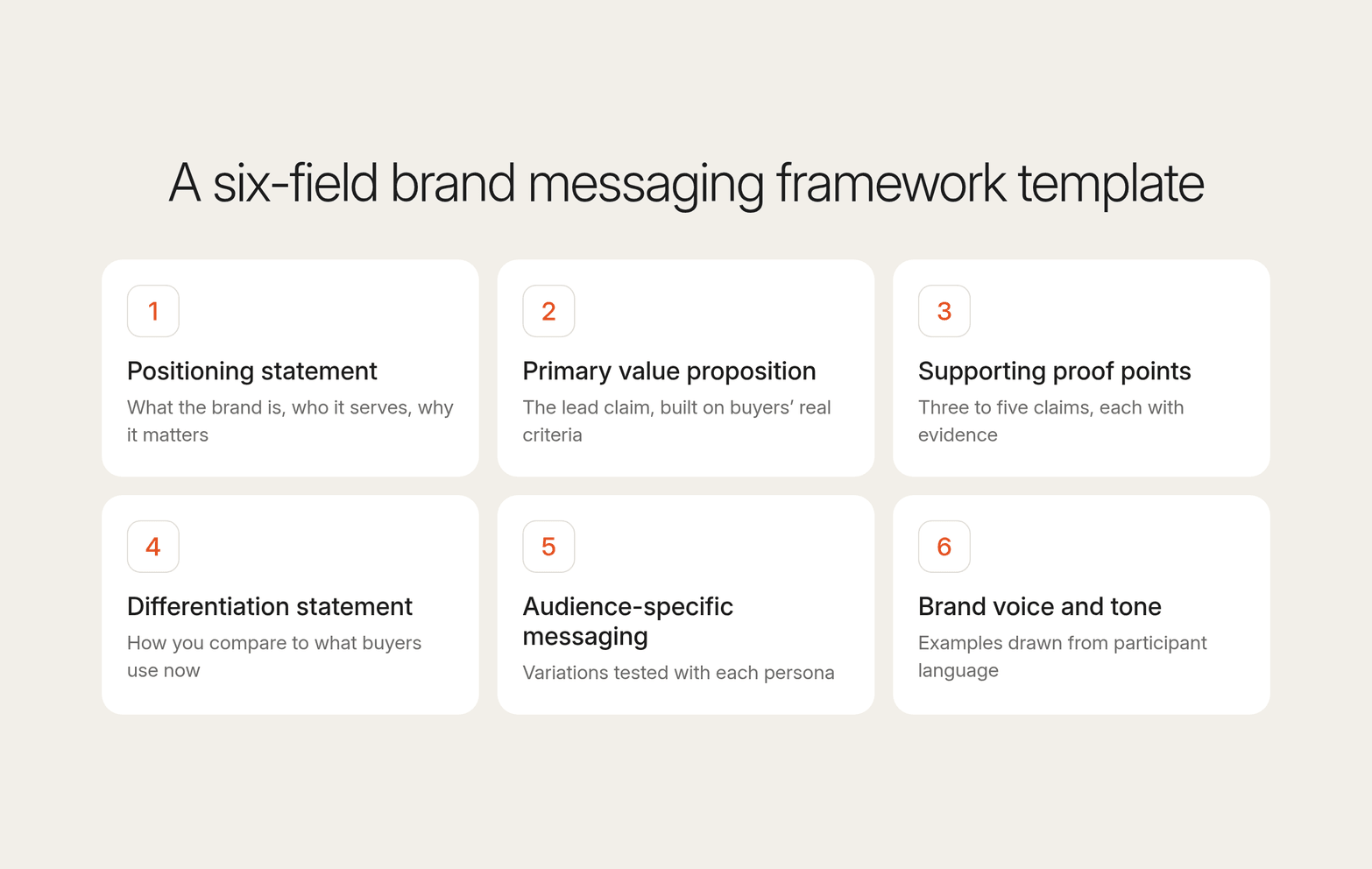
A customizable brand messaging template keeps frameworks consistent and complete, with every field holding language participants have verified. Use the six fields below to create a version for your business and the services you offer.
Positioning statement: one sentence on what the brand is, who it serves, and why it matters.
Primary value proposition: the lead claim addressing the buyer's actual evaluation criteria.
Supporting proof points: three to five claims, such as product features or customer outcomes, each linked to participant evidence.
Differentiation statement: how the brand compares to what buyers already use.
Audience-specific messaging: customizable variations for each buyer persona and user group, tested with that persona.
Brand voice and tone guidelines: how the brand sounds and what personality it carries, with examples from participant language.
Three rules keep the template honest:
Link every field to timestamped clips or verbatim quotes so stakeholders can audit any claim.
Back the template with a searchable insight library your team can search by theme, phrase, or audience.
Pressure-test each field before you start implementing the template.
Testing Your Brand Messaging Framework Before Launch
Pressure-test a brand messaging framework with real participants before rollout. Internal reviews miss clarity failures, misinterpretations, and differentiation gaps that surface only when people outside the organization read the language cold and form a first impression.
Positioning statement: ask what it is trying to say, to confirm the idea you intended is the idea that lands.
Value proposition and key messages: ask which words felt unclear.
Differentiation statement: ask how it compares to what participants already use.
Audience-specific messaging: test it with its target persona and check the language holds across channels, from the website to sales materials.
AI-moderated, asynchronous video interviews let studies run in parallel across markets and time zones, so findings arrive while the messaging decision is still open.
"The analysis is instantaneous. I can synthesize all the data, and also go back and watch every interview. You can ask it to challenge your own thinking. It's so easy to talk to your data."
Dafydd Jones, Associate Director, Ninth Seat
Imagine walking into the review with recordings in hand. Putting that evidence on the table ends the debate and gives everyone a shared definition of success.
Brand Messaging Framework vs. Survey-Based Validation
Many teams use surveys to rank messages, assuming the top scorer will perform best in market. The challenge is what the ranking leaves out.
| Survey ranking | Depth interviews | |
|---|---|---|
| What it captures | Preference order | Misinterpretation, hesitation, reframing, and the pain points behind a failing value proposition |
| Context | Messages rated in isolation, without taking competitors or a real decision into account | Objections, credibility gaps, and emotional signals probed in 30 to 45 minutes |
| Evidence | Scores with no quotes or video | Every response recorded and timestamped |
| Best use | Narrowing a long list quickly | Turning a ranked list into a rewrite your team can act on |
Buyers form opinions differently when a purchase is on the line, so depth interviews trade some speed and sample size for context. That shifts the focus from which message won to why.
Keeping Your Brand Messaging Framework Current
Interview-based understanding tends to drift after roughly six months as markets move and customer language shifts, so a brand messaging framework built once goes stale unnoticed. Staying current is the challenge most teams underestimate when planning messaging strategy.
Interview on a cadence. Run quarterly or biannual interviews with the same audience to catch changes in language, evaluation criteria, or competitive alternatives.
Watch for structural triggers. Revisit the framework whenever brand architecture shifts, such as a new product line or a rename.
Use the library. A searchable insight library lets your team find clips and quotes instead of commissioning a new study.
Name an owner. Assign a role in the organization, such as a brand lead, CMI director, or insights manager, to schedule updates, oversee implementing each one in live copy, and flag claims that stop matching participant language.
Small shifts in how buyers describe the problem often signal a claim that can no longer communicate what it used to. Each claim then traces to recent evidence, giving the team a current benchmark for success.
How Conveo Tests Brand Messaging Frameworks
Conveo checks each claim with real participants so the messaging hierarchy reflects what lands with buyers.
Continuous read: Conveo StoryLines keeps interviews running with the audiences a framework targets, for example every two weeks or monthly, so the read stays current.
Speed with rigor: AI-moderated depth interviews run at scale in 50+ languages, built by researchers, returning findings from 100 interviews in 3 days with timestamped clips and verbatim quotes.
Parallel testing: asynchronous interviews let teams test positioning, value propositions, and differentiation at the same time, creating a full evidence base for the brand messaging architecture in a single pass.
Traceable evidence: every interview is recorded, and each theme links to the participants behind it, with video clips and verbatim quotes stakeholders can audit.
Searchable insight library: recurring themes and facets are recognized across studies, so the next read starts from what earlier ones established, and the evidence is there when an executive questions an assumption.
Enterprise insights teams at Google, AB InBev, Kellanova, General Mills, and JDE Peet's rely on Conveo to understand their consumers.
Frequently asked questions
What is a brand messaging framework example?
A complete brand messaging framework example includes a positioning statement, value propositions, proof points, a differentiation statement, and audience-specific messaging, each linked to participant evidence. An internal line such as "an enterprise-grade solution that operationalizes customer-centric innovation at scale" might become "get real customer feedback on a concept before you commit budget to it" once rewritten from participant language. Buyers approve the second because they understand it.
What is brand meaning in marketing?
Brand meaning is what a brand represents to its buyers: the idea they hold of what it stands for and the personality they attach to it, well beyond the logo. Participants' own language reveals it, and it often differs from the team's intended version. Demographic personas and a brand identity describe who customers are and how the brand presents itself, but only interviews reveal brand meaning as buyers experience it.
How do you write a brand messaging framework?
Write a brand messaging framework in participants' language, so it communicates in words buyers recognize and avoids clarity failures. Run depth interviews with your audience and ask "What do you think this message is trying to say?" Identify the confusing phrases and rewrite them in participants' words, then link every claim to timestamped video clips so each claim can be checked.
What is the difference between a brand messaging framework and a positioning statement?
A positioning statement is one component of a brand messaging framework, usually the top-level claim on what the brand is, who it serves, and why it matters. The framework adds value propositions, proof points, differentiation, audience-specific messaging, and brand voice guidelines, all within the broader brand strategy. Build both from participant language so the whole framework reads clearly to the buyers it was written for.
How often should you update a brand messaging framework?
Update a brand messaging framework at least every six months, since interview-based understanding tends to drift after roughly that long. Quarterly or biannual interviews catch changes in buyer language and evaluation criteria early. Continuous updates keep the framework working as an internal compass and every claim tied to recent evidence.
Can you use AI to build a brand messaging framework?
AI can moderate interviews and synthesize findings, but a brand messaging framework must still rest on real participants, not synthetic respondents. AI handles the operational load: recruiting, moderating, transcribing, and thematic coding at scale, so a study of 100 interviews can return structured findings in 3 days. Researchers and marketers keep the judgment work: shaping study design and interpreting findings.

About the author
Florian Hendrickx
Head of Growth
Florian is Conveo’s Chief Growth Officer, leading growth strategy and go-to-market execution as the company scales. He’s held growth leadership roles at companies like Deliverect, Robovision, and Aikido Security, and brings hands-on experience across marketing, sales, and product.
More by Florian →Qualitative insights at the speed of your business.
Conveo runs AI-moderated video interviews and structures everything they say.