In this article
TL;DR
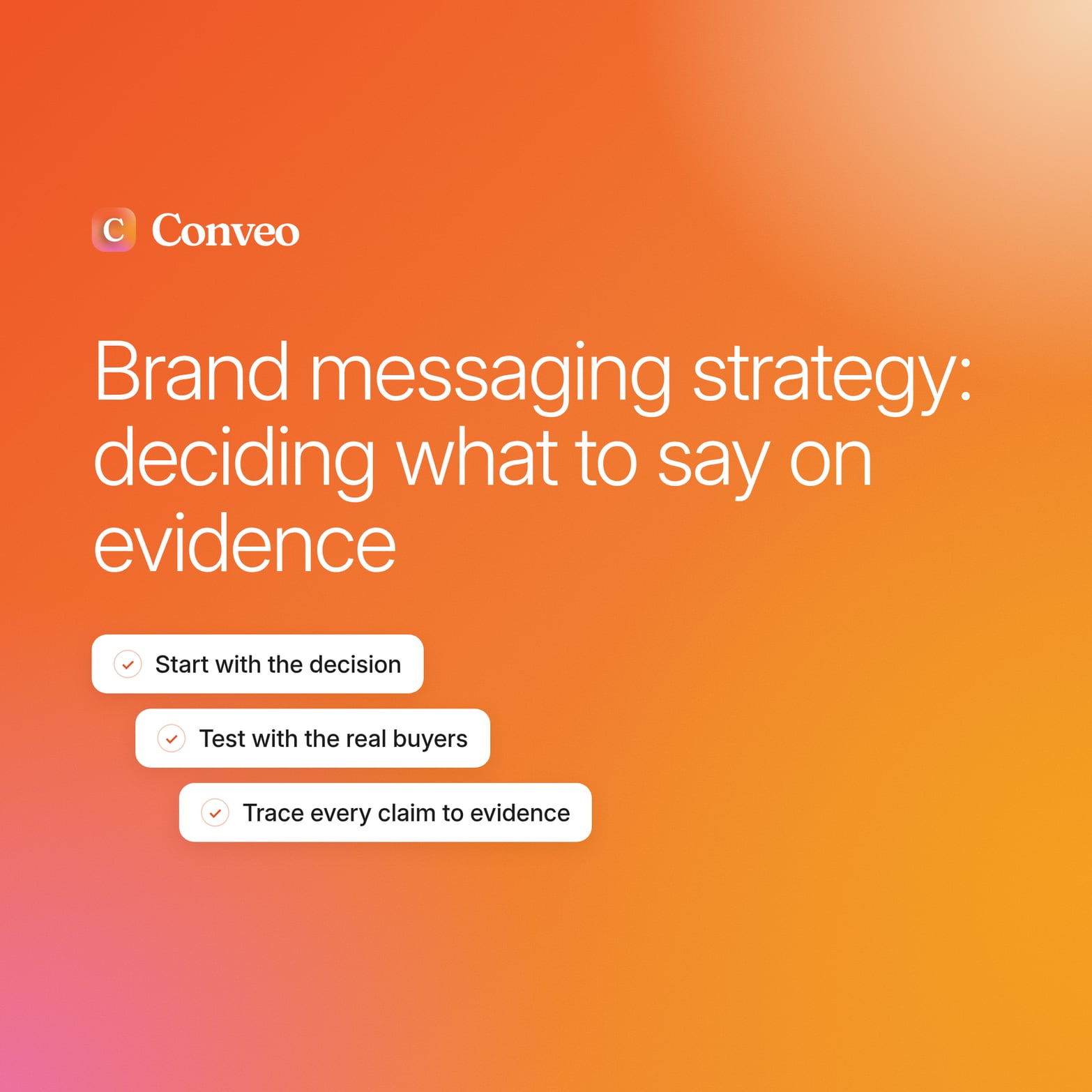
An evidence-based brand messaging strategy follows a repeatable sequence: start with the decision, recruit the real buying committee, test the message in context, analyze for clarity and difference, and document with traceability.
Most brand messaging strategy is set once a year, based on research that was already old when it was commissioned.
Brand messaging strategy goes stale because of timing: traditional agency-based messaging research takes 6 to 12 weeks, so findings land after briefs and creative are locked.
Messaging evidence becomes decision-useful when it traces to timestamped video clips and verbatim quotes a stakeholder can open and verify, not survey scores.
Running brand messaging research continuously instead of annually keeps your brand messaging framework a living read on the target audience, with consistent messaging across every team.
Teams set brand messaging strategy once a year, and they set it against research that was already old the day it was commissioned. So the strategy speaks to a target customer who has since moved on. By the time the messaging reaches a live campaign, the audience has shifted, and the message no longer connects with the people it was written for.
Too many brands find this out in the real world, after launch, when buyers send mixed signals about what the company actually does.
The mechanism is timing. Traditional agency-based messaging research takes 6 to 12 weeks, so the findings arrive after the briefs and the creative are already locked. The strategy inherits assumptions no one has tested against a current customer, so nobody knows just what the buyer took from the message.
Another way to run this exists. Conveo keeps messaging evidence current between planning cycles, so teams revise strategy when the audience shifts rather than when the calendar allows.
This guide covers how to build a brand messaging framework on evidence that remains true when the decision is made, and how to keep it that way. Done well, that framework gives a company clear positioning, a credible value proposition, and consistent messaging across every team that communicates with buyers.
Why Brand Messaging Strategy Breaks
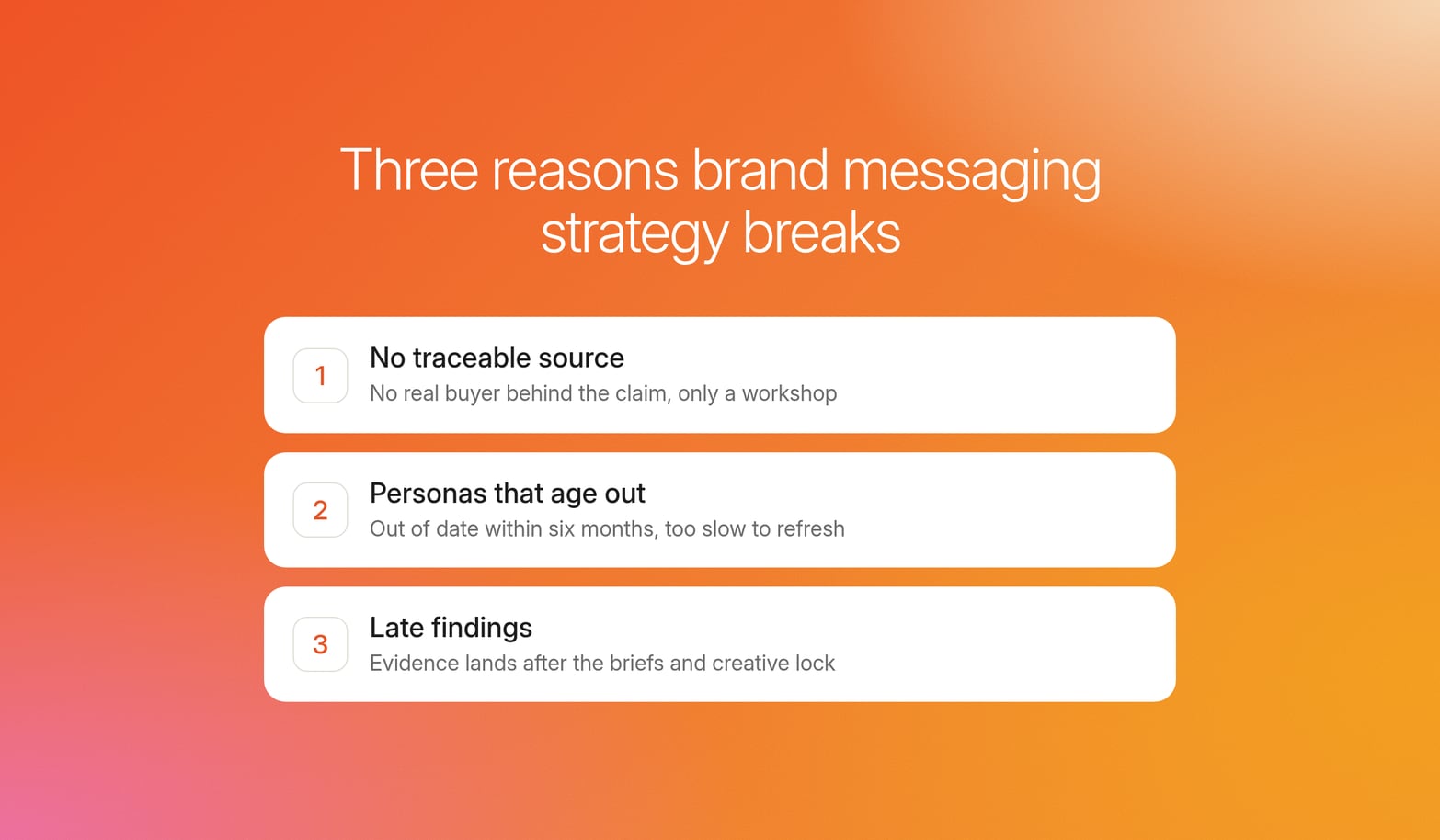
Three failure modes show up again and again:
No traceable source. A stakeholder asks 'where did this come from?' and the team cannot point to a real customer who said it. The messaging traces back to a workshop, not a person. Without a source, the brand story and the mission statement become opinions that the rest of the organization has to take on faith.
Personas that age out. Personas drift out of date within six months, but slow research cycles make a refresh impractical, so the team keeps working from a portrait that no longer matches the buyer.
Late findings. Findings arrive after the briefs and creative are locked, so the evidence informs nothing.
Mixed signals follow: sales says one thing, the website says another, and brand consistency erodes.
Why Agency Research Arrives After the Decision
A brand message strategy built through traditional agency research runs on a 6- to 12-week cycle, and the decision window usually closes before the evidence lands. Teams then ship messaging that sounds right internally because insiders share context first-time prospects don't have.
The result is a branding problem that better copywriting cannot fix, because the inputs are stale.
Where the cost shows up
The cost of stale messaging surfaces in small, concrete places. Stale buyer persona research is where it usually starts.
Homepage copy. Copy that reads as precise to the team reads as ambiguous to a buyer arriving cold from search.
The elevator pitch. The version leadership recites no longer matches what buyers say back.
The brand promise. Buyers judge it against what the product and service deliver, so a gap between the two shows up in the customer experience.
Messaging that cannot be updated between planning cycles stops being an asset and becomes a liability the team defends rather than uses.
What Makes Messaging Evidence Decision-Useful
Evidence a stakeholder can verify
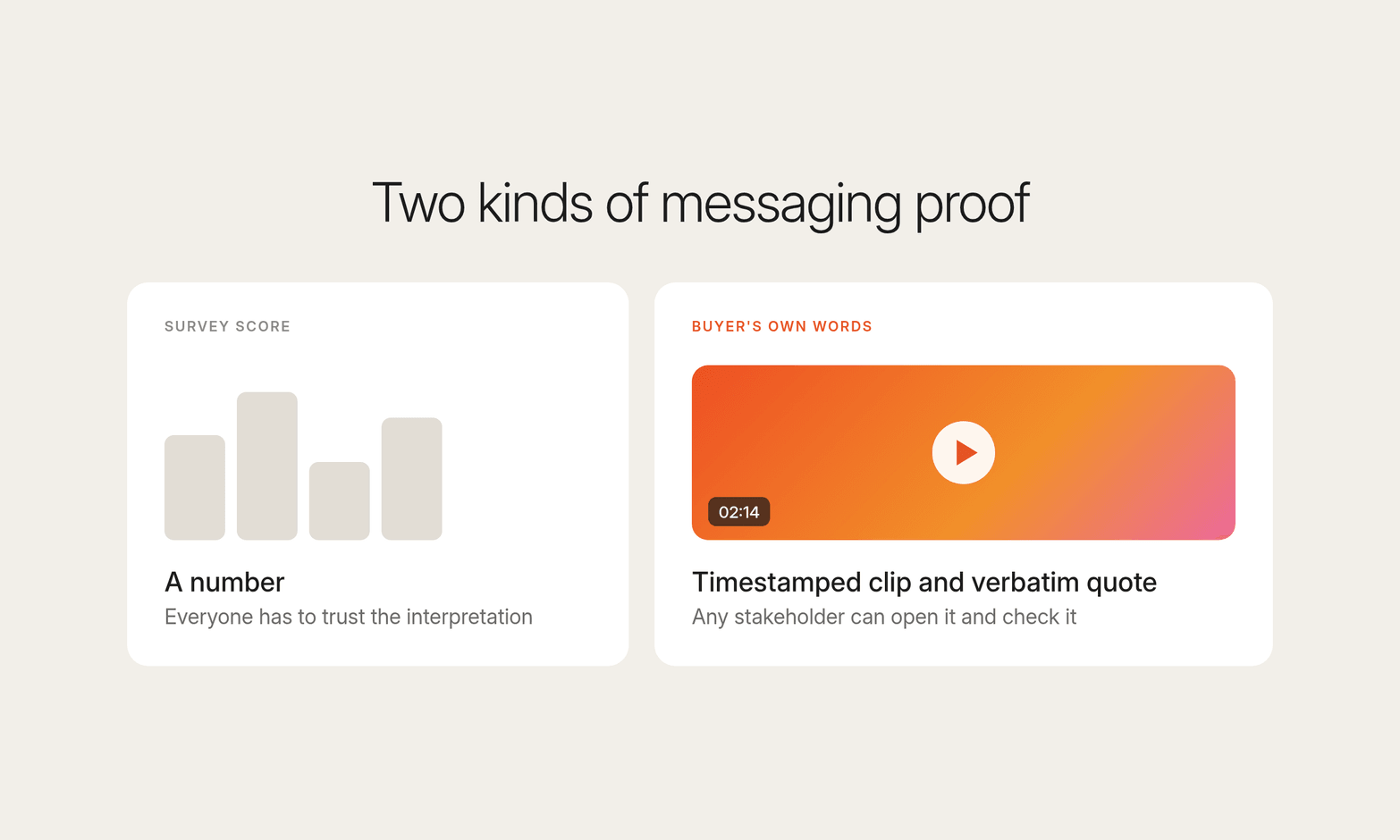
The most decision-useful messaging evidence is traceable to timestamped video clips and verbatim quotes that a stakeholder can open and verify, not survey scores or a summary deck.
When the proof is a number, the team is asking everyone to trust the interpretation.
When the proof is the customer's own words on video, the interpretation is checkable.
That checkability builds credibility with stakeholders who weren't in the room when the interviews ran.
Why surveys fall short
A message can score well and still fail because a survey doesn't capture what a person understood before they rated it.
Conversational, open-ended testing surfaces what the message is trying to say in the buyer's words, not the team's intent. It also reveals emotional connection, or the lack of it, in the hesitation, the reframing, and the phrase a buyer reaches for unprompted.
Questions that expose friction
Two probing questions do most of the work:
'What felt unclear?'
'What would you change?'
They reliably expose the friction points and copy fixes that scores never reveal. This matters for B2B brand messaging in particular, where buyers verify claims before they trust them.
A clear value proposition and strong positioning survive that check, because the unique value they claim shows up in buyers' own words. Dollar Shave Club is a well-known example of a launch message built in the buyer's language: it named the frustration of overpaying for razors in plain terms.
Output that gets adopted
Stakeholder adoption rises when the output is a decision document with three to five findings, each tied to a concrete copy change and its supporting clips.
Depth interviews, focus groups, and other qualitative research methods all produce that kind of evidence when the questions are designed for clarity failures. Sales teams can reuse the same clips to explain the offer in words buyers already recognize, which turns research into everyday communication.
How to Build a Brand Messaging Strategy on Current Evidence
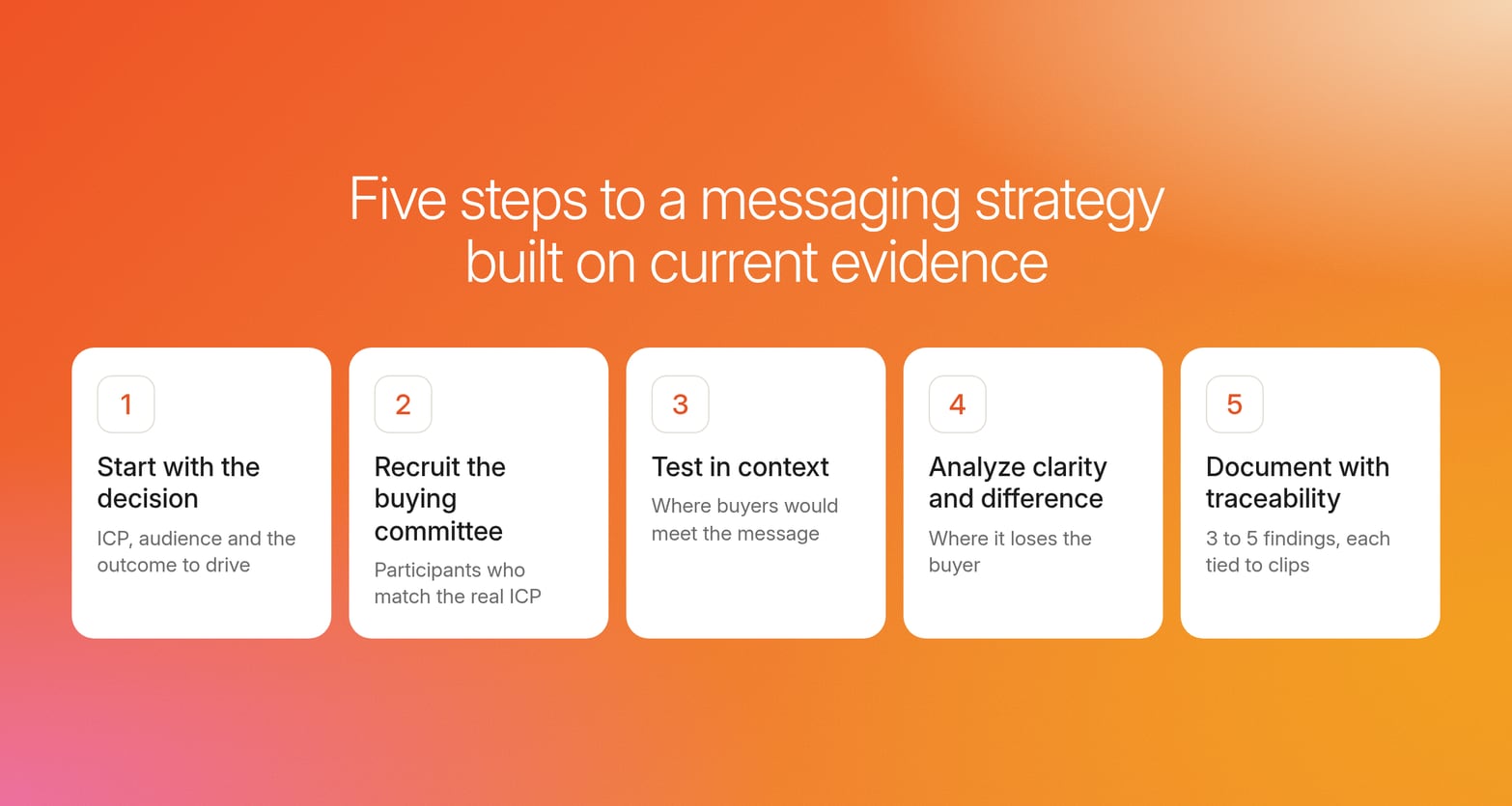
Building a brand messaging framework on current evidence follows a repeatable sequence. Run it in order, and each step produces something the next one uses.
Start building with the decision. Define the ICP, the target audience inside it, and the desired outcome the messaging needs to produce for the business. Decide what success looks like, whether that is a demo request, a shortlist, or a renewal. Test the message to see whether it drives action toward that outcome.
Recruit the real buying committee. Broad consumer panels produce noisy feedback. Importantly, recruit participants who match the actual ICP and the segments being targeted, including the researchers, marketers, procurement, and executives who shape enterprise buying in your industry. Different segments reach different outcomes from the same message, so each one needs its own voice.
Test the message in context. Design open-ended interviews that put the message where the buyer would encounter it in the real world, not in isolation. Test the headline, the elevator pitch, and the value proposition. Probe for clarity failures and gaps in competitive differentiation, and include the places where buyers check claims, such as peer community forums and review sites.
Analyze for clarity and difference. Read for where the message loses the buyer and where it fails to separate from the alternative.
Document with traceability. Write three to five findings, each tied to a concrete copy change and its supporting clips.
What the framework needs to hold up
A brand messaging framework needs four elements:
A narrative spine
Proof points
Audience-specific variants
The evidence behind each claim
For multi-stakeholder enterprise buying, keep one narrative spine and tailor the proof to researchers, marketers, procurement, and executives.
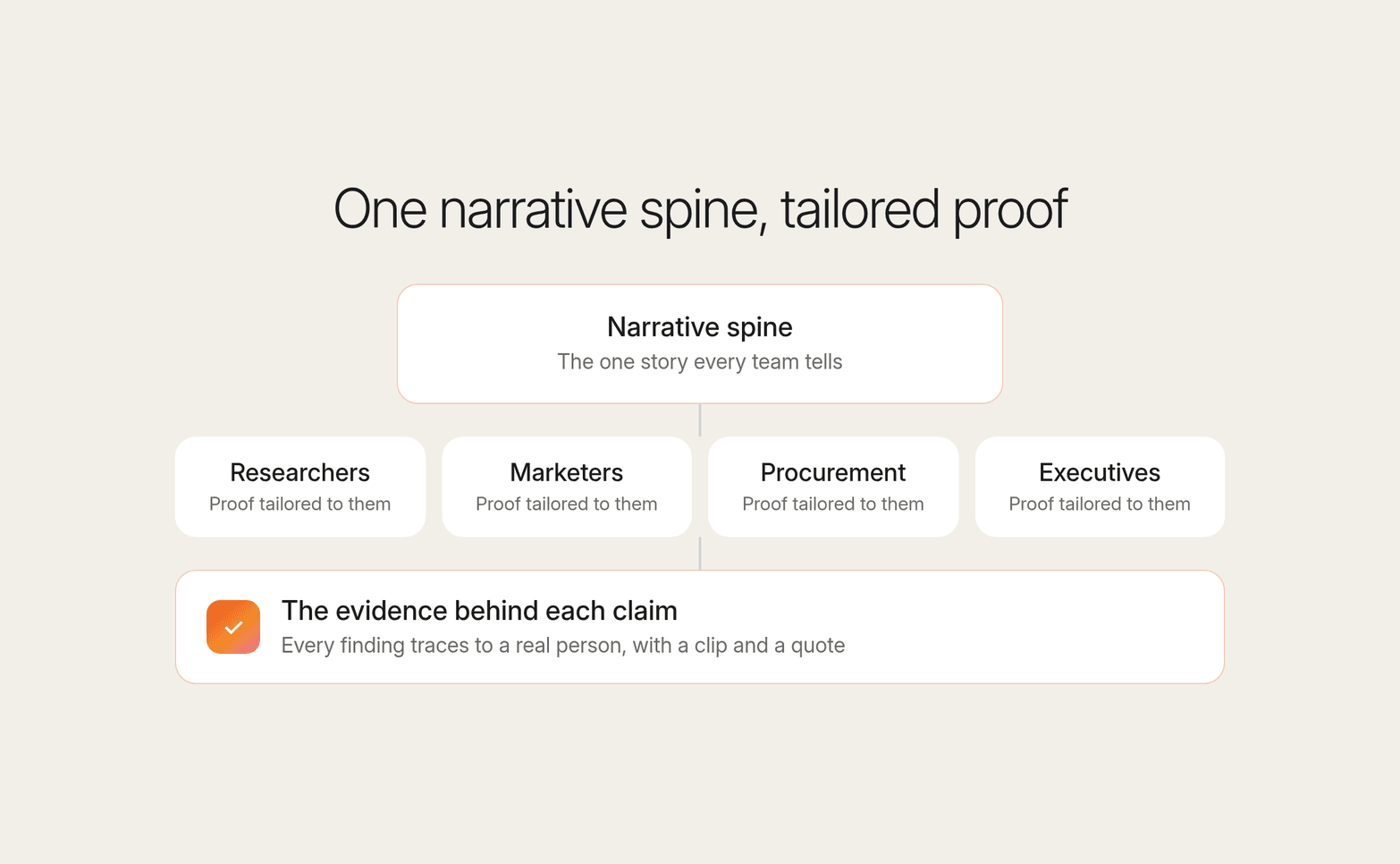
The rigor is what makes it defensible: every finding traces back to a real person who said it, so a brand messaging strategy built this way survives the 'where did this come from?' question. The same evidence tests the positioning statement and the brand promise, since both rest on claims a buyer has to believe, and it gives the whole structure a firm foundation.
Run Messaging Research Continuously
Run this continuously rather than once a year, and messaging becomes a living read on the audience instead of an annual artifact.
Conveo StoryLines is what makes the continuous version practical. It runs messaging programs as waves, for example every two weeks or monthly, and detects how themes move across the wave time series. That is signal detection in customer conversations over time, not a query into what the CRM already recorded.
A regular cadence also helps teams stay consistent and gives leadership visibility into how buyer language shifts between launches.
How Messaging Research Compounds Over Time
A single set of depth interviews yields several reusable outputs:
Messaging learnings
Language banks
Reusable messaging assets, which cut repeat studies
Those assets also feed content creation: writers start from verified buyer language, so teams can produce more content without losing brand consistency.
Conveo's AI-moderated interviews run in parallel and asynchronously across 50+ languages; for example, 100 interviews in 3 days, so teams test messaging across markets and decide inside the window.
Preventing Messaging Drift Between Planning Cycles
Messaging fails gradually, through drift. Personas and messaging fall out of date within about six months, but slow research cycles make a refresh impractical, so companies let the drift accumulate until a launch exposes it.
Brand consistency usually slips first at the edges: regional pages, sales decks, and partner content.
AI speeds the drift up
AI-generated content speeds the drift up. When AI tools can produce more content in an afternoon, an outdated message reaches more channels before anyone checks it against the buyer.
Feeding AI systems verified buyer language and a maintained proof point library gives them a source to draft from.
Three governance mechanisms
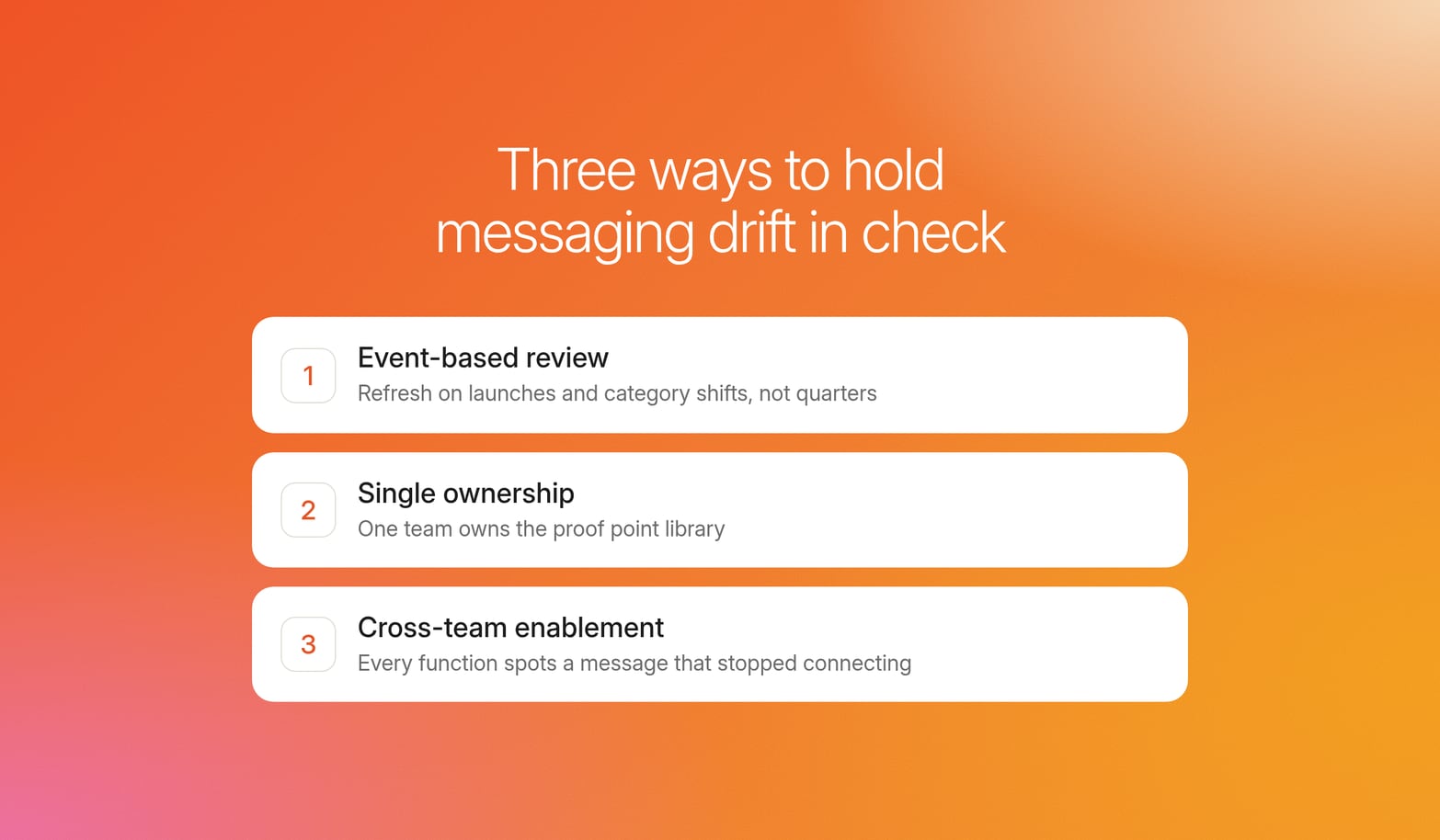
Three governance mechanisms hold the drift in check:
Event-based review. One approach is to tie the review cadence to product launches and category shifts rather than calendar quarters, so evidence gets refreshed when the market actually moves.
Single ownership. Assign a single team to own and maintain the proof point library, so no message circulates without a source.
Cross-team enablement. Train stakeholders across functions to recognize when a message has stopped connecting, so the signal reaches the people who can act on it.
Together, these branding, product, and campaign messaging strategies keep messaging aligned to the same current evidence throughout a campaign. Consistent messaging also helps a company attract talent and build community, because the same story reaches candidates, partners, and buyers.
Teams refresh on the Conveo platform when the audience shifts, not when the budget cycle permits, because a study of 100 interviews can run in 3 days. Strategy becomes a living system tied to ongoing customer evidence, not a static artifact that quietly goes stale between refreshes.
Why Conveo Fits for Messaging Decisions
When a messaging refresh is due, too many brands default to surveys, an agency project, or generic AI tools, and each forces a tradeoff:
Surveys are fast and inexpensive, but shallow. They miss clarity failures because they never capture how a person read the message before scoring it.
Agencies bring depth and craft, but the 6- to 12-week timeline and per-project cost mean the evidence often arrives after the decision window has closed.
Generic AI tools write fluent summaries, but a stakeholder cannot open a clip behind them to verify the claim.
Conveo changes four things:
Continuity. Messaging decisions do not wait for a research calendar, and decision lag is the real cost, so an always-on read on the audience is worth more than a better annual study. Teams working this way revise the narrative when the market moves, not when the budget cycle permits.
Rigor. Continuous evidence is worthless if nobody trusts it. Conveo is built by researchers, and the method stays visible. Each theme links to the participants behind it, with video clips and verbatim quotes stakeholders can audit. A stakeholder can open the clip behind a copy change and check it, which is where the credibility comes from.
Compounding. Conveo's searchable insight library recognizes recurring themes and facets across studies, so language banks, objections, and message variants stay in context against everything learned since, and the next study starts from what earlier ones established.
Capability. This is research you couldn't run before at agency scale, across markets and segments an agency project would price out of scope.
Together, these four elements give a team a sturdier evidence base and consistent messaging across regions and functions. Speed matters last, and it is real: a study of 100 interviews can run in 3 days.
Brand Messaging Research Methods Compared
Conveo is a premium option rather than the cheapest line item, which the table below states plainly.
| Dimension | Agency | Survey tools | Conveo |
|---|---|---|---|
| Timeline | 6 to 12 weeks | 1 to 2 weeks, shallow | 100 interviews in 3 days, depth maintained |
| Cost | High, per project | Low, but no probing | Premium, not the low-cost choice: research you couldn't run before at agency scale |
| Evidence type | Summary decks, no video | Scores, no verbatim context | Timestamped video clips, verbatim quotes |
| Reusability | Static deliverable | No insight library | Compounding insight library, every study makes the next one smarter |
Enterprise insights teams at Google, AB InBev, Kellanova, General Mills, and JDE Peet's rely on Conveo to understand their consumers.
Where Conveo Is Not the Right Fit
Conveo fits companies with real depth of demand: recurring messaging, concept, and positioning questions where the reason behind the score is what decides the call. Teams that need a single number checked once, with no need to understand why buyers read the message that way, will get most of what they need from a survey platform.
The second test is persistence. If findings only need to serve one meeting and never need to be reused by brand, product, or regional teams, a compounding insight library isn't worth the investment.
When the same questions keep returning, and the answers need to hold across teams, the economics land the other way.
Frequently asked questions
What is a brand messaging strategy template?
A brand messaging strategy template is a working document that holds your narrative spine, proof points, audience-specific variants, and the evidence each claim traces back to. Those four elements sit downstream of the positioning statement and the value proposition, which set what the template has to prove. Most templates fail for one reason: teams fill them out once and never update them. Within about six months, the template drifts out of date, and it quietly becomes a record of what used to be true. Templates now also feed the AI tools and AI systems that draft copy, so a stale one spreads quickly. The fix is a refresh trigger tied to audience shifts rather than to the planning calendar.
What is a brand messaging strategy framework?
A brand messaging strategy framework forces the team to answer 'where did this come from?' with real customer evidence rather than internal assumptions. It starts from brand positioning and connects the mission statement, brand story, and brand promise to the value proposition buyers hear and the unique value behind it. Most frameworks break because they are built on research that was already old when it was commissioned, so the framework addresses a target customer who has since moved on. A framework becomes actionable when each claim in it carries a named source: a participant, a quote, and a clip. Clear positioning and strong positioning both depend on that same chain of evidence.
How do you test brand messaging before launch?
Test brand messaging before launch in three moves. First, name the desired outcome. Second, run open-ended, conversational interviews with participants who match your actual ICP and buying committee, putting the message in context rather than in isolation. Third, probe for clarity failures and competitive differentiation gaps. Two questions do most of the work: 'What felt unclear?' and 'What would you change?' They expose the friction points and copy fixes that scores miss. A useful standard is whether a stranger can repeat the message back in their own words, as they can with a plain-spoken launch message like Dollar Shave Club's.
How often should brand messaging be updated?
Update brand messaging when the audience shifts, when the category or industry moves, or when a launch exposes a clarity failure. Update on those triggers, not on a fixed calendar. In practice, personas and messaging drift out of date within about six months, so annual updates arrive too late to matter. AI-generated content tightens the timing further, because more content reaches the market faster and an outdated message travels with it. A wave-based program, for example every two weeks or monthly, keeps the read current without turning messaging into a permanent research project, and it helps teams stay consistent across regions and channels.
Why are surveys not enough for message testing?
Surveys capture the rating, not the reading. A message can score well and still fail in market, because a scale never records what the person understood, missed, disbelieved, or felt, including whether the message built any emotional connection. Conversational interviews surface the message in the buyer's own words, which is what tells a team which sentence to change. Conveo's AI-moderated interviews run in parallel across markets and time zones in 50+ languages, so the depth scales across markets.

About the author
Dieter De Mesmaeker
Co-Founder & CEO
Dieter is CEO and co-founder of Conveo. Before starting the company, he founded DataCamp and scaled it into one of the leading edtech platforms in the world.
More by Dieter →Qualitative insights at the speed of your business.
Conveo runs AI-moderated video interviews and structures everything they say.