In this article
TL;DR
Brand messaging fails late because the insight into what's wrong with it usually arrives after the decision is locked in.
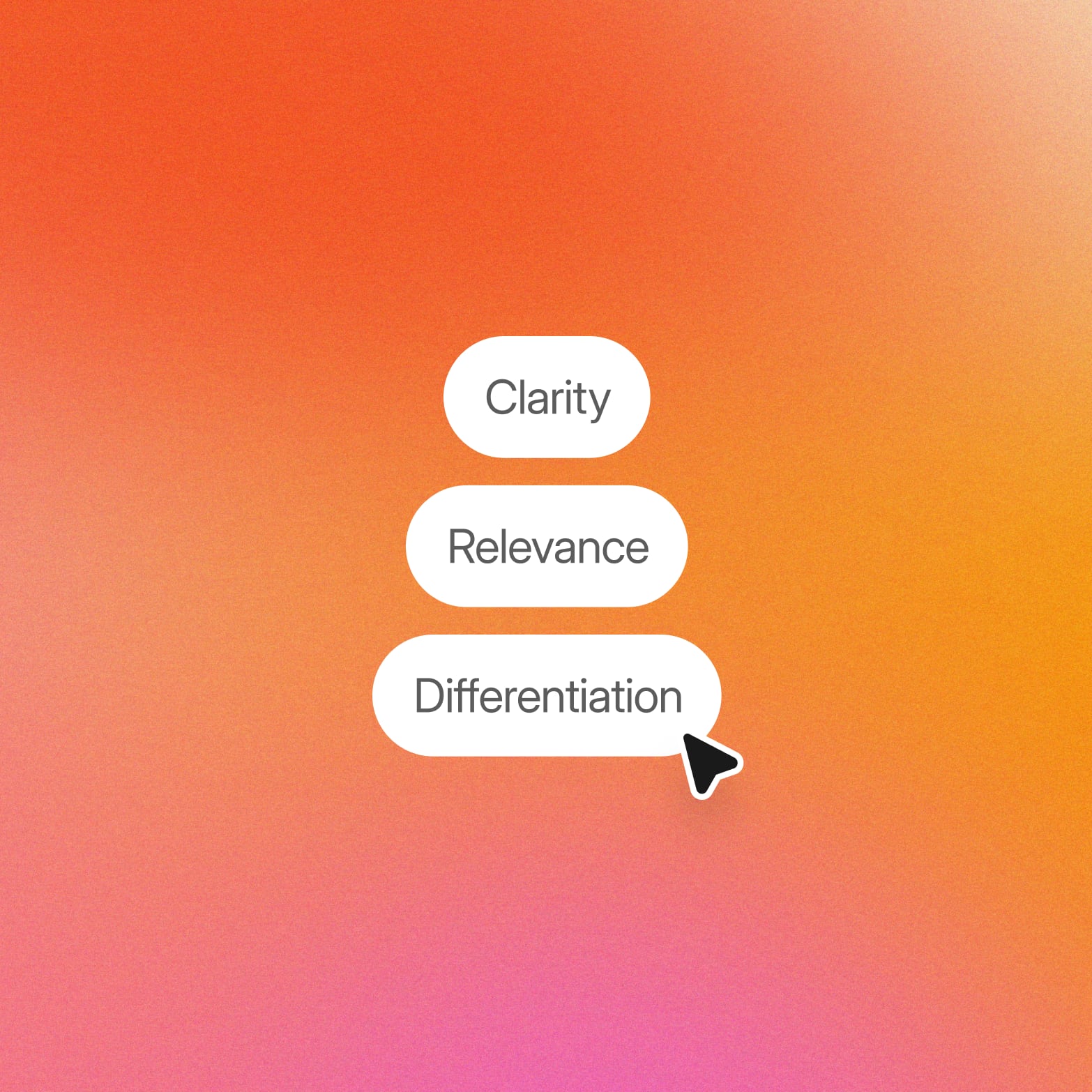
The three most common failure modes are clarity (prospects can't explain what you do), relevance (written from features outward instead of pain inward), and differentiation (never answers "why choose this over what we already use").
Surveys reveal which variant scored best but not how the target audience interpreted the language. Conversational depth interviews surface the reasoning behind the reaction.
Effective messaging is tested against four dimensions: clarity, relevance, differentiation, and emotional resonance, including the two that are hard to see from inside a review meeting.
Test while the copy is still in draft: recruit to your ICP, run three-stage sessions, and log patterns (comprehension gaps, restated language, repeated objections, high-resonance phrasing) instead of chasing a single top-scoring variant.
What is brand messaging (and why most of it fails before launch)
Most brand messaging fails for the same reason: the insight about what's wrong with it arrives after the decision is already closed. By the time performance data shows a headline isn't landing, the campaign has run, and the brand positioning choice that caused the problem is already embedded in everything downstream.
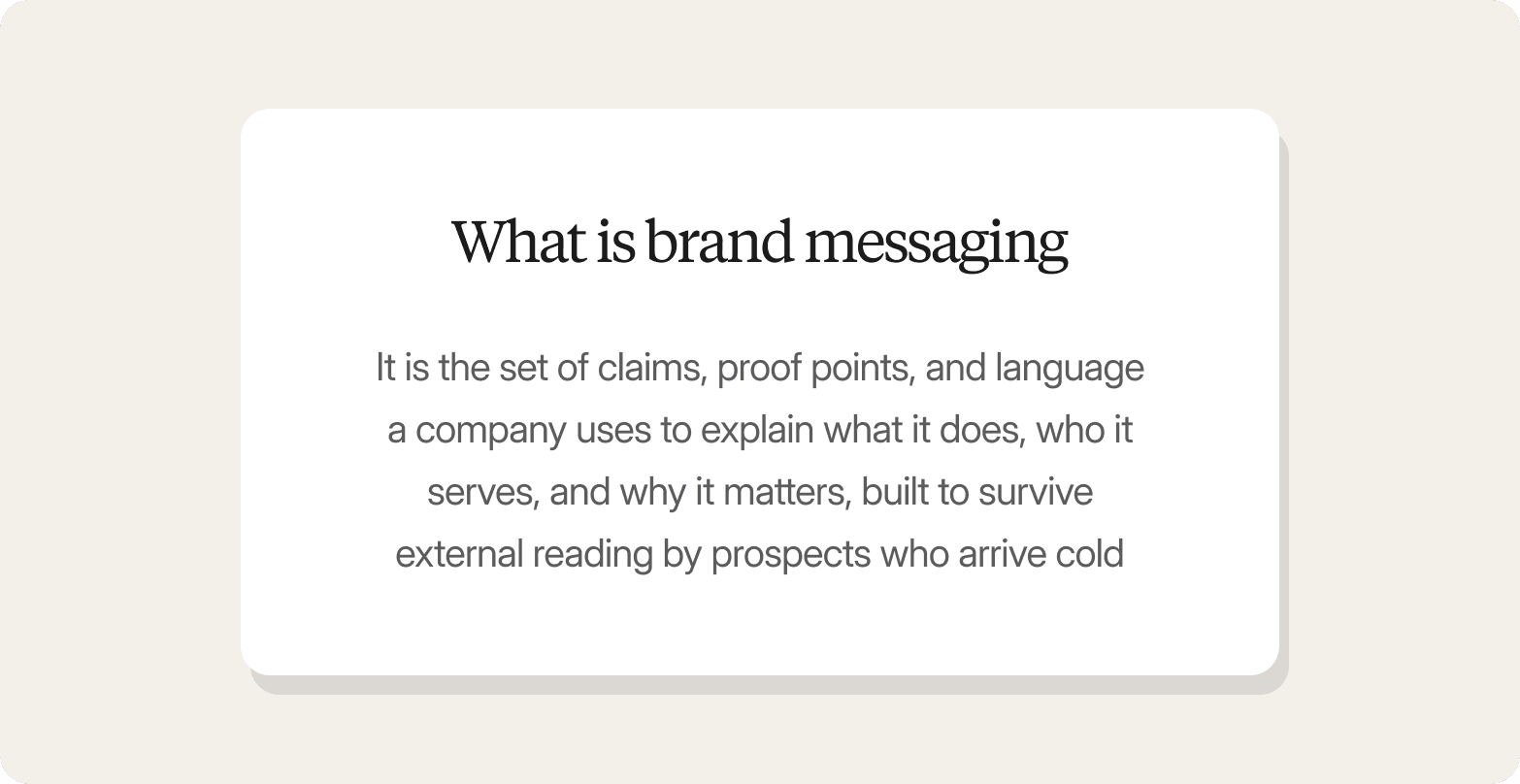
Defining brand messaging takes a sentence: it is the set of claims, proof points, and language a company uses to explain what it does, who it serves, and why it matters, built to survive external reading by prospects who arrive cold. Brand messaging encapsulates what the brand stands for, in as few words as a stranger is willing to read, working on that stranger in thirty seconds rather than with the full context an insider has.
The structural problem is that teams write, socialize, and approve messaging internally. The same teams drafting the copy already know the product and the customer type, so that shared context fills every gap without anyone noticing. The first genuine external reading happens at launch, when misreads carry real cost, and the message a company ships and the message customers experience are rarely the same.
It helps to separate the two jobs the work is doing.
| Question | Internal brand messaging | External brand messaging |
|---|---|---|
| Who reads it | People who already know the brand | A shopper comparing options on shelf |
| What it can assume | Shared shorthand and context | Nothing |
| Where it lives | Brand guidelines, briefs, internal decks | Packaging, ads, campaign launch copy |
| How it usually gets tested | Internal review and sign-off | Rarely, until after launch |
Internal messaging can lean on that shorthand. External messaging has to earn comprehension from the first line.
Three failure modes account for most of what goes wrong.
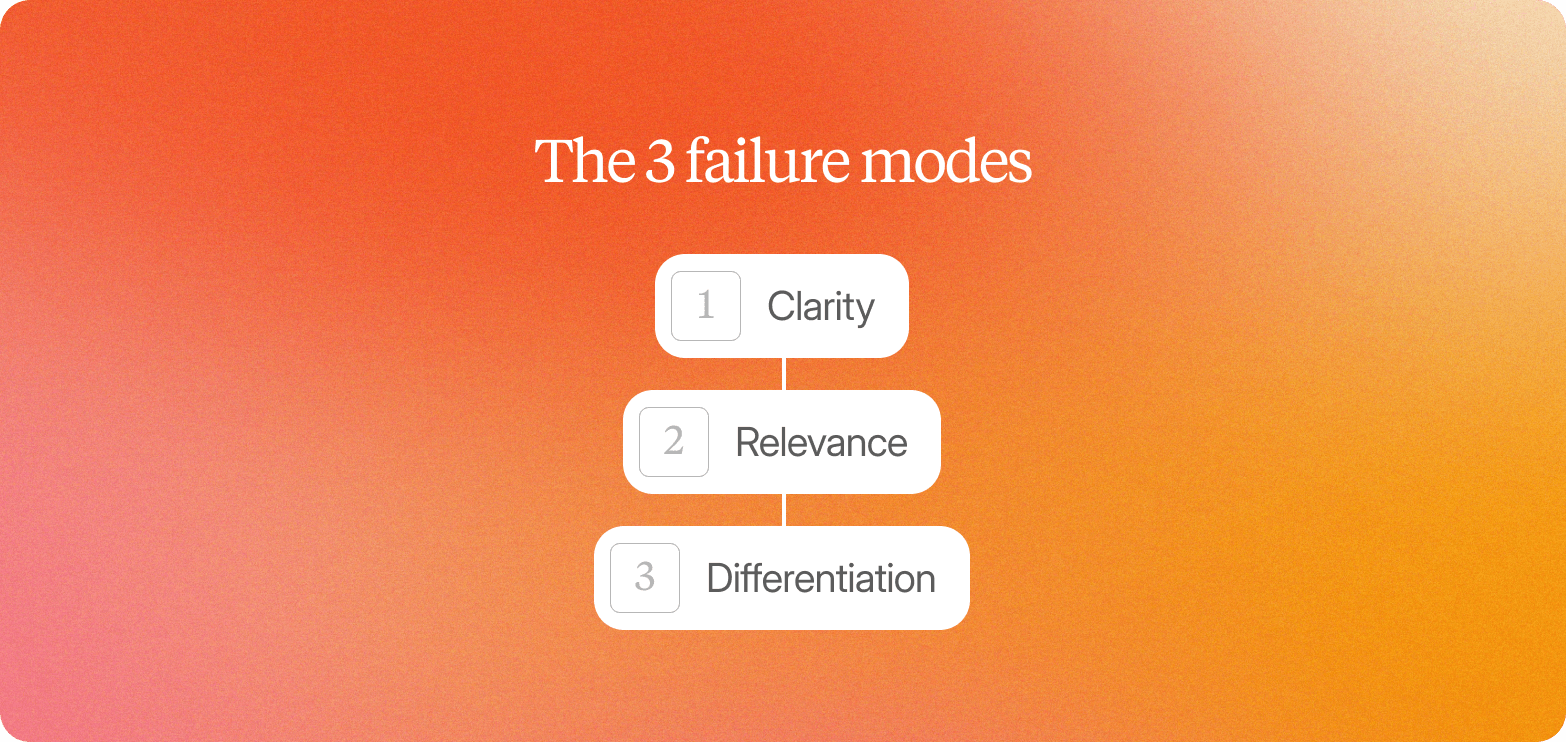
| Failure mode | What goes wrong | What it looks like |
|---|---|---|
| Clarity | Shoppers cannot explain what the brand does or stands for after reading the pack or the tagline | A yogurt brand's "gut health made simple" platform line gets read as a supplement claim rather than a breakfast yogurt, because it signals nothing about the category, the format, or the occasion |
| Relevance | Copy is written from formulation or manufacturing outward rather than from shopper motivation inward | The message describes what's in the product without naming the reason a shopper picks it up in the first place |
| Differentiation | The message describes the category but never answers the displacement question | An on-pack claim like "no artificial preservatives" describes something half the shelf already says, and doesn't explain why a shopper would switch |
In all three cases, the brand promise is intact internally and unreadable externally.
Why surveys can't tell you what your brand messaging actually says
The default approach to brand messaging research is familiar: run a survey, ask participants to rank variants of your key messages, collect clarity ratings on a 1-to-5 scale, and declare a winner. It's fast, scalable, and gives everyone in the room a number to point to.
| A survey score tells you | A survey score leaves out |
|---|---|
| Which variant scored highest | How your target audience interpreted the words they rated |
| Which claim was rated most clear | What associations they brought to the language |
| Which headline drew the most positive sentiment | Whether a claim marked "clear" is believed or merely tolerated |
Surveys capture reactions and miss the reasoning: a score can hide misreads, comprehension gaps, or the exact phrase that triggered quiet resistance.
Conversational research changes what's available to you, and Conveo is built to fill that gap: video depth interviews capture hesitation and tone shifts that reveal whether a claim is genuinely accepted or politely endorsed. Branding and messaging research done in conversation gives you the reasoning behind the reaction along with the reaction itself.
Depth interviews, typically 30 to 45 minutes, let a moderator paraphrase a claim back and push past the polished first answer. Focus groups introduce a different dynamic, since social pressure and the loudest voice in the room shape the group's stated views; for evaluating copy line by line, individual interviews produce cleaner signals.
Without that conversational depth, marketing leaders optimize for the highest-scoring variant without knowing whether it communicates their intended message. The score improves. The misread stays.
The 4 dimensions every brand message must pass
When brand messaging fails, the usual cause is a test that covered only one or two of the four dimensions that determine whether a message works. Clarity, relevance, differentiation, and emotional resonance are the essential components of any working brand messaging framework.
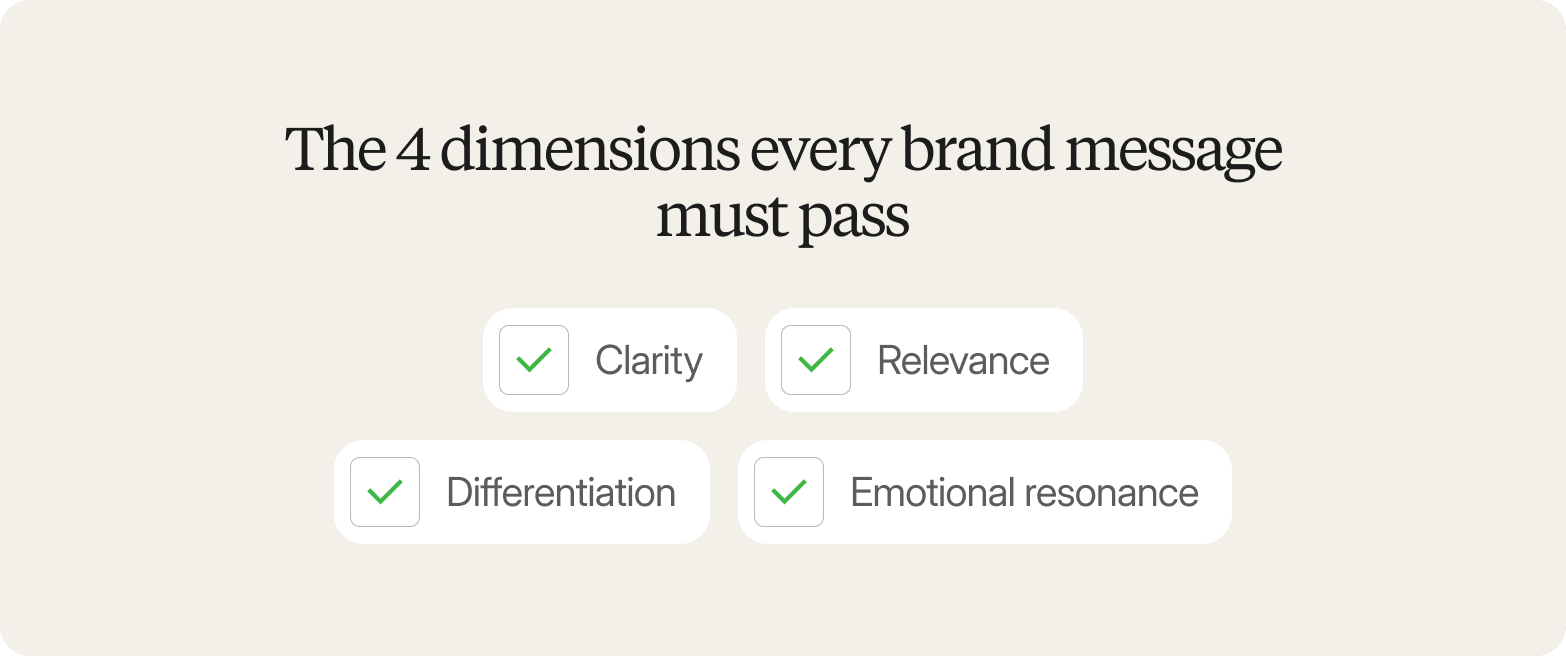
| Dimension | The buyer's question | What breaks when it's missing |
|---|---|---|
| Clarity | "What does this company actually do?" | The message creates confusion and never gets repeated |
| Relevance | "Is this about my situation?" | The message gets ignored rather than rejected |
| Differentiation | "Why choose this over what we already use?" | The incumbent wins on relationship and inertia |
| Emotional resonance | "Why should I care about this now?" | The message is read, acknowledged, and deprioritized |
A messaging framework that only checks two of the four will keep passing copy that was never checked on the other two.
Clarity: can a stranger restate the brand promise?
Clarity is whether a shopper can explain what a brand does or stands for in their own words after reading the pack or the tagline, without relying on brand familiarity or prior context, and can do so closely enough to repeat it to a friend at the shelf. A claim a shopper cannot restate in a sentence won't be remembered at the point of purchase or used to justify choosing one brand over another. A yogurt line positioned as "gut health made simple" finds shoppers assume it's a probiotic supplement rather than a breakfast yogurt: internally logical, externally opaque.
Relevance: does it describe the buyer's problem or the product's features?
Relevance is whether the message reflects the shopper's stated motivations, rather than being written from formulation or ingredient list outward. The test is whether your target consumer reads it and thinks "this is for me" or "this is a product description." Generic claims like "made with real ingredients" fail here, as they describe no shopper segment's actual reason for buying and serve as a placeholder rather than a unique value proposition. When relevance is missing, the message gets ignored rather than rejected.
Differentiation: does it answer the displacement question?
Differentiation answers "why choose this over what we already use?" rather than describing the category generically. Whether a claim differentiates depends on the specific brand making it. Undifferentiated messaging loses to the incumbent on shelf by default, since the incumbent already has the habit and the trial. "No artificial preservatives" describes something several competitors already say; reframing around the specific occasion or outcome the product delivers changes the competitive question entirely. In a crowded category, selling points every brand shares stop working, and brand positioning collapses into price and shelf presence. A strong brand can absorb an undifferentiated claim for a while on loyalty alone. A challenger cannot.
Emotional resonance: does it give the buyer a reason to care?
Emotional resonance is whether the message triggers the intended response: urgency, relief, confidence, or ambition. This is where brand voice and brand personality do real work, since the same claim delivered flat and delivered with conviction produce very different recall. Ingredient callouts that read like a spec sheet ("now with 20% more protein, added electrolytes, zero sugar") are accurate and completely inert. No emotional connection forms around a nutrition panel.
Why internal review misses two of the four
Clarity and emotional resonance get caught internally because they're visible in a room. Relevance and differentiation are harder to assess, because the people reviewing the message already know the product and already understand why it beats the alternative. Those two only surface when tested with the actual ICP, by people with no reason to be generous with their interpretation. Strong messaging passes all four; few messages ever get checked against more than two.
How to test brand messaging before it ships
The operational half of a brand messaging strategy is straightforward: test while the copy is still being drafted, before it has shipped. Doing this during the drafting stage means gaps surface in time to fix them, rather than appearing as performance problems months after launch.
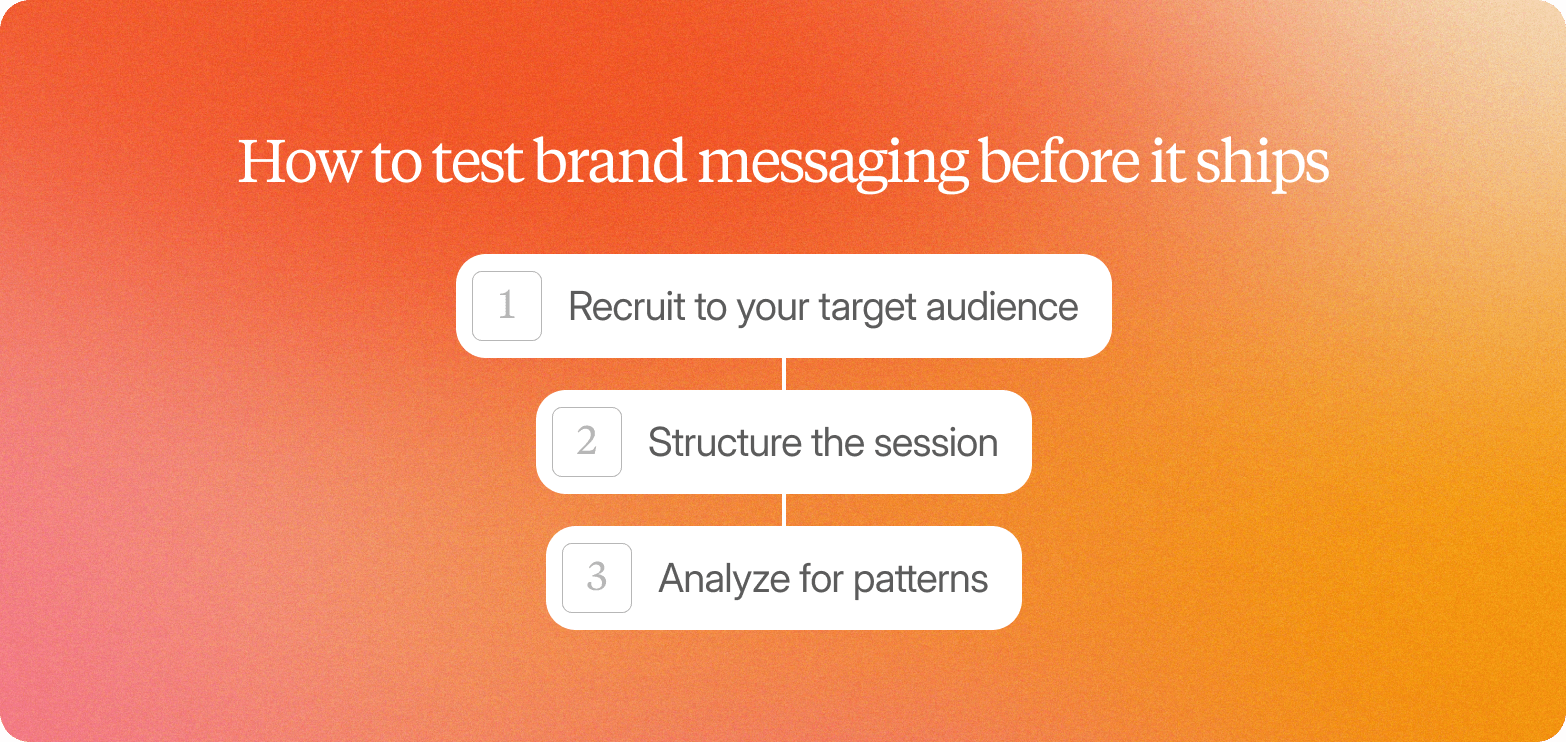
Recruit to your target audience
Broad samples introduce noise that's misleading for niche category messages, because a participant who doesn't buy in the category can't tell you whether the framing lands. Match participants to the actual target consumer profile, category usage, purchase frequency, demographic, and exclude those already familiar with your brand, since familiarity bias inflates comprehension.
Watch the walkthrough: how to run AI-moderated video interviews.
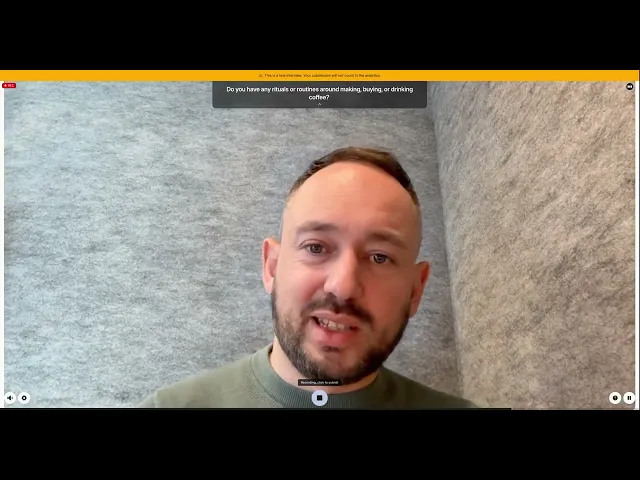
Structure the session in three stages
| Stage | What you're testing | The question to ask |
|---|---|---|
| 1. Baseline | The status quo the message has to beat | "What do you use today, and what would have to change before you'd switch?" |
| 2. Decoding | Clarity and comprehension | "What is this trying to say, in your own words?" |
| 3. Displacement | Differentiation and credibility | "What would this need to replace, and what would have to be true before you took it seriously?" |
The decoding question is the most diagnostic in a messaging test, and it works one level up too: testing a brand positioning statement means asking participants to restate it before asking whether they agree. Cap each session at three to four concepts; more introduces order effects.
Analyze for patterns
Track where comprehension breaks down across key messages, how participants rephrase claims, and which objections recur. Deliver findings as auditable evidence, direct quotes and timestamped clips, since stakeholders who weren't in the room can't evaluate a summary score.
"You see them physically doing it. Testing the product for the first time, being probed right there. That unfiltered, in-the-moment reaction is possibly the most powerful thing you can see as a researcher."
Dafydd Jones, Associate Director, Ninth Seat
Teams using Conveo catch this while the copy can still change, before a campaign has run, and iterate asynchronously across 50+ languages, so a multi-market brand messaging test doesn't have to wait for launch to surface a misread.
What to do with the patterns you find
Most brand messaging research ends with a ranked list of variants. What teams rarely know is what to change, because a ranking tells you the outcome of interpretation and hides the gap between what you intended and what participants heard.
The more useful output is a pattern log. Six patterns are worth tracking, and each points to a specific rewrite.
| What you logged | What it signals | What to change |
|---|---|---|
| Comprehension gaps. The same phrase misread by three or four participants | The language is doing something unintended | Replace the abstract phrasing with the concrete words participants used |
| Restated language. How participants explained your claim back | The vocabulary the market already uses | Build the claim, and often the brand story, from their phrasing |
| Repeated objections. The same concern in five interviews | A structural credibility problem rather than noise | Attach a quote, metric, or named proof point directly to the claim |
| High-resonance phrasing. Visible agreement, "that's exactly it" | Where the emotional connection is forming | Lead with it, and protect it through internal review |
| No displacement. Participants can't say why they'd switch | Differentiation is too vague to act on | Add a displacement statement naming the incumbent and the switching trigger |
| Flat reactions. The message lands as neutral | The problem is framed too abstractly | Reframe the problem statement before touching the headline |
Restated language is usually the most valuable raw material in the study: customers show you the vocabulary they already use to describe the problem. A company's slogan carries the most compression risk of any asset you own, since there's no room to explain a phrase the audience doesn't already recognize. Strong brand messaging is assembled from language the market is already using.
High-resonance moments disappear in a transcript, which is why video matters; it's where the emotional connection becomes visible. The goal throughout is to understand the gap between intent and interpretation, then rewrite to close it.
How to build brand messaging from customer evidence
Most brand messaging is written from the product outward, grouping capabilities into pillars that mirror the business model rather than the buying decision, a brand strategy problem before it's a copywriting one.
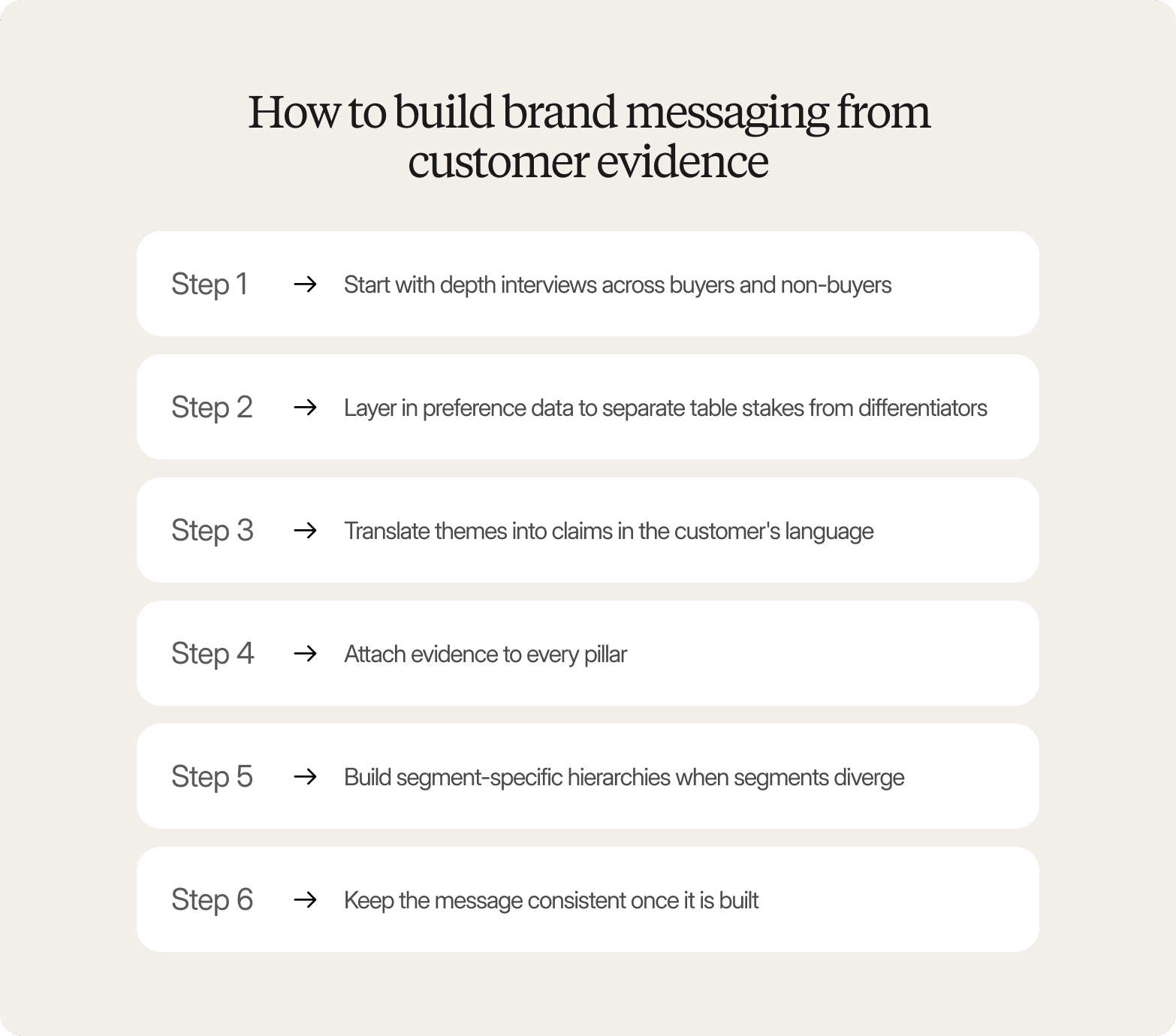
The alternative is customer evidence: qualitative themes paired with preference data and the reasoning behind it, gathered in the same session. Every claim, from positioning and value proposition to a headline, can be traced back to a real customer statement.
1. Start with depth interviews across buyers and non-buyers
Run separate conversations with recent buyers and lapsed or lost-to-competitors shoppers to surface the language they use to describe the problem and the criteria they use to evaluate options. Language that recurs unprompted earns a place in the messaging architecture.
Note what does not belong there: a mission statement, a vision statement, and a core values document all describe the company to itself, reasonable inputs for internal brand values work and poor inputs for external copy, since none were written to be read cold by a comparison shopper.
2. Layer in preference data to separate table stakes from differentiators
Trade-off exercises like MaxDiff tell you which claims matter most when customers are forced to choose. Conveo's MaxDiff tells you why: follow-up probes in the same session separate claims that feel important from those that actually move decisions, and show where different value propositions land. Setup details are in the MaxDiff questions guide.
3. Translate themes into claims in the customer's language
When a theme surfaces across multiple interviews, say "we needed to move faster but couldn't sacrifice rigor," the workable claim keeps both halves of that tension: rigorous depth interviews without the agency queue. Abstract phrasing like "efficient qualitative research" loses the specific tension customers named.
4. Attach evidence to every pillar
Each claim should carry a proof layer: a direct quote, a timestamped clip, or a segment delta from the MaxDiff output. Messaging without attached evidence is aspirational; messaging with attached evidence is auditable. The key elements of the finished framework remain the same in every case: a positioning claim, three to five pillars, and a proof point for each.
5. Build segment-specific hierarchies when segments diverge
When younger shoppers prioritize sustainability claims while value shoppers prioritize price, a unified message serves neither. Build separate hierarchies for each segment, grounded in evidence specific to that market segment.
6. Keep the message consistent once it is built
Consistent messaging is an operational problem more than a creative one. When sales teams work from last quarter's deck while content marketing publishes the new framing, buyers who see both learn the claims are negotiable. Update the source of truth first, then cascade: the messaging framework, a brand style guide entry per pillar (claim, proof point, brand voice notes, phrasing to avoid), then website copy, sales enablement, and campaign briefs.
A short style guide entry keeps brand messaging consistent across marketing channels, from the website to social media platforms, better than a quarterly reminder. Language is the part of brand identity that drifts fastest; the same discipline governing visual identity applies here: brand consistency across marketing materials, social media posts, and a blog post six months out compounds into brand recognition.
Teams running this process on Conveo get both halves in one workflow: the depth interviews that surface the customer's own language, and the preference data that tells you which claims actually move a decision.
Where Conveo fits in testing brand messaging before it ships
Messaging fails when the only evidence behind it is an internal read or a survey score, and holds up when every claim traces to something a real participant said. That's the always-on discipline Conveo is built around, with rigor as the reason the evidence is trustworthy.
The advantage compounds in two ways. First, on timing: a misread surfaces while the copy can still change, before a campaign has run and the budget is spent. Second, on accumulation: language and objections logged from one messaging test inform the next, so teams testing brand messaging repeatedly aren't starting from zero, and a searchable insight library keeps that evidence usable as market trends move. Messaging otherwise lags behind a company's development; the product moves faster than the copy.
Supporting both: Conveo's depth interviews run asynchronously across 50+ languages, so a multi-market test doesn't wait weeks to surface a problem, and each finding is backed by a timestamped clip instead of an aggregated score nobody can interrogate. Layer in Conveo's MaxDiff, pairing preference ranking with AI-moderated probing in the same session, and a team gets what customers prefer and why, before a headline ships.
In summary, brand messaging is a research achievement more than a writing one, and it compounds: every test makes marketing efforts cheaper to plan because the language that works with new customers is already documented. For most teams, the gap between intent and interpretation is a quiet drag on a business's success, showing up as underperforming campaigns rather than a messaging problem.
Frequently Asked Questions
What is brand messaging?
Brand messaging is the set of claims, proof points, and language a company uses to explain what it does, who it serves, and why it matters, designed to withstand external scrutiny by prospects who arrive cold. It encapsulates what the brand stands for in language a stranger can decode on first read.
Why do surveys fail to catch messaging problems before launch?
Surveys capture reactions and miss the reasoning behind them. A message can score well and still fail because the score doesn't surface misreads or the phrase that triggered quiet resistance.
What are the four dimensions a brand message needs to pass?
Clarity, relevance, differentiation, and emotional resonance. A framework that only checks two of them keeps approving copy that was never tested on the other two.
When should brand messaging be tested?
While the copy is still being drafted, before it ships. Depth interviews during drafting surface comprehension gaps in time to fix them, rather than as performance problems months after launch.
What should teams log from a messaging test instead of just a winner variant?
A pattern log across six categories: comprehension gaps, restated language, repeated objections, high-resonance phrasing, missing displacement statements, and flat reactions. It shows what to change as well as which variant won.

About the author
Florian Hendrickx
Head of Growth
Florian is Conveo’s Chief Growth Officer, leading growth strategy and go-to-market execution as the company scales. He’s held growth leadership roles at companies like Deliverect, Robovision, and Aikido Security, and brings hands-on experience across marketing, sales, and product.
More by Florian →Qualitative insights at the speed of your business.
Conveo runs AI-moderated video interviews and structures everything they say.