In this article
TL;DR
Brand name testing is market research that measures how a candidate name performs with your target market on comprehension, memorability, trust, distinctiveness, and preference, capturing why a name works and which one scored highest.
The search for the right brand name usually ends in a workshop vote or preference poll, which picks a winner without surfacing the associations or category mismatch that sink it after launch.
Pairing scores with adaptive probing from the same participants catches naming risk while the shortlist of potential names is still open.
Most naming teams have plenty of internal opinion about a shortlist and little evidence from the consumers who will meet the name. This guide covers what brand name testing measures, an eight-step framework for running it, where researcher judgment decides the call, and the mistakes that let a weak name through.
When a workshop vote becomes a costly naming mistake
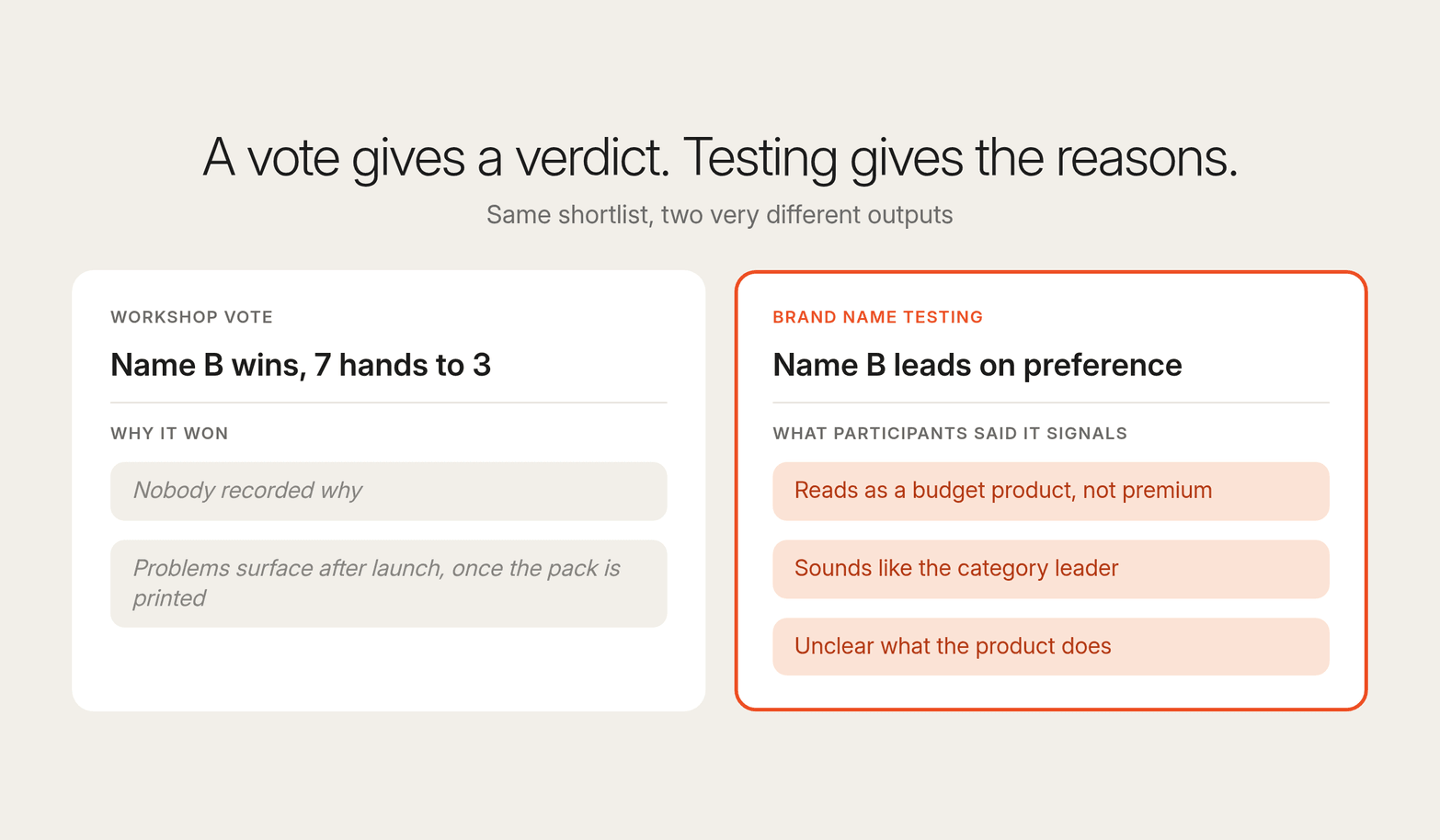
The search for the perfect brand name usually ends in a workshop: four potential brand names on a slide, a show of hands, and a winner everyone can live with. Nobody records why. The room skipped brand name testing, a form of naming research that asks the target audience what a name signals before it ships.
A preference poll captures a ranking but never asks why. A name can win the vote while signaling the wrong category, confusing shoppers about what the product does, or attracting the wrong audience. Survey design alone can't fix that, because a closed question returns a choice without the reasoning.
The workshop setting makes it worse. Nobody in the room is incentivized to probe past a show of hands, and polite agreement can hide a negative reaction that one follow-up question would have exposed. Those problems surface after launch, once the packaging is printed and the domain is bought. For a new brand, that cost lands before it has earned any reputation to absorb it.
What brand name testing actually measures
Brand name testing is market research that measures how a candidate name performs with the target audience on five key metrics. Preference is the only metric a ranking poll captures, so a naming study should collect all five, with each score coming from the same participant.
| Metric | What it tests | Captured by a preference poll? |
|---|---|---|
| Comprehension | Participants can say what the products or services are, who they serve, and which brand values the name signals | No |
| Memorability | Participants can pronounce the name and recall it after seeing other options, an early read on brand recall | No |
| Trust | Participants find the name credible for its category and price point | No |
| Distinctiveness | Participants see the name as separate from other brands in the category | No |
| Preference | Participants favor the name over alternatives | Yes |
A well-chosen name holds up on all five. To determine where a name falls short, ask participants what each name suggests about the offering, audience, price tier, and experience. That question also catches the quietest risk: a name that sounds familiar in the wrong way, interchangeable with brands already on the shelf. Distinctiveness is where a strong brand name builds its competitive advantage, the same question brand positioning research asks of the whole brand.
An 8-step framework for testing names with real audiences
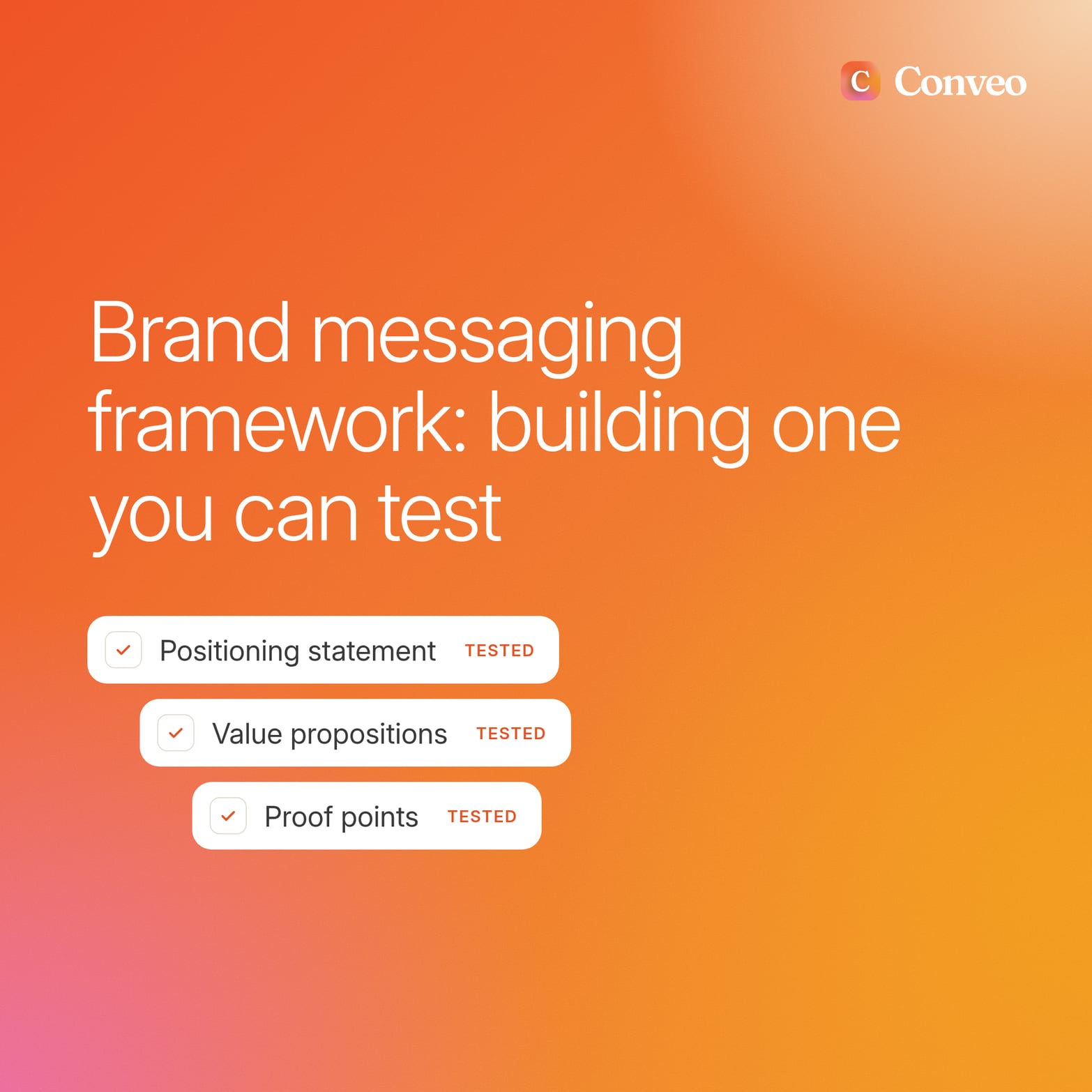
Brand name testing runs in eight steps: write the brief, recruit consumers, set a category baseline, show each name on its own, score and probe, ask what each name suggests, run a head-to-head, and group the reasons by theme. A researcher can use it to conduct brand name research this week, whether the shortlist is for a new brand, a company name, or an existing business renaming a line.
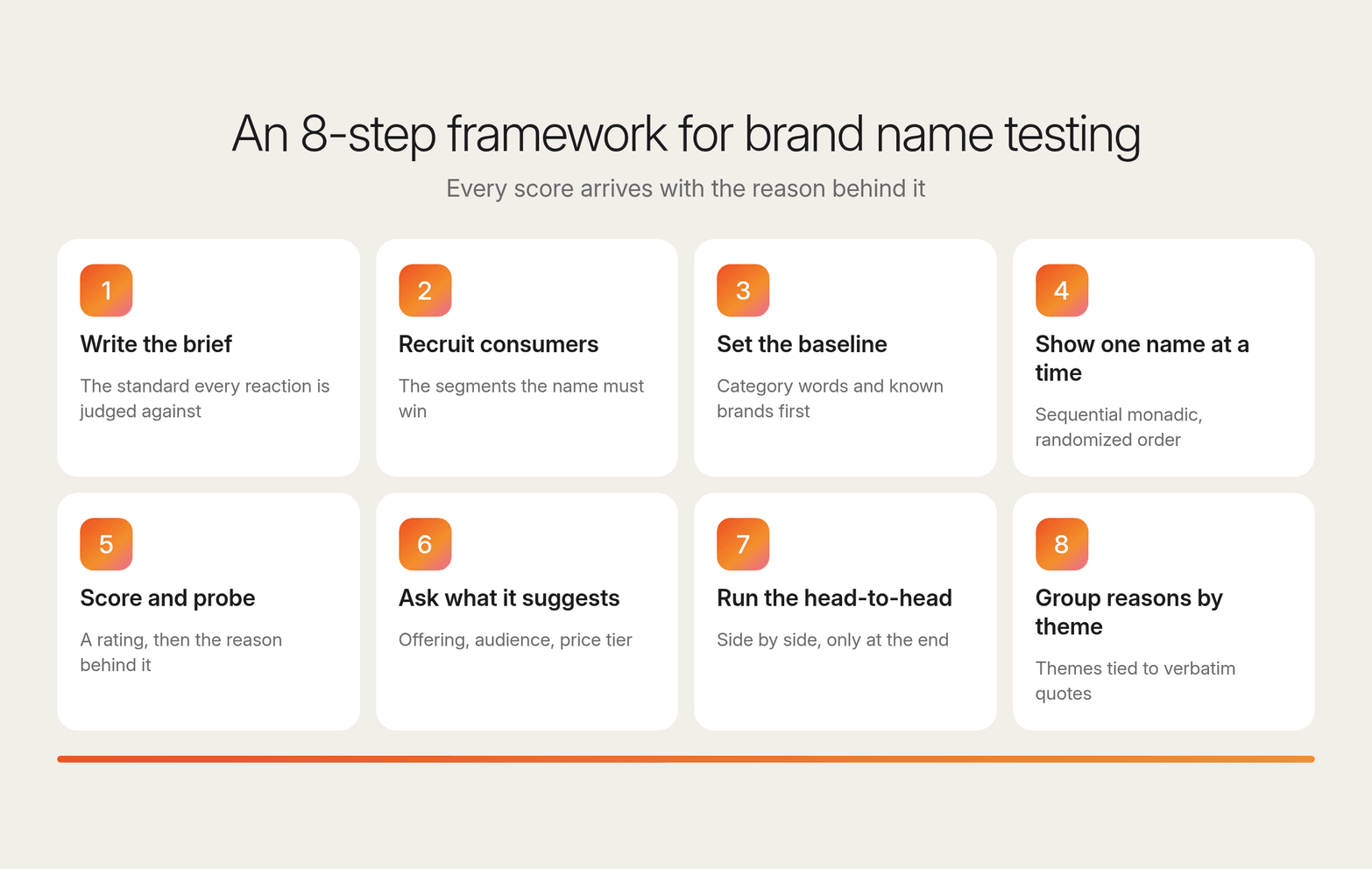
Write the naming brief as a test standard. First, list what an effective brand name must signal about category, audience, and price tier, and what would disqualify it. Judge every reaction against this standard and the brand's objectives.
Recruit the consumers the name must win. Testing brand names with real audiences means screening for the relevant segments, including category users who already know competitors. Colleagues know the strategy, so they cannot stand in for potential customers.
Set the category baseline first. Before showing any name, ask participants how they describe the category and which brands they know. If you're renaming, include the current brand name as a benchmark against what customers already recognize.
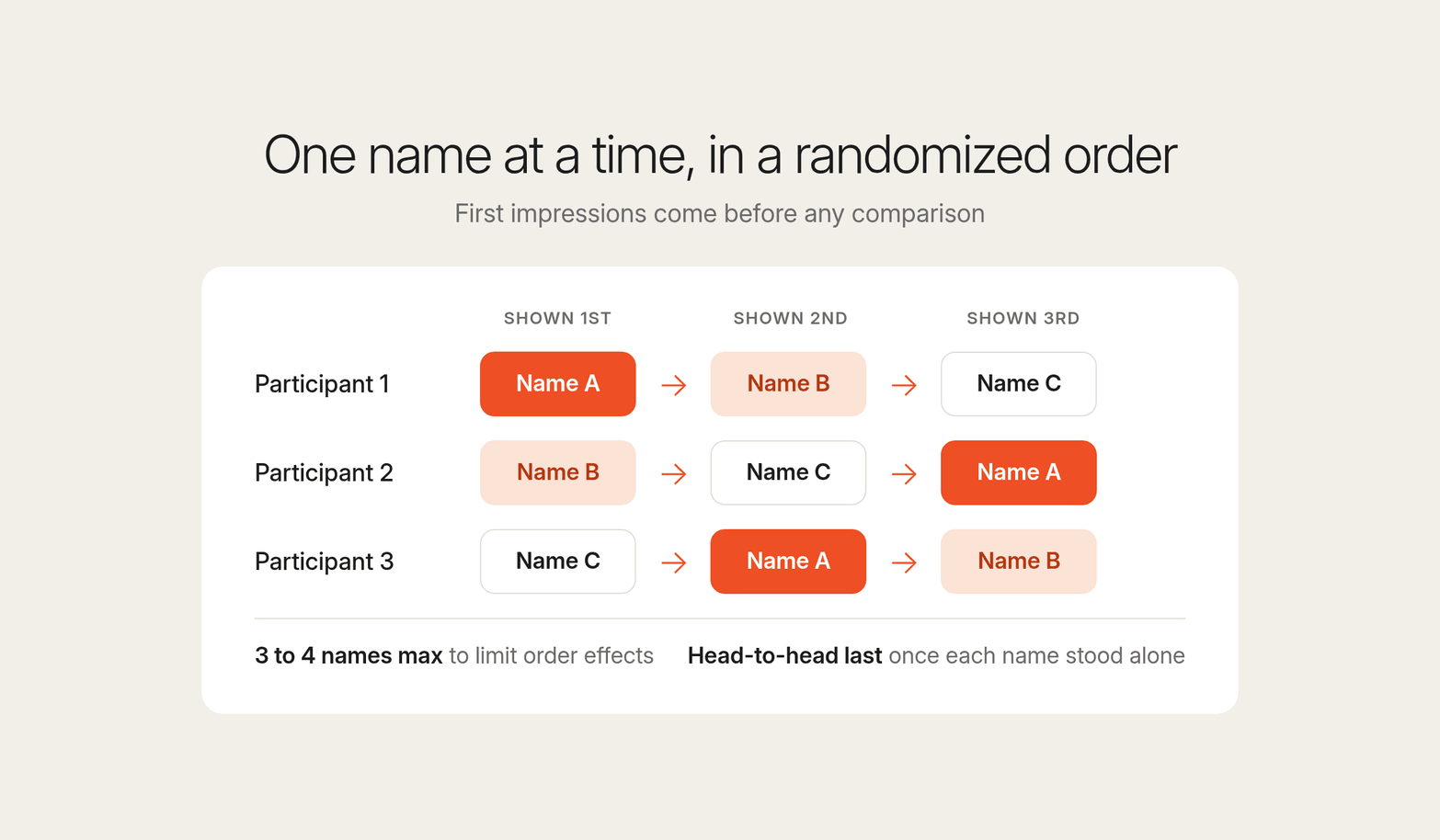
Show each name on its own. Use sequential monadic testing: present a single stimulus, one name at a time, and capture first impressions before any comparison. Cap the set at three or four names to limit order effects. Conveo can show each name one at a time in a randomized order across participants.
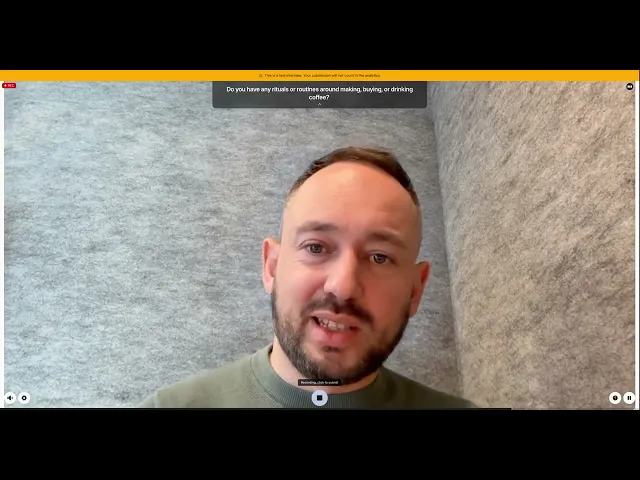
Score and probe in the same moment. Ask for a rating on comprehension, trust, and appeal, often on a Likert scale, then ask for the reason behind it. For example, if a participant says a name feels "off," follow up by asking what it reminds them of. Conveo's AI research assistant asks follow-up questions when an answer is vague or leaves a gap, building on what the participant said earlier.
Ask what each name suggests. Have participants describe the offering, audience, price tier, and experience each name implies, and which ideas it brings to mind. Gaps between their description and your brief identify the risks a poll never shows.
Run the head-to-head last. Show the names as multiple stimuli side by side, ask which one participants would advise the brand to launch, then ask what risk the weakest option creates.
Group the reasons by theme. As the final step, analyze explanations across participants, and cluster them into themes tied to verbatim quotes. Vote counts say which name led, while themes say whether it should.
Where researcher judgment still decides the naming call
AI-moderated interviews can surface what a name signals to each participant, and the success of brand name testing depends on how a researcher interprets those signals. A trained researcher still makes three critical decisions: guide design, probe depth, and reconciling conflicting reactions before a recommendation reaches stakeholders.
The researcher also frames the category language and competitor set, which significantly affects whether the results mean anything. Conveo runs the video conversations and organizes participants' responses, freeing researchers for analysis and interpretation.
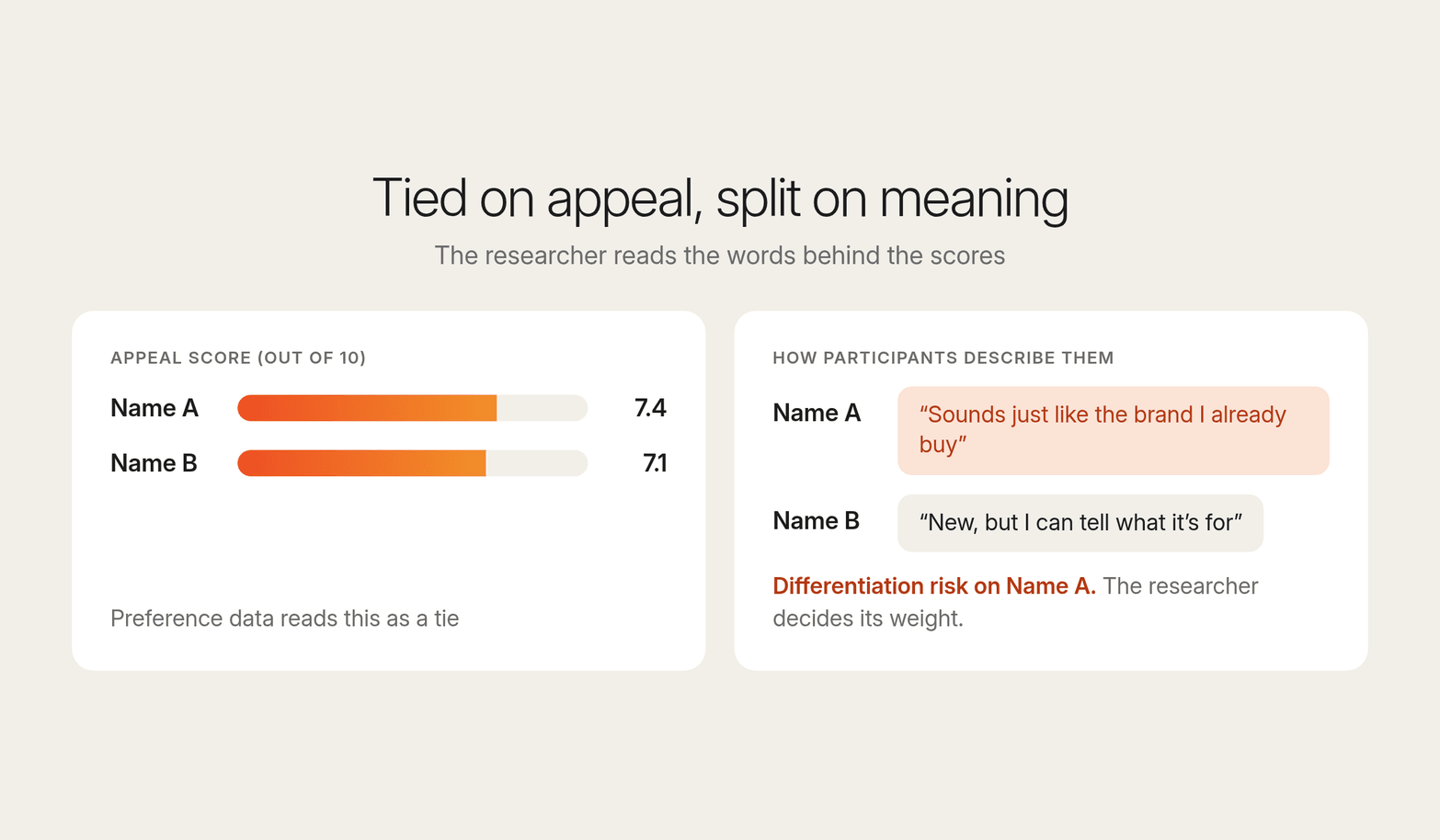
In a representative example, two names score within a point on appeal, but participants describe one with the words they use for an established competitor. The preference data treats them as tied. A researcher running thematic analysis on the verbatim evidence sees a differentiation problem and decides how much weight it carries in the final call.
Brand name testing in practice: 3 naming decisions
Brand name testing pays off when it catches a failure a preference poll would have scored as a win. The scenarios below are representative, built from common naming patterns rather than client results. Each looked like a successful brand on paper, and each shows one of the different types of failure a ranking hides.
Representative scenario 1: the wrong price tier
A consumer brand shortlists three names for a premium skincare line, and the front-runner wins on appeal. Asked what the name suggests, participants describe a drugstore product, a lower price point, and a quick routine. The team would have launched a premium line under a budget-sounding name, then spent a year correcting the brand perception it created.
Representative scenario 2: clear, liked, and interchangeable
A fintech company tests names for a savings app. One name scores well on clarity and appeal, but most participants cannot say how it differs from the category leader they named during the baseline, and several mix the two up. The launch budget would have built brand recall for a competitor.
Representative scenario 3: "interesting," decoded
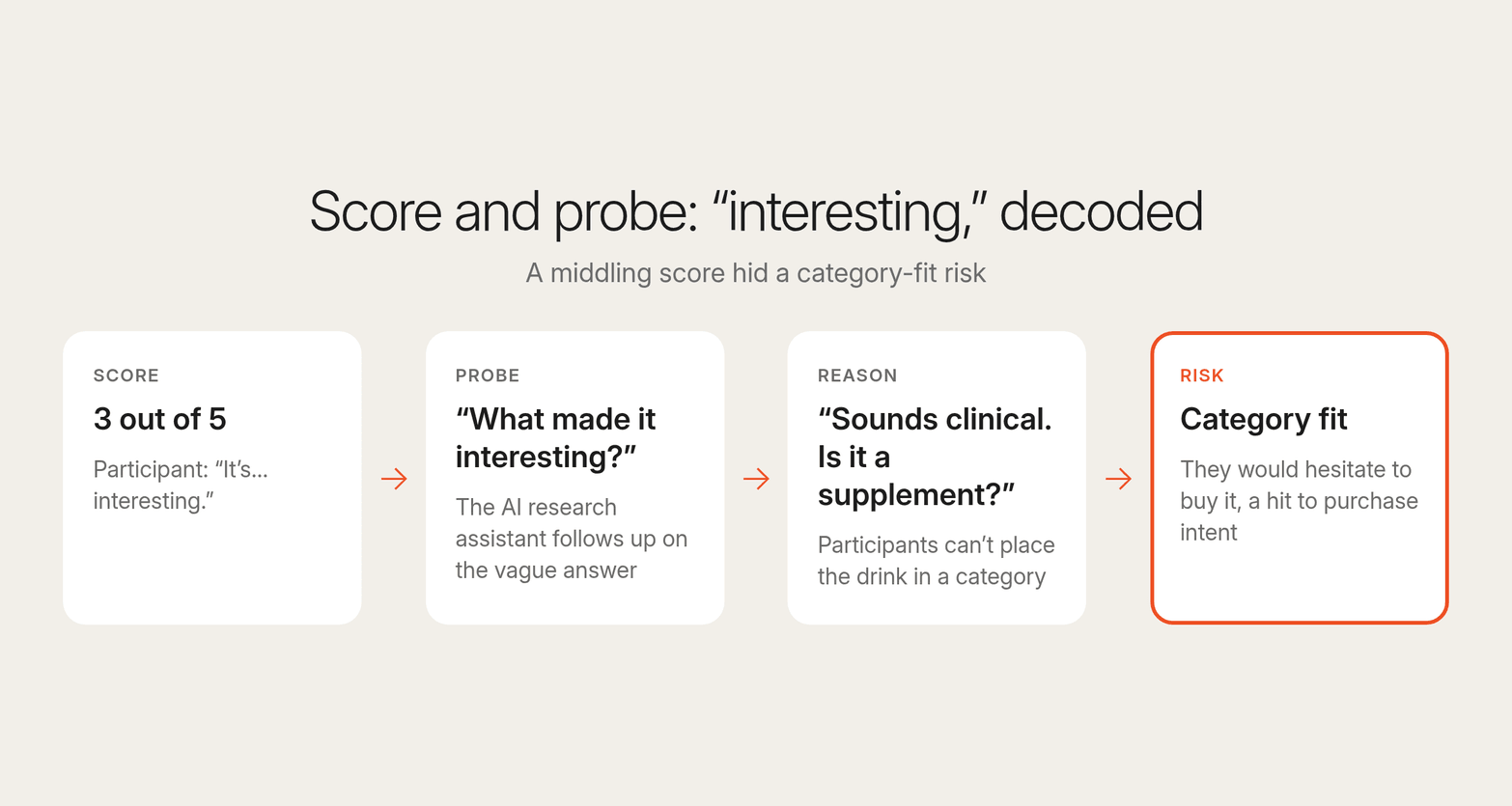
A beverage team tests four names one at a time. On one candidate, participants keep saying "interesting," which a closed-ended Likert scale would have logged as a middling score. The AI research assistant would ask what made it interesting, and participants describe a name that sounds clinical, with some unsure whether the drink is a supplement. They said they would hesitate to buy something they couldn't place in a category, a direct hit to purchase intent. A name has to motivate people to try the product, and this one gave them a reason to pause.
Watch how an AI-moderated follow-up works in a live session:
5 common brand name testing mistakes that let a weak name through
Most brand name testing mistakes share a root cause: the study collects a verdict without the reasons behind it.
Ranking names without asking why. A preference ranking hides confusion and category mismatch until the market reports them. Follow every rating with an open question so customer feedback arrives with its reasons.
Testing too many names at once. Beyond three or four names, clarity drops and order effects creep in. Split larger shortlists of potential names into separate cells.
Skipping competitor context. A name can rate as clear and appealing while sounding interchangeable with other brands. Given the importance of that baseline, capture category awareness before any name appears.
Showing the name as a bare word. Shoppers meet names on a pack, a shelf, or an app store listing. Show each name in a realistic setting, the way packaging research shows a pack on a shelf.
Treating an online poll as research. Moving a brand name testing survey online makes it faster to field, but respondents still answer a closed-ended scale with no follow-up.
"The only time you could do in-the-moment moderation was if I was doing it myself, in someone's home, in a focus group. Coming back two hours later on a community platform, some people have forgotten their point."
Dafydd Jones, Associate Director, Ninth Seat
Each fix moves the evidence ahead of any soft launch, while switching to the right name still costs nothing but a revised brief.
Why Conveo fits naming research under a launch deadline
Brand name testing has to fit inside the launch calendar, or teams fall back on the workshop vote. With Conveo, naming teams keep the deadline and trade the poll for real consumer feedback before the name locks. For questions that stay open across a launch runway, Conveo StoryLines runs the same core questions in waves, for example every two weeks or monthly, showing where brand perception of a shortlisted name moves.
Each theme links to the participants behind it, with video clips and verbatim quotes stakeholders can audit. The platform recognizes recurring themes and facets across studies in a searchable insight library, so the next shortlist builds on what earlier naming research established.
The AI research assistant works in 50+ languages, so teams can test the same shortlist across markets at the same time without coordinating separate local agencies. Conveo is SOC 2 Type II certified, GDPR-compliant, and offers EU data hosting, which procurement asks about first.
For the executive signing the launch budget, a name that changes after a soft launch takes packaging, domains, media, and whatever reputation the business built with it. Asynchronous interviews run in parallel across segments and time zones, so you can complete 100 interviews in 3 days, leaving room for an informed decision before brand identity work locks.
Frequently asked questions
How does brand name testing online work?
Online brand name testing now means asynchronous, AI-moderated interviews that probe associations and category fit, rather than a digital brand name testing survey. Participants react to each name on video, and the AI research assistant follows up on what they say. That adaptive probing turns a vague reaction like "interesting" into specific evidence about credibility and purchase intent, something static survey respondents never get.
What is the best brand name testing approach?
The best brand name testing approach pairs preference ranking with structured qualitative probing into associations, category fit, and distinctiveness, all from the same participants. First, show each name as a single stimulus to capture honest first impressions. Participants then describe what each name suggests about the offering, audience, and price tier. The session closes with multiple stimuli side by side, asking which name participants would launch and what risk the weakest option carries.
How many names should you test at once?
Test three or four names per brand name testing session. Beyond that, fatigue sets in, and order effects favor whichever name appeared first. Split larger shortlists into separate cells so the data stays comparable.
Does brand name testing work for global launches?
Yes, brand name testing works for global launches, provided each market gets its own participants and category baseline. The AI research assistant works in 50+ languages and shows stimuli in each participant's language. Recruitment runs through 8 integrated panel providers plus your own participant lists, so a team can field the same shortlist in every market at once. Local category language is the critical variable. A name that reads as premium in one market can sound clinical or prove hard to pronounce in another, and only participants from each target market can identify which.
How is brand name testing different from a focus group?
A focus group, the classic market research format, gathers group feedback in real time, which is useful when the team wants to hear debate. AI-moderated interviews are a key [alternative to focus groups](/insights/alternatives-to-focus-groups): each participant can provide feedback without hearing anyone else first, so group influence doesn't shape the initial read. Many naming teams use both, choosing based on what the decision needs.

About the author
Meg Gerli
Research Impact Lead
Meg is a Research Impact Lead at Conveo, working with insights and research teams on the studies they run with Conveo.
Meet Meg on film →Qualitative insights at the speed of your business.
Conveo runs AI-moderated video interviews and structures everything they say.