

TL;DR
Brand positioning research measures whether your strategic territory feels ownable, differentiated, and credible to real customers, upstream of both brand tracking and concept testing.
It breaks down when run the traditional way: sequential agency fieldwork arrives after the campaign brief is already written, using traditional methods that were never built for how fast strategic decisions actually move.
Four core methods each answer a different question and play a key role in a strong positioning program: IDIs (language and emotional drivers), focus groups (competitive positioning), perceptual mapping (whitespace), and ethnography (behavior vs. stated preference).
Video-first AI moderation lets teams run hundreds of positioning conversations in parallel, with traceable video evidence, in days rather than weeks, so market research findings inform strategic decisions while the decision window is still open.
The deliverable matters as much as the method: territories with proof, language banks, context-linked maps, and stakeholder-ready storylines get used; a 40-slide deck gets skimmed once.
Positioning debates stall when teams lack traceable consumer evidence. Everyone has a view on which marketing messages will land, which target market to prioritize, or which brand territory to own, but without real customer conversations to anchor the room, those debates rarely resolve into informed decisions anyone will defend. Brand positioning research exists to break that deadlock, but the traditional workflow for running it creates its own problem.
Rigorous positioning market research typically requires multiple qualitative studies across audiences, markets, and message territories. Run through an agency using traditional methods, each wave takes 6 to 12 weeks and costs compound across geographies. For a team validating positioning before a campaign brief is locked, that timeline rarely fits how quickly strategic decisions actually move: the findings sound good, but the campaign has already shipped. Insights teams end up documenting decisions rather than shaping them, which is exactly why brand positioning research is important early, not after the fact.
What's changing is the infrastructure. Video-first AI moderation now makes it practical to run market research that collects positioning evidence from hundreds of real consumer conversations in parallel, with findings surfacing in 3 to 5 days, traceable to the source and structured for stakeholder review.
What Brand Positioning Research Actually Measures
Brand positioning research is the systematic process of understanding how target customers perceive a brand relative to competitors, and whether the strategic claims a brand makes land the way leadership intends. It answers a question neither a brand health tracker nor a post-campaign survey can: does our positioning territory feel ownable, differentiated, and credible to the people we're trying to reach? Good brand research also clarifies a brand's unique value proposition long before a single ad is produced.
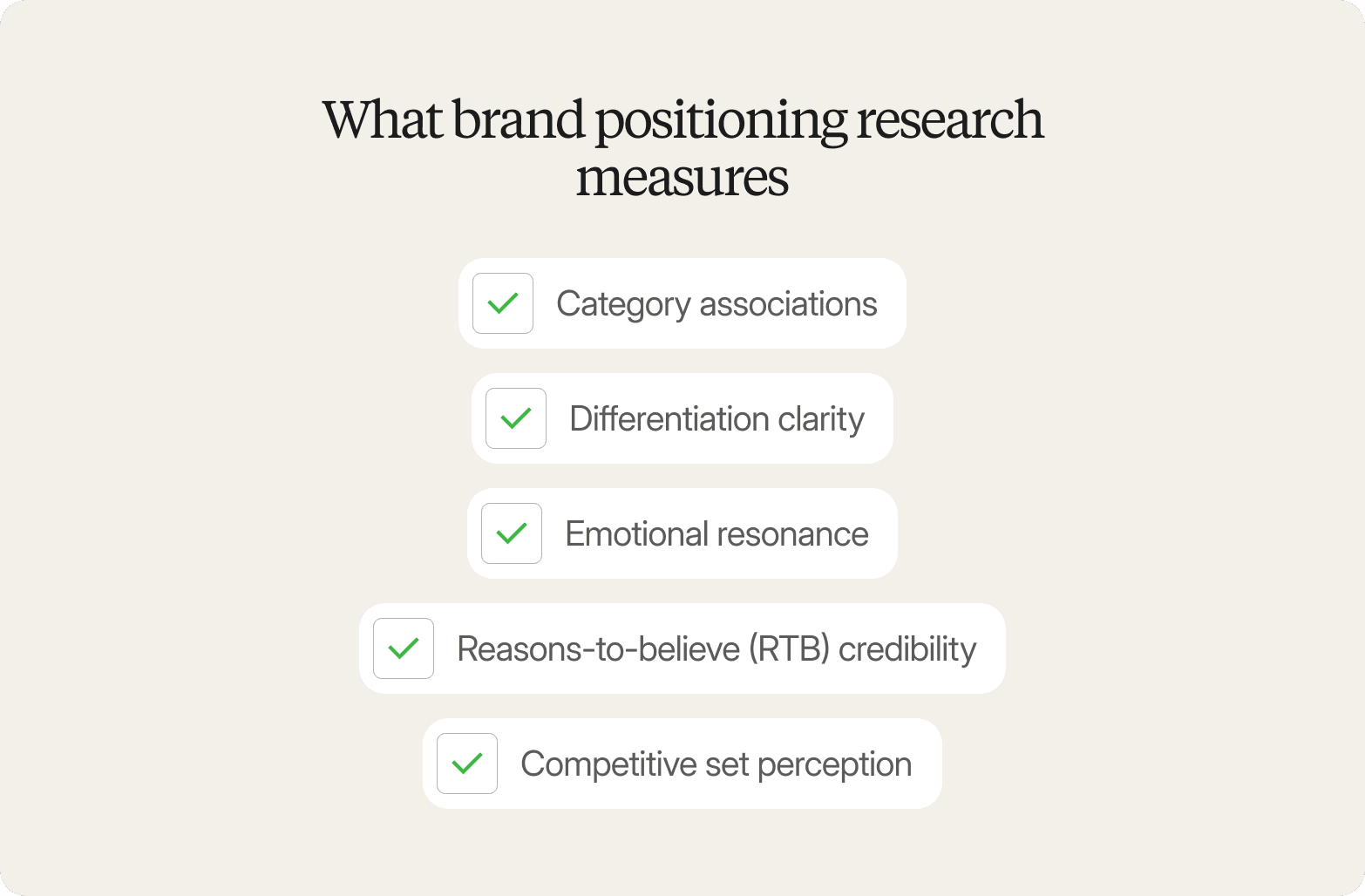
It measures five distinct things:
Category associations: the attributes consumers automatically associate with a brand, where brand awareness and category meaning intersect.
Differentiation clarity: whether consumers can articulate what a brand stands for relative to the two or three alternatives they would genuinely consider.
Emotional resonance: whether the positioning creates a felt sense of relevance, or reads as generic; this is where consumers feel a claim is authentic rather than performative.
Reasons-to-believe (RTB) credibility: whether the evidence a brand offers actually substantiates its claims and its value proposition.
Competitive set perception: which brands consumers mentally group together, which determines the real battle for competitive positioning, not the one assumed in the strategy deck.
This is distinct from two adjacent research types. Brand tracking monitors awareness and sentiment over time; it tells you whether equity is rising or falling, not why your brand perception is or isn't working. Concept testing validates specific executions- an ad, a pack design, a product name- against consumer reaction. Positioning research sits upstream of both.
A concrete example: a CPG brand considering a "sustainably sourced" platform in the same category as companies like Trader Joe's or Coca-Cola needs to know whether target consumers read the claim as authentic or greenwashing before investing in that territory. Positioning research answers that by probing the credibility of the RTB and which competitor already owns adjacent territory in the consumer's mind, work brand tracking cannot do, and concept testing does too late.
3 Reasons Traditional Brand Positioning Research Breaks Down
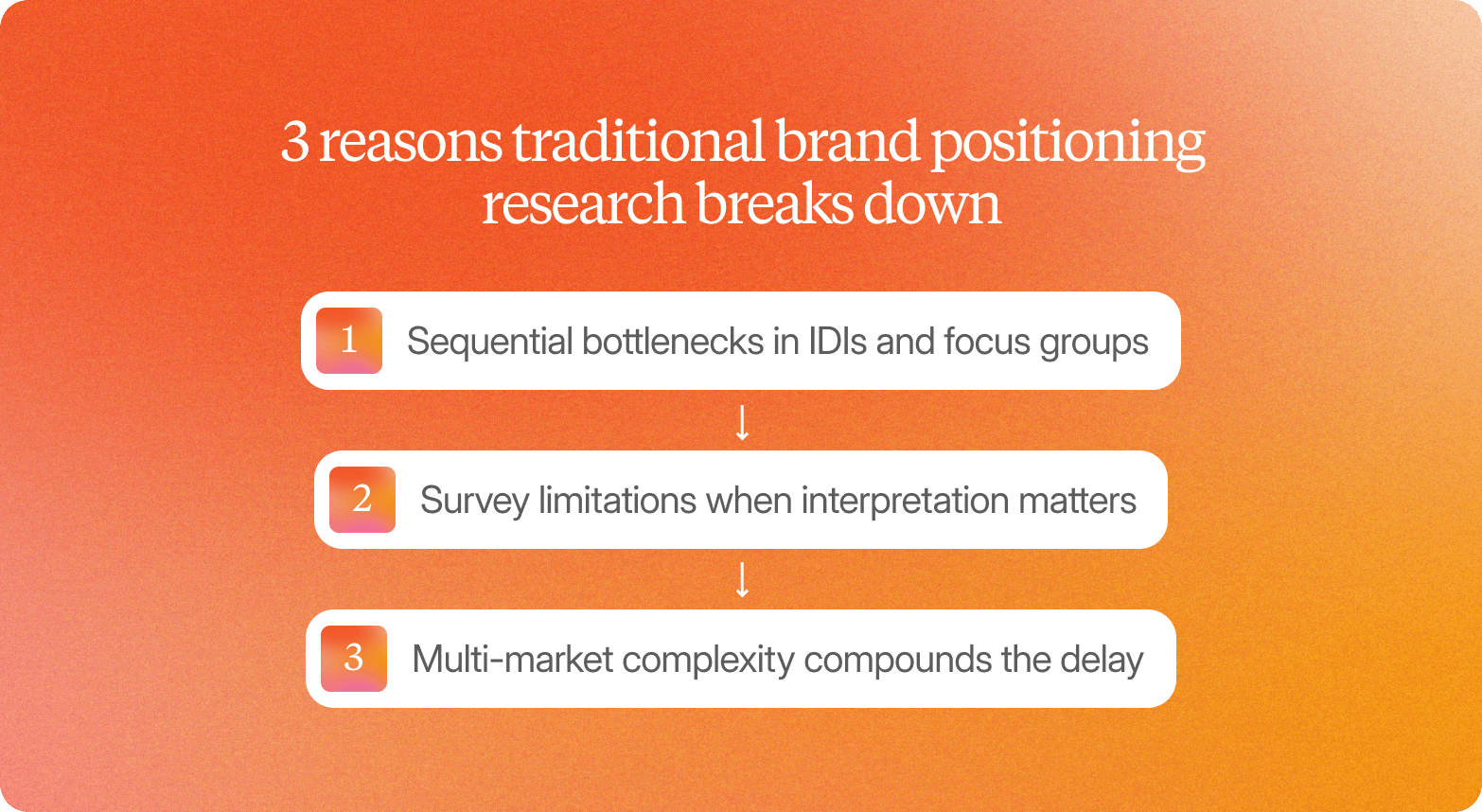
The challenge isn't the methodology. It's that the operational model built around agencies, scheduled focus groups, and sequential analysis, the traditional methods most brand research still relies on, was never designed to keep pace with campaign calendars.
Sequential bottlenecks in IDIs and focus groups
Classic in-depth interviews and focus group programs bottleneck at every stage: recruiting participants, scheduling sessions across time zones, transcribing recordings, and hand-coding themes. By the time a hypothesis has been explored and synthesized, weeks have passed, and the market share a competitor was quietly gaining goes unnoticed.
Survey limitations when interpretation matters
Surveys can rank positioning options against each other, but they cannot explain why a claim landed differently with one segment of prospective customers than another, or which specific word triggered skepticism. A claim that scores well on a five-point scale but confuses participants in conversation will underperform in the marketplace. Surveys surface the score; consumer preferences rarely reveal themselves in a single number.
Multi-market complexity compounds the delay
Global brands rarely test positioning in a single market. Coordinating local agency partners, translating stimulus materials, and reconciling findings from Frankfurt, Chicago, and Singapore into a coherent output can add months of work that cannot realistically inform strategic decisions on a campaign-driven rhythm.
This is a structural failure, not a research one: teams commit to campaign messaging before positioning research returns, then treat the research as confirmation rather than input. It's exactly the gap that pushes teams to avoid testing altogether and simply guess.
4 Core Brand Positioning Research Methods
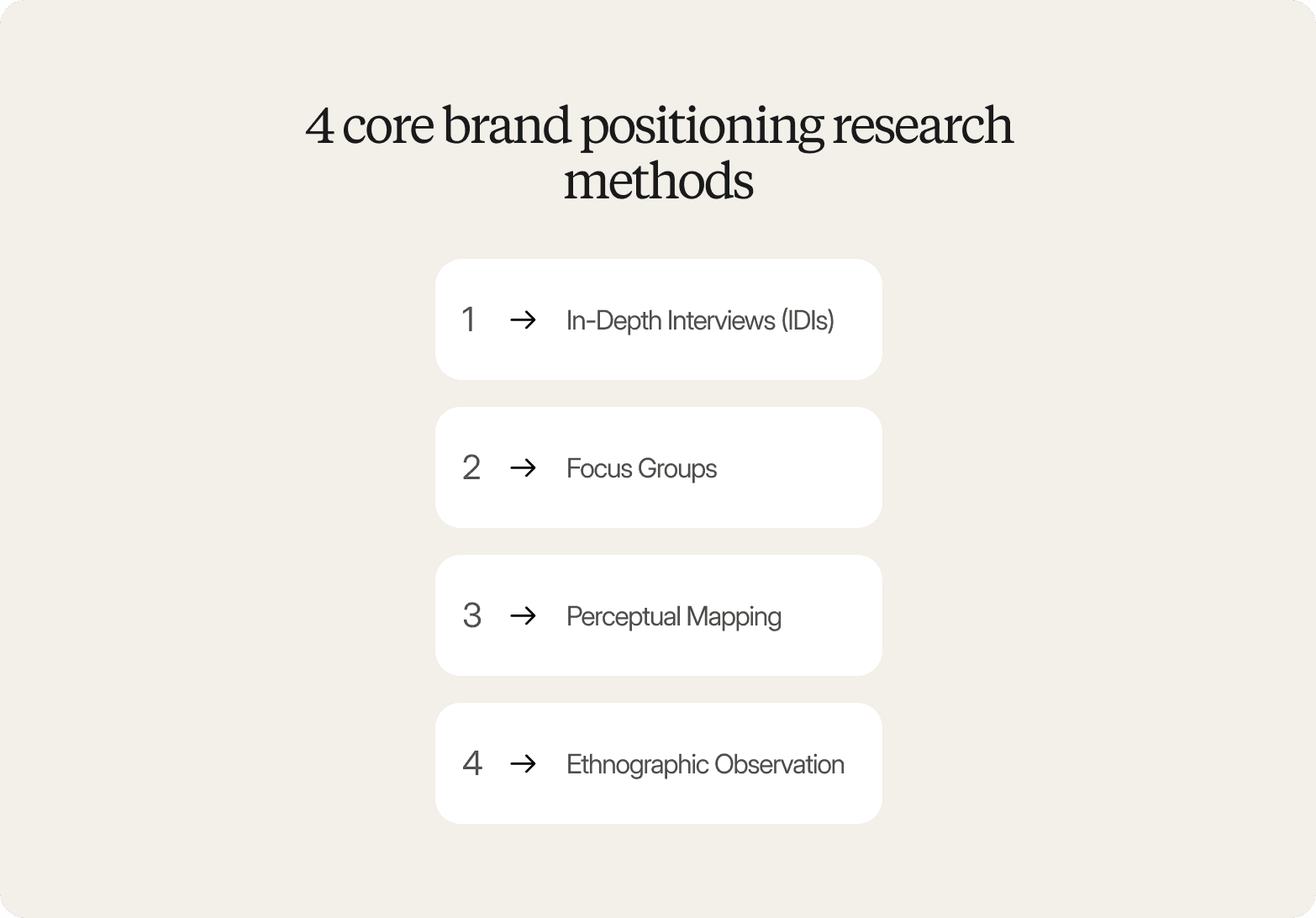
Each method is best matched to a specific question and plays a key role in building a strong positioning program.
In-Depth Interviews (IDIs)
IDIs are the foundation of qualitative positioning work because positioning is ultimately a language problem. The goal of these customer interviews is to discover the words and emotional logic customers actually use, not to confirm what a brand believes about itself. An adaptive moderator that follows participant wording surfaces the "why" behind reactions in a way pre-coded surveys cannot.
Use IDIs to: understand emotional drivers, category entry points, and consumer needs.
Limitation: rich but small-sample; they reveal the shape of a territory, not how widely it's held across the broader market.
Focus Groups
Focus groups show how competitive perceptions form in social context, capturing how positioning holds up under peer influence from other potential customers.
Use them to: observe competitive set perception and gather relevant insights on how a category is discussed as a group.
Limitation: group dynamics favor the most vocal participants, suppressing ambivalent reactions and masking the divergent views positioning work depends on.
Perceptual Mapping
Perceptual mapping quantifies where customers place brands on the key attributes that drive category choice, typically plotted on two axes from survey data.
Use it to show stakeholders where whitespace exists in a crowded marketplace or to confirm that a repositioning effort has shifted consumer perception.
Limitation: a map shows where brands cluster but not why; pair it with qualitative follow-up to interpret it with confidence.
Ethnographic Observation
Ethnographic methods capture brand interaction as it actually happens, in routines participants wouldn't think to mention.
Use it when: stated preferences and actual behavior may be misaligned, or category usage is habitual.
Limitation: longer timelines and higher per-participant costs; works best as an early discovery input rather than a primary validation method.
How to Conduct Brand Positioning Research: A 6 Step Framework
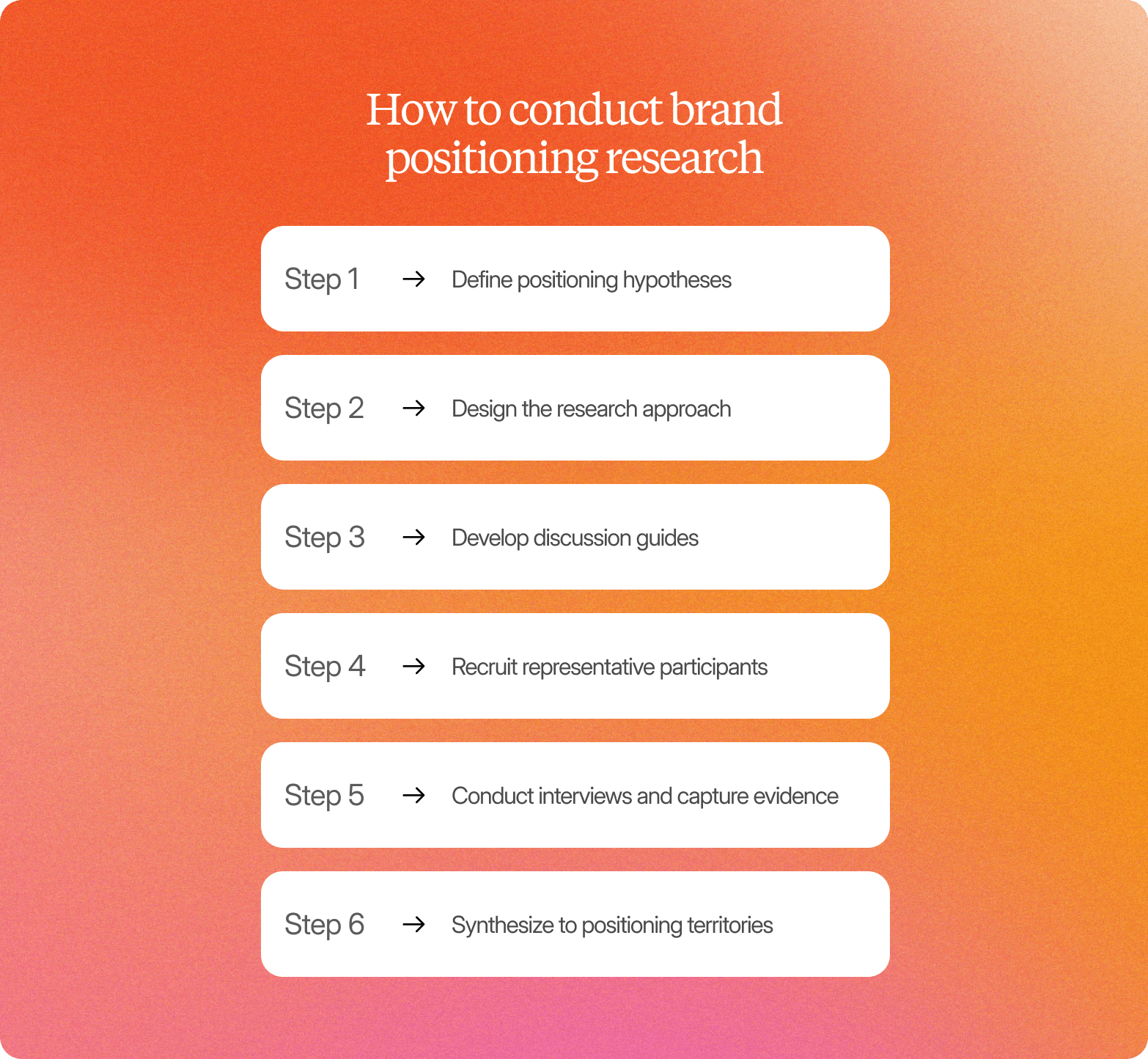
Conducting positioning research well starts with a clear hypothesis, not an open-ended fishing expedition. Six steps take a team from strategic intent to stakeholder-ready territories.
1. Define positioning hypotheses
Start with two or three territories to test, not ten loosely defined options; avoid testing a long list of vague ideas in the hope one sticks. Each should specify the target market it speaks to, the competitive set it differentiates against, and the central differentiation claim. Without this specificity, research yields reactions to vague ideas rather than evidence to inform strategic decisions.
2. Design the research approach
Choose qualitative-first when positioning language is still exploratory or emotional resonance is central. Surveys validate pre-defined options at scale and can quantify consumer preferences, but they can't tell you why a participant paused before agreeing, or how they quietly reworded your claim in a way that revealed a credibility gap.
3. Develop discussion guides
Strong questions surface the participant's mental model, not yours. These brand positioning research questions should open with category-entry prompts, then move toward differentiation by asking participants to explain claims in their own words. "What would you need to believe for that to feel true?" reveals RTB credibility gaps faster than any rating scale.
4. Recruit representative participants
Sample across existing customers, competitive brand users, category non-users, and prospective customers who haven't chosen a side yet. Positioning that resonates only with your existing base builds brand loyalty among people you've already won, not positioning that wins new target buyers. The most useful signal often comes from competitive users who articulate exactly why your claim doesn't yet land.
5. Conduct interviews and capture evidence
Video-first capture preserves the signals text-based research loses: the pause before agreeing, the tone shift when a competitor is mentioned, the visible reframe when a participant rephrases your claim into language that makes sense to them. Adaptive probing follows participant language rather than forcing responses through a fixed script.
6. Synthesize to positioning territories
Code transcripts for category language, differentiation clarity, emotional drivers, and RTB credibility, then map findings to defensible territories with proof-backed reasons to believe. Example: Territory 2 ("Clinical Credibility") generated the strongest differentiation clarity among competitive users, who cited third-party validation as the missing credibility bridge. Recommended RTB: pair the efficacy claim with a specific study reference and a visible certification mark, the kind of proof that can justify higher prices when a premium claim is genuinely credible.
Brand Positioning Research Deliverables That Stakeholders Actually Use
Positioning research rarely fails because the thinking was wrong. It fails because the output was a 40-slide deck that got presented once and never reopened. Four output formats turn relevant insights into decisions instead of talking points.
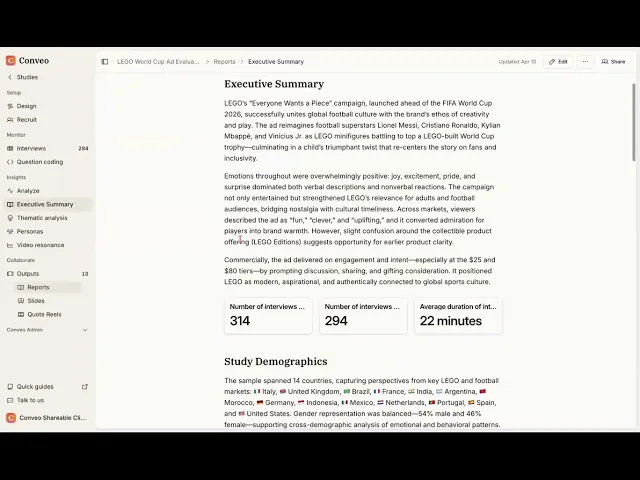
Watch the walkthrough: Reading a Conveo Report →
Positioning territories with proof
Rather than a single recommended platform, present two or three options side by side, each built around clear core benefits and a distinct brand message, with supporting customer feedback and reasons to believe tied directly to video clips from real interviews. Stakeholders evaluate options against actual consumer language instead of debating which direction "feels right."
Language banks
Verbatim customer phrases, organized by theme: the words people use to describe the category and reach for when competitors come up. Copywriters pull directly from this bank when drafting marketing messages and positioning statements that identify core benefits in language customers already use.
Perceptual maps with qualitative context
Maps without context invite argument. Linking each cluster to the interview clips that explain it resolves the question: when a stakeholder asks why a competitor sits where it does, the answer is a consumer saying it in their own words, on video.
Stakeholder-ready storylines
A five-slide narrative covering the hypothesis, key findings, recommended territory, and supporting evidence, designed for an executive review. The goal is a format that travels without the researcher in the room, so marketing efforts across the company can move on the same evidence.
Video clips matter across all four formats for the same reason: they close the credibility gap. Traditional research delivers a deck; modern positioning research delivers a searchable, reusable evidence library teams return to across multiple strategic decisions.
"Our leadership remembers the stories. Conveo beats another slide deck every time"
— Head of Customer Insights, JDE Peet’s
Multi-Market Brand Positioning Research: Workflow and Governance
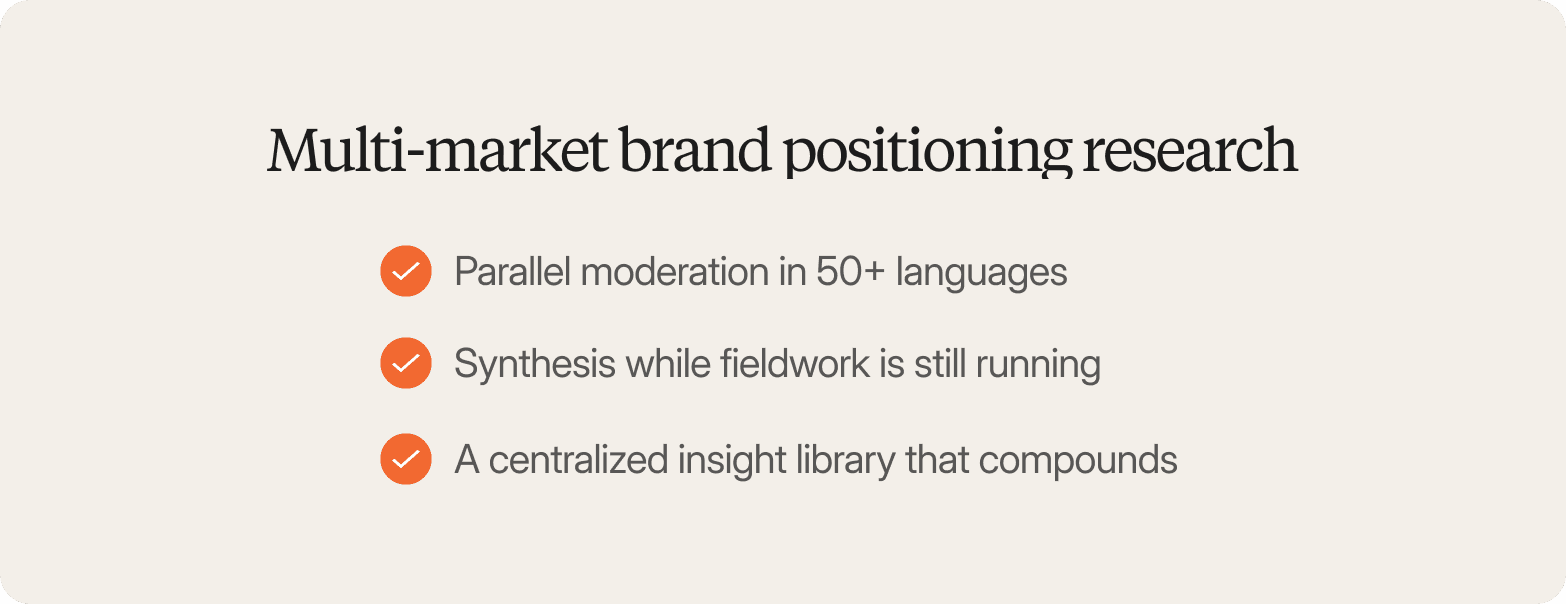
Running global positioning research the traditional way means separate agency briefs per market, translated stimulus, sequential fieldwork, and reconciling findings that arrive in different formats at different times. For a three-market study across the US, UK, and Germany, that routinely adds 8 to 12 weeks before cross-market synthesis can even begin.
Parallel moderation in 50+ languages
A positioning study no longer runs sequentially from market to market. Conveo's AI moderator conducts sessions in each local language simultaneously across 50+ languages, without local agency coordination. A study that would have taken three sequential fielding waves runs as a single parallel wave.
Synthesis while fieldwork is still running
Automated transcription and translation eliminate the two- to four-week gap that typically exists between fieldwork and cross-market analysis. As sessions land, transcripts are generated and translated, so synthesis can begin while the final interviews are still completing.
A centralized insight library that compounds
Instead of regional findings disappearing into separate decks, every study feeds a searchable repository. Teams query across markets and identify where positioning strategy is consistent and where it diverges, building institutional knowledge rather than starting from scratch each cycle.
The governance question is real: how much positioning should be held constant globally, and how much should flex locally, especially when local marketing efforts and pricing, including how a claim justifies higher prices in one market but not another, pull in different directions? In practice, the core emotional territory tends to travel well, whereas specific reasons to believe often need to be localized. Consider a fintech brand testing trust messaging across the US, UK, and Germany: parallel moderation surfaces how "security" lands differently in each market, available in days rather than months.
When to Use Qualitative vs. Quantitative Brand Positioning Research
Defining your brand positioning research objectives before choosing a method is the most consequential decision in the design process. The right choice depends on where your positioning work actually stands, and how much market share is at stake.
Choose qualitative when... | Choose quantitative when... |
Positioning language is untested, and you need to understand how customers interpret the claims | You have three to five stable, pre-defined options and need to rank preference at scale |
Emotional resonance and category meaning matter more than statistical validation | You need to measure shifts in awareness, consideration, or purchase intent after a change |
You need to capture hesitation and reframing, signals video-first AI moderation captures at scale rather than sampling them | Stakeholders require confidence intervals before committing significant investment, particularly when higher prices are on the table |
The core tradeoff: surveys deliver scale but miss the depth that explains why customers respond as they do; interviews deliver that depth but require rigorous synthesis before findings generalize. The strongest programs use both in sequence.
Run Positioning Research at the Speed Your Business Moves
Brand positioning research has a timing problem most teams work around rather than solve: by the time agency-run studies return findings, the brief is written, or the innovation gate has closed. Conveo, the video-first AI research platform, changes that constraint at the workflow level, leading with credibility, not just speed, which is why brand positioning research is important to get right from day one.
Traceable evidence, not summaries. Every theme stays anchored to the video clip and verbatim quote that generated it, so stakeholders audit the evidence rather than accept an analyst's summary.
Real participants, no synthetic respondents. Findings come from conversations with real people, recruited through Conveo's integrated panel network or your own lists, so positioning evidence holds up under scrutiny from even the most skeptical clients.
Depth without a human moderator on every call. Adaptive AI moderation follows each participant's own wording, so the "why" behind a reaction surfaces without booking moderators across time zones.
A compliance posture built for regulated categories and an insight library that compounds across studies round out a platform designed for enterprise research teams, not one-off projects. Hundreds of conversations run in parallel, and findings arrive in 3 to 5 days.
Hundreds of enterprise teams, including Google, Bosch, Reddit, and FOX, rely on Conveo to move from real consumer conversations to structured, decision-ready positioning evidence.
Frequently Asked Questions
What Is Brand Positioning Research?
How Do You Conduct Brand Positioning Research?
What Are Brand Positioning Research Questions?
What Is the Difference Between Brand Positioning Research and Brand Tracking?
How Long Does Brand Positioning Research Take?