In this article
TL;DR
The insight that arrives after the decision has closed might as well never have happened. Velocity and hit rate on new products, campaigns, and channels now decide who stays competitive, and both depend on a research process that delivers understanding while the window is still open.
Most organizations treat research as project outputs. Findings scatter across decks, inboxes, and shared drives. Teams re-commission studies they already ran because the conclusions from the last round are unfindable.
Customer intelligence management changes this by connecting every study to every prior finding. Themes, quotes, and video clips flow into a searchable, traceable repository that turns raw research into actionable insights instead of slide decks nobody reopens. Nothing gets researched twice.
When understanding compounds rather than expires, every interview makes the next one smarter. The research function becomes a durable asset, and an effective customer intelligence strategy starts by treating it that way.
What Is Customer Intelligence Management?
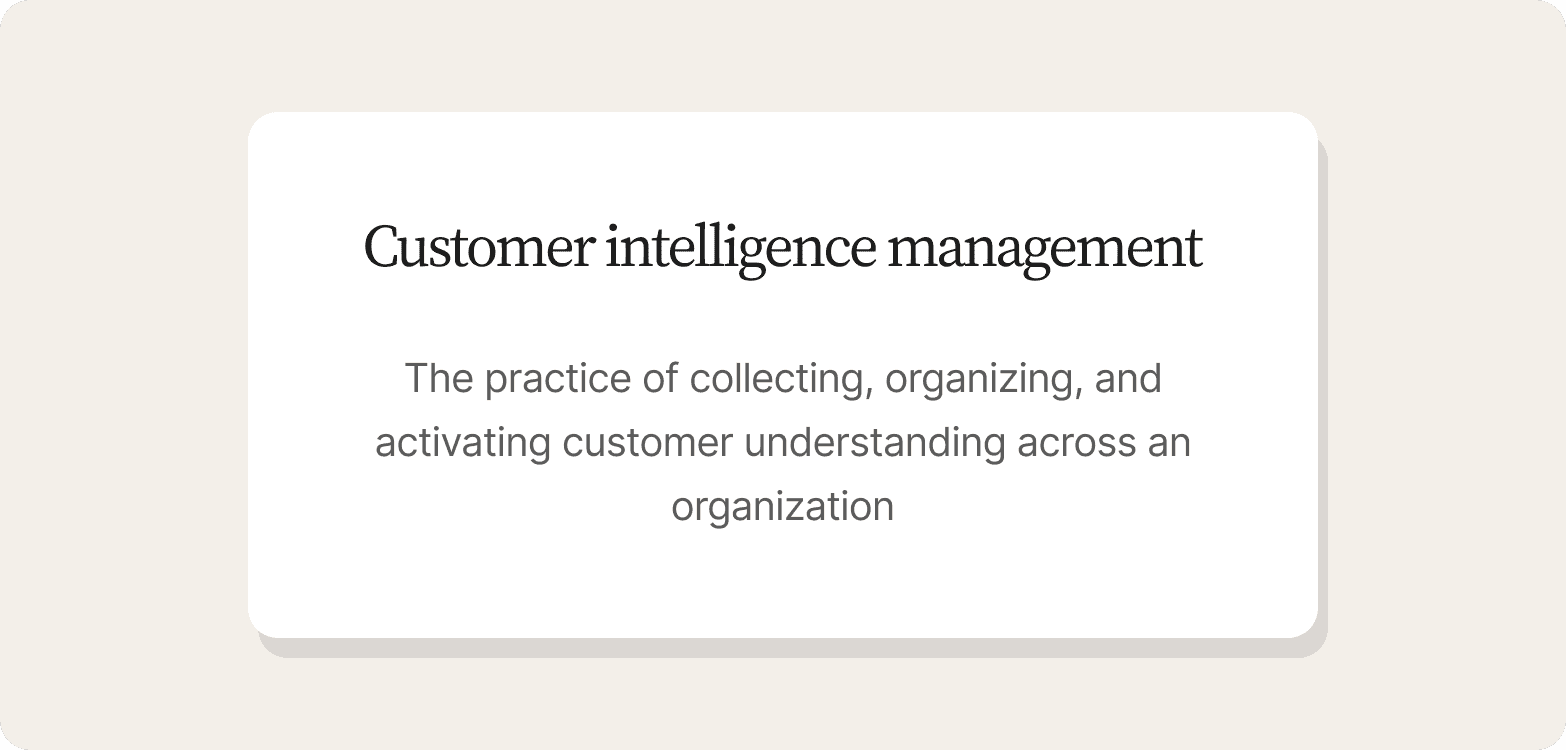
Customer intelligence management is the practice of collecting, organizing, and activating customer understanding across an organization, so that what teams learn from customers becomes a durable asset. In practice, that means a working customer intelligence strategy: standards for what counts as evidence, how it gets tagged, and how it gets reused.
Most organizations default to treating insights as project outputs. A study closes, findings land in a 40-slide deck, transcripts sit in a shared folder no one maintains, and key quotes get copied into emails or Slack threads. Six months later, none of it is searchable or traceable back to the original participant.
The alternative treats customer intelligence as infrastructure. Every theme, quote, and video clip flows into a searchable, traceable repository that connects across studies. When a brand manager asks, "What did customers say about this packaging format last year?" the answer surfaces in seconds, with the source attached. No new study required.
The cost of the failure mode is steep. Without a connected repository, researchers cannot verify whether a question has already been answered, so budgets get spent on ground already covered. Customer intelligence focuses on why customers behave the way they do, and that explanation disappears when findings are filed away rather than managed.
The compounding benefit runs the other way. When customer understanding is the infrastructure, every study builds on the last, and teams direct their efforts toward the questions they genuinely have not answered yet, which is the real benefit of customer intelligence over one-off reporting.
Why Customer Intelligence Management Fails in Most Organizations
Research findings rarely disappear. They scatter. A deck lands in someone's downloads folder, a synthesis report gets filed in a shared drive no one fully navigates, and an agency deliverable sits in an inbox thread from two years ago. The data exists. No one can find it, so teams commission the same study again.
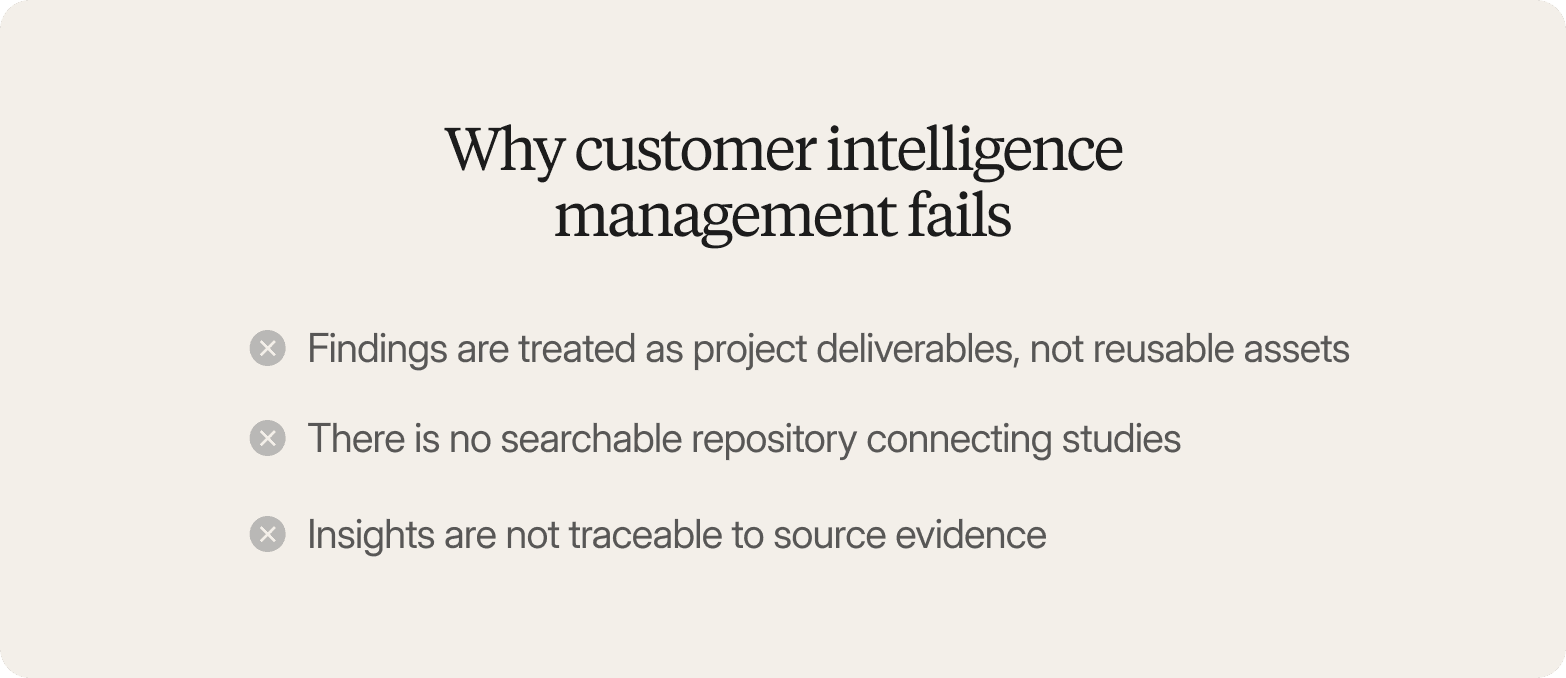
Three structural failures drive this, and they compound each other.
Findings are treated as project deliverables
Agencies deliver decks. Internal teams write reports. Both get filed at the end of a project with no mechanism for retrieval. When a new team needs customer input on packaging, pricing, or messaging, they start from scratch because finding what was already learned takes longer than re-running the research.
There is no searchable repository connecting studies
Teams cannot answer "what did customers say about our onboarding experience?" without reading through dozens of decks or asking a colleague who might remember. Institutional knowledge lives in individual researchers' heads, so it depreciates every time someone leaves.
Insights are not traceable to source evidence
Stakeholders receive summary slides that include claims such as "customers value simplicity," but they cannot verify those claims by watching the interview or reading the verbatim quote. Customer intelligence data that can't be traced back to a real conversation is an assertion with a chart around it.
The operational consequence is predictable: budget flows back into research already done, and decisions get made without customer input because no one knew the relevant study existed. Teams here are dealing with a retrieval and traceability problem, and additional customer intelligence efforts pointed at the wrong layer of the stack will leave it in place.
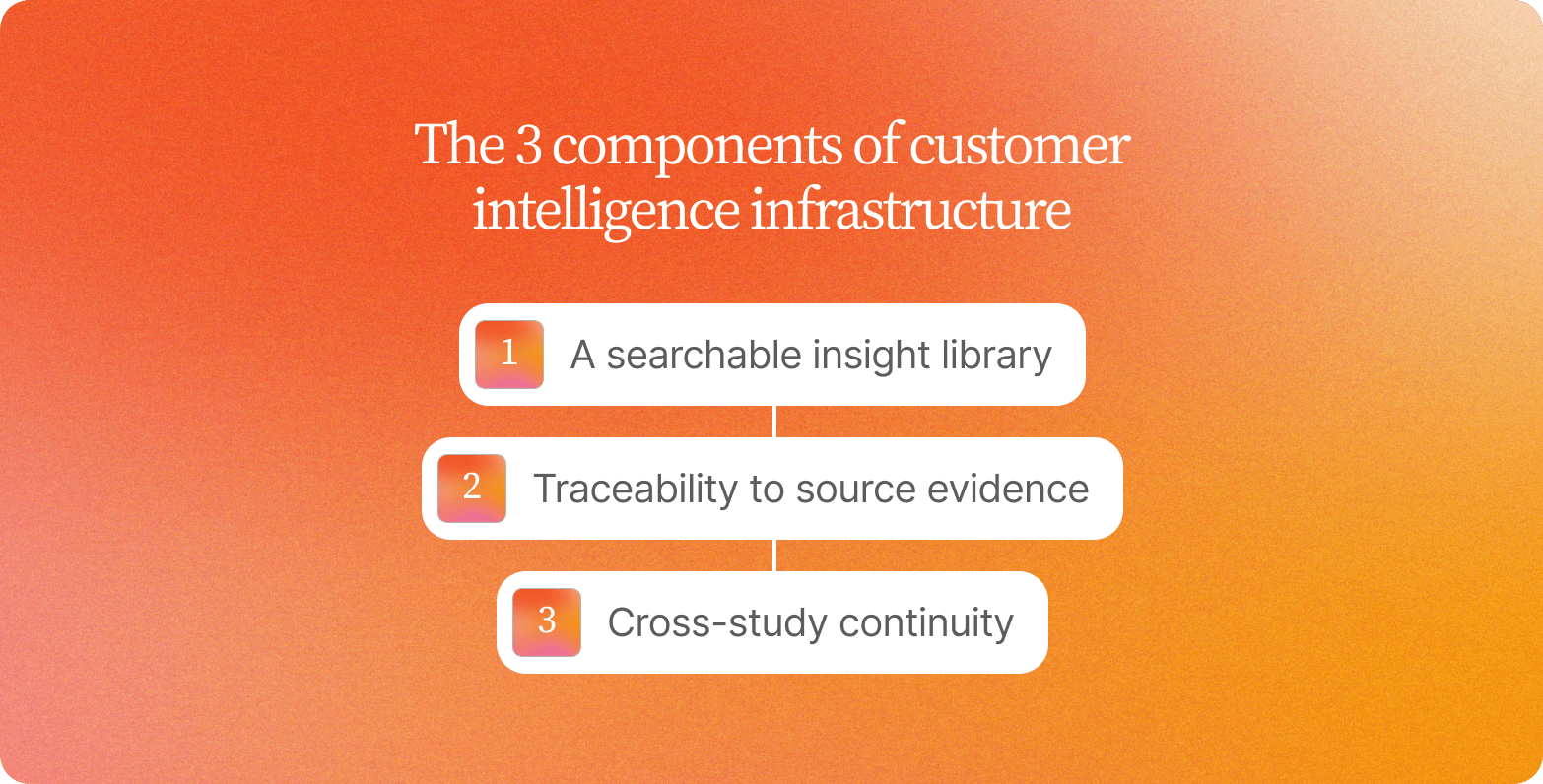
The 3 Components of Customer Intelligence Infrastructure
Most organizations have built strong customer data infrastructure: CRMs that track every interaction, CDPs that unify behavioral signals, analytics platforms that surface what customers do. That layer runs on transactional data and purchase history: what was bought, when, and how often. Even a strong data analytics stack for analyzing data across the customer journey shows where a customer dropped off; analyzing customer data alone can't explain why, and customer journey mapping without a research layer underneath is just event tracking with better labels. The missing piece is the qualitative layer, the gap between business intelligence, which explains what happened, and customer intelligence, which explains why.
Three components distinguish a research archive from genuine infrastructure.
A Searchable Insight Library
Most research findings expire the moment the debrief ends. A 40-slide deck gets shared, skimmed, and filed. Six months later, a product team asks the same question a brand team answered last year, and nobody knows where to look, so they commission another study.
A searchable insight library stops that cycle. Every theme, verbatim quote, video clip, and sentiment pattern from every study is tagged, indexed, and retrievable by topic, product, persona, or research question. When a product team asks what customers said about checkout friction, the answer comes back as a search query, turning a repository of raw data points into something a team can act on.
Institutional knowledge no longer walks out the door when a researcher moves on. Findings from a concept test two years ago can surface as relevant context the moment a related question arises, allowing research to contribute to business growth in its own right.
Traceability to Source Evidence
Every theme that surfaces in a customer intelligence system should connect directly to the timestamped video clips and verbatim quotes that produced it. Stakeholders receive a summary, with the evidence one click away.
That distinction matters most in cross-functional reviews, where findings get challenged by people who weren't in the room. When a CMO questions a persona attribute, the researcher can play the participant videos where that pattern emerged, and the finding becomes something the room can evaluate directly.
Without traceability, insights erode: they survive the debrief, get diluted in the deck, and arrive at the decision meeting stripped of the context that made them credible. Traceability to source evidence is what separates a robust customer intelligence program from a folder of PDFs with a search bar bolted on.
Cross-Study Continuity
Most research functions accumulate findings the way companies accumulate files: stored somewhere, rarely retrieved, never connected. A concept test from Q2 sits in one deck, a brand equity study from Q4 in another. When a new question surfaces, the team starts from scratch.
Conveo's searchable insight library is the shipped capability behind cross-study continuity: a persistent repository where every clip, theme, and quote connects across studies and surfaces contradictions between old and new evidence, so nothing gets researched twice. Teams can track how customer sentiment shifts between waves, identify trends before they become obvious, and see how needs change across the customer lifecycle from onboarding to renewal.
Every study makes the next one smarter, because questions already answered no longer consume budget or participant goodwill. That's the deeper understanding a compounding library gives teams that a filing cabinet never can.
How to Build a Customer Intelligence Management System: 4 Steps
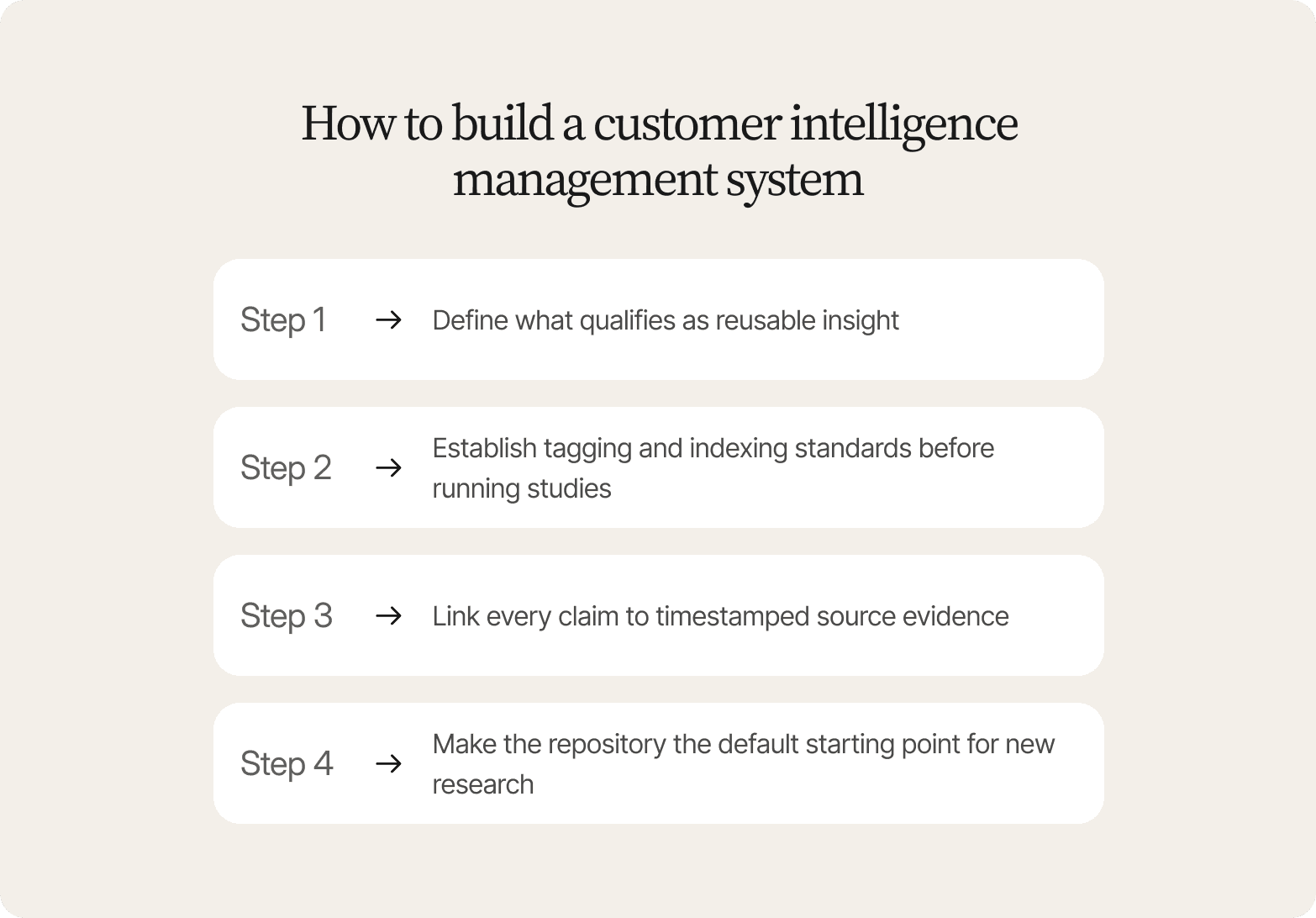
Building customer intelligence infrastructure requires both technology and process. Most organizations focus on the platform and neglect the workflow change that makes it valuable. They deploy a repository, migrate existing decks into it, and discover six months later that no one searches it. The operating model and the data management behind it are the actual problem.
Step 1: Define what qualifies as reusable insight
A finding must be traceable to source evidence, tagged by topic and persona, and structured around a theme with supporting quotes. Workshop assumptions and summary-only decks fall outside that standard. Conveo enforces this by design: every theme links to timestamped video and verbatim quotes, so every entry in the insight library carries its source evidence.
Step 2: Establish tagging and indexing standards before running studies
Decide how insights will be categorized (by product area, customer segment, or research question type) before the first interview, and apply tags during synthesis rather than retroactively. Retroactive tagging is where data quality breaks down.
Step 3: Link every claim to timestamped source evidence
When a researcher identifies a theme, they must cite the specific video clips or quotes in which it emerged. A product director reviewing a synthesis deck should be able to click through and verify the claim themselves.
Step 4: Make the repository the default starting point for new research
Before commissioning a study, search the insight library first. Repeating an inquiry without checking prior work is the clearest sign research is still being treated as a deliverable.
Customer intelligence management is a workflow problem. Get this right, and you get a robust customer intelligence program that gets sharper with every wave.
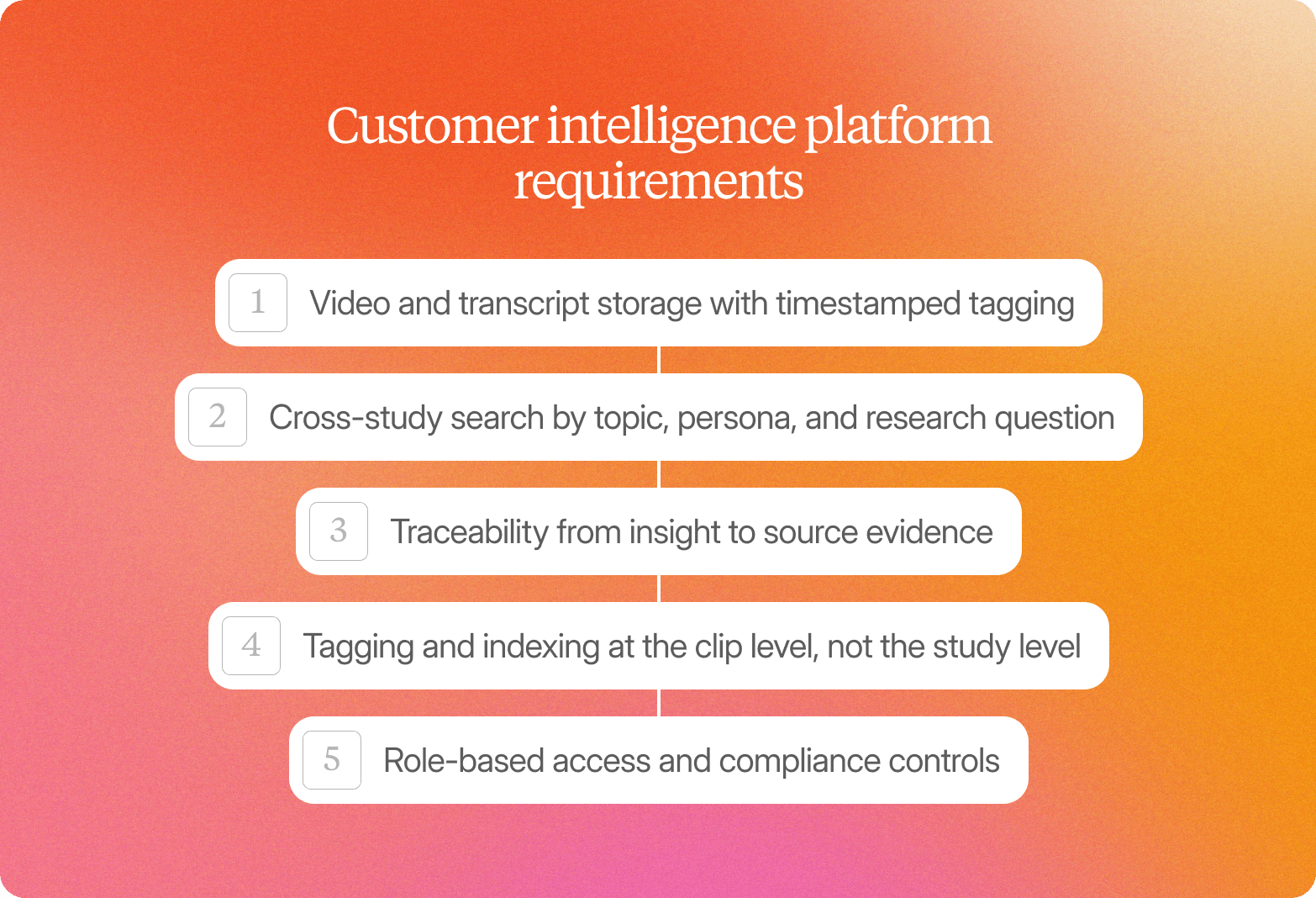
5 Customer Intelligence Platform Requirements
Most organizations attempting to build a customer intelligence platform discover the platforms they already have weren't built for this job. Notion or Confluence handle documentation well but have no concept of a timestamped video clip or a cross-study theme. Cloud storage like Google Drive or SharePoint can hold recordings, but finding what customers said about a topic means manually opening files. Generic customer intelligence tools built for ticketing or CRM data hit the same wall: they were designed to log transactions, and a 45-minute interview and the theme it produced sit outside that design.
Five requirements separate purpose-built customer intelligence software from generic storage:
Video and transcript storage with timestamped tagging. Every theme must link to the exact moment in the interview where the pattern emerged.
Cross-study search by topic, persona, and research question. Teams must be able to query what customers said about pricing and retrieve relevant clips from every study where the topic appeared.
Traceability from insight to source evidence. Stakeholders must be able to verify any claim by watching the original video themselves.
Tagging and indexing at the clip level, not the study level. A 60-minute interview contains dozens of discrete themes, each tagged independently.
Role-based access and compliance controls. Enterprise procurement checks certification, data handling, and hosting region before adoption, and for U.S. consumer data it checks alignment with frameworks such as the California Consumer Privacy Act. Conveo is SOC 2 Type II certified, GDPR compliant, EU hosting (Belgium), which removes a common blocker for teams operating under strict European data compliance rules.
Generic storage treats insights as files: named, dated, filed by project. Purpose-built infrastructure treats insights as evidence: tagged, indexed, connected across studies. It's the difference between customer intelligence analytics that can explain a pattern in a participant's own words and customer analytics dashboards that report the pattern exists.
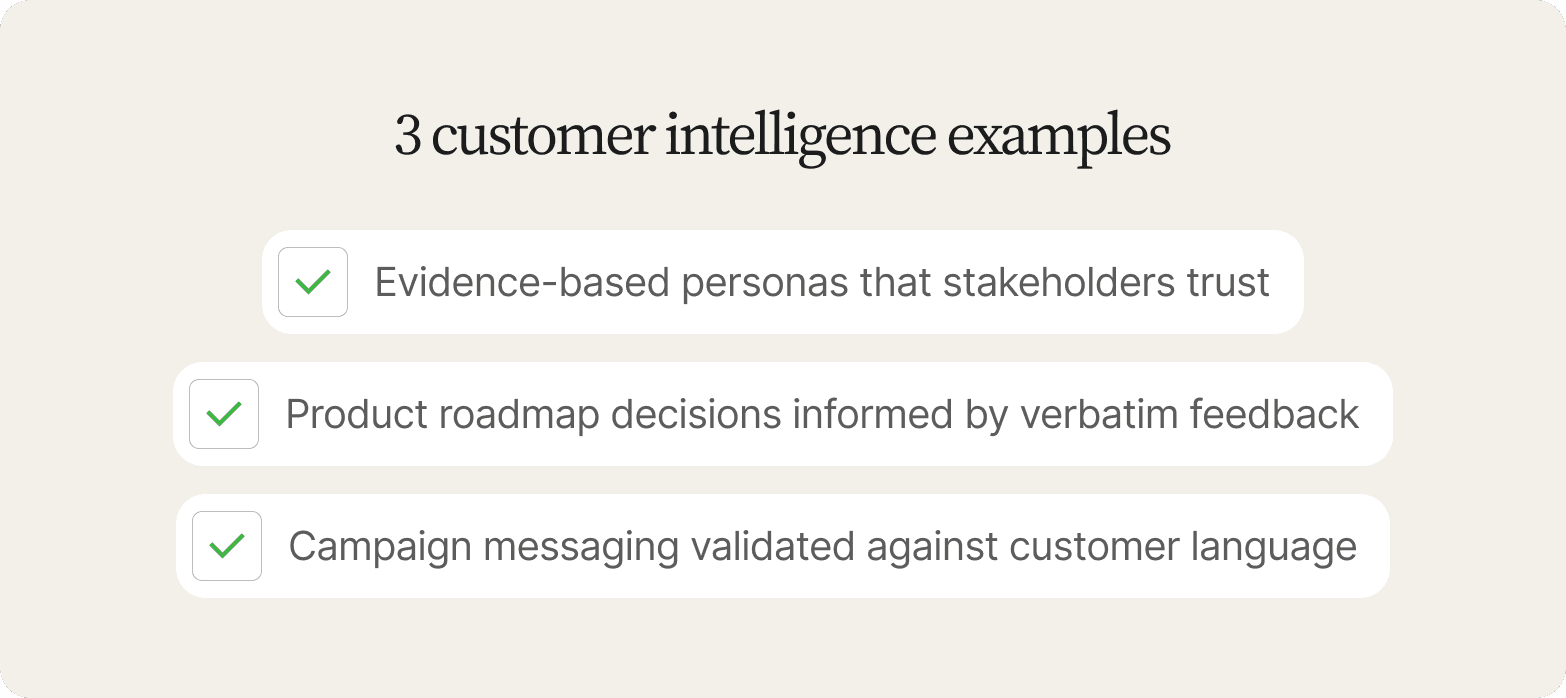
3 Customer Intelligence Examples: What Infrastructure Enables
The most instructive examples of customer intelligence are about reuse rather than volume. Once collecting customer data stops being the bottleneck, the question becomes whether the same understanding can surface in a brand decision, a product sprint, and a campaign brief without anyone commissioning a new study.
Evidence-Based Personas That Stakeholders Trust
Demographic personas fail because the attributes float free of evidence. Age, income, and region tell a product team nothing about what makes a customer hesitate at the paywall or what finally tips them toward a purchase. Stakeholders know these are educated guesses.
The infrastructure-enabled alternative starts with real interviews rather than a summary pulled from focus groups or a stack of customer surveys nobody read past the topline. Attitudinal and psychographic data on customer behavior and preferences make a persona usable. It serves as a navigable layer on top of the evidence, built to help teams understand customer preferences and inform downstream customer experience decisions.
When a product team challenges a persona assumption, the researcher plays the participant videos where the pattern emerged, and the persona becomes credible because the evidence is one click away.
Product Roadmap Decisions Informed by Verbatim Feedback
Product teams on two-week sprint cycles face a structural problem when research takes weeks to complete. By the time findings arrive, the sprint is closed, and the roadmap has moved on.
When prior studies are aggregated in a searchable insight library, a product manager can query "what did customers say about checkout friction?" and pull relevant clips and thematic summaries from interviews conducted months earlier, which are useful for identifying at-risk customers before a customer churn number appears on a dashboard.
Teams report roadmap validation shifts from a weeks-long research cycle to an hours-long retrieval exercise, which is one of the clearest benefits of customer intelligence over ad hoc reporting.
Campaign Messaging Validated Against Customer Language
Marketing teams write messaging from the inside out, using words the brand prefers rather than words that land. When customer understanding serves as infrastructure, copywriters can search the insight library for how participants described a problem in their own words, and marketing efforts built on that language tend to move conversion rates in ways generic copy does not.
How Teams Build Compounding Customer Intelligence With Conveo
When research informs decisions while the window is still open, the entire function changes. Teams stop running catch-up studies and start building on what they already know.
Conveo compresses the timeline without compromising method. Teams launch a study in under 30 minutes, and hundreds of asynchronous video conversations run in parallel without calendar coordination, across 50+ languages. The mechanism is AI-moderated interviews: adaptive probing that follows what participants actually say, with machine learning models handling multimodal analysis the moment a conversation closes.
See it in action: How AI-Moderated Video Interviews Actually Work
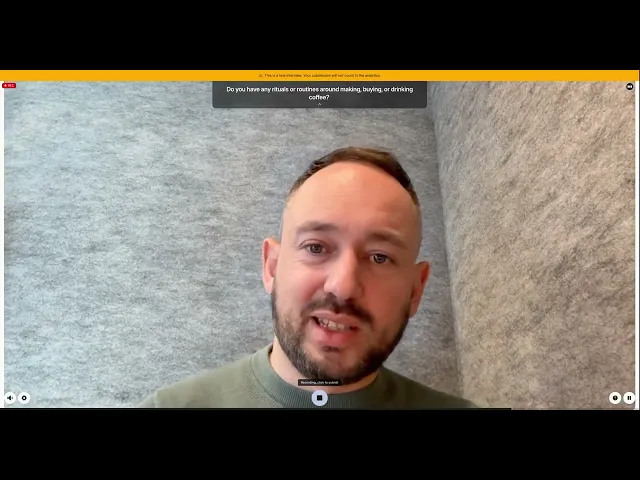
What separates Conveo from generic AI summarization is traceability. Every theme links to timestamped video clips and verbatim quotes from the exact moment the pattern emerged. Where generic tools return a score from machine learning algorithms and stop there, Conveo keeps a real interview behind every claim. That is auditable evidence, the standard enterprise decisions require.
The Knowledge Layer is Conveo's persistent insight repository: a searchable, traceable library where every clip, theme, and quote from every study connects across time. Researchers can draw on relevant findings from prior work before formulating a single question. Nothing gets researched twice: institutional understanding stays in place when a project closes, or a person leaves.
Teams report that this compounding approach drives durable increases in customer loyalty and customer lifetime value because decisions are made based on what customers said rather than on what a dashboard inferred from third-party data. With Conveo, teams reach stakeholder-ready findings while the decision is still open, and it's how research earns a seat at the table in decisions that inform strategic decisions at the company level.
For teams running continuous programs, Conveo StoryLines extends this model to chapters and waves, tracking themes over time and automatically connecting findings across studies.
Frequently Asked Questions
What is customer intelligence management?
Customer intelligence management is the practice of collecting, organizing, and activating customer understanding across an organization so insights remain searchable, traceable, and reusable over time. Most organizations treat insights as project outputs that get filed away after delivery. When customer intelligence is managed as infrastructure, every study makes the next one smarter, and nothing gets researched twice.
What is a customer intelligence platform?
A customer intelligence platform stores, indexes, and retrieves qualitative and quantitative customer insights, enabling teams to search for findings by topic, persona, or research question rather than re-running studies. Every theme and claim must link to timestamped video clips and verbatim quotes. Customer intelligence platforms are built for cross-study search, traceability, and reuse, which is what distinguishes them from generic storage.
What are customer intelligence examples?
Customer intelligence examples include evidence-based personas where every attribute links to a verbatim quote, product roadmap decisions informed by searchable customer feedback, and campaign messaging validated against the language customers actually use. These are only possible when insights are stored in a searchable, traceable repository rather than scattered across decks and email threads.
How is a customer intelligence platform different from a CRM or CDP?
CRMs handle customer relationship management: emails, calls, deals, and support tickets. CDPs unify behavioral signals: clicks, purchases, page views, segment membership. Both tell you what customers did. A customer intelligence platform stores qualitative understanding- the themes, quotes, and video evidence that explain customer motivations, objections, and language, so it compounds over time.
How long does it take to build a customer intelligence repository?
Teams starting with a purpose-built platform like Conveo can have a searchable, traceable repository after their first study because every theme, clip, and quote flows automatically into the insight library. Migrating legacy decks and transcripts takes longer, typically weeks to months, because tagging and traceability work must be done retroactively.
How does customer intelligence relate to customer complaints and support data?
Customer complaints, support tickets, and customer effort score responses are useful feedback data, but they capture how customers interact with a product after something has gone wrong or has already worked. Customer intelligence management pulls that signal upstream: moderated conversations surface customer expectations and customer pain points before a complaint turns into customer churn, so teams building an effective customer intelligence strategy treat support and commerce metrics, like average order value, as one input among several. Spelling out the acronyms helps: customer intelligence CI is the qualitative, why-layer; customer relationship management CRM is the transactional, what-layer. Treated as separate systems that inform each other, they tell a fuller story than either alone, and the resulting CI data is what moves the numbers that matter. Beyond a survey score, it means improving customer service, building stronger customer relationships, and supporting personalized customer experiences that increase customer satisfaction in ways a dashboard alone can't. Some teams call this consumer intelligence instead of customer intelligence; the label matters less than whether the underlying work is traceable to a real conversation.

About the author
Florian Hendrickx
Head of Growth
Florian is Conveo’s Chief Growth Officer, leading growth strategy and go-to-market execution as the company scales. He’s held growth leadership roles at companies like Deliverect, Robovision, and Aikido Security, and brings hands-on experience across marketing, sales, and product.
More by Florian →Qualitative insights at the speed of your business.
Conveo runs AI-moderated video interviews and structures everything they say.