In this article
TL;DR
A customer intelligence platform helps teams bring customer data and feedback together, making it easier to make strategic decisions.
Some platforms focus on behavior throughout the customer lifecycle, such as purchases, website activity, or support tickets. Others help teams understand why customers behave that way through interviews and qualitative research.
When comparing platforms, check whether you can trace insights back to the original evidence, and whether the platform meets your organization's security and compliance requirements.
This guide explains the different types of customer intelligence platforms, what to look for when comparing them, and where Conveo fits.
Customer data is easy to collect, but much harder to turn into decisions people trust. Some platforms show what customers do, while others explain why they do it, and choosing the wrong type leaves you with evidence that doesn't answer the questions you’re trying to solve.
This guide explains the different types of customer intelligence platforms, when each one makes sense, the criteria to use when comparing vendors, and the common mistakes to avoid during the buying process. By the end, you’ll be able to choose a platform with confidence and make strides in your customer intelligence strategy.
What Is a Customer Intelligence Platform?
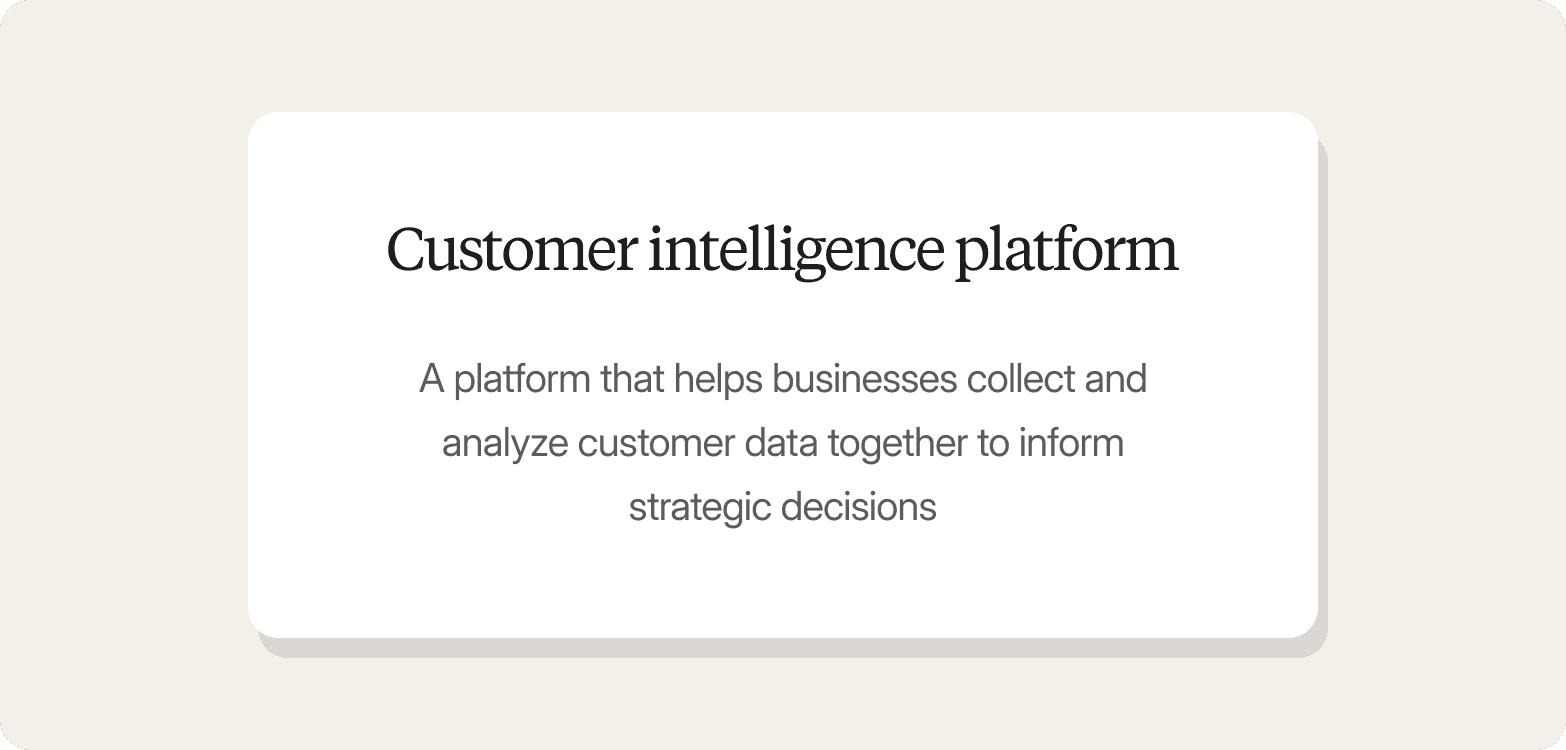
A customer intelligence platform helps businesses collect and analyze customer data together to inform strategic decisions. The term covers two types of software:
The first combines behavioral and transactional data from across the business. These customer intelligence tools pull together customer activity such as clicks, purchases, product usage, and customer support tickets to show what customers do over time, often using machine learning to flag patterns.
The second is a qualitative platform that captures customers' feedback through interviews and other research methods. These consumer insights platforms explain why customers behave the way they do instead of only showing the outcome.
For example, a customer relationship management (CRM) or analytics platform might show that mobile checkout abandonment increased last month. It can't explain whether customers were confused by the checkout flow or frustrated by slow page loads. That answer comes from speaking directly with customers.
Customer Intelligence Platforms vs. VoC Platforms: What's the Difference?
Both Voice of the Customer (VoC) platforms and qualitative customer intelligence platforms help you find the “why” behind customer behavior, but they differ in their approach.
VoC platforms collect feedback through structured surveys, tracked over time as metrics such as NPS or CSAT, sometimes alongside review mining and tracking mentions on social media platforms.
A qualitative customer intelligence platform collects feedback through interviews and open conversation instead. A customer explains their answer, and the interviewer, human or AI-moderated, follows up on whatever they just said.
Choose a VoC platform if you need to understand the same customer experience across a large number of customers. For example, if you're investigating customer loyalty across every market you operate in, asking everyone the same questions makes it easier to compare responses and spot patterns.
Choose a qualitative customer intelligence platform when the answers themselves need to be explored. For example, if customers repeatedly raise problems during onboarding, an interview can follow that thread until the team understands exactly what happened and what needs to change.
Many teams use both. A VoC program gives a consistent view across thousands of customers, while qualitative interviews dig deeper into the themes that emerge.
Why Teams Need Customer Intelligence Platforms (Not Just Analytics Tools)
Customer insights feed decisions across the entire business, from product roadmaps and pricing to marketing campaigns, sales messaging, and support improvements. Without a customer intelligence platform, the same problems keep coming up:
Research is too slow. Traditional studies or focus groups can take weeks or months, so by the time the results are ready, key decisions have already been made. A pricing study commissioned before launch often arrives after launch, so the team ships with a guess rather than an answer.
Teams keep asking the same questions. Past interviews and surveys are hard to find and reuse, so the same customer problems get researched again and again. A support team might already know why customers cancel, buried in a study from eighteen months ago, while the retention team commissions a new one to answer the same question.
People don't trust the findings. If no one can see the customer evidence behind a conclusion, it's much harder to act on it. A recommendation backed only by a summary leaves the room unsure whether it's actually right, so decisions stall while people second-guess the conclusion instead of moving on it.
A customer intelligence platform brings customer evidence into one place. As more customer data is added, the platform becomes more useful, turning scattered signals into actionable insights that grow more valuable with every study.
3 Core Capabilities of Customer Intelligence Platforms
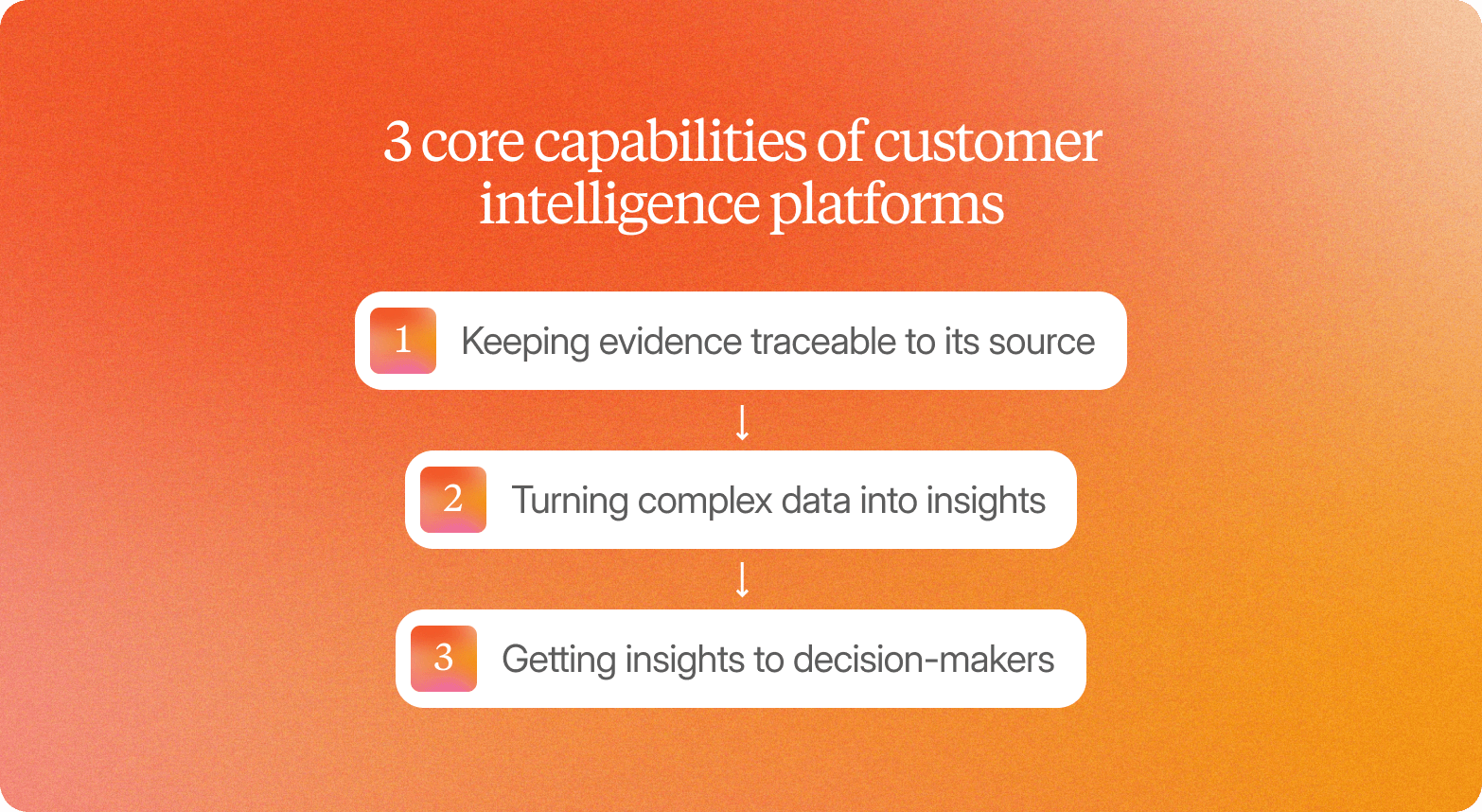
Comparing platforms gets easier once you evaluate them on the same three things: how they collect evidence, how they turn it into insight, and how they share that insight with the people who need it.
1. Keeping Evidence Traceable to its Source
A platform's first job is making sure every insight can be traced back to its source. Behavioral data does this naturally: a purchase is logged automatically, and a customer complaint is logged when the customer interacts with the support team. Qualitative research is different. Once interviews are summarized into themes, it's easy to lose sight of what the customer said.
Good qualitative platforms keep that connection intact by linking every finding back to the original interview, so stakeholders can review the evidence instead of relying on a summary.
Video-first platforms preserve even more context. Conveo links every insight to a timestamped video clip, letting stakeholders hear the participant's words and see how they were delivered.
2. Turning Complex Data Into Insights
Once you have evidence from many conversations, the job shifts from capturing individual answers to finding patterns across them. Software can transcribe interviews, run sentiment analysis, and identify recurring customer concerns across studies, work that used to take a researcher days to do manually.
Feedback analysis gives teams a clearer picture of what customers consistently care about, making it easier to prioritize decisions based on recurring evidence rather than individual data points.
3. Getting Insights to Decision-Makers
Research only influences decisions when people can consume it quickly. A platform should make it easy to move from a recommendation to the data-driven insight behind it, without digging through interview recordings or waiting on data scientists to translate a lengthy report.
Timestamped clips remove that friction. Stakeholders can see the customer's explanation for themselves in a couple of minutes, making it easier to understand the finding and act on it.
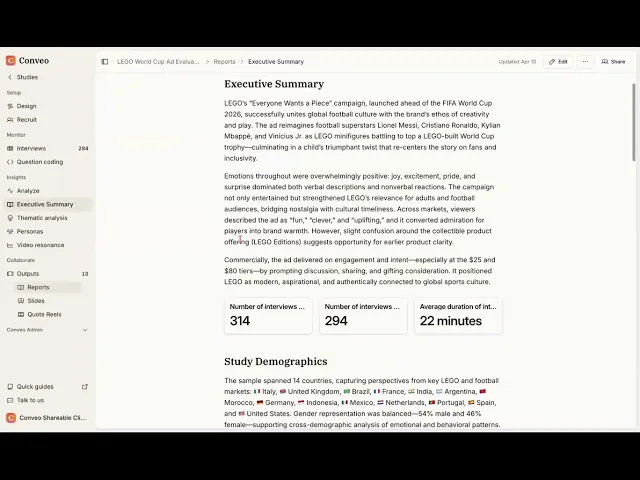
Watch the walkthrough: Reading a Conveo Report
How to Choose a Customer Intelligence Platform That Supports Business Growth
The best customer intelligence platform depends on the questions your team needs to answer. These four questions will help you decide which type fits your work.
1. What Evidence Do You Need?
If your goal is to measure customer behavior, a CRM or analytics platform is usually the right choice. For example, if you want to know which marketing channel drives the most purchases or how often customers use a new feature, behavioral data already contains those answers.
If you're trying to decide what to change, you'll usually need qualitative evidence instead. Before redesigning that new feature, you might want to interview customers to understand why adoption isn’t as high as you anticipated. Customer feedback gives you concrete evidence you can use to inform any changes you make.
2. Can Someone Check Where An Insight Came From?
If a platform summarizes customer conversations with AI, ask how someone verifies the result. Can you open the interview the insight came from, or do you only see the summary?
Say your research recommends changing your onboarding flow. If nobody can trace that recommendation back to the customer conversations behind it, the discussion often shifts from what customers said to whether the summary is accurate. Being able to review the original evidence keeps the conversation focused on the decision instead.
Note: If the platform stores customer conversations, check that it also meets your procurement requirements. SOC 2 certification, GDPR compliance, and regional data hosting are common requirements for enterprise teams.
3. How Much Of The Research Process Does It Handle?
If you're running a one-off pricing study before launch, stitching together a few specialist tools probably isn't a problem. You'll only do the work once.
If your product team interviews customers every week, that same process becomes repetitive. Recruiting participants on one platform, exporting transcripts from another, and building reports elsewhere add time to every project. An end-to-end customer intelligence platform brings those steps together, making it easier to run research as part of your normal workflow rather than as a series of disconnected tasks.
If you’re spending $40,000 to $100,000 or more each year on agency-led qualitative research, you should also consider whether an end-to-end platform would let you bring more of that work in-house. Savings often come from replacing recurring agency work with an in-house process your team can run whenever new questions arise.
"Conveo democratized research for us. Brand managers can now run studies themselves"
CMI Lead, Edgard & Cooper
4. Will The Research Still Be Useful Next Year?
Many teams have years of customer research but no easy way to find it when a new question comes up.
For example, before redesigning a feature, a product team might want to know whether customers have already described the same problem. If the answer is buried in a presentation from last year, the team may end up running another study simply because the original research is difficult to find. Look for a platform with a searchable research library that lets your team find previous evidence in plain language before starting new research.
This becomes much more important if you're running around ten or more qualitative studies each year, where building on previous findings can save both time and research budget.
3 Common Pitfalls When Choosing a Customer Intelligence Platform
The questions above will help you compare platforms, but the buying process can still trip you up. Here are some common mistakes to watch out for when comparing tools.
1. Buying Based on the Demo, Not a Pilot With Real Customer Data
A demo shows a platform using carefully prepared examples but can’t show how well it handles your research questions or your team's way of working. Before signing a contract, run a pilot study using one of your own projects and let the people who'll use the platform evaluate the results. It's much easier to spot gaps during a pilot than after you've committed to a year-long contract.
2. Not Checking Data Governance Requirements Until the End
If a platform stores customer conversations, involve security and procurement before you've settled on a favorite. For example, if your company requires GDPR compliance or that customer data remain in the EU, finding out that a platform can't meet those requirements can bring the evaluation to a halt. Checking those requirements early helps you avoid wasting time comparing tools that will never be approved.
3. Comparing Features Instead of Starting With What Decisions You Want to Make
Feature checklists make platforms look easy to compare, but they rarely tell you how useful the software will be in practice.
Instead, evaluate each platform against a real business question. For example, if your next study is about declining feature adoption, ask each vendor to show how their platform would help your team answer that question. You'll learn much more by seeing the same problem solved on two different platforms than by comparing a list of features.
How Conveo Delivers Actionable Insights You Can Trust
The questions throughout this guide are the same ones teams use to evaluate a customer intelligence platform. They're also the principles Conveo was built around: evidence you can verify, a workflow that keeps research moving, and a knowledge base that becomes more useful with every study. Here’s how:
Every insight in Conveo links back to the exact moment a participant explained it, so stakeholders can review the original video instead of relying on a summary.
The platform manages the full qualitative research workflow, from participant recruitment and AI-moderated interviews to analysis and reporting, reducing delays caused by moving work between separate tools.
Each completed study also becomes part of a searchable insight library, making it easier to find prior research and build on what your team already knows rather than starting from scratch.
For enterprise teams, Conveo is SOC 2-certified, GDPR-compliant, and offers regional data hosting.
“My team is pretty cutting edge and uses a lot of new technology, and I have to say Conveo is the best research tool I've seen so far. You can tell it has a doctorate in research.”
Research Lead at a Fortune 500 consumer goods leader
Frequently Asked Questions
What is a customer intelligence platform?
A customer intelligence platform brings customer data into one place so teams can make better decisions. Depending on the platform, that data may come from customer surveys, website analytics, support conversations, interviews, or other customer interactions. Some platforms for customer intelligence focus on customer analytics and behavioral data collection, while others focus on qualitative research. Together, they help businesses understand customer needs, improve the customer experience, and gain a competitive advantage through more data-driven decisions.
What's the difference between customer analytics and customer intelligence?
Customer analytics describes the technique itself, using data from sources like purchase history and support tickets to find patterns in customer behavior. Customer intelligence is the broader platform category, pairing that analysis with real customer feedback so a team understands not just what changed, but why
What are some examples of customer intelligence platforms?
Customer intelligence examples fall into two main categories. CRM and customer analytics platforms combine data from disparate data sources to create a unified view of the customer journey, helping teams identify trends across purchases, support activity, and website behavior. Qualitative research platforms collect interview and feedback data to explain customer pain points and customer expectations before businesses make product or marketing decisions.
Which is the best customer intelligence platform?
The best customer intelligence tool depends on the decisions your team needs to make. Teams focused on customer analytics, predictive analytics, or customer lifetime value may be better served by behavioral platforms. Teams validating new concepts or improving messaging usually need a qualitative platform with traceable evidence. The right customer intelligence platform is the one that matches your research goals and workflow.
How do customer intelligence platforms differ from CDPs?
A Customer Data Platform (CDP) is designed for data management. It combines data collected from different customer touchpoints into a unified customer profile that marketing teams and customer success teams can use for segmentation and personalized service. A customer intelligence platform focuses on turning that information into insights, helping teams understand customer behavior and customer sentiment to make more strategic decisions.
What should I look for in customer intelligence software?
Start by thinking about the decisions you need the platform to support. Check where the data comes from, how easy it is to verify the findings, and whether the platform fits how your team works. Good customer intelligence software should also support data integration, maintain high data quality, and make prior research easy to find, rather than leaving insights scattered across reports.

About the author
Dieter De Mesmaeker
Co-Founder & CEO
Dieter is CEO and co-founder of Conveo. Before starting the company, he founded DataCamp and scaled it into one of the leading edtech platforms in the world.
More by Dieter →Qualitative insights at the speed of your business.
Conveo runs AI-moderated video interviews and structures everything they say.