In this article
TL;DR
Insights management software helps teams get more from the research they already have. Without it, findings often stay tied to individual projects and are difficult to find or reuse.
Findings also need to be easy to check. Stakeholders should be able to trace an insight back to the original participant evidence.
The right platform can replace parts of a fragmented research stack, reducing manual handoffs and helping teams build on past research instead of starting from scratch.
This guide compares 15 insights management platforms based on research process coverage, traceability, the ability to find and reuse past research, security and compliance, and integrations.
Research becomes more valuable when teams can build on what they already know. Without the right insights management platform, findings can remain scattered across separate projects and tools, making past research harder to reuse and causing teams to spend time looking for evidence they’ve already collected.
This guide covers 15 insights management platforms across different categories and explains how they compare. You'll also learn what to look for when evaluating a platform, so you can identify the right fit for your research program and make a more informed buying decision.
What Is an Insights Management Platform?
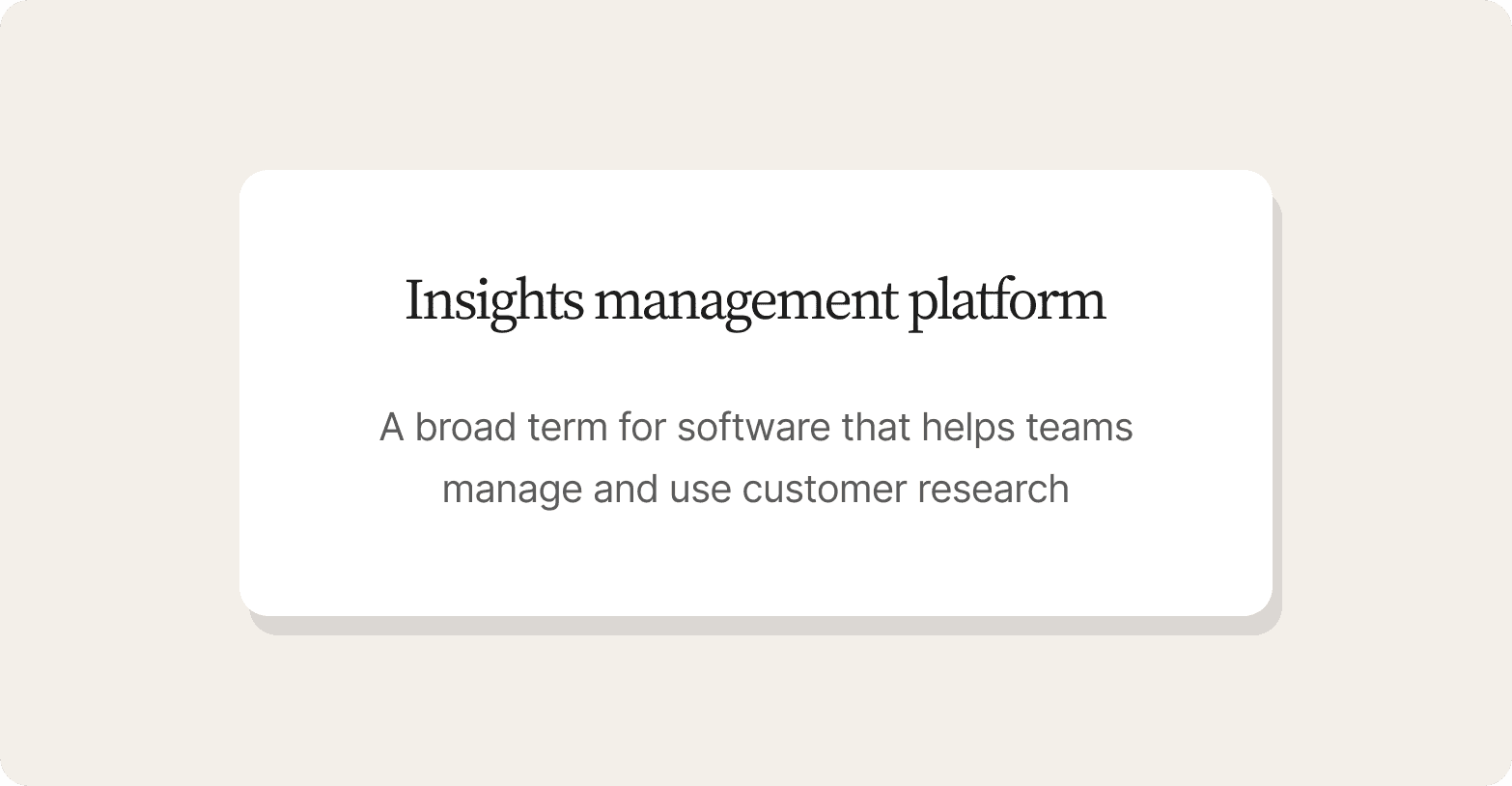
Insights management platform is a broad term for software that helps teams manage and use customer research. Because the term covers different types of products, the capabilities can vary widely. Core functions may include:
Collecting or importing research data
Analyzing interviews and other research evidence
Organizing findings so teams can search and reuse them
Sharing insights with stakeholders
Customer insights platforms with broader coverage can connect new research with existing knowledge, so findings remain linked to the evidence behind them as they move between studies.
Types of Insights Management Platforms
The table shows some of the main types of platforms that fall under “insights management” and how they fit into the research process:
| Tool or approach | What it does well | What it doesn't cover |
|---|---|---|
| Consumer understanding platforms | Generate new qualitative evidence, analyze it, and connect findings across studies | Capabilities vary by platform, so teams should assess the full workflow rather than the category name |
| Knowledge bases | Store and organize documents, notes, and other existing information | Generate new research or connect findings to original research evidence |
| Survey platforms | Collect structured feedback from large groups and analyze quantitative responses | Provide the depth and context of qualitative research |
| Research repositories | Organize completed studies and make past research easier to find | Generate new consumer insights |
| Research agencies | Plan and conduct research projects, including recruitment and moderation | Build a persistent, searchable body of research that your internal team can use across projects |
The important distinction is whether you're managing research that already exists, generating new evidence, or doing both. That distinction can help you work out what role a platform should play in your research stack.
7 Criteria for Evaluating Insights Management Software
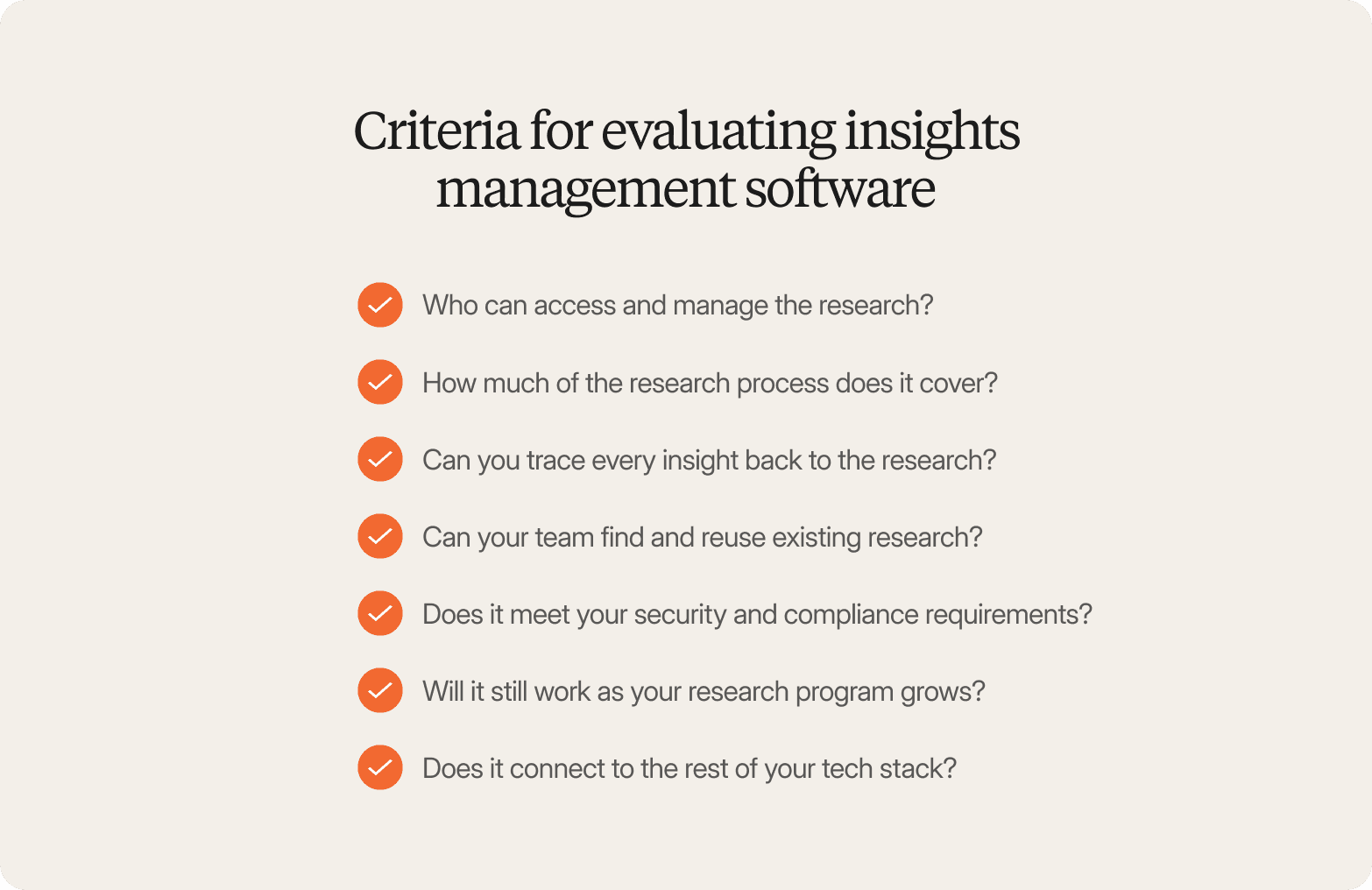
Choosing an insights platform can affect the quality of your research and how confidently you can use its findings. When comparing platforms, look at these seven areas.
1. Who can access and manage the research?
Start with access. Research often involves sensitive participant data, so you need to know who can view and edit findings to ensure compliance. Ask vendors:
Can you set different permissions for researchers, stakeholders, and administrators?
Can access be managed at the study or project level?
Is there a clear record of who accessed or changed research?
2. How much of the research process does it cover?
A platform may call itself an insights platform while still requiring separate tools for tasks like recruiting participants or analyzing data. Map the platform against your current workflow. The more of the process it handles in one place, the less time your team spends moving files and findings between tools.
Ask vendors:
Which parts of the research process can we manage on the platform?
Which steps still require another tool?
Can research move from raw interviews to analyzed findings without manually moving files?
3. Can you trace every insight back to the research?
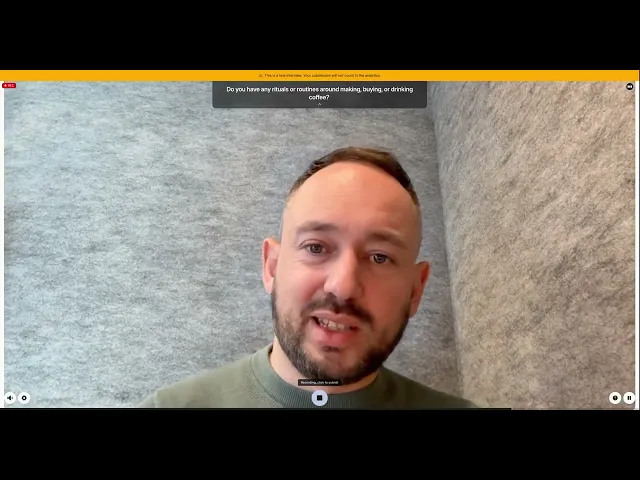
AI-generated summaries can speed up research, but they can also make it harder to tell whether a finding reflects what participants actually said. Look for a clear chain from finding → quote → participant → original recording. Ideally, a stakeholder should be able to click an insight and instantly see the relevant quote and a timestamped video.
See the traceability chain in action: AI Moderation in Action
Ask vendors:
Does every finding link back to participant quotes?
Can users open the original video and jump to the relevant timestamp?
Can researchers and stakeholders verify how an AI-generated finding was produced?
4. Can your team find and reuse existing research?
Research offers better outcomes for teams when you can draw on relevant findings from past studies rather than starting from scratch. Ask vendors:
Can users search across studies, transcripts, and findings from one place?
Can they filter or narrow results by topics, projects, participants, or other useful criteria?
Can users trace a past finding back to the original research when they want to explore it further?
5. Does it meet your security and compliance requirements?
Enterprise industry research platforms must meet your organization's security requirements before you can store participant data and research in them.
At minimum, check for SOC 2, GDPR compliance, regional data hosting, SSO, on-demand PII deletion, and full audit trails. If your organization has additional requirements, confirm those during sales calls. Ask vendors:
Does the platform have SOC 2 and GDPR compliance?
Can our data be hosted in a European region?
Can administrators delete participant PII on demand and see a full audit trail?
6. Will it still work as your research program grows?
A platform that works for a few studies may not work for a large research organization. Think beyond the number of users. Consider how many studies your teams run and how many people need access.
For example, an enterprise team running 50 or more studies a year needs a platform that can provide ongoing support at that volume without adding more admin work.
Ask vendors:
Can the platform support 50 or more studies a year?
Can multiple research teams use shared workflows and standards?
Does performance remain reliable as the amount of research stored in the platform grows?
7. Does it connect to the rest of your tech stack?
Your research platform should not become another silo. Check whether it can connect with the systems your teams already use to store knowledge and report results.
Ask vendors:
Does it integrate with our knowledge base, CRM, and reporting tools?
Is there an API for connecting the platform to our internal systems?
Can insights move into the tools stakeholders already use without manual exports?
15 Insights Management Platforms Evaluated
Use the table as a quick comparison before diving into the full profiles.
| Platform | Research process | Traceability | Security & compliance | Integrations |
|---|---|---|---|---|
| Conveo | Study design through recruitment, interviews, analysis, and synthesis | Every finding → quote → timestamped video from a real participant | SOC 2, GDPR, primary infrastructure in Belgium | 8 panel providers, self-recruitment, custom links, and MCP for AI assistants |
| Great Question | End-to-end | Transcript + video | SOC 2, GDPR | 20+ integrations |
| Listen Labs | End-to-end | Quotes + timestamped clips | SOC 2, GDPR | No public integrations |
| Outset | Most stages | Quotes + video clips | SOC 2, GDPR | Limited |
| Strella | End-to-end | Quotes + video clips | SOC 2, GDPR | Recruitment-focused |
| GetWhy | End-to-end | Quotes + video clips | SOC 2, GDPR, EU hosting | Some |
| Discuss.io | Most stages | Transcript + timestamped clips | GDPR; US hosting | API + partners |
| UserTesting | Testing-focused | Video timestamps | SOC 2, GDPR, multi-region hosting | Broad |
| Remesh | End-to-end | Source-linked responses | SOC 2, GDPR | AI + data connections |
| Marvin | Analysis + AI interviews | Clips + transcripts | SOC 2, GDPR | 30+ data sources |
| Dovetail | Analysis + storage | Source material available | SOC 2, GDPR, EU hosting | 30+ integrations |
| Looppanel | Analysis + storage | Theme-level organization | SOC 2, GDPR | Broad |
| Condens | Analysis + storage | Transcript + timestamped video | GDPR, EU hosting | Broad |
| Suzy | End-to-end | Source-linked recordings | SOC 2, GDPR | None listed |
| Voxpopme | Collection + analysis | Theme + timestamped video | SOC 2, GDPR, EU servers | AI assistant connections |
The platforms below are grouped by primary focus, so you can compare tools that best fit your needs.
Consumer Understanding Platforms
1. Conveo
Conveo is consumer understanding infrastructure built for enterprise research teams. Every study builds on what came before it: findings carry forward automatically, and the platform keeps refining its picture of the customer as new research lands. Over time that adds up to a live, always-updating view of what customers think and do.
Research process coverage: Covers study design and multimodal research through synthesis and delivered findings in one workflow. For ongoing research, studies can run in waves, with automatic signal detection identifying changes over time and turning them into an insight report and quote reel.
Tracing insights back to the research: Every finding links through a quote to a timestamped video clip from a real participant. Conveo draws on video, audio, and text in its analysis, so stakeholders can verify a finding against the original evidence.
Finding and reusing past research: Findings connect across studies automatically. Conveo recognizes shared themes and participant groups from customer insight research and surfaces what has changed automatically.
Security and compliance: SOC 2 and GDPR compliant, with primary infrastructure hosted in Belgium.
Integrations: Supports recruitment through panels including Respondent.io and Norstat, alongside self-recruited participants and custom links. Its MCP Server also connects AI assistants such as Claude to build and run studies from a chat interface.
Access and permissions: Uses organization-level roles ranging from full control to read-only, alongside study-level sharing permissions. Where permissions overlap, the highest level of access takes priority.
Scalability: Consolidating recruitment, moderation, transcription, analysis, and storage into one workflow removes the steps required by a fragmented stack. 100 interviews can be completed in as few as three days, so you can run qualitative research at scale.
"The pace, responsiveness, and research expertise of the Conveo team, on top of the top AI-moderated qual platform, have been invaluable to us in scaling brand advertising internationally."
Matt Harris, Research & Insights Lead, EMEA, at Canva
2. Great Question
Great Question helps product managers and designers run interviews, surveys, and usability tests without relying on a dedicated research team.
Research process coverage: Covers study setup, recruitment, interviews, surveys, prototype testing, and usability testing in one platform.
Tracing insights back to the research: Every quote links to its original transcript and the relevant moment in the video recording.
Finding and reusing past research: Includes a built-in research repository with cross-study search and synthesis, so teams can find past research without a separate repository.
Security and compliance: SOC 2 Type II and GDPR compliance are confirmed. Data is hosted in the US.
Integrations: Offers more than 20 native integrations, including Zoom, Slack, Salesforce, and User Interviews, plus Zapier for connecting with other apps.
3. Listen Labs
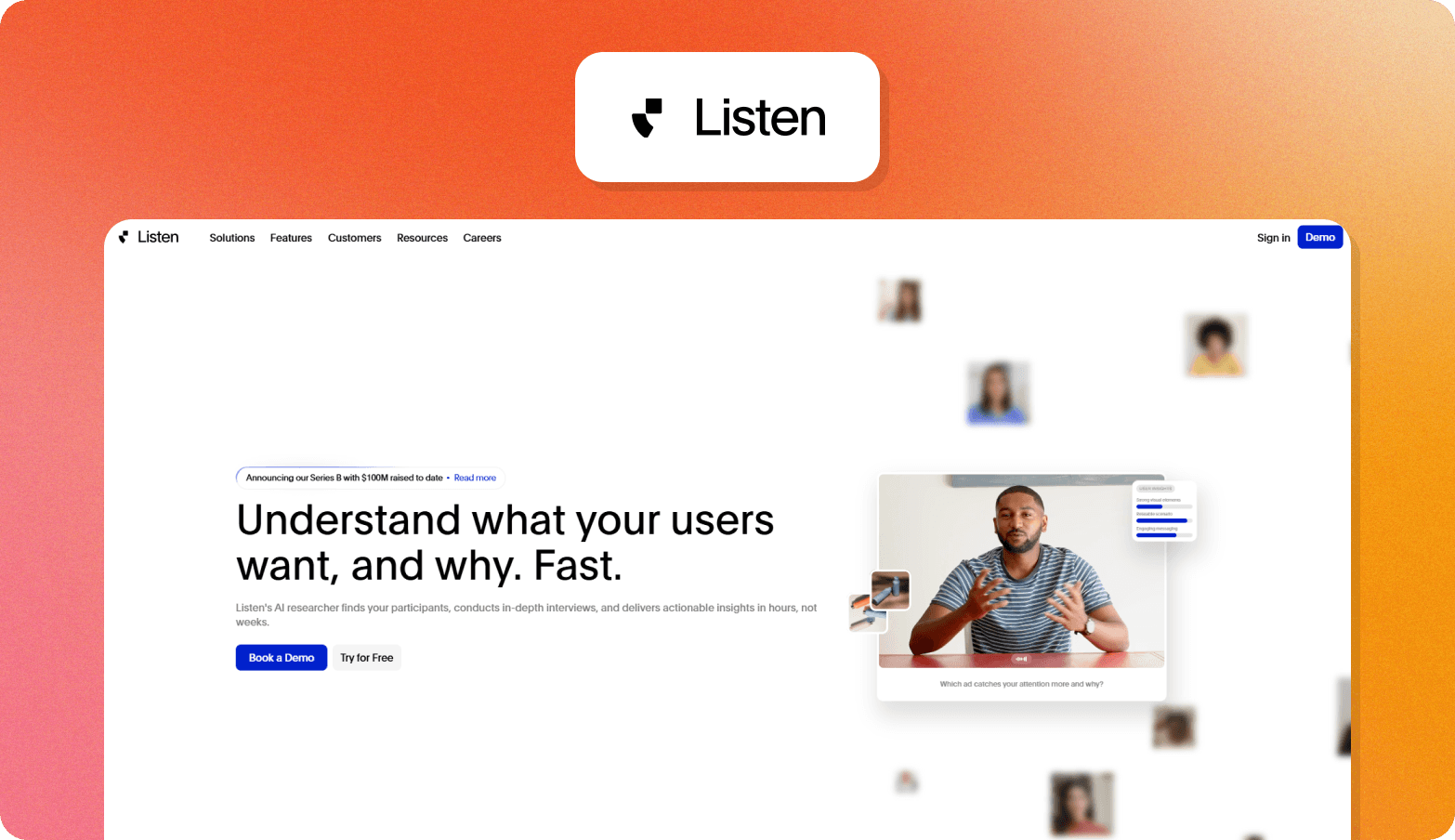
Listen Labs uses AI-moderated interviews to help teams run research from study setup to analysis quickly.
Research process coverage: Covers study design, participant recruitment, AI-moderated interviews, analysis, and reporting in one workflow.
Tracing insights back to the research: Insights link to source responses, including verbatim quotes and timestamped clips.
Finding and reusing past research: Mission Control lets teams search across studies, identify trends, and track findings over time.
Security and compliance: SOC 2 Type II and GDPR compliant. EU data hosting isn’t publicly confirmed.
Integrations: No integrations are listed on Listen Labs’ website.
4. Outset
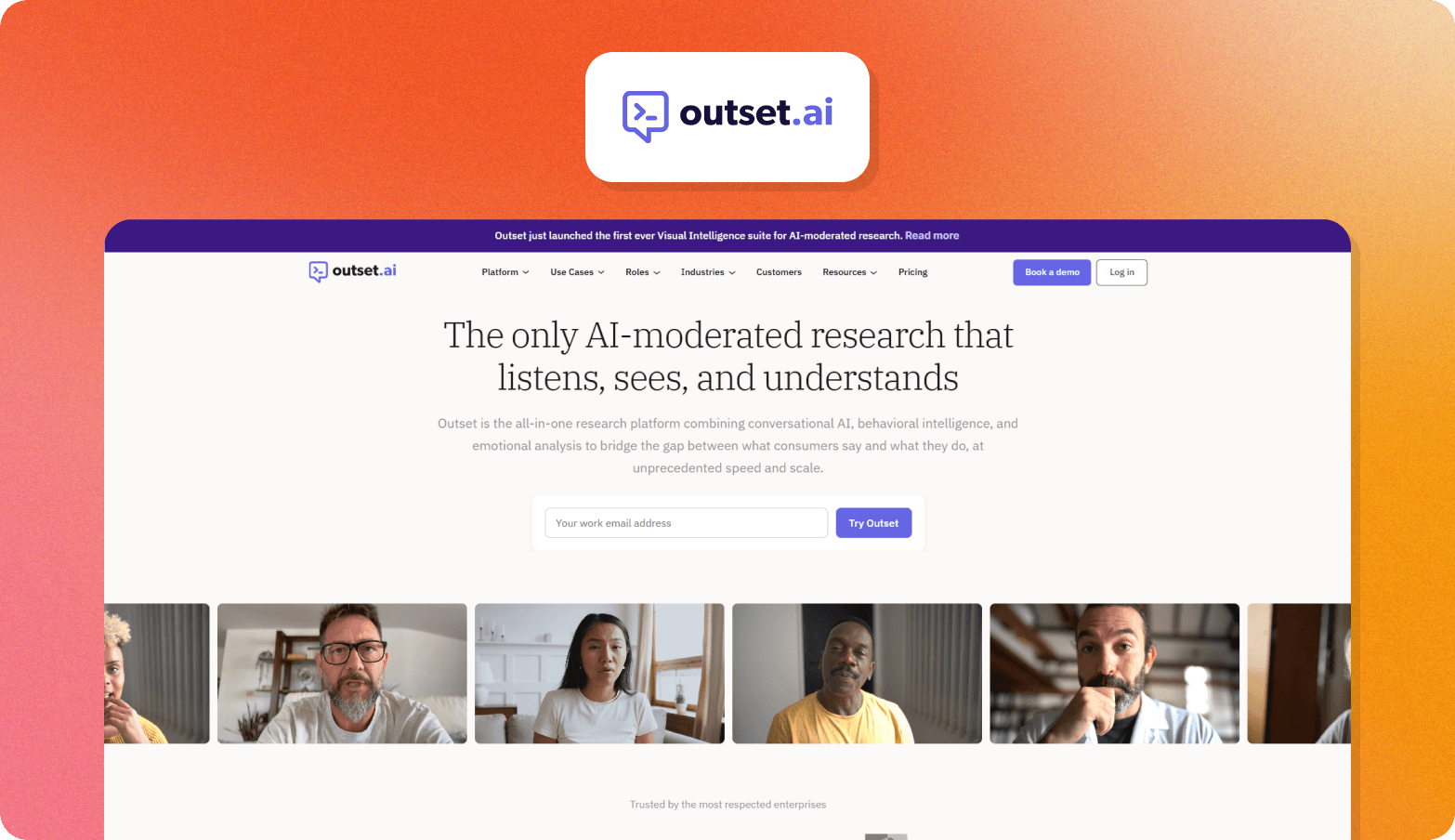
Outset uses an interviewer with AI capabilities to run asynchronous interviews and ask participants follow-up questions based on their responses.
Research process coverage: Covers study design, recruitment, interviews, and data analysis in one platform.
Tracing insights back to the research: Themes link back to participant quotes and video clips.
Finding and reusing past research: Outset doesn’t include a built-in cross-study repository. Teams can send transcripts and reports to Dovetail for long-term storage and search.
Security and compliance: SOC 2 Type II and GDPR compliant. EU data hosting isn’t publicly confirmed.
Integrations: Outset doesn’t detail broader integrations on its website beyond Dovetail.
5. Strella
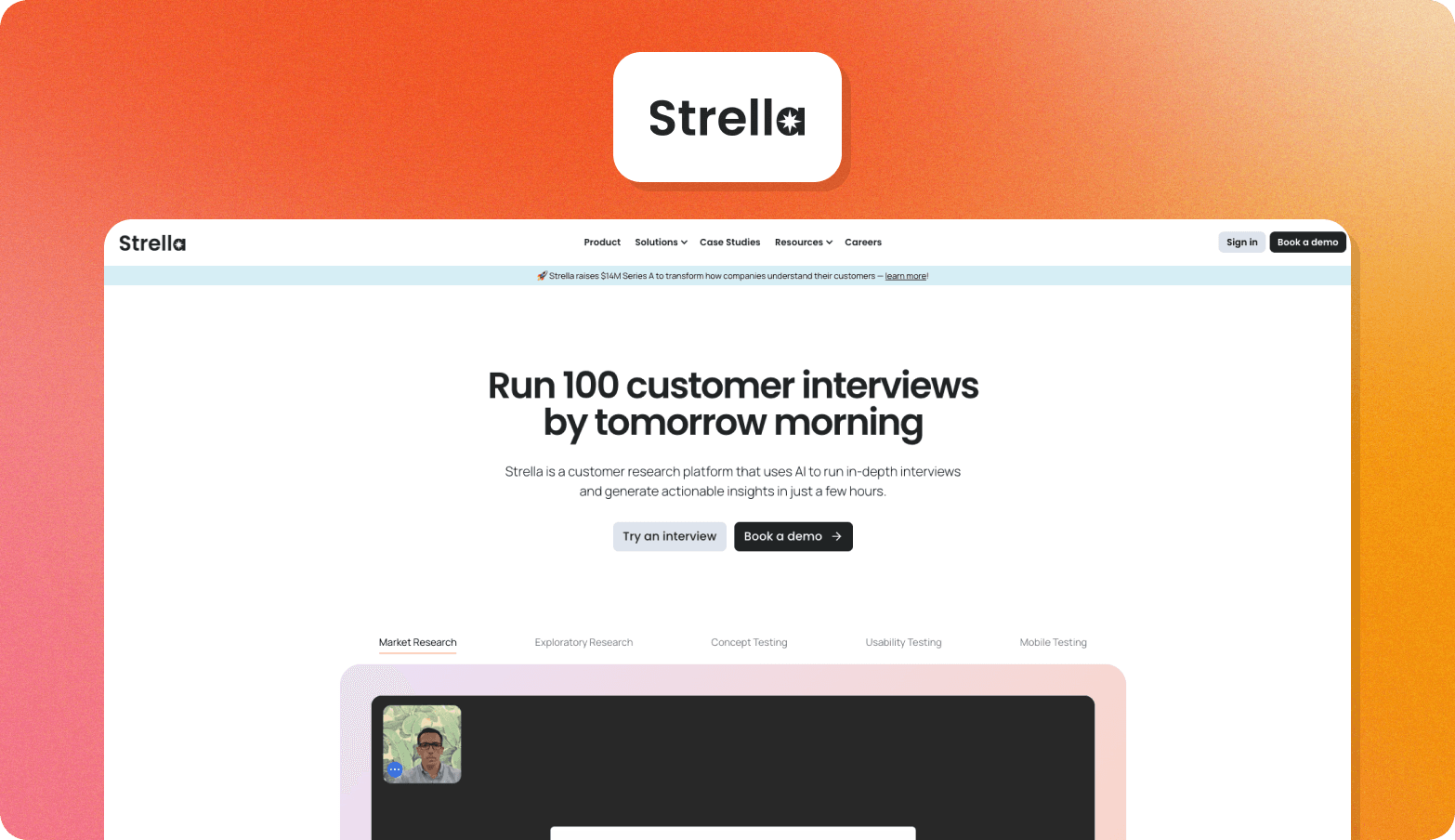
Strella supports both AI-moderated and human-moderated video and voice interviews in one platform.
Research process coverage: Covers study setup, recruitment, incentives, scheduling, AI or human-moderated interviews, and real-time analysis.
Tracing insights back to the research: Insights link to verbatim quotes and video clips.
Finding and reusing past research: Explorer lets teams search across studies and find clip-level evidence from multiple projects.
Security and compliance: SOC 2 and GDPR compliance are confirmed. Data is processed in the US, with no EU hosting option.
Integrations: Integrates with Respondent and User Interviews for participant recruitment. No broader tool integrations are publicly documented.
6. GetWhy
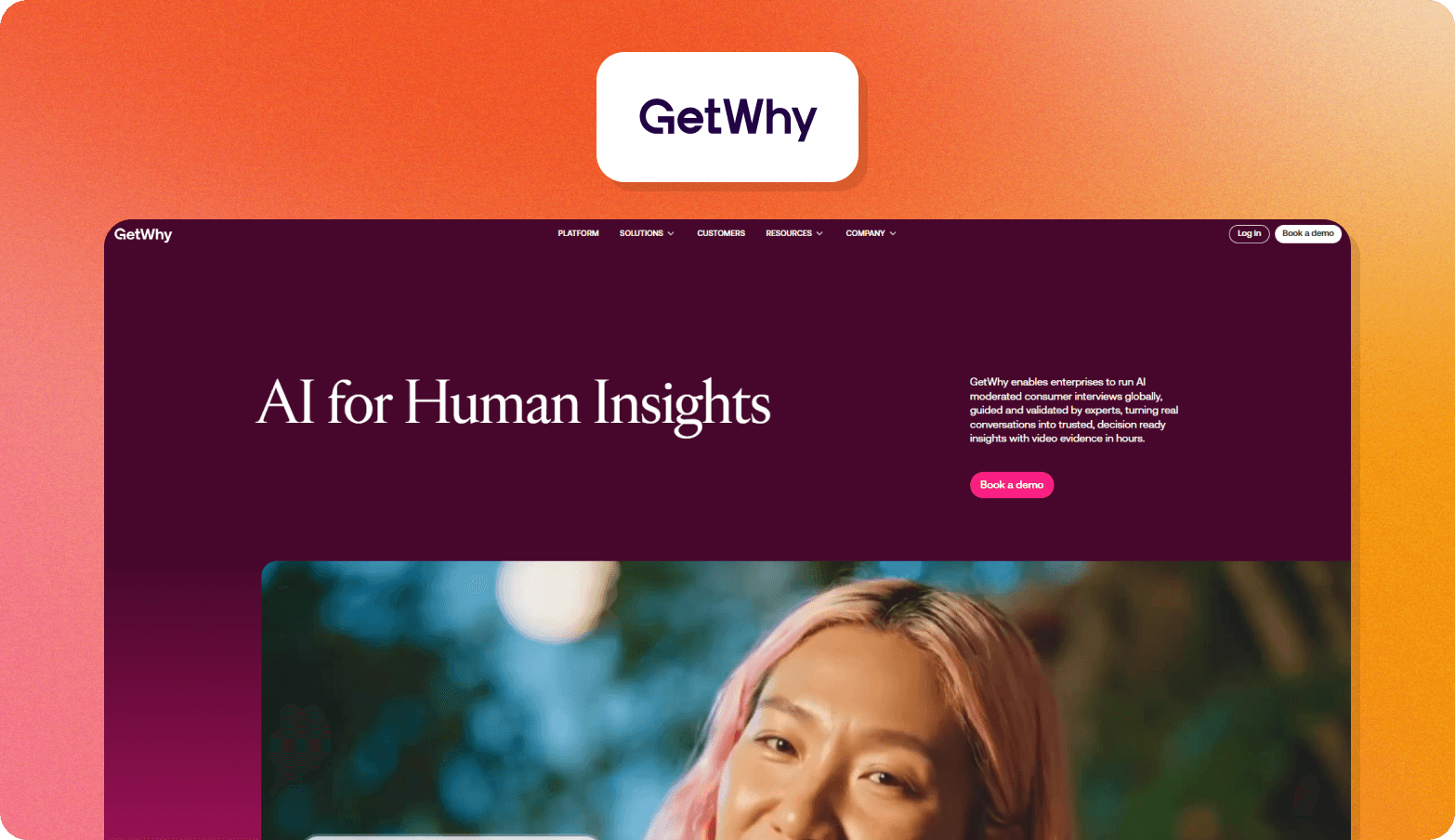
GetWhy combines AI-moderated video research with oversight from professional market researchers throughout each study.
Research process coverage: Covers recruitment, interviews, and synthesis in one workflow.
Tracing insights back to the research: Findings link to video clips and participant quotes.
Finding and reusing past research: Research Agent lets teams search across studies using natural language and filter results by segment, region, and time period.
Security and compliance: SOC 2, GDPR compliance, and EU data hosting are confirmed.
Integrations: Connects with insight repositories including Market Logic and Stravito. GetWhy also mentions connections with enterprise LLMs and data platforms, although specific integrations aren’t publicly listed.
7. Discuss.io
Discuss.io combines AI-moderated and human-led interviews, allowing teams to choose the approach that suits each study.
Research process coverage: Covers participant sourcing, interviews, analysis, and insight sharing.
Tracing insights back to the research: Transcripts are linked to recorded video, and researchers can turn quotes into timestamped clips.
Finding and reusing past research: Includes a cross-study research repository and tools for searching across past studies. Ask Your Data answers questions using sourced evidence from the research.
Security and compliance: GDPR compliance is confirmed. SOC 2 and EU data hosting aren’t publicly confirmed, and data is hosted in the US.
Integrations: Offers a public API and integrations with tools including Microsoft Copilot, Claude, Alida, Fuel Cycle, and User Interviews.
8. UserTesting
UserTesting focuses on unmoderated usability testing and think-aloud studies, with moderated live sessions also available.
Research process coverage: Primarily supports unmoderated usability testing and think-aloud studies, alongside moderated live conversations. It doesn’t offer AI-moderated interviews to scale qualitative research.
Tracing insights back to the research: Insights Discovery links findings to video timestamps through AI-powered natural-language search, although this does not yet cover live conversations.
Finding and reusing past research: EnjoyHQ provides a cross-project research repository with keyword and semantic search across studies.
Security and compliance: SOC 2 Type II, GDPR, and EU, US, or APAC data hosting are confirmed.
Integrations: Integrates with a range of tools including Figma, Jira, Slack, and Microsoft Teams.
9. Remesh
Remesh is built for understanding how groups respond and interact around a topic, rather than relying solely on one-on-one interviews.
Research process coverage: Covers study setup, recruitment, live and asynchronous group sessions, and real-time AI analysis. Remesh Video is a paid add-on for one-on-one interviews.
Tracing insights back to the research: AI-generated themes and consensus scores link back to participant responses with inline citations. Remesh Video adds clip-level traceability.
Finding and reusing past research: Conversation Merge combines up to 10 conversations for cross-study analysis, including themes and sentiment.
Security and compliance: SOC 2 Type II and GDPR compliance are confirmed. Data is processed and stored in the US, with no EU hosting option.
Integrations: Remesh Connect links with AI tools such as ChatGPT and Claude and can also bring data in from tools including Google Drive, SharePoint, Workday, and Qualtrics.
Knowledge Bases
10. Marvin
Marvin is an AI-native customer feedback repository that organizes and synthesizes research teams have already collected, with AI-moderated interviews available for gathering new data when needed.
Research process coverage: Covers research analysis and includes AI-moderated interviews, but teams need a separate way to recruit participants.
Tracing insights back to the research: Every finding links back to video clips, transcripts, and survey responses.
Finding and reusing past research: Repository-wide search across past studies is available on the Enterprise plan.
Security and compliance: SOC 2 and GDPR compliance are confirmed. European data hosting is available, but only on the Enterprise plan.
Integrations: Connects to more than 30 data sources.
11. Dovetail
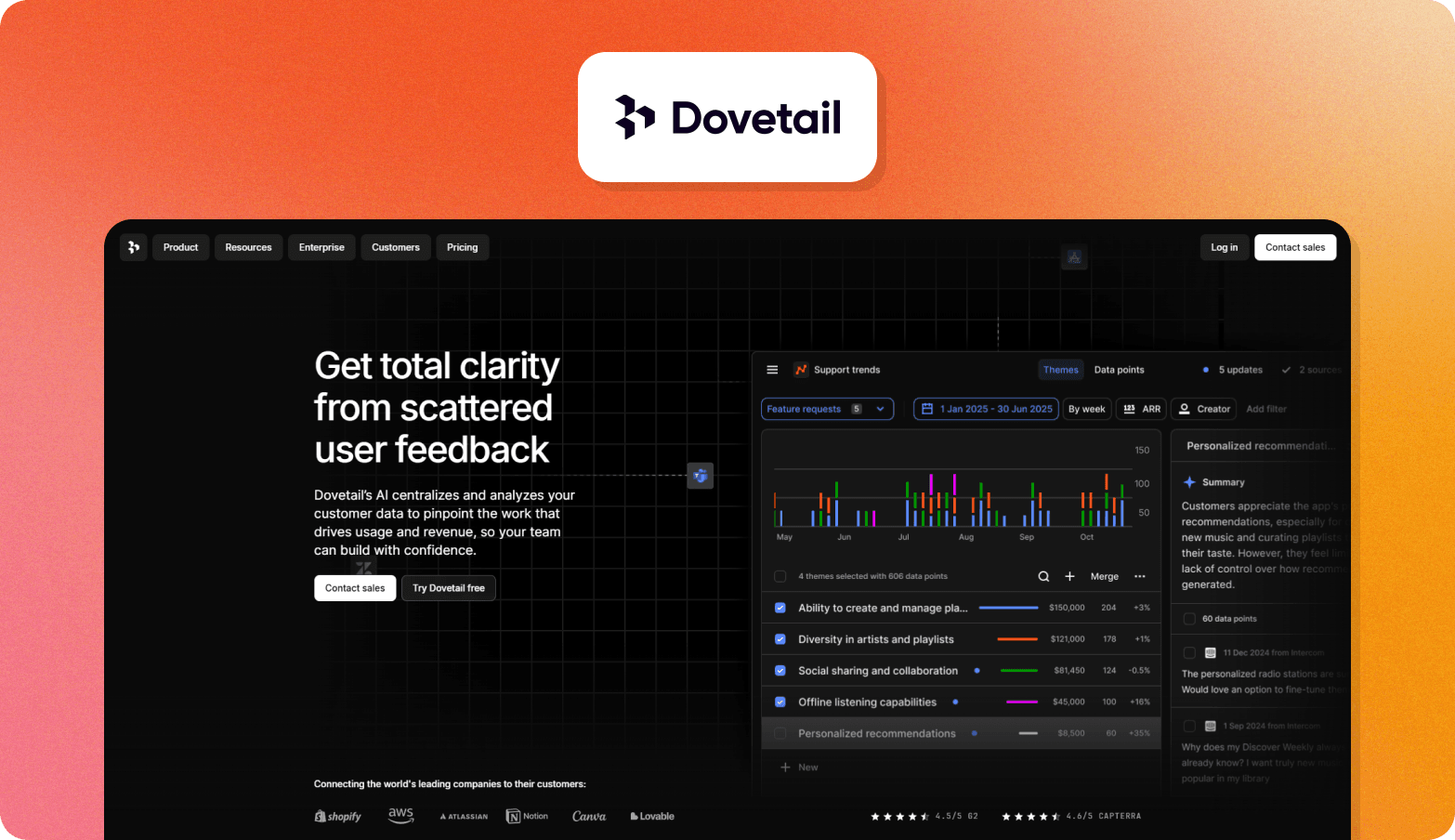
Dovetail brings customer knowledge from different sources, research and beyond, into one searchable place.
Research process coverage: Covers research analysis and storage but does not support participant recruitment or interview moderation.
Tracing insights back to the research: AI can identify themes and patterns and create reports and highlight reels, although a direct link from a finding to a timestamped video clip isn’t publicly confirmed.
Finding and reusing past research: Strong at storing, organizing, and searching across existing research, but does not generate new studies.
Security and compliance: SOC 2 Type II, GDPR compliance, and EU data hosting are confirmed.
Integrations: Connects with more than 30 tools, including Zoom, Salesforce, HubSpot, Zendesk, Slack, Microsoft Teams, and Notion, as well as AI tools.
Research Repositories
12. Looppanel
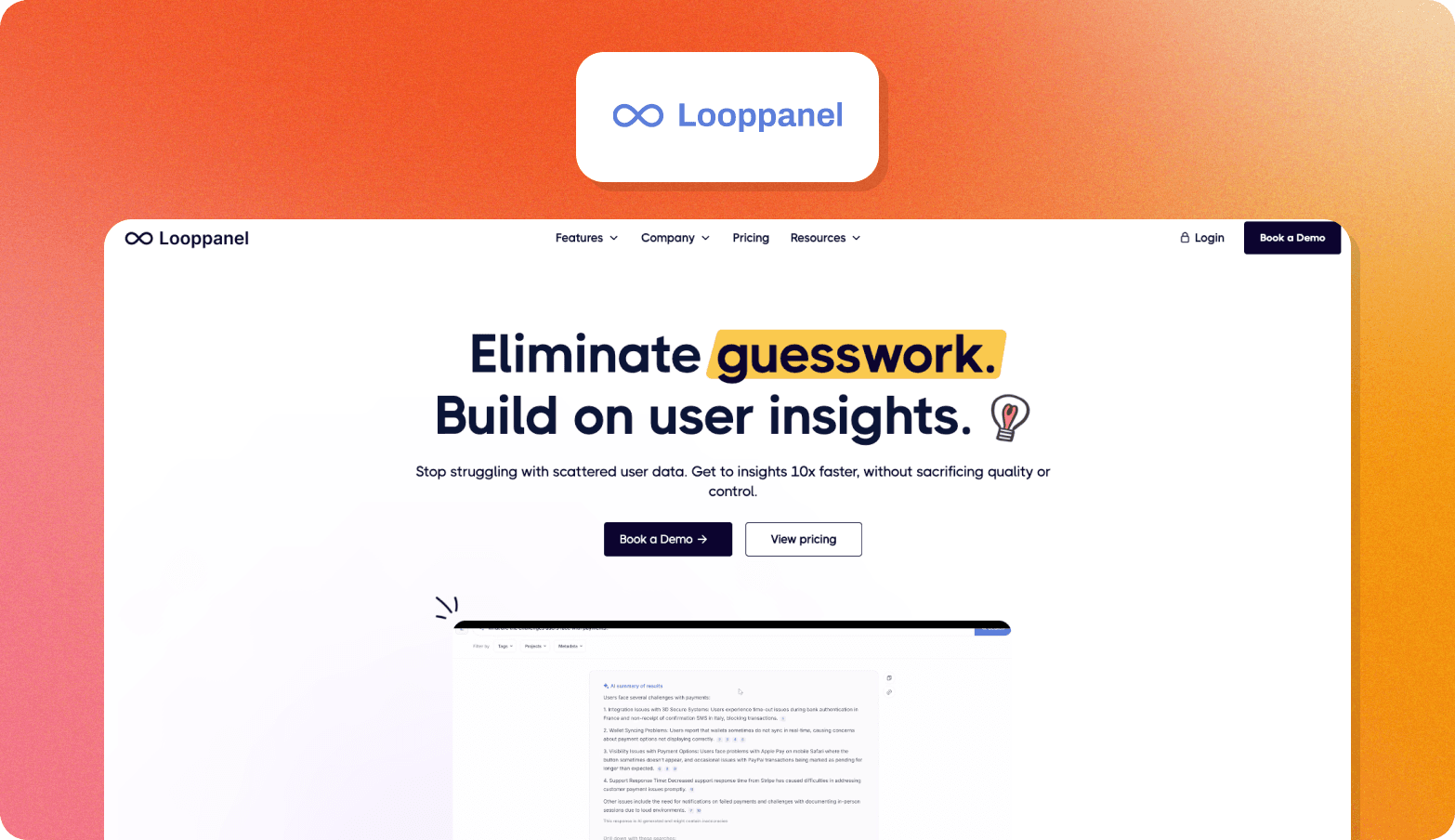
Looppanel helps research teams make sense of interview data and build a searchable repository they can return to later.
Research process coverage: Covers post-interview analysis and research storage. Recruitment and interview execution happen outside the platform.
Tracing insights back to the research: Automatically groups notes by question and theme across the research repository.
Finding and reusing past research: Automatically enriches stored research to help keep the knowledge base organized and searchable over time.
Security and compliance: SOC 2 Type II and GDPR compliance are confirmed. Data is stored in the US, with no EU hosting option.
Integrations: Connects with common video conferencing, CRM, support, and research tools. It also offers an API for custom integrations.
13. Condens
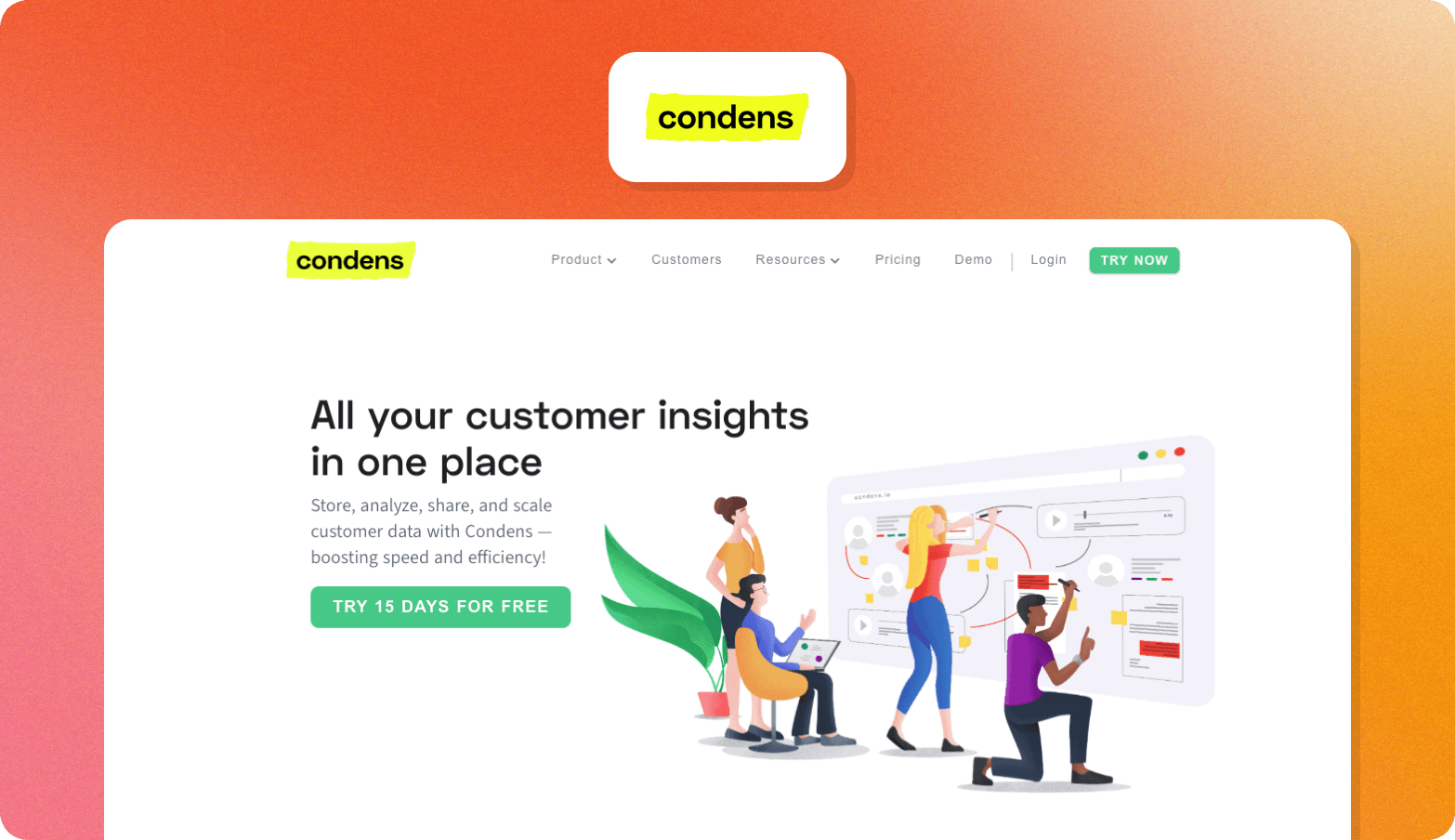
Condens is a research repository that gives teams one place to organize customer research.
Research process coverage: Focuses on analysis and research storage rather than recruitment or running studies.
Tracing insights back to the research: Every point in the transcript links to the relevant moment in the original recording. Users can click the transcript to jump to that point or turn highlighted text into a timestamped video clip.
Finding and reusing past research: Gives stakeholders a self-serve way to explore published findings and search across the wider research repository with AI.
Security and compliance: GDPR is confirmed and EU-only data hosting is available. SOC 2 isn’t publicly documented.
Integrations: Connects with tools including Google Drive, Microsoft 365, Zoom, Figma, and Miro, with additional connections available through Zapier and MCP.
Survey Platforms
14. Suzy
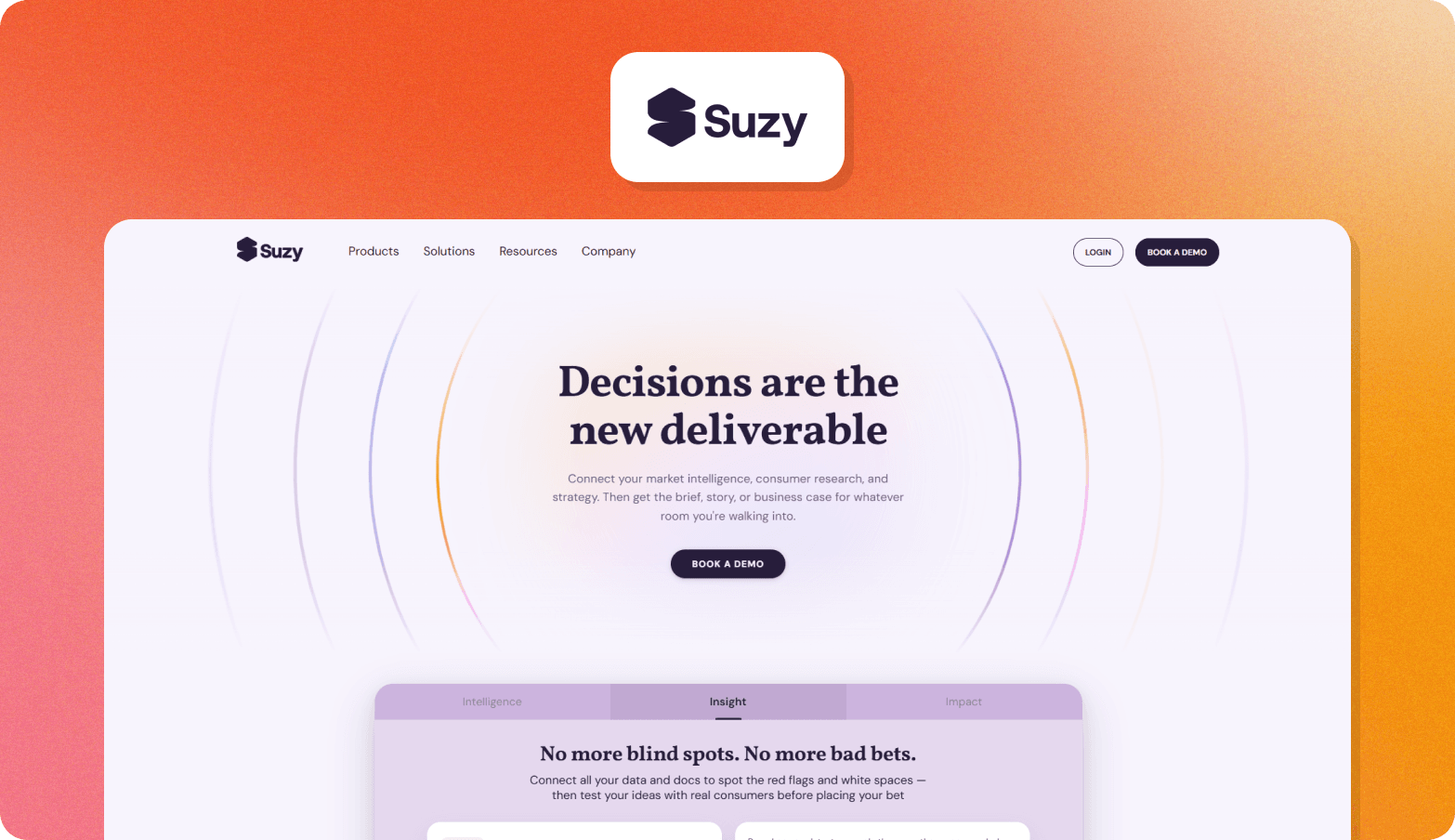
Suzy gives teams several ways to collect consumer feedback, from self-serve surveys to moderated and AI-moderated research.
Research process coverage: Covers study setup, surveys, participant recruitment, interviews, analysis, and reporting.
Tracing insights back to the research: Findings from video and live interviews link to the original verbatim, recording, and transcript. AI-moderated voice interviews link to the original audio and transcript quote.
Finding and reusing past research: Suzy Insight brings research from different studies into one searchable hub that teams can query.
Security and compliance: SOC 2 and GDPR compliance are confirmed. Data is processed and stored in the US, with no EU hosting option.
Integrations: Suzy doesn’t have any public information on integrations,
15. Voxpopme
Voxpopme is built around video surveys, capturing and analyzing customer feedback on video at scale, with other methods available when a study calls for it.
Research process coverage: Covers AI-moderated voice interviews, live one-on-one sessions, and video survey collection in one platform.
Tracing insights back to the research: Theme Explorer links identified themes directly to the video clips where participants mentioned them, with playback starting at the relevant moment.
Finding and reusing past research: Its Data & Insights Repository stores videos, transcripts, tags, and themes from across studies in one place.
Security and compliance: SOC 2 Type II and GDPR compliance are confirmed. Servers are located in Dublin and Frankfurt, although some processing may take place in the US through subprocessors.
Integrations: Connects with Claude and ChatGPT through MCP, allowing teams to search their research library and create studies from their AI assistant.
Why Enterprise Insights Teams Need More Than a Repository
A repository tool can seem like a good way to keep consumer insights organized and accessible, but a platform that only offers this functionality can cause problems later on, for example:
More manual work. Researchers may need to move transcripts and recordings between different systems before they can store them.
Research that gets reused less. If stakeholders have to search through slide decks or reports to answer a question, they may still turn to the research team for a fresh study instead.
Findings that lose their context. Research from one study can become disconnected from related work conducted elsewhere, making it harder to build on what the team already knows.
The problem becomes more serious when stakeholders find a conclusion but can’t see where it came from. A finding may end up in a slide deck or repository without a clear link back to the original participant conversations. Without that trail, people have to rely on the researcher's interpretation.
How to Roll Out an Insights Management Platform Without Disrupting Research
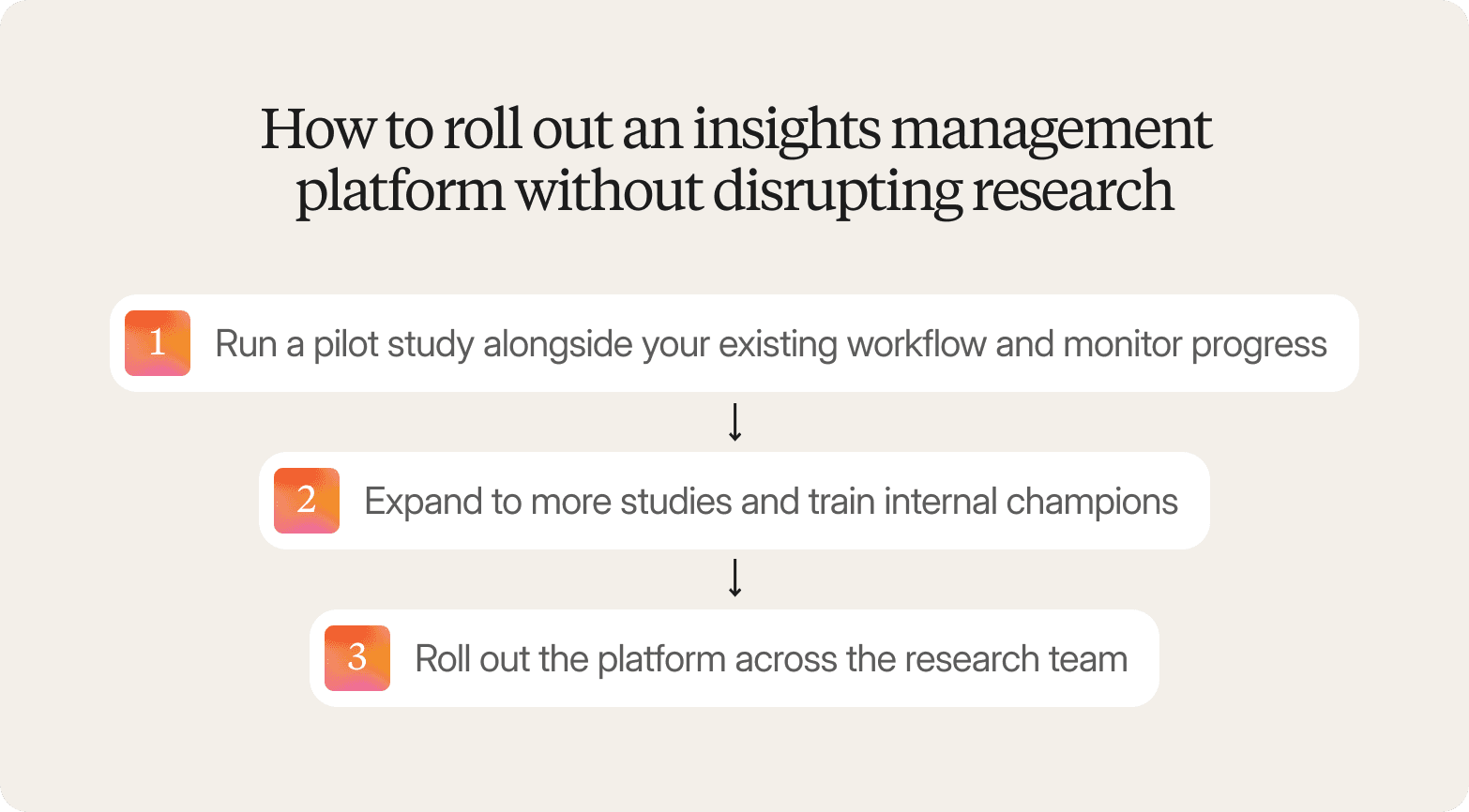
Introducing a new platform for an entire team can feel disruptive. Moving everything at once can create extra work for researchers and force teams to change their methods mid-study. A gradual rollout avoids that problem. Here’s how to approach it.
Phase 1: Run a Pilot Study Alongside Your Existing Workflow and Monitor Progress
Start with one study and run it without changing how you conduct your other research. If you currently work with an agency, you can continue that workflow while using the new platform for the pilot.
The goal is to see how the platform handles your research from start to finish and identify any changes your team needs to make. A pilot can usually run for 2 to 4 weeks, depending on the study.
Phase 2: Expand to More Studies and Train Internal Champions
Once the pilot is complete, the next step is to expand the platform to 3 to 5 studies. This gives the team a chance to use it across different research needs before making it part of the wider process.
At this stage, train a small group of internal champions who can help other researchers use the platform and answer practical questions. Allow 1 to 2 months for this phase so teams can build the platform into their existing ways of working.
Phase 3: Roll Out the Platform Across the Research Team
Once the platform has been tested across several studies, you can begin the wider rollout. This may include moving historical insights into the platform so past and future research can live in one place.
A full rollout can take 3 to 6 months to get the complete picture, depending on the amount of existing research and the size of the team. The important point is that active studies do not need to stop during the transition. Teams can move to the new platform gradually rather than trying to replace every existing tool or process at once.
How Conveo Gives You a Complete Picture of Consumer Insights
The platforms in this guide solve different parts of the insights management problem. Some help teams generate new research. Others help them organize and reuse research they have already completed.
Conveo is purpose-built to bring those two parts together. Teams can generate new qualitative evidence, analyze it, and build on it in future studies without moving findings into a separate repository. That means the knowledge layer grows alongside the research program rather than being something researchers have to maintain after each project.
New research adds to what the team already knows. Findings connect across studies, helping researchers identify relevant past evidence when investigating a new question.
Insights remain connected to the original research. Every finding can be traced back to the participant evidence behind it, giving stakeholders the ability to verify conclusions.
The same system supports the research process and the knowledge it generates. Teams don’t need one platform for research and another to make that research reusable in future studies.
"I chose Conveo because it was giving me an easy-access platform to run projects in several countries at the same time, together with a background of real researchers that gave me assurance that my projects would be with the robustness that I need."
Carla Mahfuz, Senior Manager Consumer Insights, Ferrara Candy Company
Frequently Asked Questions
What is the difference between an insights management platform and a knowledge base?
A knowledge base stores and organizes information your team has already captured. An insights management platform can also connect research findings across studies, making them easier to search, analyze, and use in future decision-making. Platforms that support qualitative research can go further by generating new evidence and connecting findings back to the original conversations.
How do I know if AI-generated insights are trustworthy?
Look for research-grade traceability. Every AI-generated finding should link back to the verbatim participant quote and the relevant timestamp in the original recording. This gives researchers and stakeholders a way to check the evidence behind an insight rather than relying on an unexplained AI summary.
Can we consolidate our research stack without disrupting current workflows?
Yes, but implementation should happen gradually. Start with a pilot study alongside your existing methods, then expand to more projects as your team gets comfortable with the platform. This lets you evaluate its capabilities and refine your process before moving more of your research onto it.
What compliance requirements should an insights management platform meet?
Enterprise buyers should check for SOC 2, GDPR compliance, European regional data hosting, SSO, on-demand PII deletion, and full audit trails. You should also confirm how the vendor handles data retention and access permissions before putting participant data into the platform.
How many tools can an insights management platform replace?
That depends on the platform. An end-to-end platform may cover recruitment, moderation, transcription, analysis, and storage, reducing the number of separate tools your team needs. A research repository mainly handles storage and retrieval, so you may still need other tools to generate and analyze research. When evaluating a platform, compare its capabilities with your current research stack to see where consolidation is realistic.
What’s the difference between insights management software and performance management software?
Insights management software helps teams collect, organize, analyze, and reuse research to support business decisions. Insights performance management tools are designed to help HR teams manage employee performance through processes such as goal setting, performance conversations, continuous feedback, development plans, and progress tracking.

About the author
Florian Hendrickx
Head of Growth
Florian is Conveo’s Chief Growth Officer, leading growth strategy and go-to-market execution as the company scales. He’s held growth leadership roles at companies like Deliverect, Robovision, and Aikido Security, and brings hands-on experience across marketing, sales, and product.
More by Florian →Qualitative insights at the speed of your business.
Conveo runs AI-moderated video interviews and structures everything they say.