In this article
TL;DR
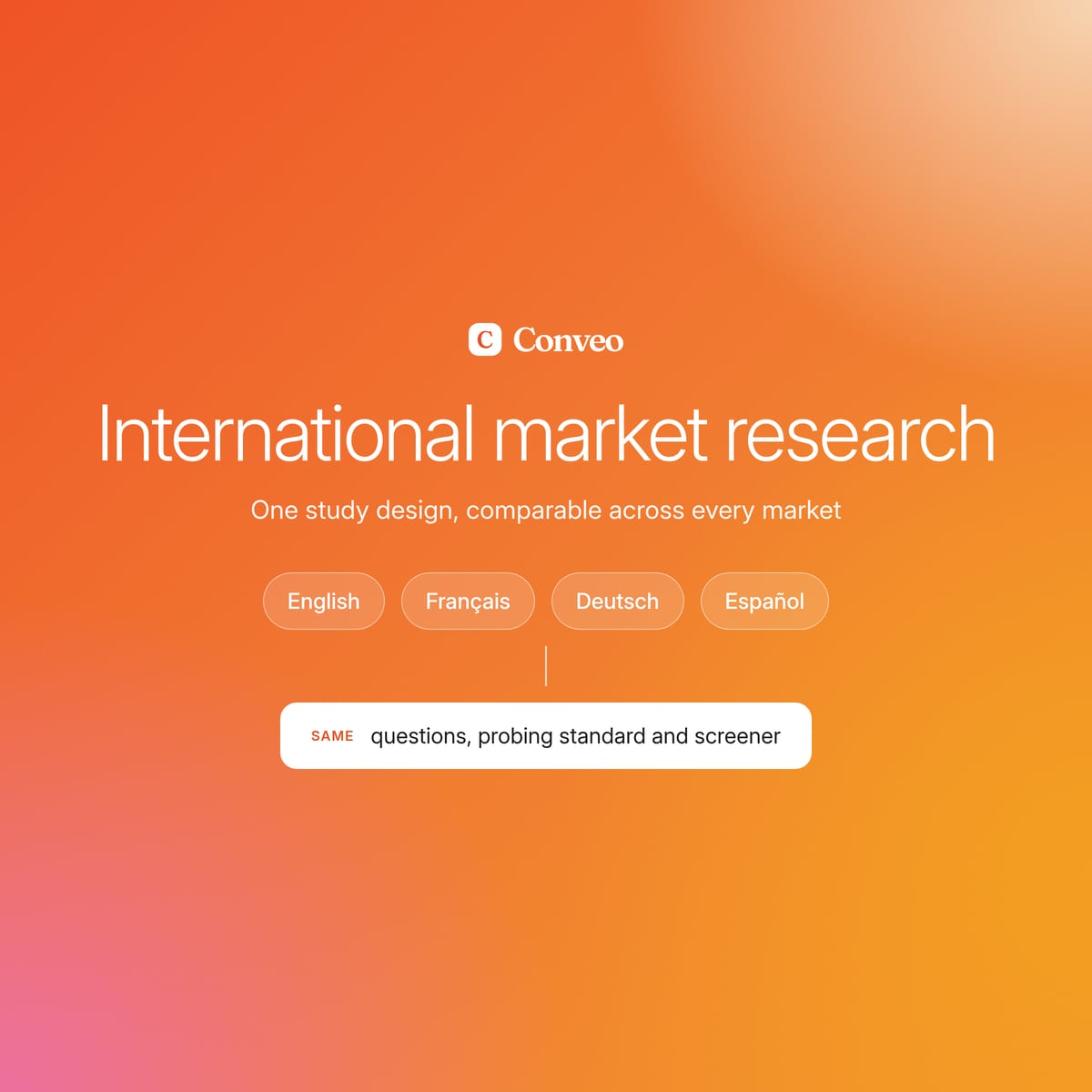
International market research produces comparable findings when one study design uses consistent moderation across countries and languages.
Most teams run each market on its own instrument instead, often through a separate market research firm, with drifting translated guides and no shared design.
Local reports end up incomparable, and the gap often surfaces only after a global strategy call has already been made on top of them.
Transcripts, subtitles, and analysis come back in one language, so teams can read every market side by side.
For teams running international market research across several countries, the real test is whether they can compare findings from every market before the global decision closes. This article explains why multi-market studies fragment without a shared instrument, what true comparability requires, and a five-step framework for scoping a study that withstands stakeholder scrutiny.
Why international market research often lags the decision it informs
A brand proves a concept in its initial market, then extends the study to other countries as it reaches for new audiences. The global pricing or market entry call then gets made on three market reports that were never built to compare.
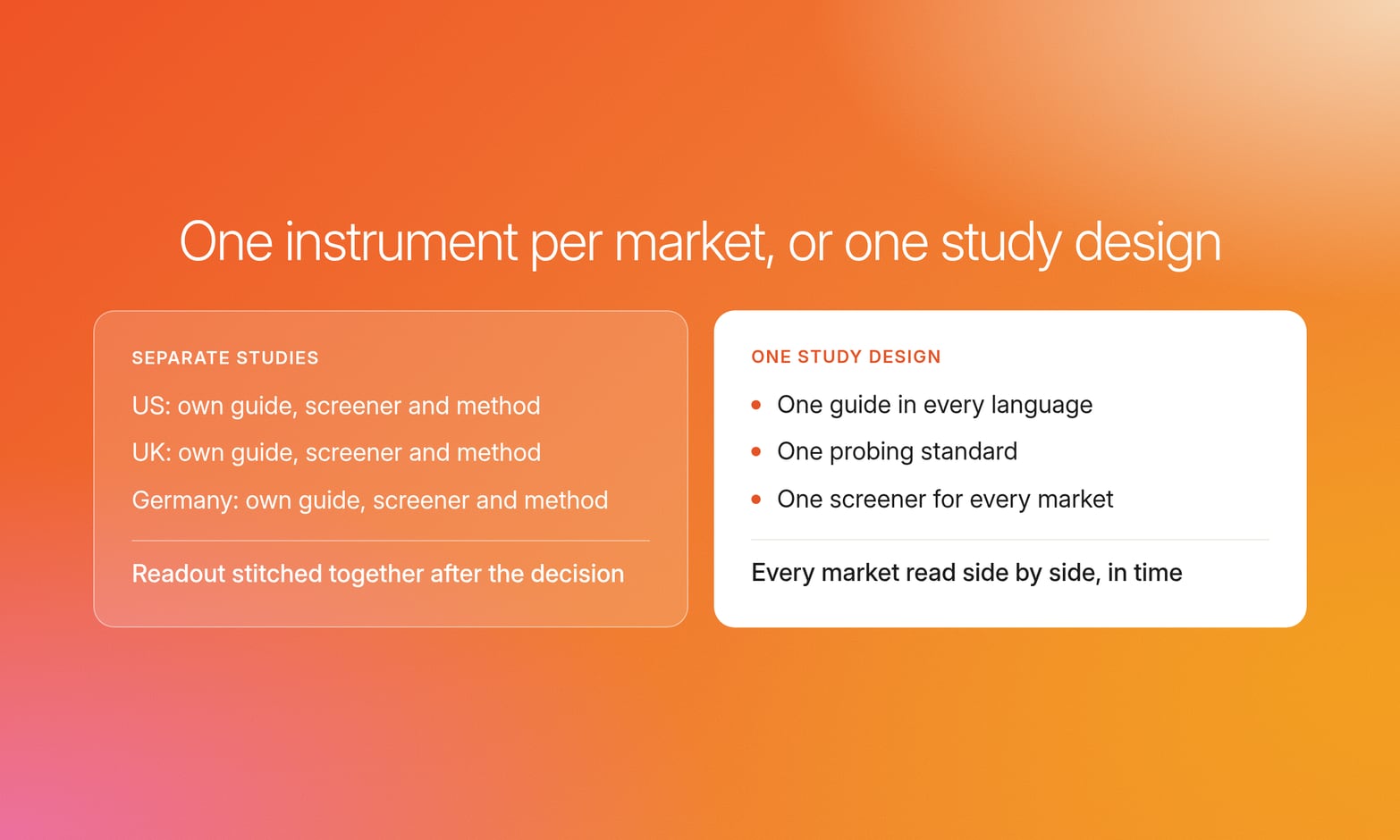
By the time anyone notices the US, UK, and German findings used different question wording and different screeners, the decision is already live. When each market runs on its own instrument, whether in-house or through separate market research companies, this is the default outcome. It leaves teams without a clear picture of any target market.
Whether a market runs in-house or with an agency partner, it often gets research services or customized research solutions built for that one country. So each market brings its own:
Moderator and guide translation
Screener and recruitment criteria
Research methods, such as focus groups in one local market and in-depth interviews in another
Recruitment, data collection, translation, analysis, and reporting run in sequence, with no one owning comparability until fieldwork ends. Someone then stitches the global readout together from raw data in three formats, after the window for strategic decisions has mostly closed.
What counts as true comparability in international market research
International market research is research run across two or more countries to inform decisions like market entry, positioning, or pricing, and it usually blends primary and secondary research.
Secondary research, such as industry reports, trade stats, and market data, sizes foreign markets, tracks market trends, and maps the competitive landscape. Primary market research has to explain consumer behavior, and that is where comparability becomes the real test of a credible cross-cultural research program. Comparability means three things hold constant in every market:
The instrument: the same questions, stimulus, and constructs
The probing standard: the same follow-up depth
The recruitment logic: the same screener and participant definitions
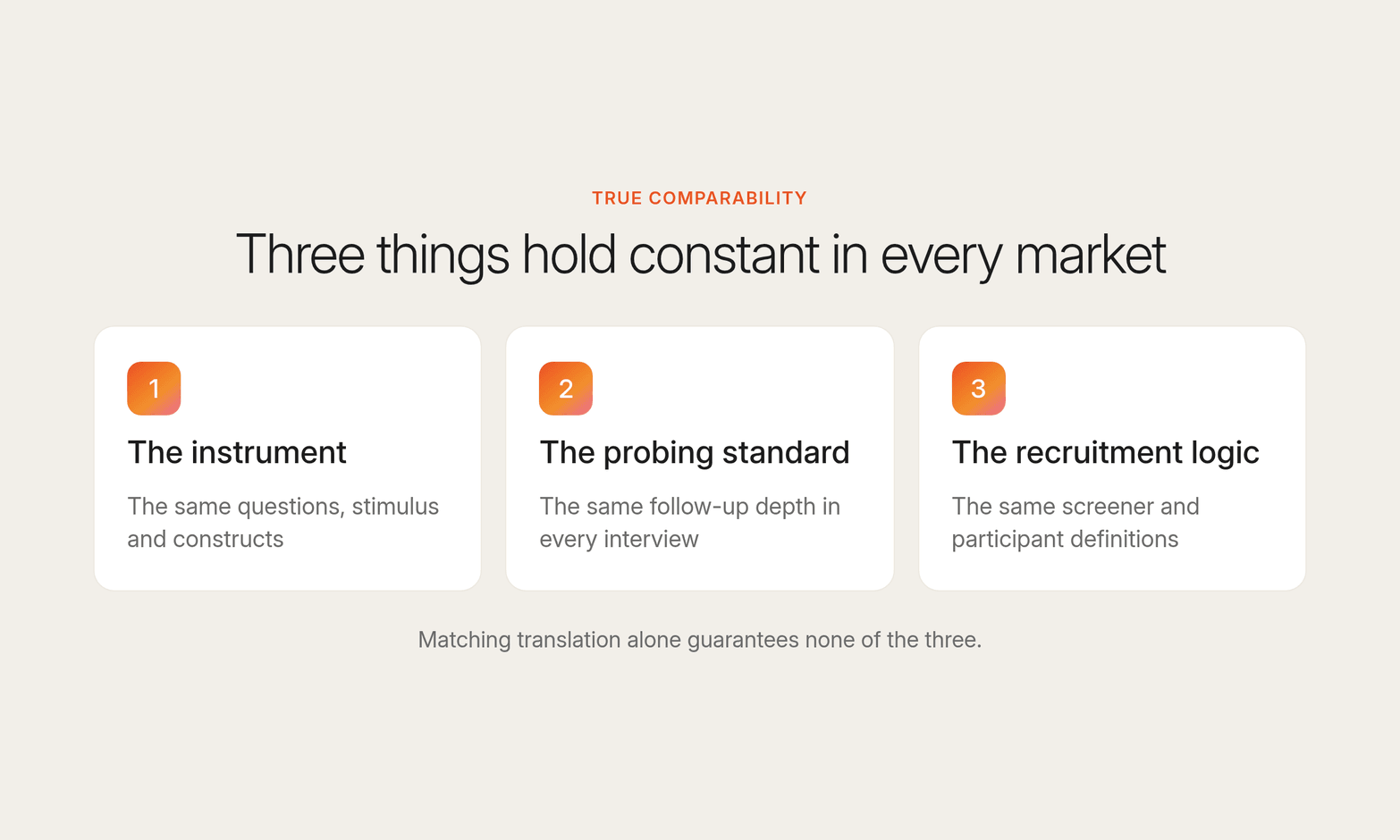
Real-time translation in research gets the words across, but matching translation satisfies none of those three. Identical words can carry different category meaning across different cultures, and identical questions behave differently wherever cultural differences shape how people answer.
When each country runs its own version of the study, no one owns that standard, so comparability breaks before analysis starts. This is why international market research is important to scope centrally, before any local team or agency partner touches the guide.
A five-step framework for running one study across markets
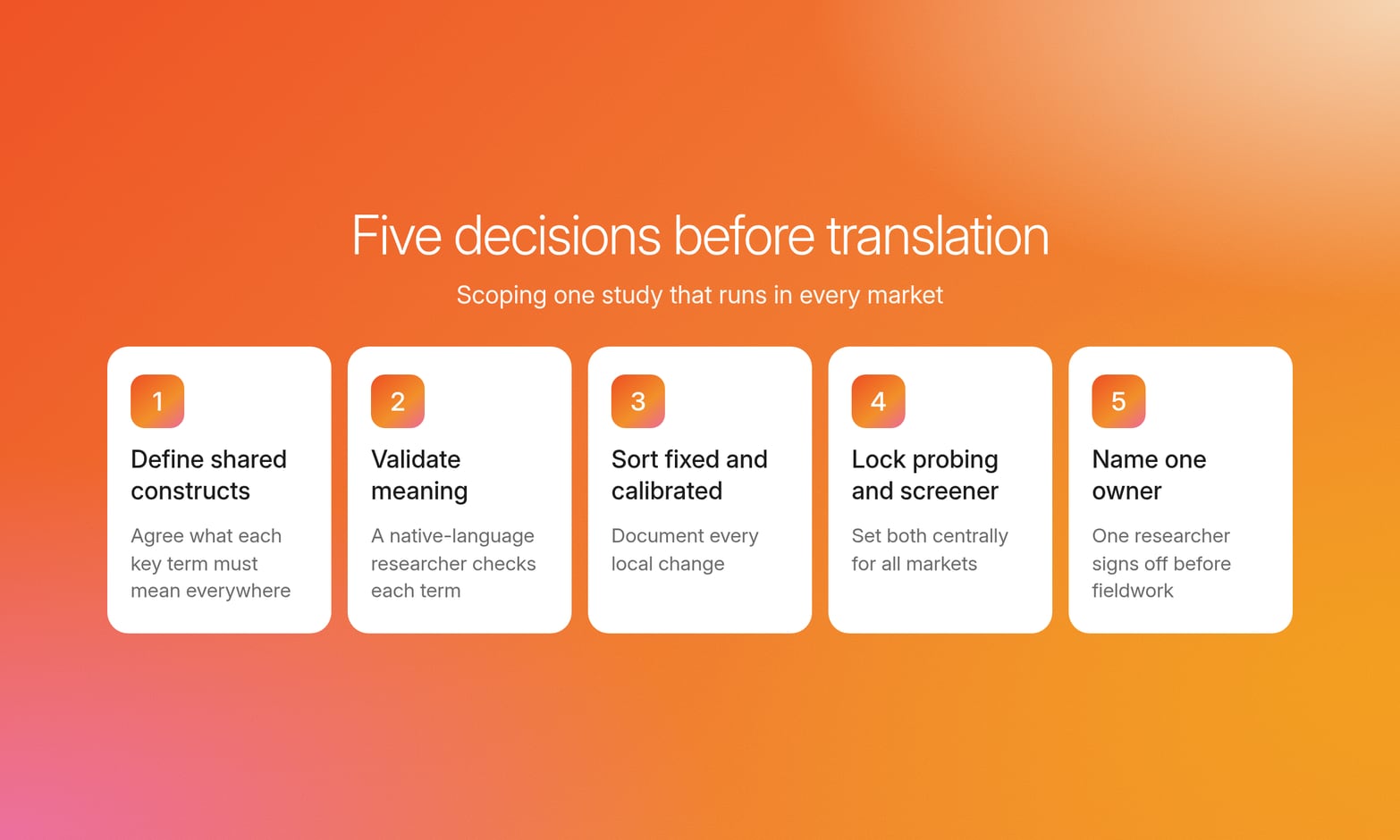
To conduct international market research that holds up, five decisions need to happen before translation. They apply whether the study mixes qualitative and quantitative research or runs interviews alone.
Define objectives and shared constructs first. Write down the study's main objectives and what each key term, such as "premium," must mean to target consumers in every market.
Validate meaning equivalence. A native-language researcher with a good understanding of the category checks that each term keeps its category association and cultural nuances, replacing literal translations that lose them.
Sort questions into fixed and calibrated. Keep behavioral and recall questions fixed. Calibrate pricing, hypothetical preference, and emotional-response questions to local market conditions, and document each change.
Lock one probing standard and one screener. Set probe depth and recruitment criteria centrally, following the same rules for participant recruitment in qualitative research in every market, whether the study runs consumer interviews or expert interviews. Confirm consent and data handling meet regional laws in each country.
Name one owner of comparability. One researcher signs off the instrument and research processes for all markets before fieldwork starts.
Where researcher judgment still decides the findings
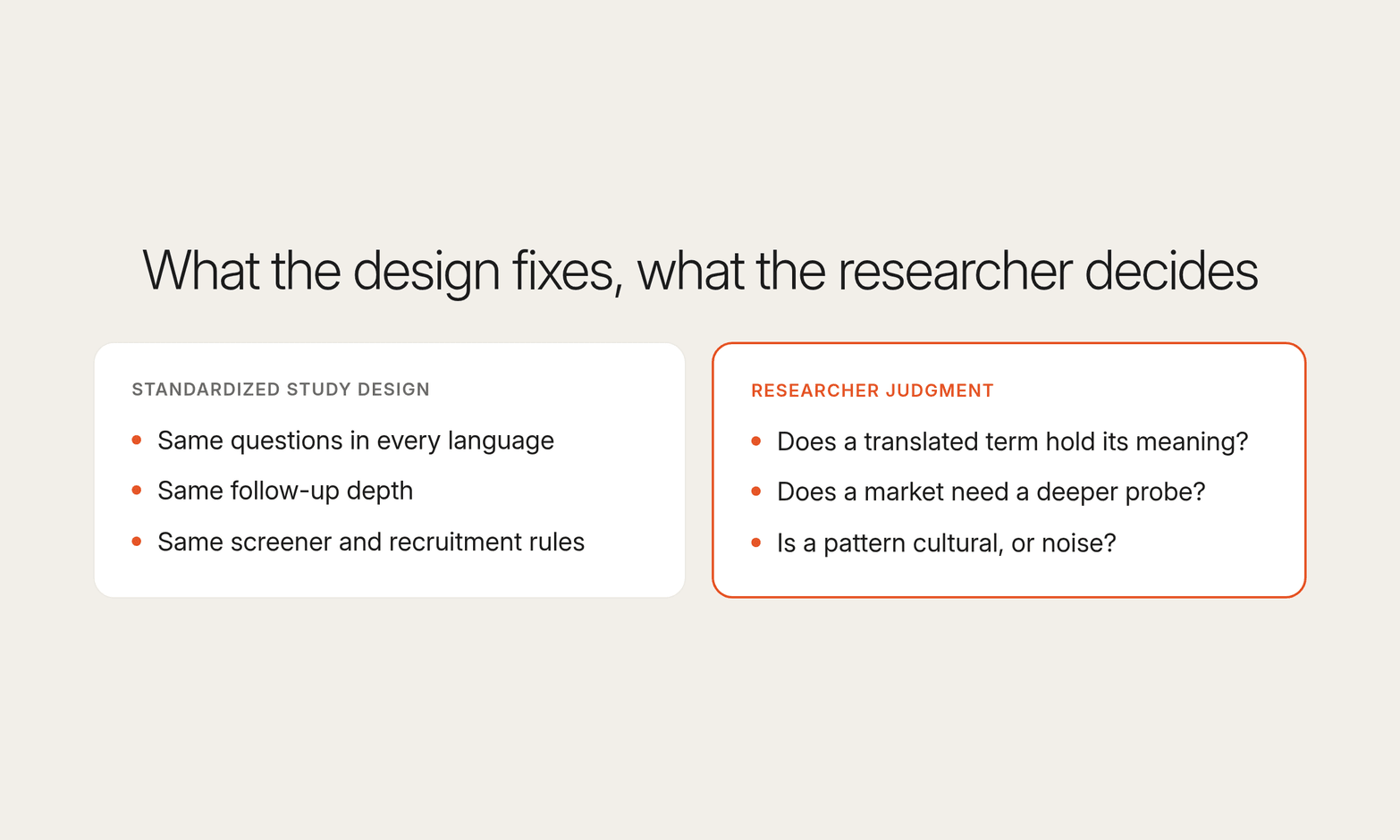
In cross-cultural market research, a standardized design removes operational drag and leaves judgment with the researcher. Researchers still decide:
Whether a translated term holds its meaning
Whether a market needs a deeper probe
Whether a pattern reflects real cultural differences or noise
That call takes a deep understanding of the brand and category. It is also where a research team's competitive edge lives, because it turns consistent evidence into actionable insights. That call matters most in qualitative research at scale, where patterns repeat across hundreds of interviews.
Stakeholders can check the researcher's call, because each theme on Conveo links to the participants behind it, with video clips and verbatim quotes to audit.
Three multi-market studies, three different comparability problems
Three breakdowns recur in market research for international expansion, each with a different root cause. These are illustrative scenarios drawn from common patterns, with no client data behind them.
| Comparability problem | Illustrative example | What breaks |
|---|---|---|
| Translation drift | A food brand tests a "natural" claim in the US, France, and Japan. Local teams render it as "organic" or "additive-free." | Each market tests a different claim. |
| Framing drift | Every market gets the same fair-price question. One market shops mostly through discount distribution channels and anchors low; another anchors on status. | A Van Westendorp pricing model read across both measures different things. |
| Probing drift | One moderator probes every hesitation; another accepts first answers. | Depth differences read as differences in consumer behavior. |
Each breakdown traces to a missing shared study design. Each one also skews the global market insights a team relies on for market share calls.
The comparability mistakes that quietly break global studies
These mistakes recur in global marketing research when no one owns cross-market comparability.
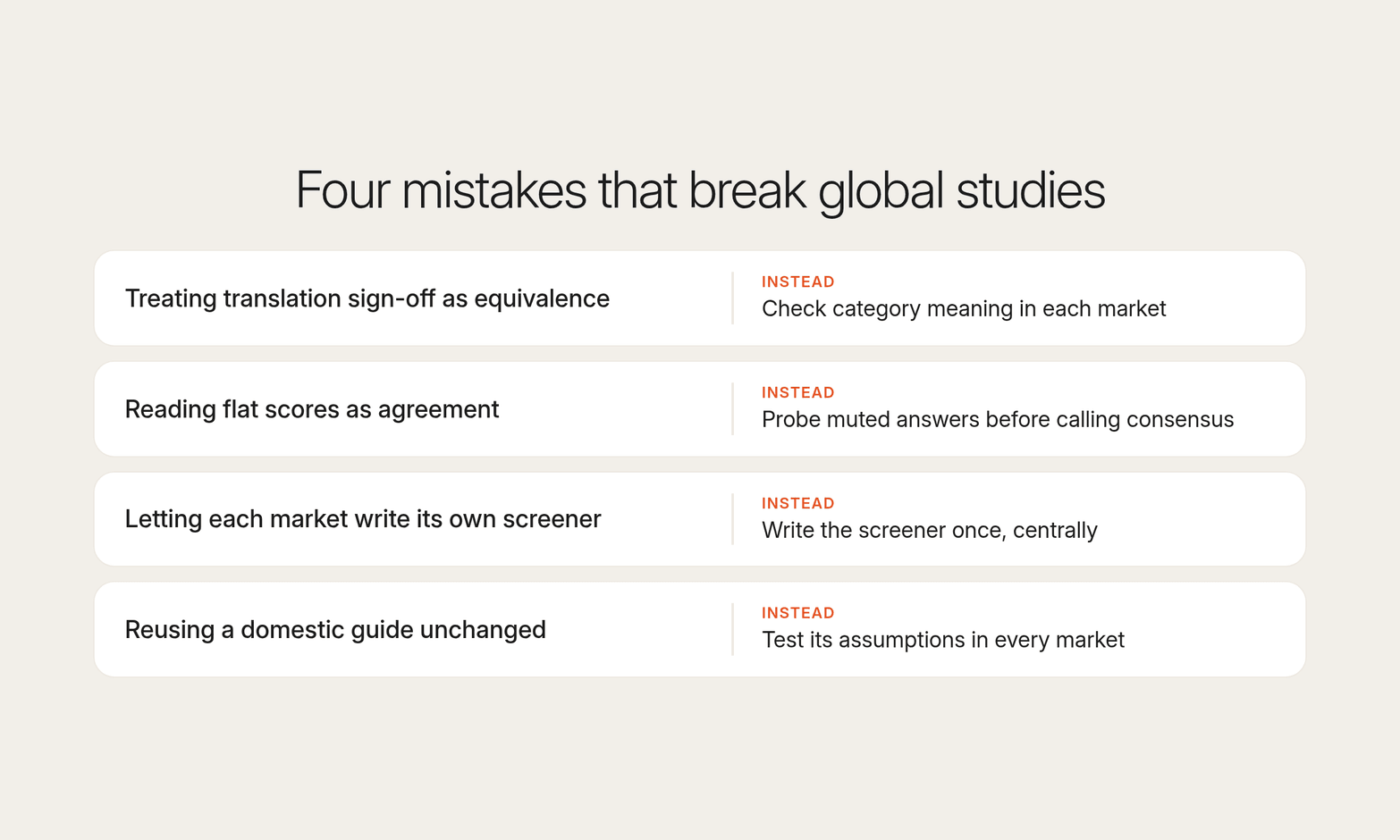
Treating translation sign-off as equivalence. Certification confirms the words match. It says nothing about category meaning.
Reading flat scores as agreement. In quantitative research and online surveys especially, muted emotional responses in some cultures make real variation look like consensus.
Letting each market write its own screener. "Category buyer" means weekly in one market and yearly in another. Write the screening survey questions once, centrally.
Reusing a domestic market research guide unchanged. The guide carries assumptions about how buyers in its home market think, and those assumptions rarely transfer.
Why Conveo fits: one study design, every market, side by side
Consumer insights and market intelligence teams running multi-market studies need the findings available while the decision they inform is still open. Here is how Conveo supports that:
One study design in 50+ languages. Conveo runs AI-moderated video conversations with no bilingual moderators to coordinate. It keeps the core guide consistent across every market while adapting follow-up questions to each participant's answers.
Data handling built for regional laws. SOC 2 Type II certified, GDPR compliant, EU hosting (Belgium). That matters when regional laws differ by market.
Add markets to the same design. Participants choose their interview language, the topic guide translates automatically, and screener questions apply to every recruitment source, so the guide, probing, and screener stay identical as markets are added.
Continuous consumer understanding. Conveo StoryLines runs the same design on a recurring cadence, for example every two weeks or monthly, so shifts in each market show up wave over wave.
This short video shows how AI-moderated interviews probe every participant to the same standard.

Each theme links to the participants behind it, with video clips and verbatim quotes stakeholders can audit, while researchers keep the interpretation. Recurring themes are recognized across studies in a searchable insight library, so the next market starts from what earlier ones established, and global insights build into a comprehensive view across markets.
"The pace, responsiveness, and research expertise of the Conveo team, on top of the top AI-moderated qual platform, have been invaluable to us in scaling brand advertising internationally."
Matt Harris, Research & Insights Lead, EMEA, Canva
Frequently asked questions
What are some international market research examples?
A common example is running a consumer research concept test in the US, UK, and Germany on a single design. In this illustrative case, UK participants read "gut health" as clinical, so the team tested "digestive comfort" instead. Separately run market studies might have reported weaker UK appeal without catching why.
How does the researcher's role change when every market runs on one study design?
The researcher's role shifts from reconciling separate market reports to interpreting findings that are already comparable. The team can run primary research across markets with one design, whether in-house or with an agency partner. Researchers still decide what those findings mean for the business in each market.
How do you handle pricing questions across currencies and markets?
Culture calibrates pricing and other hypothetical-preference questions, and we document each calibration decision so the reasoning travels with the data and teams can build effective market-specific strategies. For currencies, show prices in each market's local currency and compare markets on relative measures, such as acceptable price ranges, because converted figures hide differences in local purchasing power. In Conveo, price testing is live in research preview: Van Westendorp or Gabor-Granger runs inside the interview, a single pricing question adapts its currency by market, and AI follow-ups ask participants why.
How many participants are needed per market for comparable results?
In qualitative research, sample sizes still depend on the research question and category, and on the sampling methods in qualitative research the team chooses. A niche category such as premium pet food may need fewer, harder-to-recruit participants than a broad category such as snacks. Comparability depends most on a consistent screener and probing standard across markets, with matching headcounts a secondary concern.
Who should own comparability across a multi-market study?
One researcher should sign off on the instrument, the probing standard, and the screener for every market in a global research program before fieldwork starts, so no local team or agency partner sets its own.

About the author
Dieter De Mesmaeker
Co-Founder & CEO
Dieter is CEO and co-founder of Conveo. Before starting the company, he founded DataCamp and scaled it into one of the leading edtech platforms in the world.
More by Dieter →Qualitative insights at the speed of your business.
Conveo runs AI-moderated video interviews and structures everything they say.