
TL;DR
Qualitative research at scale means running hundreds of in-depth conversations in parallel across markets and languages, without trading away the depth that makes qual data credible.
The bottleneck was never the conversation. It was sequential recruiting, manual coding, and market-by-market moderation, which compound the more studies you run.
AI tools shift execution from sequential to parallel, compressing multi-market data collection from 6 weeks to 3 days and turning raw qualitative feedback into actionable insights faster.
Credibility at scale depends on three things: real participants, traceability from claim to source, and auditable video evidence, so the human element in interpreting the research findings never disappears.
Scale is the right call for defined research objectives across segments and markets. It adds noise on exploratory or ethnographic work, where a tailored approach and depth beat breadth.
Conveo is a video-first AI-powered research platform that runs the full research process, from recruitment through stakeholder-ready reporting, on real conversations with real people.
Your agency delivers qualitative findings six weeks after the campaign decision was already made. The research is thorough, the themes are well-structured, and the personal accounts behind each quote are compelling. None of it changes what happened in the room three weeks ago, when the team committed to a direction without real consumer input. This is the operational reality for most insights professionals trying to run qualitative research at scale: the methodology is credible, but the timeline makes it nearly impossible to act on the rich insights buried inside the data.
The tension is structural. The manual steps that make traditional qual rigorous are also the steps that make it slow: recruiting participants sequentially, scheduling moderation windows, transcribing recordings, and manually coding themes from unstructured data. When a research team tries to run more studies, the bottleneck compounds, and the function cannot keep up with the volume of decisions it is being asked to inform.
AI-moderated interviews change the constraint. When conversations run asynchronously and in parallel, a study that once required three weeks of fieldwork can complete in days, and the analysis process surfaces thematic clusters as recordings land. What becomes possible is more than faster research. It is real conversations at scale, with stakeholder-ready evidence and research findings delivered in days rather than weeks.
"Trustworthy insights overnight, the researcher's holy grail"
— CMI Lead, Edgard & Cooper
This article covers how that shift changes the research model, what makes scaled qualitative research credible rather than merely fast, and where the approach works and where it does not.
What qualitative research at scale actually means
Qualitative research at scale means running dozens or hundreds of in-depth conversations simultaneously across markets, languages, and segments, without sacrificing the depth or analytical rigor that make qualitative data analysis credible in the first place. Scale, in this context, is not a synonym for volume, nor is it a pivot toward turning open-ended responses into a rigid survey.
Traditional qualitative research operates on a small-N model: 8 to 12 interviews per study, conducted sequentially, followed by manual transcription, thematic coding, and a synthesis process that can span weeks. That model was designed for a world where research influenced strategy on a quarterly cadence. It no longer keeps pace with the speed at which product, brand, and marketing decisions are actually made.
The shift is from sequential to parallel: instead of one market, one moderator, one wave at a time, teams run one-on-one conversations simultaneously across geographies, with the analysis process beginning as sessions conclude rather than after the last interview wraps up. A multi-market packaging test that runs 250 conversations in sequence can stretch beyond 20 weeks; run in parallel, the same 250 conversations fit inside a five-day fieldwork window.
What scale does not mean: replacing depth with volume, removing adaptive probing, or flattening rich, textual data and narrative analysis into coded checkboxes. The standard for what counts as a genuine qualitative conversation, one that surfaces the underlying reasons behind behavior, has to hold regardless of how many conversations run at once.
Why traditional qualitative methods break down at scale
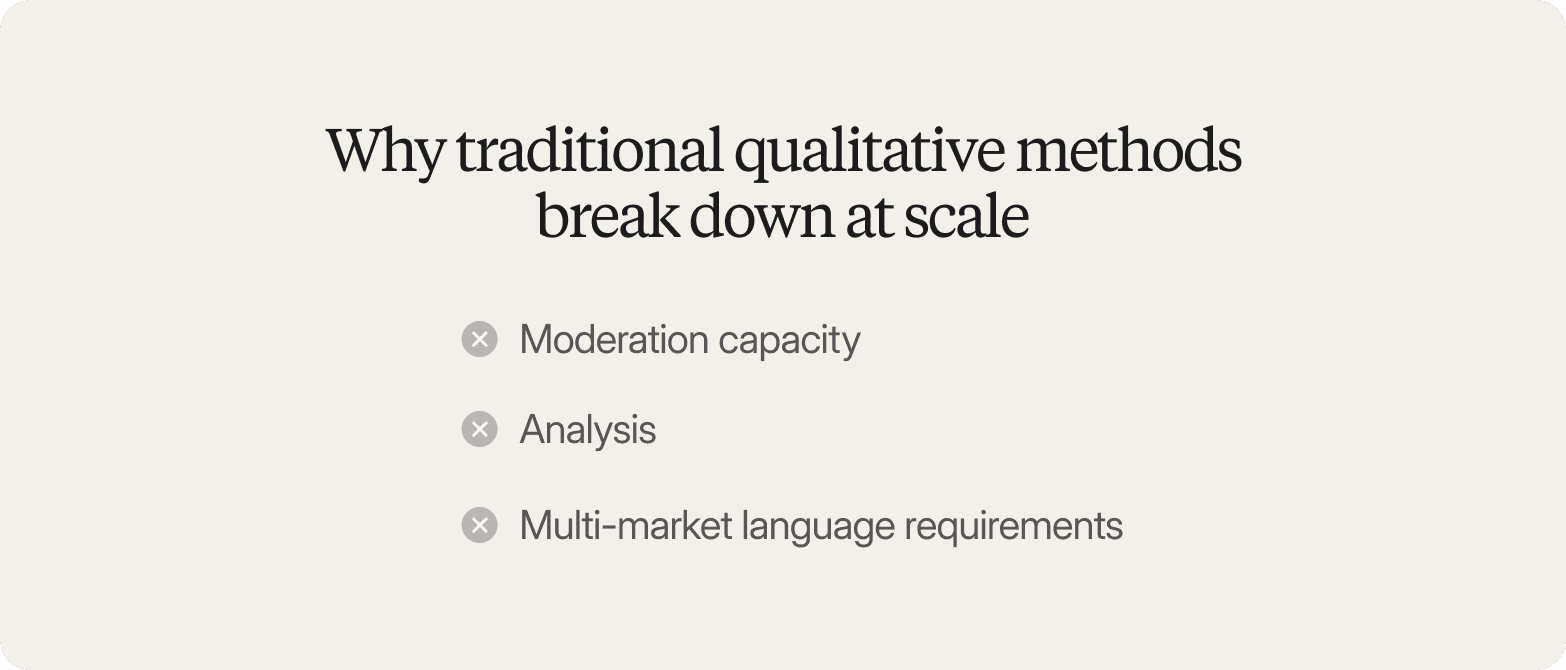
Three bottlenecks prevent qualitative research at scale from being operationally viable under traditional methods. Each adds time on its own, and because they run in sequence rather than in parallel, the delays compound across the entire process.
Moderation capacity. A human moderator conducts one interview at a time rather than engaging with participants simultaneously, so running 100 interviews means 100 moderator hours plus the overhead of coordinating calendars, time zones, and no-show rates. Teams report conducting three to four sessions per day before quality degrades, so a study of that size takes several weeks in fieldwork alone, before a single transcript has been read.
Analysis. Manual coding, transcription, and thematic synthesis add hours of work for every hour of recorded audio, and content analysis at this volume quickly overwhelms a small research team. Post-fieldwork processing typically requires two to four hours of analyst time per interview, so across 20 or more sessions, that is one to two weeks of data analysis before synthesis even begins. The interview is rarely the slow part; everything that follows it is.
Multi-market language requirements. Large volumes of qualitative feedback arrive in multiple languages simultaneously, and native-language moderators are required for each geography. That means recruiting, briefing, and moderating sequentially: complete the UK wave, analyze it, then move to Germany, then France, then Japan. Agency-led qualitative work typically runs 6 to 12 weeks from brief to findings, while the decisions those findings inform move on a two- to four-week cycle.
The result is a structural tradeoff that most insights professionals know well: depth or speed, but not both. That tradeoff is not a methodology problem. It is an execution model problem.
How AI changes the execution model for qualitative research at scale
The bottleneck was never the conversation itself. It was everything around it, and that is exactly what an asynchronous model removes. Because AI-moderated sessions run asynchronously, participants open a link on their own schedule, so a study with 300 participants requires one study launch rather than 300 scheduled slots. Conversations run in parallel across markets, languages, and time zones, without adding a single moderator hour.
What keeps those conversations from flattening into glorified surveys is adaptive probing. Rather than following a rigid script, the AI moderator adjusts its follow-up questions based on what each participant actually says: if a participant hesitates when describing a product's price, it probes that hesitation; if someone uses unexpected language to describe a competitor, it follows that thread. The depth that distinguishes a well-moderated interview from a survey does not disappear at scale. It scales with the study, and human oversight ensures the researcher remains in control of what the findings mean.
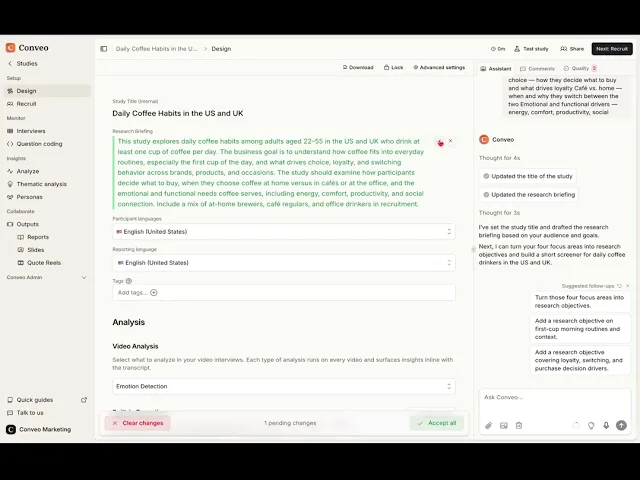
The fastest way to analyze qualitative research at scale is not to have analysts work faster. It is to remove the manual steps that consume most of their time. As recordings complete, Conveo, a video-first AI research platform, automates the work that used to sit between fieldwork and findings:
Transcription, translation, and coding. Every session is processed automatically as it lands, applying automated analysis and sentiment analysis to identify patterns as they emerge, collapsing hours per interview into minutes of human review.
Thematic analysis at scale. Unlike other AI tools that stop at transcription, generative AI within Conveo's workflow drives thematic analysis across hundreds of conversations at once, surfacing emerging trends and recurring themes without requiring a human to read every transcript line by line.
Watch the walkthrough: How to build and launch a study in Conveo →
Data visualization. The platform renders theme frequency across markets, so patterns that would take an analyst days to notice by hand surface immediately.
Multi-market coverage. Conveo supports 50+ languages for AI moderation, with automated transcription and translation, removing the multi-market bottleneck that typically adds weeks to global studies.
Those findings do not die in a single deck. Because every study feeds a shared insight library, themes compound across projects: a pricing signal from one market can be checked against earlier structured data without re-running fieldwork. That compounding knowledge turns a series of one-off projects into continuous customer understanding and supports more data-driven decisions across the organization.
What human researchers do in this model is different, not diminished. They review AI-generated themes, refine synthesis, and shape findings into the narrative stakeholders need, with every conclusion tied to verbatim quotes and timestamped video clips. That replaces the familiar debate over an untraceable summary slide with direct inspection of evidence, and it is exactly where the human element in qualitative research still matters most.
In a representative scenario, a 300-participant concept test across 10 markets launches on Monday, interviews are complete by Wednesday, synthesis is ready by Friday, and stakeholder reporting follows the next Monday. That is a research cycle that fits inside a single business week, not a six-week agency engagement.
What makes scaled qualitative research credible
Scaling qualitative research creates a credibility problem that speed alone cannot solve. When stakeholders cannot trace a finding back to a real conversation, they discount it, and when artificial intelligence is involved, that skepticism intensifies. Enterprise buyers have been burned by black-box outputs, summaries with no source attribution, and findings that felt manufactured rather than heard.
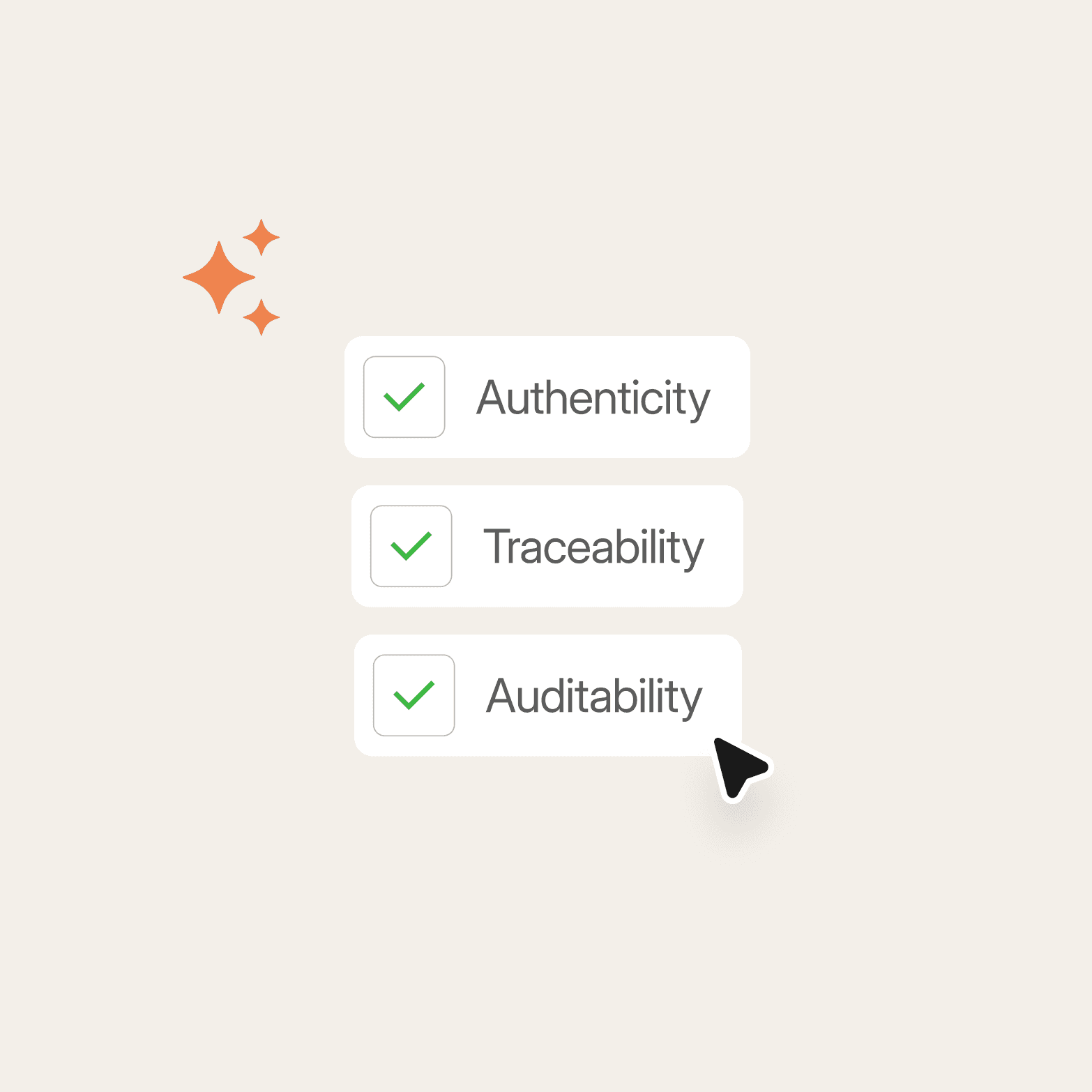
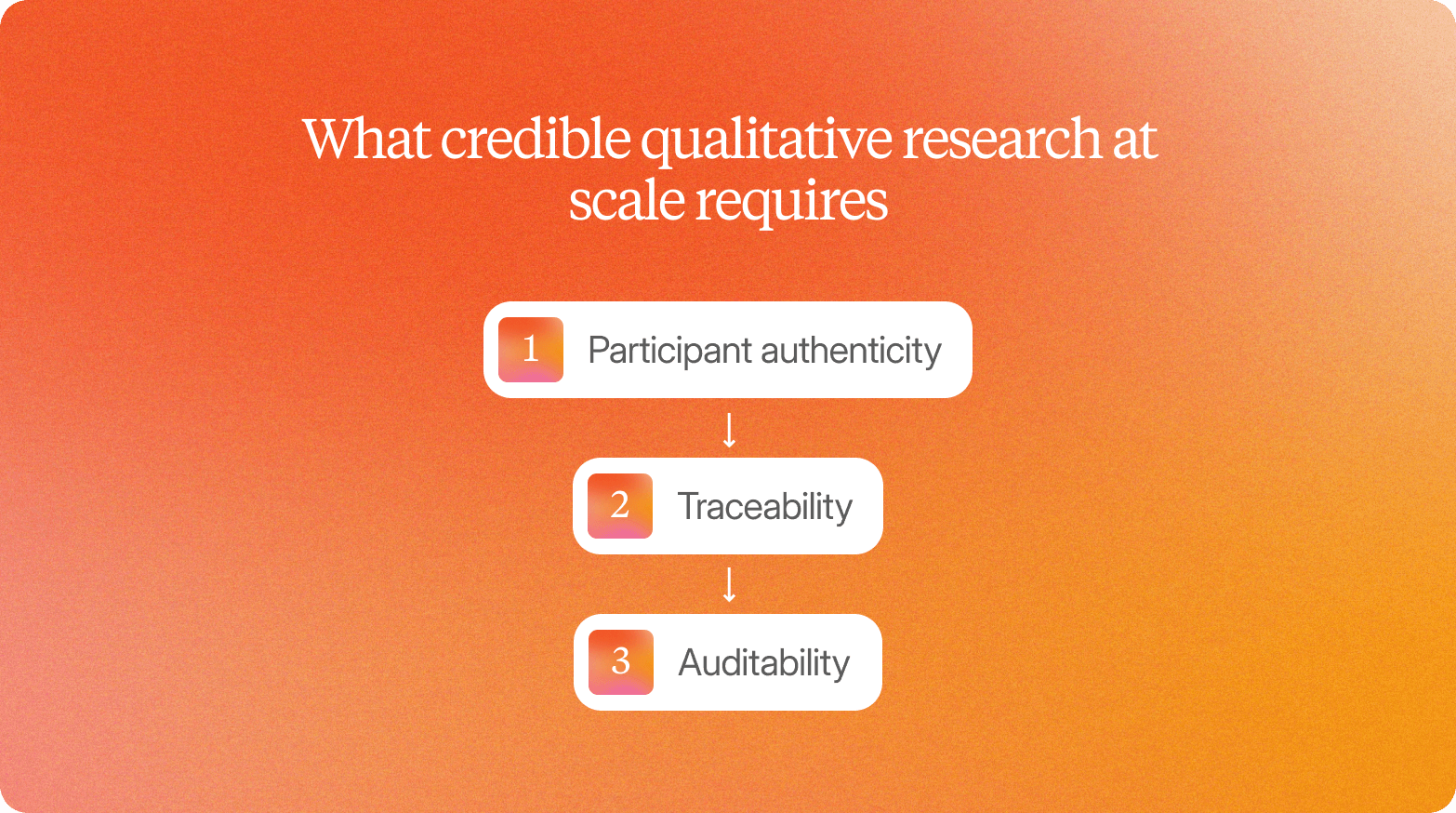
Credible qualitative research at scale requires three things:
Participant authenticity. Real people, real conversations, real video. Not synthetic personas generated by a model, not AI-simulated focus groups. Stakeholders can tell the difference between a quote that sounds like a human and one that reads like a prompt response.
Traceability. Every theme, every claim, and every headline finding must link back to a specific participant, a specific moment, and a specific quote. Without that chain, findings are assertions rather than evidence-backed actionable insights.
Auditability. Stakeholders need to go further than the summary deck. They need to watch the clip, read the transcript, and verify the subjective interpretation themselves.
This is where video-first methodology changes what is possible. A text transcript tells you what someone said. Video tells you whether they hesitated before answering, whether their tone shifted when a price point came up, and whether their expression contradicted their words. At scale, those signals compound into patterns that transcripts miss entirely, giving researchers a broader context for interpreting non-numerical data than a coded spreadsheet ever could.
Compliance is the other half of credibility, and it is where most AI-interview platforms fall short. Many standalone AI-powered tools have no confirmed enterprise security posture, which quietly stalls vendor evaluations before they reach a decision. Conveo is built around all three credibility requirements and closes that compliance gap: participants are real people, with no avatars or synthetic responses anywhere in the workflow, and every AI-generated finding links to its source video clip with translated subtitles for multi-market studies. For enterprise procurement teams, Conveo holds SOC 2 certification, GDPR compliance, and EU regional data hosting.
Credibility at scale is not a feature. It is infrastructure, and it requires careful consideration long before a single interview is fielded.
When to scale qualitative research (and when not to)
Deciding whether to run qualitative research at scale is itself a research design decision, and getting it wrong in either direction has real consequences. Scale too early on an ill-defined problem, and you collect large volumes of data without a signal. Scale too late on a multi-market validation question, and you leave critical decisions exposed to a sample that cannot capture the full range of customer feedback you need.
The cases where scaling is the right call are fairly clear: concept testing across distinct segments, packaging research spanning multiple markets, continuous discovery workflows, and brand tracking studies that require longitudinal input. All benefit from larger participant volumes and clear research objectives. In these situations, the question is defined, the segments are known, and the goal is to confirm or quantify patterns already identified directionally, sometimes by combining qualitative and quantitative research into a mixed-methods approach.
The cases where scaling adds noise rather than clarity matter just as much:
Exploratory research, where the problem space is still undefined, benefits more from depth than breadth. A company testing whether a new product category is viable should talk to 10 well-chosen buyers with genuine domain expertise, not 200 general participants who have never encountered the problem.
Ethnographic work that requires sustained observation in context cannot be substituted with parallel interview volume.
Grounded theory approaches that rely on theoretical sampling call for a tailored approach rather than a fixed sample size set in advance.
The signal is in the deeper understanding, not the count.
On saturation: more interviews do not automatically mean better insight. Research consistently shows that thematic saturation within a well-recruited, homogeneous segment is typically reached within 9 to 17 interviews. This finding, drawn from academic research rather than applied research in a commercial setting, still holds directionally: beyond that point, additional interviews in the same segment tend to confirm existing themes rather than surface new ones. The practical implication is that scaling should mean covering more segments, not more interviews per segment, past the point of diminishing returns.
That is also why segmentation has to come first. Scaling without clearly defined segment profiles collapses distinct qualitative insights into a blended average that represents no one accurately. A CPG brand testing packaging across five markets has a genuine need to scale because the cultural contexts, retail environments, and consumer expectations differ; the segmentation logic is clear before a single interview is conducted.
Scale is a framework for addressing specific research objectives within the right scope. It is not a proxy for rigor, and more quantitative data is not always better data.
Competitive differentiation
When evaluating qualitative research at scale, teams typically compare three categories: traditional agencies, survey platforms, and AI interview platforms. Each forces a tradeoff:
Approach | Speed | Depth | End-to-end workflow | Enterprise compliance |
Traditional agencies | 6 to 12 week turnaround | High methodological depth | No, separate vendors per stage | Varies by agency |
Survey platforms | Fast | Low, numbers without the why | Partial | Varies by platform |
Most AI interview platforms | Fast | Stops at the interview itself | No, recruitment, analysis, and reporting are separate problems | Often lacks confirmed posture |
Conveo | Fast | Full qualitative depth via video | Yes, recruitment through reporting in one platform | SOC 2, GDPR, EU hosting |
Conveo is built to eliminate those trade-offs in a single workflow: study design, participant recruitment, AI-moderated video interviewing, multimodal analysis, and stakeholder-ready reporting all run on a single platform, whether the use case is UX research, brand tracking, or concept testing. Recruitment runs through Conveo's integrated panel network: teams recruit through Conveo's panel partners, including Respondent.io and User Interviews, or bring their own list by CSV upload, QR code, or WhatsApp, with reach across 50+ markets. Conversations are real, with no synthetic respondents and no avatar-based responses, only verified participants captured on video.
That combination is why enterprise teams, including Google and Unilever,, use Conveo to expand their research capacity and turn customer feedback into strategic decisions inside the decision window. It lets research teams run studies they could not previously run at agency scale, and every study adds to a compounding insight library, so comprehensive understanding of the customer deepens across the organization rather than dying in individual decks. For teams that need qualitative research at scale without trading depth for speed, Conveo is the infrastructure layer that makes continuous, data-driven decisions operationally viable.
Frequently Asked Questions
What does a qualitative research-at-scale study look like?
How do you conduct qualitative research at scale?
What is the fastest way to analyze qualitative research at scale?
Can qualitative research be scaled without losing depth?
What are the risks of scaling qualitative research?