In this article
TL;DR
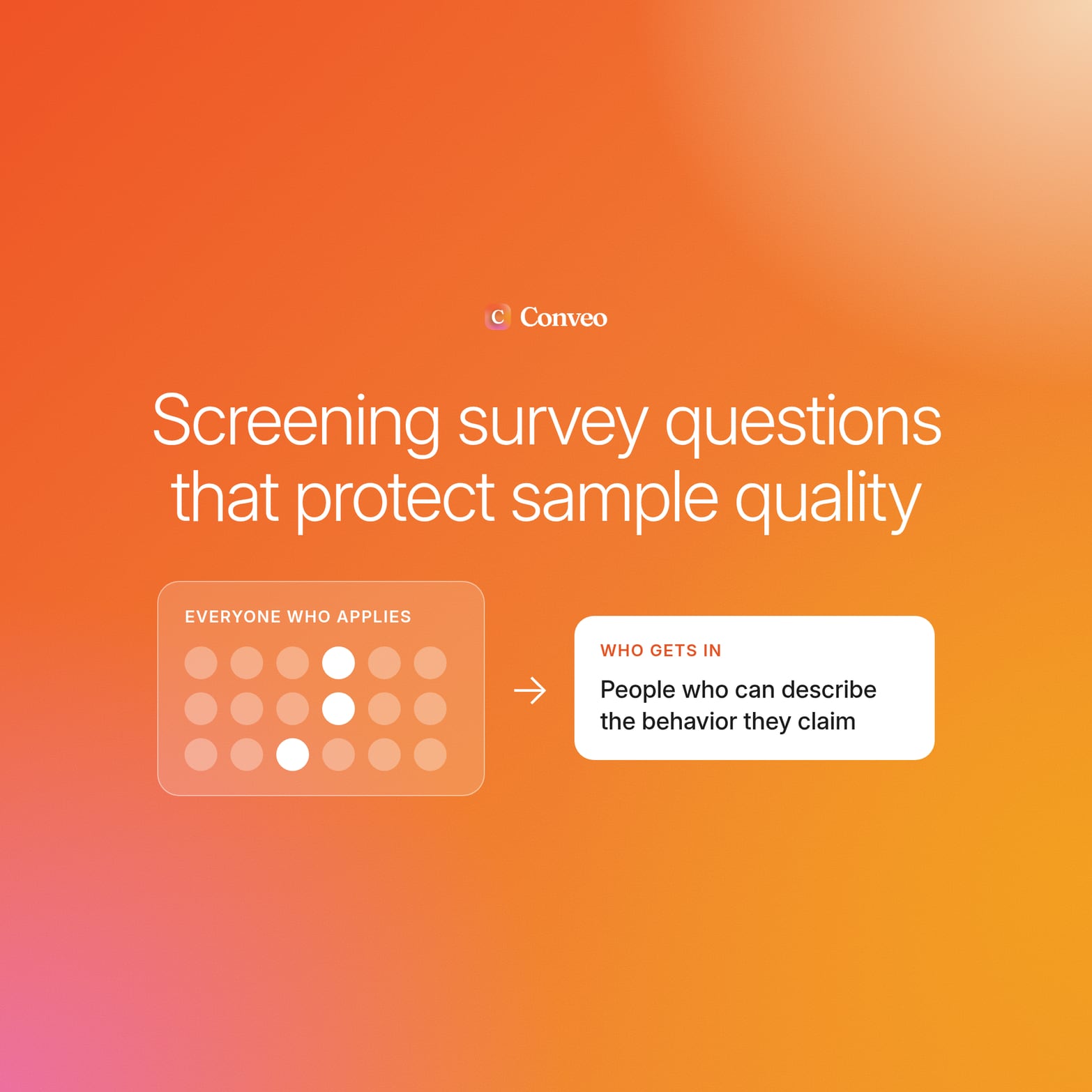
Screening survey questions are eligibility filters that determine who enters a study, and they fail when the wording telegraphs the qualifying answer or relies on self-reported identity, such as title, age, or company size.
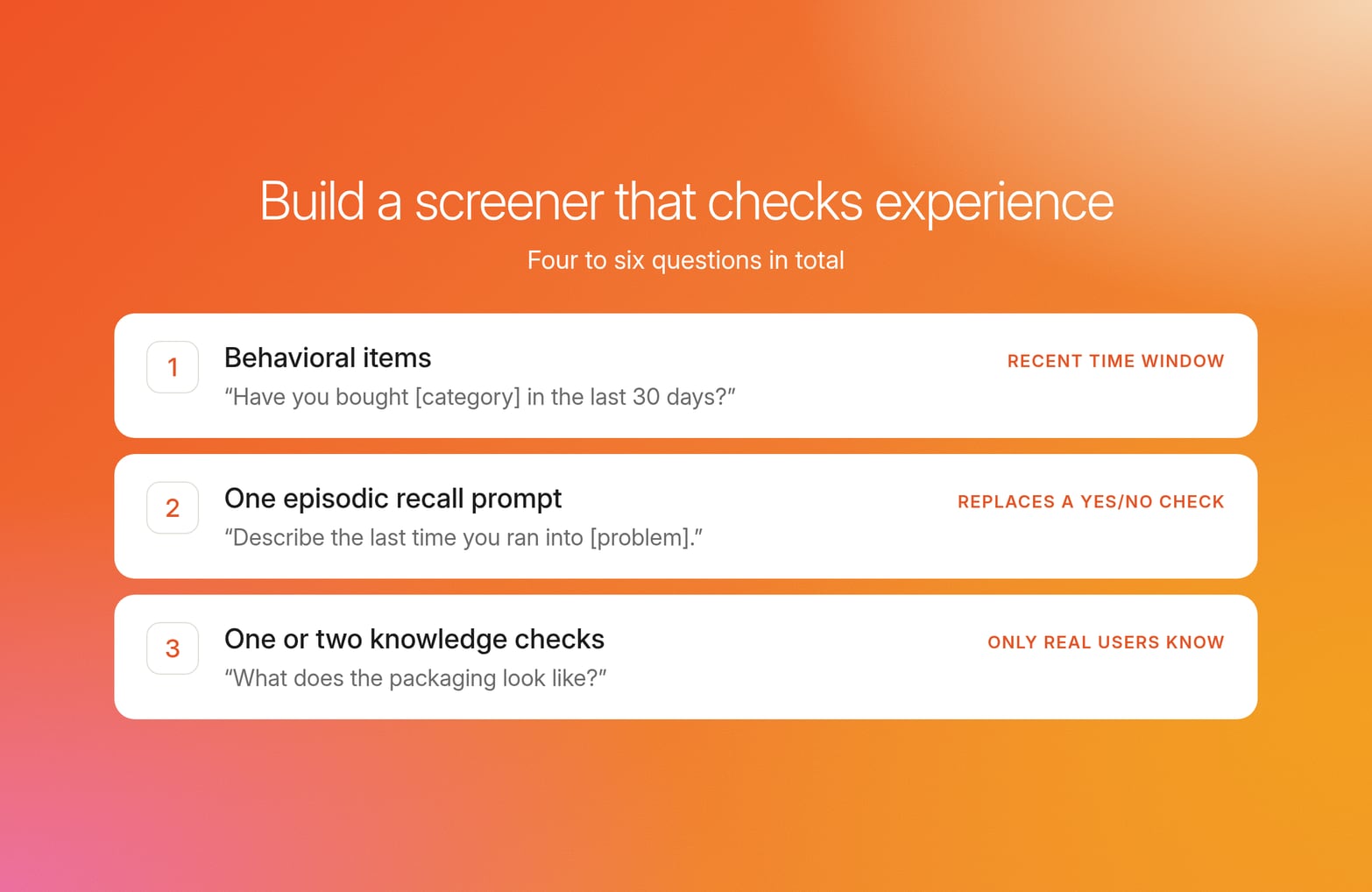
Four to six questions that combine behavioral items, one episodic recall prompt, and one or two knowledge-verification items filter for real experience and protect data quality.
A two-layer screening process, screener questions for fit followed by interview follow-ups that test each claim against real detail, catches weak-fit participants before they skew results.
Screening survey questions can make a sample look correct on paper while behaving nothing like the target audience. A participant clears every criterion, then stalls on the first interview question. They cannot describe a single recent instance of the behavior they claimed.
Screeners reward whoever guesses the qualifying box. Nothing checks that claim against specific detail before the sample is locked and the actual survey or interview fields.
Below are question patterns that force specificity, checks that catch gaming, and a way to verify criteria before results skew. Each of these best practices applies to the screener you already run.
What are screening survey questions, and why do qualified samples still fail?
Screening survey questions are the eligibility filters in a screener that decide who enters a study, covering behavior, role, and context. Their job is to ensure only the right people take your survey; the audience depends on that decision.
Most screeners rely on age, income level, job title, or company size because they are quick to write. Those fields fail in three ways:
They don't predict behavior. A shopper who fits every demographic box may never have bought the category you are researching.
They are too broad. A question like "Do you watch TV?" qualifies almost everyone.
They reward faking. Participants answer dishonestly to look good or because they are only after the reward. Incentives for research participants attract both groups, so the screener has to separate them.
The result: professional participants pass, the people the study needed get filtered out, and teams end up with survey data that matches only the persona sheet.
A screener that names the target tells participants which box to tick.
Why do screeners telegraph the right answer?
Screeners telegraph when the wording reveals which option qualifies, which rewards guessing over experience. Leading questions are the most common cause.
Compare two versions of the same screening survey question:
Leading: "Are you unhappy with your current laundry detergent?"
Neutral: "How would you describe the laundry detergent you use now?"
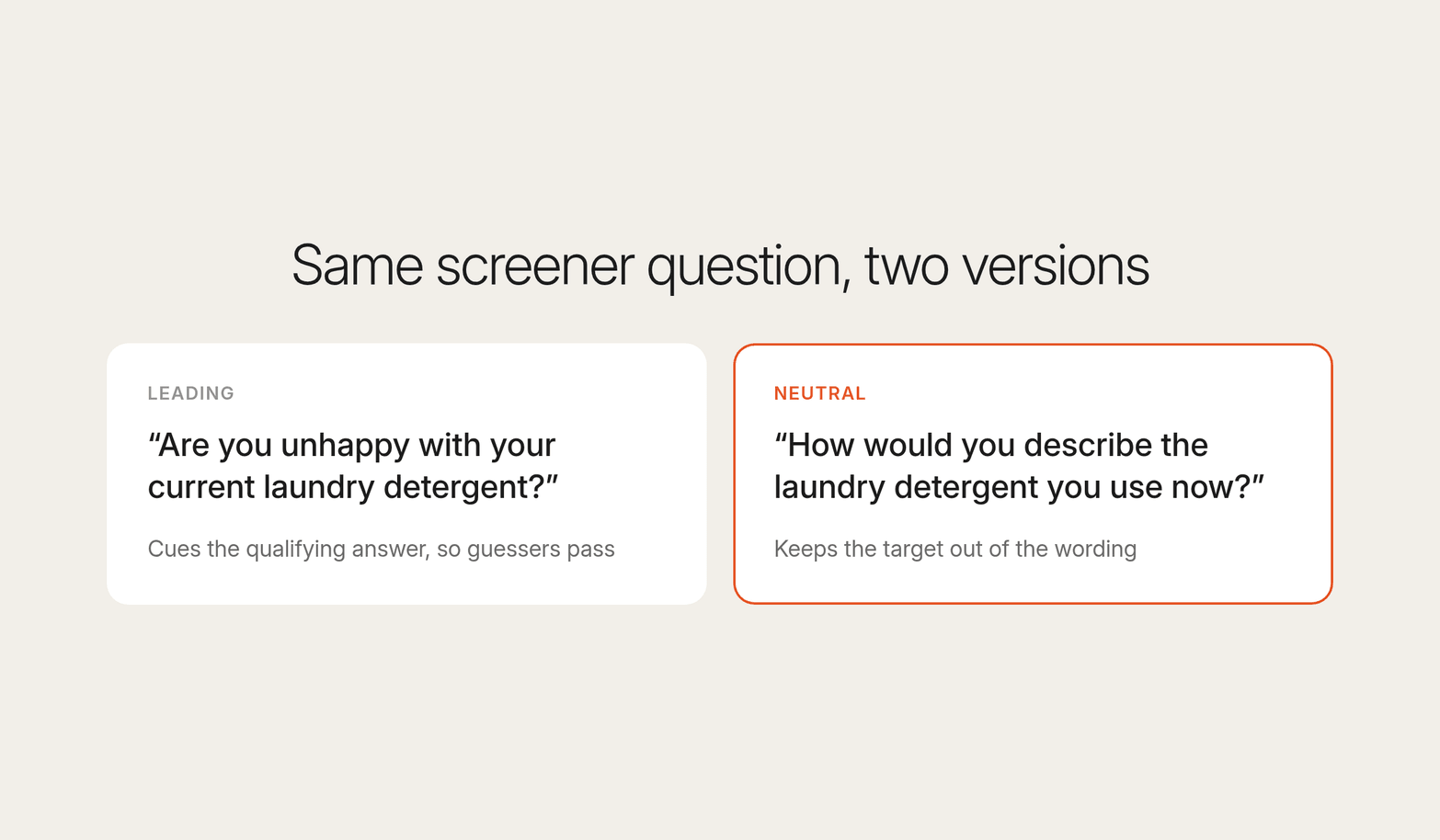
The leading version cues the "right" answer before the participant has said anything true. Acquiescence bias, a common form of research participant bias, means participants who qualified by agreeing with a frustration tend to agree with the messaging built to address it, and the marketing strategies built on that feedback inherit the error.
When writing screening questions, hide study intent:
Keep the topic, brand, and qualifying criterion out of every stem.
Place the qualifying option among plausible answer options so it carries no visual weight.
Ask about the category before the product.
Describe the behavior and keep the target out of the wording.
How do behavioral and episodic recall questions improve screening survey questions?
Behavioral screening survey questions reference recent actions, such as "Have you bought [category] in the last 30 days?"
Episodic recall is a prompt such as "Describe the last time you ran into [problem]."
Of all screening question types, these two are the hardest to fake because specificity is harder to fabricate than agreement. Build the screener this way:
Four to six questions total, so qualification stays fast without losing signal.
Anchor behavioral questions to a recent time window, with the most crucial questions at the very beginning.
One episodic recall prompt in place of a yes/no identity check.
One or two knowledge-verification items only genuine users would know.
Three rules keep the sample tight:
Write selection criteria in concrete terms (category usage, purchase recency, household role, and direct experience with the problem) so the sample shares the specific characteristics of the persona.
In message testing, exclude participants already familiar with your brand, since familiarity bias inflates comprehension and appeal. An awareness item such as "Which of these brands have you heard of?" catches them.
Screen out industry insiders with a standard item: "Do you or does anyone in your family work in any of the following industries?" Regulated categories such as alcohol or healthcare often add industry-specific screeners on top.
Every slot should ask for something a participant can only supply from experience. Conveo sets screening criteria in the same flow as the study build, so that principle carries into qualification.
Filter for people who can describe the experience.
Which screener question examples work for common study types?
This library pairs example screener questions with the study type and what each one filters. See participant recruitment in qualitative research for how these pair with invite volume.
Treat them as starting patterns, then adapt the time window and category to your study and target market.
| Study type | Example screening question | Answer format | What it filters |
|---|---|---|---|
| Concept testing | "Which of these categories have you bought in the last three months?" | Multiple choice with decoys | Real category buyers |
| Ad or message testing | "Where have you seen ads for [category] in the last two weeks?" | Multiple choice, with "None of the above" pinned last | Recent category ad exposure |
| Brand tracking | "Which brands in this category come to mind?" then "Which have you seen recently?" | Open-ended, then multiple choice | Guessing and brand familiarity |
| UX discovery | "Walk me through your most recent session in [product]." | Open-ended | Fabricated usage |
Two notes on format:
Decoys do the work in concept testing. In a pet food study, for example, include one fictional category among the response options and disqualify participants who select it, before any concept testing questions are asked.
Open-ended formats take longer to review, but they force participants to produce detail rather than recognize it. That detail is what makes a sample defensible to stakeholders.
For B2B studies, run multiple screeners, one per buying-group role, to keep targeting criteria clean. See B2B market research for role-specific screener patterns.
Match the screener to the decision the study will inform.
How do you detect when screening survey questions are being gamed?
A sample that qualified on paper but cannot describe one recent instance of the claimed behavior was never verified. Run these checks on your screening survey questions in a pilot, which also serves as an incidence-rate test, before fielding. These checks are the core of screener-stage survey fraud detection.
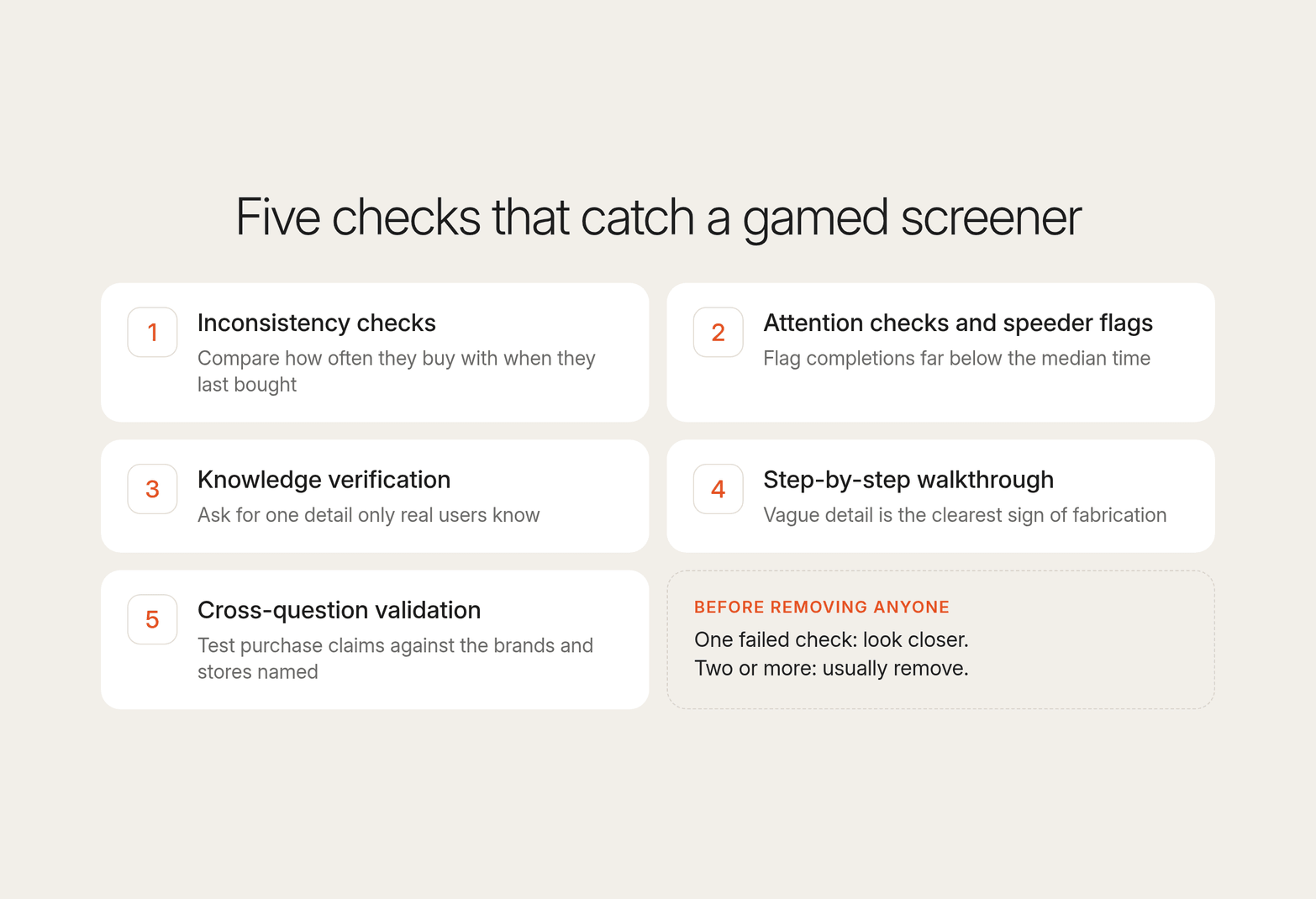
Inconsistency checks: ask about usage in multiple questions, such as purchase frequency and last-purchase date, and compare the answers.
Attention checks and speeder flags: flag completions far below the median time.
Knowledge-verification items: ask for one detail only real users know, such as what the packaging looks like.
Step-by-step walkthrough: ask for the most recent purchase or use in order. Vague detail is the clearest signal of fabrication.
Cross-question validation: test purchase claims against the brands and stores participants describe.
Screener checks catch inconsistencies in participants' selections. The interview adds a second check: in Conveo, the AI research assistant asks follow-up questions when an answer is vague or leaves a gap, building on what the participant said earlier.
Before removing anyone:
Review flagged survey responses by hand. One failed check is a reason to look closer; two or more usually justify removal.
Weigh the cost. Strict criteria can exclude participants with unusual but genuine experience, and every added check lowers yield, so set an expected screen-out rate before fielding.
Each justified removal protects data quality and keeps unqualified participants out of data analysis.
Static forms detect inconsistency but cannot ask a follow-up. That gap is where weak-fit participants get through.
How many screener questions is too many, and how do you balance rigor with feasibility?
As a general rule, past six questions, signal rarely improves, and each extra item adds friction. Too many screening questions also give professional participants another cue they can guess. To keep the screener short:
Ask the minimum number of questions needed to separate qualified participants from the rest.
Use branching logic to end the screener once a must-have fails.
Hold sensitive questions until the end to respect participants' time.
Plan yield before you write the screening survey questions and gather data:
Set the target sample size and the expected incidence rate.
Rank each criterion as must-have or nice-to-have.
Loosen nice-to-have criteria first when quota fills slowly, and never loosen the behavioral filter.
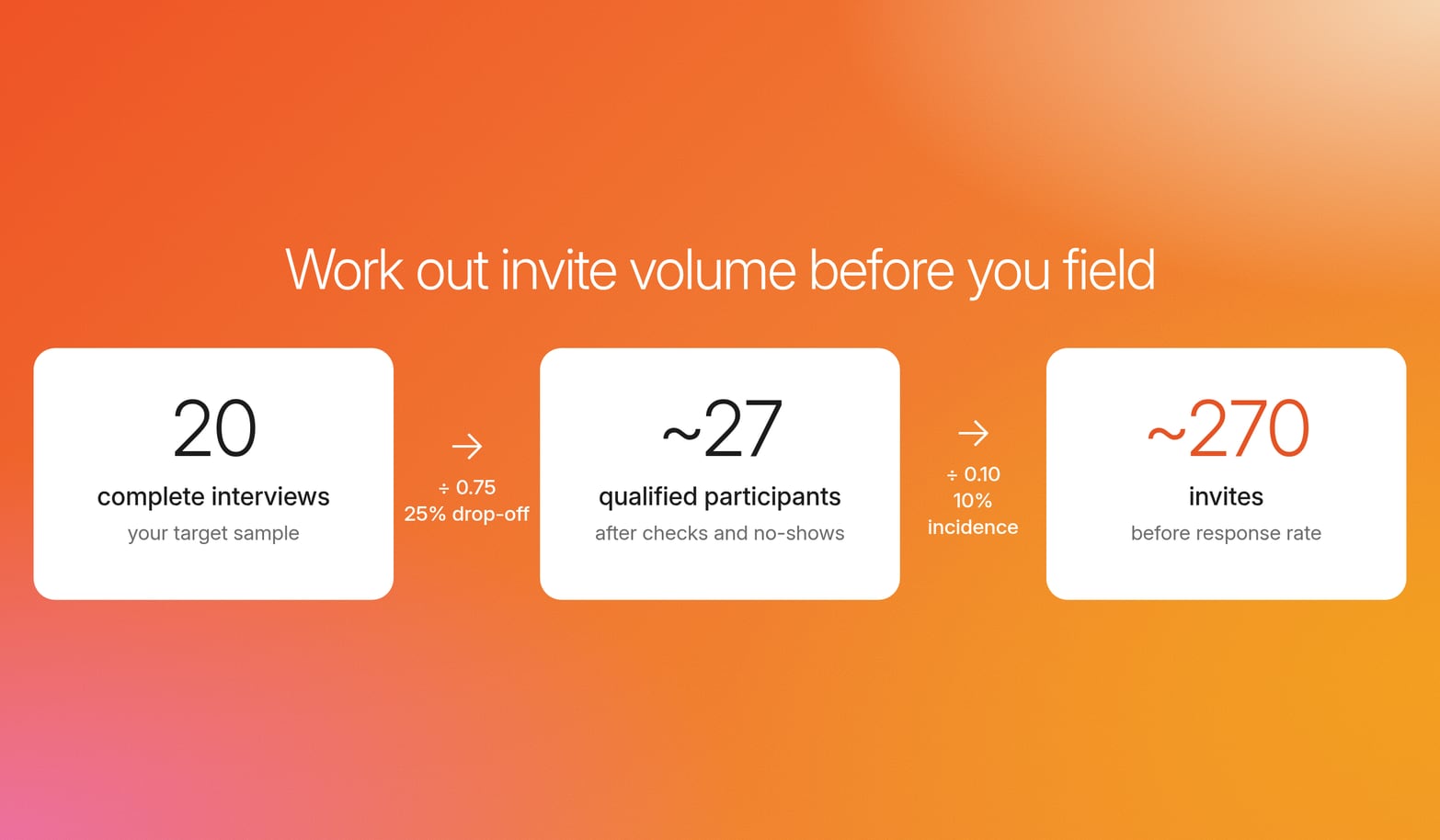
To estimate invite volume, divide the desired number of complete responses by the share you expect to keep after quality checks and no-shows, then divide by the incidence rate:
| Step | Input | Result |
|---|---|---|
| Target interviews | 20 complete responses | 20 |
| Account for drop-off | 25% removed after quality checks or no-shows (20 ÷ 0.75) | ~27 qualified participants |
| Account for incidence | 10% incidence rate (27 ÷ 0.10) | ~270 invites, before response rate |
Total responses drive survey costs, so more responses only help when the screener holds.
Criteria also define which segment comparisons are interpretable and how credible findings look to the stakeholders funding marketing efforts. The real deliverable of good screening is a sample that leadership can't poke holes in.
Protect the behavioral filter, flex the demographic ones.
How does Conveo support screening survey questions?
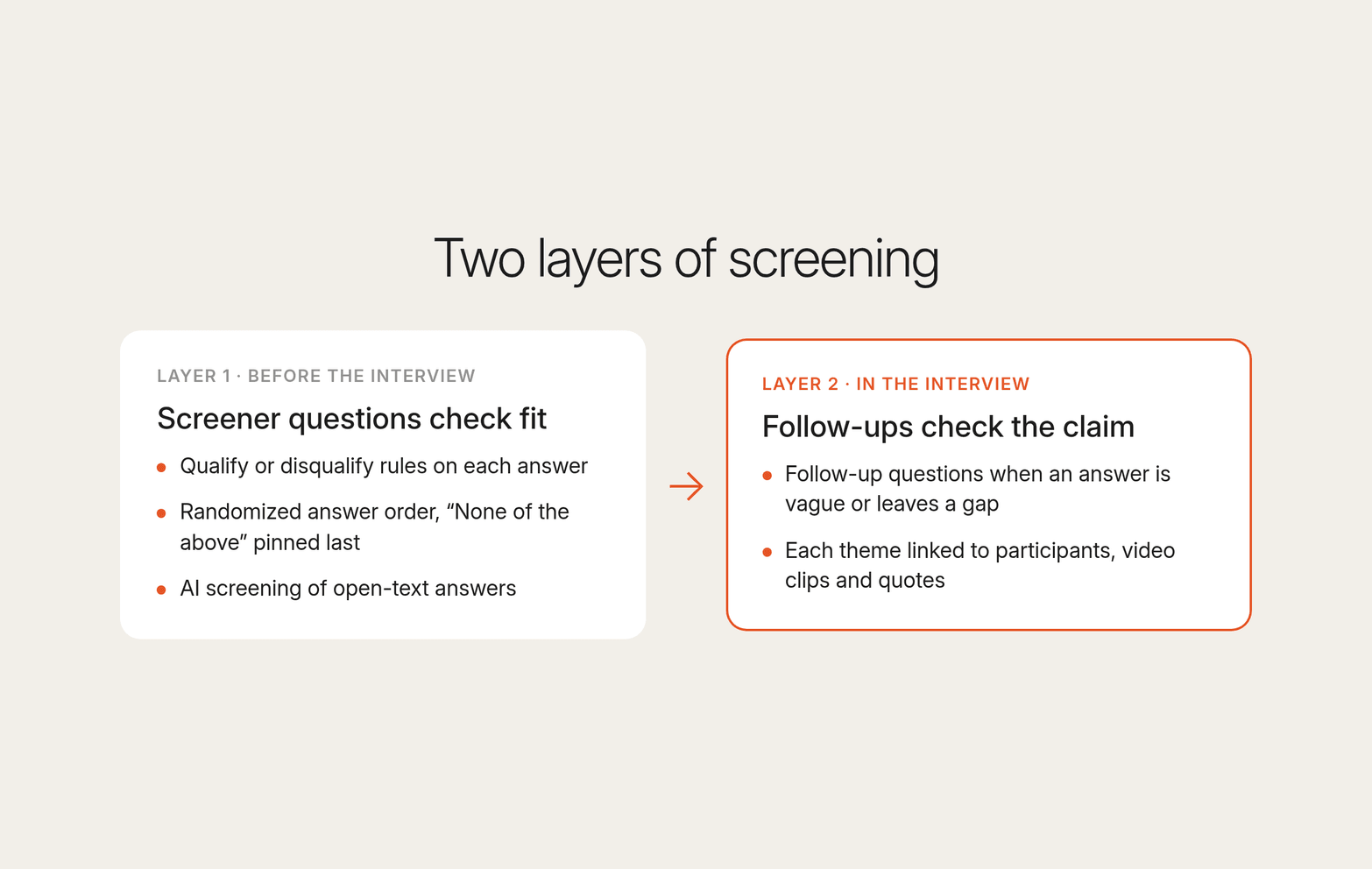
Conveo runs screening in two layers. Screener questions check fit before the interview, and the video conversation that follows checks each claim against real detail.
Layer one, screening for fit:
Screener questions run inside the study before the interview, with qualify or disqualify rules on each answer.
Answer order is randomized, with options like "None of the above" pinned last, so the qualifying option sits among plausible answers.
Image options and AI screening of open-text answers against categories you define test what participants write as well as what they tick.
The Recruit assistant turns a plain-English sample description into screener questions and quota groups.
Screeners work with any recruitment source, and qualifying answers become segments you can use later in analysis.
Layer two, checking the claim in the interview:
Conveo's AI research assistant asks follow-up questions when an answer is vague or leaves a gap, building on what the participant said earlier.
Each theme links to the participants behind it, with video clips and verbatim quotes stakeholders can audit.
"You see them physically doing it. Testing the product for the first time, being probed right there. That unfiltered, in-the-moment reaction is possibly the most powerful thing you can see as a researcher."
Dafydd Jones, Associate Director, Ninth Seat
Both layers work alongside your criteria: researchers still decide who qualifies.
Studies also keep moving once the screener is set:
Security and localization: Conveo is SOC 2 Type II and ISO 27001:2022 certified, GDPR compliant, with EU data hosting and 50+ languages.
Capacity: interviews run in parallel across markets and time zones, so findings arrive while the decision is still open.
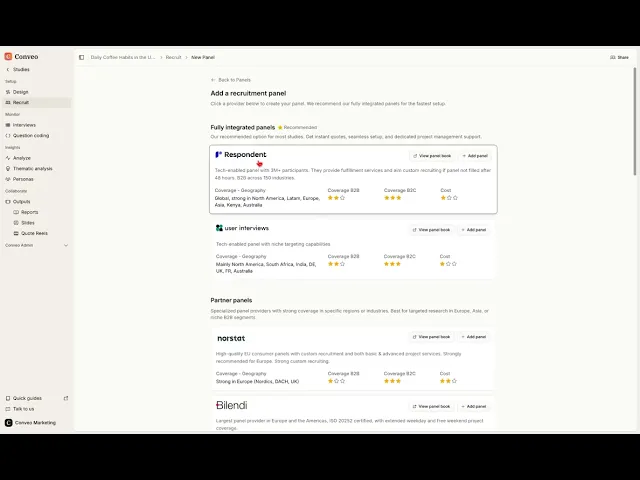
Recruitment: recruit participants through 8 integrated panel providers (including Cint, Toluna, and Respondent), or upload your own list.
The screener qualifies participants for fit, and the interview confirms it in detail.
Frequently asked questions
How do you write screening survey questions that don't telegraph the right answer?
Use neutral, behavior-based wording and never reveal the topic, brand, or qualifying criterion in the stem. Ask what participants did recently, avoid leading questions, and place the qualifying option among plausible answer choices.
How many screener questions should a survey have?
A screener should have four to six screening survey questions. That range leaves room for behavioral items, one episodic recall prompt, and a knowledge check while keeping completion high and your target audience engaged.
What are examples of behavioral screener questions?
Two examples of behavioral screener questions are "Have you bought [category] in the last 30 days?" and "Describe the last time you ran into [problem]." Both ask about recent, specific behavior rather than identity, which is the focus of effective screening questions.
How do you spot professional participants and fraud in a screener?
Pilot with inconsistency checks, speeder flags, knowledge-verification items, and a step-by-step walkthrough of the last purchase or use. Vague or contradictory detail is the clearest way to identify participants who answer dishonestly.
How do you calculate invite volume from incidence rate and drop-off?
Divide the target sample size by the share you keep after quality checks and no-shows, then divide by the incidence rate. Twenty interviews with 25% removed and 10% incidence need roughly 270 invites.
How do interview follow-ups check screener answers?
Screener answers show what a participant selected, and interview follow-ups test it. In Conveo, the AI research assistant asks follow-up questions when an answer is vague or leaves a gap, building on what the participant said earlier, so a weak-fit participant shows up before the data is analyzed.

About the author
Alex de Hemptinne
Business Impact Lead
Alex is a Business Impact Lead at Conveo, partnering with enterprise teams to embed AI-led research into their workflows. From the first study to full-scale rollout, she helps customers shift from project-based research to continuous customer intelligence.
Meet Alex on film →Qualitative insights at the speed of your business.
Conveo runs AI-moderated video interviews and structures everything they say.