In this article
TL;DR
Product concept testing evaluates a product idea with your target audience before development, using a description, mockup, or video as stimulus, and it works best when the feedback comes back while the concept is still cheap to change.
Concept insight that arrives after the build decision has closed might as well never have happened: velocity and hit rate on new concepts now decide competitive advantage. Effective concept testing keeps decisions grounded in what the target audience prefers, so internal opinion carries less weight, and that separates successful launches from expensive misses.
Most concept tests are well run but poorly timed. The research confirms a direction the product development process has already started building, because early-stage testing has always felt impractical: too slow for the sprint, too shallow to explain a reaction, too expensive to run twice.
That timing gap is why teams validate new ideas after committing significant resources. Market research should give potential customers a say before that commitment, and here it arrives after.
This guide covers two things: how to design a product concept test that returns build-ready requirements, and how to choose a method based on the decision you need to support, with a few examples of how that plays out across a target market. Both assume AI-moderated interviews are an option, distinct from a traditional focus group: one-to-one video interviews where a researcher sets the guide and the AI research assistant adapts follow-up questions to what each participant says.
| Method | Best for | What to know |
|---|---|---|
| Agency qualitative research | Depth and stakeholder credibility | Findings often land weeks after the decision window has closed |
| Survey-based quantitative testing | Reaching scale fast with quantitative data | Ratings and rankings never explain the reasoning behind a reaction |
| DIY unmoderated testing platforms | A low-cost, self-serve setup | Static scripts cannot probe when an answer in the collected data raises a new question worth asking |
| Conveo, AI-moderated video interviews built by researchers | Reliable feedback on why a concept lands or falls flat while it is still cheap to revise | Every barrier is traceable to a real participant on video |
How to design a product concept test that produces build-ready requirements: 5 steps
A well-designed product concept test does one job: it separates "the concept was unclear" from "the concept was clear and unappealing." Those are different problems with different fixes, and most concept tests conflate them because they only capture a directional score.
Good product concept testing produces specific, build-ready fixes, where a lone score tells you nothing about what to change. That is ultimately what separates successful concept testing from a test that only confirms what the team already believed.
The stakes sit above the research team. A concept that passes an unclear test absorbs development budget for two or three quarters and sets a launch date marketing then has to defend. A wrong call here shows up as wasted spend long before it becomes a soft launch.
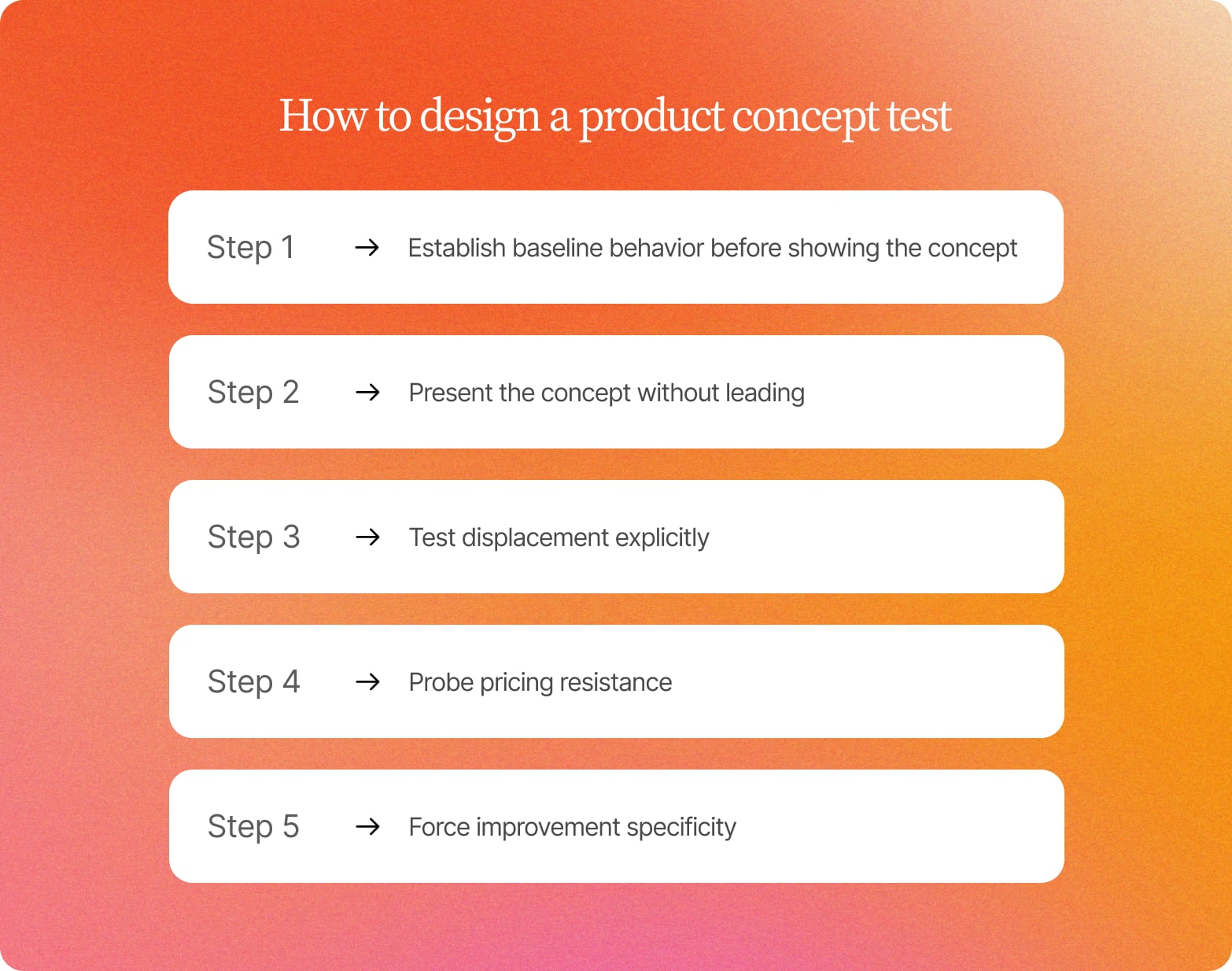
Step 1: Establish baseline behavior before showing the concept
Before any stimulus appears, capture what your target audience, including current customers, uses today: when they reach for it, and why. Skip this, and you lose any ability to measure displacement later, because you have nothing to displace from.
The mechanism is episodic recall. Ask: "Walk me through the last time you hit this problem." That prompt surfaces frequency, context, and the actual workaround someone used, where an abstract question gets the idealized version.
This kind of data collection makes it easier to identify patterns across participants later, so no finding rests on a single anecdote. Screening for people who genuinely have that behavior matters as much as the wording of the prompt. Gathering feedback grounded in real behavior, ahead of any stated intent, is what step one is for.
Step 2: Present the concept without leading
Show the concept materials, whether that is a written description, a mockup, or a video, and get an initial unstructured reaction before any structured questions follow.
This applies as much to B2B brand messaging concepts as to product creative concepts. A messaging test that skips baseline and displacement rigor because "it is only words" produces the same false signal as a product test. Gathering feedback this early, before anyone commits to a direction, keeps the rest of the test honest.
Framing questions that telegraph the intended reaction, such as "don't you think this solves your problem," inflates positive feedback that does not predict market behavior. A participant will agree a described benefit sounds good far more readily than they will change what they actually do.
Step 3: Test displacement explicitly
Ask directly: "What would you stop using, including any existing features you rely on, or stop doing to make room for this?"
A concept that scores high on general appeal but produces no answer here, or a vague one, signals that its perceived value isn't differentiated enough to earn a behavior change. That distinction matters commercially: it separates a concept that grows the category from one that cannibalizes an existing product line.
Step 4: Probe pricing resistance
Ask what price feels right and what would justify paying more. The goal is to find the real value gap behind a weak price reaction, which generic purchase-intent questions never reach.
Weight responses like "I already have something that does this" heavily. That line names the exact competitive barrier the concept must clear, and a concept that clears it earns a real competitive advantage over a marginal improvement.
Step 5: Force improvement specificity
Close with a forced-improvement question: "What must change for you to choose this over what you use now?" This step turns a reaction into actionable feedback the team can build against.
The output should be a ranked list of barriers, each tied to a verbatim quote and a video clip from the collected data. That gives a product or brand team insights it can act on directly, with no summary paragraph left for someone to interpret.
Static surveys can ask all five product concept-testing questions, but they cannot follow up on any of them. When a participant hesitates before the displacement question, or their tone shifts while a price is shown, a script moves to the next item on the list.
With Conveo, researchers keep probing in that moment. They brief the AI research assistant on what to chase, and the follow-up happens live, producing more reliable feedback than a fixed script ever could. Video adds a layer text cannot touch: a furrowed brow at a price point, or a flatter tone when a benefit does not land, shows up on screen before it shows up in the words someone chooses. That is what makes the qualitative feedback here richer than a comment box.
How to choose a product concept testing method based on decision type and timeline
Most teams pick a method before they define the decision, which is backward. Running concept testing without clear research objectives leads to a survey because it is fast, an agency because it feels credible, and a concept test that answers a question nobody asked.
Work backward from three variables instead:
Decision type: what kind of decision this product concept testing needs to support
Timeline: how much time the business has actually given you
Output: what will make the decision defensible in the room where it gets made
Getting this sequencing right is what makes concept testing work in practice and keeps it from producing a report nobody acts on.
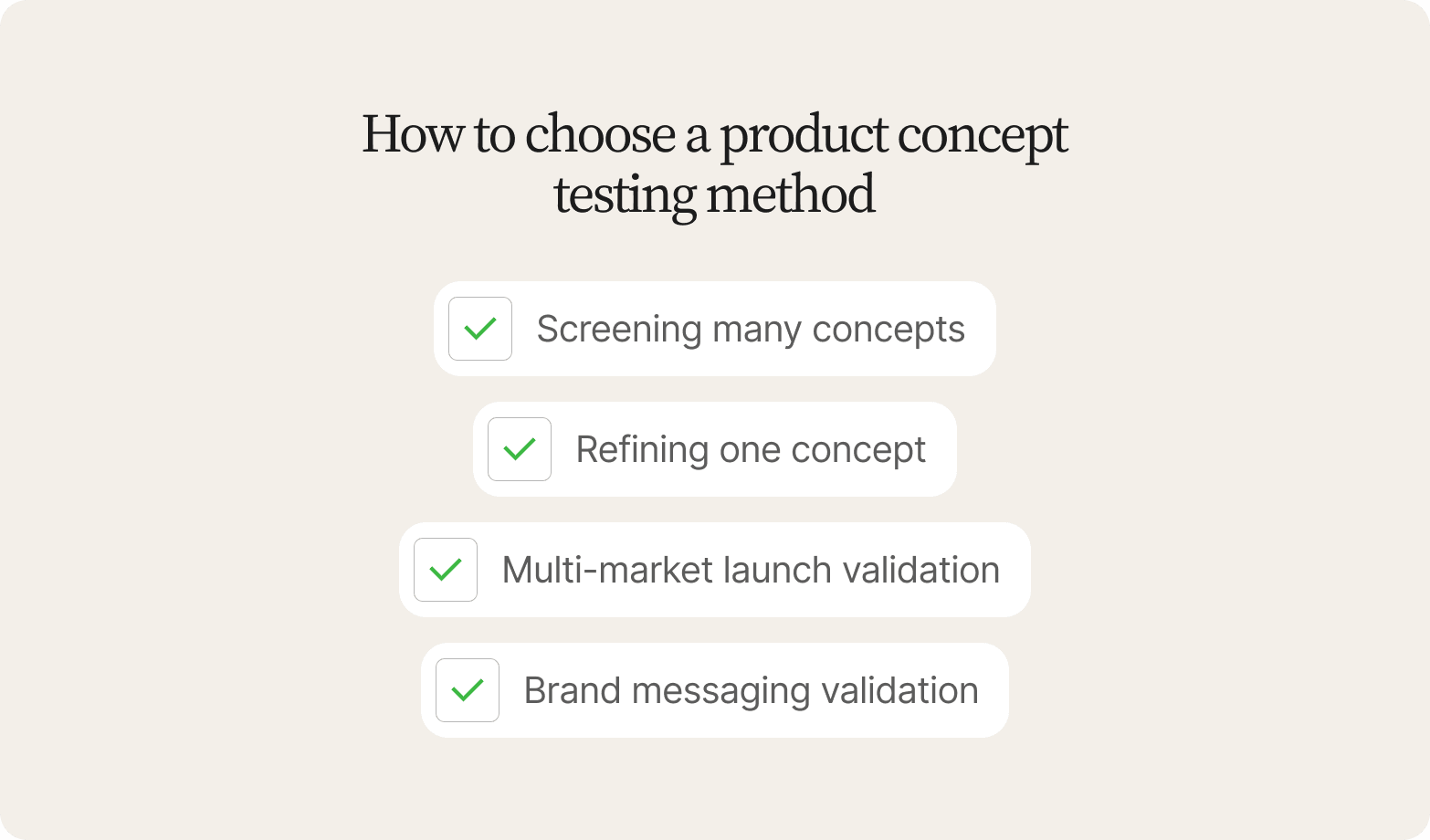
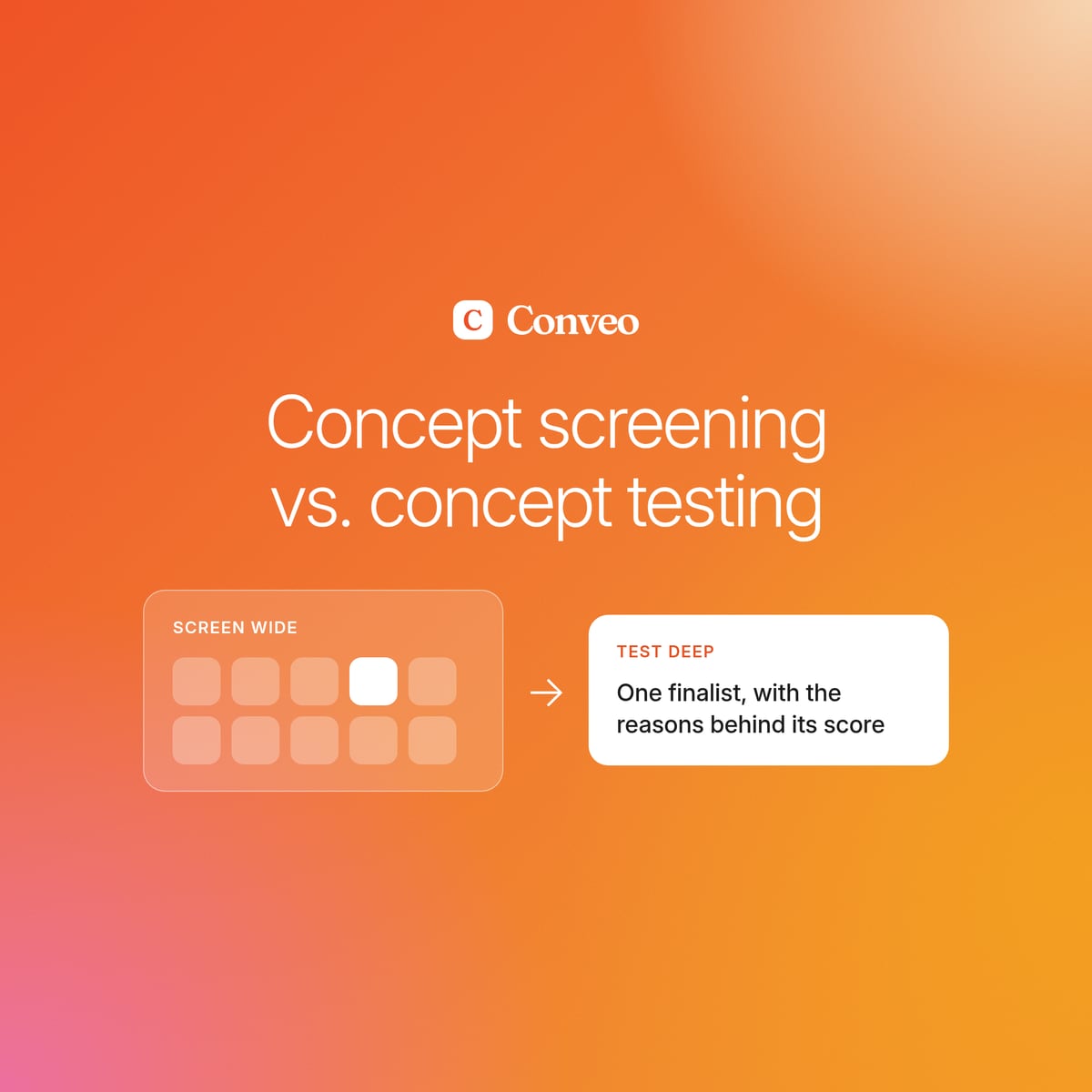
1. Screening many concepts
When the problem is narrowing 5 to 10 or more concepts down to finalists, the goal is elimination: compare multiple concepts quickly and drop the weak ones.
Timeline runs 1 to 2 weeks. The key output is relative preference scores paired with high-level themes explaining why concepts won or lost. A sequential monadic survey with open-ended follow-ups works here, as does running AI-moderated interviews with 20 to 30 participants per concept, when speed matters more than volume of verbatim detail.
This kind of comparative testing works best with a manageable set. Teams that try to test too many concepts at once end up diluting attention across them all.
The tradeoff is real: screening buys directionality. The fixes come in the next round. You will know which two or three concepts deserve more investment, and the next round tells you what to fix about them.
2. Refining one concept
Once the most promising concept survives screening, the question changes from "which one" to "what needs to change before we build this." The timeline extends to 2 to 3 weeks because the required output is different: displacement barriers, forced-improvement requirements, and an in-depth understanding of where the concept confuses people and where it fails to appeal.
The gap between "confuses people" and "fails to appeal" only surfaces through depth interviews with 30 to 50 participants, where researchers follow hesitation as it happens and gain deeper insights into the switching costs and price gaps that quantitative data from a scored survey would flatten into a single number.
The tradeoff is time per participant. What comes back, though, is a list of fixes tied to verbatim quotes and video clips.
3. Multi-market launch validation
A finalist concept that tests well in one target market still carries risk everywhere else. This decision type needs 2 to 4 weeks and produces within-market preference scores, a cross-market theme comparison, and region-specific barriers across different demographic groups that a single-market test would never reveal.
The method is parallel sequential monadic testing run simultaneously across markets, AI-moderated in local languages, with 30 to 50 participants per market. Teams often use the same setup to test multiple concepts in parallel, once more than one finalist survives screening. Watching how reactions vary by region also surfaces market trends and deeper insights that a single-market read would miss entirely.
The tradeoff is sample size: more markets means more interviews, but it is far cheaper than discovering a localization gap after launch.
4. Brand messaging validation
Brand testing for a positioning statement, tagline, or campaign creative that shifts brand perception is a narrower question with a tighter timeline: 1 to 2 weeks. Because the results here often feed straight into marketing strategies and the marketing campaigns built on top of them, getting the diagnosis right matters more than it might for an internal product decision.
The required output is a clarity diagnosis, a measurement of perception shift, and a clean separation between emotional and rational response, since messaging often succeeds on one axis and fails on the other.
Researchers choose AI-moderated interviews here because they can ask, in the moment, why a phrase landed or didn't, in the participant's own words, with no need to infer it from a rating scale.
These four decision types are a few examples, and the list is open. But mapping decision type to timeline and output first is what keeps product concept testing from becoming a survey with extra steps.
See how to build and launch a study in Conveo:
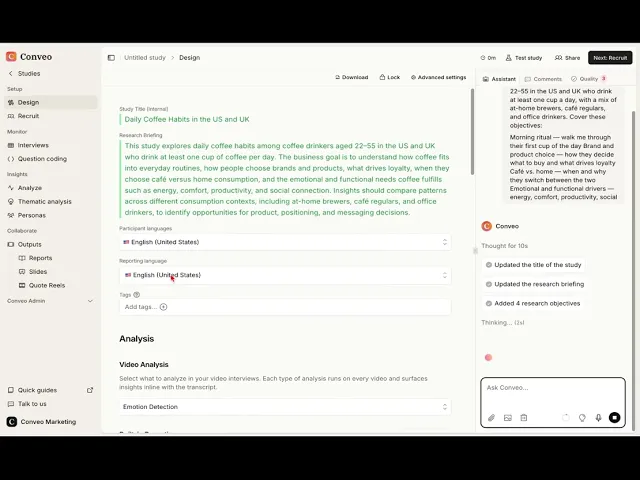
How teams run product concept testing on Conveo
1. Concept feedback stays available between cycles
Enterprise insights teams at Google, Unilever, AB InBev, Kellanova, General Mills, and JDE Peet's use Conveo to keep consumer understanding available while the decision is still open. For concept work, the baseline, displacement, and forced-improvement questions get asked while the concept is still a document.
Conveo StoryLines, the wave-based AI-moderated research program, gives brand and insights teams a continuous read on how consumer response moves as concepts evolve wave over wave. Turning that consistency into a competitive advantage separates these teams from those still testing concepts one at a time.
2. Rigor that stakeholders can check
Conveo is built by researchers, so every barrier in a ranked output traces to a participant, a verbatim quote, and a video clip a skeptical stakeholder can watch.
Recruit through Conveo's integrated panel network or your own list, and screen on behavior over stated interest, using the same episodic-recall approach used to establish baseline behavior before showing the concept. This is also where teams identify patterns across sessions and stop reacting to a single loud opinion, since the qualitative analysis behind each barrier stays tied to video as well as the transcript.
3. Findings that compound
Findings land in Conveo's searchable insight library, where concept tests connect across projects. That turns what would otherwise be scattered data into a deeper understanding teams can actually reuse.
A rejected concept from last quarter explains this quarter's pricing objection. Decision-making gets faster with every wave, and nothing gets researched twice.
4. Procurement and delivery
Procurement gets a clean answer: SOC 2 Type II certified, GDPR compliant, with data hosted in Europe.
Because teams field concept tests in parallel in 50+ languages, findings arrive while the concept is still a document, giving teams an earlier read on a concept's potential success across the full customer base.
Frequently asked questions
What is product concept testing?
Product concept testing evaluates a product idea with your target audience before development, using a description, mockup, or video as stimulus. Done well, it returns a ranked list of barriers and required changes alongside the appeal score, early enough for the team to act on them.
How is concept testing different from usability testing?
Concept testing asks whether the idea is clear, differentiated, and worth switching for. Usability testing asks whether people can complete tasks with existing features in a product that already exists.
Can AI-moderated interviews replace quantitative concept screening?
No. Use scored screening, built from familiar survey components, to eliminate weak concepts. Then run AI-moderated interviews on the finalists to add qualitative feedback that explains the scores and drives fixes.
Why do concepts that score well still fail at launch?
Usually because the test measured stated appeal and skipped displacement. If no participant can name what they would stop using to make room for the concept, the customer feedback you collected describes politeness.
How early should a concept be tested?
As soon as the idea can be described in a paragraph or sketched, well before it is fully developed. The value of a concept test falls with every week of development spend committed against it, which is why teams that validate ideas early protect the most runway.
What role do focus groups and user feedback play alongside AI-moderated interviews?
Focus groups are useful for early, exploratory reactions in a room, and ongoing user feedback from current customers helps validate a direction after launch. Neither covers what the depth interviews described here do: a group setting suppresses dissent, and post-launch feedback arrives too late to change the build.

About the author
Hendrik Van Hove
Founder & CPO
Hendrik is Conveo’s Chief Product Officer and co-founder. He's extremely passionate about technology and the real positive impact it can bring. Before Conveo, he ran AI strategy projects at McKinsey for the Fortune 2000, working with boards and every function from marketing, to sales to insights.
More by Hendrik →Qualitative insights at the speed of your business.
Conveo runs AI-moderated video interviews and structures everything they say.