In this article
TL;DR
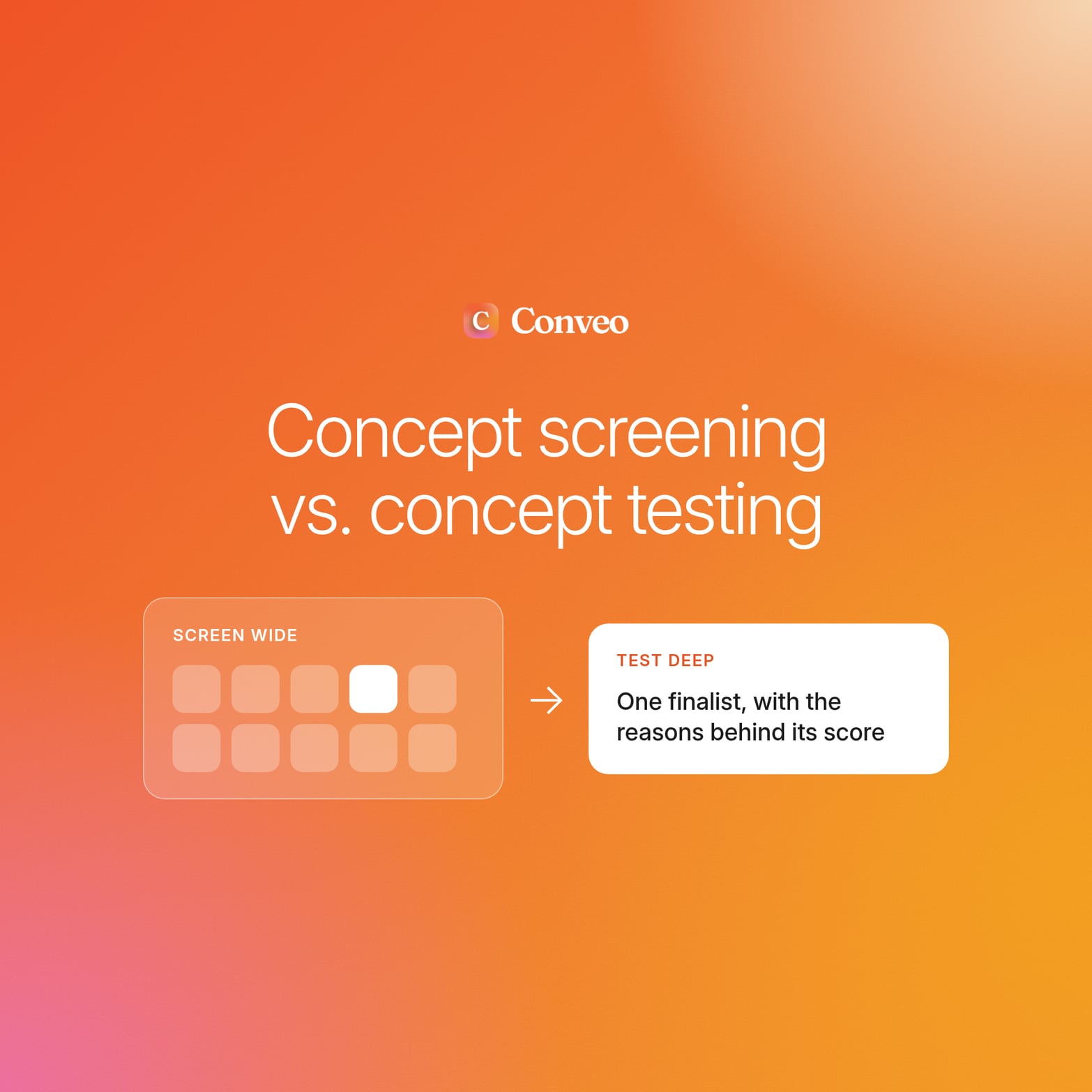
Screening and testing are different decisions in market research: screening narrows a wide field of concepts to explore, while concept validation confirms a finalist and surfaces what needs to change.
Most concept tests return a purchase-intent score from a static survey that ranks a concept but can't diagnose why it scored that way; by the time anyone digs in, the roadmap decision it was meant to inform has often already closed, putting market success at risk.
Conveo's AI research assistant uses adaptive, AI-moderated probing to ask follow-up questions that turn vague hesitation into specific pricing thresholds, displacement signals, and iteration requirements.
Running screening and testing as studies in one Conveo workspace makes concept development iterative, with both decisions feeding the same searchable insight library instead of two disconnected studies.
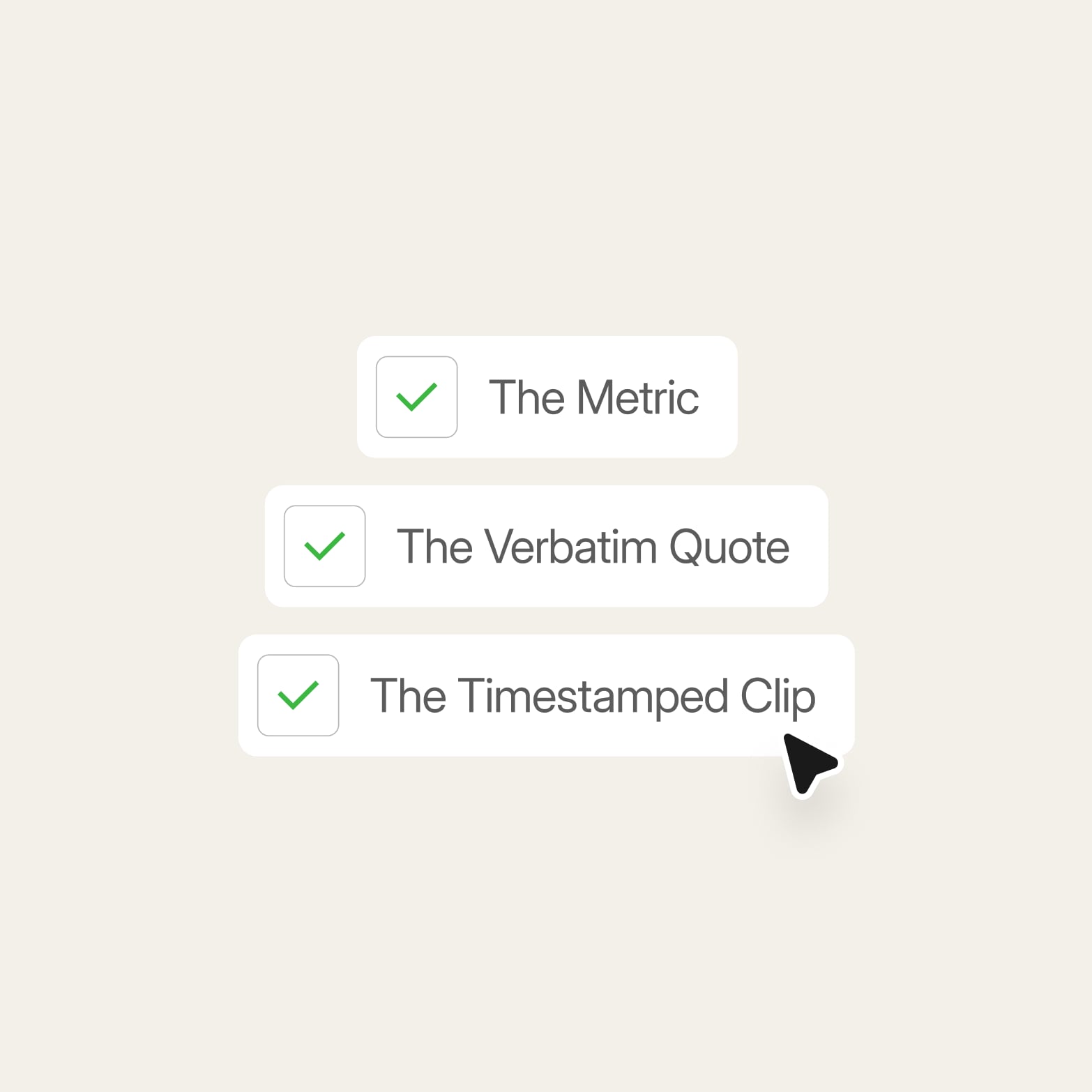
Each theme links to the participants behind it, with video clips and verbatim quotes, which is what makes the output defensible in a stakeholder review and supports informed decisions.
Why survey-based concept tests return scores without diagnosis
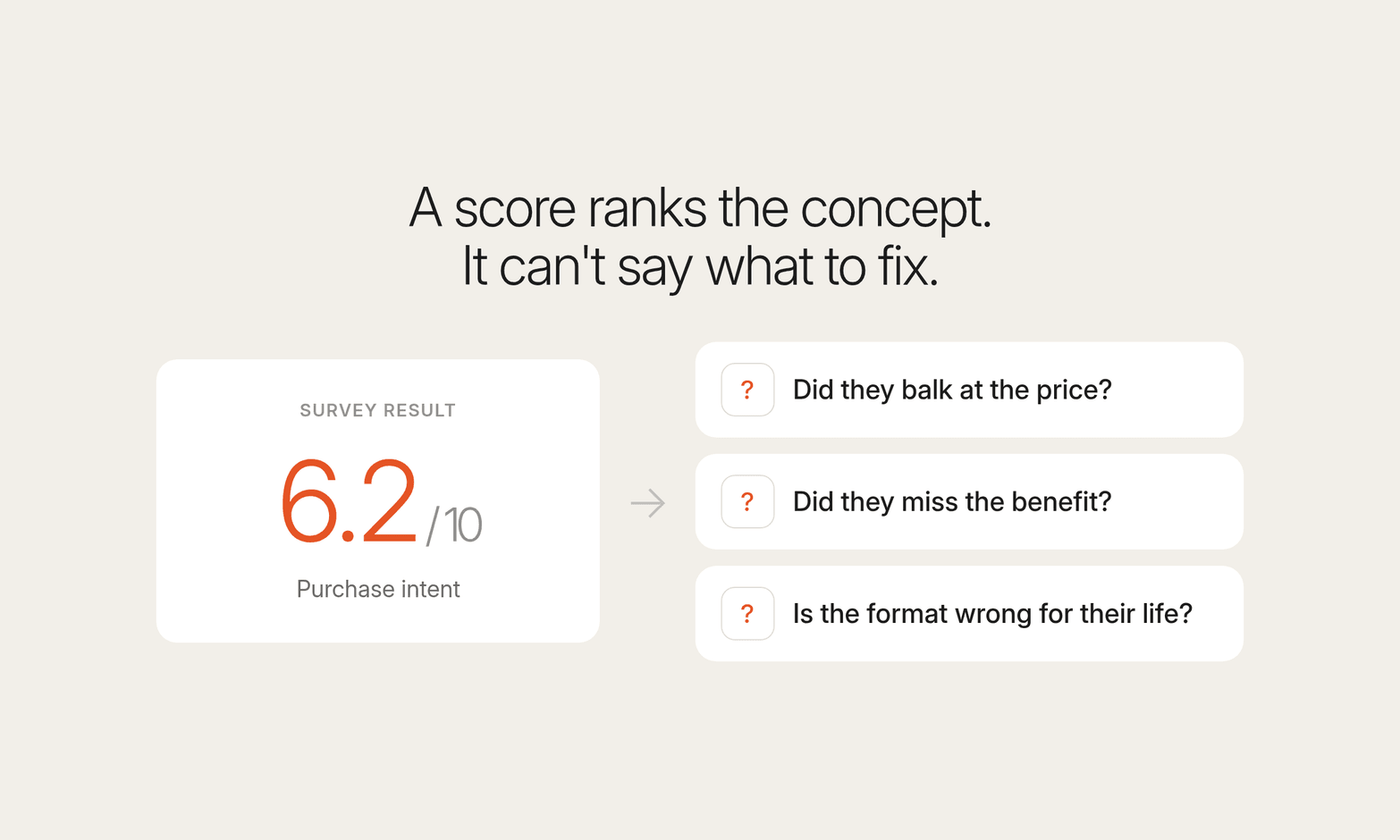
Most concept tests end the same way: a score lands, and then the roadmap decision it was supposed to inform gets made anyway, because nobody had time to find out what the number actually meant. Teams commission a concept test, get back a result such as a 6.2 out of 10 purchase-intent score or 62% trial intent from a sample of respondents, and still can't determine what to fix. That quantitative data ranks the concept, yet it leaves open whether people balked at the price, failed to grasp the benefit, or found the format wrong for how consumers live in real life.
"What happened quite consistently was that the product was always doing better than the concept."
Carla Mahfuz, Senior Manager, Consumer Insights, Ferrara Candy Company
The mechanism is the instrument. Static survey scripts ask the same questions of every respondent, such as "Would you buy this?", and record the answer, but they can't probe a shrug, a flat "it's interesting," or a pause that signals friction without naming it. So the friction stays invisible. Without follow-up questions, teams get no feedback on what to change, and they end up in one of two places:
They iterate blindly.
They commission a second study to diagnose what the first one missed, doubling both the timeline and the money spent.
AI-moderated interviews use artificial intelligence to close that gap. Participants answer in their own words, so the responses show consumer preferences that a rating scale flattens. Conveo's AI research assistant can turn an objection like "I wouldn't pay that much" into a specific pricing threshold and a value-proof requirement by asking, "What would need to be different for you to choose this over what you use now?"
There's a further gap. Without baseline consumer behavior captured first, concept reactions float free of real alternatives, and you lose the displacement signal that tells you whether potential customers would actually switch.
The difference between screening and testing
Define each decision before choosing a method, and let clear objectives set the focus.
| Dimension | Screening: the wide decision | Testing: the deep decision (concept validation) |
|---|---|---|
| Question it answers | Which of your test ideas resonate with consumers and meet market needs? | Does a finalist, such as a new product concept, clear the decision threshold? |
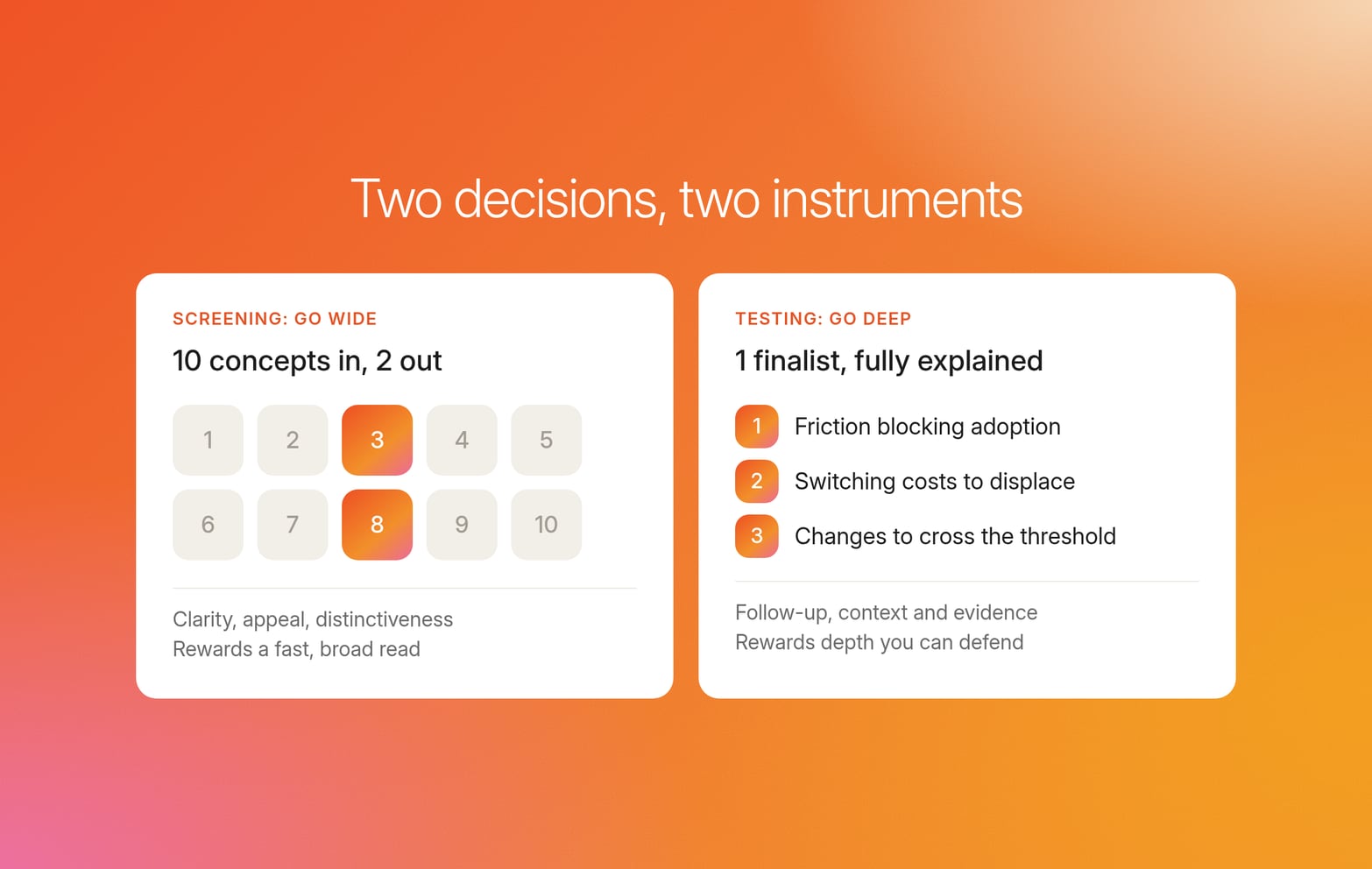
| What you do | Start with 10 concepts and narrow to two, separating the ones that resonate from those that fail on clarity, appeal, or perceived distinctiveness | Run a concept test that surfaces the exact friction blocking adoption, the switching costs required to displace what people already use, and the specific changes needed to cross a decision threshold |
| Goal | Breadth and speed, so you can separate the live options from the dead ones quickly, without necessarily going deep on any single idea | Depth and traceability, so the evaluation of each concept explains why it earned its result |
| What it rewards | A fast, broad read | Follow-up, context, and evidence you can defend in a stakeholder review |
The methods don't transfer. The importance of matching method to decision-making shows here: run both with the same survey tool, and you get more detail than screening needs and less than testing requires. Teams then miss in one of two directions:
Over-investing in screening: running focus groups and agency studies that take far longer than the decision warrants to narrow 10 concepts.
Under-investing in testing: launching a finalist without knowing why a sizeable share said no.
In Conveo, teams run the wide screen and the deep test as studies in one workspace, an iterative process where both decisions feed the same searchable insight library rather than two disconnected studies run with different instruments.
What good probing reveals that static scripts miss
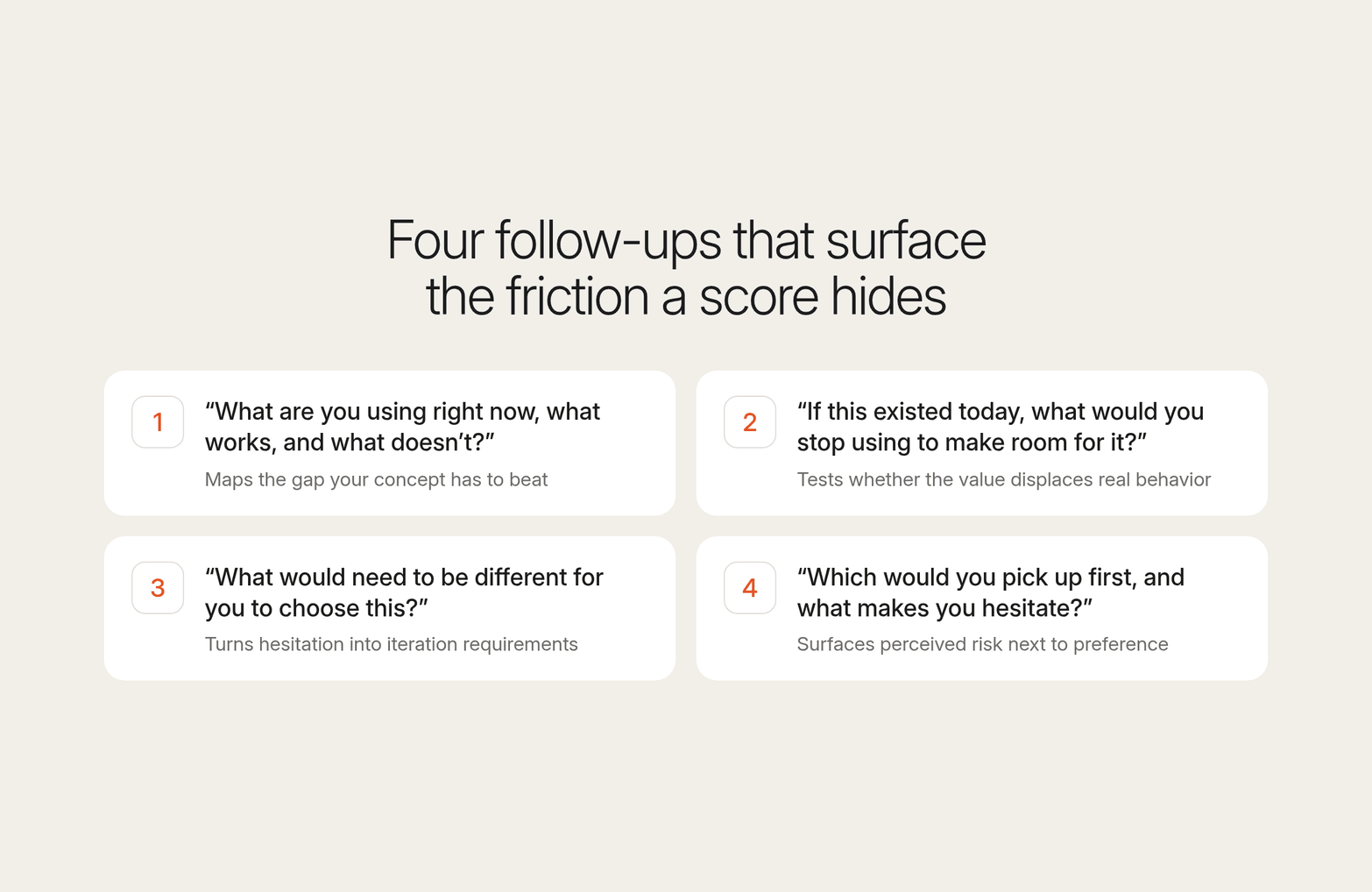
A static survey script asks "Would you buy this?" and stops. A skilled moderator instead asks, "Walk me through the last time you ran into this problem. What happened?" to force episodic recall and reveal consumer behavior: how often the problem occurs in real life and in what context. Four follow-up questions surface the friction a score hides:
What are you using right now, what works, and what doesn't? Maps current solutions and the consumer needs they leave unmet, pinpointing the gap your concept has to beat.
If this existed today, what would you stop using or stop doing to make room for it? Tests whether the value is strong enough to displace real behavior.
What would need to be different for you to choose this over what you use now? Converts hesitation into direct requirements for iteration.
Which of these would you pick up first, and what would make you hesitate on the others? Surfaces perceived risk alongside stated consumer preferences.
Video adds what text cannot:
Facial cues and tone: Conveo's AI-moderated interviews capture the shifts that appear during feature and price exposure, the moments participants rarely put into words.
Weaknesses and patterns: Those aspects of a reaction expose weaknesses in a concept that a rating never shows, and analyzing responses across participants surfaces patterns that point to what to fix first. Teams that analyze results this way get specific feedback they can act on.
Traceability: Linking each theme to the participants behind it, with video clips and verbatim quotes, is crucial for making concept test findings auditable and far harder to dismiss when stakeholders challenge them. That rigor is essential to credibility, because a score alone can't provide it.
Timeline and depth trade-offs across approaches
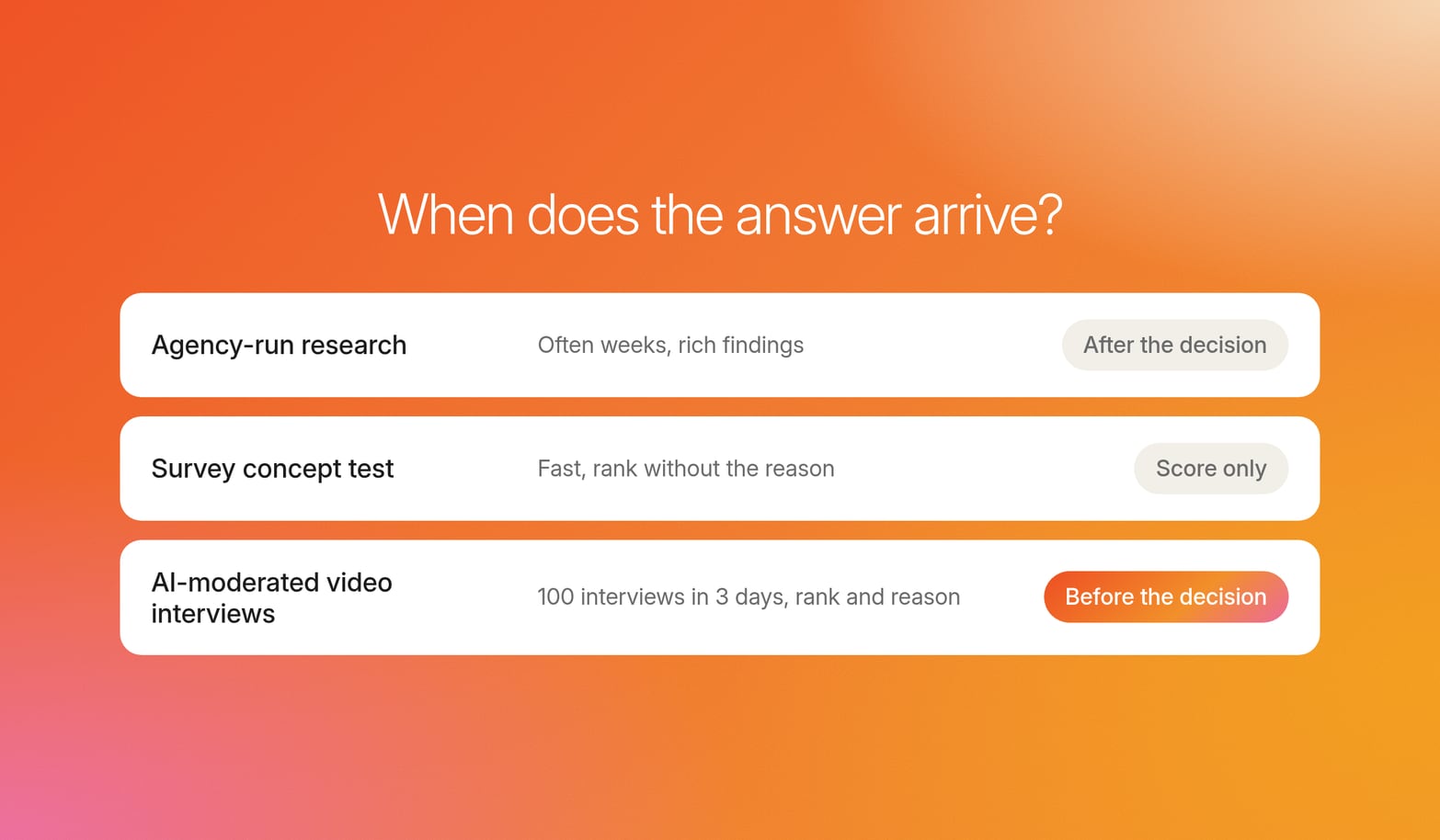
The real constraint is when the answer arrives relative to the decision, and business decision-making moves on its own schedule. Each approach handles that constraint differently:
Agency-run research: Traditional qualitative market research, from focus groups to agency-run studies, takes time, often weeks, so findings can land after the roadmap or campaign has already been signed off. The study happens; the decision it was meant to inform does not wait.
Surveys: A survey-based concept test returns quantitative data quickly, but it can only provide rank, and it strips out the hesitation, tone shifts, and follow-up probes that explain why an idea scored 6.2 instead of 8.5. Whoever owns a brand or a new product launch needs the reason alongside the rank, because the reason shapes the next iteration's effectiveness.
AI-moderated video interviews: Conveo has run 100 interviews in 3 days, so refinement can happen before the decision closes.
That timing matters to the person who owns the innovation roadmap as much as to the researcher running the study: a concept refined in time can still reach the market opportunities that justified it.
Comparison table: survey-based concept tests vs AI-moderated video interviews
The table below compares two evaluation methods, survey-based concept tests and AI-moderated video interviews, across five aspects: depth of follow-up, timeline, traceability, multi-market execution, and the ability to capture switching-cost signal.
| Dimension | Survey-based concept tests | AI-moderated video interviews |
|---|---|---|
| Depth of follow-up | Static scripts that ask the same questions of every respondent, no probing | Conveo's AI research assistant turns objections into iteration requirements through adaptive probing |
| Timeline | Weeks, through an agency or a survey panel | Conveo has run 100 interviews in 3 days |
| Traceability | Summary PDFs and quantitative data tables | Each theme links to the participants, video clips and verbatim quotes behind it |
| Multi-market execution | Coordinating multiple agencies | Parallel execution across 50+ languages |
| Switching-cost signal | Hypothetical preference | Episodic recall and displacement probes |
Multi-market concept testing without coordinating multiple agencies
A multi-market concept test breaks in two predictable ways:
Identical questions everywhere: Asking the same questions in every market, reusing culturally loaded questions about pricing, hypothetical preference, or emotional reaction without adapting them, means the responses mean different things to consumers in different markets.
Agency coordination: Coordinating several agencies across time zones and methodologies rarely produces comparable findings and complicates how teams analyze results across regions.
The cost is time and money: coordinating agencies across several markets can add weeks to the timeline, so results arrive after the regional roadmap decision has already closed. Conveo addresses both problems:
Parallel coverage: Running interviews in 50+ languages with recruitment through 8 integrated panel providers expands how many ideas a team can test across regions in parallel, so market opportunities in each region reach the roadmap discussion in time, without waiting on a chain of agency handoffs.
Localized questions: Your team can localize culturally loaded questions in the discussion guide to fit local market needs, and Conveo's AI research assistant runs them in 50+ languages. A question such as "Would you pay $X?" can become "How does this compare to what you pay now?" in markets where a hypothetical price question falls flat.
One searchable library: Every market's findings land in the same searchable insight library, so the team can pull up what earlier tests found before commissioning the next one.
"The pace, responsiveness, and research expertise of the Conveo team, on top of the top AI-moderated qual platform, have been invaluable to us in scaling brand advertising internationally."
Matt Harris, Research & Insights Lead, EMEA, Canva
When to kill a concept vs when to iterate
Before fieldwork starts:
Set clear objectives.
Define your kill and iterate thresholds.
List the assumptions behind the concept.
A concept that scores high on clarity and appeal but feels familiar can cannibalize what your business already sells, so a strong score does not necessarily signal a green light. Probe how potential customers see its distinctiveness against real alternatives to determine whether the score holds up.
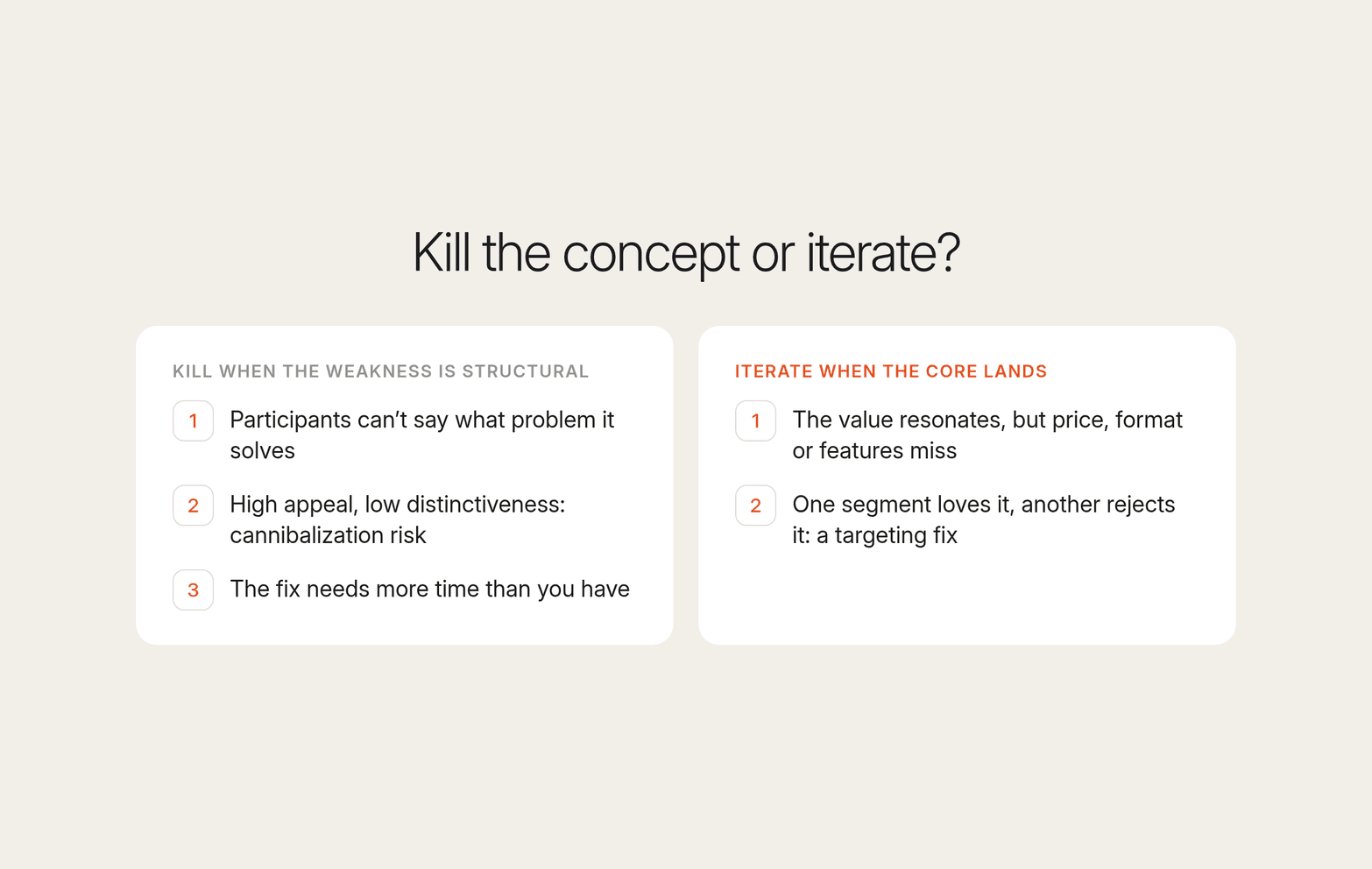
Kill the concept when its weaknesses are structural:
Participants cannot articulate in their own words what problem it solves or what they would give up to make room for it.
It scores well on appeal but poorly on distinctiveness, which signals cannibalization risk rather than category expansion.
The iteration required exceeds the time you have to develop the product or campaign, making a weak launch the higher-risk path.
Iterate the concept when:
The core value resonates but pricing, format, or feature set misses, and participants give specific requirements for crossing the threshold.
One segment loves it while another rejects it, which points to a targeting or positioning fix rather than a failed concept.
Linking each finding in the concept test to the video clips and verbatim quotes behind it turns stakeholder debates from opinion contests into evidence-backed decisions, which matters for innovation teams deciding where to put their money.
Where Conveo fits across both decisions
Conveo is Consumer Understanding Infrastructure: studies run in one workspace and feed one searchable insight library. Four things make that work for both decisions:
One workspace: Screening and testing are different jobs, and a team's success depends on staying focused on one connected body of evidence and matching each stage's objectives to the method.
A shared library: Conveo lets a team run the wide screen and the deep test as studies in the same workspace, so a finding from screening 10 concepts sits in the same searchable insight library a team draws on when exploring consumer needs and testing the finalist.
Traceable credibility: Each theme links to the participants behind it, with video clips and verbatim quotes in their own words. That evidence holds up in stakeholder decision-making, whether someone questions the research's effectiveness or asks why a concept got killed or iterated.
Regional reach: Recruitment runs through 8 integrated panel providers, and interviews run in 50+ languages, so a regional rollout can reuse one market research process across every market.
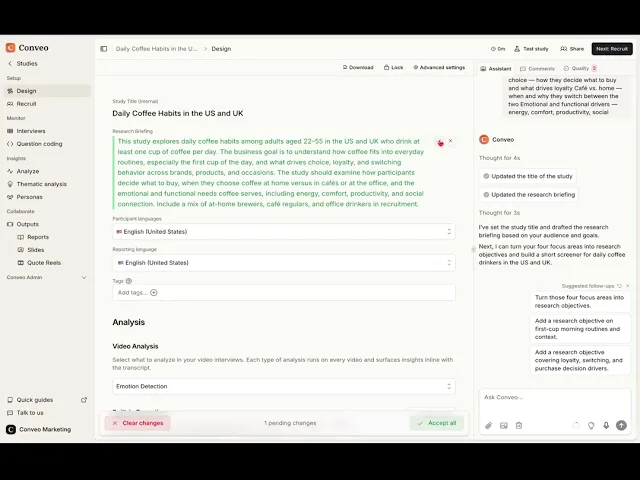
See it in action: build and launch a study in Conveo.
Frequently asked questions
What is a concept test?
A concept test evaluates whether a new product, service, or brand campaign idea meets consumer needs and resonates with potential customers before you commit resources to development or launch. As a form of [concept validation](/glossary/concept-validation), it measures four things: clarity (do people understand what it is?), appeal (do they want it?), distinctiveness (does it differ from what they already use?) and adoption friction (what blocks them from choosing it?). The result helps determine whether to launch, iterate, or kill the concept on evidence rather than internal assumptions.
What are the best concept test questions?
The best [concept test questions](/insights/concept-testing-questions) go past "Would you buy this?" to follow-up questions that reveal switching costs, displacement, and adoption friction. Four work harder. "Walk me through the last time you ran into this problem. What happened?" forces episodic recall and real context. "What are you using now, what works, and what doesn't?" maps the gaps your concept must beat. "If this existed today, what would you stop using to make room for it?" tests whether the value can displace behavior. "What would need to be different for you to choose this over what you use now?" converts hesitation into iteration requirements. Conveo's AI research assistant asks follow-up questions when an answer is vague or hesitant, turning objections into requirements.
How long does a concept test take?
It depends on the method. Agency-run qualitative research usually runs the longest, often weeks. Surveys return results faster but can only provide rank, stripping out the hesitation and follow-up that explain why a concept scored 6.2 instead of 8.5. With AI-moderated video interviews, Conveo has run 100 interviews in 3 days, so refinement can happen before the roadmap decision closes.
What is the difference between a concept test and a product test?
A concept test evaluates an idea before you develop it and tells you whether to build, iterate, or kill it, which reduces the risk of building the wrong thing. A product test evaluates a working prototype or finished product after development and tells you whether to launch, refine, or delay it, which reduces the risk of launching something that fails in the market. Running the concept test first saves the cost of building a product that never met market needs.
Can you run a concept test across multiple markets simultaneously?
You can, though a multi-market concept test breaks when you reuse culturally loaded pricing, preference, or emotional-reaction questions without adaptation, or when you coordinate several agencies across time zones and methodologies. Coordinating agencies across several markets can add weeks to the timeline. Running AI-moderated interviews in 50+ languages with recruitment through 8 integrated panel providers lets teams test ideas across regions in parallel. Every market's findings land in the same searchable insight library, so the team can pull up what earlier tests found before commissioning the next one.
What makes a concept test output credible to stakeholders?
A concept test earns stakeholder trust when its analysis traces back to real people. Three things build that trust. Named evidence: debates turn into opinion contests when nobody can point to who said what, which stalls the decisions that depend on understanding the friction blocking adoption. Traceable findings: linking each theme to the participants, video clips and verbatim quotes behind it makes the study auditable and hard to dismiss in review. Visible reactions: video shows the hesitation and enthusiasm that summaries flatten, so stakeholders watch reactions during price and feature exposure instead of reading a paraphrase.

About the author
Dieter De Mesmaeker
Co-Founder & CEO
Dieter is CEO and co-founder of Conveo. Before starting the company, he founded DataCamp and scaled it into one of the leading edtech platforms in the world.
More by Dieter →Qualitative insights at the speed of your business.
Conveo runs AI-moderated video interviews and structures everything they say.