In this article
TL;DR
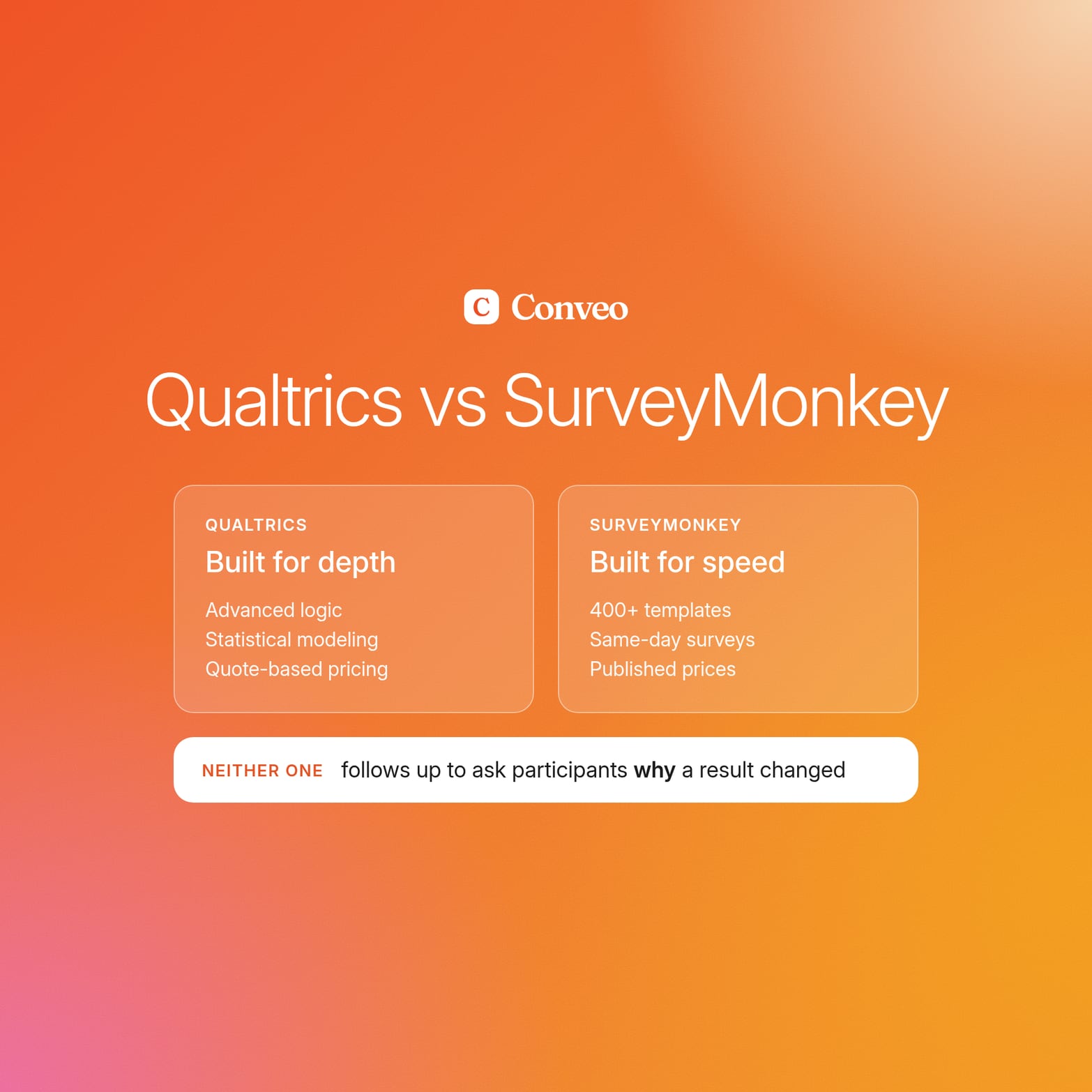
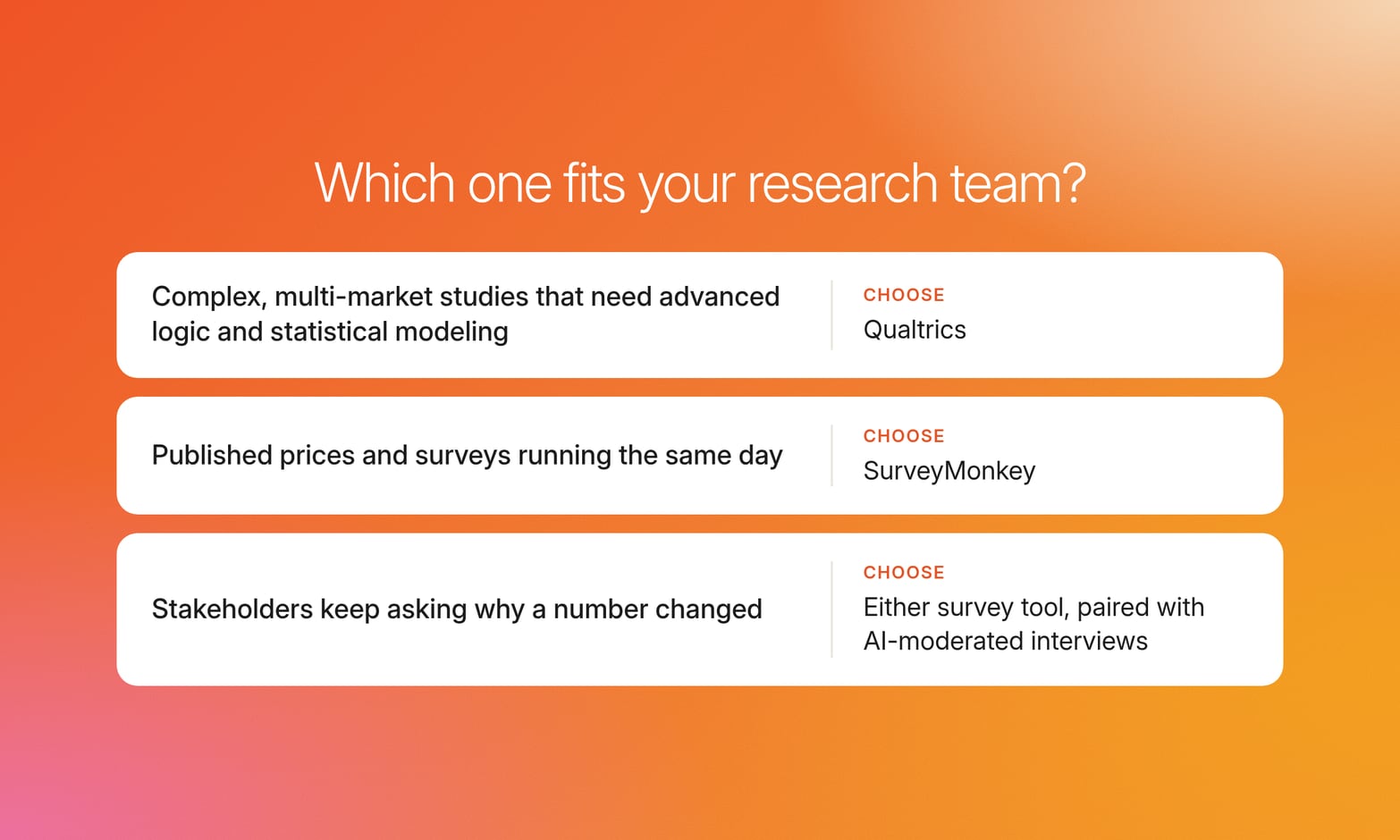
When comparing Qualtrics vs SurveyMonkey, Qualtrics fits teams running complex, multi-market studies that need advanced logic and statistical modeling. SurveyMonkey fits teams that want published prices and surveys running the same day.
Both hold SOC 2 Type II and support GDPR, but SurveyMonkey only offers SSO and HIPAA support on its Enterprise plan.
Neither platform runs AI-moderated interviews, so neither can follow up with participants to explain why a result changed.
Surveys alone are enough for tracking known numbers or sizing an opportunity. Insights teams whose stakeholders keep asking “why” should pair their survey tool with AI-moderated interviews.
Conveo runs those interviews alongside Qualtrics or SurveyMonkey, and a pilot on one survey result lets you test the approach before rolling it out.
Choosing between Qualtrics and SurveyMonkey comes down to a trade-off between depth and simplicity. Qualtrics handles complex research but takes longer to learn, while SurveyMonkey is quick to pick up but has fewer advanced features. Comparing cost is harder still, because SurveyMonkey publishes its prices and Qualtrics only shares them through a quote.
Without a clear side-by-side view, teams can sit through sales calls and still choose a platform that’s either more than they need or too limited for the research they run.
This guide compares Qualtrics vs. SurveyMonkey on survey creation, analysis, pricing, and security, so you can see which one fits your research program. It also covers the questions neither platform can answer, and how to pair your survey tool with AI-moderated interviews when stakeholders want to go deeper than survey responses.
What Qualtrics and SurveyMonkey do well
Qualtrics is cloud-based experience management software that many enterprise organizations use to run customer experience and market research programs at scale. SurveyMonkey is an indirect Qualtrics competitor. It focuses on making custom surveys quick to build and send, which suits teams that need fast data collection without specialist training.
Qualtrics and SurveyMonkey are both popular choices for collecting customer feedback thanks to their long track records and strong user reviews. On G2, both score 4.4 out of 5. Qualtrics Market Research has more than 3k reviews, while SurveyMonkey has more than 24k, giving buyers a substantial base of user feedback to draw on when choosing a platform.
This comparison looks at what information each research software tool can give you and where you need other methods to find the answers.
Qualtrics vs SurveyMonkey: key features comparison table
To choose between Qualtrics and SurveyMonkey, you need to know how each one handles the basics. Here’s how the two market research platforms compare:
| Qualtrics | SurveyMonkey | |
|---|---|---|
| Survey templates | Qualtrics offers more than 50 pre-built survey templates, plus over 20 guided solutions that come with a ready-made survey and report. | SurveyMonkey has more than 400 ready-made survey templates for creating lightweight surveys quickly. |
| Survey logic | You can branch and randomize questions and set quotas. Loop & Merge repeats a set of questions for each brand or product a participant selects. | SurveyMonkey handles standard skip logic, basic piping and simple branching well, with advanced logic and block randomization on Premier plans. |
| Question types | Participants can answer some questions on video. | Questions include image choice and file upload. Participants can’t answer on video. |
| AI-powered features | Qualtrics can add AI follow-up questions to vague open-text answers on its newer pricing plans, and Text iQ tags open-ended answers by topic. | SurveyMonkey uses AI to create and edit surveys through chat. It also summarizes open-ended answers and answers questions about your results. |
| Feedback analysis | Crosstabs come as standard. Regression and clustering are available through the paid Stats iQ add-on. | Statistical significance testing starts on Advantage plans, and crosstabs start on Premier. |
| Advanced research methods | Qualtrics supports Conjoint and MaxDiff studies, and its AI Research Agent can help build them. | LaunchPad studies come with MaxDiff and Van Westendorp already set up and report results such as key drivers automatically. |
| Omnichannel feedback collection | Surveys go out by email, link, QR code, and social media. SMS and WhatsApp are paid add-ons, and WhatsApp surveys can run as a back-and-forth conversation. Website and in-app feedback needs a separate license. | Surveys go out by email, web link, QR code, SMS, and website embed, and the link can be shared through WhatsApp. A mobile SDK covers in-app surveys, and SurveyMonkey’s GetFeedback adds website feedback buttons and forms. |
| Multilingual surveys | Qualtrics supports surveys in 76 languages. | Multilingual surveys are available on Premier plans and above. |
| Data export | You can export feedback data to CSV, Excel, SPSS, XML, and Google Sheets, or as JSON through the API. | Paid plans export to CSV, Excel, SPSS, PDF and PowerPoint. |
| Integrations | Qualtrics connects with tools including Google Workspace and Google Analytics. | SurveyMonkey has more than 200 integrations, including Salesforce, HubSpot and Tableau, plus connectors for Claude and ChatGPT. |
| Research panel | Qualtrics Panel Services gives access to more than 200 million third-party respondents. | SurveyMonkey Audience reaches more than 335 million people in over 130 countries, from $1 per response. |
| Pricing model | Qualtrics doesn’t publish prices. It quotes based on the responses and video you expect to collect, and every plan includes unlimited users. | SurveyMonkey publishes its prices. There’s a free plan for short surveys, and team plans start at $30 per user per month, billed annually for at least three users. |
| Response limits | No response caps are listed. Cost grows with how much research you run. | Each paid plan has a yearly response cap, with a fee for every response over it. |
| Ease of use | Qualtrics has a steeper learning curve and requires a code-fluent developer for advanced customizations. G2 reviewers rate it 8.5 for ease of use and report about two months to implement it. | SurveyMonkey provides clean, intuitive charts and is easier to pick up. G2 reviewers rate it 9.2 for ease of use and report implementing it in about a month. |
Knowing which features a customer feedback platform does and doesn’t offer is a solid start for comparison. However, you also need to know whether the format can give you enough depth for the customer insights you need.
The question a Qualtrics vs SurveyMonkey comparison doesn’t answer
Surveys from Qualtrics and SurveyMonkey can show you what participants think about a topic, but they often fall short of telling you why.
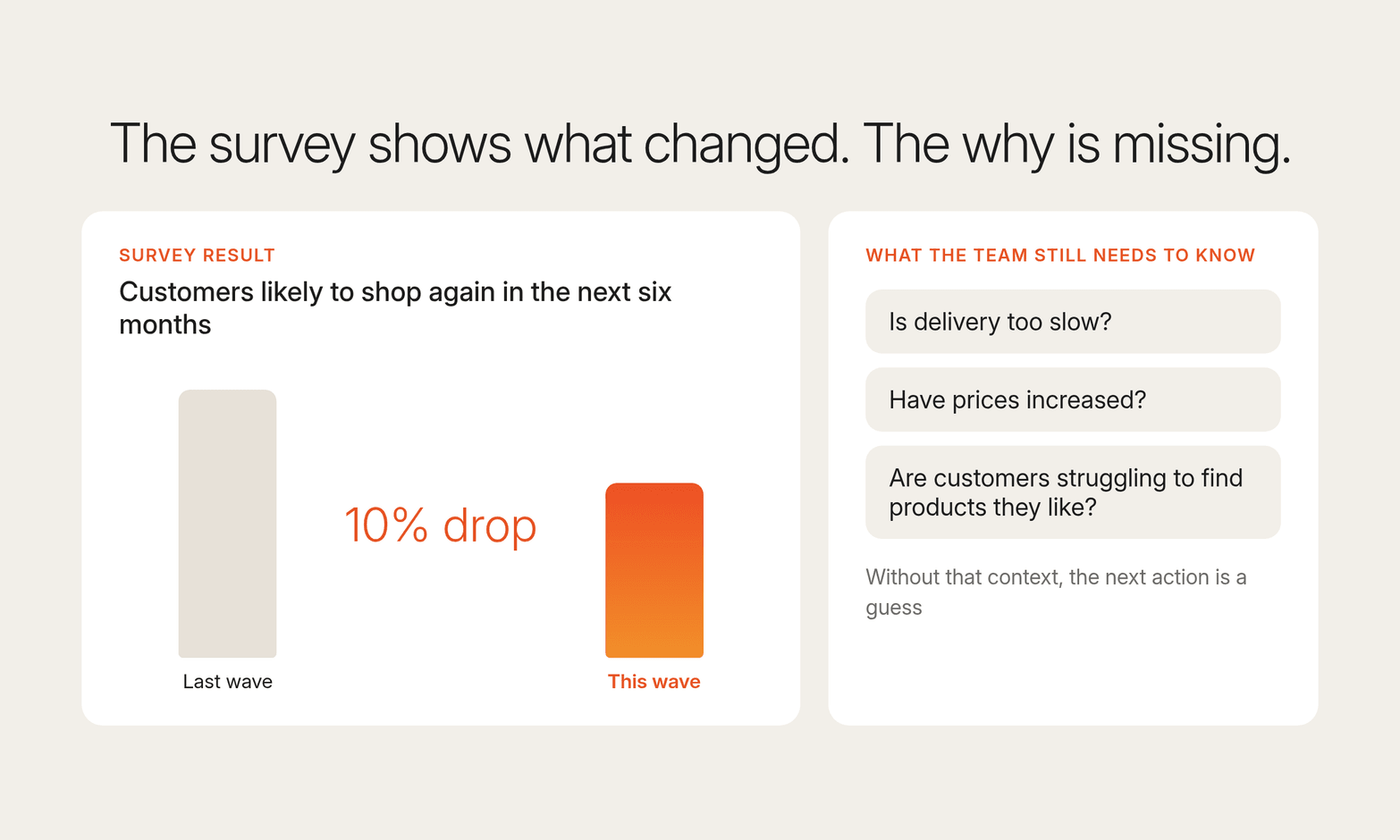
For example, say a survey shows that the number of customers likely to shop at an online homeware store again in the next six months has dropped by 10%. The result gives the team data, but no context to tell them what’s causing the drop or how to remedy it. Is delivery too slow? Have prices increased? Are customers struggling to find products they like? Without that context, the team will struggle to know what action to take.
Open-ended text fields can provide more information, but it’s still up to the participants to decide what they expand on and how much detail they provide. Qualtrics can add an AI follow-up when an open-text answer is too vague, but the follow-ups stop after one or two questions.
Because of the nature of traditional surveys as a research method, neither platform turns the responses into a conversation where each question builds on the last answer.
When Qualtrics or SurveyMonkey surveys are enough
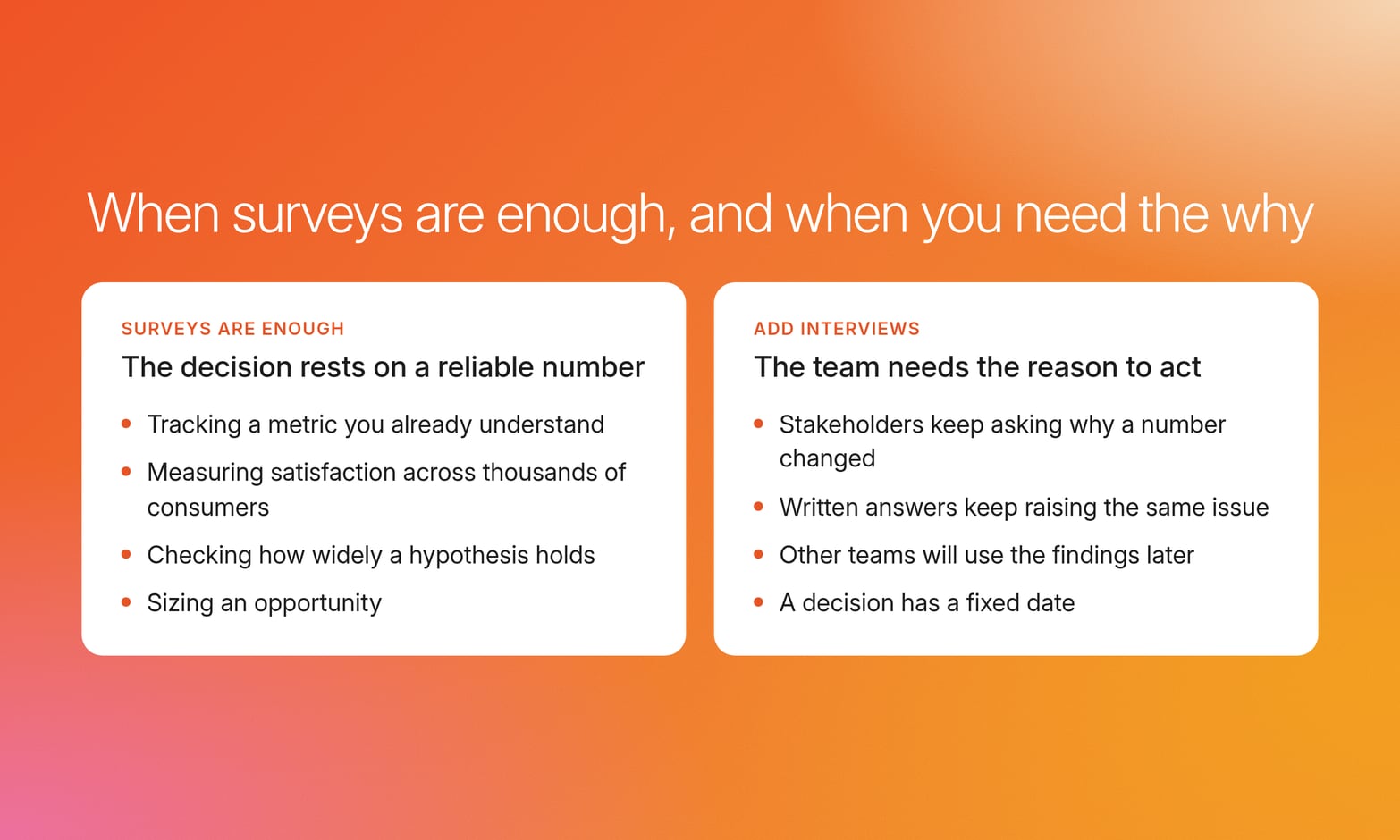
While survey data alone can’t give you the reasoning behind customer feedback, in some situations it’s enough to make a decision. This includes scenarios like:
You’re tracking a metric you already understand over time. For example, a beverage brand might run a quarterly tracker on awareness of a new flavor. As long as the number climbs as expected, stakeholders only need to see the trend.
You’re measuring satisfaction across thousands of consumers. A grocery delivery service, say, could send a short survey after each order as part of its customer feedback program and compare scores by city to spot where service is slipping.
You already have a hypothesis and need to check how widely it holds. Suppose interviews suggest that parents choose a snack brand for its low sugar. A survey of 2,000 shoppers would show how many actually rank sugar as their main reason.
You need to size an opportunity. One case would be a skincare brand testing two packaging designs to see which one more consumers would pick off the shelf.
In each of these cases, the decision rests on having a reliable number. The priority is collecting high-quality data from the right sample rather than exploring individual responses.
When you need to find out the “why”
Sometimes a data point needs more explanation before the team can act on it confidently. Consider these scenarios:
Stakeholders keep asking why a number changed. A coffee chain’s regular survey might show fewer people planning to visit for two quarters in a row, leaving the team with nothing to tell leadership beyond the score.
Written answers keep raising the same issue. Say several participants in a pet food survey mention that the new bag is hard to reseal. Interviews would show what goes wrong and whether it’s stopping people from buying again.
Other teams will use the findings later. Research on breakfast habits for a cereal brand could feed into a product launch and a marketing campaign, and the team behind each one would want to see the evidence for themselves.
A decision has a fixed date. Suppose a frozen food brand has to decide whether to change its pack design before a retailer decides which products to stock next season, and the survey scores for the new design were weak.
AI-moderated interviews offer a way to dive deeper into participant responses and give you more actionable insights.
How AI-moderated interviews work alongside survey tools
When you need qualitative data along with numbers, surveys and AI-moderated video interviews can work as two parts of the same research plan.
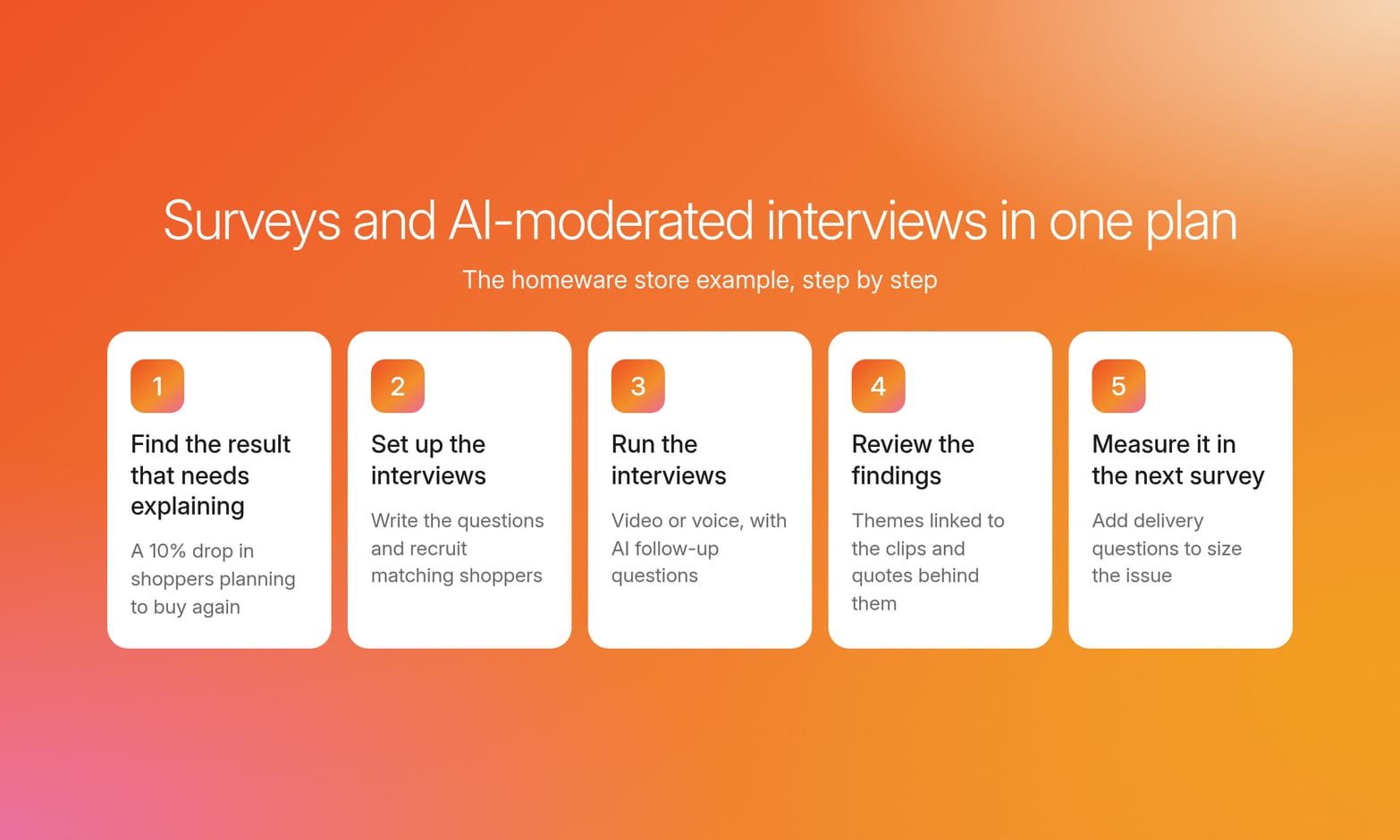
Using the homeware store example from earlier, here's how you could achieve that with Conveo, which runs AI-moderated interviews with consumers and analyzes the results:
Find the result that needs explaining. The store’s Qualtrics or SurveyMonkey survey shows a 10% drop in shoppers planning to buy again. The team checks which shoppers the drop comes from, such as repeat buyers in one region.
Set up the interviews in Conveo. The team writes the questions it wants answered, such as what’s changed since a shopper’s last order, and recruits shoppers who match that group. Participants can come from Conveo’s eight integrated panel providers or the store’s own customer list.
Run the interviews. Shoppers answer on video or by voice, in more than 50 languages. Conveo’s AI research assistant asks follow-up questions when an answer is vague, so a shopper who says they “probably won’t order again” gets asked what’s behind it. Because the interviews are recorded, the analysis also picks up tone of voice and, on video, facial expression.
Review the findings. Fielding and analysis often complete within days. Conveo groups the answers into themes, and each theme links back to the clip and quote behind it. Researchers can watch the clips and correct the analysis before sharing it, so stakeholders hear shoppers explain the delivery problem in their own words.
Measure it in the next survey. The team adds questions about delivery to its next survey to see how many shoppers are affected and where.
The team keeps running its surveys as before, with the interviews fitting in between them.
"The pace, responsiveness, and research expertise of the Conveo team, on top of the top AI-moderated qual platform, have been invaluable to us in scaling brand advertising internationally."
Matt Harris, Research & Insights Lead, EMEA, Canva
How Qualtrics, SurveyMonkey and Conveo handle security and governance
Whichever survey software you choose, and whether you add AI-moderated interviews now or later, each vendor will need to pass your security review. Interviews also record participants’ faces and voices, which adds security considerations around data collection.
Here’s how each feedback collection tool handles common requirements in enterprise security reviews:
| Qualtrics | SurveyMonkey | Conveo | |
|---|---|---|---|
| Certifications | Qualtrics holds SOC 2 Type II and HITRUST certification. It also has FedRAMP High authorization. | SurveyMonkey holds SOC 2 Type II and PCI DSS certification. | Conveo is SOC 2 Type II and ISO 27001:2022 certified. |
| GDPR | Qualtrics provides GDPR controls, including tools for handling erasure requests. | SurveyMonkey complies with GDPR and gives customers tools to handle data requests. | Conveo is GDPR compliant. |
| Data hosting | Qualtrics stores data in several regions, including the US, Canada, Germany, the UK, Australia, Singapore and Japan. | Enterprise customers can choose a US, Canadian, or EU data center. | Conveo offers EU hosting in Belgium. |
| SSO | Qualtrics supports SSO and lets admins require multi-factor authentication. | SSO is available on the Enterprise plan. | Conveo supports SSO and granular access controls. |
| Personal data removal | Admins can delete personal data stored in survey responses, tickets, and contacts. | Account holders can delete individual responses, and Enterprise teams can search across accounts to find and delete a respondent’s data. | Conveo removes names and phone numbers from transcripts and captions, flags uncertain ones for review, and deletes study data on request. |
| Participant quality | Qualtrics offers bot detection and duplicate detection, though its Fraud Detection features aren’t included in every license. | SurveyMonkey’s Audience panel uses bot and fraud detection and a double opt-in process. | Conveo gives every completed interview an automated quality score. Researchers can hide weak sessions from analysis and report suspect participants to supported panel providers. |
| Buying process | Qualtrics doesn’t publish prices, so every purchase starts with a quote request. | SurveyMonkey publishes prices for its individual and team plans. Enterprise pricing is available on request. | Conveo offers custom pricing. |
How to run a pilot project with AI-moderated interviews
A pilot lets you test AI-moderated interviews alongside a study before changing how your team works. It gives you evidence to show stakeholders and budget holders when you ask to use the method more widely, and it keeps the risk low because your existing operational workflows carry on as normal.
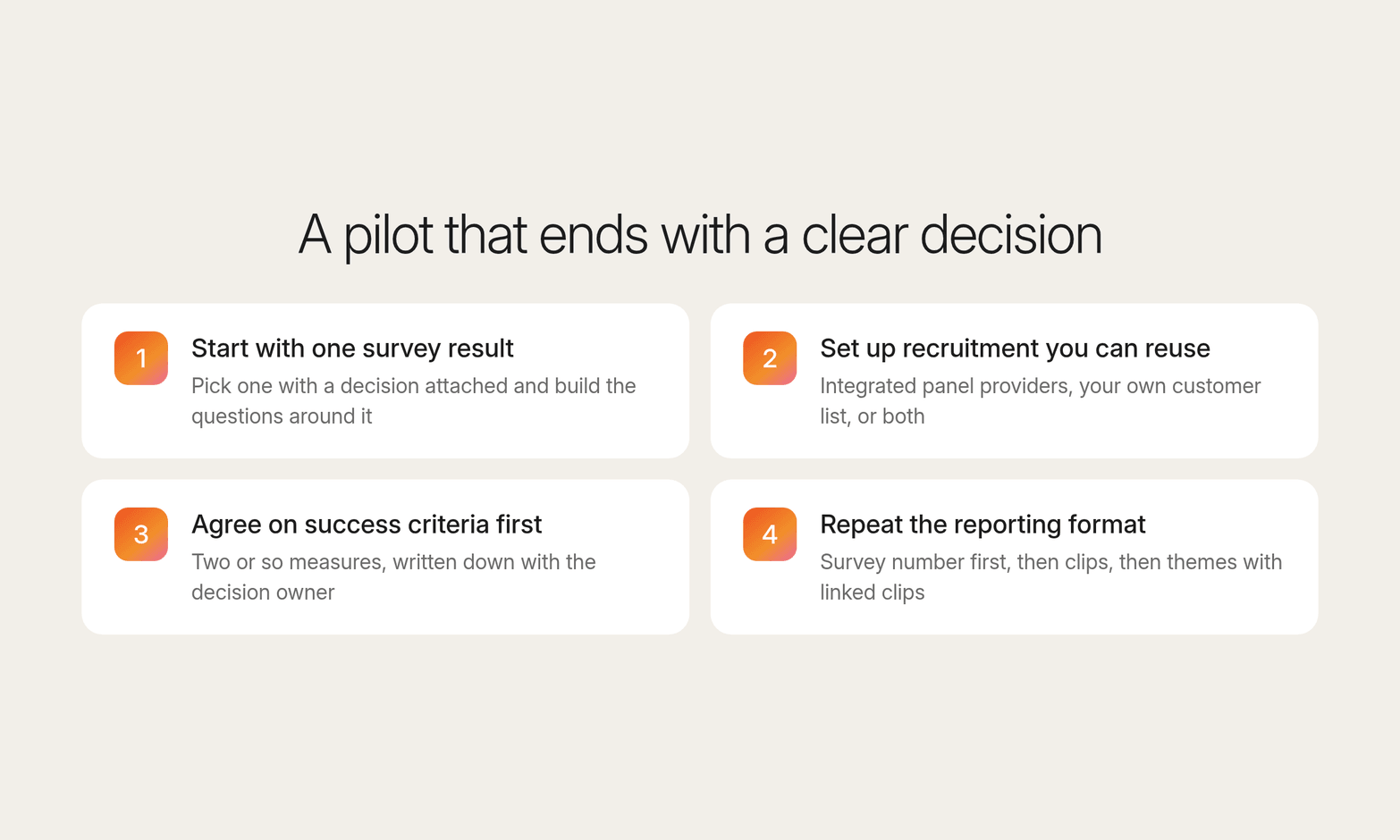
Here's how you can run a pilot that ends with a clear decision on whether to make AI-moderated interviews a regular part of your research:
Start with one survey result that has a decision attached. Pick something a stakeholder has already asked about, such as a drop in repeat purchase intent that’s due for discussion at next quarter’s planning meeting. Ask the decision owner what they’d need to hear from consumers before they act, and build the interview questions around that.
Set up recruitment so you can reuse it. Decide whether participants will come from Conveo’s integrated panel providers, your own customer list, or both. Reuse your survey software’s screening questions so interviews reach the same kind of consumer. Later studies can then start from the same setup.
Agree on success criteria before the interviews run. Write down two or so measures with the decision owner. For example, the findings are ready before the planning meeting, and the stakeholder makes at least one decision based on them.
Create a reporting format you can repeat. Open with the survey number, then play clips of consumers explaining it, and share the themes with their linked clips so stakeholders can check the findings afterward.
By the end of the pilot, you’ll have a repeatable process for combining survey data with interviews, plus evidence of where the method helps your team make better-informed decisions. Together, they make the case to budget holders for adding AI-moderated interviews to your research workflow.
Conveo: where the "why" comes from
Whichever survey platform you choose, Conveo works alongside it, so your team can explain survey results while keeping the tools it already uses.
Conveo is Consumer Understanding Infrastructure. It runs AI-moderated interviews with real consumers and turns them into findings the wider business can use. More than 400 enterprises use Conveo, including Google, AB InBev and Canva.
Here’s what it gives your insights and brand teams:
Explanations that keep up with your surveys. Researchers can investigate a survey result as soon as it raises a question, so findings arrive while the decision is still open. For questions that come back every quarter, Conveo StoryLines runs interviews in waves, for example monthly, and compares each wave with earlier ones to show what’s changed.
Findings anyone can check. Every theme links back to the participants behind it, with the video clip and quote, so anyone reviewing the results can see where a finding came from.
Research that builds on itself. Every study feeds Conveo’s searchable insight library, which recognizes recurring themes across studies, so before starting new research the team can see what consumers have already said.
An easier security review. Conveo is SOC 2 Type II certified, ISO 27001:2022 certified, and GDPR compliant, with EU hosting in Belgium.
Multilingual studies on a short timeline. Interviews run in more than 50 languages, and fielding and analysis typically wrap up within days.
Frequently asked questions
What does Reddit say about Qualtrics vs SurveyMonkey?
Reddit users describe Qualtrics as powerful for academic and clinical research, and many of them use it through a university license. For smaller projects, they often find its price and complexity more than they need. SurveyMonkey comes across as a reliable choice to create surveys quickly, but users running advanced experiments find its logic options restrictive. Some also see it as dated next to lighter tools like Google Forms.
What do reviews say about Qualtrics vs SurveyMonkey?
As of October 2026, both score 4.4 out of 5 on G2. Reviewers rate SurveyMonkey higher for ease of use (9.2 vs 8.5) and ease of setup (9.0 vs 8.3), and report implementing it in about a month, compared with two months for Qualtrics. Qualtrics scores slightly higher for quality of support, and nearly half of its reviewers work at companies with more than 1,000 employees.
Is Qualtrics or SurveyMonkey better for market research?
It depends on your research objectives and feedback volume. Qualtrics suits complex market research, and SurveyMonkey suits quick studies with standard designs. Qualtrics handles advanced survey logic, including Loop & Merge, which repeats a set of questions for each brand or product a participant selects. SurveyMonkey has more than 400 templates and ready-made studies for concept and pricing tests, so teams can launch faster when they don’t need heavy statistical modeling. Whichever you choose, use surveys when you need to know how many people think or do something, and interviews when you need to understand their reasons.
What are the main Qualtrics alternatives and SurveyMonkey alternatives?
For conversational forms, Google Forms is free with a Google account, and Typeform asks one question at a time for more engaging surveys. Alchemer, formerly SurveyGizmo, is another survey platform built for custom research setups. For customer feedback programs, Zonka Feedback collects responses through email, SMS, WhatsApp, web, and in-app, and uses AI to group them into themes. Medallia is a solid Qualtrics competitor, as it’s known for operational customer experience management. For explaining survey results, Conveo runs AI-moderated interviews alongside any of these platforms.
Can Qualtrics or SurveyMonkey run AI-moderated video interviews?
Not as of October 2026. Qualtrics can add one or two AI follow-up questions to an open-text survey answer, and its live interviews use a human moderator over Zoom. SurveyMonkey’s AI features cover building surveys and summarizing results. Teams that want AI-moderated video interviews run them in a separate tool alongside their survey platform.
Do researchers stay in charge of AI-moderated interviews?
Yes. Researchers decide what to ask and who to interview, and they review and correct the analysis before it’s shared. The AI research assistant runs each conversation, asking follow-up questions based on each participant’s answers, and can run many interviews at once, so researchers spend their time on the questions and the findings.

About the author
Florian Hendrickx
Head of Growth
Florian is Conveo’s Chief Growth Officer, leading growth strategy and go-to-market execution as the company scales. He’s held growth leadership roles at companies like Deliverect, Robovision, and Aikido Security, and brings hands-on experience across marketing, sales, and product.
More by Florian →Qualitative insights at the speed of your business.
Conveo runs AI-moderated video interviews and structures everything they say.