
TL;DR
Research participant bias is a systematic distortion that happens during the research process itself, distinct from sampling, measurement, or analysis bias.
It shows up as social desirability, demand characteristics, acquiescence, participation (selection) bias, and groupthink, each pulling findings in a different direction.
Qualitative studies are especially exposed: with 15 to 20 study participants, a systematic response pattern does not average out the way it can in survey research across a larger population.
You minimize participant bias at every stage: behavioral screeners at recruitment, neutral prompts in design, private probing during moderation, and evidence linking during analysis.
Conveo, a video-first AI research platform, applies research methods designed to reduce the social pressure that drives bias through private one-on-one video interviews, adaptive AI-moderated probing, and traceable evidence.
Research participant bias is one of the most reliable ways to build a confident-looking research program on a foundation that does not hold. When study participants sit across from a moderator, join a group discussion, or answer questions they sense are leading somewhere, they edit themselves. It's the gap between what people say in a research context and what actually drives their decisions, and it directly affects the validity of any research study built on it.
Participant bias occurs for various reasons and takes several forms, each type of bias pulling findings in a different direction. In one-on-one interviews, socially desirable answers replace candid ones. In focus groups, dominant voices pull the room, and quieter participants align rather than contradict. In poorly constructed guides, leading questions confirm hypotheses before the conversation even starts. Awareness of these factors is the first step toward designing research questions that reduce their influence.
The business consequence is straightforward: findings reflect the interview itself, not the customer. Teams act on what participants thought they were supposed to say, and product decisions get made around stated preferences that do not survive contact with real behavior. Private, video-based AI interviews with adaptive probing reduce the social pressure that drives these distortions, surfacing participant responses that group formats and text-only approaches routinely miss.
What Is Research Participant Bias?
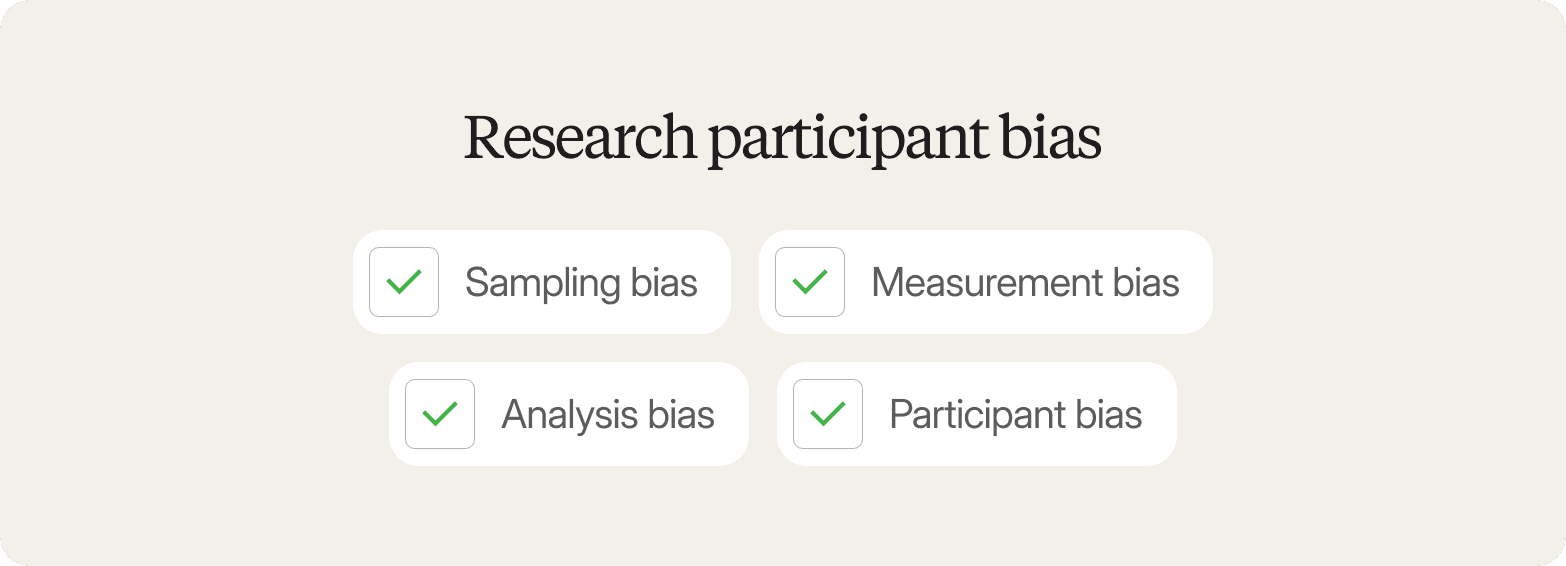
Research participant bias refers to systematic patterns in how participants respond that distort findings away from their actual beliefs, behaviors, or experiences. It's one type of research bias among several:
Sampling bias — a recruitment problem: the wrong people in the room
Measurement bias — a question design problem: the framing leads participants toward a particular answer
Analysis bias — an interpretation problem: the researcher reads the data through a predetermined lens
Participant bias — none of these. It operates during the conversation itself, shaping what people say in real time, and it can undermine the validity of an otherwise well-designed research process
The mechanism is direct. Participants adjust their responses based on perceived social norms, moderator expectations, or group dynamics. They answer the question they think they should answer rather than the one they were asked, which means they are not responding naturally or answering truthfully about their personal beliefs. A participant in a group session will claim they always read privacy policies before accepting terms; behavioral data tells a different story. That gap between stated preference and actual behavior is social desirability bias operating at its most consequential.
A survey with 2,000 participants can absorb some distortion, and patterns emerge despite the noise because a large enough sample size smooths out individual deviations across the larger population. Qualitative research does not have that buffer. When depth and candor from 15 to 20 participants are the evidence base for a strategic decision, a systematic response pattern in the wrong direction does not average out. It shapes the conclusion.
Why Research Participant Bias Distorts Findings
Participant bias does not introduce random noise. It introduces systematic distortion: participants consistently shape their responses toward what they believe the researcher, the brand, or the study design expects. The result is data that reflects the social dynamics of the research situation rather than actual customer behavior, motivation, or intent.
Bias Type | What It Is | Common Trigger |
Social Desirability Bias | Participants present themselves in a positive light rather than describing actual behavior | Identity-linked topics (health, parenting, ethics), video interviews with eye contact |
Demand Characteristics | Participants shift responses to match what they think the study is trying to prove | Visible moderator enthusiasm, questions that telegraph the expected outcome |
Acquiescence Bias (Yea-Saying) | Participants default to "yes" to appear cooperative | Closed-ended survey questions, agree/disagree scales |
Participation Bias (Selection Bias) | Sample skews toward people who chose to participate | Recruiting from a customer list, convenience sampling |
Groupthink and Conformity Bias | Participants align stated views with the group's dominant opinion | Vocal participants dominating early in a focus group |
Social Desirability Bias
Participants present themselves in a positive light, offering a version of themselves they believe the researcher wants to see rather than an accurate account of their actual behavior. Someone asked about recycling habits may describe a consistent, conscientious routine when their real behavior is more selective, answering in a socially desirable way rather than describing what they actually do. The gap widens in group settings, in video-on interviews where eye contact creates a sense of being evaluated, and on any topic tied to identity: health choices, parenting decisions, ethical consumption. Product teams that build on this data invest in features designed for a more diligent user than the one who actually exists.
Conveo's AI-moderated format reduces this pressure by design. Participants respond to a conversational AI moderator rather than a visible human judge, producing responses that more accurately reflect behavior rather than aspiration and helping teams generate more unbiased results.
Demand Characteristics
Demand characteristics occur when participants pick up on cues about what the study is trying to prove and shift their responses to match what they believe the researcher wants to hear. In experimental research, this is the risk of the study design itself becoming an independent variable: the treatment participants receive is no longer just the product or concept being tested; it's also the researcher's visible expectations. The trigger is rarely explicit: a moderator's visible enthusiasm during a product demo, a question framed around what participants "liked" rather than what they noticed, or a study design that sets expectations before the conversation even begins. A participant who watches a researcher light up while walking through a new prototype may praise its usability not because they found it intuitive, but because the social context made criticism feel unwelcome. Brand teams that run concept tests without controlling for this effect often validate messaging that lands in the room but fails in market. Controlling for it requires neutral question framing, consistent moderator behavior, and study designs that do not telegraph the expected outcome, since participant reactivity to a visibly interested researcher is one of the most common ways in which demand characteristics enter the research process.
Acquiescence Bias (Yea-Saying)
Acquiescence bias occurs when participants agree with statements regardless of their actual views, defaulting to "yes" to appear cooperative or sidestep conflict. A participant might agree that they prefer simple interfaces, then agree moments later that they prefer feature-rich ones, because neither question invited genuine pushback. Closed-ended survey questions, agree/disagree scales, and rapid-fire survey research formats are the most common triggers: they reward speed over reflection and make disagreement feel socially costly. Innovation teams chasing strong concept scores are particularly exposed, because the tendency to agree may reflect a participant's reluctance to say no to someone who seems to want a yes rather than a genuine reaction.
Participation Bias (Selection Bias)
Selection bias occurs when the sample skews toward people who chose to participate, systematically excluding those with different characteristics, experiences, or motivations. The most common trigger is convenience: recruiting participants from a customer list oversamples satisfied users and misses detractors who have already churned or disengaged. Recruitment channels that attract only highly engaged users compound the problem, producing findings that reflect the enthusiast segment rather than the broader target population a team actually needs to understand. Certain groups, including dissatisfied customers and non-users, are structurally underrepresented in convenience samples of this kind.
Groupthink and Conformity Bias
Groupthink and conformity bias occur when participants adjust their stated views to align with the dominant opinion within a group. A participant who enters a focus group skeptical of a new concept may reverse that position entirely after three others praise it, not because their genuine reaction changed, but because social pressure did. This pattern is most likely in group formats where vocal participants dominate early exchanges, and moderators do not actively solicit dissenting views before consensus forms.
Other Biases to Watch For
A few other biases are worth knowing even though they aren't the focus of this piece. Halo effect bias is the tendency to let one positive impression- a likable moderator, a polished prototype, color judgments of unrelated attributes; it's a form of top-down processing, where a general impression shapes the interpretation of specific details rather than the other way around. Recognizing these patterns alongside the core types above rounds out a working sense of the general concept of bias in social science research.
5 Research Participant Bias Examples
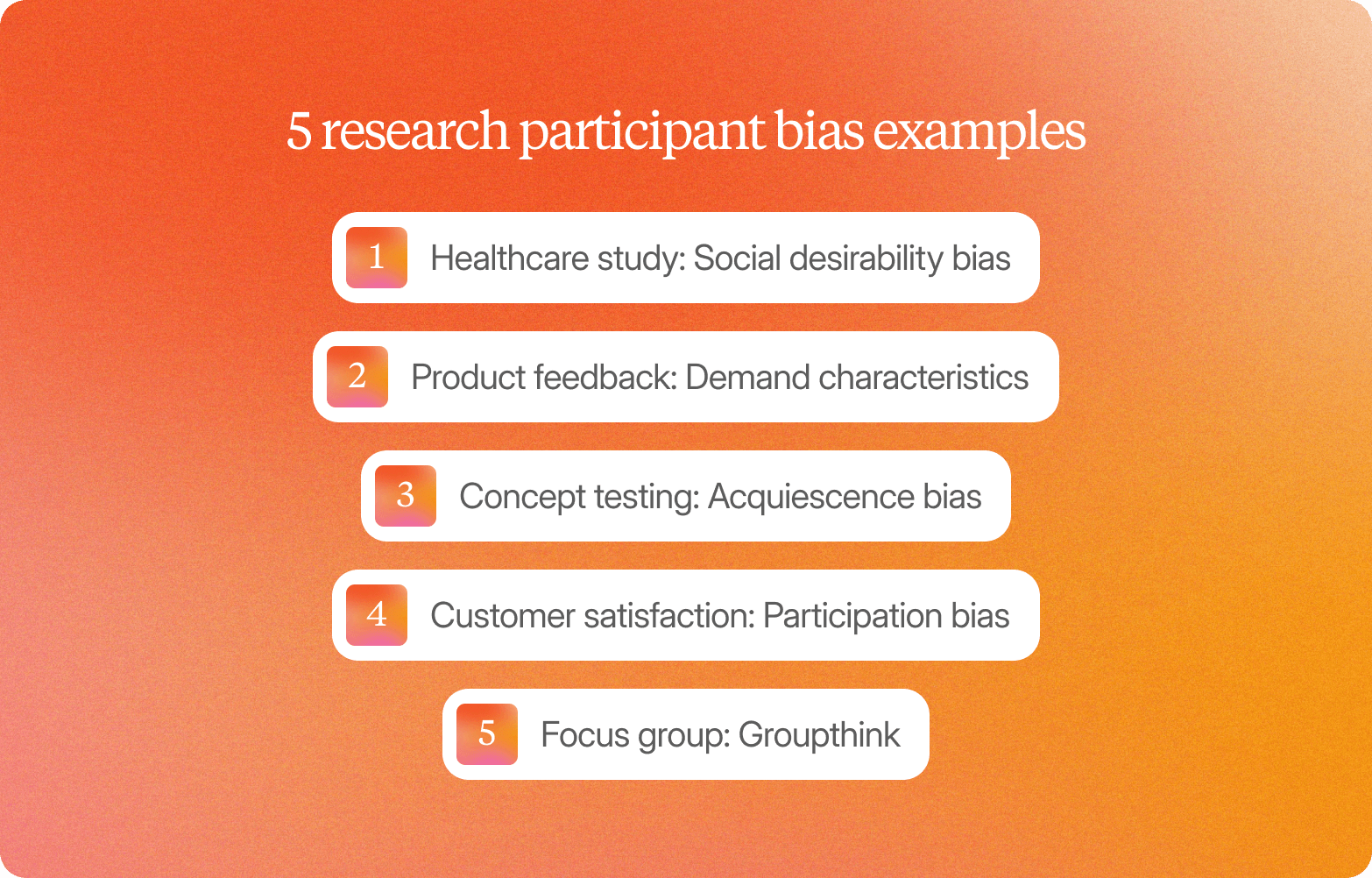
The scenarios below are representative examples, not specific results from Conveo clients. Each involves a different bias mechanism, but they all produce the same outcome: findings that feel credible until reality contradicts them.
Healthcare Study: Social Desirability Bias
A hospital research team wanted to understand how consistently patients follow post-surgery care instructions. In moderated group interviews, patients reported following protocols "always" or "almost always," and care teams designed discharge programs that assumed high compliance. Readmission data told a different story: actual adherence was roughly 40% lower than reported. Patients answered in ways that felt socially acceptable in a clinical setting, with a healthcare professional in the room, a dynamic well documented in clinical trials and qualitative interviews.
Product Feedback: Demand Characteristics
A product team ran usability sessions on a new onboarding flow. The product manager sat in on every session, visibly invested in the outcome, and participants noticed. Feedback skewed positive throughout, and the team shipped the flow with confidence. Within two weeks, analytics showed a 60% drop-off at step three. Participant performance in the session did not align with real-world usage: participants had read the room and tailored their responses to what the session seemed to be looking for.
Concept Testing: Acquiescence Bias
A brand team tested three messaging angles by asking participants, "Do you like this?" for each. Most participants said yes to all three. Without a forced-choice mechanism, there was no signal to prioritize. The team incorporated elements from all three angles into the campaign, diluting the message and producing creative that stood for nothing in particular.
Customer Satisfaction: Participation Bias
An insights team ran a survey-based satisfaction study to understand why customers were churning. Response rates were strong, and findings were positive. What the team did not account for was participation bias: the customers who responded were the ones engaged enough to open the survey. Detractors had already disengaged. The team reported high satisfaction while churn continued to climb, an outcome shaped by who chose to respond rather than by the underlying research methods.
Focus Group: Groupthink
A product team used a focus group to prioritize their next feature release. One vocal participant championed Feature A early in the session. Others adjusted their stated preferences to align with the emerging consensus, even though several had arrived preferring Feature B. Feature A was built, and adoption was low. The silent majority had never wanted it.
How to Reduce Research Participant Bias
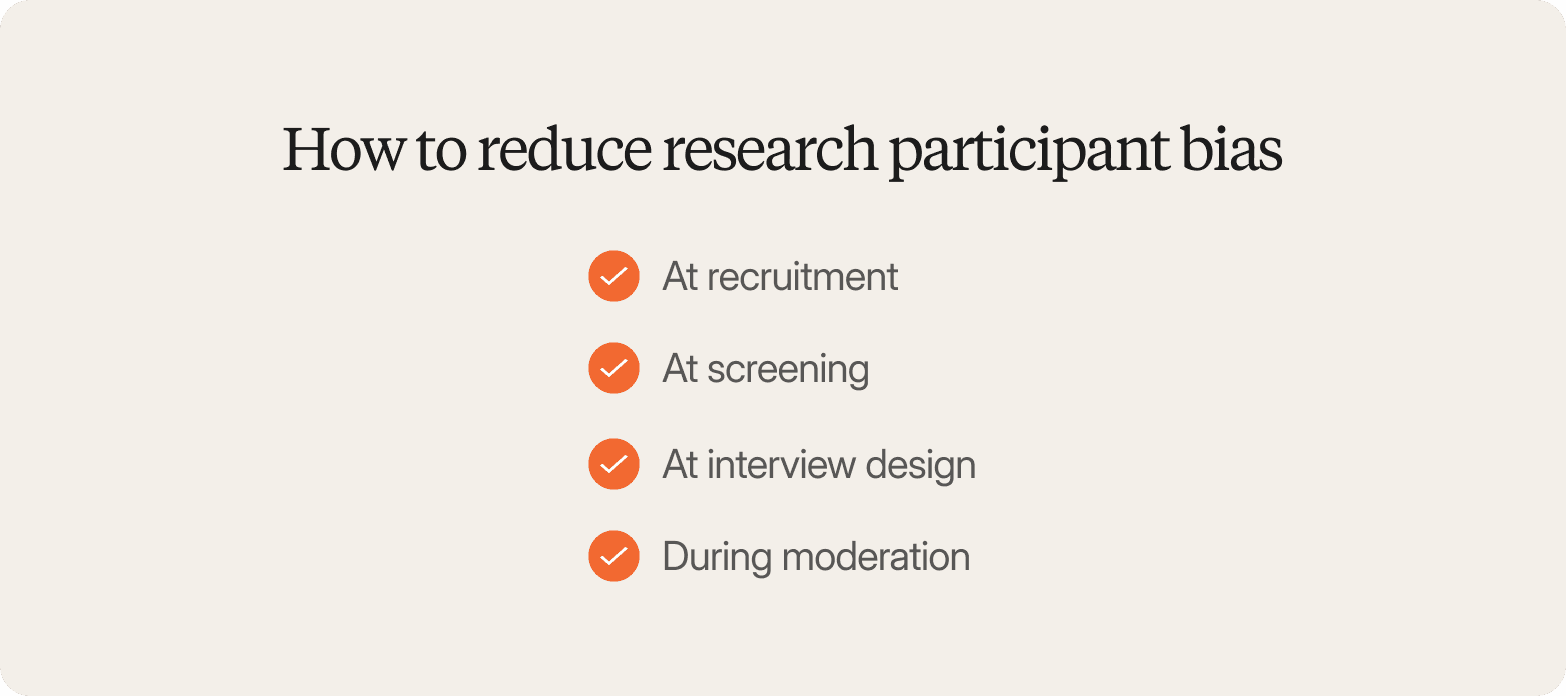
Reducing participant bias means deliberate choices at recruitment, screening, design, moderation, and analysis, each closing a door that bias would otherwise walk through. No single fix eliminates it; minimizing participant bias comes from stacking small, deliberate controls across the entire research process.
At Recruitment
Participation bias starts before the first question is asked. The participants who show up shape the findings as much as the discussion guide does, making participant selection the highest-leverage stage for controlling sample quality.
Use behavioral screeners, not demographic-only filters. Ask whether participants have used a product or service in the last 30 days, then add one or two knowledge checks that only genuine users can answer correctly. Demographics tell you who someone is; behavior tells you whether they belong in your study. Conveo's behavioral screener applies this logic at intake so unqualified participants are filtered before they reach the interview.
Diversify recruitment channels deliberately. Customer lists over-sample satisfied users by design. Mixing panel providers, social recruiting, and intercept methods captures detractors and non-users who would otherwise never appear in findings. Recruiting participants through Conveo's integrated panel network or your own list means a study is never confined to the enthusiast segment, and certain groups that convenience samples typically miss get a seat at the table.
Track repeat participation across studies. Flag any participant who appears in more than one study within a 90-day window. Experienced panel participants often learn to give responses that keep them eligible for future studies, which erodes candor over time. Platforms that maintain cross-study participation records make this check automatic rather than manual.
Prevent duplicates with technical controls, not trust. Email deduplication, IP and device flagging, and unique participant links work together to catch the cross-channel duplicates that slip through when panel and social recruiting run simultaneously.
At Screening
Validate self-reported behavior with follow-up questions rather than accepting claims at face value. If a participant says they use a product daily, ask them to walk through their most recent session in detail. Vague or inconsistent answers are a reliable signal that the claimed behavior is fabricated rather than the participant answering truthfully.
Replace leading screener questions with open-ended prompts. "Are you frustrated with your current platform?" tells participants what answer you want. "Describe your experience with your current platform" surfaces their actual frame without cueing a response direction, giving them room to respond naturally.
Set clear incentive expectations before participants enter the screener. Monetary incentives can meaningfully boost response rates but also attract people who optimize for qualification rather than for honest answers. A poorly screened participant wastes real budget, not just time. Pair incentive clarity with behavioral validation questions, attention checks, and screener logic that makes it harder to game the qualifying criteria.
At Interview Design
Bias enters a study before the first participant opens a link. The research questions you write, the order you place them in, and the response formats you choose all shape what people feel permitted to say.
Replace leading questions with open-ended prompts. "Did you find the onboarding confusing?" signals the answer you expect. "Walk me through your first experience with the product" gives participants room to surface what actually happened, including things you did not anticipate.
Remove agree/disagree scales from qualitative discussion guides. They create acquiescence bias by making agreement the path of least resistance. Use forced-choice or ranking formats instead of standard survey questions, which require participants to make genuine distinctions.
Sequence sensitive topics deliberately. Participants are far less candid about frustrations, objections, or socially undesirable behaviors when those questions appear early. Build rapport first through lower-stakes topics, then move toward the areas where honest answers are hardest to give.
During Moderation
Probe beneath polished answers by following vague or hesitant responses with neutral follow-ups: "Can you say more about that?" or "What made you feel that way?" These prompts surface underlying motivations rather than giving participants space to settle on a socially acceptable answer. Conveo's AI moderator applies this probing consistently across every session, so follow-up depth does not depend on moderator fatigue or scheduling, and it helps control for participant reactivity when someone becomes self-conscious about being observed.
Match the format to the question. For sensitive or identity-linked topics, private one-on-one interviews remove the conformity pressure that group formats can introduce; when participants are not performing for peers, candid responses become more likely. Focus groups remain the right choice when the goal is to observe interaction and debate.
Use video-based participation to add a layer of authenticity that text-only formats cannot provide. Tone shifts, facial expressions, and unguarded moments are harder to fabricate than typed responses, and a moderator who can see a participant's reaction is better positioned to detect rehearsed answers and probe further before the moment passes.
During Analysis
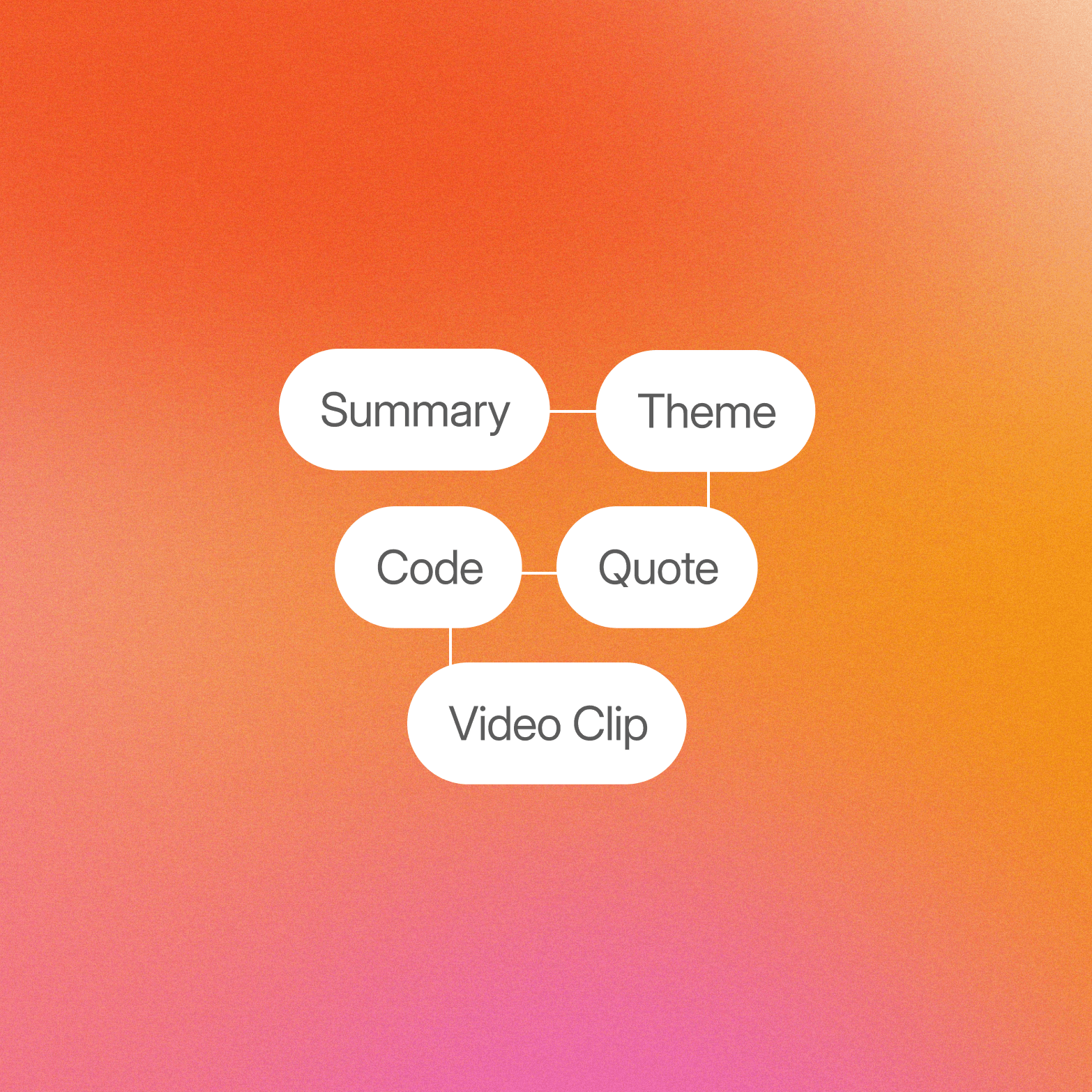
Link every theme to a specific video clip and verbatim quote. This forces a clear distinction between what participants actually said and what a researcher inferred, and it lets stakeholders follow the evidence trail themselves rather than accepting a summary at face value, which supports the overall validity of the findings.
Flag inconsistencies between stated preferences and observed behavior. When a participant praises a feature during discussion but never reaches for it during a task, that gap is data. Note it explicitly rather than letting the more confident verbal response dominate the record.
Triangulate findings across multiple data sources. Cross-referencing interview responses with behavioral analytics, support tickets, or usage logs surfaces where participant candor may have been incomplete. Patterns that hold across sources carry more weight than those resting on self-report alone, and they bring you closer to unbiased results than any single method could.
How Video-Based AI Interviews Reduce Research Participant Bias
Addressing participant bias at scale requires a different architecture for how conversations happen, who moderates them, and what evidence gets preserved. Conveo, a video-first AI research platform, is built around that structural logic through three mechanisms baked directly into the research process:
Private one-on-one video interviews reduce social pressure. Co-present research formats create implicit audience effects: participants moderate their own responses based on what others in the room appear to think. Conveo's asynchronous video interviews remove that dynamic. Each participant speaks privately, on their own schedule, without peer visibility, which teams report produces more candid objections and less consensus-driven agreement.
Adaptive AI probing surfaces underlying motivations. When a participant gives a vague or hesitant answer, Conveo's AI moderator follows up with neutral probes rather than advancing to the next scripted question. That follow-up pressure, applied consistently across every session, reduces acquiescence bias and demand characteristics: participants are less likely to guess what the researcher wants to hear when the follow-up is genuinely open, and more likely to share personal beliefs they might otherwise keep to themselves.
Video participation adds authenticity signals text cannot. Tone, expression, and spontaneous reaction are harder to fabricate than typed responses, so researchers can detect socially desirable answers and identify professional participants in ways text-only survey research formats make structurally impossible.
"Conveo's video-first approach is a real differentiating methodological advantage"
— Senior Marketing Research & Insights Manager, Google
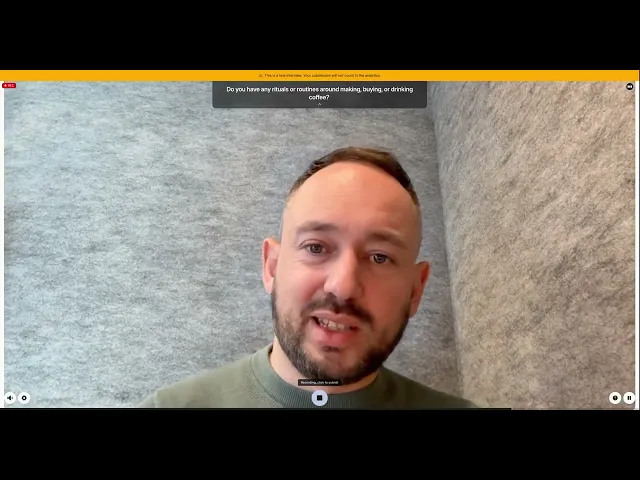
Watch the walkthrough: How Conveo's AI Moderation Actually Works →
Teams are not forced into convenience samples by scheduling pressure, and broader, more representative samples of the target population become practical without extending timelines.
Traceability closes the credibility gap with stakeholders. Every theme links back to specific video clips and verbatim quotes, so stakeholders can audit whether conclusions reflect real participant responses or researcher interpretation. Those clips and quotes also accumulate in a searchable insight library, so evidence from one study compounds into the next rather than being rediscovered each time.
Conveo uses real human participants throughout, with no synthetic or avatar-based responses, and SOC 2 certification, GDPR compliance, and EU regional data hosting address the concerns that enterprise procurement teams raise regarding methodology and validity.
Frequently Asked Questions
What Is Research Participant Bias?
How Does Participant Bias Affect Research Findings?
What Are Examples of Research Participant Bias?
How Do You Reduce Participant Bias in Qualitative Research?
What Is the Difference Between Participant Bias and Sampling Bias?
Is Response Bias the Same as Participant Bias?