In this article
TL;DR
Most teams choose user research methods based on what fits the calendar, not what fits the question. That leads to shallow evidence and rework.
Filter method options by three constraints in order: timeline, team capacity, and evidence requirements, then align the choice with your research goals and target audience.
Asynchronous AI-moderated interviews remove the scheduling bottleneck that pushes teams toward a survey tool by default.
Qualitative and quantitative methods answer different questions. Surveys confirm where problems occur; user interviews explain why.
Every research output must be traceable to source evidence: video clips, verbatim quotes, and timestamps. Without that traceability, stakeholders will treat findings as opinion.
Governance requirements (SOC 2, GDPR, data residency) are procurement prerequisites, not afterthoughts. Verify before selecting a platform or research toolkit.
UX research techniques fall into two categories: traditional methods that take four to six weeks per study, and asynchronous AI-moderated methods that compress the same depth into days. Most UX research techniques were designed for a world where research ran on its own timeline. A generative study takes four to six weeks from brief to debrief. A survey of 300+ UX researchers found the median project duration is 42 days. Usability testing required recruiting windows, moderation schedules, and synthesis sessions that rarely fit inside a two-week sprint cycle. The techniques were sound; conducting research at that pace inside a modern product development process was the problem.
What happens in practice is a predictable workaround: teams reach for whichever method fits the calendar, not the question. A survey goes out because it can be launched today and closed by Friday. A usability session gets scheduled because three participants were available this week. The research question that actually needed answering, whether it was about motivation, trade-off behavior, or an unmet user need, gets quietly set aside.
The method drives the inquiry rather than the other way around. The consequences compound. Surveys confirm that users dropped off at a specific step but cannot explain why. Usability testing reveals that participants failed a task but leaves the underlying motivation invisible. Teams ship a fix based on partial evidence, then discover three sprints later that they addressed the symptom rather than the cause. Research findings that don't hold up under scrutiny cost more than wasted development time on a product or service; they cost trust in the process itself.
This article is a practical method selector for UX researchers and product researchers who want to close that gap. It compares different research methods and research methodologies against the constraints that actually govern which one is viable: timeline, team capacity, the level of stakeholder risk attached to the decision, and the type of evidence the question demands. The goal is to shift how the user research process gets built, from "what can we run given our schedule?" to "what does this question actually require, and how do we get there?"
How to choose the right UX research technique for your question
Most UX research teams face the same starting problem: any given question has six to eight viable methods attached to it, all defensible on paper:
Depth interviews
Contextual inquiry
Diary studies
Concept testing
Usability sessions
Surveys
Card sorting
Tree testing
Without a clear selection framework tied to real research goals, teams either default to habit or default to surveys because surveys are fast. Neither is a research strategy.
The right approach is to filter UX research techniques in order of constraint severity, starting with the constraint that eliminates the most options first:
Timeline. Traditional qualitative methods carry a structural overhead: recruit, screen, schedule, moderate, transcribe, synthesize. That sequence commonly takes six weeks or more when it runs through an agency or an overloaded coordinator. For a product team working in two-week sprints, six weeks is three product decisions ago. The result is predictable: teams reach for surveys not because surveys answer the question, but because surveys fit the calendar. The method gets chosen by deadline, not by question type.
Team capacity. A team of one to three researchers can only moderate so many live sessions before scheduling friction becomes the binding constraint. In practice, most teams find the ceiling sits around 10 to 15 sessions per study when live moderation is required. That is often enough for usability work, but it creates a hard limit on generative research where broader sample coverage of the target audience matters. When moderator availability caps the method, depth suffers, not because the researcher lacks skill, but because the process does not scale beyond their calendar.
Evidence requirements. This constraint is underweighted in most selection frameworks, but it shapes what happens after the research is complete. Stakeholders who were not in the room will challenge findings they cannot verify. When a roadmap debate comes down to "customers want this" versus "I'm not sure they do," the team that can pull a video clip, a direct quote, and a traceable source wins the room. Research that produces only a synthesis deck, without the underlying participant evidence, hands skeptics an easy objection. The method needs to produce not just findings, but findings that hold up under scrutiny.
The selection logic that follows from these three filters is: start with your research question, match it to the method type that can actually answer it, then run each candidate method through the timeline, capacity, and evidence constraints in that order. What remains after that filtering is your real shortlist for how to conduct user research that actually fits the question and the target users you're trying to reach.
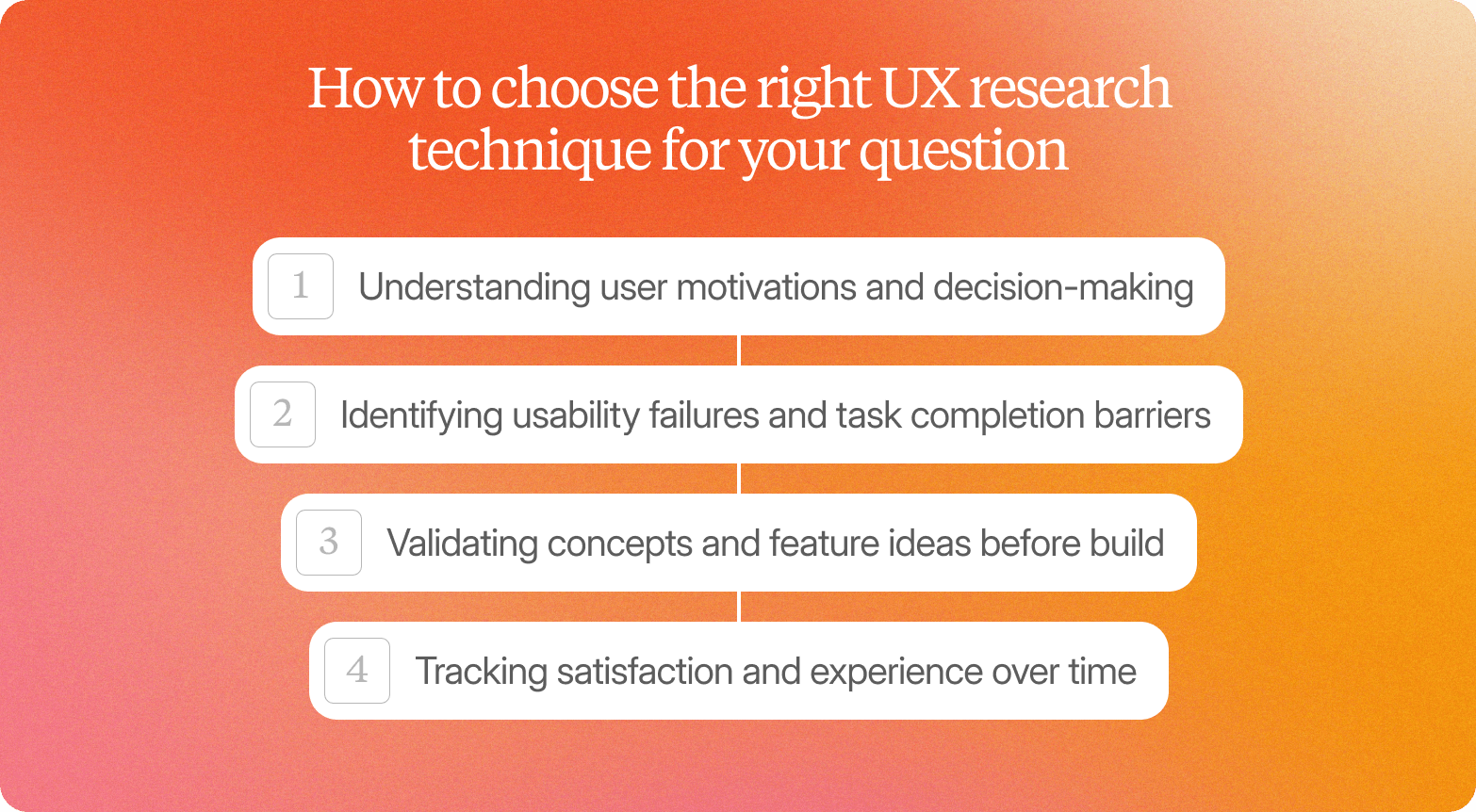
Understanding user motivations and decision-making
Motivation and decision-making questions sit at the heart of most product discovery work. When you need to understand why a user chose one path over another, or what trade-offs they weighed before acting, surveys give you a ranked list of factors. They rarely give you the reasoning behind the ranking.
Traditional UX research techniques for this question type are in-depth interviews and contextual inquiry, a form of ethnographic research that studies people in their natural environment rather than in a lab setting. Both are well-suited to surfacing the hesitation, the workaround, and the "I didn't even know that feature existed" moment that explains behavior far better than clickstream data. The tradeoff is logistical: live sessions require calendar coordination across time zones, and moderator capacity typically limits a study to 10 to 15 participants. At that sample size, you can build hypotheses. You cannot validate them with confidence.
Asynchronous AI-moderated interviews change the constraint. Participants join on their own schedule, the AI probes based on what they actually say rather than following a rigid script, and hundreds of sessions can run in parallel. Conveo, a video-first AI research platform, uses AI moderation that senses hesitation and follows up in the moment, capturing the kind of qualified, conditional reasoning ("I use it, but only when...") that live interviews surface at their best, without the scheduling overhead that makes running 15 sessions feel like a project in itself. These sessions also help teams generate ideas for future iterations, since motivation-level insight often surfaces adjacent needs nobody had asked about.
Identifying usability failures and task completion barriers
Question type
Where do users fail tasks, and what drives abandonment?
Traditional techniques
Moderated usability testing delivers rich behavioral observation, a form of evaluative research, but takes four to six weeks from recruitment to debrief. Unmoderated testing shortens that timeline, but analysis still lands after most sprint decisions are already made.
Tradeoff
User testing reliably surfaces where usability issues occur. It rarely explains why. A participant who abandons a checkout flow mid-task leaves behind a behavioral signal, not a motivation. The reasoning behind workarounds, the mental models driving wrong turns, the trade-offs users weigh silently: those require probing that screen recordings cannot provide.
Asynchronous alternative
Combining unmoderated task observation with AI-moderated follow-up interviews turns usability testing into a form of qualitative usability testing that captures both layers in a single study. Conveo's AI moderator watches where test participants hesitate or drop off, then probes in the moment: "You paused there, what were you expecting to happen?" That combination means one round of interviews can feed multiple UX artifacts simultaneously, helping teams identify patterns across personas, jobs-to-be-done maps, and mental models without commissioning separate studies for each framework.
Validating concepts and feature ideas before build
Concept validation sits at one of the highest-stakes moments in a product cycle: committing engineering time to something users may not understand, want, or need. The core questions here are whether a concept solves a real problem for a product or service and whether the target audience can grasp what it does without explanation.
Traditional approaches lean on moderated concept testing interviews or focus groups. Interviews take six to eight weeks from recruitment to synthesis. Discovery projects average a 60-day median. Focus groups can move faster, though group dynamics may influence individual reactions, which is a methodological consideration when evaluating unfiltered individual feedback. The feedback you capture can reflect social dynamics as much as genuine response.
The more practical constraint is timing. By the time a six-week concept test completes, the sprint has moved on. Engineers are already building the next iteration based on assumptions, not evidence.
Asynchronous AI-moderated concept testing changes the sequence. Participants receive the concept on their own schedule, respond in their own words, and the AI probes confusion points in real time without a moderator present. Video captures the moment a user furrows at a label or pauses on a feature description. Those reactions show precisely how target users perceive a new idea, visible and traceable, not summarized after the fact.
For teams researching across markets, Conveo's AI moderation across 20+ languages removes the localization delays that typically add weeks when running concept studies in Germany, Japan, or Brazil simultaneously. Validated feedback arrives in days, before the build decision is final.
"We ran a concept test for a new product line, in one night, we had 200 interviews analyzed"
CMI Lead, Edgard & Cooper
Tracking satisfaction and experience over time
The best techniques for tracking satisfaction over time are diary studies and longitudinal interview series, both run continuously rather than as one-off studies. Satisfaction and experience don't degrade in a single moment; they erode through small friction points that accumulate across sessions, updates, and use cases. Tracking that drift requires research that runs alongside the product, not a study commissioned after something visibly breaks.
Traditional approaches here include longitudinal interview series and diary studies. Longitudinal interviews can run weeks, months, or longer, with scheduled sessions at fixed intervals. Diary studies ask participants to self-report over two to four weeks or longer, depending on complexity. Both methods produce rich, time-stamped data on how sentiment shifts, blending self-reported data from diaries with the more observational rigor of behavioral research from interviews.
The practical consequence: attrition rises, the sample shrinks, and the findings reflect whoever stayed engaged rather than a representative cross-section of your user base.
Recurring AI-moderated check-ins address this directly. Participants receive a link on their own schedule, complete a short asynchronous session, and drop off without calendar coordination. Conveo's insight library then indexes each check-in by interview, theme, and clip, so sentiment trends are visible across waves without manual synthesis. When a new friction point surfaces in week six, the library shows whether it appeared in earlier sessions or is genuinely new. Learnings compound rather than disappear into decks.
Qualitative vs. quantitative UX research techniques
The choice between qualitative and quantitative research is often framed as a tradeoff between depth and speed. That framing is wrong, and it leads teams to answer the wrong question with the wrong method.
| Qualitative techniques | Quantitative UX research methods | |
|---|---|---|
| Answers | The "why" | The "what" and "how many" |
| Examples | Moderated interviews, contextual inquiry, diary studies, open-ended conversations | A survey tool, behavioral analytics, funnel analysis, A/B tests |
| Reveals | How people think, what motivates their decisions, how users interact with a product's user experience day to day | What users do, how often, and at what rate |
| Output | Interpretive: themes, mental models, unmet needs, and the reasoning behind behavior, built from qualitative data rather than counts | Numerical: quantitative data like adoption rates, task completion percentages, drop-off points, and usage analytics |
These approaches answer different questions. They are not competing options.
"Conveo gives us quant-level robustness and qual-style depth"
CMI Lead, Edgard & Cooper
The integration point matters most in practice. Analytics might show that one-third of users abandon the payment flow at step three. That's a precise, reliable measurement. It tells you exactly where the problem is. It does not tell you why users stop, whether they're confused by the pricing, uncertain about security, distracted by an unclear label, or simply not ready to commit. Qualitative follow-up interviews answer that. The fastest way to collect data that explains the mechanism is to pair the survey tool with a short round of qualitative interviews. Without them, the product team is left optimizing the wrong element.
The common mistake is defaulting to surveys when the research question is fundamentally about motivation, especially when raw customer feedback and user feedback point toward frustration that analytics alone can't diagnose. Surveys can confirm that a problem exists. They rarely explain the mechanism behind it.
Qualitative UX research techniques are required when the question involves decision-making, unmet needs, or unexpected behavior that metrics can't explain. Quantitative methods are appropriate when validating hypotheses at scale, tracking adoption over time, or measuring the impact of a specific change. The data analysis that follows differs too: thematic coding for qualitative research, statistical testing for quantitative.
The operational reality is that qualitative research has traditionally required six or more weeks to recruit, moderate, transcribe, and synthesize. Teams reach for surveys even when they know a survey won't answer the question. That constraint, not methodological preference, is what drives the false binary.
Running UX research techniques asynchronously
Most qualitative techniques assume a live moderator. That assumption is also a hard ceiling. A team of two researchers can typically run eight to ten moderated sessions per study before scheduling, preparation, and debrief time overwhelm everything else on their plate. The calendar becomes the constraint, not the research question.
Asynchronous AI-moderated interviews remove that ceiling. Participants receive a link, join on their own schedule, and complete sessions across time zones without any coordination overhead. Instead of blocking a week to field ten interviews, a team can run 80 or 100 sessions in the same window, each one conducted by an AI moderator that follows up based on what the participant actually says rather than advancing a rigid script. When a participant hesitates on a pricing screen or contradicts something they said two minutes earlier, the AI probes. That adaptive behavior is what separates a real interview from a survey with a voice interface. This also makes remote testing across time zones straightforward, since no one needs to be online at the same time.
The credibility question is fair: does asynchronous execution preserve the depth that UX research best practices require? The answer depends on the moderation quality. Conveo's AI moderator is designed to sense hesitation, mirror participant language, and ask follow-up questions grounded in the specific response just given. Every session is recorded in video, transcribed, translated, and coded automatically as it lands, so research data stays consistent from the first session to the hundredth. Thematic clusters, sentiment arcs, and highlight reels are generated from the full session record, not a summary. Researchers retain access to the original video at every point, so any AI-generated finding can be traced back to the moment it came from.
See it in action: How AI-Moderated Interviews Actually Work
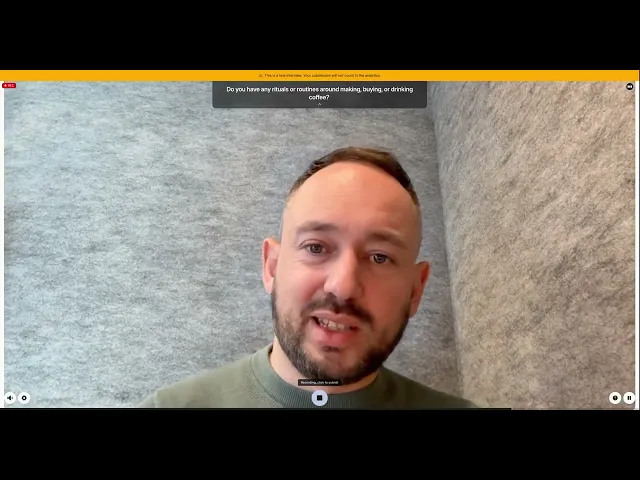
For enterprise teams choosing among ux research tools, governance is not optional. SOC 2 certified, GDPR-compliant, and EU regional data hosting are procurement requirements that determine whether a platform can be deployed at all. These credentials matter before a study brief is written, not after. Adding Conveo to an existing research toolkit doesn't mean replacing live interviews entirely; it means having an asynchronous option when the timeline won't allow for one.
The practical shift this enables is straightforward: teams can conduct ux research continuously rather than treating each study as a special project requiring approval and scheduling. Concept validation, continuous discovery, diary-style follow-up studies, multi-market interviews across languages: all of these become decisions about fit, not logistics.
Stakeholder-ready outputs for each UX research technique
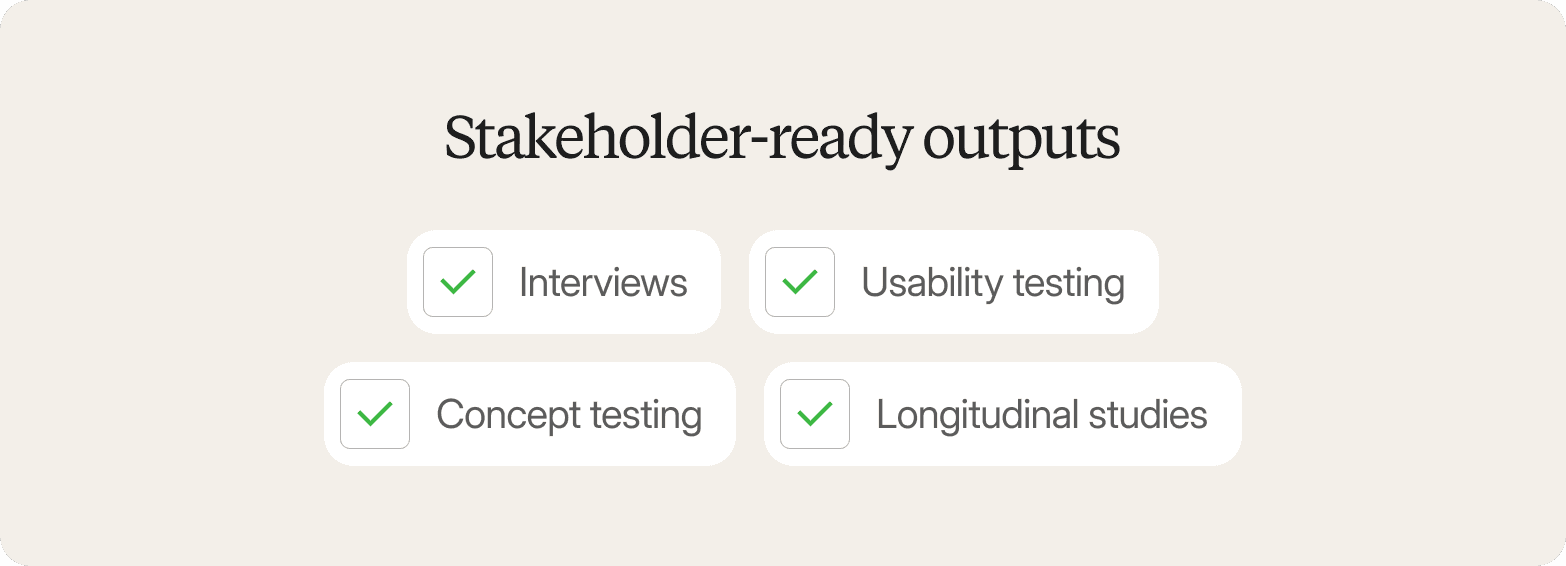
Roadmap debates stall when findings can't be traced back to real conversations. A product manager who wasn't in the room has no reason to accept a synthesized theme at face value. Without a clip, a quote, or a timestamped recording to inspect, every research output becomes an opinion that competes with other opinions. Research findings only carry weight in those debates when every claim links directly to evidence stakeholders can verify themselves.
Conveo builds that traceability into every output by technique:
Interviews: Thematic findings surface alongside the verbatim quotes and timestamped video clips that generated them. Highlight reels let product and design teams watch the moments that shaped each theme, without sitting through hours of recordings. A decision memo summarizes key findings in a format that travels to leadership without losing its source connection.
Usability testing: Task success and failure summaries include video evidence of exactly where participants struggled. Stakeholders can watch a user hit a dead end or invent a workaround, rather than reading a researcher's interpretation of what happened. That distinction matters when engineering resources are on the line.
Concept testing: Reaction clips capture the moment a participant's expression shifts at a price point or a headline falls flat. Verbatim feedback on messaging clarity, combining both verbal and written feedback from the session, is tagged and searchable. The decision-ready summary of concept strengths and weaknesses arrives with evidence attached, not assertions.
Longitudinal studies: Sentiment tracking over time is supported by video evidence of changing attitudes across sessions. Thematic analysis of emerging friction points shows not just that attitudes shifted, but when and why, in participants' own words.
The compounding value extends beyond any single study. Every user insight, clip, and theme flows into a searchable library that persists across projects. Teams report that this prevents findings from dying in decks: a researcher working on a new onboarding flow can surface relevant user language from a study run six months earlier in seconds. Over time, the library connects user insights across the organization, so research doesn't reset with every sprint. It accumulates.
Quality and governance checklist for UX research techniques
As of 2026, governance requirements have quietly become one of the biggest barriers to running qualitative research continuously at any product development stage. IT and legal teams now routinely block vendor approvals when a platform cannot produce a SOC 2 report or demonstrate GDPR-compliant data handling. The result: many UX teams default to surveys not because surveys answer their questions better, but because surveys carry less compliance overhead than video-based qualitative research. That's a method decision being made for the wrong reason.
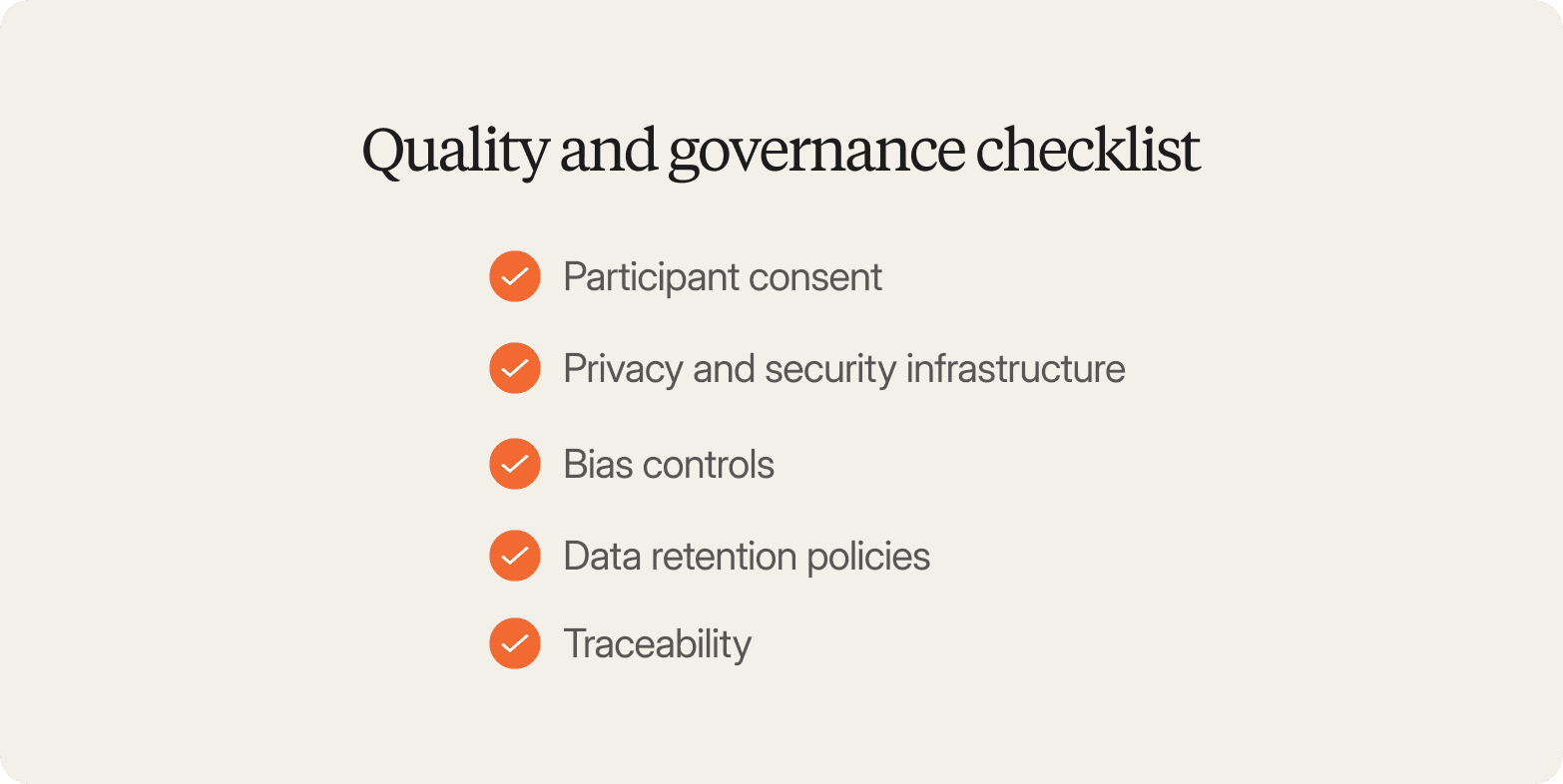
Before selecting any UX research technique or platform, verify these five requirements:
Participant consent. Participants must explicitly consent to video recording and data usage before a session begins. Consent must be documented, granular, and separate from any NDA or screener form. Bundling consent with other agreements is a common compliance gap that legal teams will flag.
Privacy and security infrastructure. SOC 2 certified, GDPR-compliant, and EU regional data hosting are baseline requirements for enterprise procurement, not optional extras. Teams in regulated industries or with European participants should confirm these credentials are independently audited, not self-reported. Conveo is SOC 2 certified with GDPR compliance and EU regional data hosting as standard, which removes the procurement barrier that stalls rollout for many AI-first research platforms.
Bias controls. AI moderation must avoid leading questions and adapt probing based on what participants actually say, not on assumed response patterns. Uncontrolled probing introduces systematic bias that undermines the validity of findings.
Data retention policies. Define upfront how long video recordings and transcripts are stored, who has access, and how deletion is handled. Vague retention terms are a procurement red flag and a real liability if participant data is retained beyond its stated purpose.
Traceability. Every finding must link back to source evidence: verbatim quotes, video clips, and timestamps. Stakeholders who cannot inspect the evidence behind a conclusion will not act on it. Traceability is also a methodological requirement, not a trust signal alone.
When these requirements are built into the platform rather than bolted on afterward, the compliance overhead disappears. Teams stop avoiding qualitative UX research techniques because of governance friction and start running video interviews as the default, the same way they already treat surveys.
Choosing surveys when the question requires depth
Surveys are built to measure, not to explain. When retention drops after onboarding or task completion falls below target, a survey can confirm the scale of the problem. It cannot tell you why users are abandoning the flow, what confused them, or what they tried before giving up. Teams that stop at survey data make product decisions on pattern recognition alone, filling the gap between "what happened" and "why it happened" with internal assumptions.
The fix is sequencing, not substitution. Use surveys to identify where behavior breaks down at scale, then follow up with AI-moderated interviews to surface the specific friction behind the numbers. That combination gives product teams something a survey alone never can: a mechanism to fix, not a metric to watch.
Running usability tests without follow-up interviews
Usability tests tell you where usability issues occur. They rarely tell you why. A participant who fails to complete a checkout flow might be confused by the button placement, uncertain about the pricing, or not ready to commit, and task observation alone cannot distinguish between those possibilities.
When teams skip follow-up probing, the fix targets the surface: a label gets rewritten, a button moves. The underlying hesitation stays intact, and the next test surfaces the same friction in a different form.
Pairing task observation with AI-moderated follow-up interviews closes that gap. After a session, Conveo's AI moderator can probe the moments where users hesitated or deviated, asking participants to explain their reasoning in their own words. The result is not just a map of where users fail, but a clear account of the trade-offs they were weighing and the mental models driving their workarounds- the context that turns a UI fix into a product decision.
Building personas without behavioral segmentation
The persona problem isn't a lack of data. It's that the segmentation criteria get decided after the research, in a workshop, by people who weren't in the field. The result: personas built on demographics and workshop-generated psychographics that no participant ever confirmed, more assumption than behavioral research. A "7/10 tech proficiency" bar sounds precise. It isn't, and stakeholders who ask where it came from tend not to ask again.
The fix requires reversing the sequence. Define your behavioral segments, essentially meaningful user groups, before you recruit, not after. A criterion like "daily active users who abandoned onboarding in the first 48 hours" gives you a segment grounded in product reality. Recruiting to that specification means your qualitative conversations are already structured around a meaningful behavioral difference. In practice, five to 15 participants per segment is enough to surface consistent patterns when the segmentation hypothesis is set upfront. Conveo's AI moderator preserves the full behavioral context of each session, so the evidence behind each persona attribute stays traceable, not asserted.
How Conveo fits into your UX research method selection
Choosing the right UX research technique is ultimately a question of matching method to question while working within real constraints across the product development process. Conveo is a research-focused platform built to remove the constraints that force the wrong match at any stage of the ux design process.
Conveo removes the same three constraints, mapped directly to the filters above:
Timeline: Asynchronous AI-moderated interviews run hundreds of sessions in parallel, delivering qualitative depth in days rather than the six-plus weeks traditional studies require.
Team capacity: Conveo's AI moderator handles adaptive probing across every session, so a two-person research team operates at the scale of a ten-person team.
Evidence requirements: Every finding links to timestamped video, verbatim quotes, and searchable clips in a compounding insight library.
Whether you're validating a concept early in the product development cycle or tracking sentiment after launch, the same asynchronous infrastructure supports every product development stage without adding headcount. That consistency matters most when the design and development process moves faster than a live-moderated study can keep up with.
The result: method selection returns to where it belongs. You choose the technique that answers the question, not the one that fits the calendar.
Frequently Asked Questions
What are the most common UX research techniques?
The most widely used UX research techniques, and the most common research methods teams reach for, include in-depth interviews, usability testing, concept testing, diary studies, contextual inquiry, and surveys. Each method serves a different purpose: interviews surface the "why" behind behavior, usability testing catches friction in real workflows, and diary studies capture experience over time. This kind of user experience research relies on picking the format that matches the question, not the one that's fastest to launch. The tradeoff with traditional qualitative methods is timing: a well-run in-depth interview study typically takes six or more weeks from brief to debrief, which means findings land after sprint decisions are already made. Asynchronous AI-moderated interviews change that equation by removing scheduling friction and running sessions in parallel, so teams get qualitative depth in days rather than weeks.
How do I choose the right UX research method?
Start with the research question, not the calendar. The question type tells you which method dimension you need: qualitative interviews for motivation and reasoning, usability testing for behavioral observation, surveys for scale and prevalence. Once the right method is clear, filter by constraints: timeline, team capacity, stakeholder evidence requirements, and the cost of a wrong decision. This is also why ux research is important: skipping this sequence means decisions rest on assumptions instead of evidence. In practice, most teams skip this sequence. Scheduling friction and limited moderator availability push them toward whichever method fits this week's calendar rather than the one that fits the question. Asynchronous AI-moderated interviews remove the scheduling constraint entirely, returning method choice to where it belongs: the research question itself.
What is the difference between qualitative and quantitative UX research?
Qualitative UX research captures the "why" behind user behavior through open-ended conversations, moderated interviews, and contextual observation. Quantitative UX research methods measure the "what" and "how many": survey responses, task completion rates, funnel drop-offs, and A/B test results. Both are necessary, but they answer different questions. Analytics can confirm that users abandon a checkout flow at a specific step, but they cannot tell you what triggered the hesitation. Qualitative follow-up, a short round of video interviews with users who dropped off, surfaces the specific friction causing the problem, giving product teams something concrete to fix rather than a metric to monitor.
How many participants do I need for qualitative UX research?
There is no single correct sample size. Nielsen Norman Group recommends starting with a small representative sample of 5 to 6 participants and analyzing as you go until you reach saturation, the point where new interviews stop generating new insights. For most qualitative UX studies, 5 to 15 participants per behavioral segment is a practical range, depending on population diversity and research scope. With two to five segments, total counts typically fall between 10 and 75, and a single research project rarely needs more than that to reach confident conclusions. The number that trips teams up is not the per-segment target. It is recruiting without segment criteria at all. When screeners are vague, you end up with a mixed sample where signal is hard to separate from noise, and you need far more sessions to reach the same confidence. Define segments first using behavioral signals, then recruit to fill them. Conveo's AI moderator supports this by running sessions across all segments in parallel, so reaching 50 or 100 participants does not require weeks of calendar coordination.
Can AI replace human moderators in UX research?
AI moderation augments human researchers rather than replacing them. It handles the operational layer: adaptive follow-up probing, multilingual interviews across 20+ languages, transcription, translation, and initial research synthesis. These steps typically consume days of manual work before a researcher can begin real analysis. What still requires human judgment is interpretation: ambiguous or contradictory responses, edge cases that don't fit emerging themes, strategic decisions about what questions to ask next quarter, and presenting findings to stakeholders in a way that drives action. AI-assisted research synthesis means qualitative outputs land in days rather than weeks, freeing researchers to focus on the work no AI can replicate.
What is the best UX research technique for remote teams?
The most practical technique for remote teams is asynchronous AI-moderated video interviews and remote testing more broadly. Participants receive a link and join on their own schedule, eliminating the time-zone coordination that forces remote teams toward surveys. With asynchronous moderation, hundreds of sessions run in parallel, so a two-person research team can gather qualitative depth from a large sample in the same window it would previously take to complete 10 live interviews. The result is continuous discovery that scales with research questions, not calendar availability.

About the author
Dieter De Mesmaeker
Co-Founder & CEO
Dieter is CEO and co-founder of Conveo. Before starting the company, he founded DataCamp and scaled it into one of the leading edtech platforms in the world.
More by Dieter →Qualitative insights at the speed of your business.
Conveo runs AI-moderated video interviews and structures everything they say.