In this article
TL;DR
A strong voice of customer example links every theme to a verbatim quote, participant ID, timestamp, and recording.
Strong VOC examples start from one business decision and use a fixed question sequence.
Most voice of customer examples are dashboards and customer satisfaction score trends that show movement but offer no evidence.
Evidence-attached VOC examples survive brand and executive review. Score trends do not.
A stakeholder opens the quarterly deck, sees the customer satisfaction score trending down, and asks the obvious question: what changed? Nobody in the room can point to a customer who said it. Voice of the customer (VOC) is the practice of capturing what customers say, do, and need in their own words, and turning that feedback into decisions before the gap opens.
Most voice of customer examples that teams copy and circulate are dashboards: net promoter score trends, customer sentiment bars, customer engagement charts, and word clouds. They show that something moved and leave out who moved it and why. The examples that hold up in review attach customer language to every finding, so raw feedback becomes evidence.
This guide covers what a good VOC deliverable contains, five example types, how to collect the evidence, and how to keep it comparable over time.
What is voice of the customer? A definition built around evidence
Voice of the customer is the structured collection of customer language, behavior, and context used to inform a specific decision. A VOC finding counts as evidence only when a stakeholder can trace it back to the customer who said it.
VOC data usually arrives from multiple channels, and each one records a different set of customer interactions:
| Channel | What it captures | Where it falls short |
|---|---|---|
| Customer satisfaction surveys | Scores and direct feedback at set moments | Little context on why a score moved |
| Care-line and support contacts | Customer complaints in the customer's own words | Skews toward problems |
| Online reviews and review requests | Public opinion after purchase | Self-selected and impossible to probe |
| User support forums | Peer questions and workarounds | Hard to link to a segment or account |
| Customer interviews | Reconstructed episodes with full context | Only as good as the guide behind them |
Natural language processing can tag customer sentiment across thousands of comments, but a dashboard built on it still shows only a trend. A strong deliverable shows which customers drove the movement and what they said.
Findings without sources get challenged and dismissed in brand and executive reviews, because "customers are frustrated" stays an interpretation until someone can play the clip.
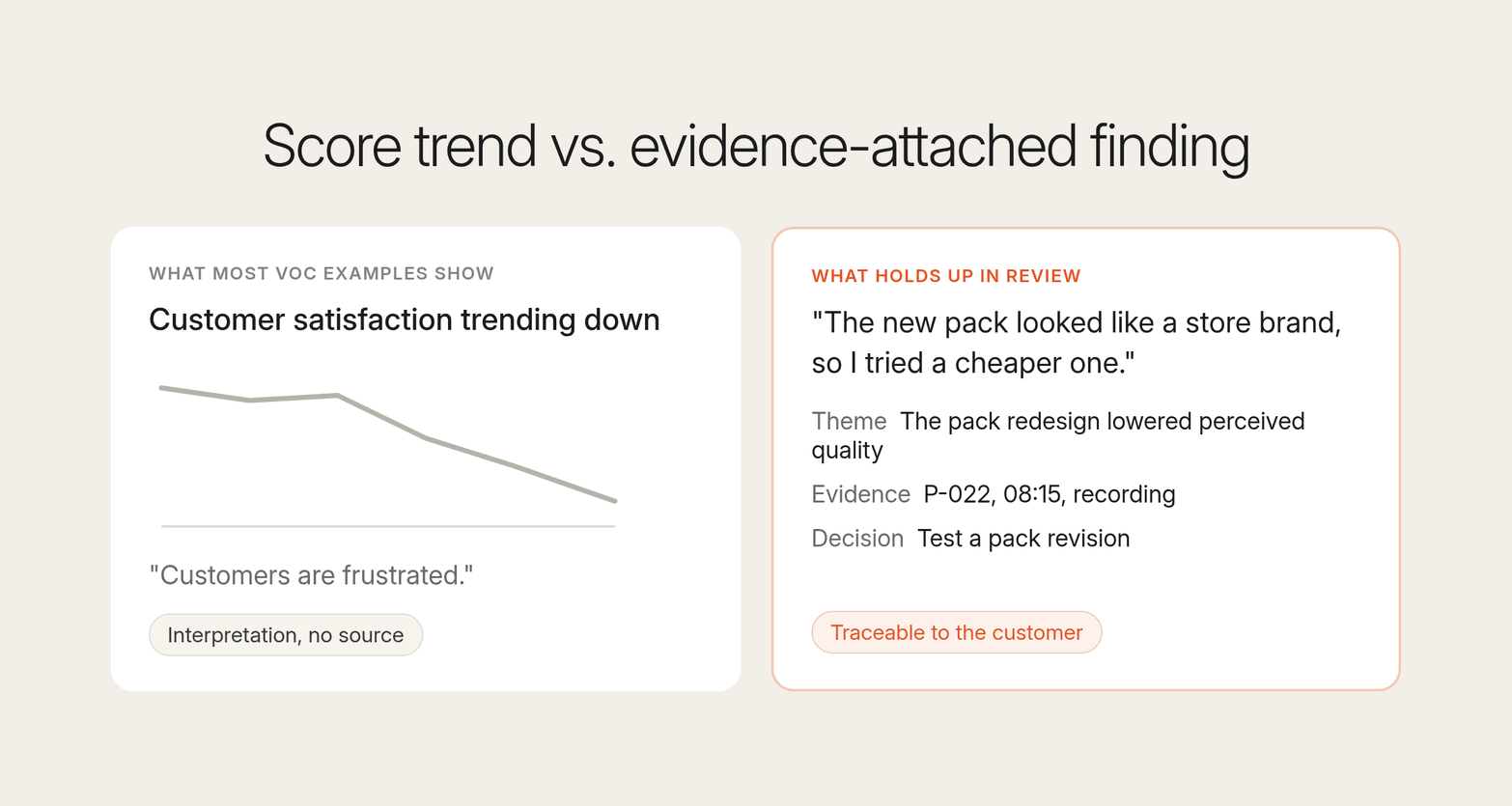
The voice of customers examples worth copying share one trait: they translate customer feedback into customer insights a stakeholder can verify. A VOC example is only as strong as the evidence a stakeholder can draw from it. For more on building an interview guide, see these voice of the customer interview questions.
Voice of customer example: the anatomy of a deliverable that holds up
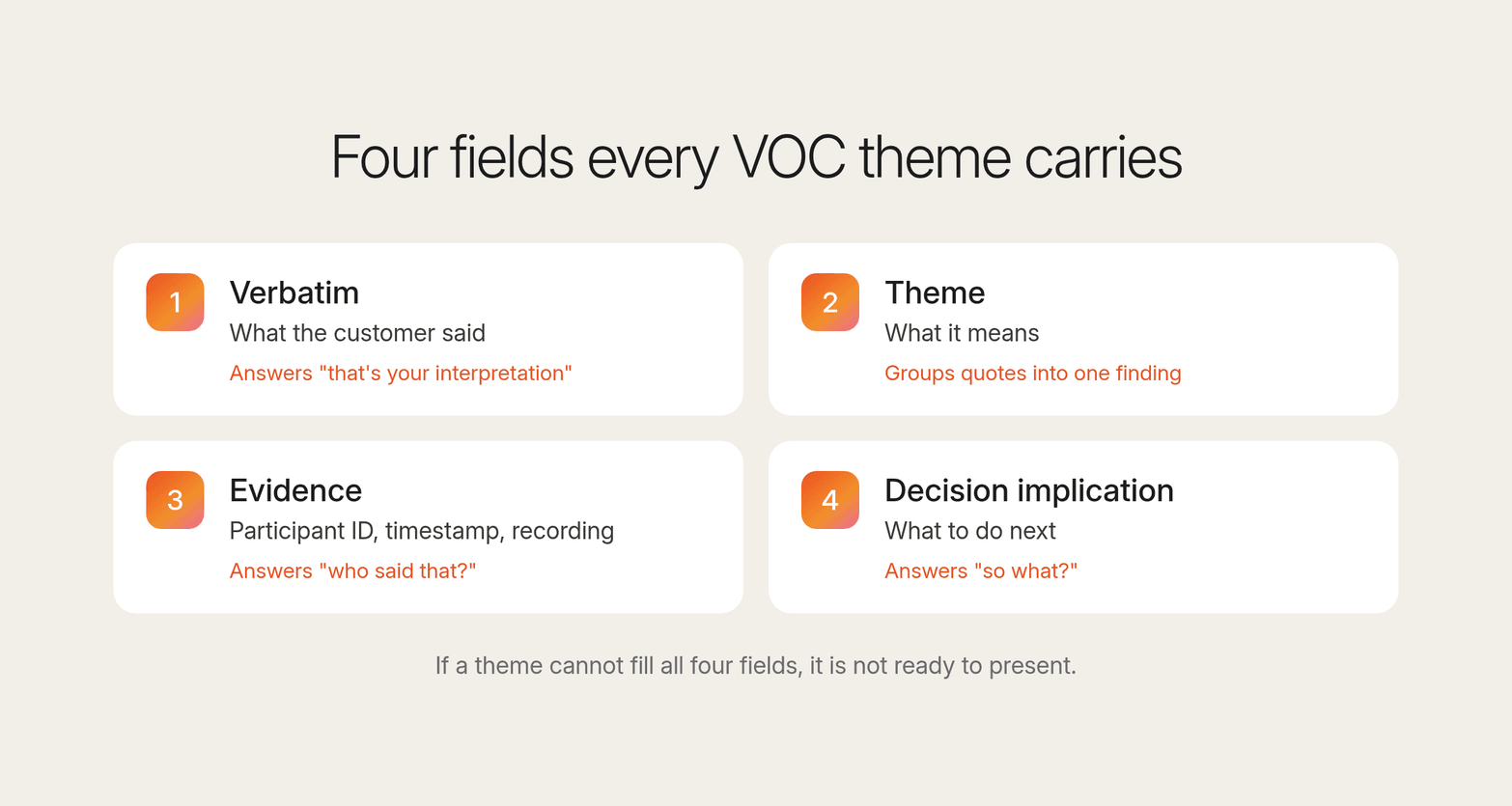
Every reported theme should carry four fields: what the customer said, what it means, where the proof lives, and what to do next. The voice of the customer table below serves as a reusable template for structured feedback. It shows three rows from a single brand-switching study for a beverage brand.
| Verbatim | Theme | Evidence (participant ID, timestamp, recording link) | Decision implication |
|---|---|---|---|
| "The new flavor launched and I couldn't find the original on the shelf anymore." | The launch crowded the core product off the shelf | P-014, 12:41, [recording] | Protect shelf space for the original in the next launch plan |
| "The new pack looked like a store brand, so I tried a cheaper one." | The pack redesign lowered perceived quality | P-022, 08:15, [recording] | Test a pack revision that restores premium cues |
| "My kids wanted the other brand because their friends drink it." | Kids' social cues drive household brand choice | P-031, 19:03, [recording] | Test family-occasion messaging in the next campaign brief |
Each column answers a stakeholder challenge:
Verbatim answers "that's your interpretation."
Evidence answers "who said that?"
Decision implication answers "so what?"
Use video evidence where possible, because transcripts miss the hesitation, tone shifts, and reactions that often explain the why.
Teams can reuse this voice of customer template across studies by keeping the columns fixed and changing only the rows. If a theme cannot fill all four columns, it is not ready to present. See the voice of customer report template.
5 voice of customer examples tied to real business decisions
Each example starts with a business decision, because the decision shapes which questions get asked. Four are representative scenarios built to show the method in the four-column format; the Canva example is a live customer story.
1. Voice of the customer examples in the food industry (decision: which pack or recipe change do we test?)
Finding: shoppers described the last time they chose a competing product from a leading brand at the shelf. A context question, "How long have you bought this product?", separated first-week buyers from two-year loyalists. Customer preferences split by tenure: new buyers cited pack clarity, and loyalists cited a recipe change.
Evidence: "It tastes sweeter now, so I picked the other one." P-310, 15:20, [recording].
Outcome: the team tested a recipe reversion with loyalists and a pack revision with new buyers. Protecting customer loyalty came first, because long-time buyers made up most of the customer base.
2. Brand campaign research at Canva (decision: will this creative direction land?)
Finding: Canva's EMEA team was weighing creative directions for an upcoming brand campaign and needed to know whether the energy they were exploring would resonate in market. Research & Insights Lead Matt Harris launched a study in 15 minutes that evening, and consumer feedback was back by the next morning.
Evidence: the exec summary went straight to stakeholders with no extra analysis, so consumer voices reached the decision while it was still open.
Outcome: research became a reflex. Twelve studies later, it is how the team works, and Canva's Germany brand marketing team now runs its own studies. Read the full Canva customer story.
3. Messaging concept interviews (decision: which offer do we launch?)
Finding: interviews tested how pet owners perceived each offer against the customer needs they described in their own words. Specific benefit language, such as "one scoop covers your dog's daily nutrition," read as more credible than aspirational claims like "reimagine mealtime."
Evidence: "Tell me what it does for my dog. 'Reimagine mealtime' doesn't tell me anything." P-009, 06:52, [recording].
Outcome: the team launched the benefit-led offer before committing media spend. Sales teams used the same clips to address retail buyers' concerns.
4. Voice of customer program example: reasons for care-line contact (decision: where do we invest in self-serve?)
Finding: this voice of customer program example tracks one recurring theme in user feedback for a meal-kit subscription brand: why subscribers contact the care line. Interviews walked each participant step by step through the app's user journey, and most calls traced to one hidden setting.
Evidence: "I contact the care line every time I travel because I can't find where to skip a delivery." P-118, 04:37, [recording].
Outcome: identifying product features that trigger care-line contact gave the team a ranked list, and the skip-delivery setting became the first self-serve fix and a direct customer retention lever. The follow-up wave closes the feedback loop by showing whether self-serve satisfaction rises.
5. Voice of the customer examples in healthcare (decision: where does the patient journey lose trust?)
Finding: participants described the last time they tried to book or change an appointment. First answers were often "It was fine," which is how satisfied customers describe experiences they would still change. Layered probing asked for the specific moment, and "fine" became a concrete account: the confirmation never arrived, so the patient called twice.
Evidence: "I wasn't sure it had gone through, so I called again. After that I stopped trusting the online booking." P-205, 09:58, [recording].
Outcome: the team prioritized confirmation messages for changed appointments over a broader booking redesign, a targeted service improvement.
| Example | Decision | Finding | Outcome |
|---|---|---|---|
| Food at shelf | Which pack or recipe change to test? | New buyers cited pack clarity; loyalists cited a recipe change | Recipe tested with loyalists, pack with new buyers |
| Canva brand campaign | Will a creative direction land in market? | Consumer feedback arrived overnight, while the decision was open | Exec summary went straight to stakeholders |
| Messaging concept interviews | Which of two offers to launch? | Specific benefit language read as more credible than aspirational claims | Launched the benefit-led offer |
| Care-line contact program | Where to invest in self-serve? | A hidden skip-delivery setting drove recurring care-line contact | Skip-delivery became the first self-serve fix |
| Healthcare appointments | Where does the patient journey lose trust? | A missing confirmation led patients to call twice | Confirmation messages prioritized over a booking redesign |
Across five industries, each decision traces back to real consumers.
How VOC translates into Six Sigma CTQ requirements
Six Sigma teams use voice of the customer to translate customer feedback into critical-to-quality (CTQ) requirements, and the same traceability rule applies. A CTQ derived from a theme is defensible only if it stays attached to the original customer language. CTQs exist to turn customer expectations into measurable targets.
The chain, with the quote and recording linked at each step:
Verbatim: "I waited two days for a callback and gave up" (P-042, 03:16, [recording]).
Theme: slow callback response.
CTQ: a requirement on callback response time.
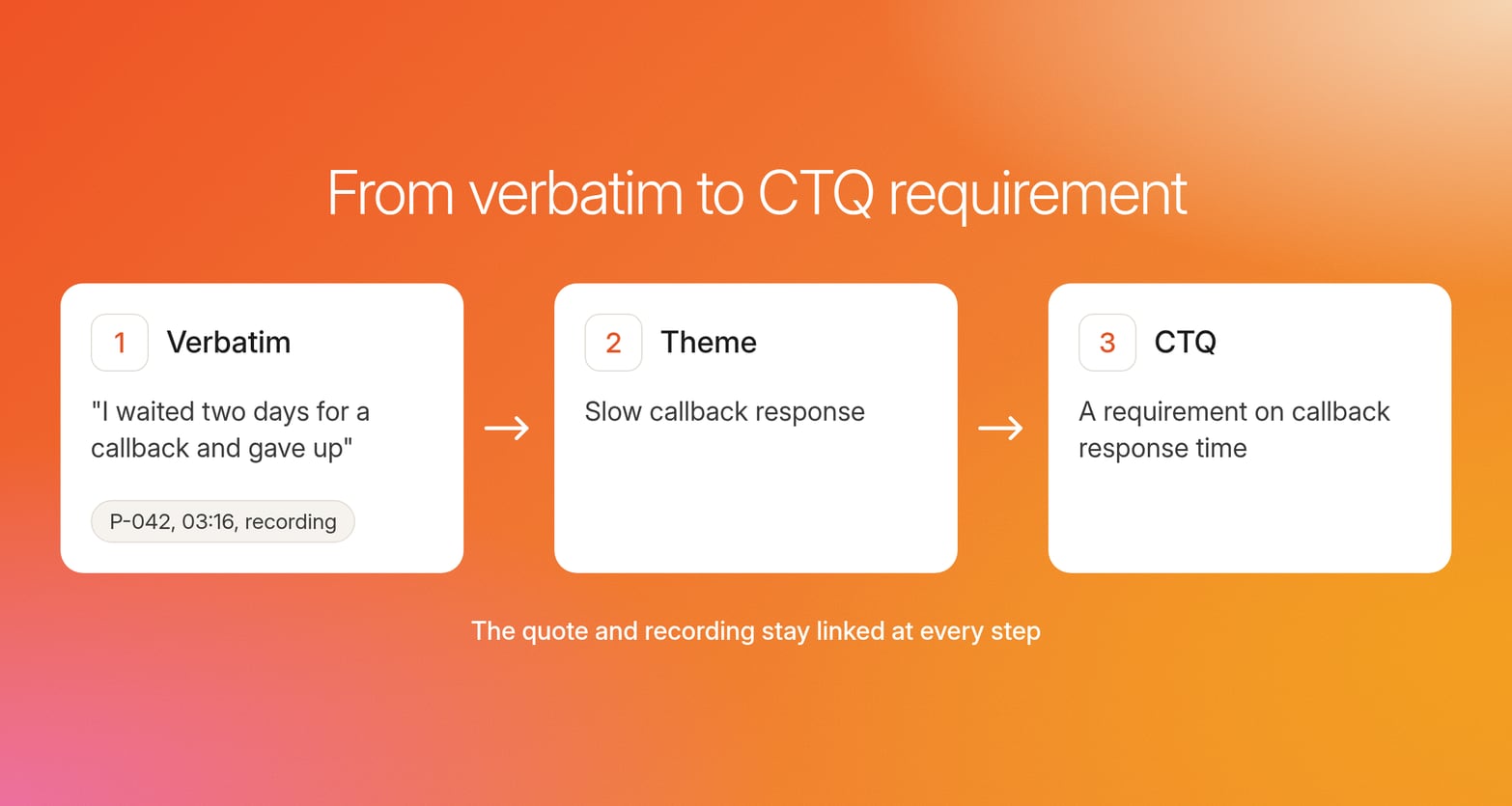
Six Sigma and other continuous improvement methods use different labels for voice of customer examples, and the evidence requirement stays the same across frameworks.
How to collect voice of customer evidence with research-grade interviews
Strong VOC evidence comes from an interview guide built around a decision. No amount of post-interview analysis can add a probe nobody asked. The guide runs in four parts, and each part has one job:
Context: establish who the participant is and how they interact with the product, so you can segment feedback.
Experience reconstruction: walk through a recent, specific customer experience in chronological detail.
Evaluation: ask how that episode compared with what the participant expected.
Implications: connect the experience to what the participant would change or do next.
Changing the order produces opinions without evidence, because participants evaluate before they remember what happened.
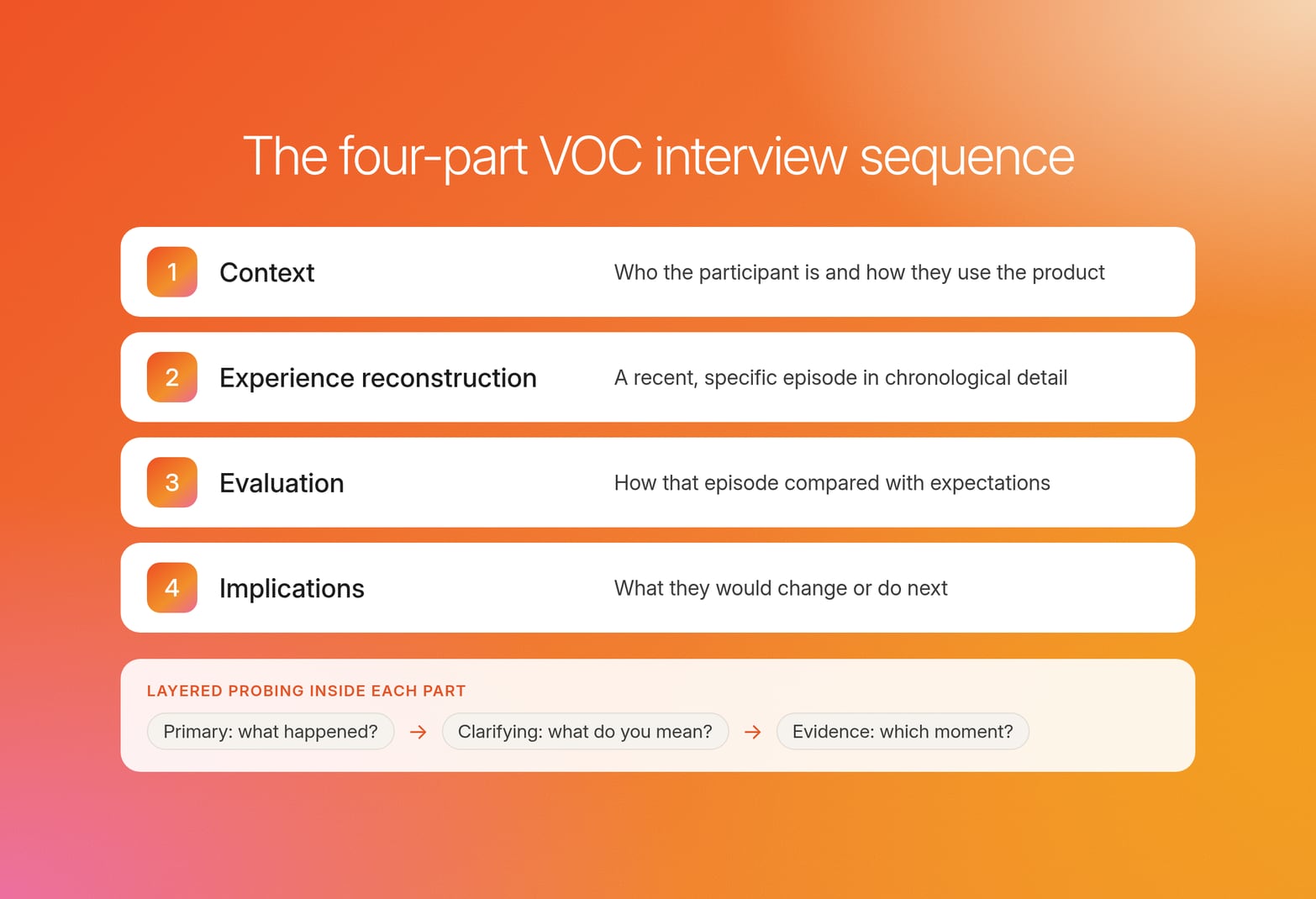
Valuable feedback rarely arrives in the first answer. Layered probing turns vague answers into usable detail in three moves:
Primary question: asks what happened.
Clarifying probe: asks what the participant means.
Evidence probe: asks for the specific moment.
Together, "It's fine" becomes "the export took three tries, so I stopped using it for weekly reports." That is how interviews uncover pain points that a rating scale flattens.
Surveys and focus groups still have a role, but each produces different evidence:
| Method | What it does well | Where it falls short |
|---|---|---|
| Surveys with conditional logic | Route participants down different paths at scale | Cannot ask a follow-up question based on what a participant just said |
| Focus groups | Capture group reaction to a stimulus | Individual episodes get blended into group opinion |
| One-on-one interviews | Reconstruct individual episodes and produce deeper insights per participant | Need a decision-led guide to stay focused |
Behavioral data from observing customers shows where customer journeys drop off, and the interview explains why. A guide that ignores decision drivers produces compelling quotes that inform no decision.
Rigor holds the evidence together through three checks:
Sampling: separate segments whose experiences differ across the customer base.
Bias mitigation: word questions so they never lead participants toward an expected answer.
Traceability: every quote traces to a real person, with a participant ID and recording behind it.
Researchers design the interview guide and keep control of interpretation. Conveo's AI research assistant asks follow-up questions when an answer is vague or leaves a gap, building on what the participant said earlier.
Keeping VOC comparable and fast: taxonomy, cadence, and multi-market runs
Three levers keep VOC data comparable over time: a consistent question taxonomy, a deliberate operating cadence, and parallel fieldwork across markets. Together they make the VOC process repeatable.
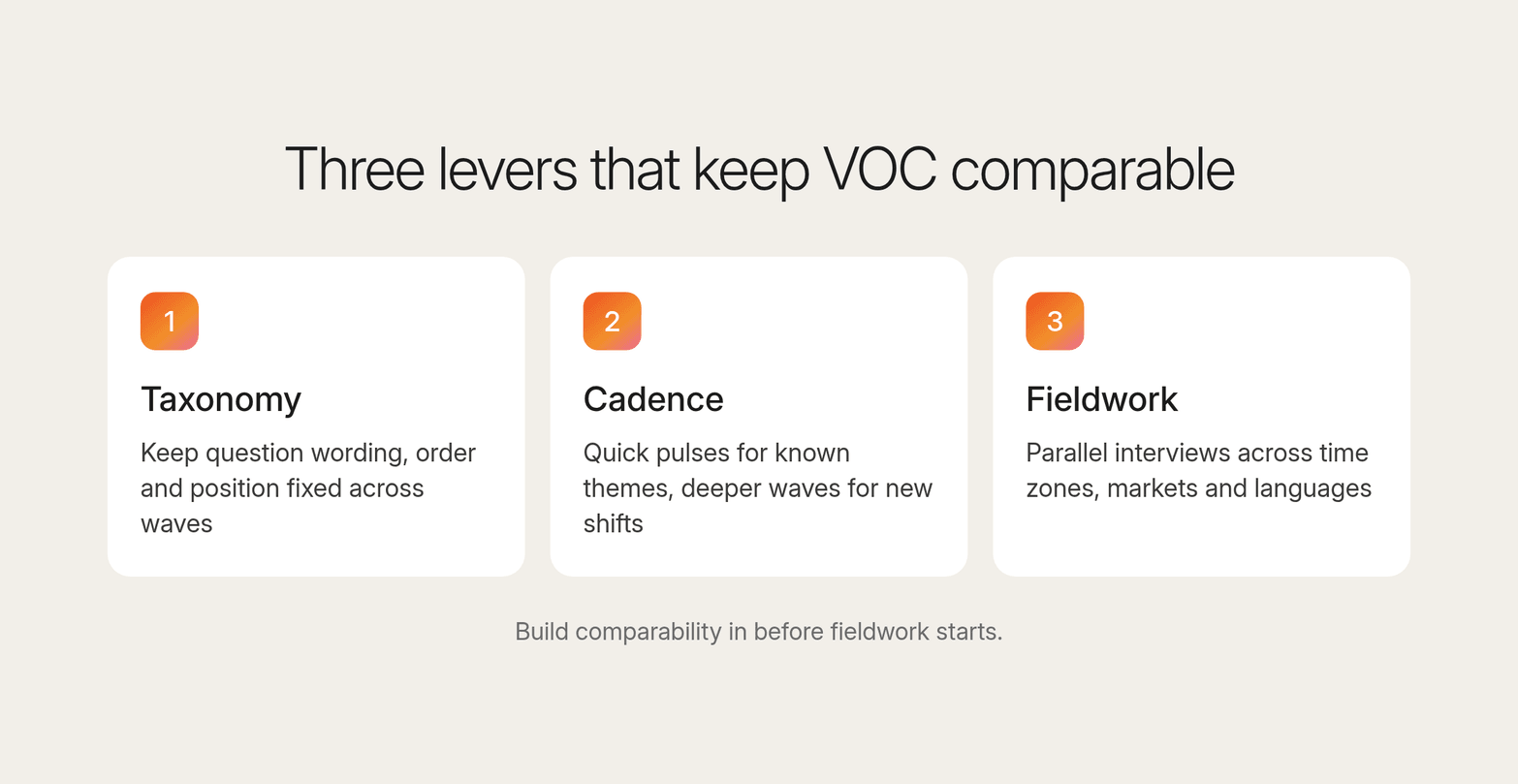
1. Taxonomy: keep question wording fixed
The same question, worded the same way and placed in the same position, lets a team analyze data across waves and spot emerging trends early. Wording drift breaks tracking: if one wave asks why subscribers "contact the care line" and the next asks why they "reach out for help," the theme splits even when user behavior is identical.
2. Cadence: match depth to the question
Quick pulses check whether a known theme is growing or fading, while deeper programs reconstruct experiences to surface insights and build a deep understanding of a new shift. Conveo StoryLines runs this kind of wave-based cadence, for example every two weeks or monthly, so consumer understanding builds wave over wave.
3. Fieldwork: run in parallel across time zones and markets
Traditional qualitative workflows often deliver findings after the decision has shipped. Teams clear scheduling bottlenecks across time zones by running async interviews in parallel.
Running interviews across 50+ languages at once also cuts localization delay. Three things still change by market:
Recruitment: criteria that reflect local customer needs.
Translation: questions translated for meaning, in local phrasing.
Reporting: original-language verbatim kept beside translations.
Enterprise VOC programs need SOC 2 Type II certification, GDPR compliance, ISO 27001:2022 certification, and EU hosting (Belgium).
A mature VOC strategy builds comparability in before fieldwork starts.
Why evidence-attached voice of customer examples win in review
A successful VOC program requires more than collection. The gap that sinks most programs is when a score trend is challenged, and nobody can produce the consumer behind it. Teams using Conveo keep consumer language attached to every reported finding, so that moment doesn't happen. Each theme links to the participants behind it, with video clips and verbatim quotes stakeholders can audit.
"You see them physically doing it. Testing the product for the first time, being probed right there. That unfiltered, in-the-moment reaction is possibly the most powerful thing you can see as a researcher."
Dafydd Jones, Associate Director, Ninth Seat
Conveo extends the team's research rigor across more studies. Recurring themes and facets are recognized across studies in a searchable insight library, so the next wave starts from what earlier ones established instead of a blank codebook.
A stakeholder who asks "what changed?" gets a named consumer and a clip. The conversation moves from whether the finding is real to what the team should do about it, which is how VOC insights move the business forward.
Watch the walkthrough: how a Conveo report reaches decision makers:
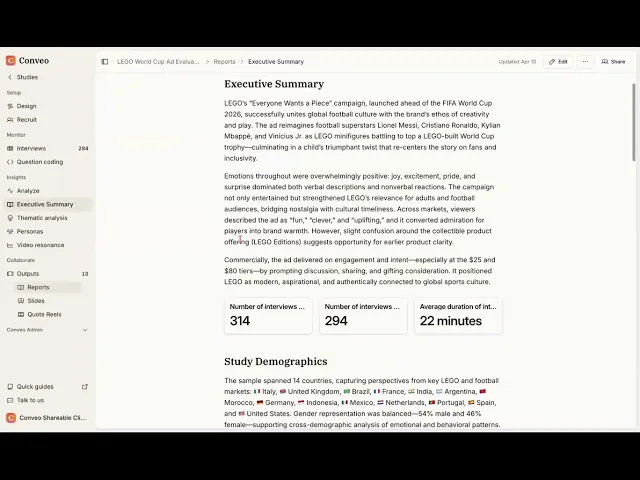
Shared evidence also speeds up cross-functional collaboration: brand, marketing, innovation, and sales teams work from the same clip, so the valuable insights behind a finding stay intact.
See how Conveo keeps the consumer behind every VOC finding
Most VOC programs already collect the right conversations. The gap opens afterward: themes get summarized, sources fall away, and the next review starts with "who said that?"
Evidence-linked voice of customer examples keep the source in place, so a score trend arrives with the consumers who explain it. That traceability is a competitive advantage: with a named consumer and a clip behind every finding, consumer understanding becomes continuous and reaches every decision.
Frequently asked questions
What is voice of the customer?
Voice of the customer (VOC) is the structured collection of customer language, behavior, and context used to inform a specific decision.
What are good voice of customer examples?
Good voice of customer examples tie each theme to a verbatim, participant ID, timestamp, and recording. Customer satisfaction score dashboards alone fall short.
What does a voice of customer report example include?
A voice of customer report example lists each theme with its verbatim, evidence, and decision implication, turning customer data into actionable insights. Stakeholders can open the recording behind any finding.
Is there a reusable voice of customer template?
Yes. Use four fixed columns: verbatim, theme, evidence, and decision implication. Identical columns keep themes comparable across studies.
Why do VOC findings get challenged in reviews?
Findings without sources read as interpretation. Stakeholders dismiss themes they cannot trace to a customer, however strong the customer sentiment data looks.
How do you keep VOC comparable over time?
Fix question wording, order, and taxonomy so voice of customer examples stay comparable. One changed phrase breaks theme tracking.

About the author
Meg Gerli
Research Impact Lead
Meg is a Research Impact Lead at Conveo, working with insights and research teams on the studies they run with Conveo.
Meet Meg on film →Qualitative insights at the speed of your business.
Conveo runs AI-moderated video interviews and structures everything they say.