In this article
TL;DR
A strong VOC program brings together customer feedback from different sources to build an ongoing understanding of customer needs, experiences, and preferences.
Voice of the Customer (VOC) programs are typically good at tracking when metrics change, but less equipped to tell you the reasons behind it.
Insights and CMI teams need VOC feedback sources that provide enough context to understand what customers are experiencing and produce evidence stakeholders can act on.
AI-moderated interviews can add depth to a VOC program by giving teams a way to explore customer experiences in more detail and build on what they learn over time.
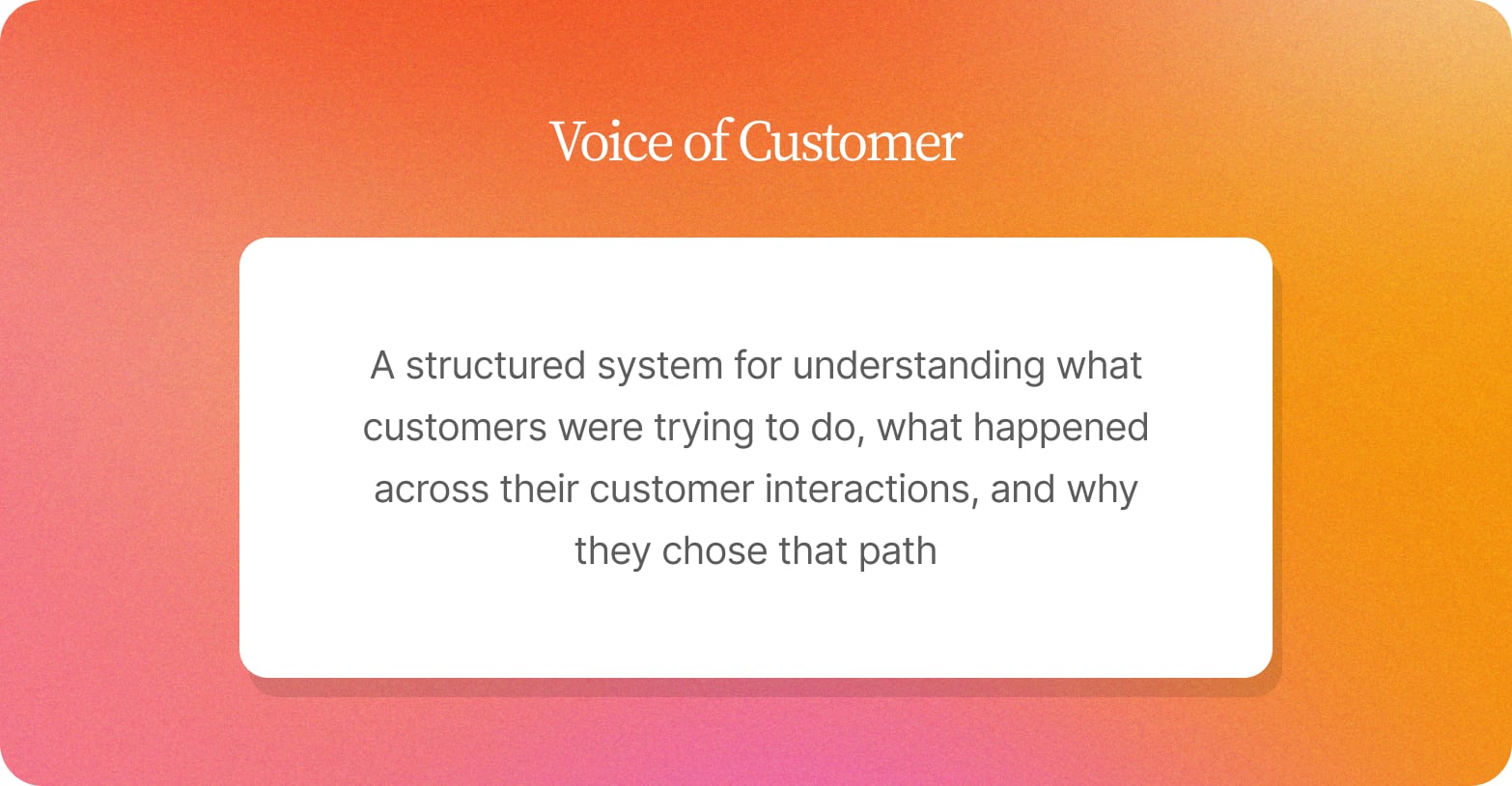
Voice of customer (VOC) is a structured system for understanding what customers were trying to do, what happened across their customer interactions, and why they chose that path. In practice, it is a repeatable process for collecting, analyzing, and acting on customer feedback and customer data in a way that reconstructs behavior and decision-making.
Customer feedback only creates value when it can influence what a business does next. A Voice of the Customer program might tell you that customer sentiment has dropped, but that number alone doesn't tell your team what went wrong or what needs to change.
This article explains what VOC is, how different methods can be used, and what makes VOC evidence useful for business decisions. By the end, Insights and CMI teams will have a clearer way to choose the right approach and assess whether their VOC program's findings are strong enough to act on.
What is voice of the customer (VOC)?
Traditional research usually starts and ends with a single research question. VOC programs bring together valuable feedback from different sources, and over time this builds an up-to-date, ongoing body of customer knowledge.
Because the program keeps running, it enables continuous improvement across the business. Each new round of feedback can be compared with the last to identify trends, such as whether a customer concern grows or fades after a fix. The overarching goals might include business outcomes like reducing customer churn, improving customer satisfaction, or growing customer lifetime value (CLV).
The 5 most common ways of collecting customer feedback
Some methods of gathering customer feedback are better suited to measuring patterns across a customer base, like changes in customer loyalty or customer retention rates. Others help explain the experiences behind those patterns.
To gain a competitive advantage, a VOC program needs both. Here are the core methods of VOC feedback collection and how they work.
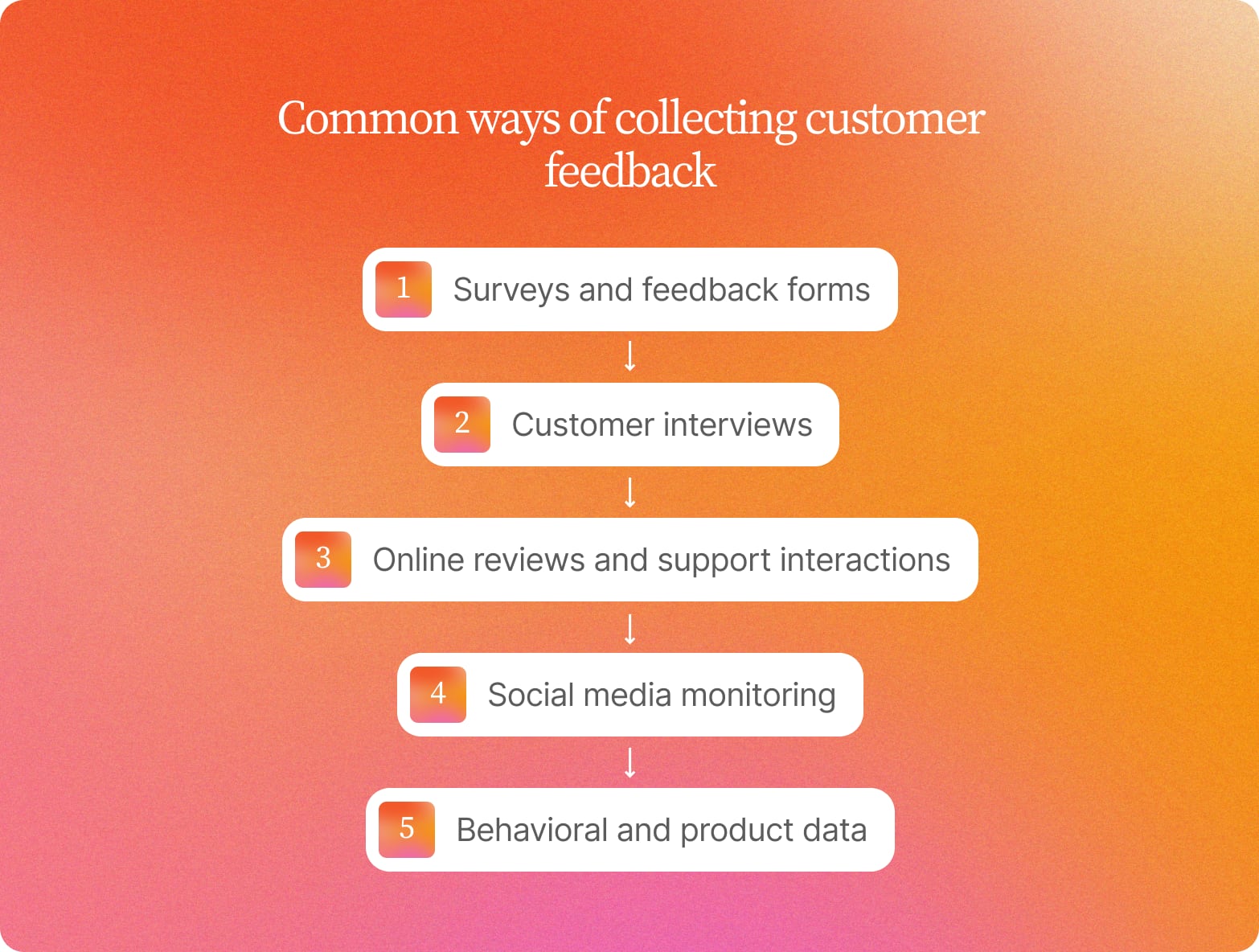
1. Surveys and feedback forms
A survey is a structured questionnaire or feedback form sent to customers, usually mixing rating scales with short text fields. It may be triggered by an event such as a purchase or a closed support ticket.
Responses get aggregated into a score or a distribution, which makes surveys useful for measuring whether sentiment is moving, and in which direction, across a large enough group to spot a trend. They're built to measure VOC metrics like Net Promoter Score (NPS) or Customer Effort Score (CES). Explaining a single customer's reasoning is a job for other methods.
A quarterly NPS survey, for example, might show the score dropped from 42 to 31 after a pricing change. The survey confirms sentiment fell, but it can't say why on its own.
2. Customer interviews
A customer interview is a one-on-one conversation built around a discussion guide with room for follow-up questions, moderated either by a person or by an AI research assistant.
The interviewer asks a set of core questions and adapts follow-ups based on what the customer says, digging into an answer that's vague or surprising. That depth lets interviews explore why customers behave the way they do through their own account of the experience.
For example, after the same NPS drop above, interviews might reveal that customers on the mid-tier plan felt blindsided by a discount that disappeared at checkout, information the survey never surfaced.
Note: A human team can only personally moderate so many interviews in a month. AI-moderated video interviews increase the number of conversations a team can run, but a researcher still needs to check the AI's synthesis against the underlying interviews before treating it as a finding.
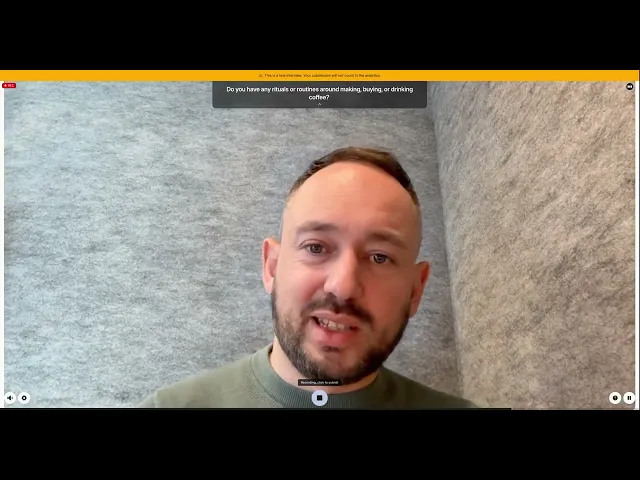
See it in action: how an AI-moderated interview probes a concept reaction.
3. Online reviews and support interactions
Reviews and support interactions capture opinions customers give on their own without being asked for direct feedback.
Customers might leave online reviews on a store page or a third-party site, while support interactions happen through an online chat or call. Both of these sources can be analyzed in bulk for recurring themes.
These formats are useful for surfacing what's bothering customers right now without you having to set up a VOC research project or send feedback requests. A spike in support tickets mentioning a confusing checkout step, for instance, can flag a problem before it ever shows up in the next survey cycle.
However, the feedback you get is shaped by which customers choose to leave a review or contact support. You won't necessarily get insights that reflect your entire customer base.
4. Social media monitoring
Social media monitoring means tracking public posts, comments, and mentions across social media and forums for opinions about a brand or product. Tools can categorize what they find by topic or sentiment, while researchers can also review the underlying comments directly.
It captures what customers are saying when nobody asked, which can pick up on a reaction a formal survey might miss. A cluster of posts complaining about a redesign, for example, can surface shortly after it launches, well before a quarterly survey would have found it.
But this form of feedback has the same limitation as reviews and customer support interactions: the people who post publicly aren't necessarily representative of the wider customer base.
5. Behavioral and product data
Behavioral and product data is a record of what customers did while using a product, such as pages they visited or where they dropped off in a journey. Analytics tools turn this into reports like conversion funnels, and some teams connect it to CRM data to see which customers the behavior belongs to.
It shows exactly where something changed in the customer journey, and teams need other sources to find out why. A spike in drop-off at the payment step, for example, confirms where customers are leaving without explaining what's causing it.
Once feedback is coming in, voice of customer analysis is what turns it from a pile of comments into findings a team can act on.
Why most VOC programs fail
Many VOC programs collect plenty of feedback but still struggle to explain what it means. When the data doesn't show you what needs to change or what to do next, teams struggle to turn the research into decisions. Over time, participation and engagement can drop, and VOC turns into another reporting exercise that no longer feeds product or campaign decisions. Eventually, it gets deprioritized or discontinued.
For example, a survey might show that satisfaction with a new onboarding experience fell from 82% to 68%. Product analytics might show that more customers are abandoning the process at the same step. Those findings tell you there's a problem. They leave open what customers encountered at that point and why it caused them to leave, so you're left to figure it out on your own.
That's where qualitative research adds context. Interviews give researchers the opportunity to ask follow-up questions when a customer contradicts themselves or describes an unexpected experience. The research can move past what changed to why it changed and offer actionable insights into the team's next steps.
How to evaluate VOC customer feedback sources
Interviews are among the best ways to gather in-depth VOC feedback, but the other feedback sources listed above can all have a place in your VOC strategy.
The trick is making sure those sources give you the deepest information possible, so you can better understand the customer experience and make informed decisions. Here's what to look for:
| Source | When it can produce useful VOC evidence | When it falls short |
|---|---|---|
| Surveys | When they combine quantitative questions with opportunities for customers to explain their answers, such as open-ended questions or follow-up questions based on their responses. | When they're limited to ratings, multiple-choice questions, and short text fields, so there's little opportunity to explore why a customer responded a certain way. |
| Qualitative interviews | When the format allows the interviewer to ask follow-up questions and explore unexpected answers. | When the VOC interview follows a fixed set of questions with no ability to adapt the conversation based on the customer's responses. |
| Support interactions | When the format allows customers to describe their problem in their own words and support agents to ask questions and explore the issue. | When customer interactions are handled through a basic chatbot or scripted flow that only asks a fixed set of questions and routes customers based on their answers. |
| Reviews and social media monitoring | When analysis looks at the substance and context of customer comments, beyond sentiment or topic tags. | When tools reduce feedback to sentiment analysis or ratings without preserving the detail of what customers said. |
| Behavioral data | When the method captures detailed behavior across the customer journey, such as the actions customers take before and after a drop-off or change in usage. This may also include connecting to your CRM data or other tools to generate more valuable insights. | When it only reports metrics such as clicks, conversions, or drop-off rates, without capturing the customer experience behind those actions. |
The more a method is limited to measuring or categorizing a signal, the more likely it is to tell you what is happening without helping you understand why. Interviews are worth including in any VOC program for this reason: even when every other source is well set up, they're the one method that reliably gets you the reasoning behind a number.
Once you know what to look for when collecting feedback, the next step is evaluating the strength of the customer data it gives you.
What decision-ready VOC evidence looks like
For VOC findings to be strong enough to make business decisions, there are a few things stakeholders should be able to check in the evidence:
| What to look for | What it means | Why it matters |
|---|---|---|
| A clear sample | You know who took part and why they were included. | Helps teams understand who the findings represent and whether they apply to the decision at hand. |
| Checks for bias | The research accounts for factors that could skew the findings, including how people were recruited and how questions were asked. | Reduces the risk of treating a distorted or unrepresentative result as reliable. |
| Traceability to real participants | Each finding can be connected to the customer who provided the evidence. | Lets stakeholders verify where a finding came from, so nobody has to trust an unsupported summary. |
| Direct customer evidence | Findings are supported by the customer's own words, with quotes or video clips where relevant. | Gives stakeholders something concrete to examine when assessing or explaining a decision. |
| Clear limitations | The research makes clear what the findings can and can't tell you. | Helps teams know when the evidence supports a decision and when more research is needed. |
Without these things, it's hard for teams to know what action to take next. Take a report that says "customers feel the new pricing is unfair." There's no way to tell who said this or whether it's a few vocal reviewers or a genuine pattern. A stakeholder either takes it on faith or dismisses it.
A decision-ready finding built on VOC best practices might show that customers who reached the highest pricing tier were the ones raising the concern. It would also link to interview clips where those customers explain that the higher price came as a surprise after they had already committed to the product. That gives the pricing team enough evidence to test a clearer pricing structure for that one customer segment and leave everyone else's pricing as it is.
Conveo's AI-moderated video interviews make the evidence behind findings available for review, including quotes and video clips.
A step-by-step VOC operating model for small insights teams
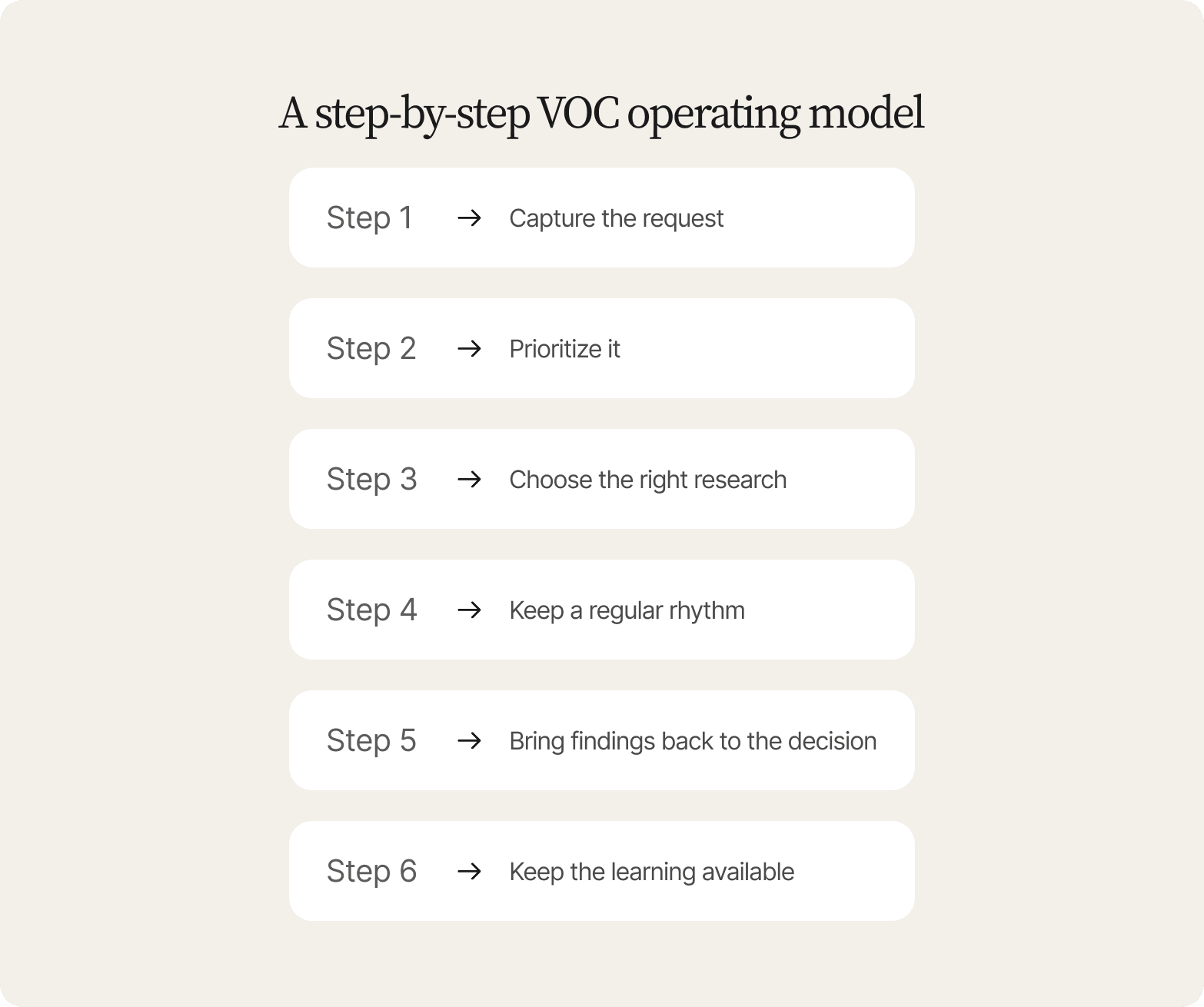
For small Insights teams with only one to five people, running VOC ad hoc alongside larger projects can feel challenging. Creating a system gives you a manageable way to keep VOC running without burning out. Here's how that might look in practice:
| Step | What the team does | Example |
|---|---|---|
| 1. Capture the request | Record the question, who needs the answer, and what decision it will inform. | The product team needs to understand why customers are dropping off during onboarding before deciding whether to change the flow. |
| 2. Prioritize it | Assess how important the decision is and whether existing customer input can answer the question. | The team reviews existing surveys and customer service interactions to see what they already know about the problem. |
| 3. Choose the right research | Use the method that can provide enough depth to answer the question. | Existing feedback shows where customers are dropping off, but interviews are needed to understand what they're struggling with. |
| 4. Keep a regular rhythm | Use weekly signals for lightweight monitoring, monthly deep dives for questions that need more investigation, and quarterly synthesis to connect findings across the research. | A weekly review flags the onboarding drop-off. A monthly interview study explores the issue in depth, while the quarterly review checks whether the concern appears elsewhere in the customer journey. |
| 5. Bring findings back to the decision | Share relevant VOC insights while the decision is still being made, ahead of any large report. | Interviews reveal that customers are unsure what information they need to provide at one particular step, so the product team changes the instructions. |
| 6. Keep the learning available | Record useful findings so future research can build on what the team already knows. | When the team next reviews onboarding, it can see the original customer feedback and check whether the same issue has appeared again. |
A system like this keeps the VOC program focused on customer input you can use to improve customer relationships, so feedback collection never becomes an end in itself. For a fuller walkthrough of setting one up, see our guide to designing and running a Voice of the Customer program.
The right voice of the customer tools depend less on how many channels they cover and more on whether findings stay connected from one study to the next.
How Conveo supports an ongoing VOC feedback program
Customer interviews get to the heart of your VOC data by connecting you with real people, explaining their experience in their own words. But there are only so many interviews researchers can carry out manually, no matter how big the team.
AI-moderated interviews raise that limit: the AI runs the conversation, and researchers spend their time deciding what to investigate and reviewing what comes back. For that to be worth doing, the interviews need to hold up to real research standards, and what gets learned needs to carry forward from one study to the next. Here's what that looks like with Conveo:
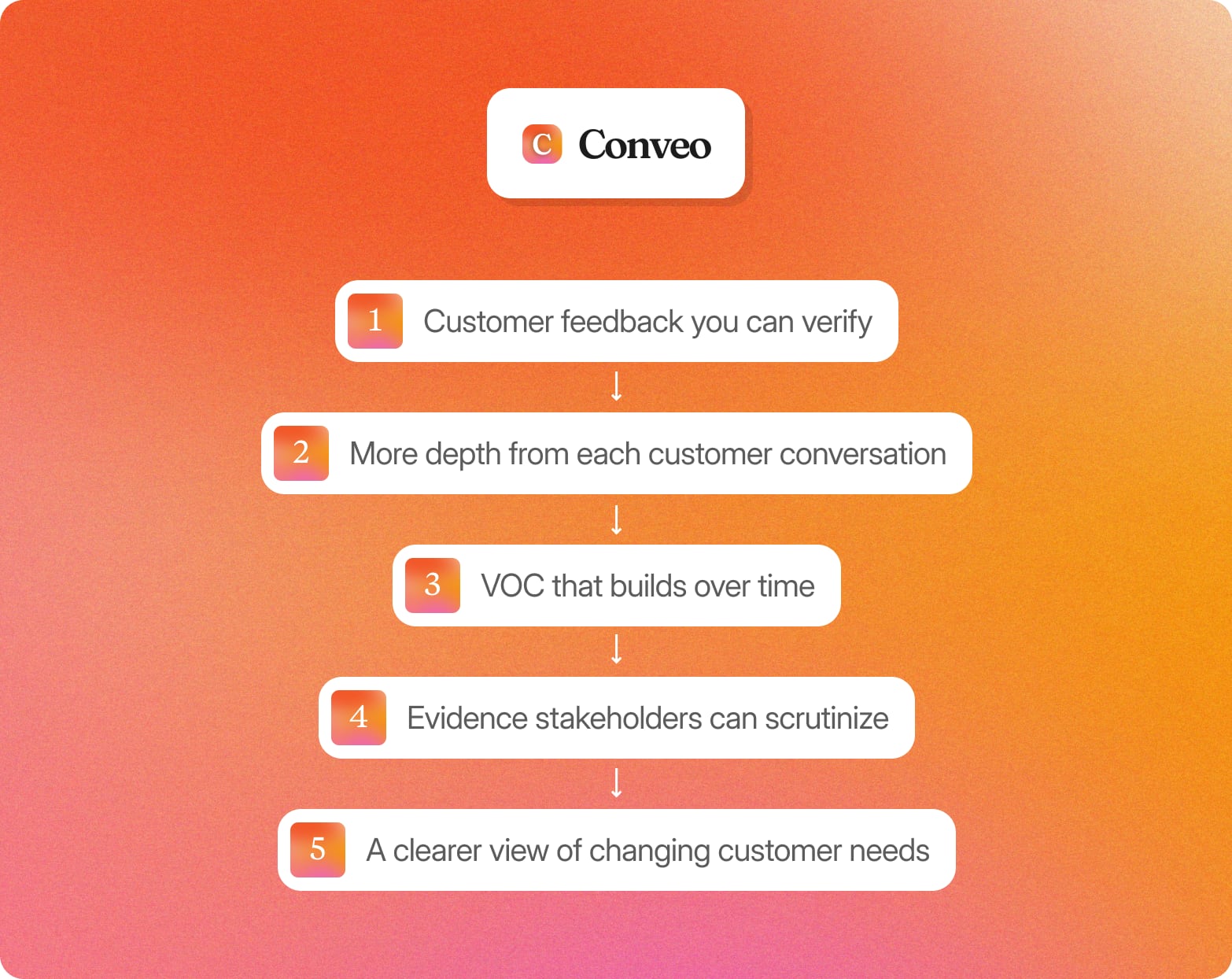
Customer feedback you can verify. Findings connect back to the participant, quote, and relevant video clip, so researchers can check the evidence before sharing it with stakeholders.
More depth from each customer conversation. Conveo's AI adapts its questions based on what participants say, so interviews can follow unexpected answers wherever they lead.
VOC that builds over time. Conveo can run individual studies as well as ongoing research programs, so teams can build on existing customer understanding across studies.
Evidence stakeholders can scrutinize. Researchers can review the underlying interviews and findings before using them to support changes to products, services, or the customer experience.
A clearer view of changing customer needs. With recurring research through StoryLines, teams can compare new waves with earlier research and identify changes in customer perceptions over time.
"The pace, responsiveness, and research expertise of the Conveo team, on top of the top AI-moderated qual platform, have been invaluable to us in scaling brand advertising internationally."
Matt Harris, Research & Insights Lead, EMEA, Canva
If you're starting from scratch, a voice of the customer template gives you a structure for questions, sources and reporting before you commit to tooling.
Frequently asked questions
What does voice of the customer mean?
Voice of the Customer is the practice of collecting and analyzing what customers say, think, and need so teams can make better business decisions. It can include customer satisfaction scores and other feedback data. Decision-ready VOC goes further by helping teams understand customer expectations and customer pain points, and what those findings mean for the business.
What are voice of customer examples?
A company sees complaints about a new feature, and interviews reveal that the feature works fine but customers struggle to fit it into their existing workflow, so the product team keeps the feature and changes the design. Customer surveys show strong interest in a product while interviews reveal concerns about its price, so the marketing team changes its messaging to address the value customers expect. Customer success interactions show repeated complaints about account setup, and reviewing the customer journey reveals the exact step where customers get stuck, so the team simplifies the process.
What is voice of the customer in Six Sigma?
In Six Sigma, Voice of the Customer captures what customers expect from a product, service, or process. Teams translate those expectations into Critical-to-Quality (CTQ) characteristics, which turn customer requirements into measurable specifications. These can then be used to assess whether a process is meeting the standards that matter to customers.
What is a voice of the customer tool?
A Voice of the Customer tool helps businesses collect and analyze customer feedback. Survey platforms are useful when teams need structured responses from a larger customer population, while qualitative research platforms help when researchers need to explore customer views in more depth. Text analytics can help teams work through large volumes of existing feedback and identify recurring themes.
How does Amazon use voice of the customer?
Amazon's approach to customer needs is reflected in its Customer Obsession leadership principle. The company describes this as starting with the customer and working backward, meaning teams begin by considering what customers need before deciding what to build. Amazon presents this approach as part of how it develops products and services and makes business decisions.
What does Gartner say about voice of the customer?
Gartner covers voice of the customer in its customer experience research, which looks at how organizations collect, analyze, and act on feedback from across the customer journey.

About the author
Alex de Hemptinne
Head of Customer Success
Alex is a Business Impact Lead at Conveo, partnering with enterprise teams to embed AI-led research into their workflows. From the first study to full-scale rollout, she helps customers shift from project-based research to continuous customer intelligence.
Meet Alex on film →Qualitative insights at the speed of your business.
Conveo runs AI-moderated video interviews and structures everything they say.