In this article
TL;DR
Best for: Insights and CMI teams that need AI customer intelligence stakeholders will actually act on, backed by evidence they can check for themselves.
The decision-lag problem: Research that arrives six weeks after the decision window closes might as well never have happened.
The trust problem: Stakeholders reject AI-generated findings when there is no way to trace a theme back to a specific participant. A clip, a timestamp, and a verbatim quote convert a synthesis into evidence.
The evidence-grade framework: Every AI-generated theme must link to a real participant moment. AI drafts the pattern; the researcher interprets it and stands behind it.
The always-on outcome: Research becomes a searchable, compounding library of insights that turns customer feedback into actionable insights. Nothing gets investigated twice.
The credibility signal: Participants are 68% more open than when using a human moderator, and every response traces back to a real person on video.
Most research programs fail on timing. The methodology holds; the calendar defeats it. A question surfaces during a product sprint or a brand repositioning conversation, and by the time the research comes back, the decision has already been made. Research that arrives after the decision might as well never have happened.
That is now the condition that separates competitive organizations from the rest. The teams that pull ahead have customer understanding available while the decision is still open, and they convert that speed into actionable insights that change the decision itself.
Speed alone leaves half the problem standing. Even when findings arrive on time, stakeholders often refuse to act on them: a sentiment score, a behavioral cluster, an aggregated signal tracking customer behavior across every touchpoint. When a product director asks "who said this, and why?", the answer is usually a model output, and the conversation behind it stays out of reach. Without that evidence layer, AI-generated customer intelligence struggles to survive an executive review.
This article is for researchers and insights leads evaluating where designed qualitative research fits alongside the signal aggregation platforms already in their stack, and what separates platforms that produce traceable findings from those that produce summaries. Every customer support ticket and every one of the millions of customer interactions logged by a CDP each quarter is a proxy for a conversation nobody actually had.
What AI customer intelligence actually means (and what it misses)
"AI customer intelligence" means something different depending on who's using it. Most vendors applying the label are describing signal aggregation: pulling behavioral data from CRMs, CDPs, VoC platforms, and social media monitoring tools, then running it through machine learning to identify patterns, forecast churn risk, or score intent. Vendors marketing customer intelligence tools and software promise a unified view by unifying data across transactional records, website behavior, app analytics, support tickets, and contact centers. That's genuinely useful: analyzing customer data at this scale can surface early warning signs before a customer churns, and predictive analytics can anticipate customer needs well enough to inform strategic decisions in real time. Through predictive modeling, it can tell you future behavior, negative sentiment building beneath a customer satisfaction score, or the customer lifecycle stage a segment has entered. What it can't tell you is why, and in most product, brand, and innovation decisions, why is the question that decides everything.
The confusion is structural. Ask ten vendors what a "customer intelligence platform" is, and you'll get ten answers: CDPs, CRMs, marketing clouds, data warehouses, and business intelligence suites all orbit the same phrase. Each promises a unified view of how customers interact with the brand, assembled from customer analytics and data analytics dashboards drawing on the same data volume.
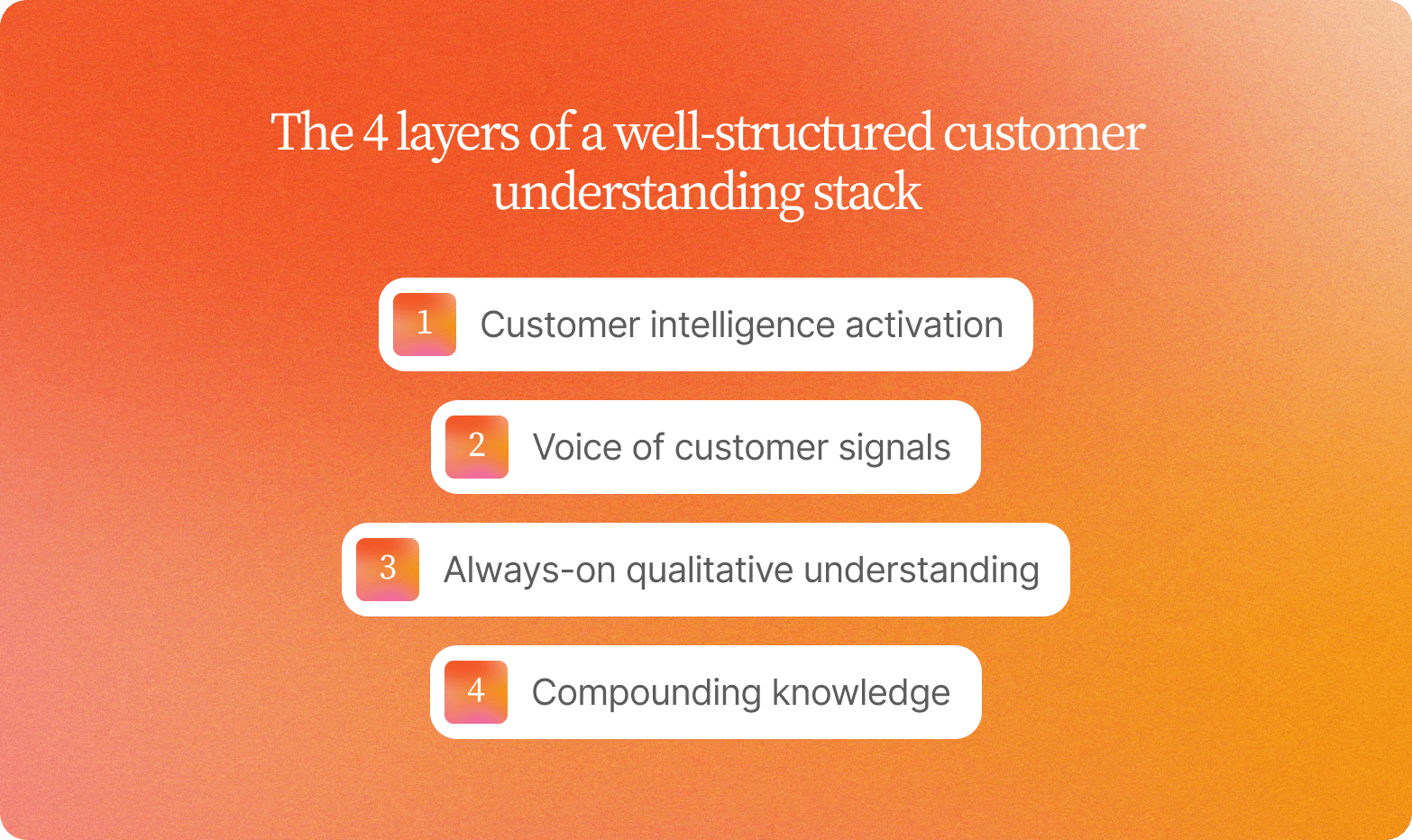
The distinction that matters is architectural. Four layers make up a well-structured customer understanding stack:
Customer intelligence activation (CDP/CRM): who are my customers and what have they done? This is where customer analytics and data integration unify data from existing systems, transactional records, website behavior, user flows, app analytics, contact centers with intelligent routing and intent detection, and customer touchpoints into a single interaction history through customer journey mapping. When done well, this can flag a reduced-churn customer cohort weeks early.
Voice of customer signals (surveys, social media monitoring, support tickets): what do customers say at scale? This layer captures customer feedback and unstructured input, scores customer sentiment, and flags negative sentiment, while remaining shallow in reasoning.
Always-on qualitative understanding: why do customers think and feel what they do? Adaptive probing surfaces pain points and the root cause analysis behind stated customer needs.
Compounding knowledge (searchable insight library): what has the organization learned over time, and how does new evidence connect to past interactions? This is where knowledge gaps get identified and closed before the next study starts.
Most platforms competing in this space, including advanced analytics tools built to identify patterns in customer behavior and predict future behavior, operate in layers one and two. They effectively aggregate a growing volume of signal data, using data collection and analytics tools that enable businesses to spot trends without asking participants questions. The gap they leave between knowing what happened and understanding why is where brand and product decisions are made. AI-moderated interviews with adaptive probing close that gap: teams report moving from a multi-week agency timeline to days, turning designed research into actionable insights that inform strategic decisions while they're still open.
Conveo spans layers three and four. AI-powered synthesis drafts the first pass; the platform enables businesses to run interviews at scale, feed every customer insight into a compounding library, and unify data that informs decisions rather than letting it expire in a deck.
The trust problem: why stakeholders reject AI-generated insights
When a CMI director presents AI customer intelligence findings, the first question they face is "how do you know?" If the answer is "the platform summarized the interviews," the recommendation stalls. Stakeholders who can't see the source, hear the voice, or watch the moment a participant said something are being asked to trust customer experience decisions they haven't earned yet.
Black-box outputs provide answers without explaining how those insights were produced, leaving no reasoning or business logic behind the findings. That lack of transparency poses a risk because leaders can't fully trust the answers. In practice, this means stalled procurement reviews and studies re-run for validation. The real cost lands on the credibility of the function.
Two failure modes sit underneath this. The first is fabricated attribution: AI summaries that present composite quotes as if one person said them. The second is synthetic personas, AI-generated profiles with no real participant behind them. Both look like research and collapse under scrutiny (more on both later).
Traceability is what resolves the trust problem. When every finding connects to a real participant moment, a verbatim quote, a video timestamp, the question "how do you know?" has a concrete answer.
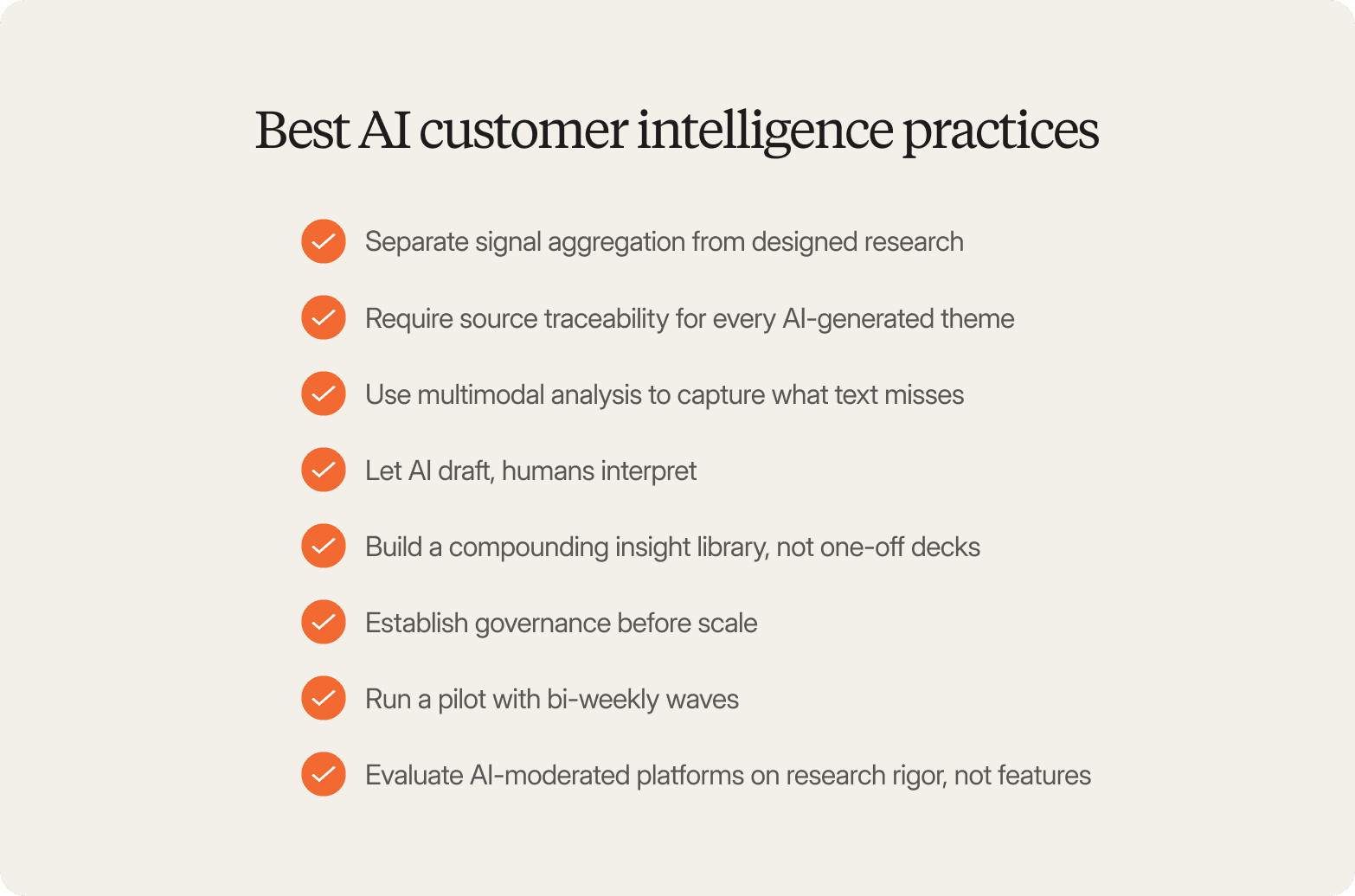
Best practice 1: Separate signal aggregation from designed research
Your CDP and CRM tell you when a segment churned or when NPS dropped. They can't tell you why. That distinction is the foundation of a functioning insights stack, and collapsing it is the most common reason research budgets get challenged by stakeholders who feel they already have "enough data."
Signal aggregation platforms are built for data collection and customer analytics at scale. They answer the what. It's genuinely useful, but behavior and rating scales don't carry reasoning.
Designed qualitative research is the layer that captures reasoning, the root cause analysis a churn dashboard can't perform on its own. When a participant explains why they chose a competitor, that's evidence a dashboard can't generate. The interview provides context for the pain points the signal was missing.
Signal aggregation sits as the detection layer, surfacing patterns in customer behavior. Designed research sits beneath it as the explanation layer. Both layers earn their place.
Best practice 2: Require source traceability for every AI-generated theme
Evidence-grade synthesis means every theme can be traced to a specific clip, a timestamp, and a verbatim quote from the person who said it, in their own words. That traceability standard separates credible AI-assisted analysis from black-box summarization and protects data quality once a theme leaves the research team.
The workflow runs in two stages. AI drafts candidate themes by clustering patterns across transcripts. That draft is fast and useful, and it stands as a hypothesis until a researcher confirms it. The researcher pressure-tests each cluster against the footage: does the verbatim match the theme? Contradictions should surface automatically and stay visible in the summary.
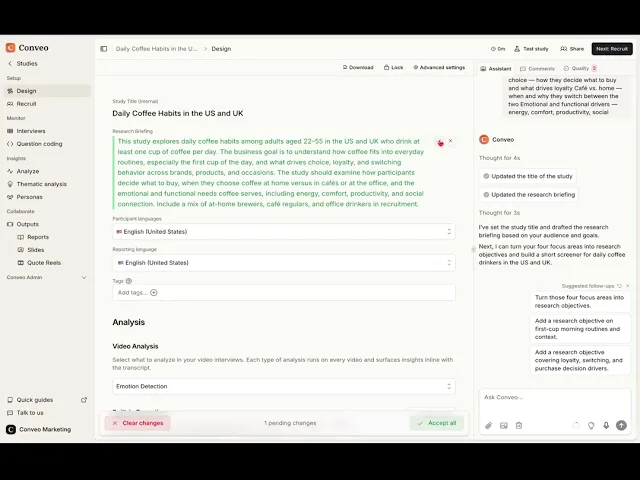
Watch the walkthrough: How to build and launch a study in Conveo
Participants are 68% more open than with a human moderator, and the mechanism is adaptive probing. When a participant hesitates, the AI moderator follows the signal rather than moving to the next scripted question. Every follow-up probe is captured and timestamped, so if a probe was leading, the researcher can see it and weight the response accordingly.
Stakeholders should be able to request on-demand access to the source video as a baseline expectation. That capability moves findings from assertions to evidence.
Best practice 3: Use multimodal analysis to capture what text misses
A participant says a concept is "interesting." The transcript records the word. The two-second pause before it and the flattening of tone stay off the page, and that's where the real objection lives.
Hesitation, tone shifts, and micro-expressions often reveal whether a stated preference reflects genuine intent, or user intent that diverges from polite compliance.
Conveo's multimodal analysis processes speech, tone, and facial cues simultaneously as each session closes, flagging moments where verbal and non-verbal signals diverge. These are the moments that explain objections, the root cause analysis a transcript alone can never surface.
"Super valuable... ahead of where most of your competitors are... quite a special way to analyze this data"
Matt Harris, Research & Insights Lead, EMEA, Canva
That traceability is what separates a finding stakeholders trust from one they question. When a recommendation is grounded in observable behavior rather than a coded theme, it holds up in the room.
Best practice 4: Let AI draft, humans interpret
This division of labor is a workflow decision with direct consequences for whether findings hold up in a C-suite presentation.
AI handles what scales poorly by hand: clustering responses, drafting theme labels, flagging sentiment shifts. A researcher can produce a structured thematic draft within hours rather than days. Implementing AI this way protects the parts of research that require human judgment.
What AI can't own is interpretation. A theme cluster is a hypothesis. It becomes a finding once a researcher confirms it against the footage: does the language match what participants said, or has clustering smoothed over a real contradiction?
Stakeholders asking "can we trust AI analysis for a decision this consequential?" are asking two things: whether a human is accountable for the interpretation, and whether the evidence traces back to a real person.
Conveo's workflow is built around that standard: AI-drafted themes link directly to the clips that generated them, so a researcher can confirm or revise the draft before it becomes a recommendation. Human interpretation is the step that turns pattern recognition into understanding.
Best practice 5: Build a compounding insight library
Most research programs die the same death. A study closes, a deck gets filed, and six months later a different team commissions almost the same study because nobody knew the first one existed. That's a structural problem: findings built to be presented rather than reused can't compound, and scattered data across shared drives is functionally equivalent to no data.
Conveo's searchable insight library is a connected repository in which every study contributes to a growing body of understanding. Prior clips, themes, past interactions, and interaction history remain accessible alongside new findings, helping teams identify knowledge gaps rather than relying solely on the most recent session. Source traceability keeps it credible: every theme traces to a real participant and a video timestamp.
This layer sits at the top of the stack, unifying data that would otherwise be scattered across decks and drives, producing real-time insights rather than quarterly reports. Teams report spending less time re-establishing context and more time answering the actual question, with real-time analytics available the moment a new question comes in. Switching costs deepen with every wave.
One failure mode worth flagging: libraries that get built but never searched. A searchable insight library depends on active retrieval habits.
Best practice 6: Establish governance before scale
Scaling an always-on AI customer intelligence program without governance immediately creates risk. Procurement, legal, and data protection reviewers are often the step that stalls a platform decision, and that's almost entirely avoidable if compliance is treated as a prerequisite.
Conveo is SOC 2 and GDPR compliant, with European hosting in Belgium. SSO integration and clean data integration with your existing systems keep access inside your identity management framework, reducing IT overhead. On-demand PII deletion lets research ops respond to subject access requests without manual data archaeology, keeping data management centralized rather than scattered. See Conveo's security overview for details.
A research function that can demonstrate data handling standards to legal and security stakeholders can expand across markets and business units without each new wave triggering a fresh compliance review.
Best practice 7: Run a pilot with bi-weekly waves
A six-to-eight-week pilot works best as three bi-weekly waves. The first establishes a baseline: one study, one segment, one focused question, generating real findings before the pilot reaches its midpoint. Implementing AI at this stage, one study at a time, is what proves the model before it scales. The second wave probes a theme the first surfaced or tests a cross-segment comparison. The third synthesizes prior learning into what changed and what the next program should investigate. This structure naturally leads into Conveo StoryLines, which runs continuous programs for teams that need an ongoing read on their market.
A pilot that runs quietly dies quietly. A short readout after each wave, no deck, one recommended action, builds more internal confidence than a formal end-of-pilot presentation, and should go to a stakeholder outside the research function who has a decision in-flight, turning the pilot into informed decisions the wider business can point to.
Every wave should feed the searchable insight library from the moment the first study closes. Three roles keep the model functional: the researcher designs and interprets each study, and the business stakeholder who received the readout owns the decision it informs. Keeping these roles distinct prevents the most common pilot failure, findings generated with no one accountable for acting on them.
Best practice 8: Evaluate AI-moderated platforms on research rigor
The "black box" objection is the biggest barrier to evaluating AI customer intelligence platforms. A platform can offer adaptive probing and thematic synthesis and still produce findings no one can trace to a real person. The question that matters is whether the data-driven insights it produces can survive a boardroom, whatever its analytics tools look like in a demo.
The scorecard below helps research teams choose the right customer intelligence platform against criteria that determine whether findings are defensible in a stakeholder review.
| Criterion | What to look for | Red flag |
|---|---|---|
| Traceability | Every theme links to a named clip, timestamp, and verbatim quote from a real participant | Themes presented without source attribution |
| Probe quality | Follow-up questions adapt to what the participant actually said | Probes are generic or identical across participants |
| Bias controls | Documented method for detecting leading questions and order bias | No visible methodology |
| Participant authenticity | Video-first sessions with behavioral screening at recruitment | Text-only sessions with no fraud detection |
| Multilingual equivalence | Concepts hold their meaning across languages, verified beyond word-for-word translation | Single-language analysis applied post-translation |
| Auditability | Full recordings and coding decisions are accessible | Analysis outputs only; raw sessions not retained |
AI drafts themes, humans own interpretation. A platform that lets researchers trace every cluster to specific participant statements meets the research-grade bar, however polished a competing output looks. Traceability is the mechanism by which a finding becomes a decision.
How to position AI customer intelligence to stakeholders
The conversation with executives usually breaks down at the same point: the insights team presents a platform, and leadership hears "another research project." That framing evaluates the investment against a single study's ROI rather than against the cost of repeatedly deciding without evidence.
The shift that works is moving from project to infrastructure. When AI-driven customer intelligence sits alongside the CRM and data warehouse rather than agency retainers, the evaluation criteria change. Conveo's searchable insight library connects findings across waves and prevents the same question from being researched twice; that's infrastructure behavior a one-off project can't match. A structured pilot with clear milestones gives executives visible proof the investment is building something durable.
Customer intelligence AI belongs in the infrastructure budget. It's the evidence layer behind every brand, product, marketing, and strategy call, from marketing efforts and pricing to long-term brand loyalty and customer loyalty.
4 common failure modes and how to avoid them
Synthetic personas that can't produce original evidence
Some platforms generate composite personas from modeled behavior rather than real conversations. If a persona claim can't be attributed to an actual person who said it, it doesn't belong in a stakeholder-ready output.
Fabricated quotes from AI summaries
AI synthesis can drift from what participants actually said. Every quote used in a deliverable must be verified against the original recording before it leaves the insights team.
Stale libraries that never get searched
An insight library treated as an archive stops compounding and starts duplicating. The highest return comes when it's the first stop before any new study is commissioned.
Governance gaps that stall procurement
Security questions that surface mid-contract are the most common cause of delayed rollouts. Completing a data-handling review before the procurement conversation begins avoids delays.
The traceability standard, built in: Why Conveo fits
The nine practices here share one requirement: findings must trace to a real participant, a real moment, a real conversation. That's met by designed qualitative research, run at scale, with every output connected to the person who produced it.
Conveo is built for teams that need always-on, AI-powered customer understanding they can stand behind, whether the goal is to improve customer satisfaction, deepen customer loyalty, or win more customers without guessing at customer needs. It runs AI-moderated interviews across 50+ languages, with adaptive probing that follows what participants actually say. Multimodal analysis captures what the transcript missed, and every theme links to a verbatim quote and timestamped clip.
"The pace, responsiveness, and research expertise of the Conveo team, on top of the top AI-moderated qual platform, has been invaluable to us in scaling brand advertising internationally."
Matt Harris, Research & Insights Lead, EMEA, Canva
The rigor behind the platform matters as much as the artificial intelligence powering it. Conveo is built by researchers, which is what sets it apart from platforms that optimize for output volume rather than credibility. The searchable insight library is where the investment accumulates: nothing gets researched twice, understanding grows more valuable with each wave, and customer insights compound rather than reset with each study. Teams at Google, Unilever, AB InBev, and Kellanova have moved from periodic studies to continuous programs that turn actionable insights into measurable business growth.
Frequently Asked Questions
How is AI customer intelligence different from a customer data platform?
A CDP aggregates behavioral and transactional signals across every customer touchpoint: what people clicked, bought, or abandoned. AI customer intelligence captures the reasoning behind those behaviors. A CDP tells you a segment churned; AI-moderated research tells you why, traceable to a specific clip and verbatim quote.
How does traceability work in AI-moderated research?
Every finding connects to a specific participant, timestamp, and verbatim quote. A researcher or stakeholder can click through to the clip that generated the theme, making the findings defensible to a CMO or a board.
What governance requirements do enterprise procurement teams actually check?
Reviewers typically look for SOC 2 and GDPR compliance, European hosting, SSO integration, and documented consent procedures, as well as how participant data is retained and deleted. Teams that begin a pilot before completing this review often find procurement adds six to twelve weeks to the timeline.
What does a pilot study typically look like before a full program commitment?
A well-structured pilot runs a discrete study on a question the team already has, so outputs can be compared with expectations. It should produce traceable, stakeholder-ready findings and include at least one session in which the researcher directly reviews AI moderation quality.
How should multimodal analysis factor into vendor evaluation?
Ask whether the analysis processes speech, tone, and visual cues together, and whether divergence between verbal and non-verbal signals is flagged automatically. Participant authenticity and auditability, both criteria in the scorecard above, depend on video-first sessions where multimodal signals can be reviewed alongside the transcript.

About the author
Alex de Hemptinne
Business Impact Lead
Alex is a Business Impact Lead at Conveo, partnering with enterprise teams to embed AI-led research into their workflows. From the first study to full-scale rollout, she helps customers shift from project-based research to continuous customer intelligence.
Meet Alex on film →Qualitative insights at the speed of your business.
Conveo runs AI-moderated video interviews and structures everything they say.