In this article
TL;DR
A concept test shows how consumers react to product ideas before the team commits budget to developing them.
Two things often skew concept testing results: consumers being polite about ideas they wouldn't buy, and concepts presented too vaguely.
Combining qualitative and quantitative research in the same session means a low score comes with the reason behind it, so you know what to change in the concept.
This guide is for insights and consumer marketing teams at consumer brands who use concept testing to decide which ideas to develop and how to refine them.
When a concept test only produces a score, a weak result leaves the team guessing. A low purchase-intent score doesn't show whether consumers misunderstood the idea or understood it and simply didn't see the value. Those problems need very different fixes.
A useful concept test gives you both the number and the reason behind it, so you can see which parts of an idea are working and what needs to change before you commit.
This guide covers what a concept test can measure and when to run one across the product lifecycle. You'll get guidance on presenting a concept, choosing a testing method, and asking follow-up questions that explain the response, so your concept testing leads to clearer decisions on what to develop.
What concept testing measures (and what it doesn't)
Concept testing is a type of market research that shows target customers a product idea before it's created and records how they react. It works for physical products, like a new snack flavor or a redesigned bottle, and for concepts around digital products or services, such as a new subscription service or updated brand positioning.
The benefit of concept testing is that it helps teams decide which early-stage ideas to develop and what to fix while changes are less costly and resource-intensive to make. A useful concept test collects five kinds of evidence to help you do this.
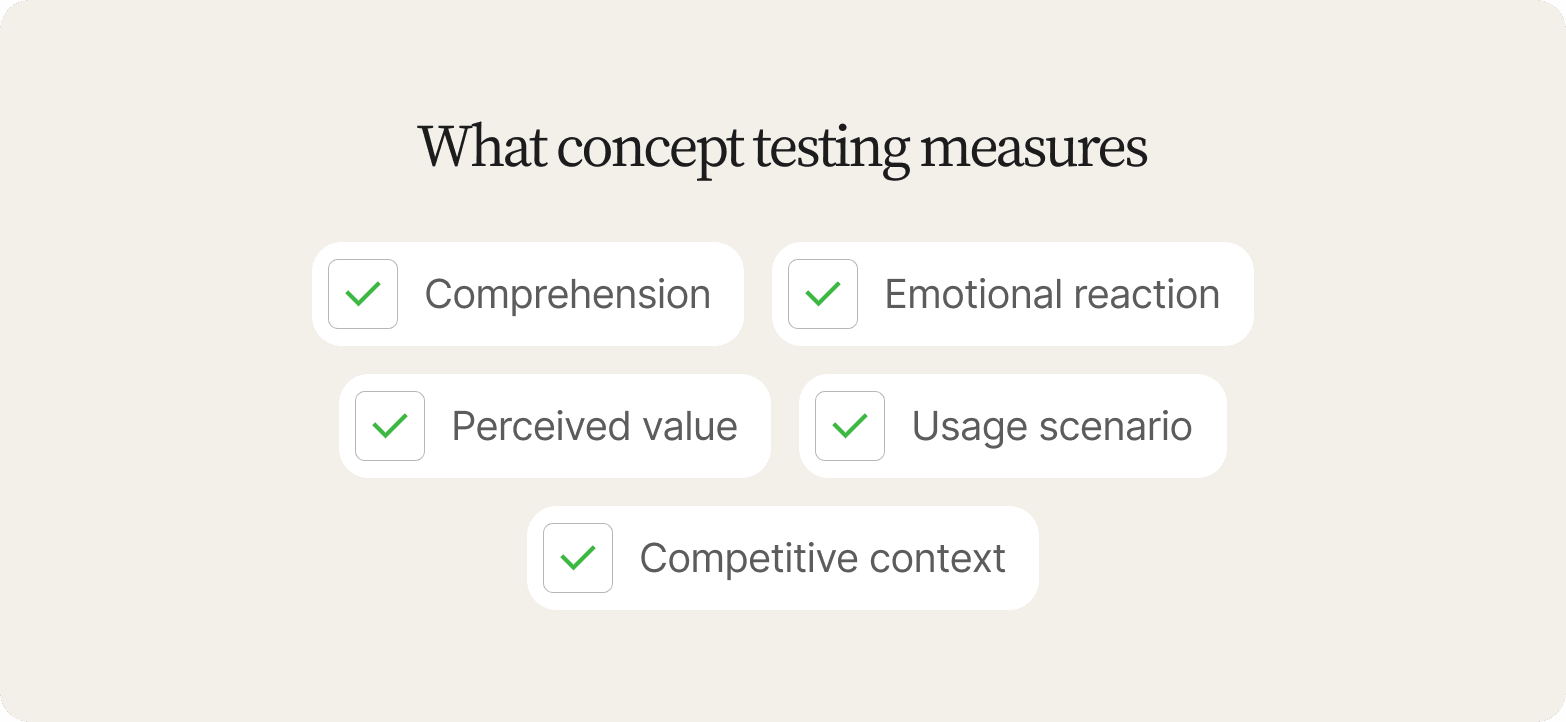
1. Comprehension: Do consumers understand what the product does?
Comprehension checks whether consumers in your target market can explain the idea back in their own words, including what it does and which problem it solves. It comes first because a consumer can easily like a concept they've misunderstood. If that happens, your findings would reflect the wrong idea.
Vague answers are usually the first sign that someone hasn't quite worked the idea out yet, for instance, when a participant says a concept is "interesting". Asking "What would you use it for?" helps show whether they've understood the concept.
2. Emotional reaction: Does it resonate or fall flat?
Most consumers are polite about new ideas, so they'll say a concept sounds good even when they have no plans to buy it. Emotional reaction measures genuine interest beyond basic courtesy.
Start with an open question like "What's your first reaction?" before any rating scale. Interested consumers tend to answer with specifics like a feature they'd use or an occasion they'd buy it for. Polite consumers stay general and say things like "it seems nice." Other cues like tone and facial expression also give more insight into participants' answers.
3. Perceived value: Would consumers pay for it and switch?
If a consumer has to drop a product or change a habit to use the product, perceived value evaluates whether the price feels worth that trade.
Asking directly about price tends to inflate the numbers, since people say yes to "Would you pay $6 for this?" far more readily than they'd pay it in a store. You'll get a more realistic read by asking about a recent purchase in the category, like what they bought and what they paid, to compare the concept's price against.
4. Usage scenario: When and how would consumers use it?
Usage scenario ties the concept to a specific moment in someone's routine. Start by asking about the last time the consumer had the problem the concept solves, then ask where the new product would have fit into that moment.
Clear answers are a good sign for adoption. A consumer who says "I'd grab this on the way to the gym" has already found a place for it. If someone can't name any occasion, they probably like the idea without needing it.
5. Competitive context: How does the concept compare to alternatives?
Consumers compare concepts with whatever they do today, which might be a rival brand or a homemade workaround, or sometimes doing nothing at all.
It helps to find out what that current option is before showing the concept. If it already works well enough for the consumer, the new concept needs a clear advantage to win them over, and the interview should find out what that advantage would have to be.
What concept testing doesn't measure
Because a concept test measures reactions to an idea, it can't answer questions that depend on a finished product or a live market. That means it's not suitable for:
Usability testing, which requires a working prototype.
Measuring final messaging effectiveness, which requires market exposure.
Measuring long-term retention, which requires usage data.
Using concept testing to answer these questions creates research debt: you spend time and budget on a study that can't provide the evidence you need, then have to run additional research later to answer the original question.
When to run concept testing across the product lifecycle
You can run a concept test at several points in the product lifecycle to learn different things. Early testing can help you choose which idea to develop, while later testing can help refine features, positioning, or a concept variant.
The problem is waiting until the team has already agreed on a direction. At that point, the test can only confirm a decision the team has already made. Running concept testing at different stages keeps consumer feedback in the decision while there are still choices to make.
1. Ideation: Which concept to develop
At the ideation stage, you're choosing between a handful of rough ideas. A snack brand might be weighing a protein bar against a savory bite, and testing the concept can show which idea solves a problem consumers care about and is easiest to understand.
This is the easiest point to change direction. A concept test can rule out a weak idea before the team commits to developing it, when there are still other options to choose from.
2. Prototyping: Which features to prioritize
Once a concept is chosen, you need to understand which features are worth developing. Testing feature descriptions or mock-ups can show which features consumers see as important and which add little value.
For example, a skincare brand might add a refill system that makes sense to the team but leaves consumers unsure how it works. Concept testing research can show that before it becomes part of the final product.
3. Pre-launch: Which positioning to lead with
At this stage, concept testing can compare different ways of positioning the same product. Showing consumers two or three positioning lines reveals which benefit stands out and whether any wording is confusing or easy to misread.
A pet food brand, for example, might find that "vet-approved" gets a stronger reaction than "grain-free." This is where concept testing overlaps with message testing: both can show which claims resonate and which need to be refined.
4. Post-launch iteration: Which concept variant to scale
After launch, concept testing can help teams decide whether a new version is worth scaling. The original concept may have worked when it launched, but customer expectations or competing products can change perceptions.
Testing a new variant gives the team a way to check whether the new idea is worth rolling out. This type of testing can be done on an ongoing basis.
How to present a concept for testing
For the most useful results, a concept needs to be clear enough for consumers to understand what they're evaluating without telling them what to think. Use these best practices as guidance.
What to include in every concept stimulus
To make sure participants have enough information to provide valuable feedback, each concept you present (also called a stimulus) should include the following:
| Element | What to include | Example |
|---|---|---|
| Problem or need | Describe the current problem or unmet need the concept is intended to address. | "Every time your detergent runs out, the whole plastic bottle goes in the trash." |
| Specific benefit | State a concrete benefit that consumers can react to. | "Uses 60% less plastic than a 1.5L bottle." |
| Use case | Explain when and how the consumer would use the product. | "Pour the pouch into your empty bottle when you run out of detergent." |
| Alternative | Identify the product, service, or behavior the concept would replace. | "Instead of buying another 1.5L detergent bottle." |
How to avoid bias in a concept stimulus
Bias in a concept stimulus usually comes from the wording or the images, and it tends to make results look more positive than they are. Here's what to avoid:
Leading or hypothetical wording. "The revolutionary refill everyone's switching to" tells consumers what to think, while "A refill pouch for your detergent bottle" leaves the judgment to them. Openers like "Imagine never running out of detergent again" have a similar effect, because consumers react to an ideal they've pictured. Describe what the product does and when it's used.
Aspirational images. A pouch shown in a bright, spotless laundry room is mostly selling the room. A plain photo of the pouch next to the bottle it refills shows consumers what they'd be buying.
Even with neutral wording and images, some consumers will give short, polite answers that don't explain their reaction. Conveo's AI research assistant asks a follow-up question whenever an answer is vague or doesn't match something the consumer said earlier, so you find out what's behind a lukewarm response.
"The pace, responsiveness, and research expertise of the Conveo team, on top of the top AI-moderated qual platform, have been invaluable to us in scaling brand advertising internationally."
Matt Harris, Research & Insights Lead, EMEA, Canva
3 concept testing methods: Monadic, sequential monadic, comparative
The main difference between concept testing methods is how many concepts each consumer sees and in what order. That can change how confidently you can compare concepts and how much participant data you need. Use this table to decide which method suits your needs best.
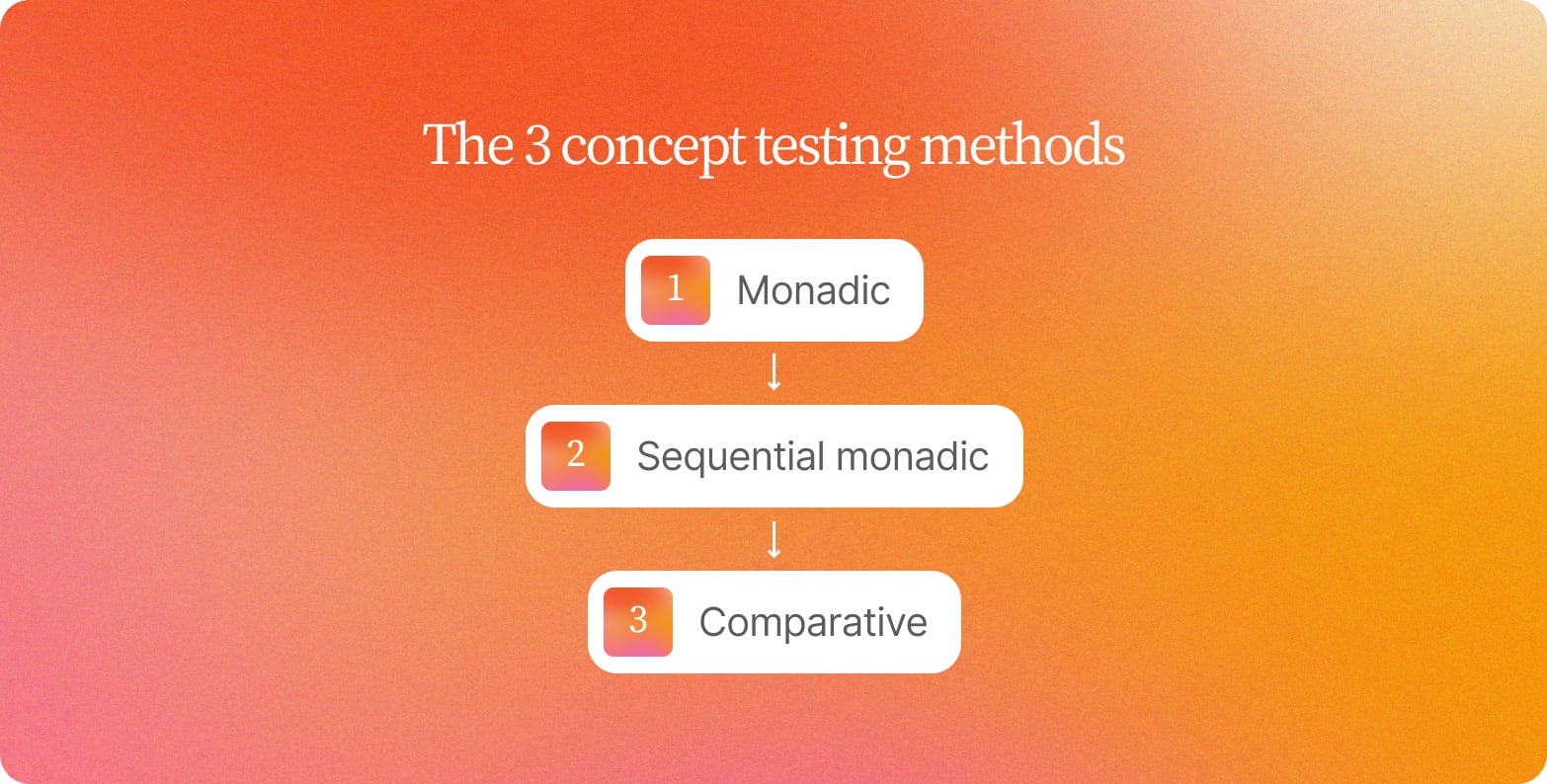
| Method | How it works | Best for | Trade-off |
|---|---|---|---|
| Monadic | Each consumer sees one concept | High-stakes go/no-go decisions | Needs a larger sample, because each concept gets its own group |
| Sequential monadic | Each consumer sees two to four concepts, one at a time, in random order | Choosing between a few concepts | Later concepts are judged partly against earlier ones |
| Comparative | Each consumer sees multiple concepts side by side and ranks them | Narrowing a long list quickly | Shows which concept wins, with little detail on why |
Once you're clear on the method you're using and the stimuli you'll present, planning the questions you'll ask ensures your concept test stays focused and you get consistent, specific feedback.
How to build a concept test discussion guide for more actionable feedback
A concept testing discussion guide has two parts: questions about what consumers do today, then questions about the concept itself.
Start with current habits, before consumers see anything. Ask what they buy in the category and why they chose it. Those answers are the benchmark for the concept, and without them you can't tell whether a consumer who likes the idea would switch to it.
After consumers have seen the concept, work through the five types of evidence. Each opening question has a follow-up to use when the first answer is vague:
| Evidence type | Opening question | Follow-up |
|---|---|---|
| Comprehension | "In your own words, what is this product?" | "What would you use it for?" |
| Emotional reaction | "What's your first reaction?" | "What specifically makes it interesting to you?" |
| Perceived value | "What did you pay the last time you bought [category]?" | "What would make this worth switching to at [price]?" |
| Usage fit | "When did you last have [problem]?" | "Walk me through where this product would have fit in." |
| Competitive context | "What would you stop buying if you bought this?" | "What would it need to do better for you to switch?" |
The follow-ups are where most of the useful detail comes from. When a consumer says "I'm not sure," asking "What would need to change for you to be sure?" usually turns hesitation into a specific objection. A fixed script can only ask the follow-ups written in advance, so these questions need an interviewer, human or AI, who responds to what the consumer said.
Video adds detail that a transcript misses. A consumer who says "yeah, I'd buy it" in a flat voice is telling you something the words alone don't. Conveo's multimodal analysis reviews video alongside the transcript and links findings to timestamped clips, so the team can watch the moment for themselves.
This can be even more important when you're running product concept testing across different markets.
Multi-market concept testing: Language, culture, and comparability
Testing a concept in several markets means that the questions have to make sense to consumers in each market, and the results have to be comparable across all of them. Here's how to approach it:
1. Localize anything tied to local habits
A word-for-word translation can keep the meaning of a question and still lose what it refers to. Price is the most common example: a concept priced at $6 reads very differently in a market where the category usually sells for the equivalent of $2. Use local currency and set the price against what consumers there already pay.
Brand references work the same way. A question that names a US market leader will confuse consumers in markets where that brand isn't sold, so swap in the local equivalent.
2. Keep the core questions the same
To compare markets, the order of the guide and the wording of the core concept testing questions need to stay fixed. If one market hears "What's your first reaction?" and another hears "Do you like it?", differences in the results could come from the wording. A simple rule is to localize prices and brands and keep everything else identical.
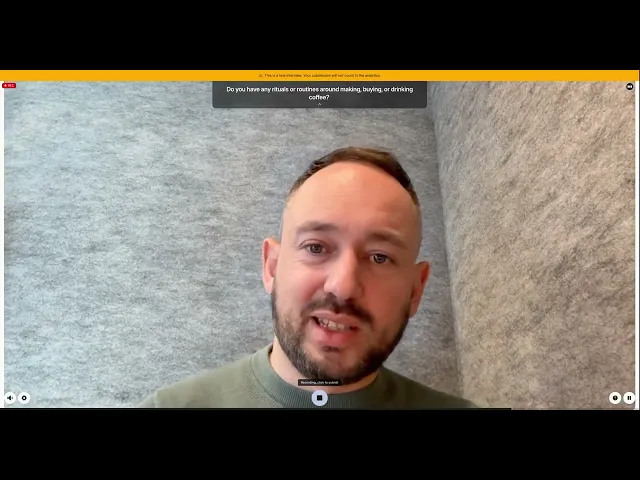
Conveo runs AI-moderated video interviews in 50+ languages, so consumers in each market can answer in a way that's natural for them. See how the AI research assistant probes a concept reaction:
How to mix qualitative depth with quantitative signals in concept testing
The simplest way to combine quantitative and qualitative research in a concept test is to ask for a rating, then ask why in the same interview. The score gives you a number you can compare across concepts, and the answer explains the score, so you're never left matching numbers from one study to explanations from another.
When one score comes back low, the follow-up needs to find out a specific thing:
| Evidence type | Score to collect | If it's low, find out |
|---|---|---|
| Comprehension | Share of consumers who can describe the main benefit correctly in their own words | Which part of the concept they misread |
| Emotional reaction | How appealing consumers find the concept, on a 1 to 5 scale | What put them off, and whether it's the idea itself or the way the concept describes it |
| Perceived value | Whether the price feels worth it for what the product offers, on a 1 to 5 scale | Whether the price is the problem or the benefit isn't strong enough to justify it |
| Usage scenario | How often consumers expect to use it, from weekly to rarely | Whether they can name a specific moment in their routine where it fits |
| Competitive context | Share of consumers who'd choose it over what they use now | What their current option does that the concept doesn't |
Combining both approaches in concept testing helps save time and budget, as you don't need to recruit or plan a separate follow-up to explain your results.
Conveo's approach to concept testing
Insights teams use Conveo to run concept testing whenever a new idea is ready, with the reason behind every consumer reaction built into the results. Here's how it works as a concept testing tool:
Follow-up questions on every vague answer. Conveo's AI research assistant interviews consumers on video and asks follow-up questions when an answer is vague or leaves a gap, building on what the consumer said earlier.
Findings you can trace to the source. Every theme links back to the participant behind it, with a timestamped video clip and quote, so anyone reviewing the results can check where a finding came from.
Enterprise-grade security. Conveo is SOC 2 Type II and GDPR compliant, with data hosted in Europe.
Findings that build across studies. Every study lands in Conveo's searchable insight library, so when the next concept goes into testing, the team can pull up what earlier tests found.
Frequently asked questions
What is concept testing?
Concept testing is research used to evaluate an idea with potential customers before it's fully developed. A concept test can show whether people understand the idea and see value in it. The strongest concept testing research goes beyond a rating or preference score to uncover why people reacted that way.
What are some examples of concept testing?
Concept testing examples can range from comparing new product ideas in the discovery phase to testing a value proposition before a product launch. For example, a consumer packaged goods brand might use a concept screening survey to compare several new snack concepts and identify the most promising concept for full-scale development. A brand might also test different packaging or positioning ideas to understand customer preferences and how each option affects brand perception.
How is concept testing different from usability testing?
Concept testing asks whether an idea works for the target audience before it has been built. Usability testing asks whether people can use a working product or prototype successfully. In simple terms, concept testing helps you decide whether an idea is worth developing, while usability testing helps you find problems with something you've already built.
What's the difference between concept testing and focus groups?
Concept testing evaluates how individual consumers respond to a specific product idea, while focus groups use a moderated group discussion to explore people's opinions and reactions. Concept testing is useful when you need to compare responses across a target audience and understand what drives those responses. Focus groups are useful when the group discussion can help uncover how people think about or react to an idea.
What's the difference between monadic and sequential monadic testing?
Monadic testing shows each participant one concept, so their reaction is not shaped by another concept they have just seen. Sequential monadic testing shows participants several concepts one at a time, usually in a randomized order. It lets you compare concepts while still capturing each reaction on its own.
How do you know if a concept test result is reliable?
A useful concept test gives you more than a score. The stimulus needs to be clear, the questions need to avoid leading participants, and the sample needs to reflect the target audience. Most importantly, you should be able to understand what sits behind the result. If a concept scores poorly, for example, the research should help explain whether people misunderstood it or couldn't see when they would use it.

About the author
Hendrik Van Hove
Founder & CPO
Hendrik is Conveo’s Chief Product Officer and co-founder. He's extremely passionate about technology and the real positive impact it can bring. Before Conveo, he ran AI strategy projects at McKinsey for the Fortune 2000, working with boards and every function from marketing, to sales to insights.
More by Hendrik →Qualitative insights at the speed of your business.
Conveo runs AI-moderated video interviews and structures everything they say.