In this article
TL;DR
The gap: Dashboards show what happened and what customers did, not what they were thinking when they did it, and that's the layer pricing, positioning, and messaging decisions actually need.
The fix: AI-moderated video interviews supply that missing layer at speed, compressing research cycles from weeks to days so the evidence arrives before the decision does.
The proof: Every insight traces back to a real participant, a timestamped clip, and a verbatim quote, which is what lets teams trust AI-generated recommendations enough to act on them.
Best for: Insights and CMI professionals evaluating whether their decision intelligence stack can actually explain customer behavior, not just report it.
What AI decision intelligence actually requires (and what most systems miss)
An insight that arrives after the decision has closed is functionally equivalent to no insight at all. When the window shuts, so does influence. Velocity plus hit rate on new decisions is now the competitive variable, and neither survives a decision-making process that works in quarterly batches.
AI decision intelligence, sometimes shortened to decision intelligence (DI), refers to systems that combine data, business rules, and machine learning to recommend or automate business decisions. The discipline draws as much on decision theory, decision modeling, and data science as it does on software engineering.
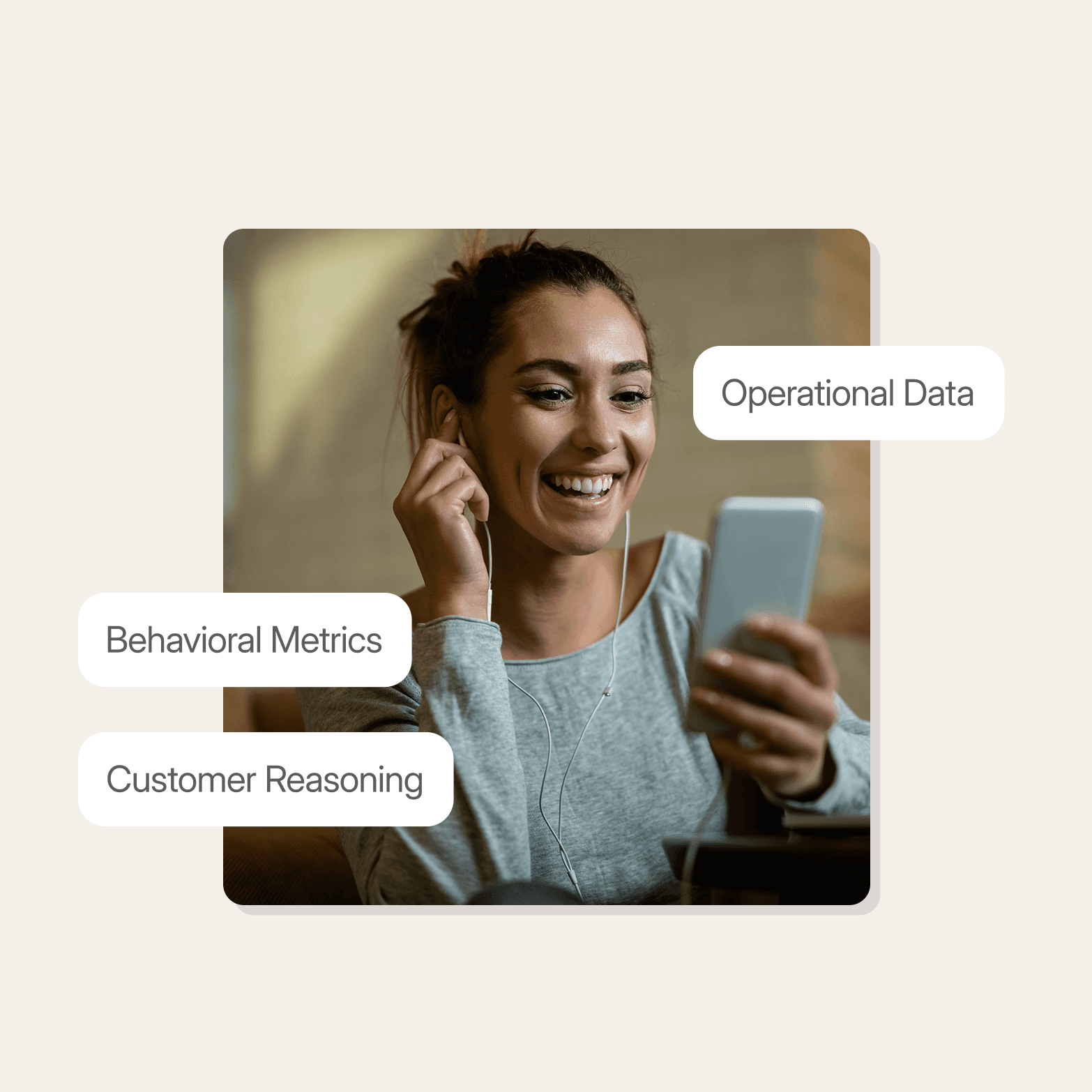
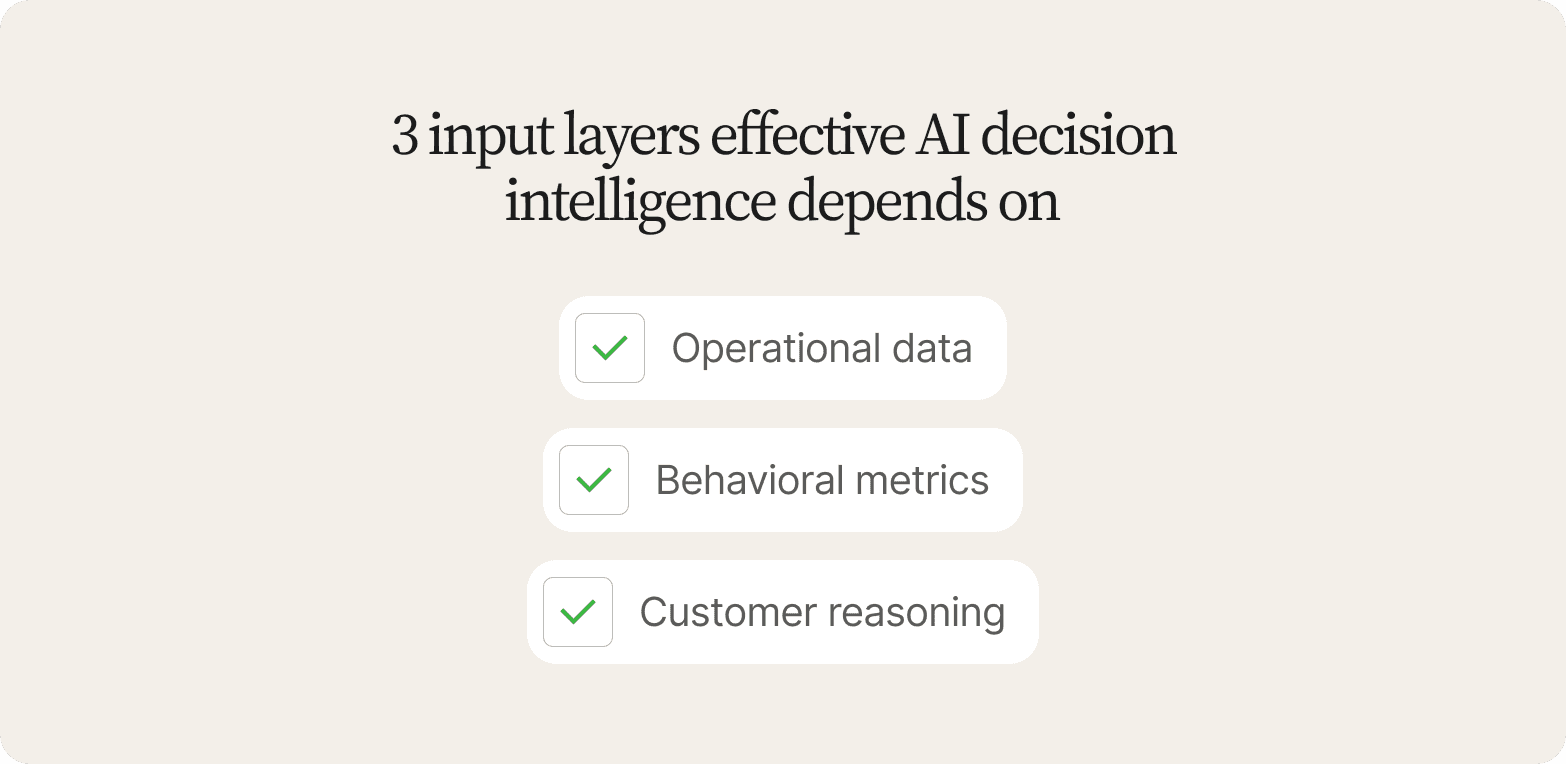
Effective AI decision intelligence depends on three input layers.
The first is operational data: what happened inside the business, drawn from ERP systems, CRM records, transaction logs, and the feeds that inform supply chain decisions, scattered across multiple internal systems, often arriving as both structured and unstructured data that must be reconciled before a platform can act on it.
The second is behavioral metrics: what customers did, captured through clickstream data, conversion rates, and customer data. Most enterprise platforms integrate these disparate data layers with reasonable confidence, drawing on both historical and real-time data.
The third layer is the one that gets skipped: customer reasoning, the traceable, research-grade, deep understanding of why customers behaved the way they did. This layer carries as much weight as the other two. For any decision touching pricing, positioning, messaging, concept validation, or brand strategy, the "why" determines whether the recommendation is sound or simply plausible-looking.
Business intelligence (BI) shows you what happened. A decision intelligence platform tells you what to do. But when the decision involves customer-facing choices, both depend on the reasoning behind customer behavior. A dashboard can show that conversion dropped 14 points after a packaging change. It cannot tell you whether customers found the new design confusing, unappealing, or less visible on shelf. That distinction changes everything about the corrective action.
The gap persists because operational data and behavioral metrics are designed to reduce cleanly to machine-readable data points. Customer reasoning resists that reduction. It lives in what people say, how they say it, what they hesitate over, and what they contradict between the first and second time they are asked.
Capturing it at the volume and speed decision intelligence systems require, even with advanced analytics layered on top, has historically meant choosing between depth and scale: either run rigorous qualitative research that takes weeks, or accept behavioral proxies that answer the wrong question quickly.
That tradeoff is the structural problem Consumer Understanding Infrastructure is built to close. Conveo is Consumer Understanding Infrastructure: infrastructure that sits alongside the CRM and ERP, distinct from research or survey platforms. When the reasoning layer is traceable, video-verified, and delivered in days rather than weeks, it becomes a usable input for the AI decision intelligence stack, enabling organizations to act while the recommendation is still being shaped.
Why dashboard data can't answer the questions that matter
Most customer-facing decisions rest on a stack of operational data: NPS scores, support ticket volume, churn rates, session recordings, and product usage logs. Decision intelligence platforms are good at connecting these sources through routine data analysis. The objection is reasonable: if the data is integrated, what is missing?
What is missing is the layer that explains why customers did what they did, and whether they would do it again under different conditions.
Consider what each data type actually tells you. Operational metrics tell you what happened: NPS moved by 3 points, support tickets spiked after a release, and conversion dropped on the pricing page. Behavioral metrics tell you what customers did: they clicked, they churned, they abandoned. What was happening in the customer's mind when they made those choices stays outside both layers. That reasoning is the input customer-facing decisions actually require.
A support ticket tells you a feature broke. It leaves open whether the customer tolerated it because they had no alternative, or whether that friction is quietly building a case to switch. NPS tells you satisfaction shifted. It leaves open whether the driver was a product change, a competitor's move, or a pricing perception that your messaging created six months ago. The number confirms something happened. The reasoning behind it stays out of reach.
This is where adaptive probing changes the equation. When a participant says something unexpected during an AI-moderated interview, Conveo's AI moderator, powered by natural language processing, follows that thread in real time, asking the next logical question rather than advancing to the next item on a script. The result is behavioral and attitudinal context that no dashboard can surface, because dashboards record what customers did while the reasoning stays unrecorded.
For strategic decisions about positioning, messaging, and product direction, that reasoning is the primary input. A team deciding whether to reframe a value proposition cannot do so based on click data. A team evaluating two product directions cannot resolve the tradeoff from churn rates alone. The "why" layer is the evidence that makes the decision defensible.
How AI-moderated research feeds decision intelligence with traceable evidence
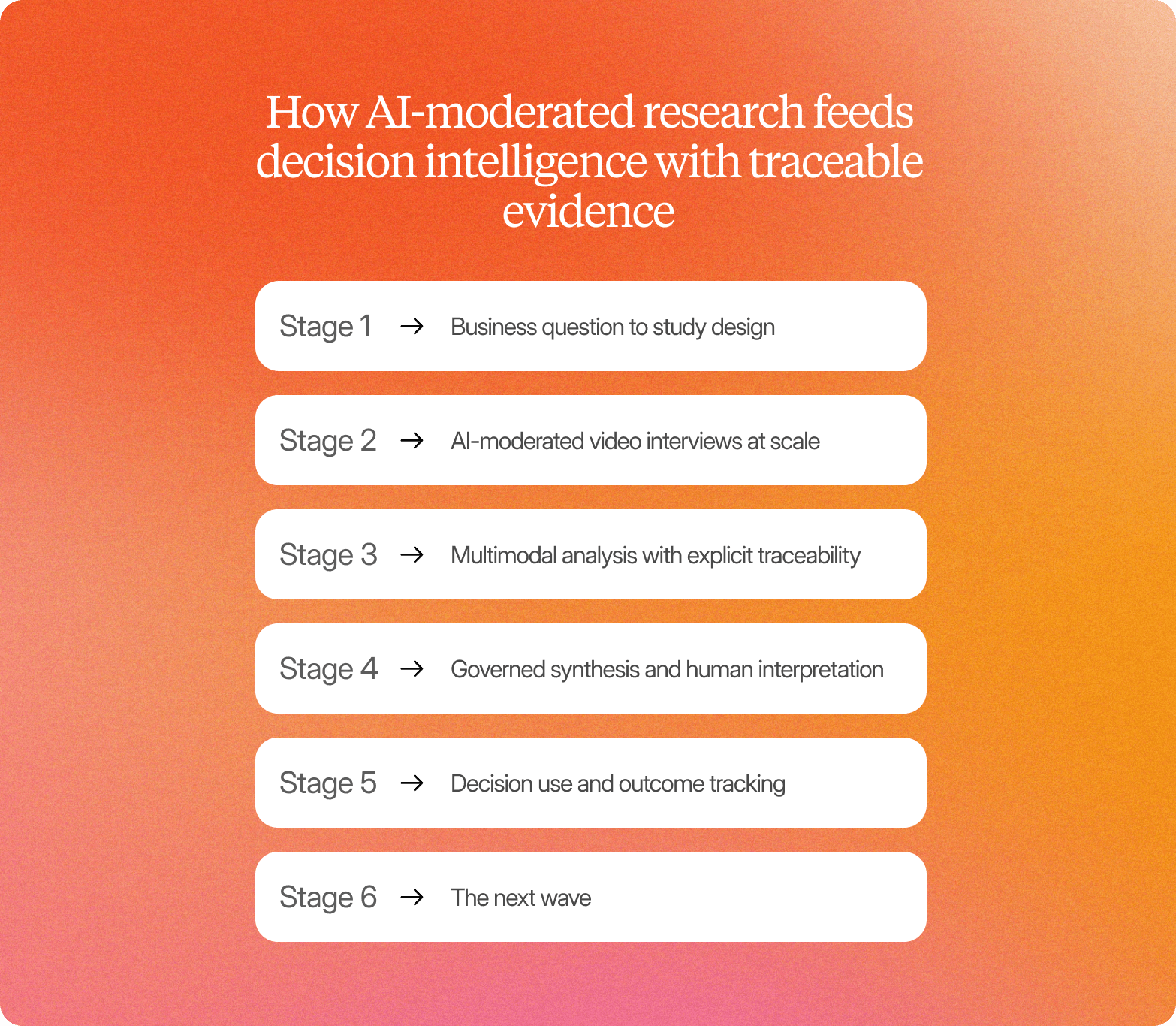
The workflow that turns a business question into a decision-ready recommendation runs in a tighter loop than most insights teams currently operate. Here is how each stage connects and why governance at every handoff separates research-grade evidence from AI-generated noise.
Stage 1: Business question to study design
A decision window opens: a concept needs validation, a campaign is being briefed, a brand equity shift needs to be explained. A researcher shapes the discussion guide: the hypotheses to test, the participant profile, the probing logic. This is where human judgment is non-negotiable: human decision makers, not the algorithm, own the study design. The AI moderator executes the guide, but the researcher designs it. That distinction matters for methodology continuity and for every governance review that follows.
Stage 2: AI-moderated video interviews at scale
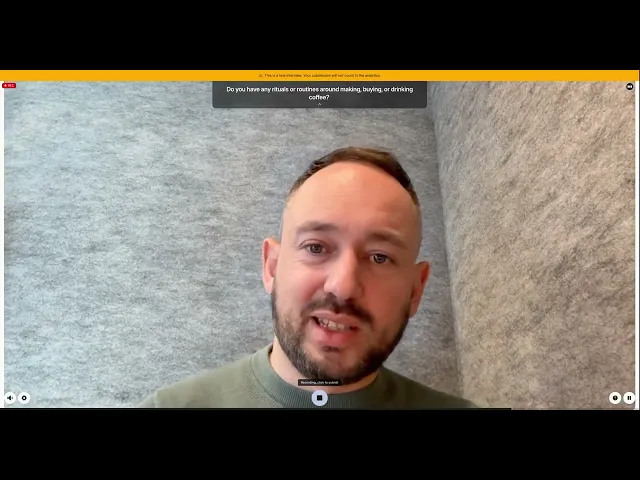
Participants receive a link and complete their session on their own schedule, in 50+ languages, with an AI moderator built on machine learning algorithms trained to recognize hesitation and tone shifts, following what they actually say rather than advancing to the next scripted question.
When a participant hesitates, shifts tone, or gives an unexpected answer, the AI probes. Participants are 68% more open than in a traditional moderated session, which means the underlying data is richer.
See it in action: How AI-Moderated Video Interviews Actually Work
Stage 3: Multimodal analysis with explicit traceability
As recordings land, analysis begins immediately. Multimodal analysis encompasses speech, tone, and facial cues, capturing the nonverbal signals that a transcript alone cannot convey. A brow furrow at a price point, a tone shift when a competitor's name appears: these are the signals that explain why a number moved, not just that it did. Every theme that surfaces is designed to generate insights that link directly to a timestamped video clip and verbatim quote. Stakeholders can inspect the evidence behind any recommendation without asking a researcher to reconstruct it from memory.
"Super valuable... ahead of where most of your competitors are... quite a special way to analyze this data"
Matt Harris, Research & Insights Lead, EMEA, Canva
Stage 4: Governed synthesis and human interpretation
Thematic synthesis is AI-assisted, but interpretation stays with the researcher. That is the governance model, an exercise in data governance as much as research methodology: the AI handles the operational work of coding and clustering at scale, while human intelligence, the researcher's judgment, applies context, flags contradictions, and frames implications for the specific decision at hand. Every participant is real, every session is recorded, and every insight traces to the person who said it, which is what makes findings presentable to executive audiences rather than only internally useful.
Stage 5: Decision use and outcome tracking
Findings are delivered to stakeholders as structured, stakeholder-ready reports with embedded video clips. The recommendation lands with its evidence attached, which means the team presenting it can answer "how do you know?" in the room, not in a follow-up email. That credibility shifts the insights function from a team that validates the final decision after the fact to one that shapes it while it's still forming, helping the business make more consistent decisions over time.
Stage 6: The next wave
Every study feeds the insight library, building a base of data-driven insights rather than a one-time report. Themes connect across waves, contradictions surface automatically, and the next study starts with the accumulated context of everything learned before it. Nothing gets researched twice. For teams that need an ongoing read of their market rather than a one-off answer, Conveo StoryLines runs continuous, wave-based AI-moderated research programs with themes tracked across waves and findings connecting across studies.
The 3 levels of decision intelligence maturity (and where customer understanding fits)
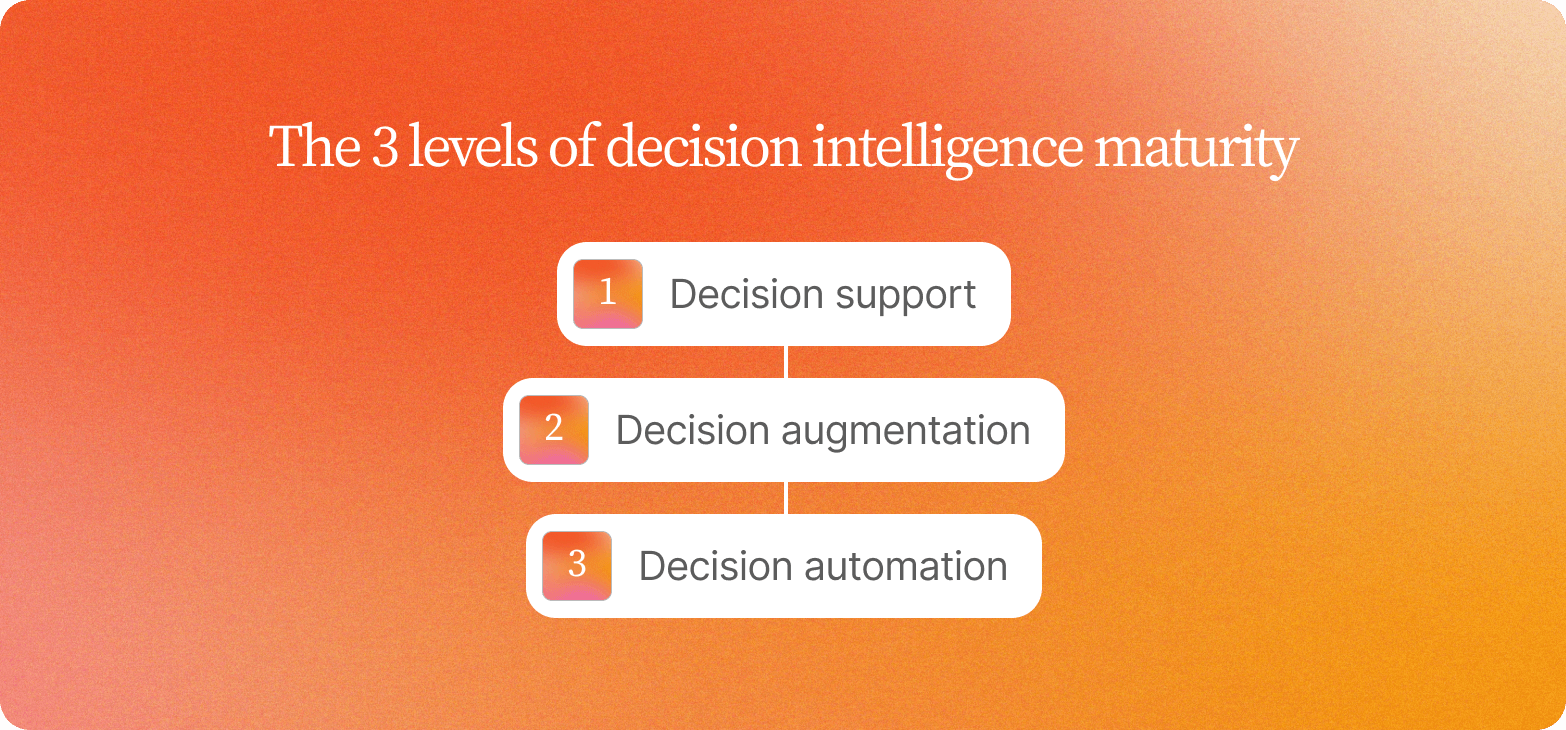
Most organizations already use AI to support decision-making in some form. The real question is how far along the maturity curve they can safely go, and what quality of evidence each level actually demands.
1. Decision support
AI surfaces patterns through predictive analytics, flags anomalies, and generates summaries for human evaluation. The stakes are bounded. If a recommendation is wrong, a researcher catches it before it reaches a stakeholder. Evidence quality matters here, and a degree of ambiguity remains tolerable because human judgment is still the final filter.
2. Decision augmentation
AI-generated outputs, often built on prescriptive analytics, directly shape strategic choices: which concept moves to market, how a campaign message is framed, whether a product feature gets funded. The human is still in the loop, and the AI's contribution carries real weight. At this level, a researcher can only stand behind a finding they can trace. If a stakeholder asks, "How did you reach this conclusion?" the answer needs to point to a specific place. Every insight needs a named source, a verbatim quote, and a video clip of the person who said it. Black-box synthesis breaks down under this level of scrutiny.
3. Decision automation
AI decision intelligence feeds directly into product, pricing, or campaign systems via decision-workflow automation, with minimal human review between insight and action. The governance requirements here are non-negotiable. Synthetic participants, hallucinated quotes, and opaque thematic clustering become liability at this level.
This is exactly where the objection "we can't trust AI outputs for decisions without knowing how conclusions were reached" becomes a legitimate governance concern for any decision-intelligence framework a business adopts, rather than a change-management problem. The answer is to build on a foundation where traceability is structural.
Conveo's approach to decision intelligence technology is built for this: every insight traces to a real participant who completed a recorded session, with every theme connected to a timestamped quote or clip. That architecture is what lets organizations progress up the maturity curve without accumulating governance risk at every step.
What research-grade AI decision intelligence looks like in practice
The following scenarios are representative and illustrative, not individual named client cases.
Two scenarios show where traceable qualitative inputs change the potential outcomes teams actually choose between.
Concept testing under a launch deadline
The innovation team has a four-week window before a line extension goes to market. Survey scores from a prior round show two concepts performing within the margin of error of each other, so the team defaults to the one the creative director prefers. What they lack is the reason one concept consistently triggers hesitation at the pricing moment while the other clears it. With AI-moderated video interviews running across the target segment in parallel, that pattern surfaces in the facial and tonal data before the decision closes, not after the launch review. The finding lands in the insight library tagged to the concept, category, and price sensitivity theme, so the next concept test starts from what was already learned rather than re-learning it.
Churn diagnosis when behavioral data shows the what but not the why
Retention metrics show a drop-off at week six of the customer lifecycle. The product team has the cohort data, the funnel breakdown, and the relevant data points behind three competing hypotheses: onboarding friction, a missing feature, or a pricing perception gap. Without knowing which one is driving behavior, the team is choosing between interventions based on seniority rather than evidence. AI-moderated depth interviews with recently churned participants surface the actual language customers use when they describe the moment they disengaged, language that sits outside all three internal hypotheses. It points instead to a trust signal that erodes during the trial period, traceable to specific participants with verbatim and video timestamps, and now cross-referenced in the insight library against any future study that touches on onboarding or trial experience.
What connects both scenarios is that the findings stay live. Each one compounds. When the next question touches on pricing, retention, or segment strategy, the platform surfaces what has already been learned and flags where new evidence contradicts prior assumptions, protecting business performance along the way. Periodic agency studies answer the question in front of them. A compounding insight library makes every future question smarter.
Evaluating AI decision intelligence platforms: The 7 questions procurement won't ask but should
Most vendor comparison content in this category asks whether a platform supports AI moderation, how many languages it covers, and whether it integrates with your existing internal systems. Those are table-stakes questions. The evaluation criteria that actually distinguish credible Consumer Understanding Infrastructure from a well-packaged demo are almost never included in the standard RFP template.
1. Input traceability: can every finding be traced back to a real person who said it?
Ask the vendor to show you a specific insight and walk you backward to the source. You should be able to reach a timestamped video clip, a verbatim quote, and a participant identifier. If the answer involves a summary generated from aggregated responses by opaque AI models with no individual-level traceability, treat that as a governance risk.
2. Participant authenticity: are you talking to real people, or synthetic proxies?
Some platforms now generate synthetic participants from prior data or demographic models. Ask directly: are participants real humans who completed a live session? Platforms that cannot confirm real participation cannot confirm that findings reflect actual consumer behavior.
3. Moderation quality: who designed the probing logic, and how does it adapt?
AI moderation varies widely in methodological rigor. Ask whether the discussion guide is static or adaptive, and what happens when a participant gives an unexpected answer. Ask who on the vendor's team designed the moderation framework, and what their research background is. Conveo's platform is built by researchers, so the moderation logic reflects genuine methodological discipline rather than a generic interview script.
4. Analysis transparency: how does the platform move from raw data to thematic output?
"AI analysis" covers everything from keyword extraction to genuine thematic synthesis. Ask for a walkthrough of how themes are generated, whether the researcher can interrogate or override the output, and how contradictions across participants are surfaced rather than smoothed over.
5. Compounding value: does understanding accumulate, or does each study start from zero?
Ask whether the platform maintains a searchable insight library that links evidence across projects, and whether a researcher can query across studies in plain language without rebuilding context from scratch each time.
6. Researcher oversight: where does the human stay in control?
Ask specifically where in the workflow a researcher reviews, interprets, and applies judgment. The answer tells you whether the platform is built to support methodological accountability or to sidestep it.
7. Organizational adoption: who else in the business can access findings, and how?
Ask whether stakeholders in brand, product, and strategy can search and retrieve findings without researcher mediation, and whether the platform supports SSO, role-based access, and regional data hosting as part of a broader data governance program for multi-market teams. These are questions about whether the investment pays out beyond the research function.
How Conveo closes the customer reasoning gap
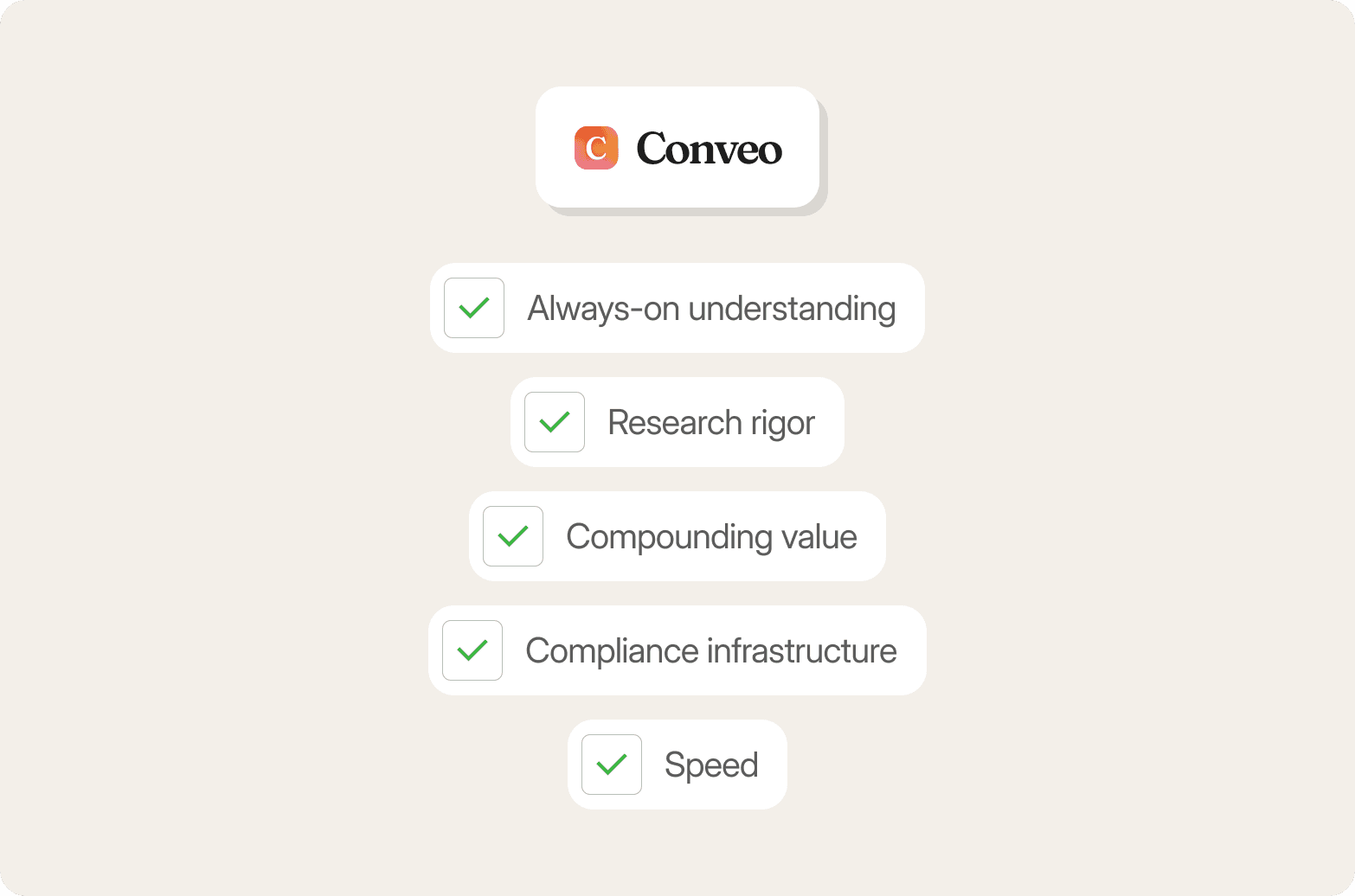
The argument this article has built points to a specific gap: AI decision intelligence stalls when the customer reasoning layer is missing, untraceable, or arrives too late to influence the decision. Closing that gap requires always-on qualitative evidence that is fast enough to reach stakeholders before the decision closes, rigorous enough to survive a boardroom challenge, and structured to compound rather than expire, translating into measurable business outcomes.
Always-on understanding
That is the infrastructure Conveo is built to provide. For teams that need continuous reading rather than periodic studies, Conveo StoryLines (Continuous Consumer Understanding) runs wave-based, AI-moderated research programs, typically bi-weekly or monthly, with themes tracked across waves and findings connecting across studies, helping teams forecast future trends rather than just react to them. The decision window stays open long enough for the insight to land.
Research rigor
Hundreds of enterprise teams, including Google, Unilever, AB InBev, and Kellanova, rely on Conveo to run AI-moderated research at scale. The platform is built by researchers and data scientists, and participants are 68% more open than when using a human moderator, yielding richer evidence to support smarter decisions while maintaining the methodological standards that make findings credible to senior stakeholders.
Compounding value
Every study feeds the insight library with actionable insights that carry forward. Every theme connects to prior evidence. Every future study starts smarter. It is what makes Consumer Understanding Infrastructure different from a series of commissioned studies.
Compliance infrastructure
Conveo is SOC 2 compliant and GDPR compliant, with European hosting and primary infrastructure in Belgium. For procurement and governance readers, the audit trail runs from recommendation to participant.
Speed
Teams report compressing timelines from weeks to days, delivering findings while the decision is still open.
Who Conveo is not for
If your team runs fewer than five qualitative studies per year, or if your decisions do not require traceable, research-grade evidence, a lighter survey platform may be a better fit. Conveo is built for enterprise teams who need continuous customer understanding at scale.
For insights and CMI teams who need to shift from post-hoc validators to strategic partners, the starting point is a single study. The value builds from there.
Frequently Asked Questions
What is AI decision intelligence, and why does customer understanding matter for it?
AI decision intelligence refers to systems that combine data, business rules, analytics, and machine learning to recommend or automate business decisions. Most implementations cover operational data and behavioral metrics well, often through routine AI and machine learning pipelines. The layer that consistently gets skipped is customer reasoning: the traceable, research-grade understanding of why customers behaved the way they did. For decisions about pricing, positioning, messaging, or product direction, the reasoning layer is the primary input.
How is AI-moderated qualitative research different from a survey or an NPS program?
Surveys and NPS programs capture responses to fixed questions, which means they can only surface what the researcher already knew to ask about. AI-moderated interviews adapt in real time: when a participant says something unexpected, the AI moderator interprets the natural language as it's spoken and follows that thread rather than advancing to the next scripted item. Participants are 68% more open than when using a human moderator, and video evidence preserves tone and nonverbal signals that written responses cannot convey.
How long does it take to get findings from an AI-moderated study?
Teams report compressing timelines from weeks to days using AI-moderated research at scale. The compression comes from running sessions asynchronously and in parallel rather than sequentially: participants join on their own schedule, across time zones, without waiting for a moderator's calendar. Moderation, transcription, and thematic analysis occur in real time as recordings arrive, rather than after all sessions are complete.
What makes AI-moderated research trustworthy enough for executive-level decisions?
Traceability is the foundation for data-driven executive-level decisions. Every insight, theme, and recommendation in a Conveo study links back to a real participant who completed a recorded video session. Stakeholders can watch the moment a finding was said and verify the source without asking the research team to reconstruct it. The platform is built by researchers and data scientists, and the governance model keeps human interpretation at the center: AI handles moderation and transcription; researchers own the study design and conclusions.
How does a compounding insight library change the value of qualitative research over time?
A single study answers the question in front of it. A compounding insight library makes every future question smarter. The value of that institutional memory grows with every study added, compounding into stronger strategic outcomes over time. When a new study addresses a previously researched topic, the library automatically surfaces prior evidence and flags contradictions between old and new findings. Stakeholders in brand, product, and strategy can search it in plain language and retrieve sourced answers without researcher mediation.

About the author
Florian Hendrickx
Head of Growth
Florian is Conveo’s Chief Growth Officer, leading growth strategy and go-to-market execution as the company scales. He’s held growth leadership roles at companies like Deliverect, Robovision, and Aikido Security, and brings hands-on experience across marketing, sales, and product.
More by Florian →Qualitative insights at the speed of your business.
Conveo runs AI-moderated video interviews and structures everything they say.