In this article
TL;DR
The customer decision journey is the path a buyer takes from first noticing a need to choosing and staying with a product or service, usually described in five stages: awareness, consideration, evaluation, purchase, and retention.
Post-purchase journey mapping captures hindsight rationalization: people smooth over contradictions and forget the paths they almost took.
Studying the customer decision journey while the choice is still open surfaces the hesitations, pain points, and workarounds a retrospective interview edits out.
A defensible customer journey map needs an ongoing research system: behavioral segmentation, saturation-based sampling, a retrievable evidence library, and waves tied to real decision gates.
Timing decides whether research can influence a decision at all: insight that lands after a gate closes becomes a post-mortem.
Video evidence traced back to real participants is what makes a journey map survive a stakeholder review and build trust.
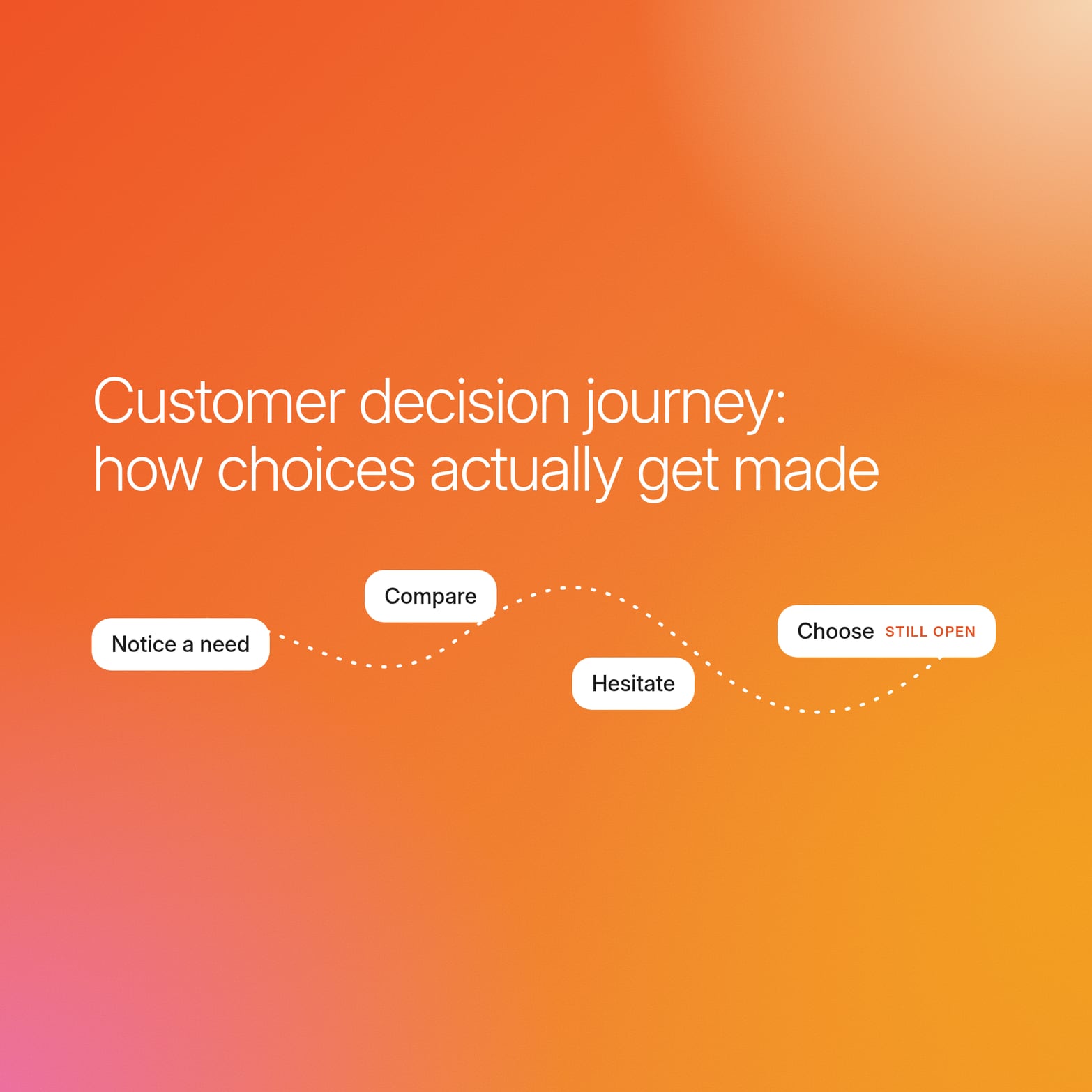
The customer decision journey your team maps after a launch reads like a clean, rational sequence: awareness, then consideration, then a confident choice. It rarely happens the way teams expect. Ask buyers why they chose you once the purchase has closed, and they hand back a tidy story that edits out the false starts, the options they almost picked, and the weeks they spent hesitating. Satisfied customers tell the tidiest version of all, because the outcome already feels like proof they chose well.
That gap is a matter of timing. A post-purchase reconstruction of the customer decision journey captures hindsight rationalization. Most people smooth over contradictions, forget the moments they nearly walked away, and impose coherence on an evaluation that was messy as it happened. By the time anyone asks, the decision has closed, and insight that arrives after that point can no longer change anything.
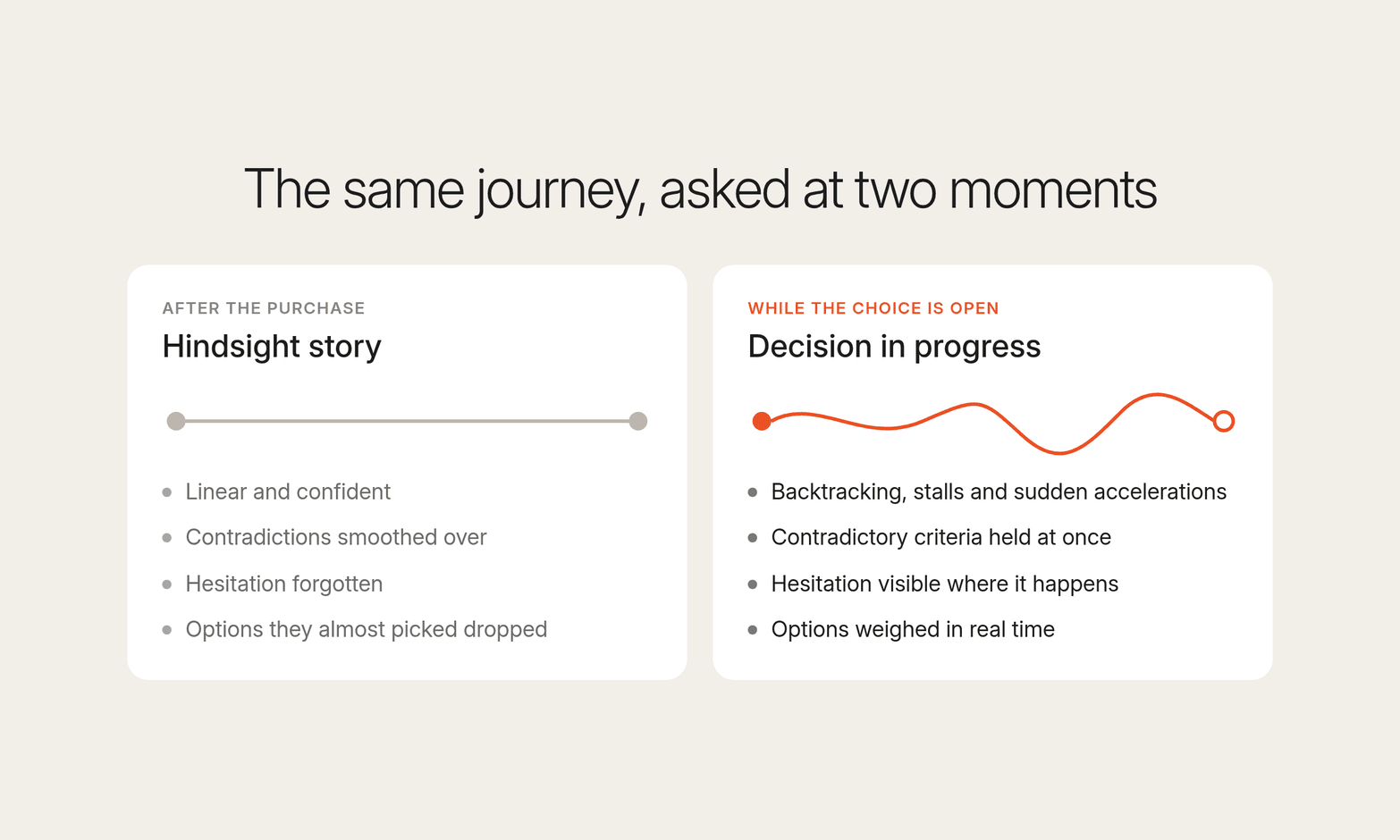
The reconstruction feels credible because it is coherent, but strategy built on it optimizes for a journey that never existed. What follows shows what becomes visible when you study consumers while the choice is still open.
Why most customer decision journey maps are built on memory
Here is how the failure repeats. A company commissions journey research after a launch, when memory has already started editing the path. Interviewing existing customers then can only recover a rationalized version of events, so the customer journey map inherits the distortion no matter how carefully it is drawn.
The story satisfied customers tell is linear and confident. The real evaluation behind most purchasing decisions was full of contradictory criteria, abandoned shortlists, and long stretches of hesitation. Optimize touchpoints, messaging, and product features against the tidy version, and you tune every place a customer interacts with your brand for a customer decision journey that never occurred.
Most alternatives share this flaw. Post-purchase interviews, customer satisfaction surveys, survey-based journey mapping, and synthetic AI persona tools all reconstruct the customer buying journey after the fact or infer it from patterns. Even detailed post-purchase feedback describes the outcome more than the path, and a synthetic model can only estimate what a buyer would likely do.
What in-progress decision research captures
Study the choice while it is still open, and the picture is still forming. Instead of a rationalized summary, you see the deliberation itself as potential customers move through the consideration stage and continue comparing solutions.
| Post-purchase reconstruction | In-progress capture | |
|---|---|---|
| Timing | After the decision has closed | While the choice is still open |
| Shape of the story | Linear and confident | Backtracking, stalls, and sudden accelerations |
| Contradictions | Smoothed over in the retelling | Contradictory criteria a buyer holds at once |
| Hesitation | Forgotten or edited out | Visible at the exact point evaluation stalls |
| Alternatives | Options they almost picked get dropped | Workarounds tried, and options weighed in real time |
You can watch someone lean toward one brand, check reviews and user-generated content, then drift back to another, and see the real problems driving customer behavior that a summary flattens into one stated reason. That is the raw material of a customer decision journey anchored to what people actually weighed.
Ninth Seat saw this in a four-touchpoint in-home study that started with a live unboxing and interviewed the same consumers again after days of use:
"Consumers did a live unboxing for us: seeing it for the first time, giving us their first reactions. They don't have time to rationalize. It's all emotive, in that moment."
Dafydd Jones, Associate Director, Ninth Seat
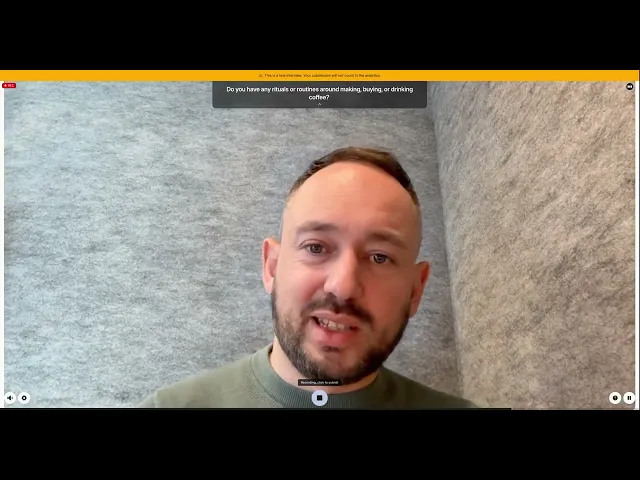
Capturing that at scale used to be the hard part. Asynchronous AI-moderated video interviews run without live scheduling, so video conversations run in parallel across markets and time zones and findings land while the brief is still open.
Depth holds up too. Conveo's AI research assistant asks follow-up questions when an answer is vague or leaves a gap, building on what the participant said earlier. That adaptive follow-up reaches the objections, pain points, and decision criteria that scripted interviews and fixed surveys miss, including the ones retail sales and consumer service teams usually hear secondhand.
See it in action: How AI-moderated video interviews work.
How to turn a customer decision journey from a slide into a research system
Most customer journey maps are static artifacts: someone creates one, presents it in a deck, and never tests it against new evidence. Turning a customer decision journey into a research system means deciding in advance what evidence to collect at each stage, how often, how, and who owns the cadence, so the focus stays on the decisions the map is meant to inform.
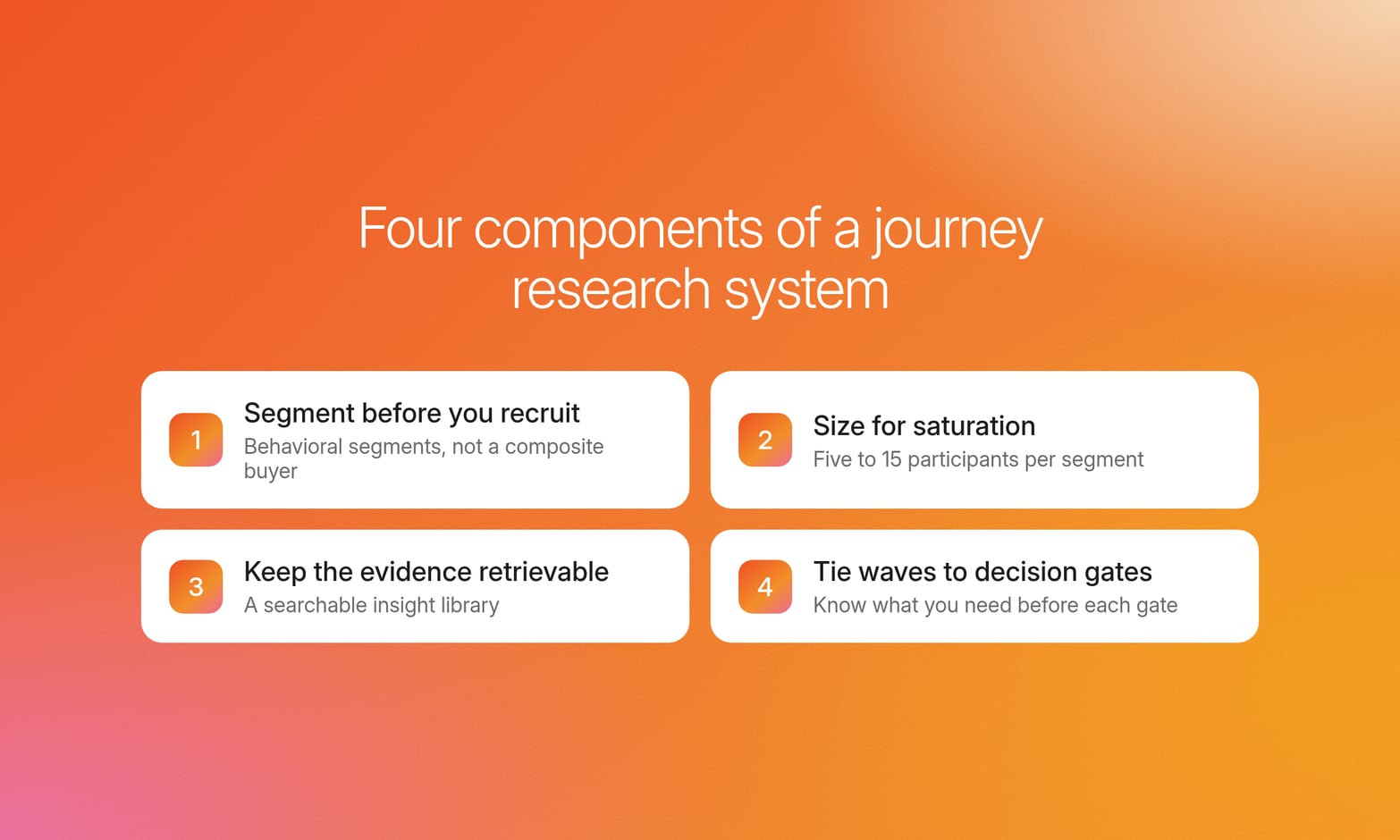
Four components make that system work:
Segment before you recruit. Define behavioral segments up front so findings don't average into a fictional composite buyer that hides real differences in customer behavior.
Size for saturation. Five to 15 participants per segment often reaches saturation fast enough to inform in-flight planning.
Keep the evidence retrievable. A searchable insight library stops research from dying in slide decks. Feed it signals from consumer support interactions and retail sales teams, so new interviews start from what you already know.
Tie waves to decision gates. Map each stage to a real internal gate (creative brief lock, packaging freeze, launch planning, and budget commits), then state what must be known before each one closes.
This is the model behind Conveo StoryLines, a wave-based, AI-moderated research program built for Continuous Consumer Understanding. One set of interviews can be analyzed against persona, JTBD, and mental-model frameworks, and with a searchable insight library connecting findings across studies, every wave makes the next one smarter.
What evidence each customer decision journey stage needs
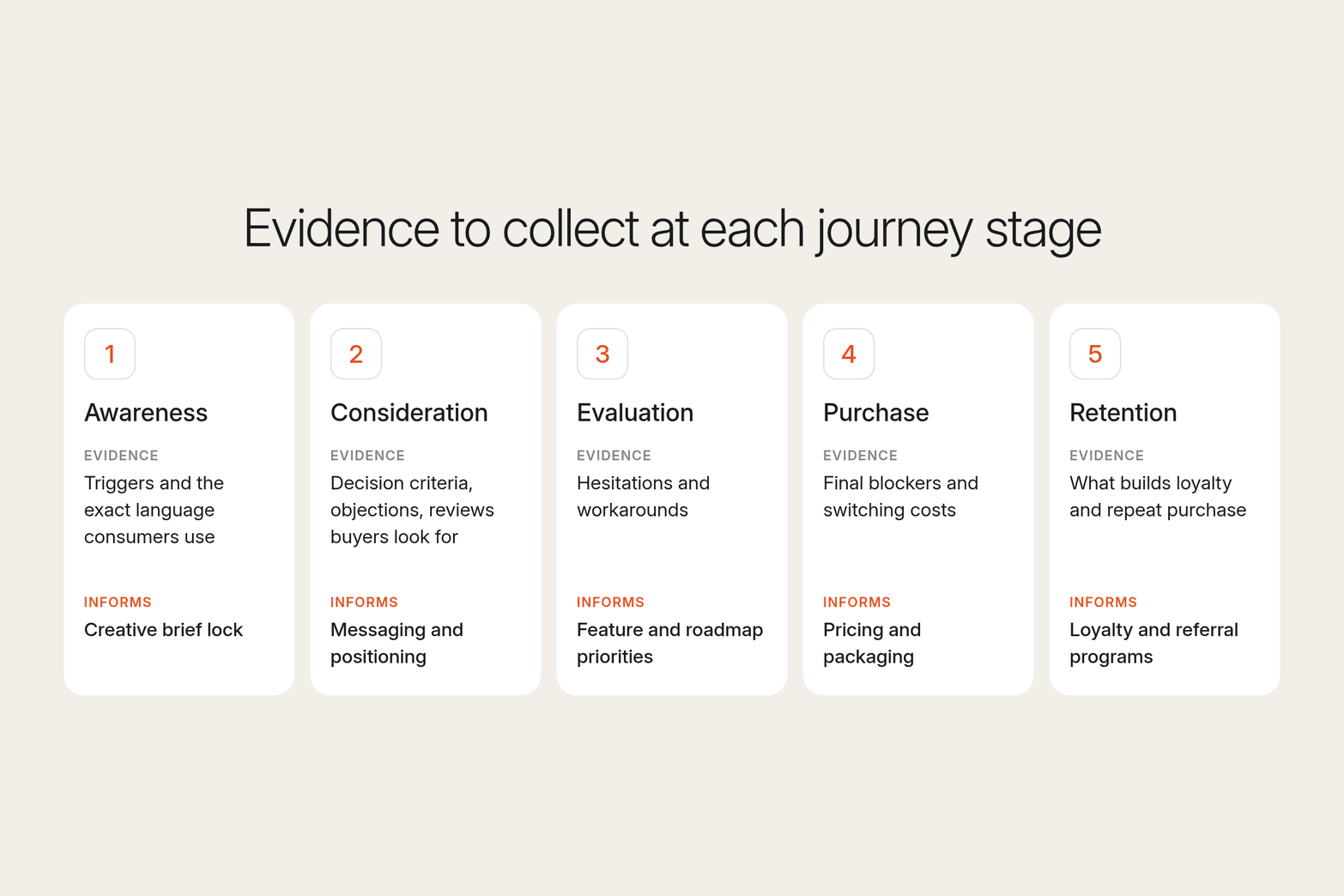
Match the evidence to the decision each stage feeds. Most journey frameworks describe five stages (covered in more depth in our guide to customer journey stages), and each one needs different proof:
| Stage | Evidence to collect | Decision it informs |
|---|---|---|
| Awareness stage | Triggers and the exact language consumers use; what relevant content looks like to them | Creative brief lock |
| Consideration stage | Decision criteria, objections, and the case studies, reviews, and user-generated content buyers look for | Messaging and positioning, so you lock the right message |
| Evaluation | Hesitations and workarounds | Feature prioritization and roadmap commitments |
| Purchase | Final blockers and switching costs | Pricing and packaging, and where to remove friction for buyers who are finally ready to commit |
| Retention stage | Post-purchase experience: what builds customer loyalty, turns a first purchase into a repeat customer, and earns word of mouth from happy customers | Loyalty and referral programs, and customer lifetime value |
Across the whole customer decision journey, findings have to land inside the decision window to count.
Decision-window framing: when journey insights must land to matter
Evidence that arrives after the decision window has closed cannot influence anything, no matter how good it is. For brand, marketing, and customer experience teams, those windows are the gates where money and direction get committed: creative brief lock, packaging freeze, launch planning, roadmap commits, and budget allocation. Each one is a point where businesses either make informed decisions or fall back on instinct.
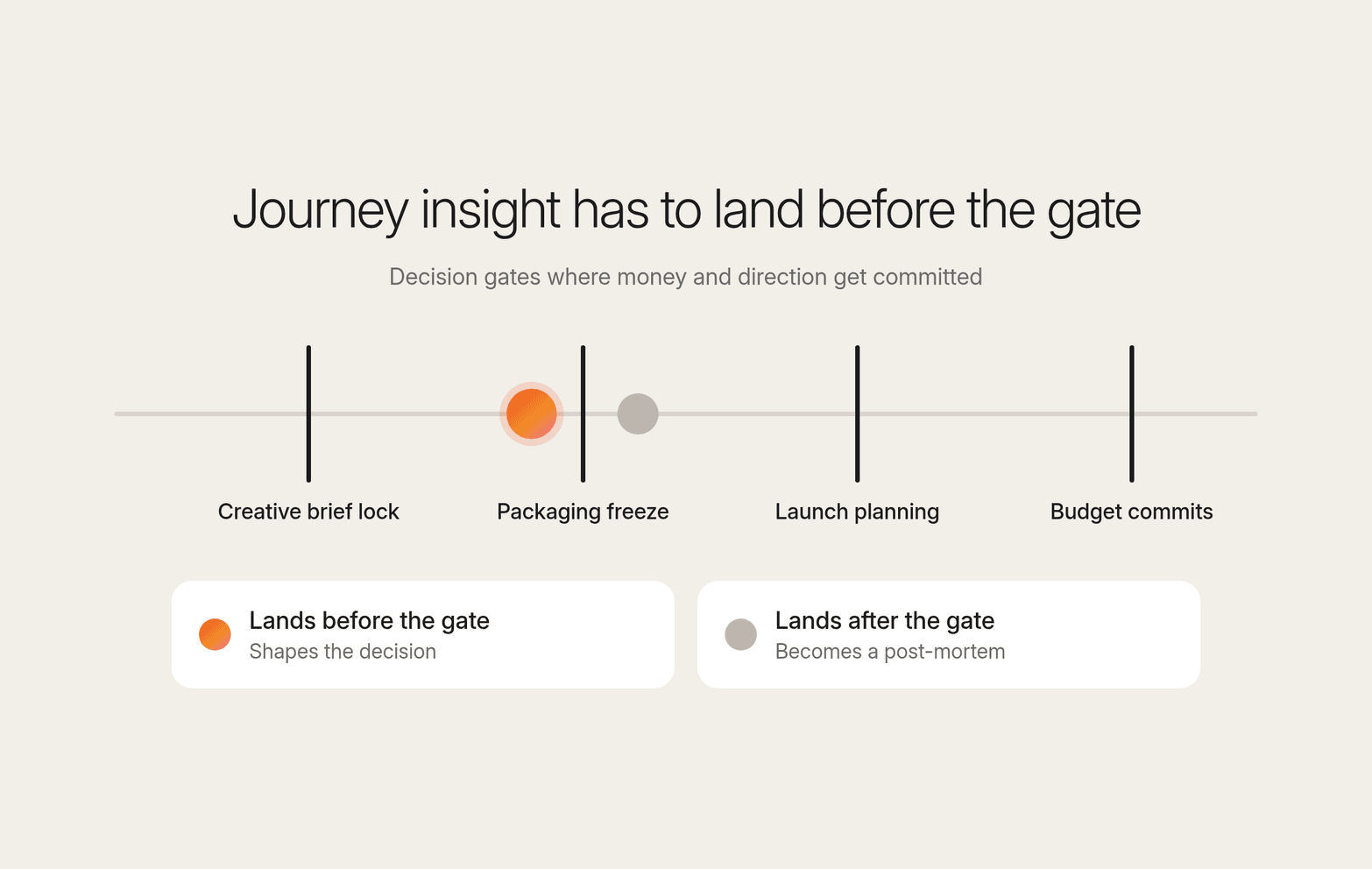
Traditional qual rarely fits. In practice, agency-led qual often takes weeks, and the decision window their client is trying to hit is usually shorter. By the time findings come back, the campaign meant to increase conversions at shelf and online has already shipped on a guess about the right message.
When asynchronous AI-moderated interviews run in parallel and synthesis builds continuously, teams gain insights on the customer decision journey early enough to shape the decision rather than justify it afterward.
Evidence standards that make journey maps defensible in stakeholder reviews
The hardest moment for a journey map is the stakeholder review. When a map rests on workshop assumptions or aggregated customer feedback, someone eventually asks who actually said this, and there is no answer. The claim collapses into opinion.
Traceable evidence changes that. When each theme behind a journey stage links to the participants, video clips, and verbatim quotes that support it, a customer decision journey becomes something a team can defend line by line. That is how insight teams build trust across the company: stakeholders can watch the customer say it.
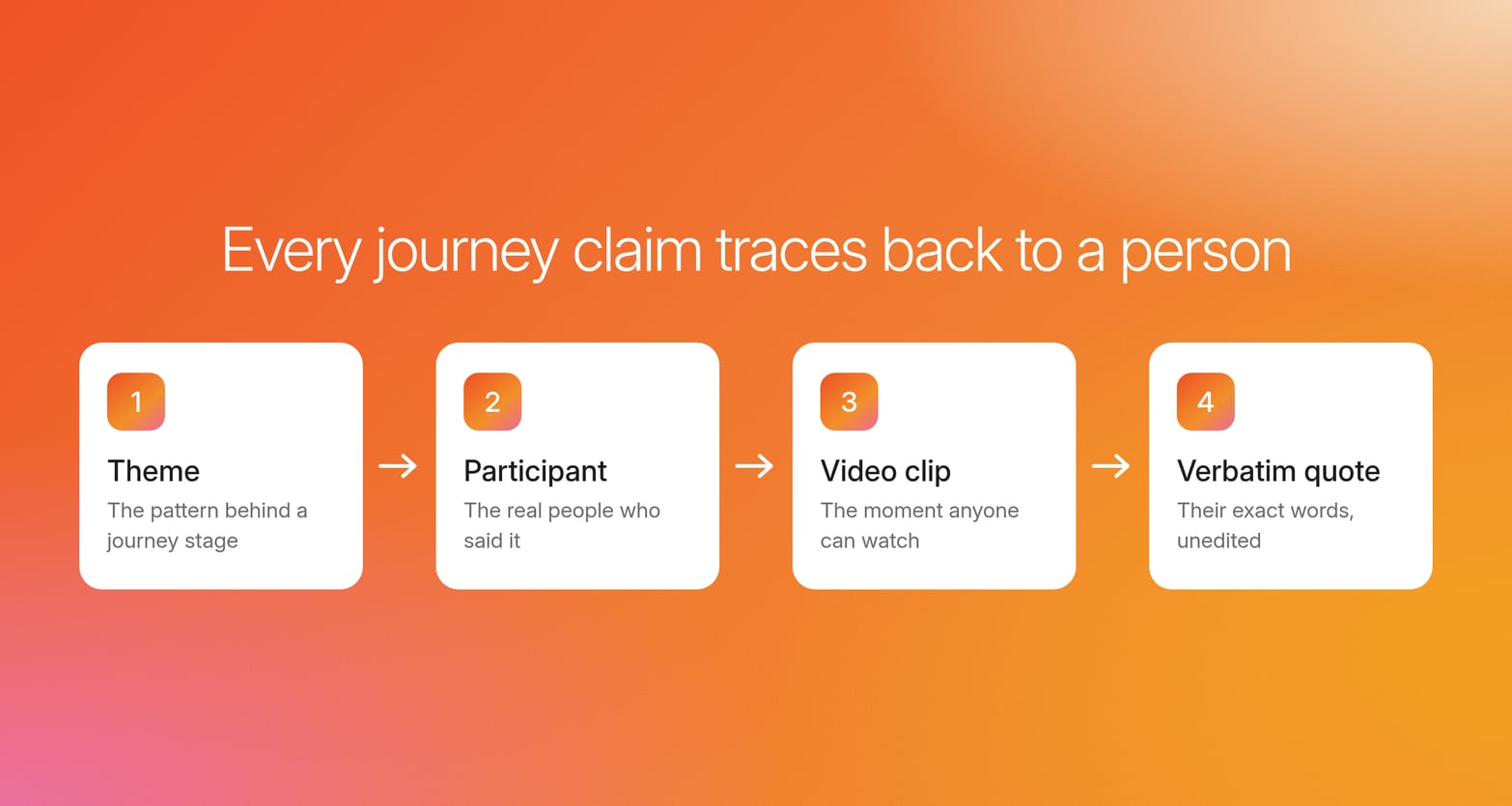
Survey-based maps cannot do this. Percentages, customer satisfaction scores, and conversion rates tell you that a stage stalls but never show the hesitation or contradiction that explains why.
In AI-moderated video interviews, multimodal signals across speech, tone, and facial expression help teams identify the reactions a rating scale misses: discomfort at a price point, confusion at a feature claim, the pause before a hedged yes.
Why the evidence compounds
Studying purchasing decisions while they're still open is faster than a retrospective, but the bigger payoff is that the evidence compounds. That's the always-on model behind Conveo StoryLines:
Rigor first. Every finding traces back to a real person saying it on video.
Compounding value. Every wave adds to a searchable insight library that connects findings across studies, so the next question starts from what's already known.
Governance built in. Conveo is SOC 2 Type II and ISO 27001:2022 certified, GDPR compliant, with EU hosting (Belgium) available for teams that need it.
Speed as a byproduct. Speed comes from removing the scheduling bottleneck.
Frequently asked questions
How do we tell the difference between a real customer decision journey and the story people tell after they've already bought?
The difference is timing, and it shows up in the customer decision journey you can actually reconstruct. Ask people after they have bought, and they give you hindsight rationalization: they smooth over contradictions, drop the options they seriously considered, and impose a clean narrative on a messy evaluation. Happy customers are especially prone to this, because a good post-purchase experience and growing loyalty make the choice feel inevitable. The reliable alternative is to interview buyers while the decision is still in progress. Conveo runs AI-moderated video conversations before the choice closes, so the account reflects an unresolved choice.
What methods actually capture the messy, non-linear path to a decision without relying on customer memory?
Methods that capture a non-linear decision path observe potential customers as the decision happens, rather than asking them to recall it. Retrospective interviews and surveys both depend on memory, which quietly edits the customer's path. Asynchronous AI-moderated video interviews capture deliberation while buyers are still comparing solutions. Conveo's AI research assistant asks follow-up questions when an answer is vague or leaves a gap, building on what the participant said earlier and surfacing the decision criteria and objections in the customer decision journey that a scripted guide would miss.
How often should we refresh journey maps to keep them aligned with how customers actually evaluate today?
Refresh journey maps on the rhythm of your decisions. Static customer personas and journey maps tend to drift from reality within about six months, leaving go-to-market calls running on stale customer language and triggers. It makes sense to tie research to internal decision gates rather than an annual planning cycle, and to keep prior evidence in a searchable insight library instead of re-interviewing existing customers about decisions they made a year ago. That way, understanding of the customer buying journey compounds across waves.
What evidence do we need at each journey stage to inform creative briefs, packaging decisions, and roadmap planning?
Match the evidence to the decision each stage feeds. Awareness needs the triggers and exact language consumers use, which feed the creative brief. Consideration needs decision criteria and objections for messaging and positioning. Evaluation needs hesitations and workarounds for roadmap commitments. Purchase needs final blockers and switching costs for pricing and packaging. Retention needs evidence of what builds loyalty and repeat purchase. Across the whole customer decision journey, findings have to land inside the decision window to count.
How do we validate journey maps across markets without local scheduling and localization bottlenecks?
Agency-led qualitative research across countries needs local moderators, sequential scheduling, and translation workflows that add weeks to a project. With Conveo, AI-moderated interviews in 50+ languages run a cross-market customer decision journey study in parallel, so teams gain insights from consumers in every market at once and see how each one responds to the same concept. Conveo's SOC 2 Type II and ISO 27001:2022 certifications, GDPR compliance, and EU hosting (Belgium) also clear the procurement and security questions that otherwise stall a multi-market rollout.
What makes a journey map defensible in a stakeholder review where survey data and workshop assumptions have failed before?
Traceability makes a journey map defensible: every claim points back to a real customer you can watch say it. Maps built in workshops or on survey data fail in reviews because no one can name the person behind the assertion. When each theme behind a journey stage links to the participants, video clips, and verbatim quotes that support it, the customer decision journey becomes evidence that helps insight teams build trust and stay focused on the real problems customers described.

About the author
Meg Gerli
Research Impact Lead
Meg is a Research Impact Lead at Conveo, working with insights and research teams on the studies they run with Conveo.
Meet Meg on film →Qualitative insights at the speed of your business.
Conveo runs AI-moderated video interviews and structures everything they say.