In this article
TL;DR
Telecom market research examines why subscribers choose, stay with, or leave a provider, covering acquisition, churn, pricing, bundles, network perception, and digital service adoption.
Across the global telecom market, retention and pricing decisions usually get made before anyone understands what actually changed for the subscriber, because behavioral data and agency research cycles only show who left.
Match the research methodology to the decision: depth interviews for churn triggers, in-interview price testing for pricing, focus groups or depth interviews for bundling.
A churn study works when you fix segment criteria before fieldwork starts.
Traceable evidence, with each theme linked to the participants behind it through video clips and verbatim quotes, makes a finding defensible to decision-makers and to stakeholder and compliance review.
AI-moderated interviews close the gap for telecom market research teams that need participant-level evidence while the decision is still open.
Most telecom insights teams already have more churn data than they can use. Dashboards flag at-risk accounts, exit surveys log a reason code, and the agency deck lands weeks later. What's usually missing is the subscriber's own account of what changed, captured while the retention, pricing, or bundle decision is still open. This guide covers how to match methods to each telecom decision, design a churn study around the trigger, and judge providers on whether their findings hold up in review.
What telecom market research covers, and where it stops short
Telecom market research examines why subscribers choose, stay with, or leave a provider. It spans acquisition, churn, pricing, bundles, network perception, and digital service adoption across consumer and business lines, for mobile, broadband, and fixed voice services alike.
The same questions apply across the telecom sector, where every major player defends its market position one retained subscriber at a time and brand loyalty runs thin. According to PwC's Global Telecom Outlook 2025-2029, global telecom service revenue is set to grow from $1.15 trillion in 2024 to roughly $1.32 trillion in 2029, while mobile ARPU is expected to tick down over the same period, putting more weight on keeping the right subscribers.
A familiar sequence plays out in retention teams at telecom companies: a save offer launches against a modeled at-risk segment, the campaign reaches subscribers who were never leaving, and the people who actually switched never see it. By the time the agency study explains the pattern, the pricing, go-to-market, or network infrastructure decision it was meant to inform has already been made. The research arrived, but the decision had already closed.
Behavioral data and agency cycles explain why this keeps happening:
What behavioral data shows: who left, through usage drops, port-out requests, and contract end dates.
What it misses: what changed for the subscriber, such as a move, a new household member, a bill shock, a new phone that no longer fits the plan, or a dead zone at a new office.
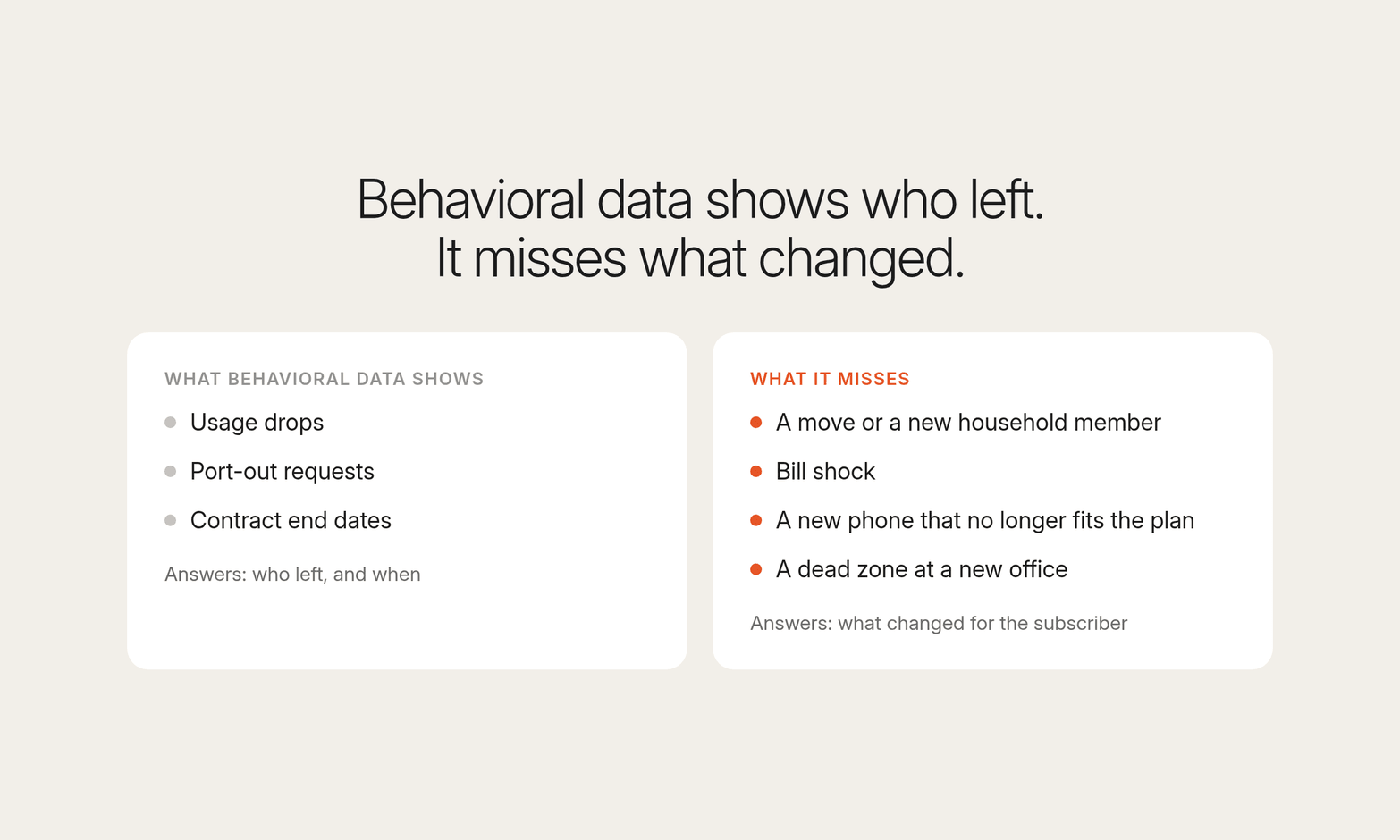
Qualitative research methods fill that gap by asking subscribers what changed. Segment claims built on behavioral data alone lack a participant quote, so they're hard to defend in review and harder to build retention strategies on. Telecom market research only earns its budget when it reaches decision makers while the decision is still open.
Match the research method to the telecom decision
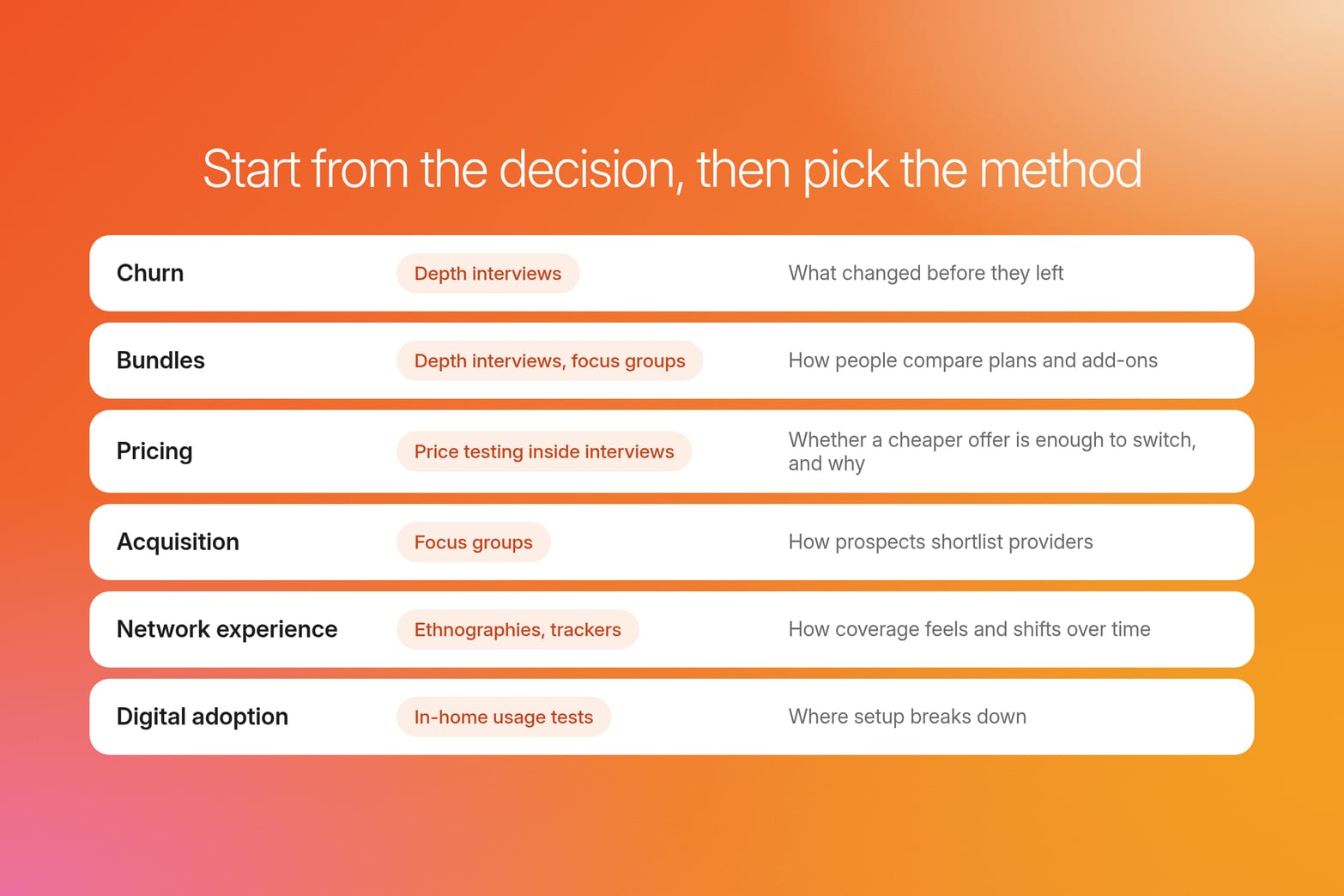
Start from the decision, then pick the research methodology. Six decisions recur across the telecommunications industry: acquisition, churn, pricing, bundles, network experience, and digital service adoption.
| Decision area | Best-fit method | What it answers |
|---|---|---|
| Churn | Depth interviews | What changed before they left |
| Bundles | Depth interviews, focus groups | How people compare plans and add-ons |
| Pricing | Price testing inside interviews (Van Westendorp or Gabor-Granger) | Whether a cheaper offer is enough to switch, and why |
| Acquisition | Focus groups | How prospects shortlist providers and compare competitors, including digital-first brands |
| Network experience | Ethnographies, trackers | How coverage feels and shifts over time, including after 5G or fiber-to-the-home (FTTH) upgrades |
| Digital service adoption | In-home usage tests | Where setup breaks down across phones, routers, and connected electronics |
Churn needs depth interviews with recent switchers and at-risk subscribers, because the trigger sits in their story. Bundling needs conversations that expose how people compare plans, add-ons, and other products in their own terms. Surveys still scale well for sizing trends, but they miss the hesitation, contradictions, and workaround behavior that explain why subscribers switch or delay renewal.
Insights teams get depth-interview and why-behind-the-number evidence for churn and bundling from Conveo's AI-moderated video interviews, while researchers and analysts keep control of study design and interpretation. For pricing, Conveo's price testing, currently in research preview, runs Van Westendorp or Gabor-Granger questions inside the interview and follows up on why, so the price response and its reason come from the same participant in the same session. Results carry a caution below 30 valid respondents, so pricing studies need a larger base than churn studies.
This short walkthrough shows a price sensitivity test running inside a Conveo study:

Choose the method based on the decision it must inform, whether that's a retention play, a new plan in development, or a round of price sensitivity testing, and make sure the evidence arrives in a form the decision can use.
How to design a churn study that finds the trigger
Churn research works best when the study centers on the trigger, the event that first made a subscriber look elsewhere.
Define behavioral segment criteria before fieldwork, for example, recent port-outs, mobile plan downgrades, or contracts nearing renewal. Criteria set in advance can't be retrofitted to whatever the first interviews suggest.
Recruit five to 15 participants per segment for in-depth interviews. That range surfaces stable behavioral patterns.
Source participants through Conveo's eight integrated panel partners or bring your own list of current and former customers.
Run interviews in parallel across segments and countries, so adding a second segment or market doesn't extend the timeline.
Ask what changed in their circumstances, and let dissatisfaction come up on its own.
Bias note: avoid leading questions about price, which hands participants a ready-made reason. Ask them to walk through the last month before the decision and let them talk it through in their own words while the AI research assistant probes on what they raise.
Build three reusable modules into the guide:
Switching triggers: trace the life, work, or billing event that first made the subscriber look at competitors.
Perceived coverage: ask where and when the network lets them down in daily routines, from dropped voice calls to slow mobile data.
Plan comprehension: check what subscribers believe they pay for against what their plan actually contains.
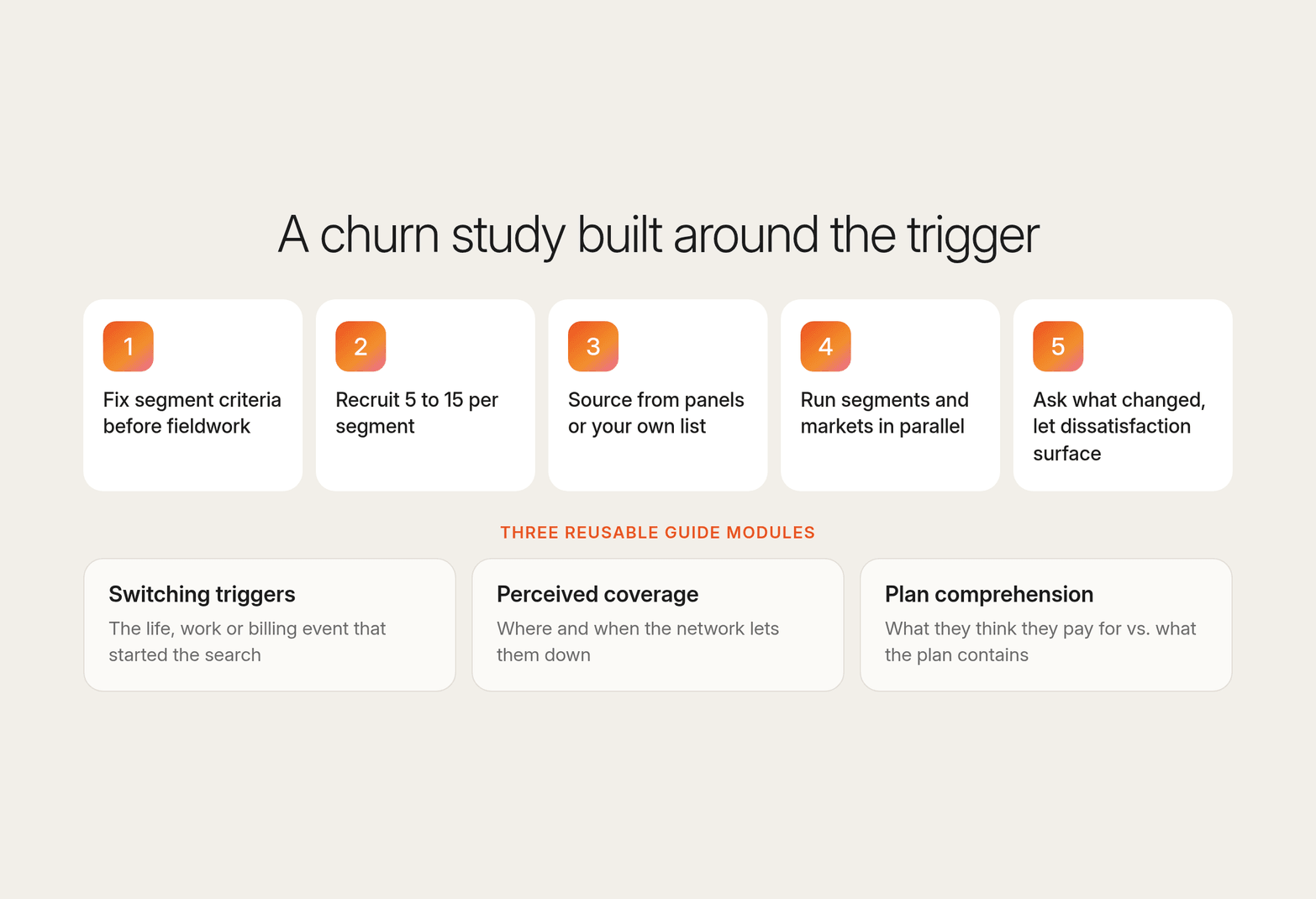
The study succeeds or fails in the design phase, before the first interview, when segment criteria are fixed.
Bundling and service perception: the questions surveys cannot answer
Bundle take-up dips, a service perception score drops, and nobody on the project can say why. Bundling research means understanding how customers weigh combined plans, add-ons, and the effort of switching. The same conversations point to growth opportunities for bundle innovation, because they show which add-ons participants would pay more for.
Cover three question areas:
Add-on value: ask participants what each component is worth and which they'd drop first. Attach rates show what was bought; the interview shows what's valued.
Plan comprehension: look for where participants misread what they pay for. Confusion over promotional pricing, phone installments, or a price-change communication often surfaces disguised as a price complaint.
Perceived service quality: find the gap between network metrics and the customer experience, meaning how coverage and support actually feel in daily use.
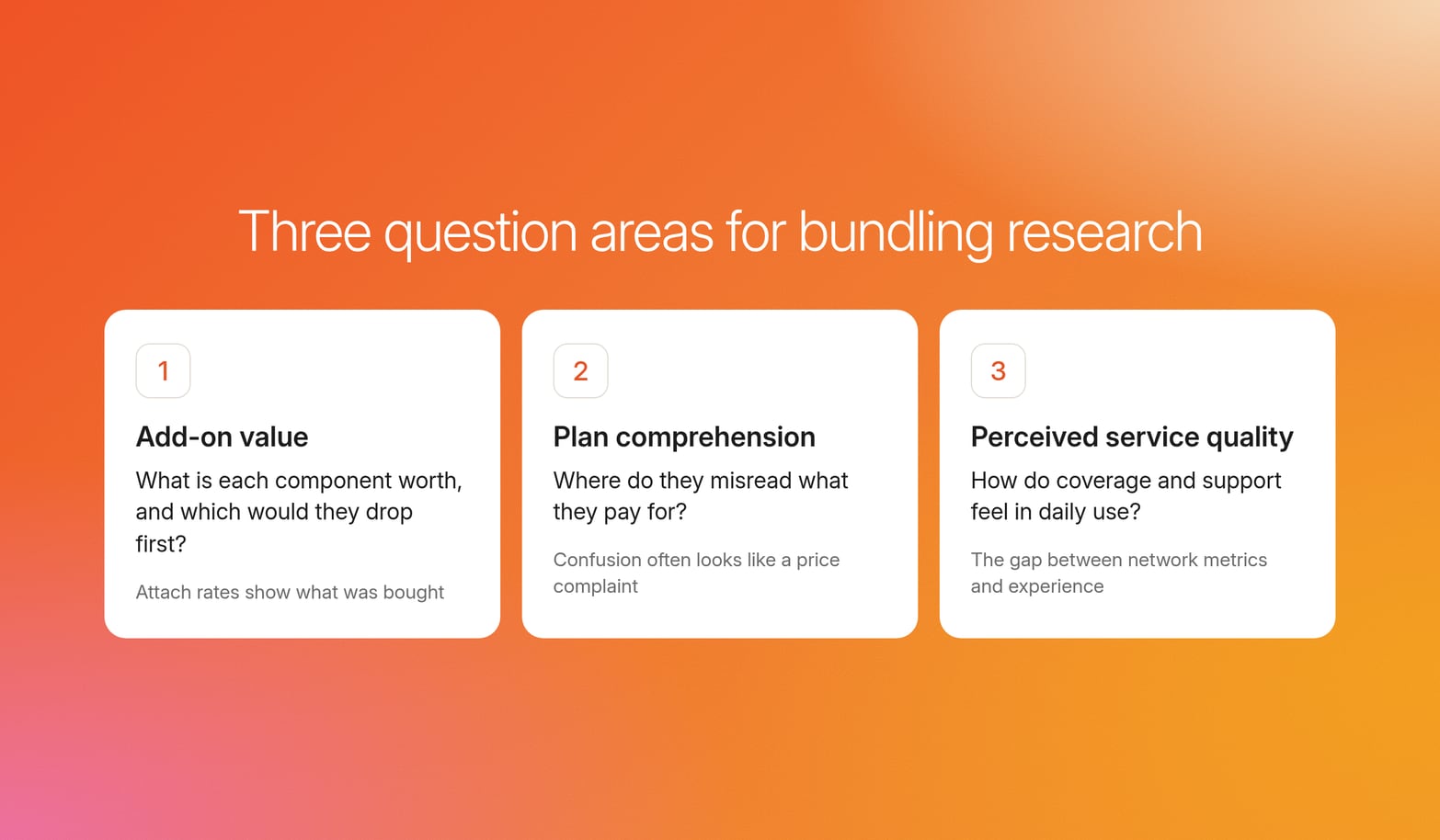
Capture participants' own words before showing any metric, so perception stays unanchored.
The same approach transfers to B2B market research on telecom accounts, where operators increasingly sell enterprise solutions beyond basic connectivity. Enterprises and other organizations add approval chains, procurement constraints, and the views of employees who use the service daily, all of which get mislabeled as "slow decisions" until a conversation surfaces the real holdup.
Video carries what fixed-response data drops: tone of voice, hesitation, and what participants do on screen. Participants can share their phone screen from the Conveo app, so the team sees exactly where a billing app lost them. Teams keep those moments as evidence, with each bundling theme linked to the participants who said or showed it. In telecom market research, bundling questions are answered in participants' own words, or by assumption.
"Conveo's video-first approach is a real differentiating methodological advantage. The ability to distill insights from reactions — not just hear answers — adds context you simply can't get from transcript-only tools."
Senior Marketing Research & Insights Manager, Top-5 tech giant
How to evaluate telecom market research companies and approaches
The real test for a telecom market research provider is whether your team can trace a switching decision back to a real participant, with evidence stakeholders can verify.
| Approach | Traceability | Depth | Churn fit | Multi-market reach | Speed |
|---|---|---|---|---|---|
| Agencies | On request | High | Strong, often late | At added cost | Weeks |
| DIY panels | Setup-dependent | Guide-dependent | Partial | Panel-dependent | Fast |
| Survey platforms | Response-level | Limited on why | Sizing only | Broad | Fast |
| Synthetic AI | No real source | Unverified | Not reliable for churn | Model-dependent | Instant |
| AI-moderated interviews | Themes linked to participants | Adaptive probing | Strong | 50+ languages | 100 interviews in 3 days |
Versus agencies, the difference is structure. Agency telecom qual typically runs in sequence over several weeks, one phase after another. Parallel AI-moderated interviews keep the depth, with 100 interviews in 3 days.
Versus survey platforms, the difference is signal. Surveys size patterns but miss hesitation, contradictions, and workaround behavior.
In synthetic respondents vs. real participants, the difference is source. The technology can generate plausible answers, and every theme still needs to trace back to a real person who said or showed it. Synthetic output has no one to trace back to.
Fit depends on traceability, speed relative to the open decision, and multi-market governance readiness, especially for teams studying the global telecom market across Asia Pacific, the Middle East, and South America. Conveo is SOC 2 Type II and ISO 27001:2022 certified and GDPR compliant, with EU hosting in Belgium.
Who this isn't a fit for: teams that need a single very large quantitative read with no qualitative follow-up, or teams that want a standing panel of hundreds of thousands of pre-recruited participants. Score every option against the open decision and the resources your team has.
Evidence standards: making telecom findings defensible
Persona and segment claims get pushback when nobody can trace them back to a real participant quote or recording. Workshop-built market research personas collapse in review because "tech-savvy" ratings, brand-loyalty scores, psychographic traits, and segment labels have no source evidence behind them.
The standard worth holding research to: each theme links to the participants behind it, with video clips and verbatim quotes stakeholders can audit. Reviewers can move directly from claim to participant and analyze the evidence themselves, which holds up in stakeholder, legal, compliance, and procurement reviews, and in front of analysts who have to defend the numbers.
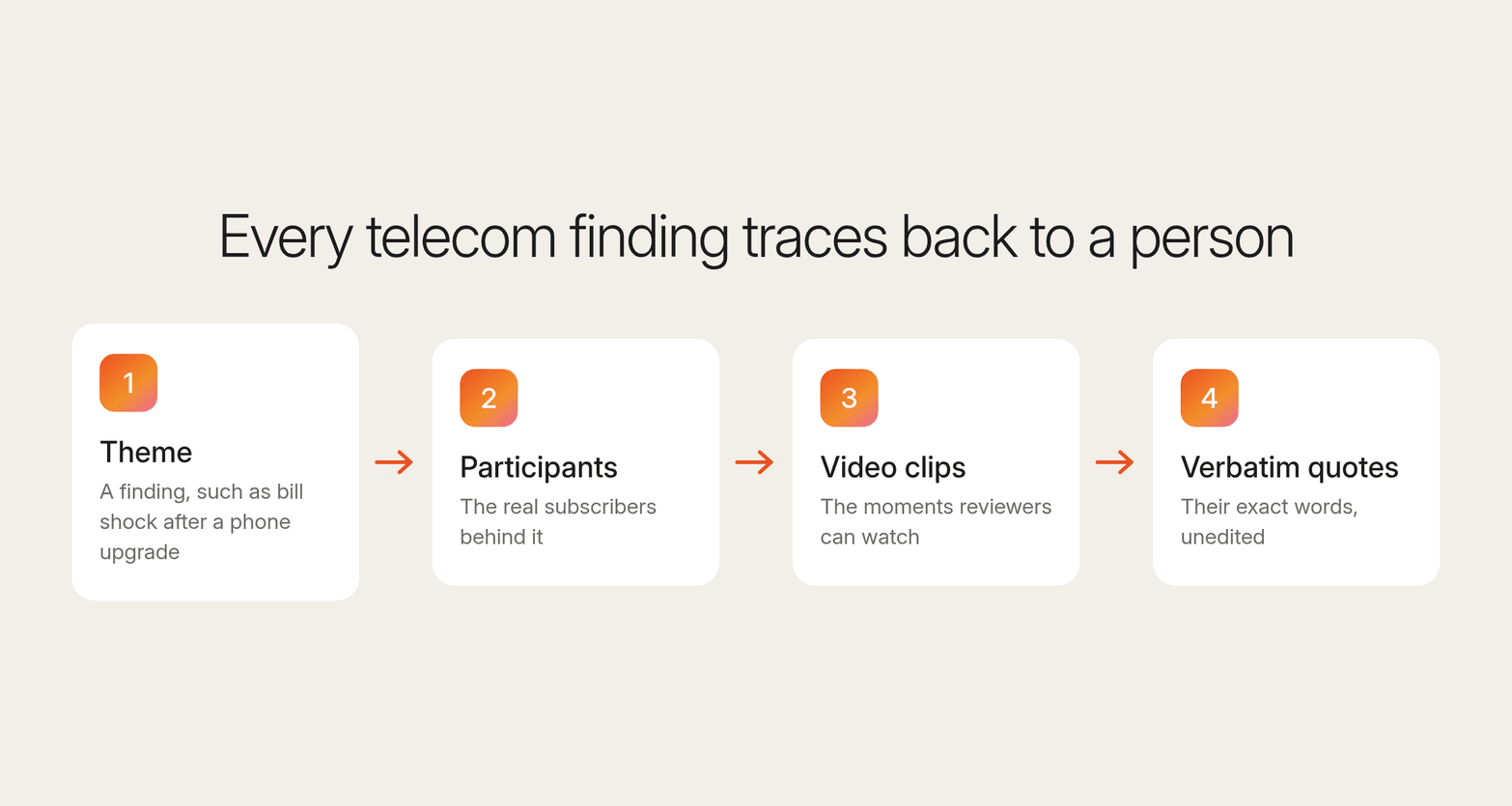
Quote reels turn that standard into a short video for stakeholders. In Conveo, the researcher picks saved participant quotes, trims each clip to the words that matter, and renders a captioned reel where every clip stays labeled by participant:
Governance needs three parts:
Consent language that names recording, analysis, and reuse.
Personally identifiable information (PII) handling agreed before fieldwork starts.
Deletion workflows for participant requests.
For multi-market studies, Conveo supports single sign-on (SSO), hosts data in the EU (Belgium), and deletes study data on request, which keeps access control, data residency, and participant requests inside the governance plan.
Recurring themes and facets are recognized across studies in a searchable insight library, so the next wave starts from what earlier ones established. That's what separates a telecom market research report stakeholders act on from one that gets shelved.
Where always-on understanding fits into telecom research
Most telecom market research assumes a project with a start and an end date. Churn triggers, bundle comparisons, and service perception also keep shifting between studies. Conveo StoryLines runs wave-based interviews with target audiences, for example every two weeks or monthly. That cadence lets a retention or pricing team see a shift forming, or gauge the growth potential of a new segment, before the next scheduled study would have caught it, at a pace the team can sustain.
The core gap in telecom market research is timing: a decision with real revenue at stake closes before the research that should inform it is finished. Three pieces keep research ahead of the decision:
Depth interviews placed against the right trigger.
A searchable insight library that recognizes recurring themes across studies.
Continuous, wave-based research for the questions that keep moving between studies.
Frequently asked questions
What's the difference between telecom market research and general consumer market research?
Telecommunications research focuses on subscription dynamics specific to the telecom industry: contract cycles, bundle comparisons, network perception, and port-out behavior, which have no direct analog in single-purchase categories.
How many participants do I need to conduct a telecom churn study?
Five to 15 participants per behavioral segment is usually enough to surface stable churn patterns, provided you fix the segment criteria before fieldwork starts. Pricing work needs more: Conveo marks price-testing results with a caution below 30 valid respondents.
Are surveys enough for churn research?
Surveys are the right tool for sizing how common a pattern is. Interviews surface the hesitation, contradictions, and workaround behavior that explain why a subscriber left or stayed.
How does price testing work inside interviews?
Conveo runs Van Westendorp or Gabor-Granger questions inside the AI-moderated interview, then follows up on why, so in price sensitivity testing the score and the reasoning come from one source. The feature is currently in research preview.
How long does a telecom churn study take?
A telecom churn study's timeline depends on the number of segments and how fast recruitment moves. Running interviews in parallel across segments keeps it short; AI-moderated studies can reach 100 interviews in 3 days.

About the author
Alex de Hemptinne
Business Impact Lead
Alex is a Business Impact Lead at Conveo, partnering with enterprise teams to embed AI-led research into their workflows. From the first study to full-scale rollout, she helps customers shift from project-based research to continuous customer intelligence.
Meet Alex on film →Qualitative insights at the speed of your business.
Conveo runs AI-moderated video interviews and structures everything they say.