In this article
TL;DR
AI market research companies include platforms your team runs, platforms with optional help from the vendor’s researchers, tools built for agencies, or an agency’s own AI.
Choose a platform your team runs when the same questions come up every quarter, such as concept or message tests. Choose an agency for projects that need in-person fieldwork, such as in-home visits, and a platform with optional research help when your team wants support on design or recruitment.
This guide is for insights and CMI teams at consumer brands building a shortlist of vendors to pilot.
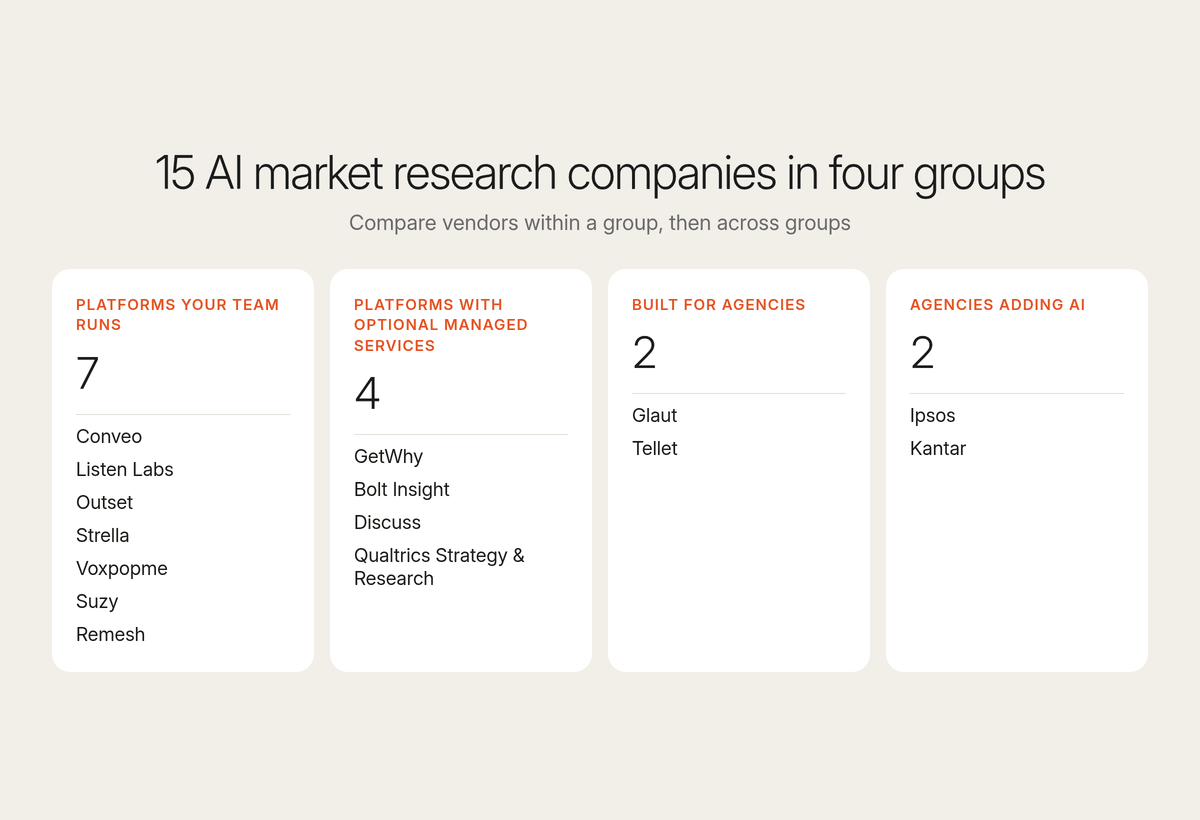
It compares 15 vendors in four groups, from platforms your team runs to agencies with their own AI tools, and ends with a three-step plan for testing your shortlist.
“AI market research company” covers very different businesses. A platform your team runs and an agency that runs studies for you can sit side by side on the same list. That makes a shortlist hard to build, since vendors that look alike on paper can suit very different ways of working.
By the end of this guide, you’ll know which kind of vendor suits the way your team works, and you’ll have a shortlist of three to five companies ready to test on a live business question.
Choosing an AI market research platform vs an agency
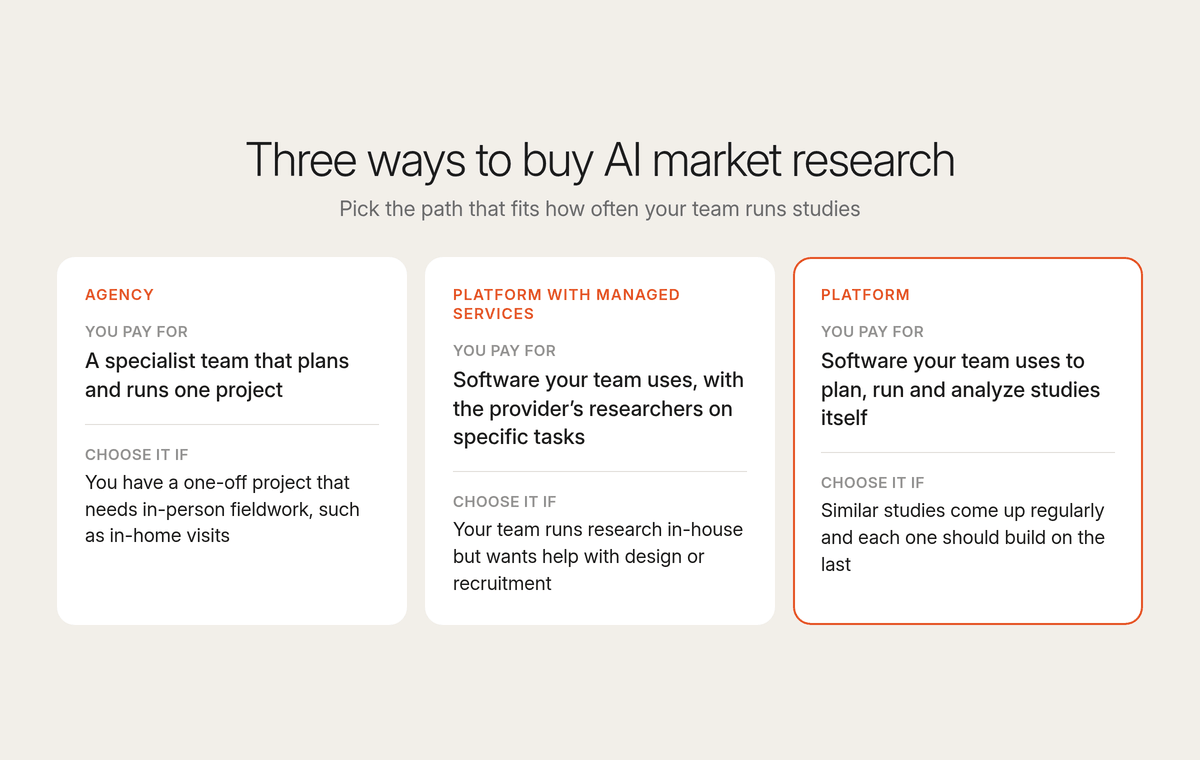
Whether you need an AI market research platform or an agency comes down to two things: how many studies your team runs in a year, and whether someone on the team has time to run them. Here’s how the three paths compare:
| Path | What you’re paying for | Choose it if | Example |
|---|---|---|---|
| Agency | A specialist team to plan and carry out a research project from start to finish. | You have a one-off project that needs in-person fieldwork, such as in-home visits or store intercepts. | Hiring an agency to interview shoppers in their homes across five markets to inform a brand repositioning. |
| Platform with managed services | Research software your team can use, with researchers from the provider helping with specific tasks. | You want to run research in-house but need help with things like writing interview questions, designing studies, or recruiting participants. | Using a provider's researchers to design your first few concept tests and recruit participants while your team learns to run them independently. |
| Platform | Research software your team uses to plan, run, and analyze studies itself. | You run similar studies regularly and want to build on previous findings without hiring an agency or relying on outside researchers each time. | A snack brand using a concept testing tool to test new flavors every quarter and compare results over time. |
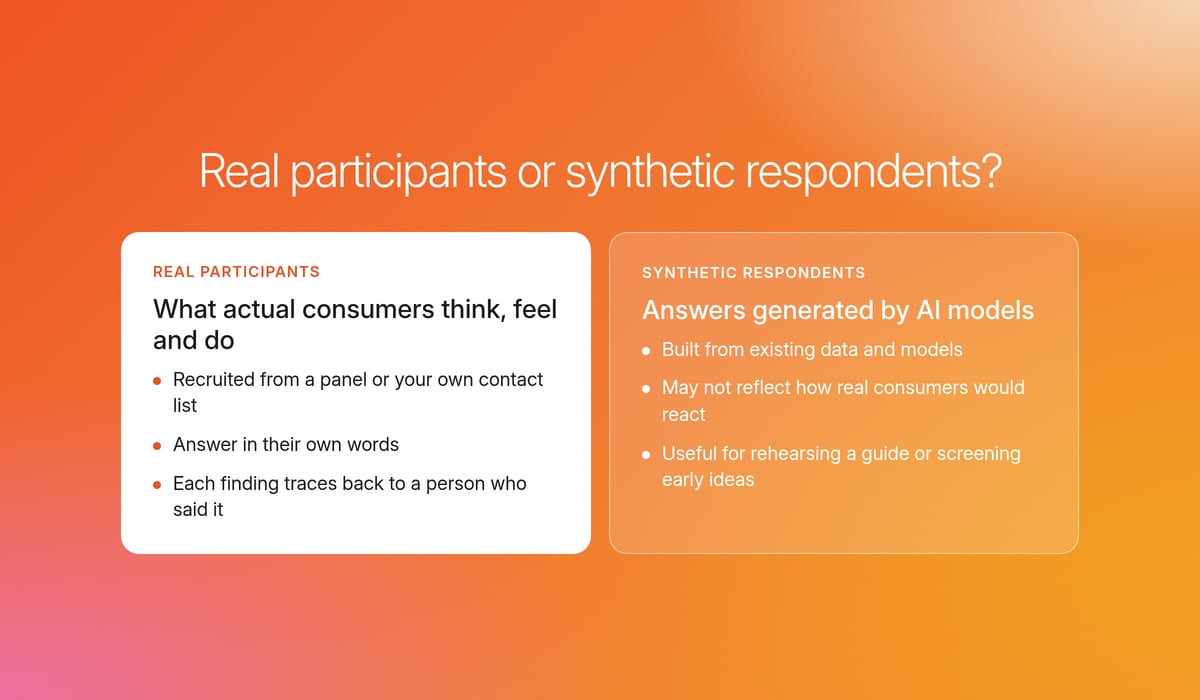
Whichever path suits your team, check whether each vendor’s answers come from real participants, synthetic respondents or both. Real participants tell you what actual consumers think, feel, and do. Synthetic respondents generate answers based on existing data and models, so their responses may not reflect how real consumers would react.
If you're using research to make decisions about things like product launches, pricing, messaging, or brand positioning, you need to know whether the findings reflect real consumer opinions or AI-generated predictions.
15 AI market research companies compared
The 15 AI market research companies here are grouped by category. Each profile covers who the company suits, its main strength, one tradeoff, pricing, and what happens to findings once a study closes. Here’s a quick comparison before going into the profiles below:
| AI market research company | Category | How people take part | Participants | Evidence behind findings |
|---|---|---|---|---|
| Conveo | Platform your team runs | Video or voice interviews | Real | Video clip and quote |
| Listen Labs | Platform your team runs | Video interviews | Real | Video clip and quote |
| Outset | Platform your team runs | Video, voice or text interviews | Real, plus digital twins | Video clip and quote |
| Strella | Platform your team runs | Video or voice interviews, with an AI or human interviewer | Real | Video clip and quote |
| Voxpopme | Platform your team runs | Recorded video answers, AI voice interviews and live interviews | Real | Video clip |
| Suzy | Platform your team runs | Surveys, interviews and concept tests | Real | Not publicly described |
| Remesh | Platform your team runs | Live or async group conversations, plus human-led video interviews as an add-on | Real | Cited responses, and video clips for add-on interviews |
| GetWhy | Platform with optional managed services | Video interviews | Real | Video clip and quote |
| Bolt Insight | Platform with optional managed services | Mobile chat interviews | Real | Transcript |
| Discuss | Platform with optional managed services | Live human-led interviews and AI interviews | Real | Video clip and quote |
| Qualtrics Strategy & Research | Platform with optional managed services | Surveys, recorded video answers and human-led interviews | Real, plus synthetic panels | Video clip for recorded answers |
| Glaut | Built for agencies | Voice answers inside a survey | Real | Audio and transcript |
| Tellet | Built for agencies | Voice notes or video | Real | Transcript |
| Ipsos | Agency adding AI | AI video interviews, alongside agency research | Real, plus synthetic respondents | Video clip |
| Kantar | Agency adding AI | Mostly predictions from past data, plus Kantar Live sessions | Predicted responses, plus real consumers in Kantar Live | Not publicly described |
Information checked November 2026.
AI qualitative research platforms your team runs
These platforms are built for your own team to run studies from start to finish.
1. Conveo
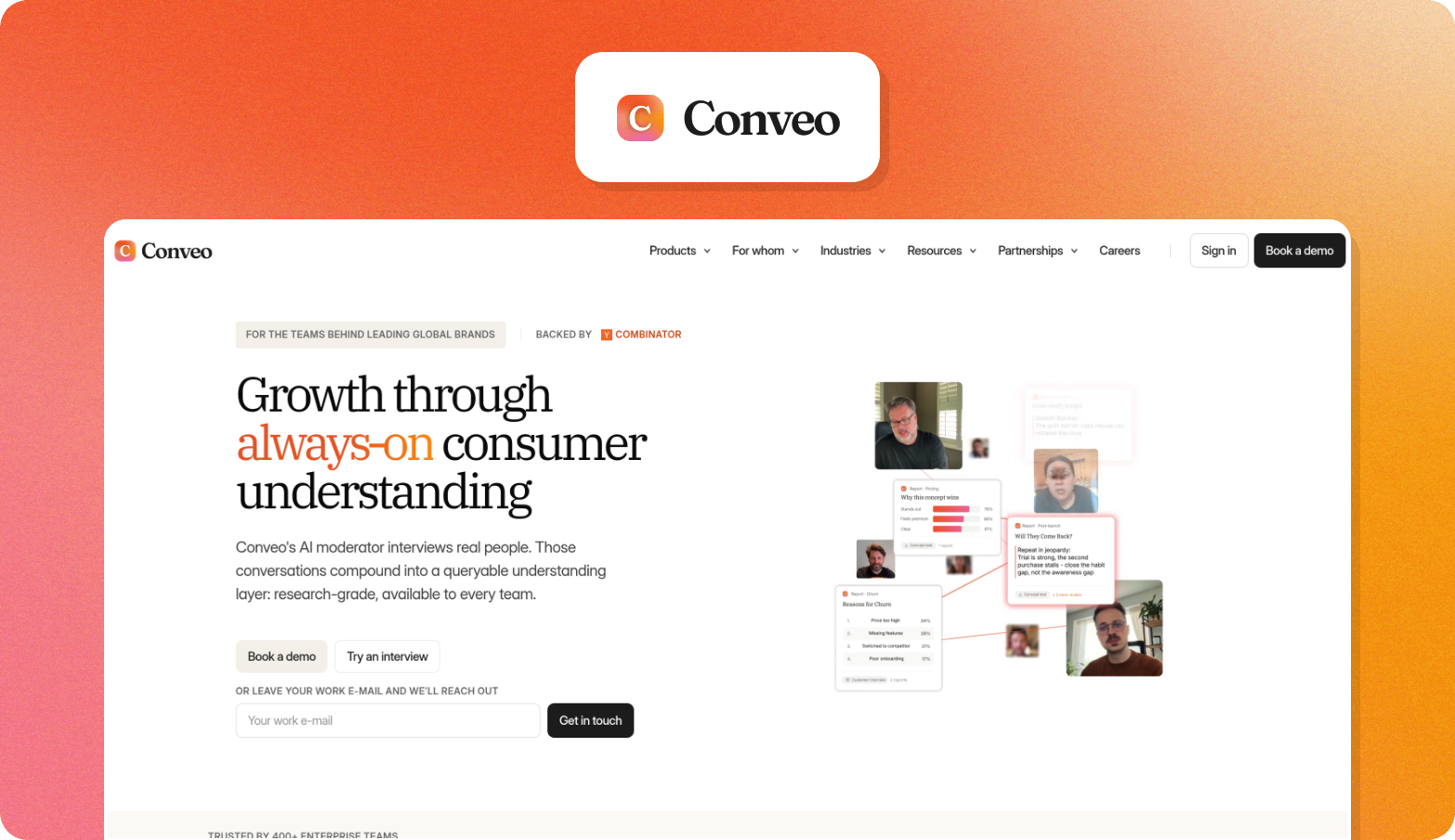
Conveo is Consumer Understanding Infrastructure. It conducts AI-moderated video and voice interviews with real consumers, with all your qualitative data kept in one place so new research builds on what earlier studies found.
See it in action: an AI-moderated interview that follows up on vague answers.
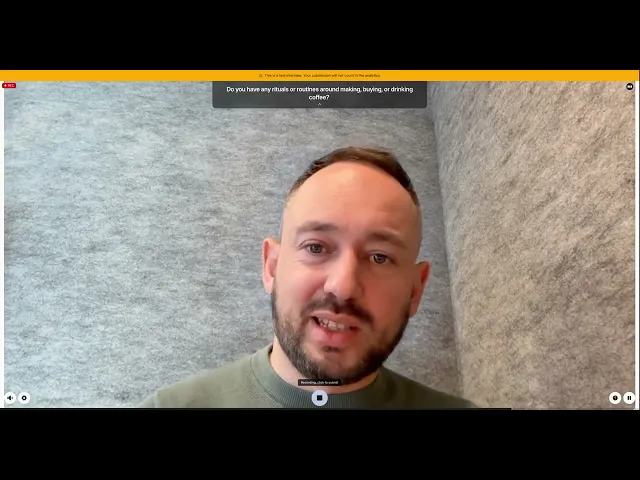
Teams can run continuous research or a single study when a question comes up. During each interview, Conveo's AI research assistant asks follow-up questions when an answer is vague or leaves a gap, building on what the consumer said earlier.
Interview analysis picks up tone of voice and, on video, facial expression. Rating and ranking questions can sit inside the interview, so the score and the reason come from the same person, and question coding splits any theme by market or age group in a cross tab.
Best for: Insights and CMI teams at consumer brands bringing qualitative research in-house and keeping it running between big projects.
Strength: Every theme links back to the participants behind it, with the video clip and quote, so stakeholders can check where a customer insight came from before they act on it.
What happens to past findings? Conveo recognizes recurring themes across studies and keeps earlier findings searchable. Talk to Your Data answers questions across studies and markets, with source quotes for each answer.
Tradeoff: Analyzing interview recordings you already have, such as past agency sessions, is in private beta, so teams with a large archive need to ask Conveo for access.
Pricing: Start for free, or book a demo for enterprise pricing. Studies run on credits, and teams that want extra help can hire Conveo-certified freelancers or agencies through the Service Marketplace, paid from the same credits.
2. Listen Labs
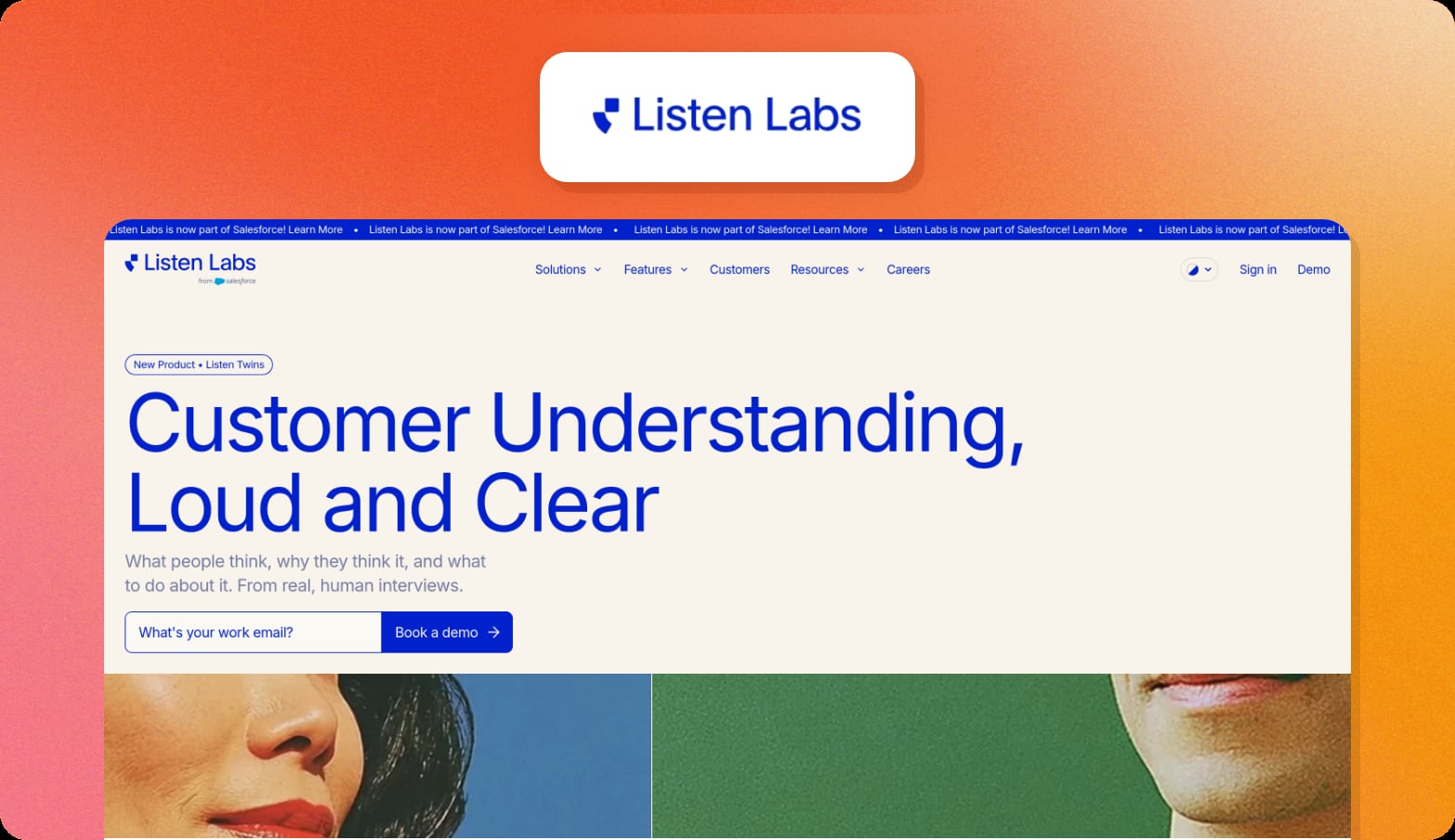
Listen Labs takes a study from a plain-language brief to a finished deck in one tool, with AI-moderated video interviews and recruitment from its own participant pool in between.
Best for: Lean marketing and insights teams without dedicated research staff who want AI to handle most of the setup and reporting.
Strength: Its Research Agent turns results into branded slide decks and highlight reels.
What happens to past findings? Mission Control pulls findings from every study into one view, where teams can ask questions across studies and track how answers change over time.
Tradeoff: Salesforce has completed its acquisition of Listen Labs and hasn't announced standalone availability or pricing, so terms for teams outside Salesforce could change.
Pricing: No public pricing at time of writing.
3. Outset
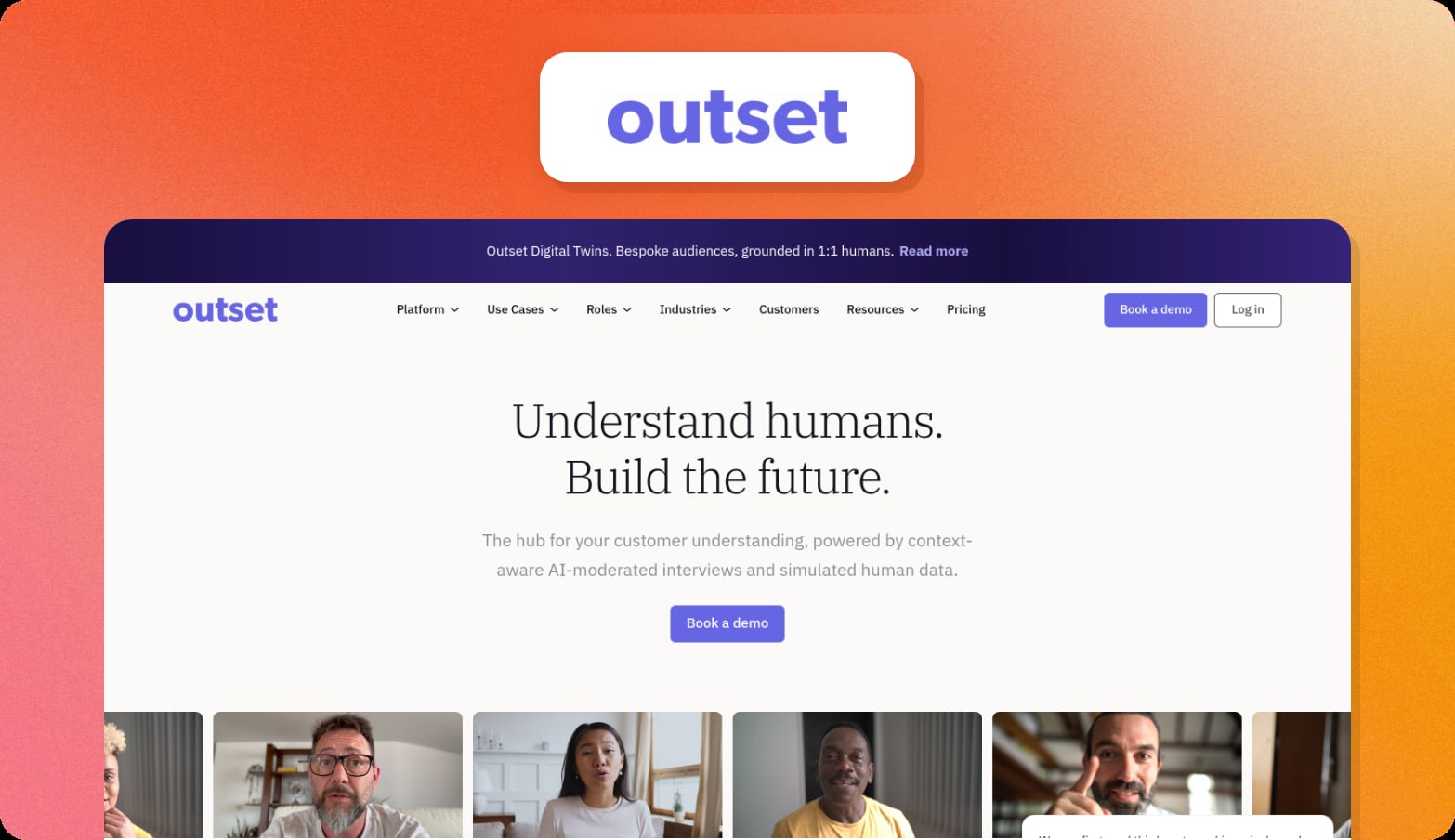
Outset is an AI-moderated research platform built around researcher control. Teams set the AI interviewer's style and how deep it probes on each question.
Best for: Teams with experienced researchers who want to tune the interviewer themselves, from product research to concept and creative tests.
Strength: The AI interviewer can see a participant's screen or the product they're holding, then ask about what it sees.
What happens to past findings? Explore lets teams search and compare findings across studies in plain language.
Tradeoff: Outset also sells digital twins built from past interviews with real people. Each twin answer comes with a confidence score and supporting quotes, but teams should keep twin answers apart from interview evidence when they report.
Pricing: Enterprise pricing based on seats, plus usage for larger studies.
4. Strella
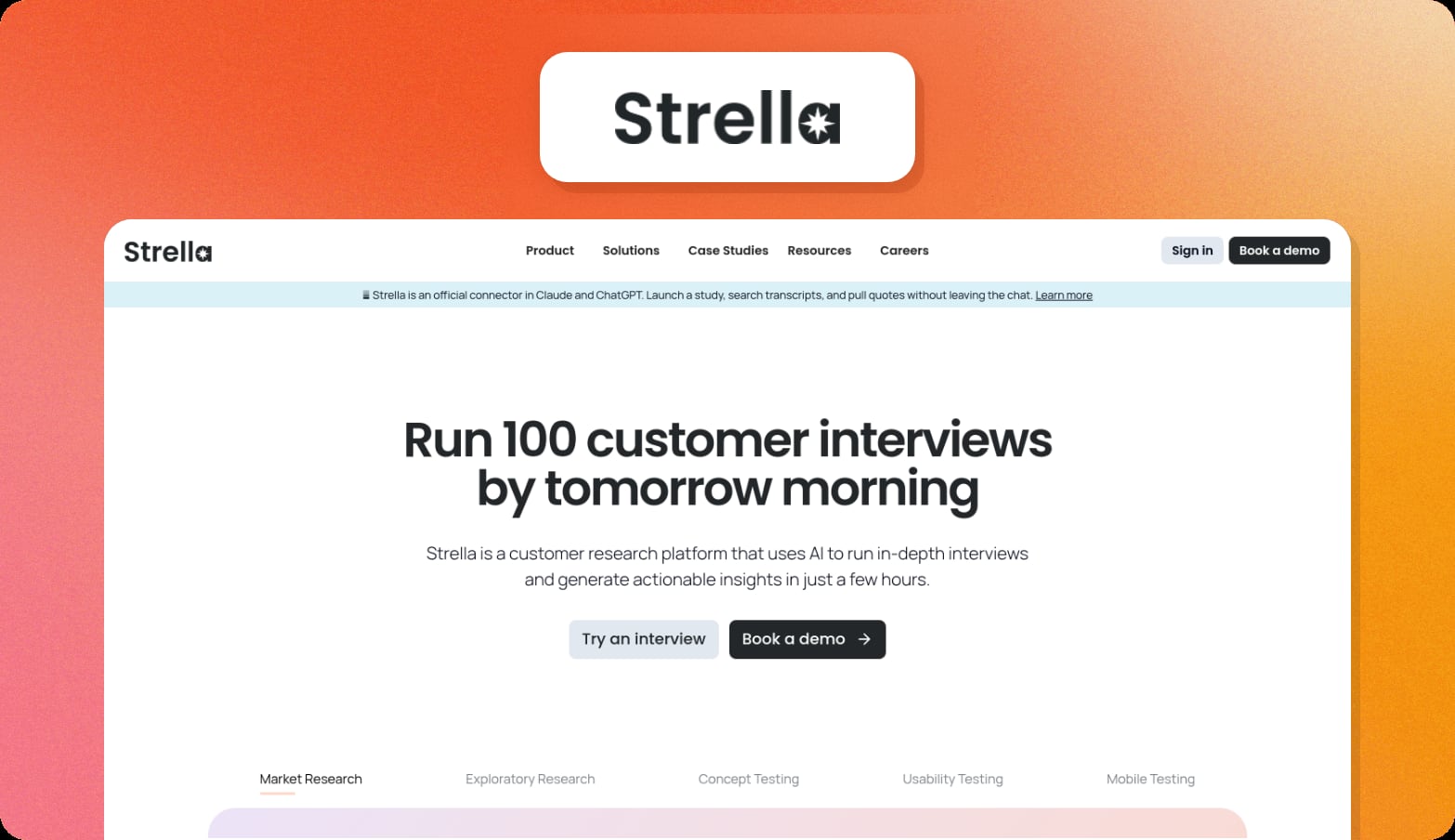
Strella gives teams a choice of interviewer on each study: its AI interviewer or one of their own researchers, on video or voice.
Best for: Marketing and product teams that want quick reads and sometimes need a human interviewer for sensitive or complex topics.
Strength: Recruitment through Respondent and User Interviews is built in, with incentives and scheduling handled in the same place.
What happens to past findings? Explorer, a chat interface, finds clip-level evidence across past projects and can turn any finding into a short video response.
Tradeoff: Teams that mix AI and human interviewers across the waves of a tracker need to keep one method fixed, or results become harder to compare.
Pricing: No public pricing at time of writing.
5. Voxpopme
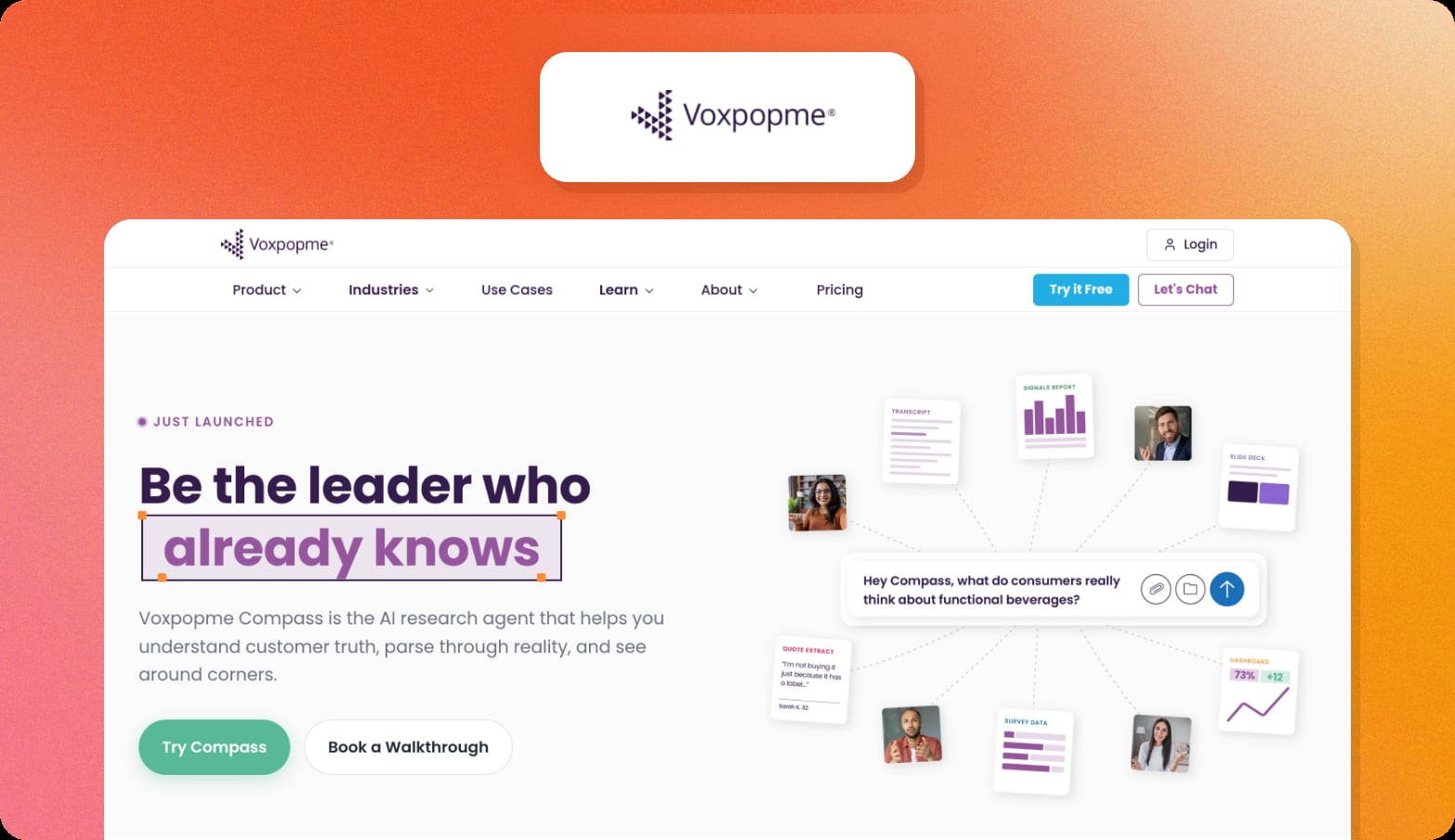
Voxpopme started with video surveys, where participants record answers to set questions in their own time, and has since added an AI Moderator for voice interviews and live interviews with a human.
Best for: Consumer brands that want a high volume of video reactions, such as quick reads on ads or packs.
Strength: Its own panel covers 27 markets, and video auditions check participants before fieldwork starts.
What happens to past findings? A cross-project repository keeps every study's videos and themes searchable, and an MCP connection lets approved users query it from Claude or ChatGPT.
Tradeoff: Video survey answers are recorded once and can't be probed. Follow-up questions come with the AI Moderator, which runs voice interviews.
Pricing: Sales-led, with no tiers or prices published at time of writing.
6. Suzy
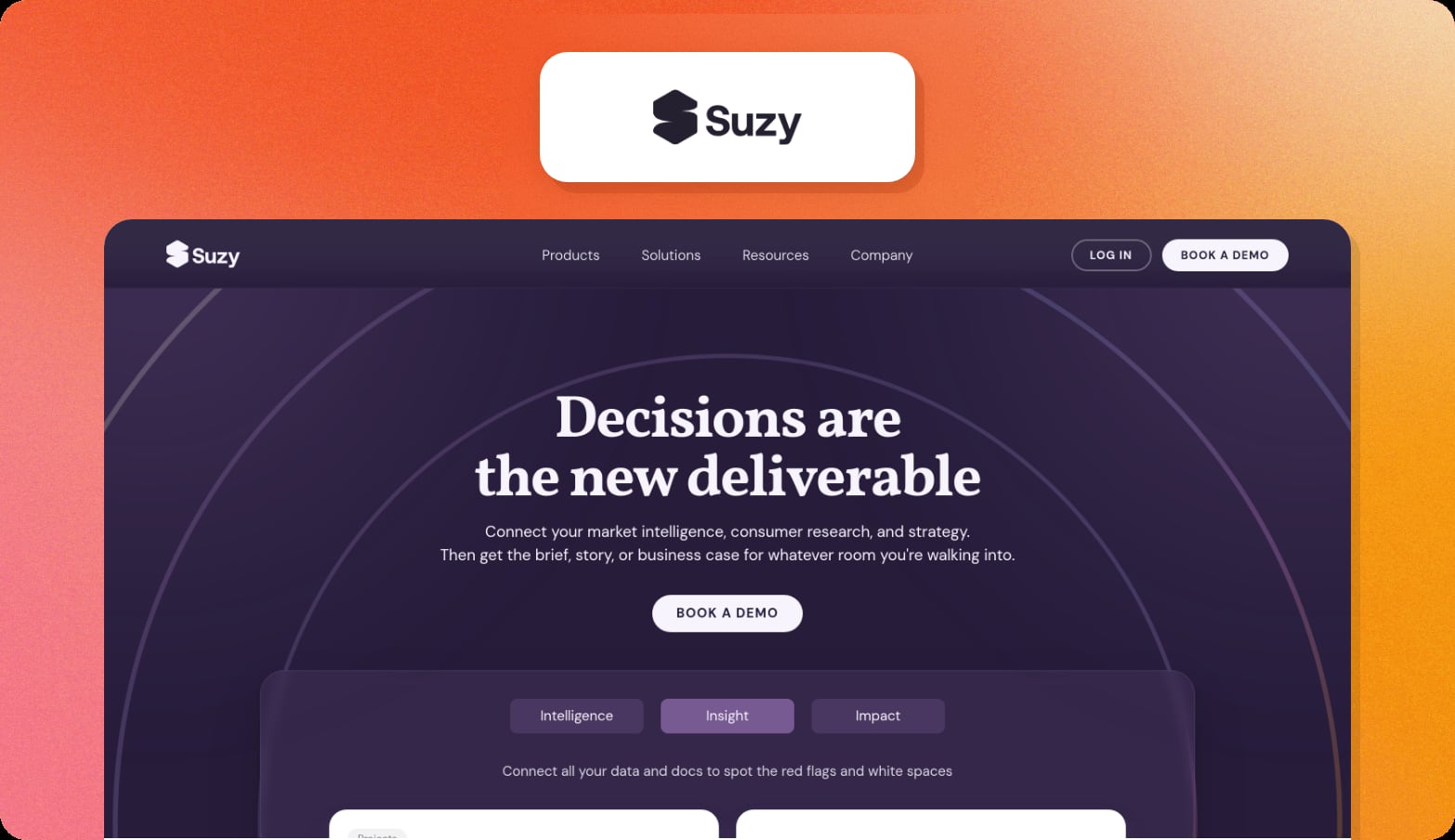
Suzy presents itself as a decision engine: a workspace that brings trend signals and research files together around a business question.
Best for: CPG brand teams that want market signals sitting next to their own research when they build a recommendation.
Strength: The Signals feed tracks trends tailored to your brand and category, and any signal can be attached to a project and explored further in chat.
What happens to past findings? Insight keeps documents, data, and chats in one workspace, and teams can query across all of it.
Tradeoff: Suzy’s site doesn’t describe what evidence sits behind its findings, such as recordings or transcripts (checked November 2026), so ask to see a finished study during a demo.
Pricing: Credits-based, with costs depending on the study and audience. No public prices.
7. Remesh
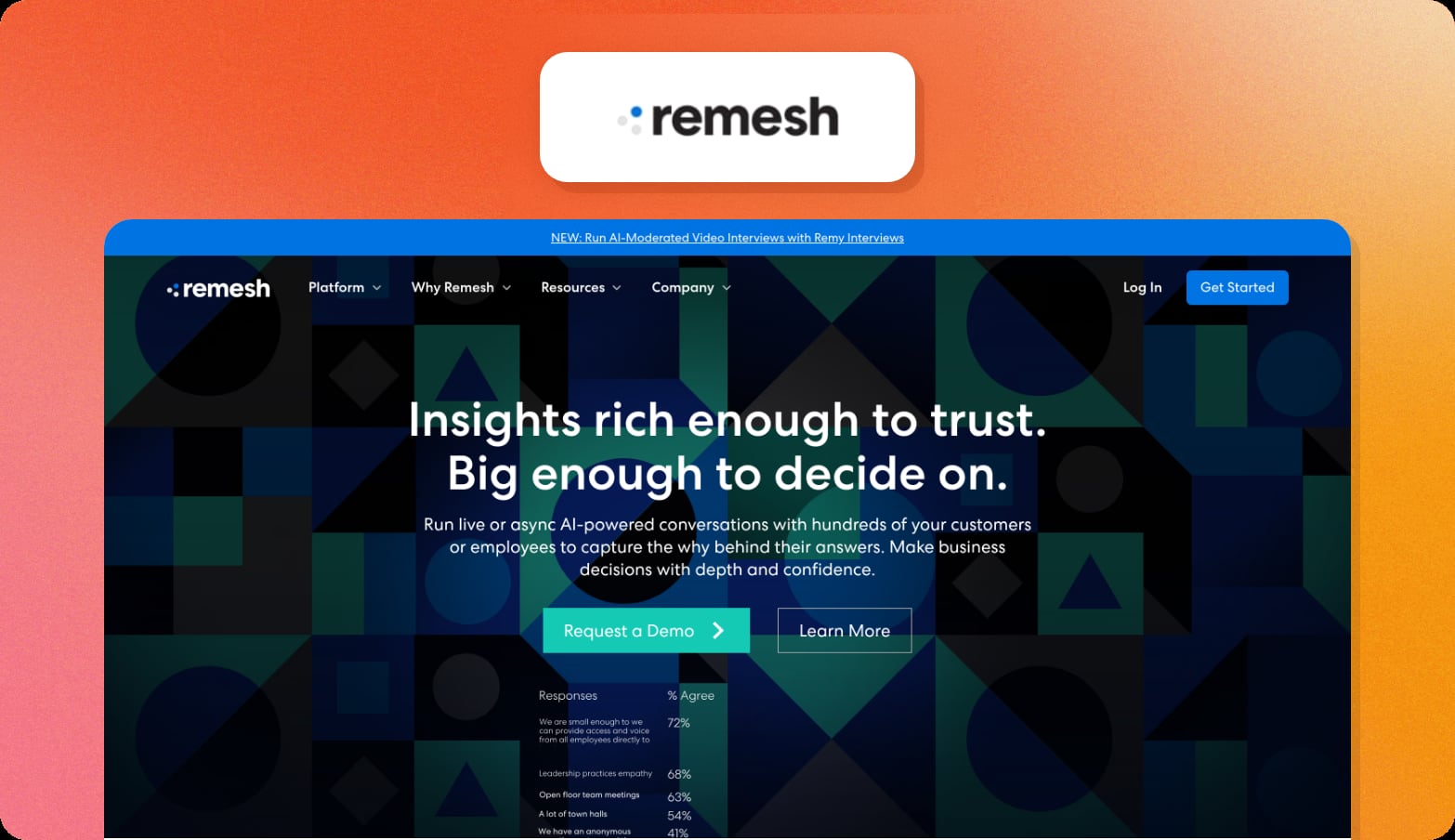
Remesh puts a large group into one live or async conversation: each person answers in their own words, then votes on answers from others in the group.
Best for: Insights teams testing messages or concepts who need to see where a big group agrees and where it splits.
Strength: Its AI agent, Remy, answers questions about a conversation with inline citations to the responses behind each point.
What happens to past findings? Conversation Merge combines up to 10 conversations for analysis, and Remesh Connect brings in past research from tools like Qualtrics or SharePoint.
Tradeoff: The group format gives breadth over qualitative depth for each person. One-to-one video interviews come through the Remesh Video add-on and use a human moderator.
Pricing: Priced per study. Rates aren't published at the time of writing.
Platforms with optional managed services
Your team runs studies on these platforms, and the vendor's own researchers or partners can take on part of a study, or all of it, when you need them.
8. GetWhy
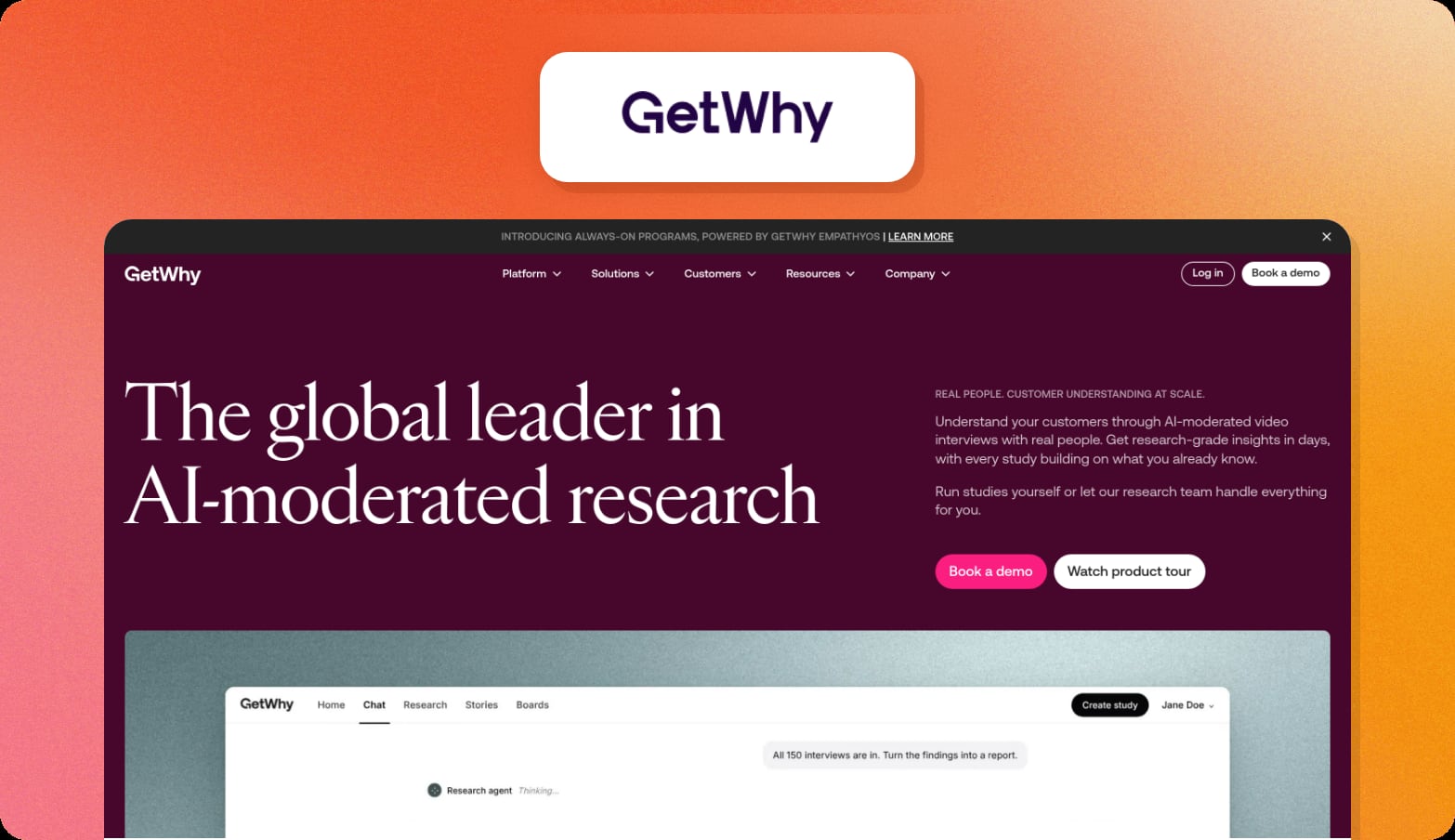
GetWhy runs AI-moderated video interviews that teams can manage themselves, with the option to brief GetWhy's senior researchers to deliver a finished study.
Best for: Consumer brands that run most studies in-house and want an expert team on call for bigger projects.
Strength: Every interview is scored against a 17-point quality framework. Interviews with moderation problems are re-run with a fresh participant, and participant problems are flagged for exclusion.
What happens to past findings? Research Agent answers plain-language questions across all studies with sources shown, and Stories packages findings as showreels or podcasts for the wider business.
Tradeoff: Studies handed to GetWhy's team build less in-house skill, so teams that want to grow their own research capability should decide upfront which projects to keep.
Pricing: Tiered plans, all priced on request.
9. Bolt Insight
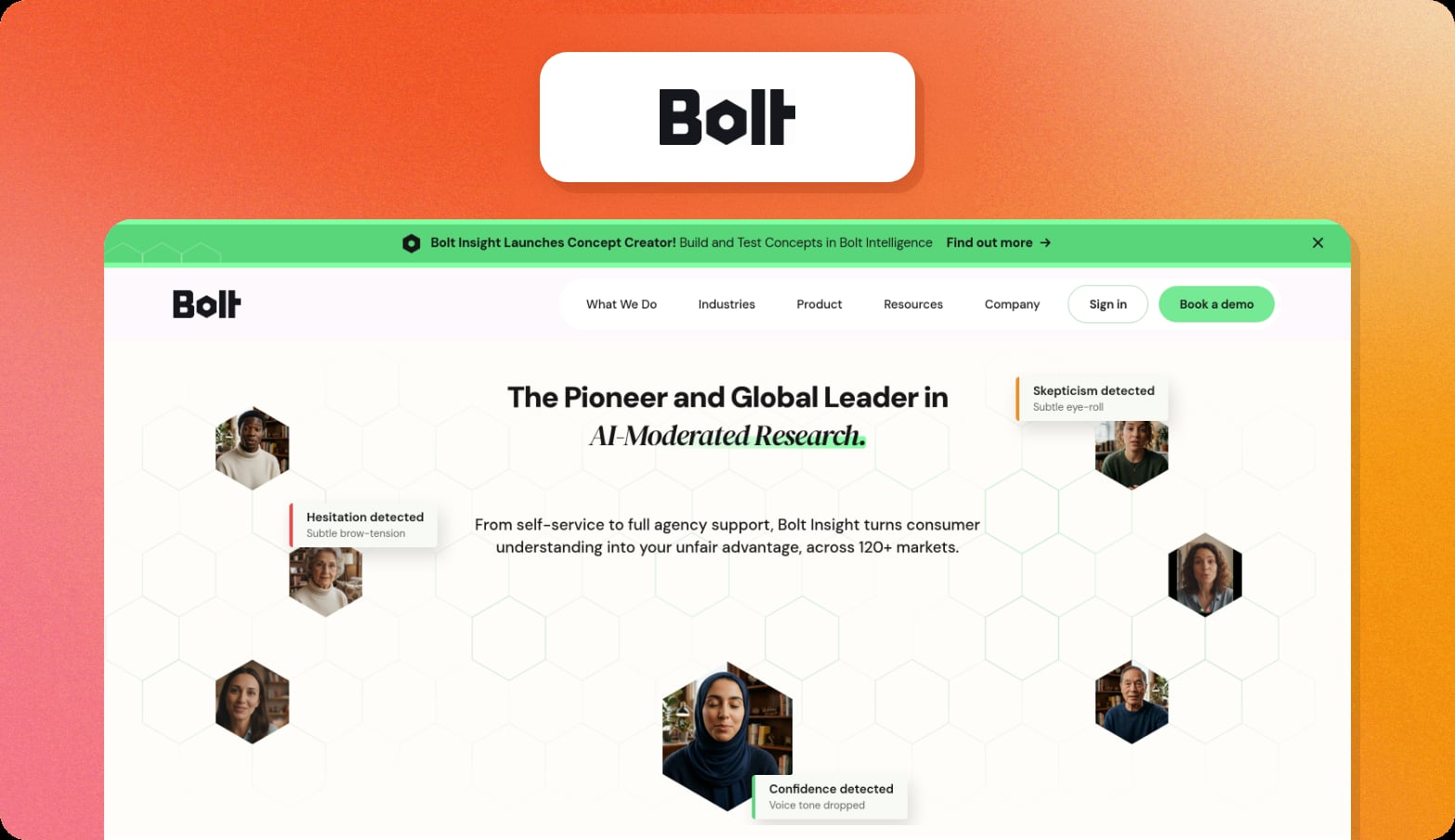
Bolt Insight runs AI-moderated interviews in a mobile chat, where participants take part anonymously from their phone without downloading an app. Teams can run studies themselves or hand the brief to Bolt's own researchers, who design, moderate and deliver the study.
Best for: Consumer insights teams researching topics people find awkward to discuss on camera, such as personal finance.
Strength: Summaries and verbatim transcripts come back in English, whatever language participants answered in.
What happens to past findings? Meta-Analysis searches every completed Bolt study alongside documents you upload, such as past reports and trend decks.
Tradeoff: Interviews run as chat, so findings trace back to transcript text. Bolt Insight's published material doesn't describe video or audio clips behind findings.
Pricing: No public pricing at time of writing.
10. Discuss
Discuss runs live human-led interviews and AI interviews from the same platform, with recruitment and project management available as add-ons.
Best for: Global insights teams that still run live focus groups and in-depth interviews and want AI interviews alongside them.
Strength: Observers can watch live interviews in other languages with real-time English translation and switch back to the original at any point.
What happens to past findings? Discuss Intelligence lets teams query their whole study history in plain language, with answers traced to quotes and clips.
Tradeoff: Discuss's privacy page lists hosting in Virginia, USA, with no EU option mentioned (checked October 2026), so teams that need EU data residency should raise it early.
Pricing: Four tiers, all priced on request, with unlimited users on every tier.
11. Qualtrics Strategy & Research
Qualtrics Strategy & Research brings market research into the same suite many companies already use for customer and employee feedback.
Best for: Enterprises already on Qualtrics that want research results next to their experience management data.
Strength: Large-scale online surveys and panel recruitment sit in one place, and Qualtrics can run panel recruitment as a managed service.
What happens to past findings? Research Hub searches across surveys and dashboards in a Qualtrics license and accepts uploaded documents.
Tradeoff: Qualtrics doesn't offer AI-moderated interviews. Video responses are recorded answers to set questions, and live interviews run with a human moderator over Zoom.
Pricing: Plans on request. Research Hub needs one of the newer simplified pricing plans.
AI research platforms built for agencies
Agencies use platforms in this category to run AI interviews for their clients. You’re unlikely to use them directly, but it’s worth knowing them in case your agency does.
12. Glaut
Glaut lets agencies add AI voice interviews to a quantitative survey, so participants talk through their answers inside the survey they're already taking.
Best for: Agencies and survey-heavy teams that want spoken open-ended answers in a quant study without changing survey tools.
Strength: Researchers can give Glaut a predefined codebook, and it applies the codes to every response, with exports to CSV or SPSS for statistical work.
What happens to past findings? Analysis runs study by study. A cross-study library isn't publicly described at the time of writing.
Tradeoff: Glaut has no panel of its own, so participant quality depends on the panel provider, even with Glaut's own checks for speeding and copy-pasting.
Pricing: No public pricing at time of writing.
13. Tellet
Tellet is an AI interview tool that describes itself as built for agencies, with participants answering by voice note or video.
Best for: Agencies running multilingual voice studies for brand clients, and the in-house teams that commission them.
Strength: Transcripts stay open to new questions after a study closes, so the team can ask the data something it didn't plan for.
What happens to past findings? Search works within each study's transcripts. Cross-study analysis isn't publicly described at the time of writing.
Tradeoff: Tellet's site lists GDPR compliance and marks ISO 27001 as coming soon. SOC 2 isn't publicly listed (checked October 2026).
Pricing: No public pricing at the time of writing.
Agencies adding AI
This category is for full-service agencies that have built their own AI tools. You're buying their people and methods, with AI speeding up parts of the work.
14. Ipsos
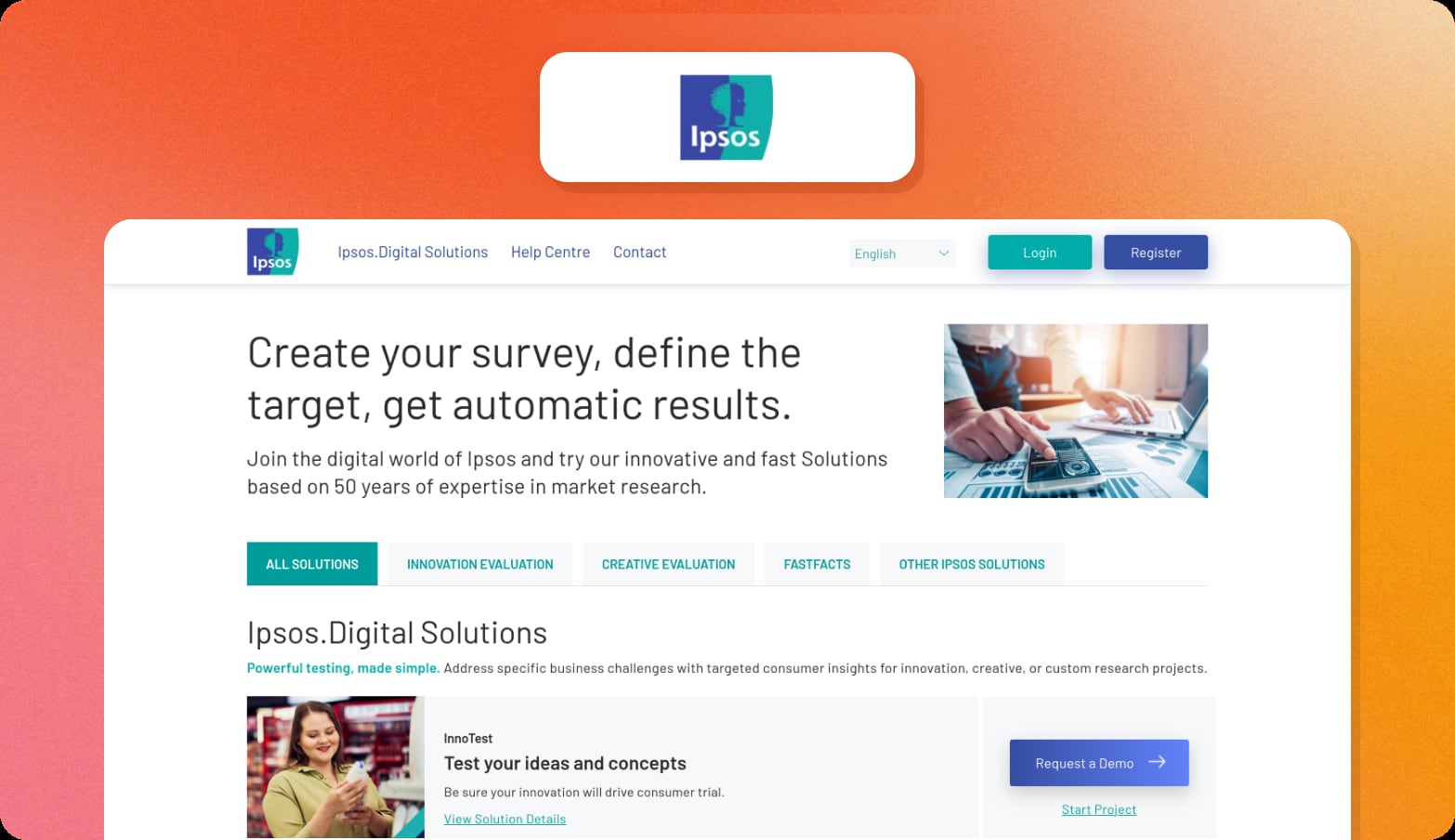
Ipsos sells AI tools through Ipsos. Digital, its self-serve portal, alongside its agency work. Its AI-Moderated Interactions product runs video interviews in 40+ languages, and teams can run it themselves, run it with Ipsos, or hand it over completely.
Best for: Teams that already work with Ipsos and want to run some AI interviews themselves while keeping the agency for larger projects.
Strength: Findings link to the video they came from, and topline results arrive shortly after fieldwork ends.
What happens to past findings? The Ipsos. Digital pages don't describe a cross-study library (checked November 2026). Each study comes with an executive summary and a chat tool for questioning the data.
Tradeoff: Ipsos also sells synthetic respondents, including digital twins for early concept screening, so check whether results come from real people or a model. Ipsos itself doesn't recommend its synthetic concept test for final validation.
Pricing: Mostly through sales. The one published price is the synthetic concept test, from $1,900.
15. Kantar
Kantar's AI tools build on decades of brand tracking and ad testing data, and most of them predict how consumers will respond to an ad or concept.
Best for: Brand and media teams screening many ads or concepts early, who want a read before spending on fieldwork.
Strength: LINK AI predicts how an ad will perform in under 15 minutes, using Kantar's history of ad tests with real people.
What happens to past findings? KAiA, Kantar's AI assistant, connects Kantar's data with a client's own brand tracking and sales data in a chat interface.
Tradeoff: Many of the tools answer without a new consumer sample. For fresh reasons from real people, Kantar Live runs moderated sessions with real consumers, though Kantar's page doesn't say whether an AI or a person runs them (checked November 2026).
Pricing: No public pricing. Custom work goes through the Kantar AI Lab.
How to run a pilot with your shortlist
The most reliable way to test a shortlist is to give two or three vendors the same live business question and compare what comes back.
Using the same question shows how each vendor handles your audience and your deadline, and gives you results you can compare side by side before signing a contract. Because the question is real, your team gets actionable insights whichever vendor you pick.
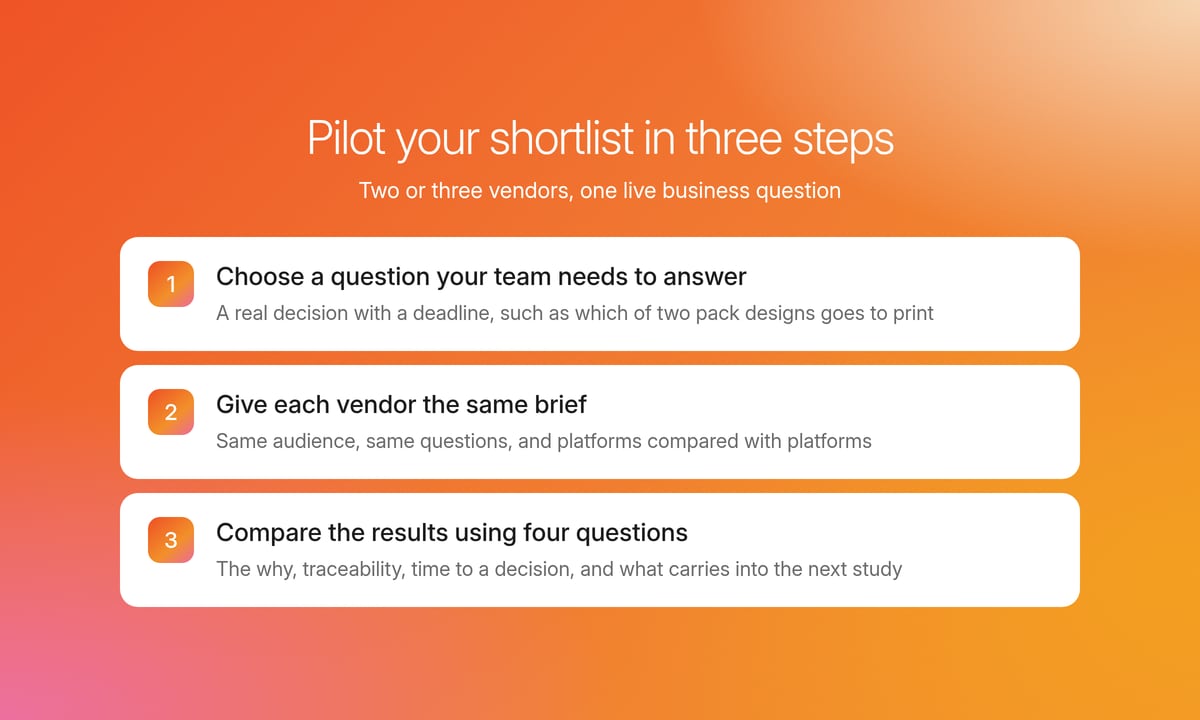
1. Choose a question your team needs to answer
Pick a research question that has a clear business decision attached to it. For example: which of two pack designs should go to print for a new snack launch?
Set a deadline for the decision and give each vendor the same background information, including the target audience, the two designs, and what you want to learn. This makes it easier to compare their work on equal terms.
2. Give each vendor the same brief
Ask two or three vendors from the same category to run the study. Compare platforms with platforms and agencies with agencies, since they offer different services.
For the pack design study, each vendor should speak to the same type of snack buyers and explore the same questions: which design catches their attention, what they expect the product to taste like, and which pack makes them more likely to buy it.
If possible, run your existing research method alongside the pilot. This gives you a baseline for comparing the quality of the findings, the time involved and the cost.
For other checks to make during setup, see this guide to choosing a qualitative research platform.
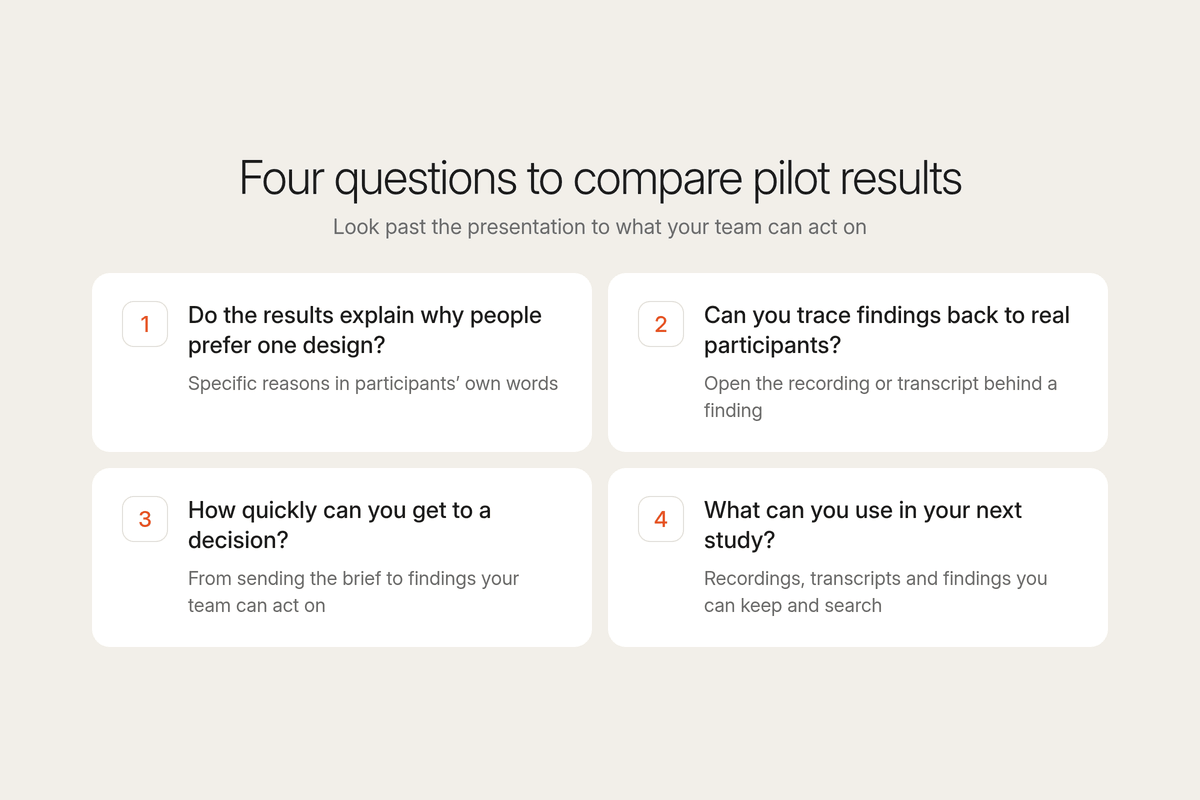
3. Compare the results using four questions
Once the studies are complete, look beyond the presentation each vendor gives you. Check what the research tells you and whether your team can use the findings to make the decision.
Do the results explain why people prefer one design? Look for specific reasons in participants' own words. For example, do shoppers prefer one pack because the flavor is easier to understand, the product looks healthier or the design stands out on a shelf? A preference score alone won't tell you what to change.
Can you trace findings back to real participants? Check whether you can open the recording or transcript behind a finding and see the original response. This helps your team understand the context and judge whether the conclusion is supported by what participants said.
How quickly can you get to a decision? Measure the time from sending the brief to receiving findings your team can act on. Include setup, recruitment, research, analysis, and any time your own team spends reviewing or preparing the results. These AI-moderated research ROI benchmarks can help you assess the time and resources involved.
What can you use in your next study? Check whether you can keep and search the recordings, transcripts, and findings after the pilot ends. When you test the next product or update the packaging, you should be able to revisit earlier feedback instead of starting your research from scratch.
With Conveo, your team can test a live business question with real consumers, review the responses behind each finding, and keep the research available for future studies. That means the pilot can help with the immediate decision and give your team useful material for the next one.
Where Conveo fits: continuous consumer understanding your team runs itself
Conveo uses AI throughout a study, from checking interviews as they happen to turning findings into the next concept to test. Every result traces back to a real consumer, and researchers decide what the findings mean.
Here’s how the AI works across a study:
Real consumers behind every answer. Conveo interviews real people recruited from eight panel providers or your own contact lists, never a synthetic respondent.
Quality checks during fieldwork. At the start of each video interview, the AI research assistant checks the lighting and framing and asks the participant to fix anything that’s off (in beta). Every completed interview then gets an automated quality score, so researchers can hide weak sessions from analysis and report suspect participants to supported panel providers.
Clear rules on AI and data. Conveo doesn’t train AI models on any client- or agency-generated data. It’s SOC 2 Type II and ISO 27001:2022 certified, GDPR compliant, with EU hosting in Belgium.
Researchers stay in charge of the analysis. They can correct the AI’s coding by hand and fix any transcript line, with the fix carrying through to exports, captions, and subtitles. Earlier versions can be restored, and the analysis only updates when they choose to re-run it.
Each study sets up the next. Talk to Your Data can turn what participants described into a concept image, which the team can refine and put in front of consumers in the next study. Studies stay in one library, so new research starts from what earlier studies found.
More than 400 enterprises, including Google, Unilever, AB InBev and Canva, use Conveo to understand their consumers.
"The pace, responsiveness, and research expertise of the Conveo team, on top of the top AI-moderated qual platform, have been invaluable to us in scaling brand advertising internationally."
Matt Harris, Research & Insights Lead, Canva
Frequently asked questions
What are the top AI market research companies?
The top AI market research companies fall into four groups. Conveo, Listen Labs, Outset, and Strella sell AI qualitative research tools that your own team runs. GetWhy, Discuss, and Qualtrics add optional research services from their own staff. Glaut and Tellet sell mainly to market research agencies. Ipsos and Kantar are agencies that have built their own AI tools. Teams that run research every month usually start with a platform, and teams that need in-person fieldwork usually start with an agency.
What is the difference between an AI market research platform and a market research agency?
A market research agency sells research services. Its researchers design the study, recruit participants, run fieldwork, and hand over the findings. An AI market research platform is research software your own team uses to run studies, with artificial intelligence running the interviews and using natural language processing to code transcripts into themes. With an agency, you’re paying for human expertise on one project. With a platform, you’re paying for tools your research team can use on every project, and the results build up in one place.
Can AI market research platforms replace an agency?
Sometimes, but many teams use both. The best AI qualitative research companies handle recurring questions well, such as concept tests and message checks, because the team can run them as often as needed. Some can also run research continuously, so the team sees how consumer views shift from one wave to the next. Agencies still suit rare, high-stakes projects that need specialist fieldwork or senior human expertise, such as a market entry study behind major strategic decisions. A common split is to run routine qualitative research in-house on a platform and keep agency budget for the projects that need it most.
Are AI-moderated interviews as reliable as human-moderated ones?
According to leading AI qualitative research providers, they can be. In AI-moderated research, the core questions stay consistent across interviews while follow-up questions adapt to each answer, which makes results easier to compare, and interviews can run in multiple languages at once. However, moderation quality still varies by vendor, so check how well follow-up questions dig into vague answers. Recordings and quotes let you check each interview yourself so you can ensure it’s accurate.
How do AI market research companies analyze qualitative data?
Many use natural language processing to transcribe interviews and code participant responses into themes. Some also read tone of voice and facial expression from video recordings. Qualitative analysis quality varies by vendor, so check whether each theme links back to the quotes or clips behind it, and whether researchers can correct the coding manually. Automated thematic analysis speeds up interview analysis, and a researcher should still review the themes before they inform a decision.
How are AI market research companies priced?
Pricing follows the business model. Agencies usually charge per project. Platforms usually charge a subscription or sell credits that teams spend on each study. Few vendors publish prices, so most quotes come through sales. The biggest cost drivers are the number of interviews and the audience, since hard-to-reach groups cost more per participant. Ask whether panel recruitment is included or billed separately, because it can change the total considerably.

About the author
Hendrik Van Hove
Founder & CPO
Hendrik is Conveo’s Chief Product Officer and co-founder. He's extremely passionate about technology and the real positive impact it can bring. Before Conveo, he ran AI strategy projects at McKinsey for the Fortune 2000, working with boards and every function from marketing, to sales to insights.
More by Hendrik →