
TL;DR
Customer intelligence examples show how customer evidence can help teams answer specific business questions and make better decisions.
This guide covers 12 examples across common decisions, from refining positioning to changing a product roadmap.
It also explains where customer intelligence comes from and what to look for when deciding whether an insight is reliable enough to use.
It’s aimed at insights and CMI teams that need to turn customer research into evidence the wider business can use.
Customer intelligence can give teams useful information about what customers want, but collecting data is only useful if it helps answer a real business question. The challenge is turning customer data into evidence that can guide a decision, whether that means changing a product, refining a message, or addressing a customer concern.
This guide covers 12 customer intelligence examples across four common business decisions. You’ll see what the team needed to decide, where the customer intelligence came from, what evidence supported the finding, and what changed as a result.
What Is Customer Intelligence?
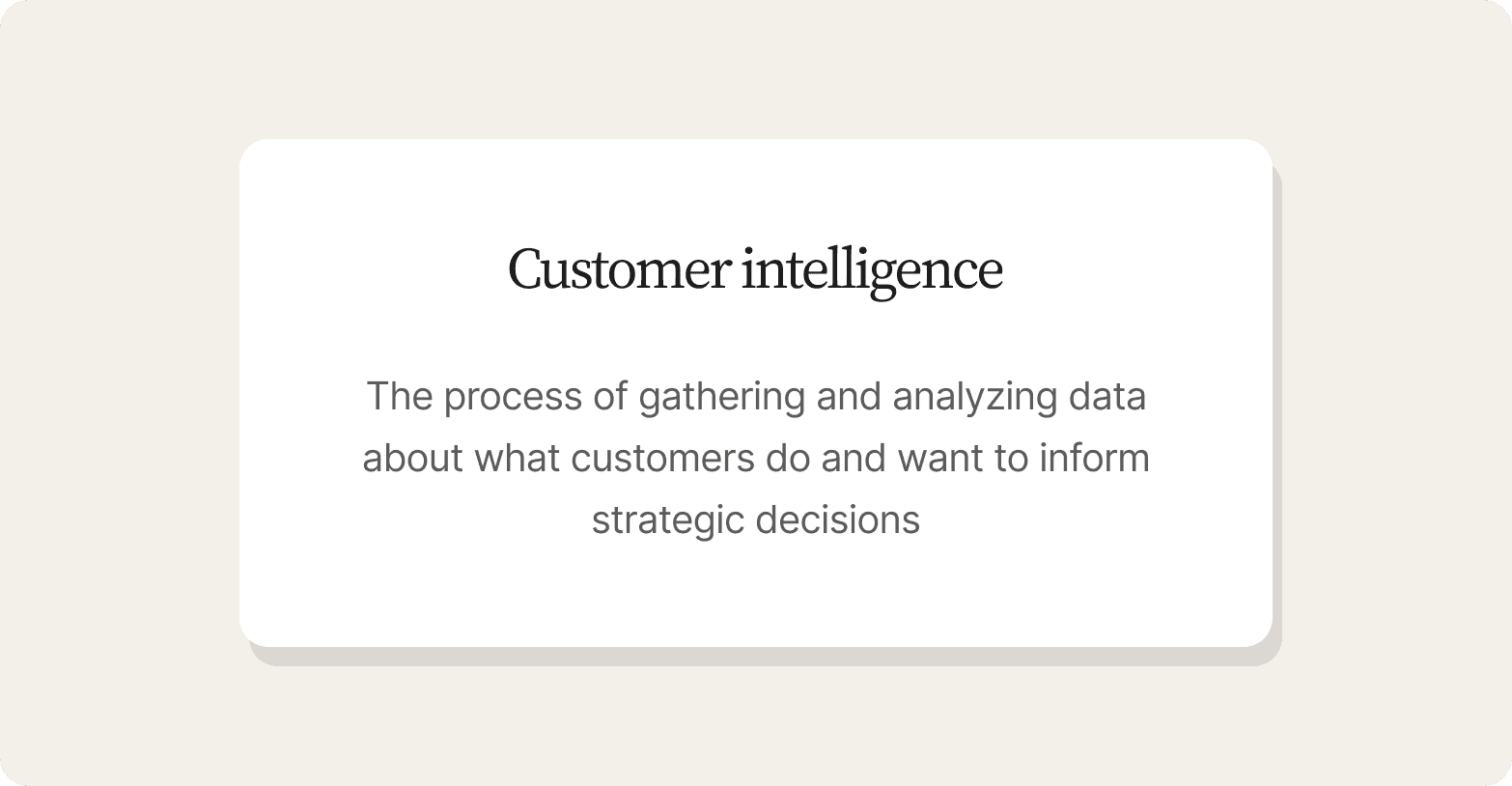
Customer intelligence is the process of gathering and analyzing data about what customers do and want to inform strategic decisions. Those decisions can apply to any area of the business, whether it’s which products or features to develop or how to improve customer satisfaction.
To be strong enough to use, customer intelligence insights need to:
Come from real people. The insight should reflect actual customers or research participants rather than assumptions or AI-generated personas, so decisions are based on genuine customer experiences.
Explain why customers think or behave the way they do. Knowing what customers did or said is useful, but understanding the reasons behind their behavior helps teams decide what action to take.
Be traceable back to source evidence. Teams should be able to verify an insight against evidence such as an interview clip or quote, so they can assess its context and trust the conclusion.
Speed is important too. Traditional agency research can take weeks, and by the time it lands, the decision it was meant to inform has often already been made. Teams that continuously run customer intelligence can turn insights around in days.
The Three Customer Intelligence Approaches, and When Each Breaks Down
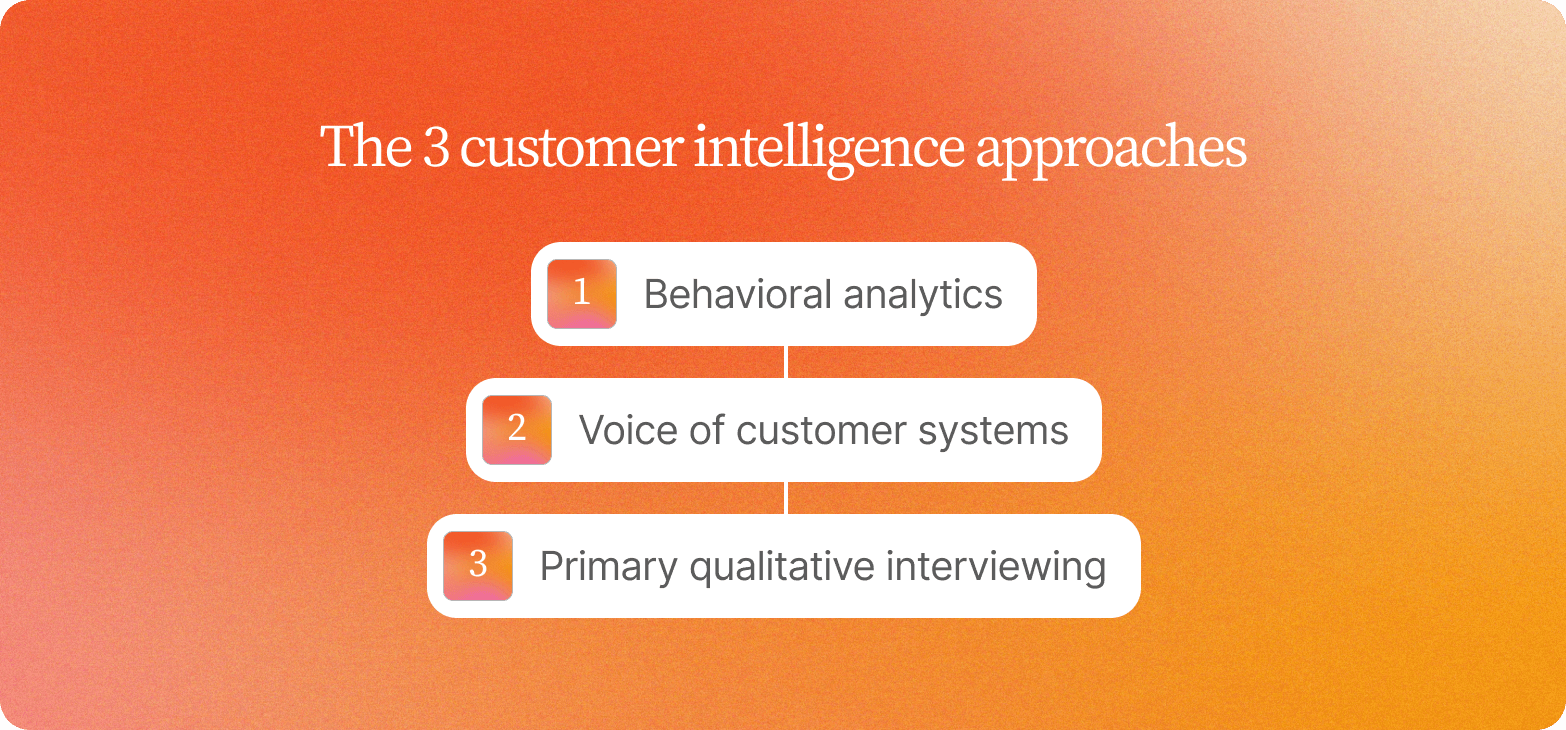
There are different ways to collect customer intelligence data, each answering different questions and with distinct limitations. Here’s a breakdown of each.
1. Behavioral Analytics
Behavioral analytics platforms track what customers do on a website or app. They can tell you which pages people are visiting most or the path users most often take to convert.
Customer intelligence analytics data is useful for identifying potential problems or opportunities. For example, it might show that many users abandon the checkout process at the payment stage. But if a stakeholder asks you to explain why, behavioral data can’t tell you on its own. Were they confused by the form? Unable to use their preferred payment method? Without that extra context, it’s hard to know what to fix.
2. Voice of Customer (VoC) Systems
VoC platforms take data from multiple sources like support tickets, online reviews, feedback forms, surveys, and sometimes VoC interviews to identify patterns and track customer feedback over time. For example, a hotel might be alerted by its VoC tool to increasing customer concerns about its slow check-in.
VoC platforms are good at showing overall themes, but those themes don't always link back to specific customers. Stakeholders can’t verify how accurate the patterns are, or understand how the platform reached its conclusion.
3. Primary Qualitative Interviewing
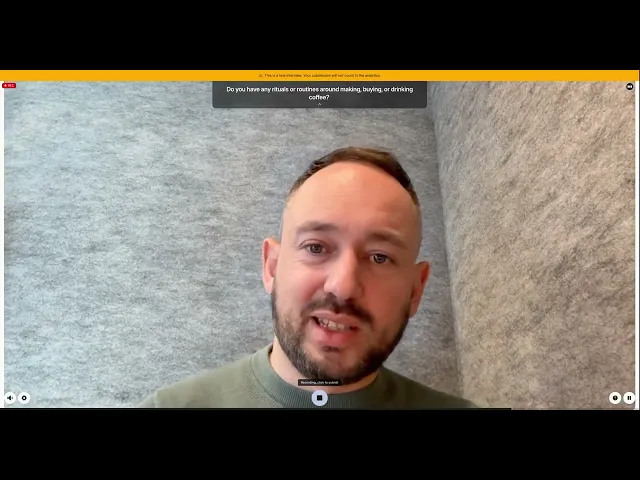
Qualitative interview platforms enable teams to run human- or AI-moderated interviews with customers at scale. Instead of limiting participants to fixed questions, interviews can follow up on relevant responses and explore unexpected topics in more detail. For example, if a customer says they stopped using a product because it became “too complicated,” the interviewer can ask what changed and which parts they found difficult.
For companies that would otherwise hire an agency to conduct qualitative research, interview platforms enable them to run multiple interviews simultaneously. This reduces the time it takes to gather customer insights while still giving participants space to explain their experiences in depth.
See it in action: How AI-Moderated Interviews Actually Work →
Once you’ve decided what customer intelligence software or approach best fits your team and your research goals, think about what business functions or decisions you want to leverage customer intelligence for.
12 Customer Intelligence Examples and What They Can Help You Decide
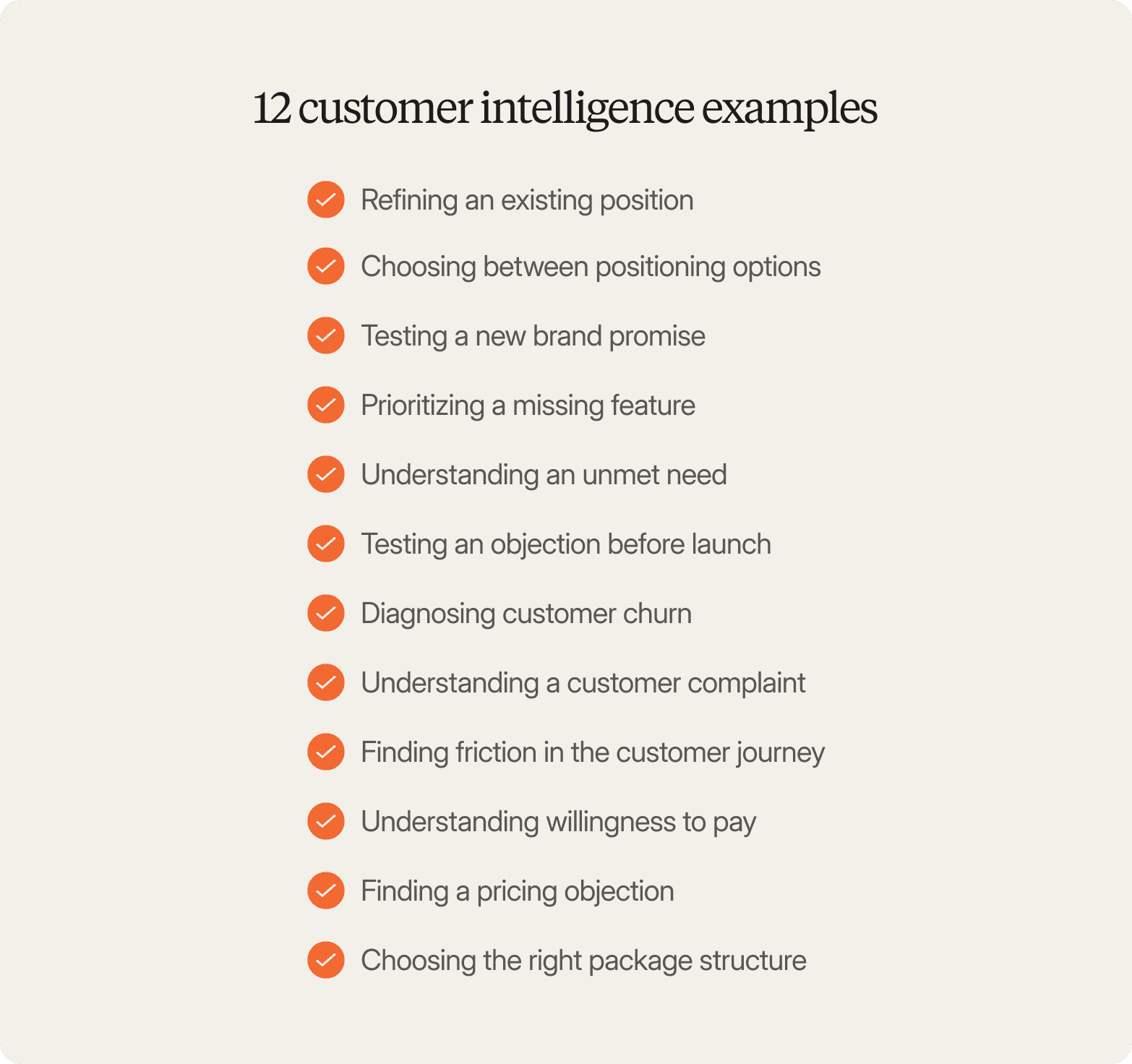
Here are 12 example scenarios of how teams can use customer intelligence to inform decisions, grouped into four common use cases.
Brand Positioning Examples
Refining an existing position. A healthcare brand preparing to launch a new service wanted to validate its positioning before finalizing the campaign. Interviews with prospective patients kept returning to one word: several participants called the brand "clinical," while the brief was built around "trusted." The team traced clips with similar responses back to the interviews, then changed the positioning brief to address what was driving that perception before launch.
Choosing between positioning options. A financial services company was deciding whether to position a new product around convenience or control. In interviews, a small-business owner said "control matters more to me than saving five minutes," a view several other participants echoed on camera. The team used those clips to choose control as the stronger positioning and carried it into the launch brief.
Testing a new brand promise. A consumer brand was considering a promise built around making everyday tasks easier. Interviews showed customers liked the idea but read "easier" differently: one participant said it meant "less time," another said "less effort," each on video. The team used that split to narrow the promise to the interpretation customers agreed on most consistently.
Product Development Examples
Prioritizing a missing feature. A project management company noticed from its analytics that users kept visiting a settings page without taking action. In interviews, a marketing lead at a 40-person agency said, "I keep looking for a way to share this with people outside our team," a need three other participants described the same way on camera. Those clips were enough to move external sharing to the top of the product roadmap.
Understanding an unmet need. An e-commerce company noticed that customers often searched for a product category but rarely bought. In interviews, a shopper pointed at a product page with no size chart and said, "I can't tell if this will fit what I need without more detail." The team paired that clip with the search data to prioritize clearer product specifications.
Testing an objection before launch. A software company was building a new automation feature and expected customers to value the time it saved. One participant, an operations manager, said on camera, "I don't want it to just run, I want to see what it changed before it goes live." That feedback, echoed by several other participants, convinced the team to add a review step before the feature shipped.
Customer Experience Examples
Diagnosing customer churn. A subscription business saw churn rising but couldn't find the cause in its analytics. In interviews with customers who'd recently canceled, one said, "I called three times and had to explain the same problem every time," a pattern that came up in half the interviews. Those clips drove a redesign of the support handoff process, and repeat contacts dropped.
Understanding a customer complaint. A retailer kept receiving complaints about its returns process but couldn't pinpoint where the frustration stemmed from. A customer explained on video, "I understood the policy, I just couldn't find the return label anywhere on the site." Based on that clip, the team redesigned the placement of return information on the site.
Finding friction in the customer journey. A financial services company saw customers abandoning loan applications partway through. In interviews, one applicant said, "I stopped because I didn't know if what I was entering was even right," a concern echoed by several others. Those clips pushed the team to add clearer guidance at each step of the application.
Pricing And Packaging Examples
Understanding willingness to pay. A SaaS company had strong sign-up interest but weaker conversion than expected. In interviews, one customer said, "the automated reporting is the only reason I'm still using this," while the rest of the package barely came up. That evidence led the team to rebuild the package around the feature customers valued most.
Finding a pricing objection. An e-commerce company tested two price points and saw little difference in conversion rates. In interviews, a shopper said, "I wasn't sure what I'd get for the higher price." The team changed how the offer was presented so customers could see what the price included before checkout.
Choosing the right package structure. A software company was deciding between a single standard package and several tiers. In interviews, one customer said, "I'm paying for three tools I've never opened," while another used all of them daily. Those clips shaped a simpler package structure that matched how customers used the product.
How to Build Customer Intelligence Over Time
Moving from occasionally collecting customer data to continuous consumer understanding means teams can answer new questions without starting a research project from scratch each time. For always-on understanding to work in practice, you need three things in place:
A recurring interview cadence (monthly or quarterly), so new findings keep arriving whether or not a specific project is underway.
Governance around recruitment and consent, so the participants coming back study after study are still real people who agreed to take part.
A way to connect findings across studies automatically, so a theme from one project surfaces again in the next instead of sitting buried in a separate transcript.
Once that infrastructure is running, the next question is whether what it produces is trustworthy enough to act on.
"The pace, responsiveness, and research expertise of the Conveo team, on top of the top AI-moderated qual platform, have been invaluable to us in scaling brand advertising internationally."
Matt Harris, Research & Insights Lead, EMEA, at Canva
Quality Checks for Customer Intelligence Data
Whichever type of customer intelligence strategy you use, a few things need to be true to make sure your research produces reliable, high-quality insights. Here are the four main areas to check:
Check | What to look for | Why it matters |
Are you hearing from the right people? | Check how participants were recruited and screened. Make sure they represent the customers relevant to the decision. | Hearing from the wrong people can lead to misleading conclusions. |
Could the research be biased? | Look for leading questions, moderator influence, or a tendency to focus only on evidence that supports existing assumptions. | The way research is conducted and interpreted can affect the findings. |
Can you trace findings back to the source? | Each claim should link to the participant who made it and the original evidence, such as a quote or timestamped interview clip. | Teams need to be able to check the context behind a conclusion. |
Is it a real pattern or an unusual response? | Look for repeated signals across participants rather than drawing broad conclusions from isolated feedback. | One memorable comment doesn’t necessarily represent a wider customer need or behavior. |
How to Turn Customer Intelligence into Briefs, Messaging, and Campaigns Stakeholders Trust
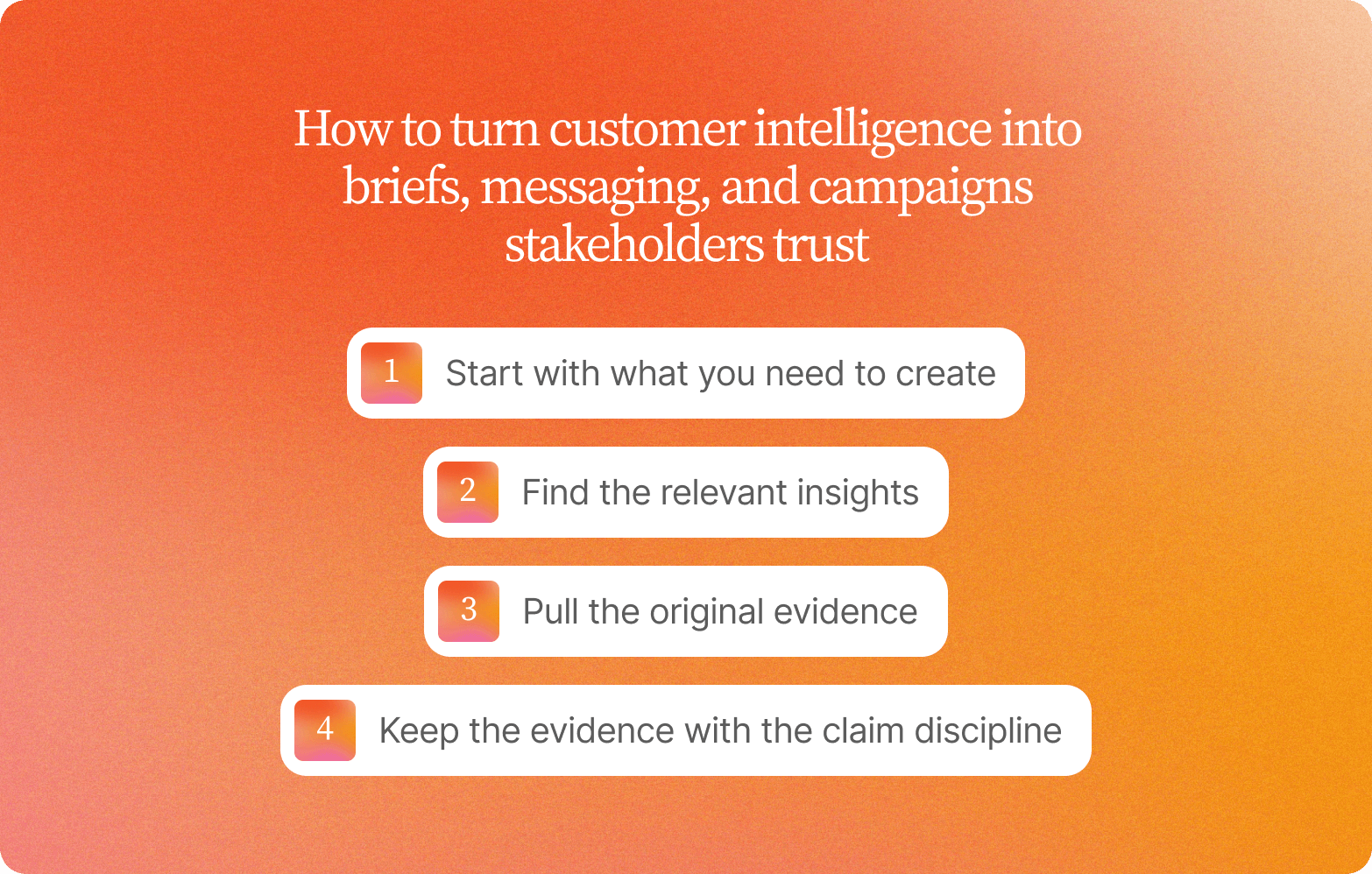
To get the full benefits of customer intelligence, you need to turn the insights into something teams can use, rather than leaving them buried in a dashboard or research folder. Follow these four steps to make sure whatever you build is grounded in evidence:
Start with what you need to create. Decide whether you need a positioning brief, messaging framework, campaign concept, or another deliverable.
Find the relevant insights. Search your research library for findings related to the decision or piece of work you are creating.
Pull the original evidence. Bring in the customer quotes and interview clips that support the findings you want to use.
Keep the evidence with the claim. Add links to the original source so anyone reviewing the work can see who said it and check the context for themselves.
Having the right customer intelligence platform helps make this process quick and painless, as it will let you search for relevant insights and pull the original evidence in minutes.
Why Insights Teams Choose Conveo for Traceable Customer Intelligence
Conveo helps teams make consumer intelligence an ongoing part of how they understand and learn from their customers, rather than something confined to individual research projects. Here’s how:
Always-on research. Teams can run research as new questions arise instead of commissioning a separate project every time they need an answer.
Research rigor. Every finding can be traced back to a real participant and the original source evidence, rather than a synthetic respondent or unsupported summary.
Knowledge that builds over time. The knowledge layer connects findings across studies, helping teams build on previous research instead of researching the same questions again.
Compliance. Conveo is SOC 2 certified and GDPR compliant, with data hosted in the EU.
Speed. Conveo runs qualitative research at scale. Insights can be delivered in days rather than weeks, with participants recruited through Conveo's panel network or a team's existing list.
Together, these capabilities help you maintain a reliable, up-to-date understanding of your customers. With actionable insights at your fingertips, you can always feel confident you’re making decisions backed by data.
Frequently Asked Questions
What are customer intelligence examples in real life?
What are customer intelligence examples in business?
What customer intelligence examples do companies use?
What are customer intelligence tools?
What does CI mean in marketing?
What does CI mean in business?