In this article
TL;DR
Qualitative research is entering a new era. The old constraints (slow timelines, small samples, findings that expire in a slide deck) are dissolving. AI-augmented qual now makes it possible to run real human conversations at scale, capture multimodal signals, and surface valuable insights that compound across studies.
Most teams default to two or three UX research methods and miss critical signals about user motivation, context, and unmet needs. This article covers three method categories:
Generative research: exploratory, to understand problems
Evaluative research: validation, to test solutions
Continuous discovery: ongoing, to stay connected to users between sprints
Surveys measure what users do. They rarely explain why. Qualitative methods fill that gap. Asynchronous video interviews remove the scheduling friction that makes user experience research feel like a project: participants respond in their own time, and teams capture voice, tone, and visual context without coordinating calendars. Conveo's research across hundreds of enterprise teams shows that the right method, run at the right cadence, eliminates the tradeoff between depth and speed.
The UX research methods you choose should match your timeline, team size, and the decision you're trying to make, not just what's fastest to set up.
The Research Method Trap
Your team runs usability tests every sprint. You send surveys after major releases. You track drop-off in the funnel all the way down to the session. And yet, when a key flow underperforms, the honest answer in the room is still: we're not sure why users are leaving.
That gap is the research method trap. The methods most teams rely on by default (surveys, analytics, and short usability tests) are optimized for operational fit rather than learning depth. They tell you what users did. They rarely tell you what users were thinking, what made them hesitate, or what they expected instead. The motivations that shape user experience stay invisible.
Live moderated interviews close that gap. A skilled moderator can surface the exact moment a mental model breaks, the specific language a user reaches for when something feels wrong, and the hesitation that never shows up in a click path. The problem isn't the method. It's the overhead: scheduling, recruiting, coordinating time zones, synthesizing before the sprint closes. That's a multi-week project compressed into a window that rarely exists.
So teams default to what fits the timeline, not what fits the question. The research process stalls, learning stays shallow, and product decisions get made on incomplete evidence.
That tradeoff is no longer inevitable. AI-augmented qualitative research dissolves the constraints that made depth and speed mutually exclusive. Asynchronous video interviews are the clearest expression of that shift: participants join on their own schedule, speak naturally to the camera, and show context that text responses miss. Sessions run in parallel across dozens of participants without a single scheduling call. The right method, run at the right cadence, is no longer a tradeoff.
"Within days, we had insights that would've taken a traditional agency a month."
Head of Customer Insights, JDE Peet’s
3 Ways to Categorize User Research Methods
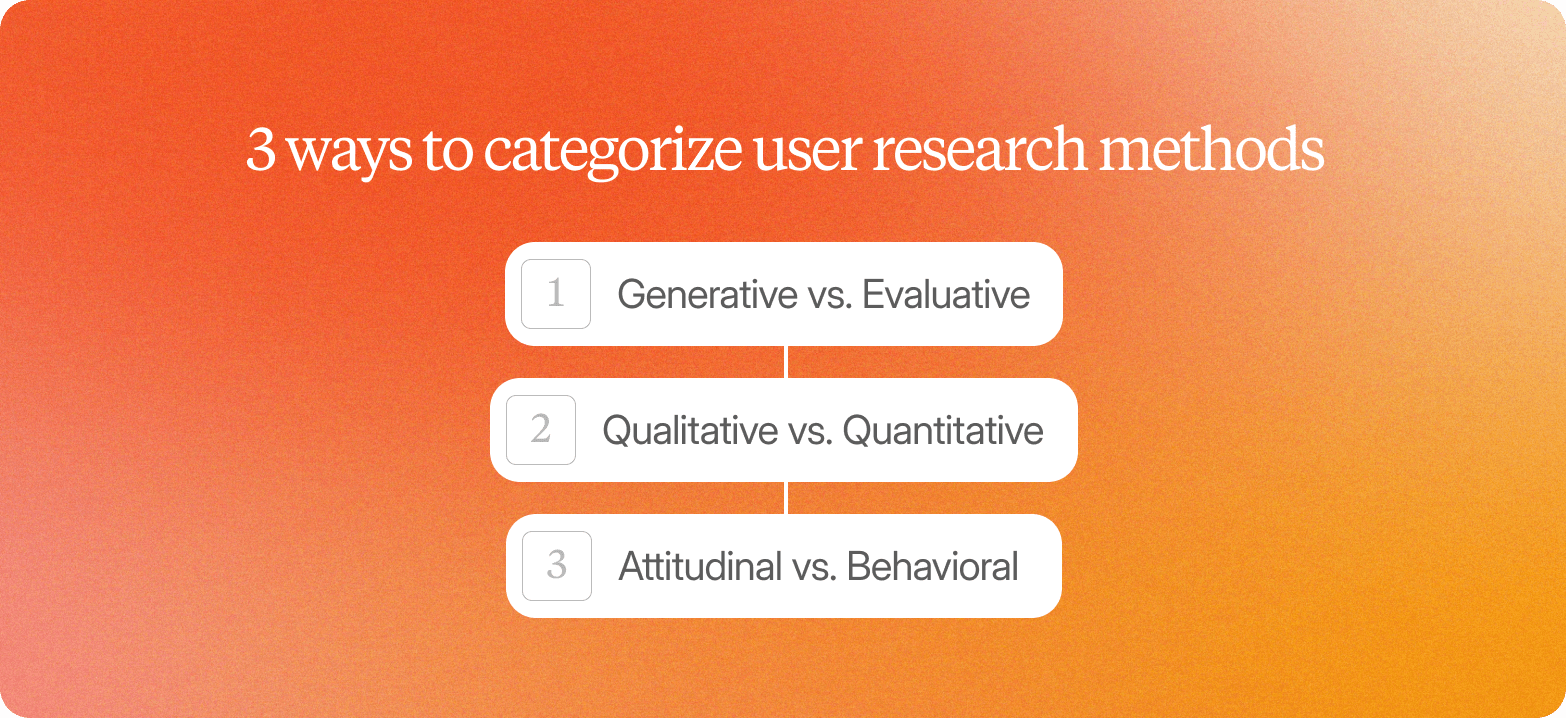
Most teams don't struggle to choose a research method. They struggle to know what kind of question they're actually asking. Three frameworks help:
Generative vs. Evaluative
Generative and evaluative research serve fundamentally different purposes. Generative research is exploratory: it runs before anything enters the design and development process, when the research objective is to uncover unmet needs, map mental models, and define the problem space with precision. Teams use generative research when they don't yet know what to build, or when they suspect their current assumptions about users are incomplete. The output isn't a verdict on a design decision. It's a clearer picture of the user's world.
Evaluative research tests something specific: a prototype, a concept, a live feature, a messaging direction. The goal is to measure how well a solution performs against user expectations and usability standards. Evaluative work answers questions like: Can users complete tasks without friction? Does this concept resonate with target users? Where does the experience break down?
Continuous research sits alongside both. Rather than running as a discrete project, it tracks changes in behavior, satisfaction trends, and emerging friction points over time. Teams running continuous discovery don't wait for a product milestone to justify a study. They maintain an ongoing line of sight into how users experience the product as it evolves.
Qualitative vs. Quantitative
The strategic question isn't whether to use quantitative and qualitative methods. It's how to sequence them. Quantitative data identifies where friction exists: which flows lose users, which features underperform, and which segments churn. Qualitative data explains why: the reasoning, the language, the hesitation that never surfaces in a dashboard. The strongest programs collect data through quantitative research to identify the signal, then deploy qualitative research methods to explain it, using those findings to generate better hypotheses for the next round of measurement.
A quick explainer: Qual vs. Quant: which one do you actually need? [Video 7 embed: Qual vs. Quant Research: Which One Do You Actually Need? (3-4 min)]
Attitudinal vs. Behavioral
Attitudinal data captures what users say they do, want, or prefer. Behavioral data captures what they actually do, measured through observation, session recordings, or usage analytics. The data collected on each side often tells a different story, and the gap between the two is where the most important insight lives.
The practical implication runs through the full range of user research methodologies: teams that rely on a single category miss a critical signal. A product team running only A/B tests gets significance without explanation. A team that runs only interviews gets articulate users who may not reflect actual behavior. The strongest research programs deliberately combine categories, matching method to question rather than defaulting to what's familiar or fast.
5 Generative Research Methods (Exploratory)
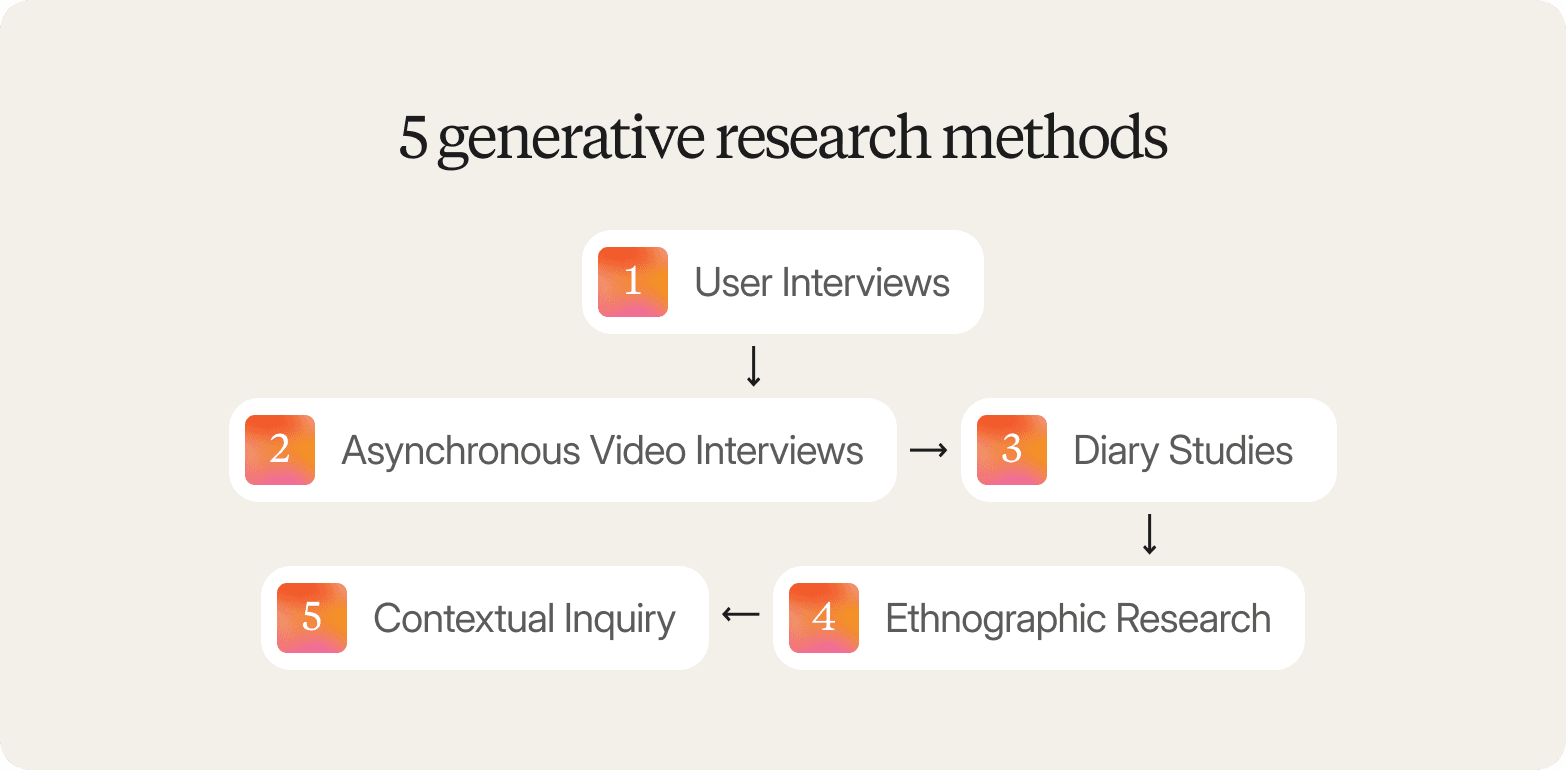
Generative research sits at the front of any well-run discovery process. Before evaluating solutions, teams need to understand the problem space: what users are trying to accomplish, what gets in their way, and what mental models they bring. User research methodologies in this category answer the "why" before any prototype exists. AI-moderated formats now make it possible to run these studies at a cadence and scale previously reserved for quantitative methods, without sacrificing depth.
User Interviews (Moderated)
One-on-one conversations guided by a researcher to explore motivations, pain points, and the context surrounding a decision. This research technique excels when a skilled moderator follows unexpected threads and surfaces the reasoning behind answers that a survey would flatten into a rating.
Best for: Unfamiliar problem spaces, complex workflows, nuanced roadmap context, especially when recruiting target users from specific segments
Tradeoff: Scheduling is manual and time-intensive. Running more than 12-15 interviews in a sprint cycle often isn't feasible without dedicated research support.
2. Asynchronous Video Interviews
Participants record video responses on their own schedule, without a live moderator. This remote testing format preserves voice, facial expression, and visual context while removing the coordination burden entirely.
Best for: Parallel conversations at scale, cross-timezone research, compressing time to first findings
Tradeoff: Follow-up depth depends on prompt quality. Well-structured discussion guides with branching logic significantly close this gap.
Instead of coordinating calendars over two weeks, a team can have 30 conversations in progress simultaneously, and user feedback begins to flow within 24 hours of launch. Conveo's AI-moderated sessions run in parallel, and automated analysis surfaces themes as responses come in, allowing teams to act on findings before recruitment is even complete. It's the fastest way to collect detailed feedback at scale without sacrificing qualitative depth.
"Conveo's video-first approach is a real differentiating methodological advantage. The ability to distill insights from reactions and not just hear answers adds context you simply can't get from transcript-only tools, or any other tool in the market for that matter."
Senior Marketing Research & Insights Manager, Google
3. Diary Studies
Participants document behaviors, thoughts, or experiences as they happen over days or weeks, using mobile prompts, short video entries, or written logs. Unlike focus groups, which capture a single moment of group opinion, diary studies track user habits as they form or change in real life.
Best for: Capturing how users engage with a product across different contexts and routines, and in-the-moment reactions that recall-based interviews miss
Tradeoff: Requires sustained participant engagement. Incentive structures and prompt frequency need careful calibration.
4. Ethnographic Research
Researchers observe users in their natural environment rather than asking them to recall behavior.
Best for: Environmental constraints, workflow habits, physical or social context that shapes product use
Tradeoff: Significant time and access requirements. Most teams use it selectively for high-stakes discovery questions.
5. Contextual Inquiry
A hybrid of observation and interview: the researcher watches a user perform real tasks and asks questions in the moment, mapping the full user journey within a real environment.
Best for: Uncovering friction that users have normalized and would never mention in a traditional interview
Tradeoff: Like ethnography, access and time are limiting factors. Works best when scoped tightly to a specific task or environment.
Generative methods reveal the "why" behind user interactions with products and give product teams the raw material to build user-centered solutions worth pursuing. Once that foundation exists, the question shifts to: Does the proposed solution actually work?
6 Evaluative Research Methods (Validation)
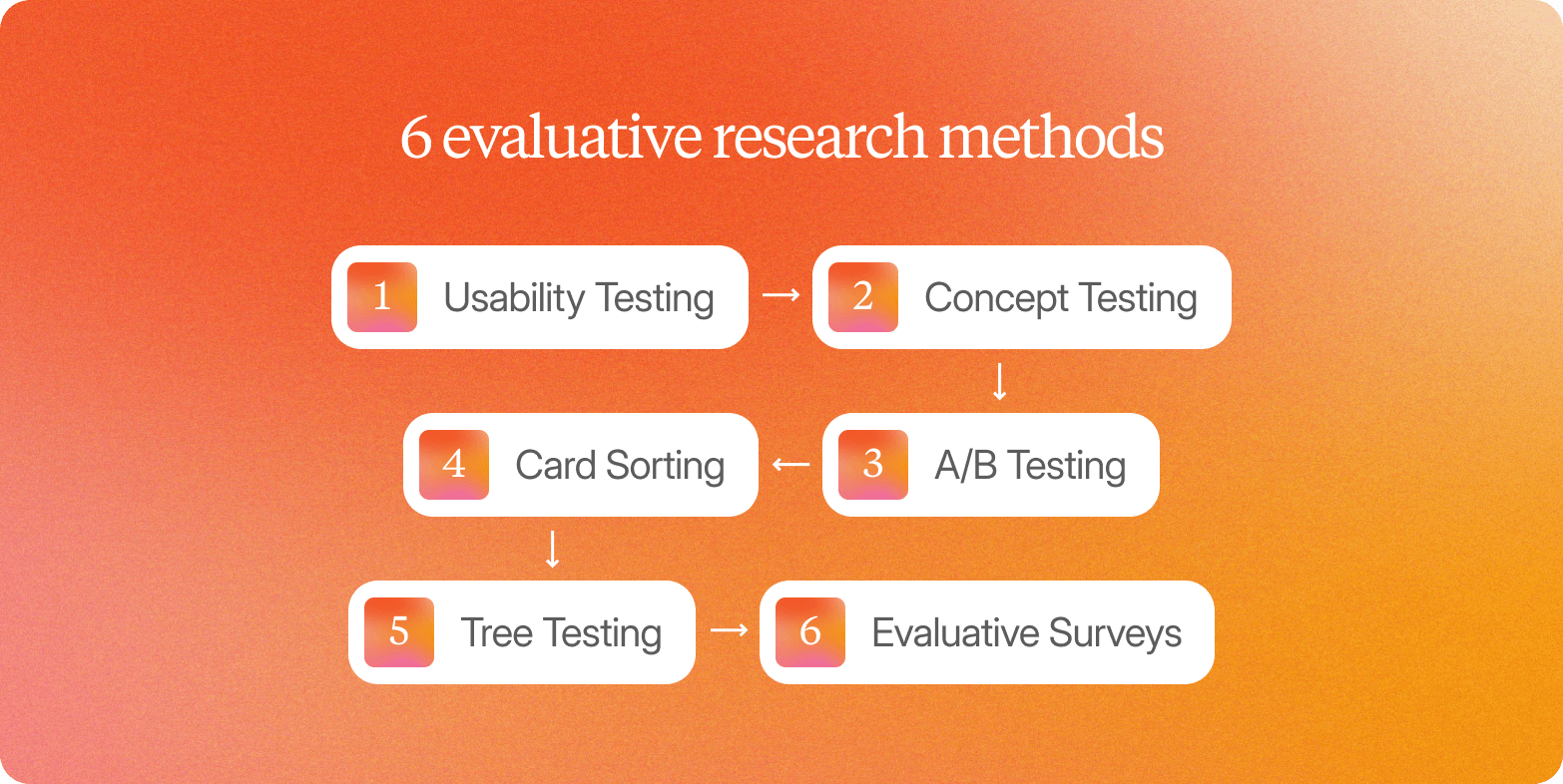
Evaluative research tests whether a solution actually works. Where generative methods surface what users need, evaluative methods measure how well a product, concept, or design meets those needs. The goal is validation: catching friction, misalignment, or failure modes before they become expensive to fix later in the design and development process. As buyer expectations for speed-to-insight accelerate, evaluative research is shifting as well: AI-assisted analysis means teams can validate concepts against real user reactions in days rather than weeks, with traceable video evidence that withstands stakeholder scrutiny.
Usability Testing
Also called user testing, this involves participants attempting to complete tasks with a prototype or live product while a researcher observes where they succeed, hesitate, or fail. When you conduct usability testing, whether moderated usability tests with a live observer or unmoderated remote sessions, you see exactly where the user interface breaks down, not just where users think it might.
Best for: Validating interface design and task flows before or after launch
Tradeoff: Sample sizes are small; edge cases can go undetected
Concept Testing
Early-stage ideas, mockups, or value propositions are shared with target audience members for structured feedback before development investment begins. Teams gauge user preferences and find out whether they're building the right thing before they build it.
Best for: Pressure-testing product direction, messaging, or feature concepts
Tradeoff: Reactions to concepts are not always predictive of behavior with finished products
A/B Testing
A/B testing is a quantitative research method that shows two or more versions of a product to separate user groups and measures performance on a specific metric (click rate, conversion, task completion), generating numerical data to answer "which" with statistical confidence.
Best for: Optimizing specific decisions with measurable outcomes at scale
Tradeoff: Tells you which variant performed better, not why. Pairing with a qualitative follow-up is often necessary to interpret the result.
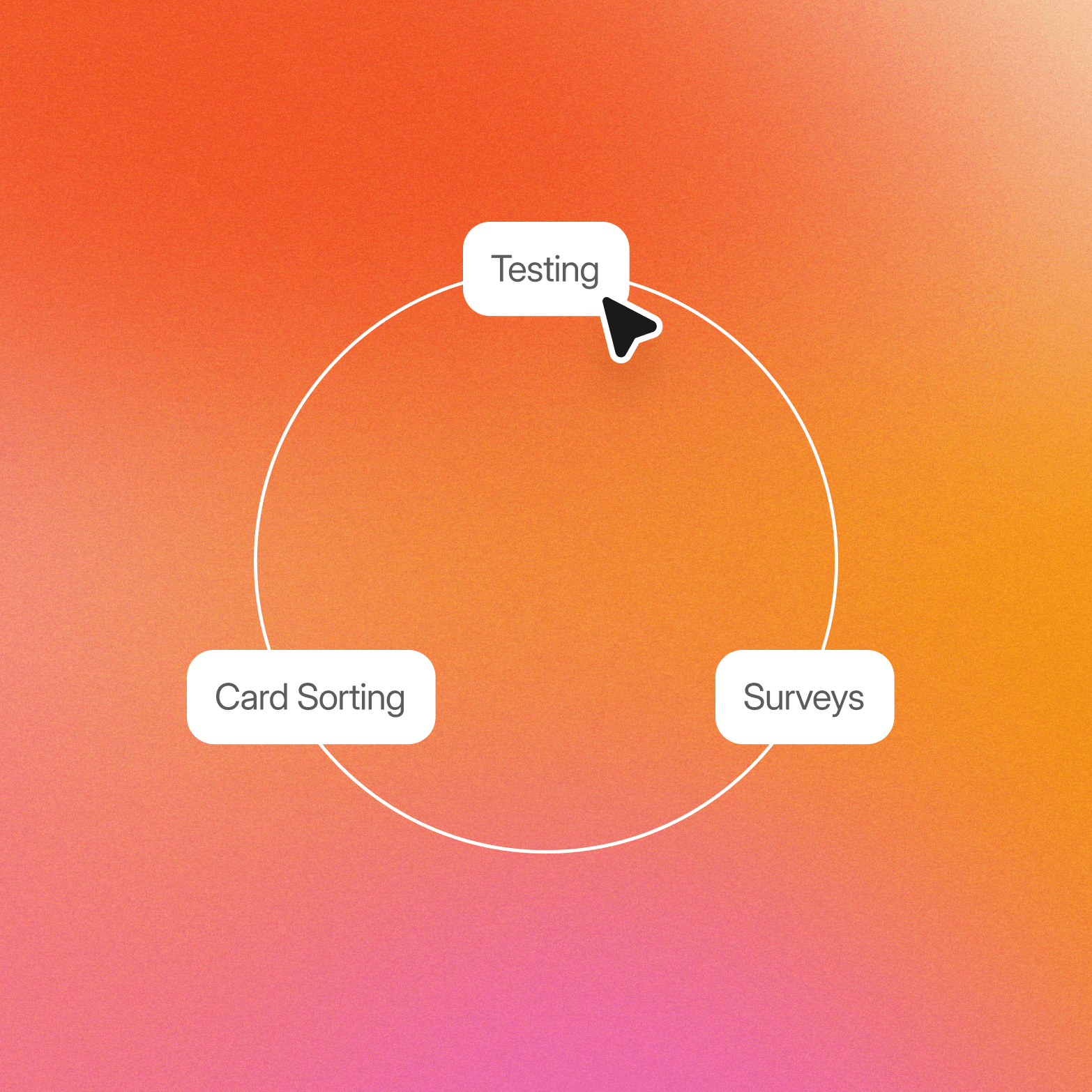
Card Sorting
Users organize content, features, or labels into categories that make sense to them. The output informs information architecture decisions that would otherwise be based on internal assumptions.
Best for: Structuring navigation, feature groupings, or content hierarchies
Tradeoff: Reflects mental categorization, which doesn't always translate directly into live navigation behavior
Tree Testing
Users navigate a text-only version of a site or product structure to find specific items, isolating whether the architecture itself is findable.
Best for: Validating information architecture before visual design is applied
Tradeoff: Artificial conditions mean real-world navigation may differ once UI is introduced
Evaluative Surveys
This quantitative research approach quickly measures user satisfaction, preferences, or task success across large samples. Scalable and easy to deploy, surveys are a common default for post-launch measurement.
Best for: Measuring user satisfaction or preference at scale
Tradeoff: Fast but shallow. The data quality suffers because motivation, hesitation, and context are lost entirely in a text response.
That last tradeoff matters most in concept testing. When teams validate early-stage ideas through surveys, they get quantitative data on preferences without the reasoning behind them. Asynchronous video interviews change that: a participant's tone shift when viewing a prototype, a pause before answering, or a visible reaction to a design element all carry information that a written response cannot. The qualitative data captured through video (tone, hesitation, visible reactions) deliver insights that static survey questions cannot. Conveo's AI moderator adapts follow-up prompts based on participant responses, drawing out the "why" in a way no survey can replicate. Teams using video-based concept testing consistently surface more actionable insight, which makes the validation more defensible and the direction clearer.
Evaluative methods confirm whether a solution works. But products and user needs don't stay fixed. The teams that stay ahead of those shifts treat research as a continuous practice, not a pre-launch checkpoint.
4 Continuous Research Methods (Ongoing Discovery)
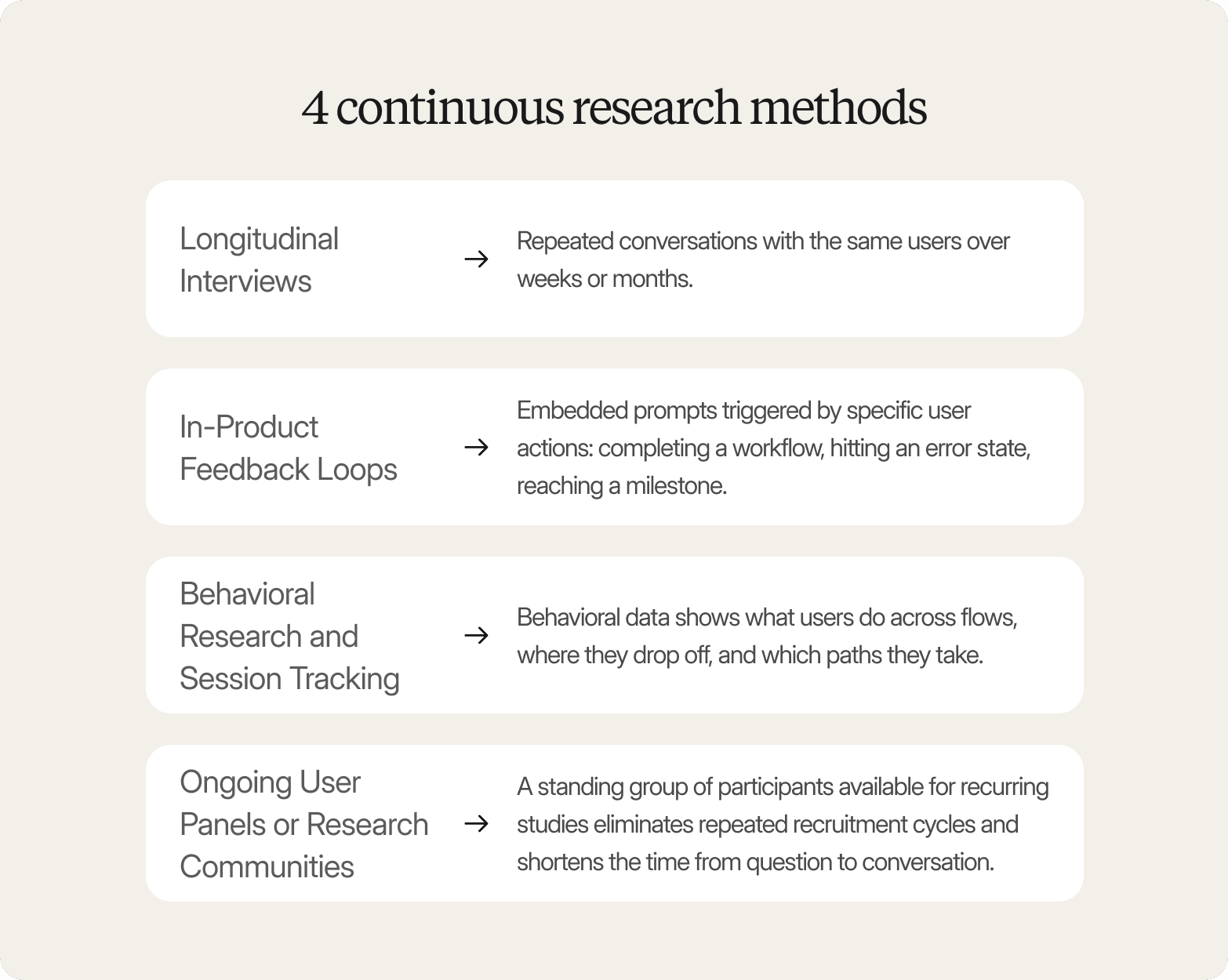
The typical research process is built around discrete questions: a sprint kicks off, a study runs, findings land in a deck, and the cycle resets. Insights don't compound. Teams re-recruit the same segments, re-ask the same questions, and re-discover friction points that a prior study already surfaced. There are continuous research methods to break that pattern.
Longitudinal Interviews
Repeated conversations with the same users over weeks or months. Instead of capturing a single moment of opinion, they map the full user journey from onboarding through feature adoption, tracking user engagement as it evolves over 30, 60, or 90 days. A structured series answers questions that a single interview cannot: how does confidence with a product evolve after 30 days? Where does initial enthusiasm stall?
In-Product Feedback Loops
Embedded prompts triggered by specific user actions: completing a workflow, hitting an error state, reaching a milestone. Customer and user feedback captured at the moment of the experience is more accurate than feedback recalled days later. The tradeoff is depth: a triggered prompt surfaces a signal but rarely explains the reasoning behind it. These work best when paired with qualitative follow-up rather than treated as standalone evidence.
Behavioral Research and Session Tracking
Behavioral data shows what users do across flows, where they drop off, and which paths they take. Tools like Google Analytics surface this quantitative data layer, which is useful for identifying where friction exists but not why it exists. Teams that rely on analytics alone often find themselves building hypotheses without the customer language needed to test them confidently.
Ongoing User Panels or Research Communities
A standing group of participants available for recurring studies eliminates repeated recruitment cycles and shortens the time from question to conversation. Whenever a new research objective emerges, a standing panel lets teams spin up a study immediately rather than waiting weeks for recruitment.
Without a searchable insight library, findings from three studies ago are effectively lost. Conveo's compounding insight library addresses this directly: every interview, theme, and clip is indexed and retrievable in plain language, so prior findings inform current questions rather than gathering dust in archived decks.
Choosing between these methods depends on the constraints at hand: timeline, budget, team size, and whether the research objective requires tracking change over time or diagnosing a specific moment of friction.
How to Choose the Right Research Method
Start with your research goals and constraints, not your preferences. The question is which tradeoff you can afford given your timeline, target users, and the evidence standard your stakeholders require.
You have 72 hours
The default move is a survey. A survey is a quantitative research method: fast and easy to analyze, but it tells you what people chose, not why they chose it. When the question is behavioral or motivational, survey data rarely hold up under scrutiny. Asynchronous video interviews remove the scheduling friction that slows live research: participants respond on their own time, Conveo processes sessions automatically, and teams can collect data from dozens of participants and review themes within 48 hours of launch.
You need multilingual insights
Multi-market research typically means coordinating separate partners, translating materials, and reconciling findings across languages, a process that can add weeks. Async video interviews with automated transcription and translation compress that overhead. With support across 50+ languages, the same study runs globally without separate moderation setups.
You need stakeholder-proof evidence
Stakeholders discount findings they can't inspect. A summary slide with no supporting quotes or video context is easy to dismiss, especially when the finding challenges an existing assumption. The methods that survive scrutiny produce traceable outputs: video clips, verbatim quotes, and theme-to-quote mapping. Conveo generates this evidence layer with structured outputs built in, so findings arrive already formatted for stakeholder review.
You can't schedule live sessions
Coordinating live interviews across time zones and sprint deadlines is where research programs stall. Async video interviews and diary studies remove this bottleneck entirely: coordination overhead disappears, and research runs in parallel rather than sequentially.
The right method depends on the question, the timeline, and the evidence your stakeholders require, not on the platform your team already uses, or what was fastest to set up last quarter.
What Makes Research Findings Credible
Stakeholders discount research more often than researchers realize. The typical failure mode isn't poor data quality alone. It's conclusions that can't be traced back to anything a real person said.
Traceability
The data collected in every session should link directly to the video clip or verbatim quote it came from. When findings are attached to real recorded evidence, the research becomes inspectable. When they're not, even accurate findings get challenged.
Participant authenticity
This matters more than it might seem. Some AI research platforms generate synthetic respondents rather than recruiting real participants, trading speed for a fabricated signal. Conveo conducts real conversations with real people, which is why the outputs hold up under stakeholder scrutiny. Any research method gains credibility when stakeholders can verify that real people provided the input.
Methodological rigor
Credible research follows a clear discussion guide, applies consistent probing across participants, and structures analysis against defined themes. Ad hoc summarization produces outputs that are fast but not defensible.
Compliance and security
For enterprise buyers, SOC 2 certification, GDPR compliance, and EU data hosting aren't procurement formalities. They're the conditions under which research can be conducted at all. Conveo meets all three, which is one reason enterprise teams treat compliance posture as a selection criterion rather than an afterthought.
Credibility is not a feature. It's the foundation that turns research into valuable insights that actually change decisions.
3 Common Research Method Mistakes
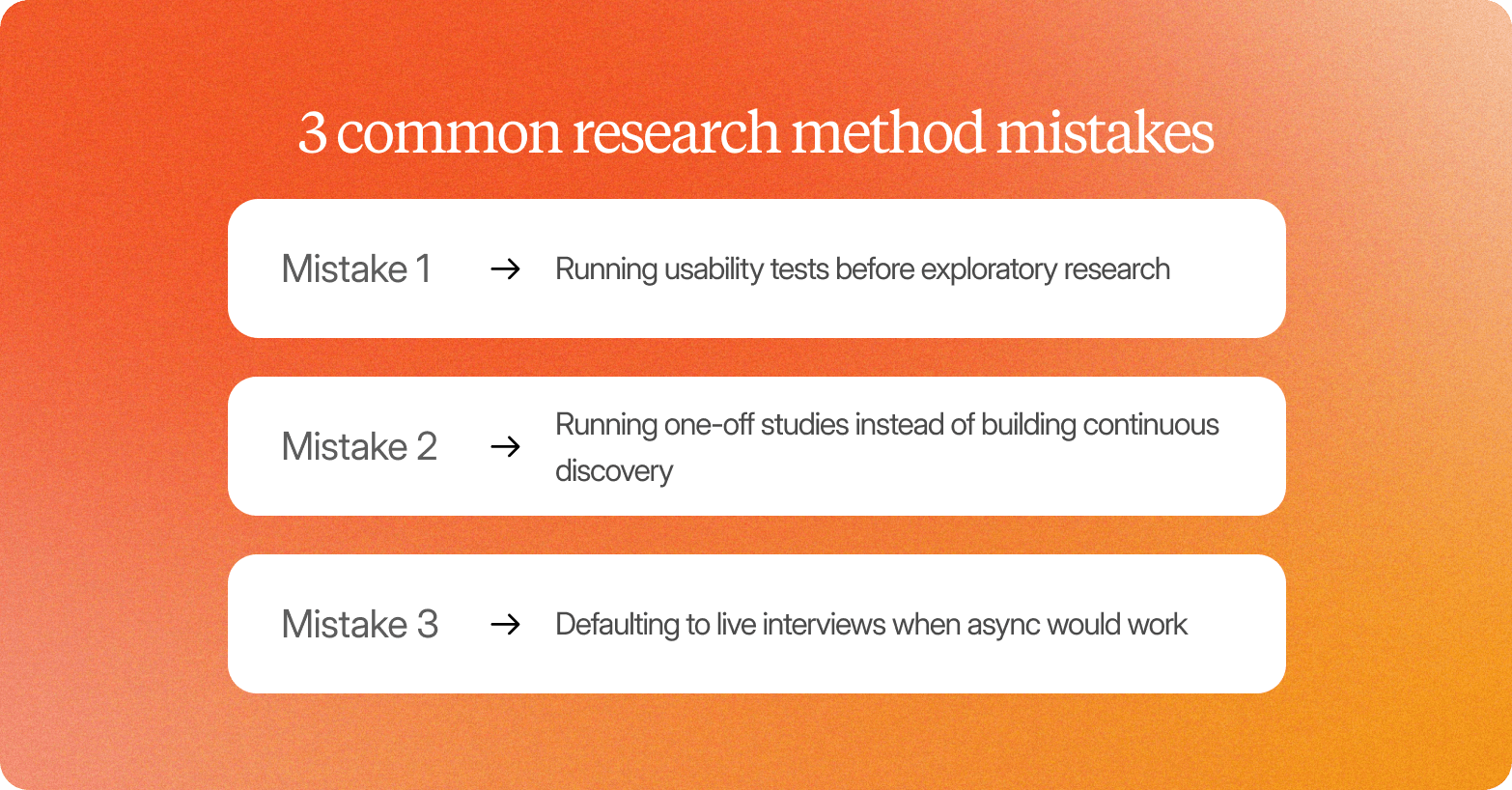
Mistake 1: Running usability tests before exploratory research
Why this happens: Evaluative research feels concrete and productive. Generative user experience research can feel open-ended and harder to scope. How to fix it: Testing a design before understanding the underlying problem often means optimizing the wrong thing. Generative research (open-ended interviews, contextual inquiry, diary studies) should establish what problem is worth solving before evaluative methods assess how well a solution solves it. Skipping this step builds confidence in the wrong direction, and the result is rarely a user-centered solution.
Mistake 2: Running one-off studies instead of building continuous discovery
Why this happens: Each study is treated as a project with a defined end. Findings land in a deck, get presented once, and stop compounding. How to fix it: When insights aren't searchable and connected across studies, teams end up repeating the same research questions. Building a persistent insight library (one where themes, quotes, and clips accumulate and link across projects) turns individual studies into a growing body of customer understanding. Research methodologies only compound in value when their outputs connect rather than sit in separate decks.
Mistake 3: Defaulting to live interviews when async would work
Why this happens: Live moderation is familiar, and researchers are trained in it. Async formats can feel like a compromise. How to fix it: For many discovery questions, async video interviews produce equally rich responses without the coordination cost. Removing scheduling overhead makes it practical to talk to users every sprint rather than every quarter, which is the cadence continuous discovery actually requires.
Method selection is a skill. Teams improve it by starting with the question, mapping it to the appropriate method, and resisting the pull toward whatever format they already know.
Comparison Table
| Method | Best For | Speed | Depth | When to Use |
|---|---|---|---|---|
| Surveys | Quantifying attitudes at scale | Fast | Low | Validating a hypothesis across a large sample |
| Usability tests | Navigation and task friction | Medium | Medium | Before a feature ships or post-redesign |
| Moderated interviews | Motivations and mental models | Slow | High | Early discovery, complex or sensitive topics |
| Async video interviews | Continuous discovery at scale | Fast | High | When sprint cadence can't wait for scheduling |
| Diary studies | In-context behavior over time | Slow | High | Habit research, longitudinal product usage |
| Card sorting | Information architecture | Medium | Medium | Navigation redesigns, taxonomy decisions |
| Concept tests | Pre-development idea validation | Medium | Medium | Pre-launch validation of features or messaging |
| A/B tests | Comparing live variants | Fast | Low | Optimizing known variables with sufficient traffic |
Async video interviews are the only UX research method that combines fast turnaround with high qualitative depth.
How Conveo Fits Into Your Research Practice
The research method trap described at the start of this article (teams defaulting to what fits the timeline rather than what fits the question) doesn't have a process solution. Teams already know they should run deeper research. The constraint is operational: scheduling, synthesis, and the coordination overhead that makes qualitative work feel like a separate project from the product work it's supposed to inform.
Conveo, a video-first AI research platform, is built to remove that operational constraint without sacrificing what makes qualitative research worth running. AI-moderated interviews run asynchronously across hundreds of participants in parallel, capturing video, voice, and visual context without a single scheduling call. Every response feeds into a compounding insight library where themes, clips, and quotes are indexed and searchable, so findings from past studies inform current questions instead of disappearing into archived decks.
For teams that need real participants (not synthetic respondents), enterprise-grade compliance (SOC 2 certified, GDPR compliant, EU data hosting), and stakeholder-ready evidence in days rather than weeks. Conveo resolves the tradeoff around which this article was written.
Recruit through integrated panel partners or your own participant lists, run studies across 50+ languages with AI moderation, and deliver traceable video evidence your stakeholders can inspect.
Frequently Asked Questions
What are the main types of UX research methods?
User experience research methods fall into three clusters: generative (in-depth interviews, diary studies, contextual inquiry), evaluative (user testing, concept validation, A/B testing), and continuous (longitudinal panels, always-on feedback loops). Each serves a distinct stage of the product development process. Teams that run only evaluative research know where users drop off, but cannot explain why. Effective product teams treat all three clusters of user research methodologies as part of a single practice.
How often should product teams run user research?
More often than most do. Teams running research only at major milestones (a feature launch, a post-redesign audit) are operating with a significant lag between what users are experiencing and what the team knows. Continuous discovery programs close that lag by maintaining a standing panel and running lightweight studies every sprint. Asynchronous video interviews make this cadence achievable without the scheduling overhead that makes moderated research expensive to run frequently. The goal isn't more studies. It's keeping insight current enough to inform decisions as they're being made.
What does generative user research look like in practice?
A product team conducted asynchronous video interviews with 20 users to understand the stalling of onboarding completion rates. Participants recorded themselves moving through the flow and narrating their experience. The finding: users didn't understand the product's core value proposition until step three of five. The team moved value messaging to step one and saw completion increase. That insight wasn't available in behavioral data or analytics, which showed where users dropped off but not why they stopped engaging.
How does evaluative research change product and packaging decisions?
In a representative scenario, a brand team testing three packaging concepts ran asynchronous video interviews and watched participants respond to each option without a moderator present. The video made the difference visible in a way survey scores could not: users visibly hesitated on concept A, rereading the user interface label multiple times, while concept B elicited immediate recognition and verbal enthusiasm. The video clips provided stakeholders with direct evidence, eliminating the debate that typically follows a summary slide.
Why does the format of user research affect finding quality?
Format shapes what participants are willing to share and how honestly they share it. Conveo's data show participants share responses that are 3-4x longer with an AI moderator than in equivalent written surveys. That shift produces more genuine reactions and more detailed feedback, particularly for evaluative tasks where first impressions matter most.

About the author
Dieter De Mesmaeker
Co-Founder & CEO
Dieter is CEO and co-founder of Conveo. Before starting the company, he founded DataCamp and scaled it into one of the leading edtech platforms in the world.
More by Dieter →Qualitative insights at the speed of your business.
Conveo runs AI-moderated video interviews and structures everything they say.