In this article
TL;DR
Brand tracking is the recurring survey measurement of brand health metrics like brand awareness, consideration, and purchase intent, but its fixed questions rarely explain why a metric moves.
When each tracker wave is paired with qualitative diagnosis, teams get the reason inside the same decision window instead of 6 to 12 weeks later.
Teams that get the reason in time act on the real driver of brand performance before the decision gets made without it.
Brand tracking tells insights teams where awareness, consideration, and favorability stand each wave. The harder question is why a number moved, and that answer usually arrives after the campaign or budget call it was needed for. This guide covers why trackers stay silent on cause, when to add qualitative diagnosis, a four-step framework for pairing it with each wave, and the program design mistakes that hide the real driver.
Why your brand tracker shows the drop but not the reason
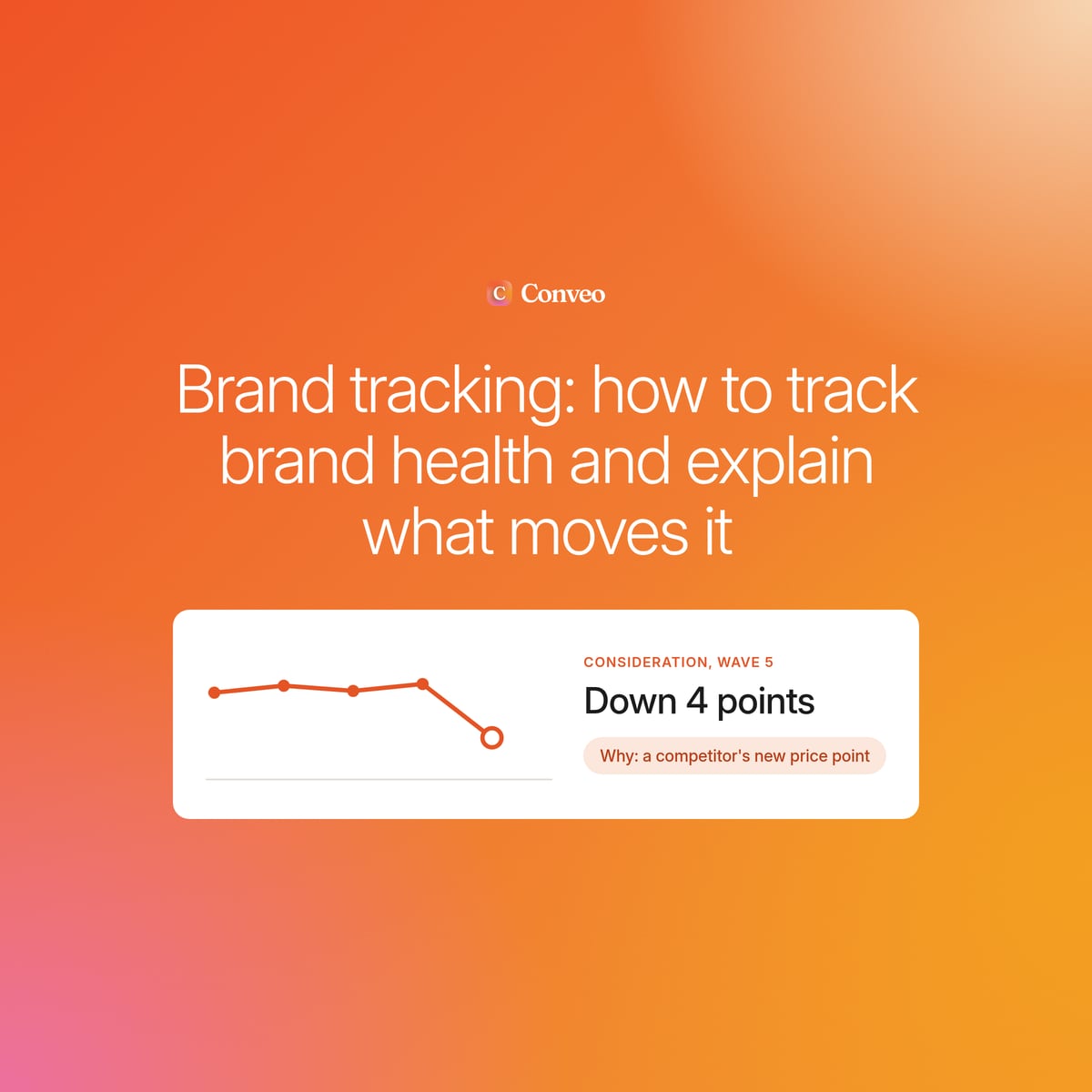
Brand tracking runs on a familiar cycle: the survey closes, the brand tracking dashboard refreshes, and consideration is down four points from last quarter. Nothing in the data says why. Stakeholders want an answer before the next marketing campaign review, because consideration often leads market share.
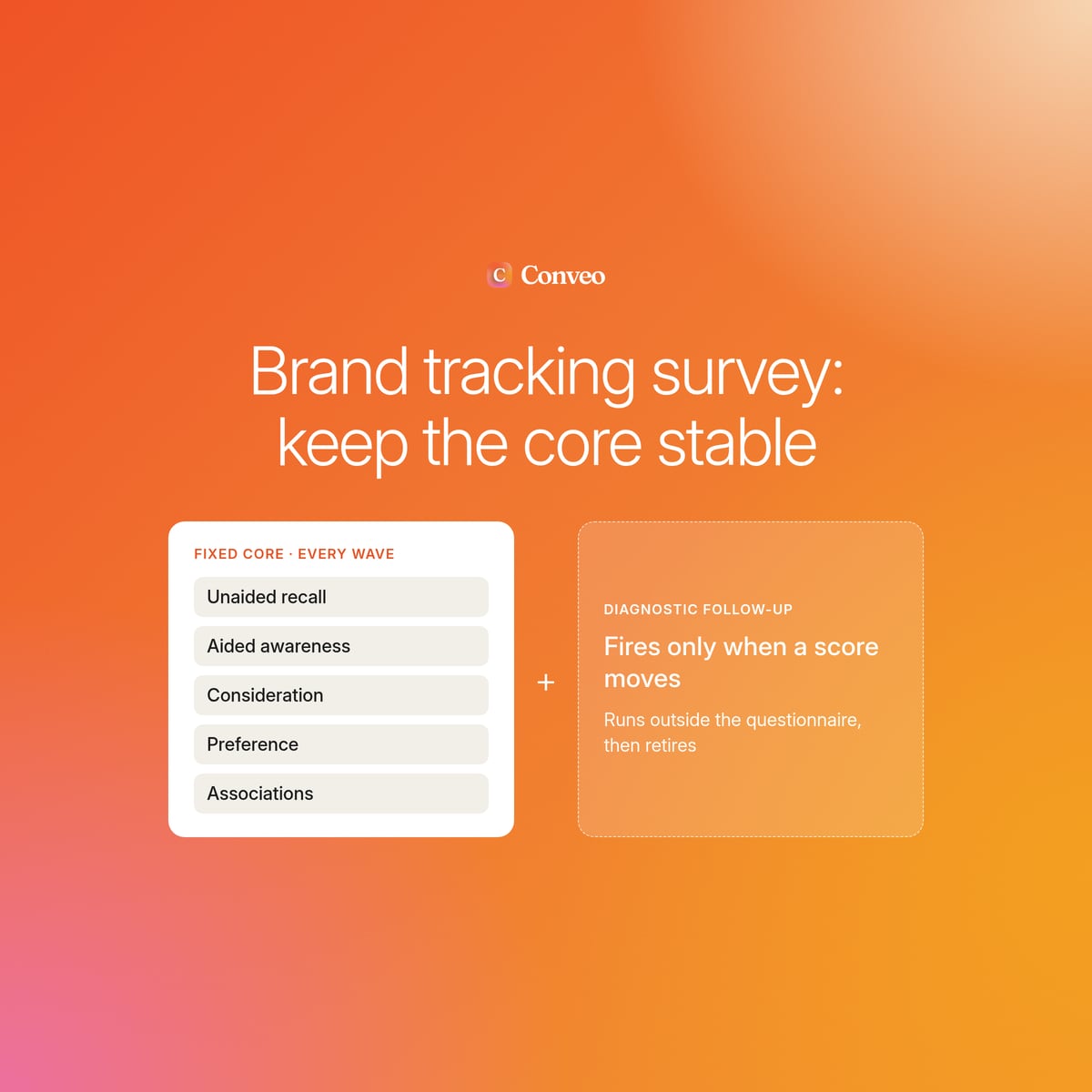
That silence is structural. Brand health tracking measures key brand health metrics like brand awareness, consideration, favorability, and purchase intent with fixed questions about your own brand and a locked set of competing brands, because consistency is what makes waves comparable. The design that keeps the trend line clean also stops it from diagnosing anything. The dashboard is numerically precise and causally silent.
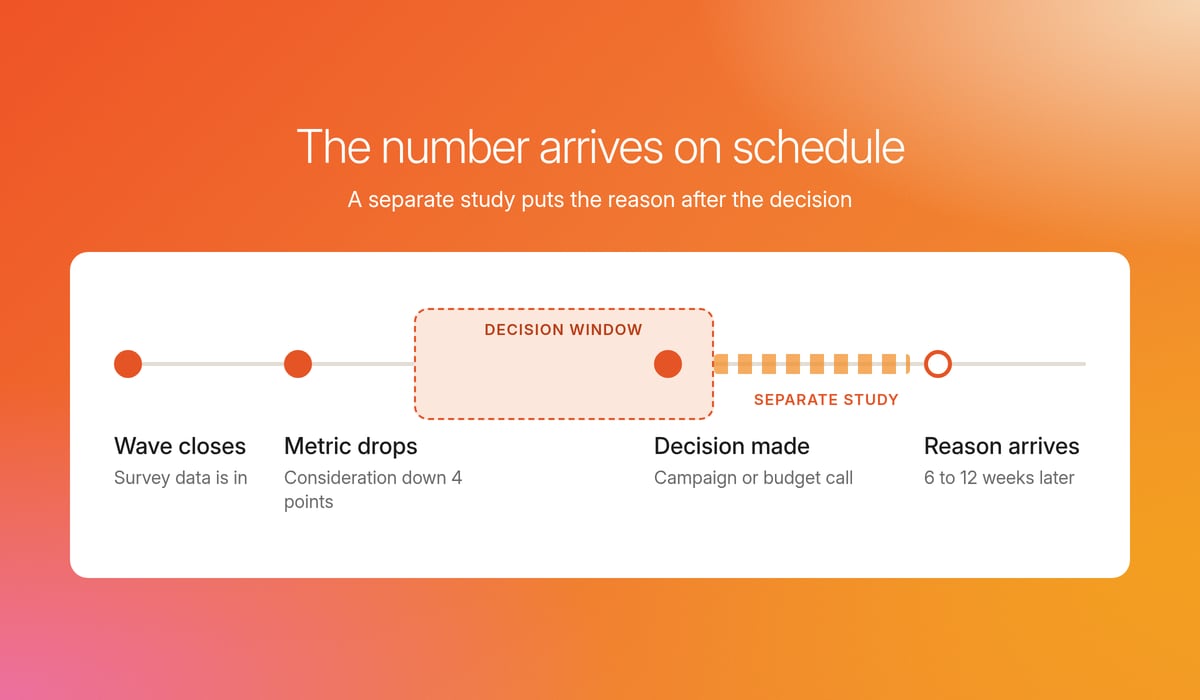
Timing makes it worse. Competitor launches, price changes, crises, and cultural shifts change how consumers purchase and what they think between waves. Brand perception and online brand reputation can turn within days, and an annual or biannual tracker can be six months behind them. When the movement finally shows up, the cause may be months old.
The usual fix adds more delay. Diagnosis gets commissioned as separate brand tracking research, which adds 6 to 12 weeks. This is where consumer understanding gaps open: the number arrives on schedule, and the reason arrives after the decision it was needed for.
What explanatory brand tracking means and when to use it
Explanatory brand tracking is the practice of pairing tracker metrics with qualitative diagnosis, so each significant movement arrives with a documented reason. Standard brand health tracking is about measuring brand performance: what changed in brand awareness, brand loyalty, or net promoter score (NPS). Explanatory tracking adds a diagnostic layer that shows why it changed and how to respond.
The tracker stays in place. Tracking key metrics with longitudinal consistency is what makes brand tracking important, and diagnosis can run beside it without touching the questionnaire or the competitive set.
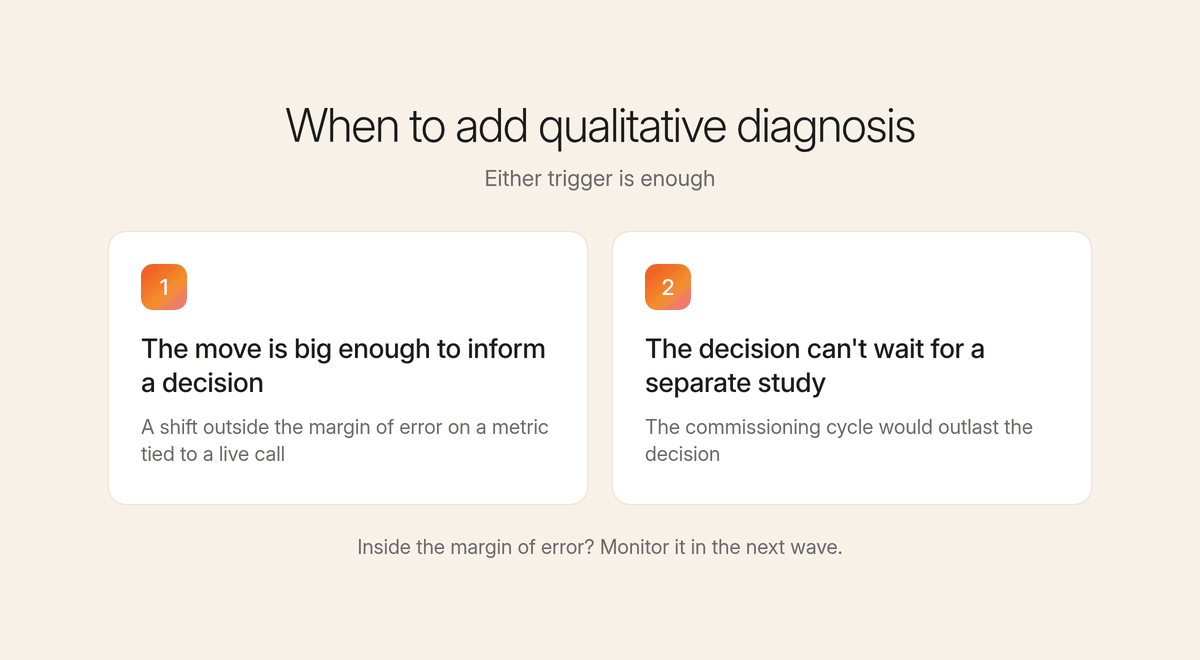
Use explanatory brand tracking when either of two triggers applies:
The move is big enough to inform a decision. A four-point consideration decline feeding a media or positioning call warrants diagnosis, as does a brand lift readout that contradicts the tracker, because acting on either untested risks treating measurement noise as a competitive threat. Wave-to-wave fluctuation inside the margin of error does not.
The decision can't wait for a separate study. Custom agency research gives tailored depth, but its commissioning cycle usually outlasts the decision. That delay is what explanatory tracking removes.
Conveo's view is that diagnosis belongs in the tracking program from the start, so the reason is ready when the number is.
| Standard brand tracking | Explanatory brand tracking | |
|---|---|---|
| What it reports | Changes in brand awareness, consideration, favorability, and purchase intent | The same metrics, plus a documented reason for each significant movement |
| How diagnosis happens | Commissioned as a separate study after the shift appears | A diagnostic layer fields on the tracker's own cadence |
| When the explanation arrives | Weeks after the shift, often after the decision | Inside the same decision window |
| Effect on the questionnaire | Fixed questions and a locked competitive set | Unchanged, because interviews run beside the survey |
A framework for pairing tracker waves with qualitative diagnosis
When a brand tracking wave moves, the response should follow rules written before the data arrives. These four steps turn a shift in brand metrics into a timeboxed investigation that lands while the decision is still open.
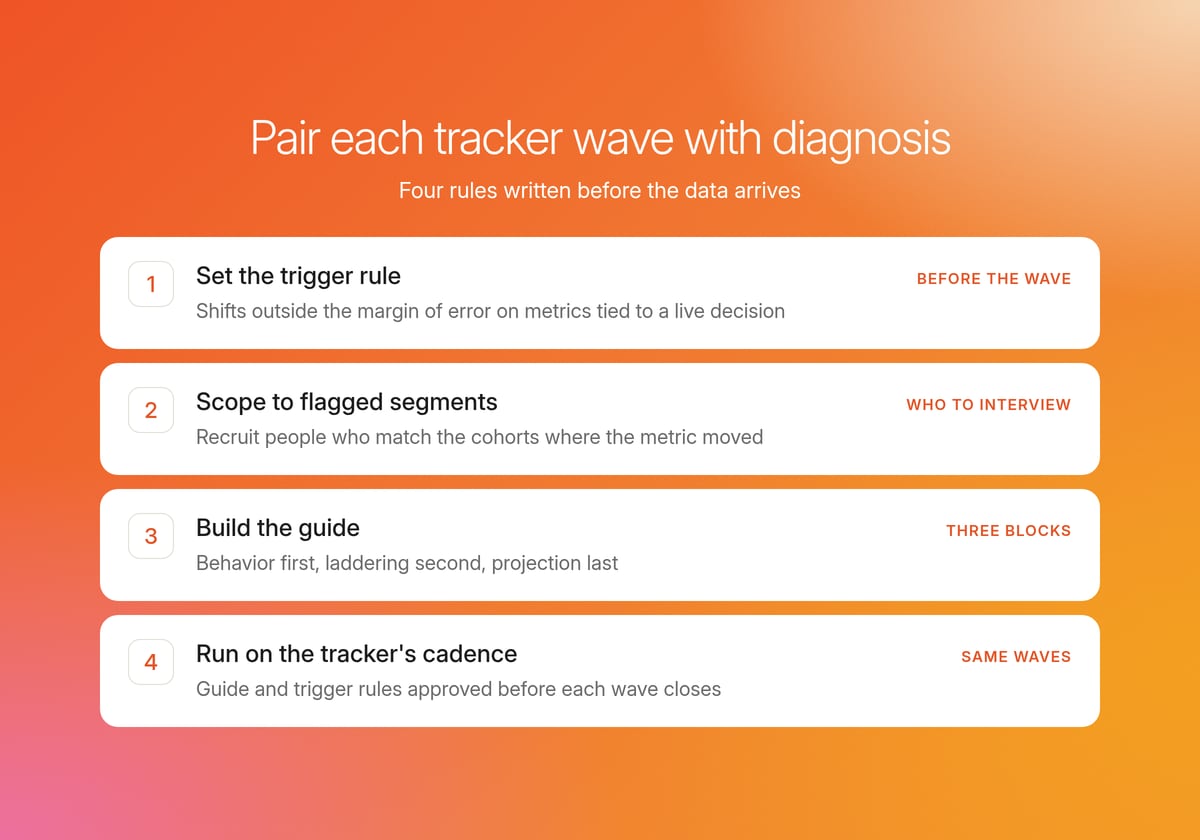
1. Set the trigger rule for qualitative diagnosis
Define the trigger in advance: any shift outside the margin of error on the right brand tracking metrics, meaning the ones tied to a live decision, such as consideration, brand preference, customer satisfaction, or NPS. A four-point consideration decline ahead of a campaign review qualifies. Treat that move as a hypothesis to test before anyone acts on it. Anything below the threshold gets monitored in the next wave of the brand tracking survey.
2. Scope the diagnostic layer to flagged segments
Field interviews only with people who match the cohorts where the metric moved. Cutting tracker data by brand usage, such as loyal customers, lapsed buyers, and new customers, shows which part of the target market shifted. If consideration fell among lapsed buyers aged 25 to 34 and held among existing customers, recruit lapsed buyers aged 25 to 34 with screener questions or from your own participant list. In practice, teams size each flagged segment for data saturation in qualitative research terms rather than statistical representativeness, adding interviews while new themes keep emerging.
3. Build the guide around behavior, laddering, and projection
Structure the discussion guide in three blocks:
Behavior first. Start with consumer behavior: the most recent brand purchase and the moments participants chose a particular brand over the one being tracked.
Laddering second. Ladder from brand attributes to consequences to the values underneath them.
Projection last. Close with projective prompts, a brand tracking technique that surfaces brand associations participants will not state directly.
4. Run the diagnostic layer on the tracker's cadence
Schedule AI-moderated interviews to field in the same recurring waves as the tracker's online survey, so both rounds of data collection run on one schedule. Approve the guide and trigger rules before each wave closes. Diagnosis then starts the day a movement is flagged, instead of waiting on a new brief, a procurement cycle, and a fresh recruit. In Conveo, teams run this as Conveo StoryLines, a continuous program that runs in recurring waves, so themes stay connected from one reading to the next.
"I had a study live by 6:15 p.m., and I had results by first thing in the morning."
Matt Harris, Research & Insights Lead, Canva
Where researcher judgment still decides the call
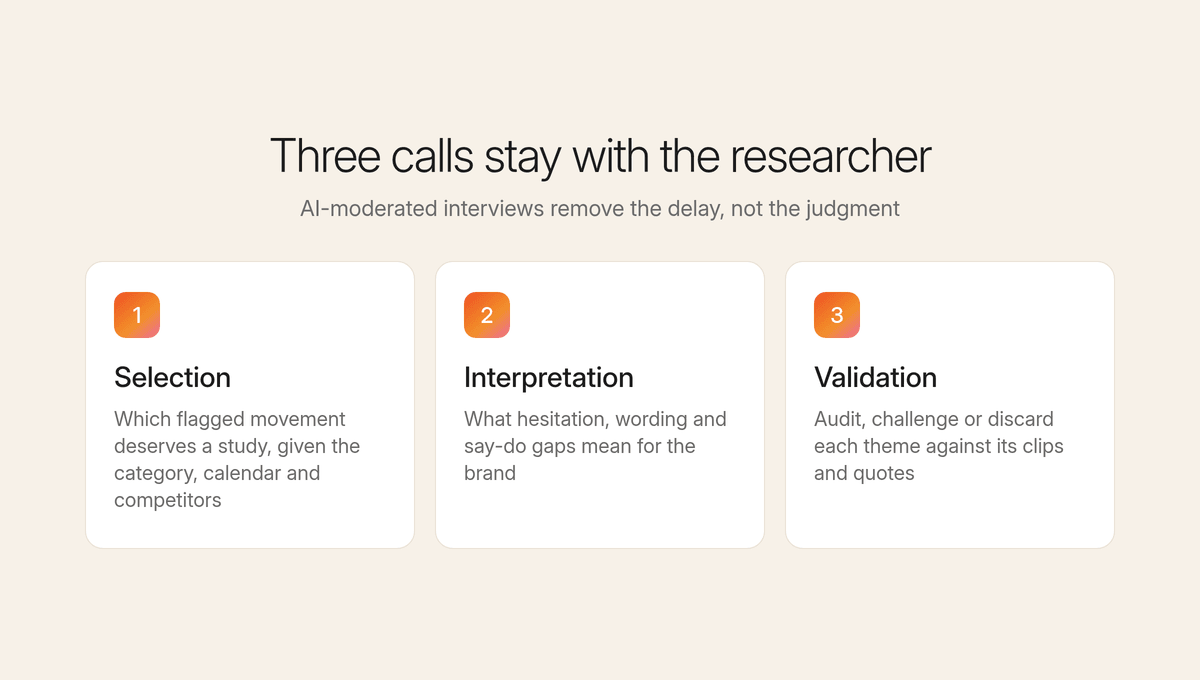
Researcher judgment is what keeps brand tracking diagnosis credible. Pairing tracker waves with AI-moderated research removes the commissioning delay between a shift and its explanation. Three consequential calls stay with the researcher:
Selection. Choosing which flagged segments and hypotheses merit follow-up. A dashboard shows where a metric moved. Deciding which movement deserves a study takes someone who knows the category, the target audience, the campaign calendar, and the competitive context.
Interpretation. Researchers probe hesitation, unexpected wording, and contradictions between what participants say and what they did. Deciding what those signals mean for brand reputation and overall brand health, and how to improve brand strategy in response, takes a researcher reading transcripts and video alongside the tracker's consumer data.
Validation. Because each theme links to the participants behind it, with video clips and verbatim quotes, researchers can audit, challenge, or discard an AI-surfaced theme before it reaches the brand tracking report. That evidence trail turns raw consumer feedback into consumer insights stakeholders trust.
3 scenarios where explanation arrived inside the decision window
Each brand tracking scenario below is a representative illustration rather than a client result. All three start with a tracker metric moving and end with the explanation arriving relative to the decision it informs.
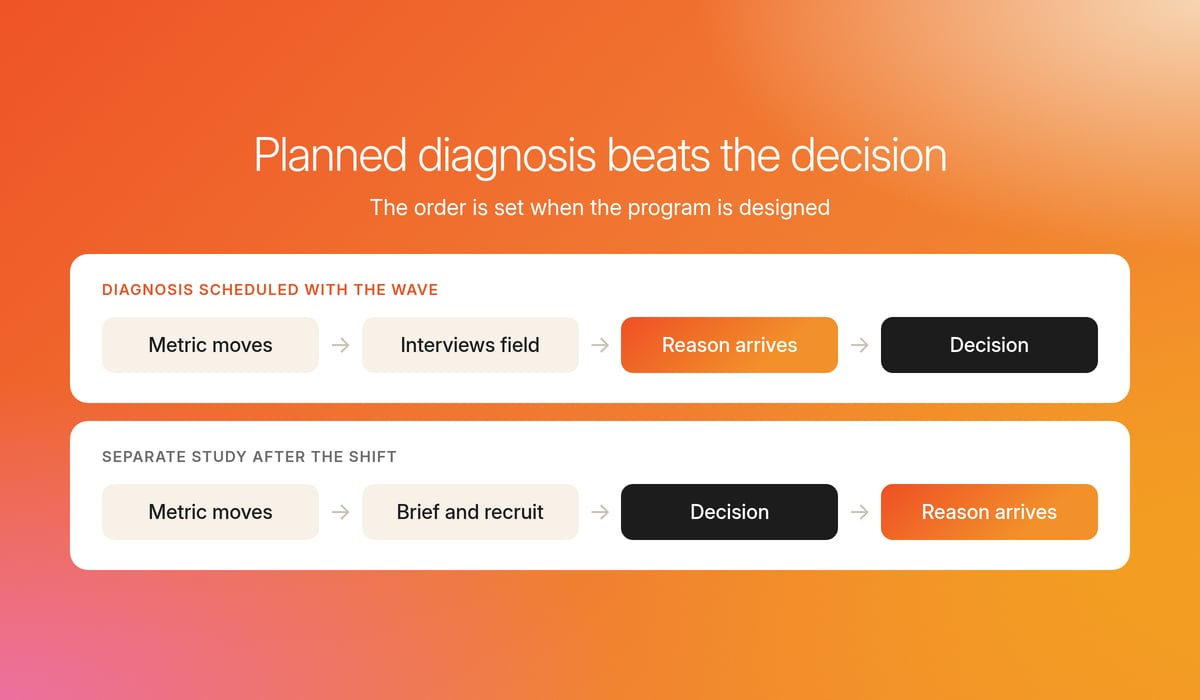
Diagnosis paired with the wave (beverage). A beverage brand's quarterly wave shows consideration down in two flagged segments, three weeks before creative locks on a new marketing campaign. Interviews field in both cohorts, and perception and purchase-intent findings arrive with time to act. Participants point to a competitor's new price point as the reason they moved to other brands. The refresh shifts from awareness messaging to value framing before creative locks.
The standard path (personal care). A personal care brand sees brand recognition slip in one region after an advertising campaign and commissions a separate brand tracking study to diagnose it. Briefing, recruitment, fieldwork, and reporting take weeks, so the explanation lands after the digital marketing budget has been reallocated on instinct. The findings are sound, but they now explain a decision nobody can reverse.
Conveo StoryLines on the tracker's cadence (financial services). A financial services team runs Conveo StoryLines alongside its quarterly tracker. When favorability and brand sentiment soften among younger customers, interviews from that wave are already in synthesis, so the reason arrives attached to the reading. The team traces the drop to confusion over a fee change and briefs customer communications before the next wave, protecting customer loyalty in the segment that moved.
What separates the second scenario from the other two is planning: in the first and third, the diagnosis was scheduled before the metric moved. Whether consumer intelligence for brand strategy arrives in time is decided when the program is designed.
3 common brand tracking mistakes that hide the real driver
Most of these mistakes are built into program design, so they repeat every wave and erode the benefits of brand tracking. Each one leaves a metric move with no usable explanation, and by the time a follow-up is commissioned, the decision window has closed.
| Mistake | What it hides | Fix |
|---|---|---|
| Asking aided awareness before unaided brand recall | Showing the brand list or brand logo first primes participants and inflates apparent mental availability, which masks the real baseline. | To measure brand awareness accurately, keep unaided questions first in every wave. |
| Writing brand association questions in internal positioning language | Statements lifted from the brand strategy get echoed back, so the tracker measures agreement with the strategy rather than consumers' actual brand perception. | Test the wording of brand attributes in qualitative interviews before it enters the brand survey. |
| Changing the panel provider, question wording, sequencing, or competitive set between waves | Each change introduces structural bias, so a real shift can look like noise and noise can look like a real shift. | Lock the design, and when a change is unavoidable, run a bridging wave alongside the old version. |
Consistent brand tracking methods make one wave's brand equity reading comparable to the last. Conveo's view is that a tracker should also measure perceptions in participants' own words, so test brand perception survey questions in interviews before they enter the tracker.
How Conveo StoryLines closes the explanation gap between waves
Teams that want the fixed tracker core and the triggered follow-up in one continuous program use Conveo StoryLines as the always-on diagnostic layer. Most tracking tools stop at the score, and StoryLines adds the reason. AI-moderated video interviews field wave by wave with the tracker, so each metric movement arrives paired with its explanation instead of waiting on a second commissioned study. The tracker keeps its longitudinal role.
The reason this holds up with stakeholders is traceability. In a representative illustration, a consideration wave flags three segments after an advertising campaign, and the team fields 200 interviews across them. Purchase-intent and perception findings arrive while the campaign window is still open. Each theme links to the participants behind it, with video clips and verbatim quotes stakeholders can audit. Conveo is used by 400+ enterprises, and researchers can inspect and correct the analysis before findings reach a report.
See Conveo reporting, quote reels, and slides in action:
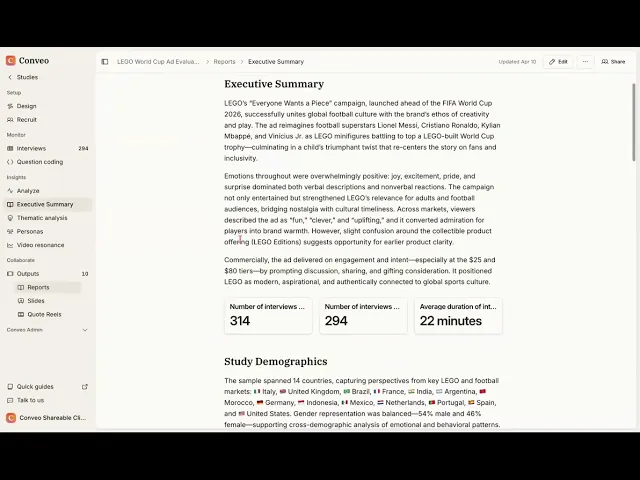
Each wave also compounds: recurring themes and facets are recognized across studies in a searchable insight library, so the next wave starts from what earlier ones established. With StoryLines V2, each wave opens on the signals that moved since the last one and the shifts that explain them, in participants' own words.
Scale makes the cadence practical. Asynchronous fieldwork runs interviews in parallel across markets and time zones, in 50+ languages, so findings arrive while the campaign decision is still open and marketing strategies can still shape brand growth.
Frequently asked questions
What do brand tracking companies offer?
Brand tracking companies mostly offer syndicated brand health trackers, custom market research, or self-serve brand tracking tools. Syndicated trackers provide daily benchmarks and historical trends, but fixed questions and competitive sets limit diagnosis. Custom brand tracking studies add tailored depth, though qualitative follow-up typically takes weeks to commission and field. Teams that need the reason inside the same window can add Conveo StoryLines alongside an existing tracker as an AI-moderated diagnostic layer.
What is a brand tracking example?
A typical brand tracking example looks like this representative one: a brand tracker survey shows unaided recall slipping among new customers in one market after a competitor launch, with no explanation attached. The team fields AI-moderated interviews in that market only and finds participants now link the category's main benefit to the competitor. The brand adjusts its local messaging before the next wave reads the impact.
Is there a brand tracking app?
Most brand tracking app searches come from teams that want continuous brand understanding, and a mobile dashboard alone rarely delivers it. Conversation about a brand online can turn within days, and an annual wave may not register the shift until marketing efforts have moved on. Asynchronous fieldwork runs interviews in parallel across markets and time zones. With Conveo StoryLines, teams run AI-moderated video conversations with real consumers in recurring waves, so each reading arrives with its reason.
How often should brand tracking run?
Cadence should match how fast perception moves in the category and how often the metrics feed a real decision, such as a new marketing campaign or a pricing change. Annual or biannual waves leave a reading that can be six months behind a competitor launch. Tracking your brand quarterly suits most teams that track brand awareness and consideration, with interviews fielded on the same schedule so a flagged movement gets investigated in the wave it appears. Conveo StoryLines waves can run more often, for example every two weeks or monthly, for teams whose decisions turn over faster than the tracker does.
What is the difference between brand tracking and brand health research?
Brand tracking is the measurement instrument: the same awareness, consideration, favorability, brand satisfaction, and purchase intent questions asked of a consistent competitive set, wave after wave, so movement is comparable. Brand health research is the wider body of work that interprets those brand health metrics, including [brand equity research](/insights/brand-equity-research-methods-measure-brand-value), positioning, brand associations, competitive analysis, and driver studies that explain what sits behind a shift in brand equity. The tracker tells a team the score changed, and the research explains what changed it, so measuring brand health takes both. Pairing the two on one cadence is what keeps the explanation inside the decision window.

About the author
Hendrik Van Hove
Founder & CPO
Hendrik is Conveo’s Chief Product Officer and co-founder. He's extremely passionate about technology and the real positive impact it can bring. Before Conveo, he ran AI strategy projects at McKinsey for the Fortune 2000, working with boards and every function from marketing, to sales to insights.
More by Hendrik →Qualitative insights at the speed of your business.
Conveo runs AI-moderated video interviews and structures everything they say.