
TL;DR
Data saturation is the point at which new interviews no longer yield new themes, codes, or insights. It's a condition of the data, not a fixed sample size.
Most well-scoped qualitative research projects reach saturation between 10 and 30 interviews, depending on the scope of the questions, sample homogeneity, and topic complexity.
Five signals indicate saturation: theme repetition without new nuance, no new codes created, convergent participant language, predictable responses, and disappearing negative cases.
Shallow saturation (caused by surface-level probing) looks identical to true saturation but reflects the limits of questioning rather than those of the topic.
Multi-segment studies must track saturation per cohort, not across the aggregate sample.
Real-time theme tracking and parallel interviewing compress the research process from weeks to days.
Most qualitative researchers running a qualitative research project hit the same uncomfortable moment: the fourth or fifth interview starts sounding familiar, but nobody is confident enough to call it. Data saturation, the point at which additional data collection no longer reveals new themes, codes, or insights, is the concept intended to resolve that tension. In practice, teams keep scheduling sessions anyway, not because they expect new insights but because they lack a defensible framework for stopping and determining that they have enough data.
That uncertainty has a cost: a concept test that should take a week stretches to three weeks, or a positioning study is delivered after the decision has already been made. The problem isn't carelessness. It's that most workflows offer no clear signal for when more interviews stop adding value to the underlying qualitative data, so the default is to run more.
This article explains what saturation means, how to recognize it, how to document it defensibly, and how modern AI-augmented field methods make saturation calls faster and more defensible than manual approaches. Understanding the importance of this concept is a key first step for any team that wants research to inform decisions rather than trail behind them.
What Is Data Saturation in Qualitative Research?
Data saturation is the point at which collecting additional data (interviews, focus groups, observations) no longer yields qualitative data relevant to the research question. A researcher reaches saturation when interview 15 covers the same territory as interviews 12 through 14. The dataset has, in practical terms, said what it has to say, and the same themes keep recurring without new nuance.
Saturation occurs when themes stabilize, codes recur across participants, and new sessions confirm existing patterns rather than introduce new insights. Researchers track this through thematic analysis: watching whether each new interview adds codes to the codebook; when it stops growing, saturation has likely been reached.
The concept has roots in grounded theory, where Glaser and Strauss first used it to describe the point at which sampling for new categories no longer adds explanatory value. That origin is why the literature still distinguishes among several related ideas: theoretical saturation (no new theoretical categories emerge), inductive thematic saturation (no new codes emerge from the ground up as interviews accumulate), and plain data saturation (no new information of any kind). Most practitioners use the terms interchangeably in applied settings, but it's worth knowing the distinction exists if a stakeholder asks you to define saturation precisely.
It's not about hitting a predetermined adequate sample size. There's no universal threshold, and a single fixed number rarely applies across projects. A tightly scoped study with a homogeneous group may saturate at eight interviews; a multi-segment study exploring a complex behavioral question may need considerably more. The criterion is informational completeness relative to the research objectives, not a number, which is why the concept sits closer to qualitative research than quantitative research, where sample size is usually calculated in advance from a statistical formula.
Saturation matters because it addresses two failure modes at once. Stopping too early risks missing important insights and low-frequency but high-impact perspectives; running too long wastes budget and delays findings without improving quality. When findings are grounded in a demonstrably saturated dataset, stakeholders can trust that the researcher neither cut corners nor padded the sample.
Why Data Saturation Matters for Research Teams
Saturation is what lets a researcher defend conclusions with confidence: the data collection stopped producing new themes, and patterns stabilized. Without that evidence, stakeholders who didn't run the study will challenge conclusions they can't inspect.
The operational problem compounds this. Traditional qualitative research workflows are sequential (recruit, schedule, moderate, transcribe, code), so saturation analysis usually lands near the end of that research process, often after the decision window has closed. A product team choosing between two concepts before a launch date can't wait six weeks for synthesis. The research becomes a post-hoc document rather than a decision input, a constraint that platforms like Conveo, a video-first AI research platform, are built to break by running interviews in parallel and tracking themes in real time.
For agencies, manual moderation and synthesis make saturation checks expensive: every confirmation interview costs moderator time and analyst capacity. As timelines compress, the temptation is to declare saturation earlier than the data supports, or to run a fixed number of interviews and hope. Neither serves the client, nor does either give the team a good sense of whether the important insights have actually surfaced.
At the extreme, research that returns after a decision is made doesn't inform strategy; it justifies it after the fact. When that happens repeatedly, leadership reserves qualitative research for retrospective reviews rather than live decisions, marginalizing the insights function exactly when real customer understanding matters most.
How to Recognize Data Saturation
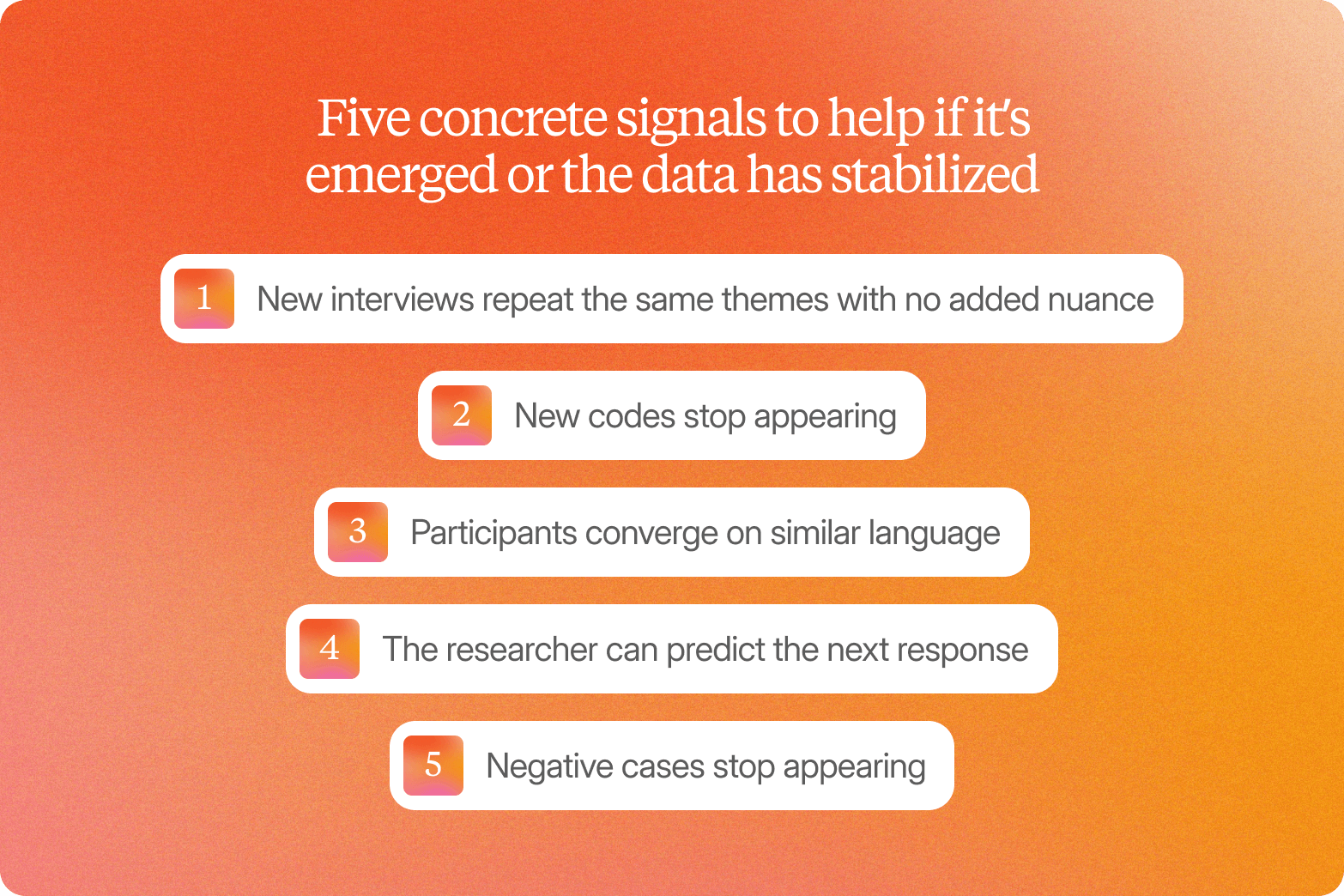
Saturation is easy to define and hard to call in real time, three weeks into fieldwork with 14 transcripts open. Five concrete signals help determine whether themes continue to emerge or the data has stabilized:
New interviews repeat the same themes with no added nuance. Repetition alone isn't saturation; repetition with no new texture is.
New codes stop appearing. If the last several transcripts add zero new codes to your codebook, the data structure is stable.
Participants converge on similar language. When separate participants reach for the same metaphors or objections, that's a meaningful signal, not just thematic redundancy.
The researcher can predict the next response. This only counts if the prediction holds consistently, across multiple interviews and participant profiles.
Negative cases stop appearing. Early outliers are valuable; when contradictions disappear across several consecutive interviews, even with deliberate sampling for dissent, the data has likely reached its boundaries.
Shallow saturation versus true saturation: Shallow saturation occurs when the interview guide never probes beyond the first response, so the data appears consistent but reflects weak probing rather than topic exhaustion. True saturation requires consistent follow-up probing (why, what happened next, what did that mean) that has stopped producing new insights, and it depends on gathering genuinely rich data rather than a thin layer of first impressions.
Segmentation resets the clock: Saturation within one persona or market doesn't mean saturation across all segments. A brand running concept research across Gen Z and Boomer cohorts is running two separate saturation processes; stability in one says nothing about the other. Conveo's automated coding tracks theme emergence within each segment as interviews run in parallel, so the per-cohort picture develops in real time rather than after a manual review pass.
Sample Size and Data Saturation
The most common stakeholder question is: how many interviews do we need, and how do we know it's an adequate sample size? Sample size is a function of saturation, not a fixed rule. Most well-scoped studies saturate between 10 and 30 interviews, driven mainly by three variables: the scope of the question, the homogeneity of participants, and the complexity of what's being explored.
A narrow, focused question with a defined population (why enterprise IT buyers choose a specific CRM) saturates quickly. A broad question spanning segments (how consumers make purchasing decisions) keeps surfacing new insights well past interview 20. Multi-segment studies need saturation within each cohort, not just overall.
Stopping too early (5 to 8 interviews) risks missing low-frequency but important insights that surface only later, particularly from smaller subgroups. Running too long (continuing past 15 to 45) mostly confirms what's already known while consuming budget and delaying synthesis. The academic literature is useful as a reference point, not as a methodological rule: Guest et al. found saturation at around 12 interviews for homogeneous samples, while Hennink et al. distinguished code saturation (often reached by interview 9) from meaning saturation, which requires more. The practical approach is a review checkpoint: run 8 to 10 interviews, get a good sense of whether new themes continue to surface, and add more participants only if they are.
How to Achieve Data Saturation
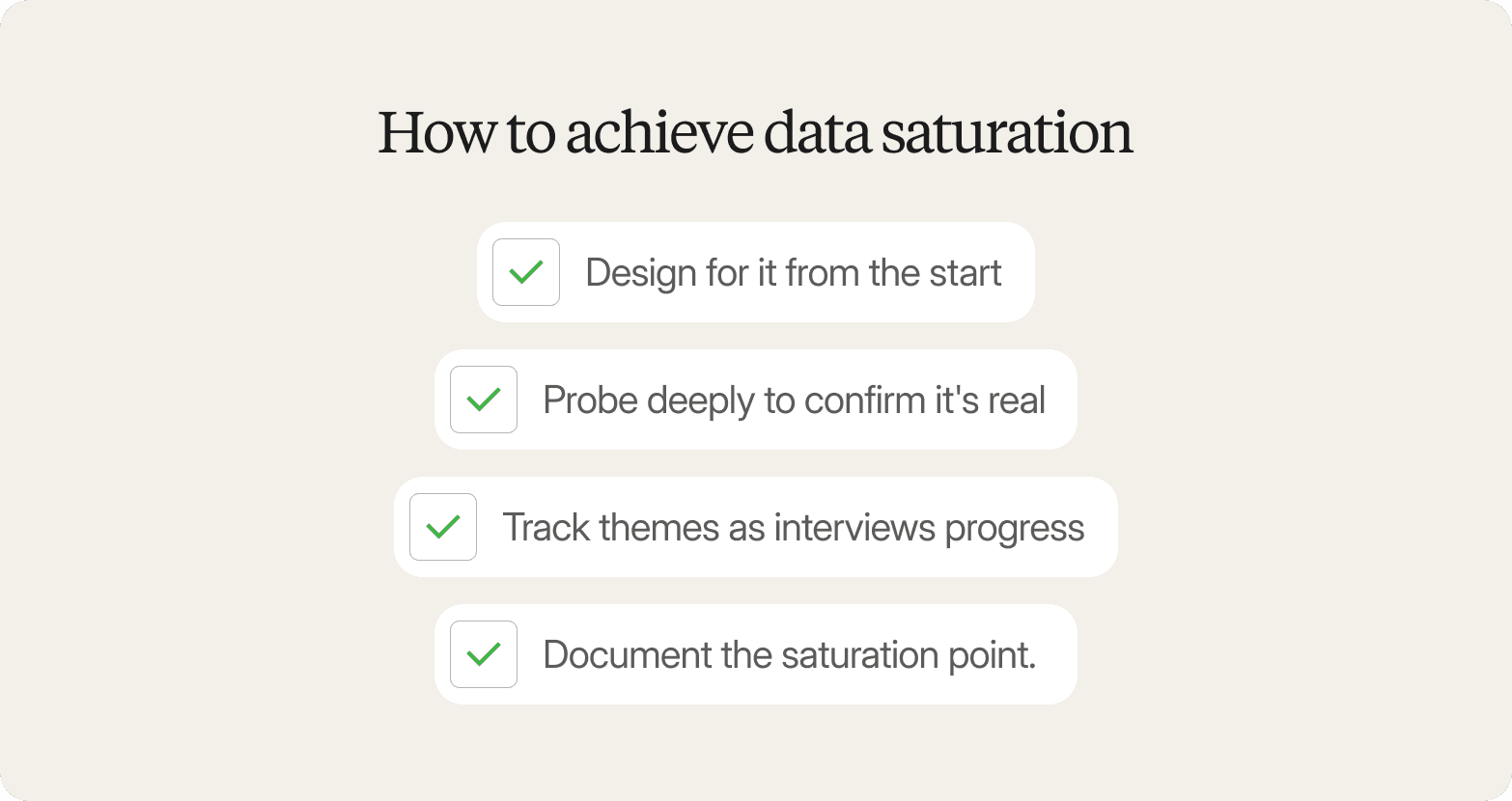
Design for it from the start
Narrow research questions and precise participant criteria give a qualitative research project a clear scope and boundaries. Rolling recruitment, an iterative approach with waves of 5 to 8 participants reviewed after each round, turns saturation into an active, ongoing assessment rather than a fixed sample-size bet.
Probe deeply to confirm it's real
Surface-level questions produce a consistent set of shallow answers that look like saturation but aren't. Adaptive follow-ups ("why does that matter," "what would change your mind") are what separate genuine saturation from repeated first impressions, and they're the key to gaining rich, important insights rather than a thin surface read. Video-first interviews make hesitation, tone shifts, and unresolved answers visible in a way text-based research can't.
Track themes as interviews progress
Coding each transcript as it arrives, with a running codebook, is what makes a saturation claim defensible. The catch: manual coding is slow, often two to three hours per interview, so tracking gets compressed exactly when fieldwork moves fast. Conveo's real-time theme detection identifies patterns as recordings arrive, so the saturation picture develops alongside data collection rather than after it.
"The AI doesn't just summarize, it surfaces patterns I wouldn't have spotted reading transcripts"
—CMI Lead, Edgard & Cooper
Document the saturation point.
"We stopped at 18 interviews because themes stabilized" isn't defensible on its own. A running saturation log, tracking each theme's first appearance, participant count, and stabilization point, linked to verbatim quotes and video timestamps, turns a judgment call into an auditable record. Cross-checking findings against other sources, prior studies, desk research, or existing literature on the topic adds a further layer of confidence.
A Practical Example
A SaaS product team wants to understand why 43% of users abandon onboarding between steps three and four. They run 20 AI-moderated video interviews with recent abandoners, using rolling recruitment over two weeks.
Interviews 1 to 5: Three pain points emerge: confusing navigation, an unclear value proposition, and intermittent technical errors.
Interviews 6 to 10: Two more appear: mobile experience issues and missing progress indicators.
Interviews 11 to 15: No new pain points; participants repeat the same themes.
Interviews 16 to 18: Deeper probing on each theme surfaces no new nuance. Two participants who completed onboarding successfully confirm the pattern from the other direction.
The researcher calls saturation at interview 18 and documents it in a table showing when each theme appeared and stabilized. The team saves two interviews' worth of time and costs, and the findings reach product and design four days earlier than planned, with the mobile experience and progress indicators prioritized first.
5 Common Challenges in Reaching Saturation
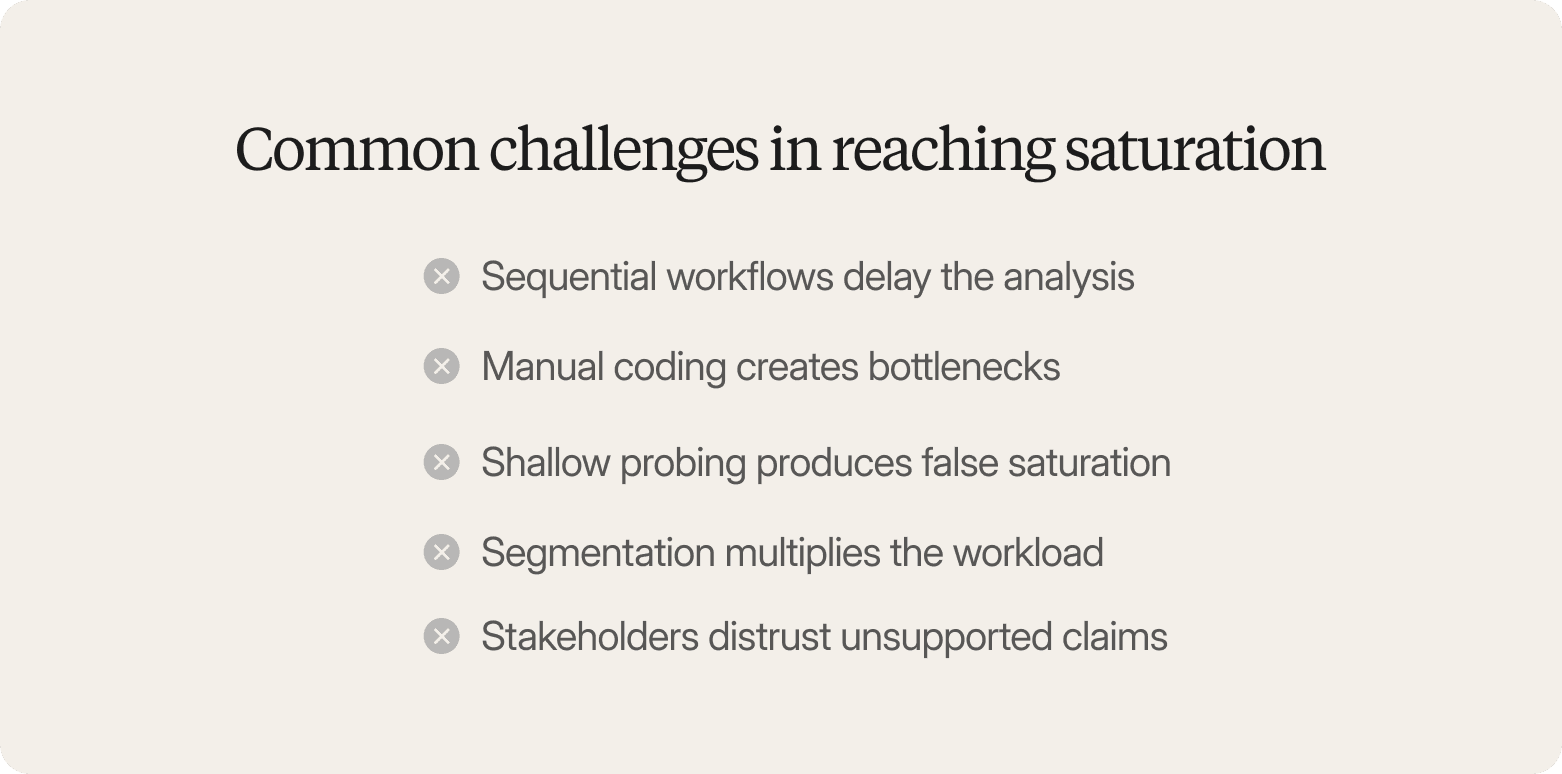
Sequential workflows delay the analysis. By the time coding catches up, the decision window has often closed.
Manual coding creates bottlenecks. The judgment isn't hard; the throughput is.
Shallow probing produces false saturation. Rigid scripts generate convergence that reflects the questions rather than the topic, and starve the study of rich data.
Segmentation multiplies the workload. A study across four regions and three personas is, in effect, twelve separate saturation analyses.
Stakeholders distrust unsupported claims. Without traceable clips and quotes, saturation becomes a contested opinion rather than a methodology stakeholders can inspect.
How Modern Workflows Make Saturation Faster and More Defensible
Real-time theme tracking: Automated detection identifies emerging codes as sessions complete, so researchers see when new-code emergence flattens instead of discovering it on interview 28 after days of coding. That makes saturation decisions traceable to evidence rather than intuition, and gives the team a good sense of momentum throughout the research process.
Parallel interviewing at scale: Asynchronous AI moderation lets dozens or hundreds of interviews run at once, compressing a three-week fielding window into days. Combined with adaptive probing that follows up on hesitation or incomplete answers, teams get both speed to saturation and evidence that it's genuine, not a ceiling created by a rigid script.
Auditable evidence for stakeholders: When every theme links to the quotes and clips that produced it, a CMI director can inspect the six participants behind a cluster and watch the relevant clips, rather than taking a researcher's word for it. Conveo's insight library automatically accumulates this evidence and lets teams check new findings against other sources and prior studies, so saturation is assessed against compounding knowledge rather than memory.
Data Saturation Across Segments and Markets
Declaring saturation based on one persona or market while missing themes in others is a common, costly mistake. A CPG team testing concepts across three consumer segments might reach repetition in its primary demographic while missing new insights in a secondary one, and the gap never surfaces.
Saturation must be assessed within each segment, region, and language cohort before it's claimed overall, since each cohort can carry different perspectives on the same underlying question. Tracking this manually multiplies the workload in proportion to the cohort count; a study spanning four regions and three personas requires twelve separate analyses, which is rarely achievable by a small team within a standard timeline. Interviewing across 20+ languages and 50+ markets further increases the risk that important insights exist in a language that the synthesis process never adequately surfaces.
Automated, per-segment theme detection changes this: instead of a manual pass per cohort, the platform flags where saturation is reached and where gaps remain within each segment independently, making multi-market research tractable without defaulting to overall pattern-matching and hoping nothing was missed.
Reach Data Saturation Faster with Conveo
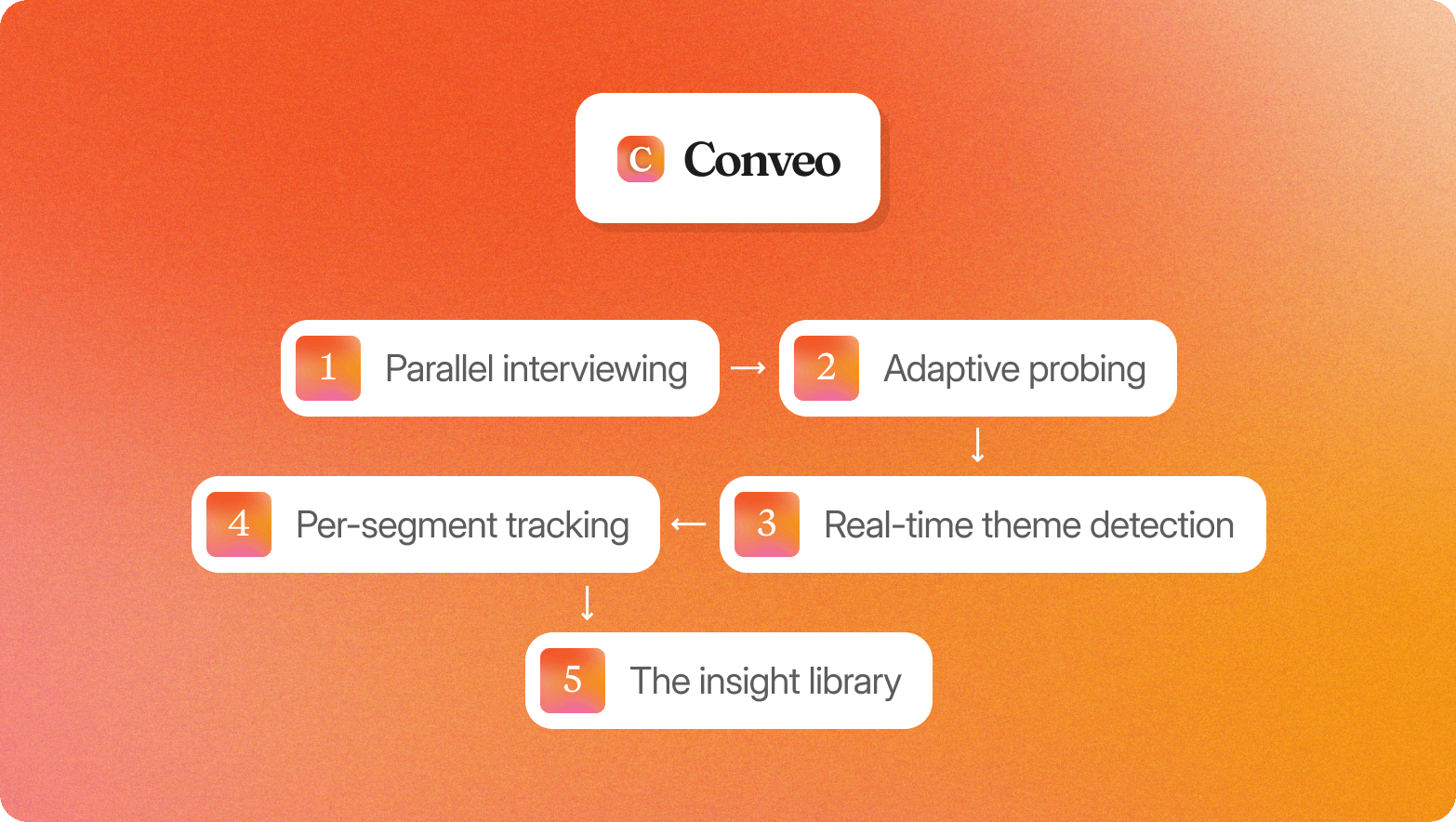
Saturation is a sound idea that most workflows can't reach, recognize, or document fast enough to matter. Conveo, a video-first AI research platform, addresses each constraint directly:
Parallel interviewing compresses weeks of scheduled sessions into days.
Adaptive probing ensures that saturation reflects real thematic convergence, gathering rich data rather than hitting a rigid script's ceiling.
Real-time theme detection makes saturation visible as it happens, not after a coding backlog clears.
Per-segment tracking runs automatically across markets and personas.
The insight library makes every saturation call auditable, linked to source quotes and clips, and checkable against other sources and prior studies.
Frequently Asked Questions
What is data saturation in qualitative research?
How many interviews are needed to reach data saturation, and how do you know you have enough data?
How do you know when you've reached data saturation?
What's the difference between data saturation and thematic saturation?
Can you reach data saturation with a small sample size?
How should data saturation be documented for stakeholders?