In this article
TL;DR
Sampling in qualitative research selects participants for information richness and answers two separate questions: who to include, and when to stop interviewing.
Sampling methods in qualitative research (purposive, homogeneous, snowball, maximum variation) set who is in the sample, and which segments it must cover.
Saturation, tested separately in each segment, sets how many. Well-scoped studies typically need 10 to 30 interviews, and homogeneous groups often saturate around 12.
A documented saturation log, kept per segment, turns the sample size into a stopping call stakeholders can check for themselves.
Every qualitative study rests on two calls made long before the findings deck: who to talk to, and when to stop. Most guides cover the first and assume the second. This guide covers both: how to choose among sampling methods in qualitative research by study type, and how to test saturation per segment so the final number holds up in review.
Why budget sets sample size, and nobody tests saturation
A qualitative research study closes at 12 interviews. The report says the sample reached saturation. Nobody tested that claim, and the product, campaign, or channel decision ships before anyone finds out which version was true.
That is decision-lag. The evidence that would have changed the call arrives after the call has closed, so the data collected might as well never have existed.
Velocity and hit rate on new products, campaigns, and channels now decide who stays competitive. Both depend on evidence landing while the decision is open.
The workflow explains how the gap opens. Recruiting, scheduling, moderating, transcribing, and coding run one after another, so a study stretches across several weeks. Manual coding, the slowest step in qualitative data analysis, then detects themes after data collection ends.
The stopping call then fails in two directions:
Stop too early, and the sample misses low-frequency, high-impact perspectives: the edge use case that sinks a launch, or the objection only one segment raises.
Run too long, and later interviews confirm existing themes without new insights, spending budget that could have covered a segment nobody studied.
Neither failure shows up in the report. A deck that says "saturation reached" looks the same whether the researcher watched new codes flatten or ran out of money. The commercial owner of the launch commits media and inventory behind a claim nobody could check.
"Even if you're doing dozens of in-depth interviews, multiple focus groups, you get those interesting nuggets and insights. But then you take them to the client and there's always a sense of: is this really a trend? It's very hard to validate, and very hard to demonstrate the difference between an important trend and a one-off anomaly."
Fergus Navaratnam-Blair, VP Trends and Futures, National Research Group (NRG)
A sample size is only as strong as the evidence behind the stopping call.
What sampling methods in qualitative research actually decide
Sampling in qualitative research is the process of selecting participants for information richness based on the research question. The goal is a deeper understanding of the question at hand; statistical representation of a population is the job of quantitative sampling.
Qualitative and quantitative research sample for different reasons. Quantitative methods use random sampling so quantitative data can generalize to a population. Qualitative inquiry works with non-numerical data: what people say and do, and the meaning they assign to it. It suits subjective phenomena, like how a shopper feels about a new pack, and social phenomena, like how a household settles on one brand over another.
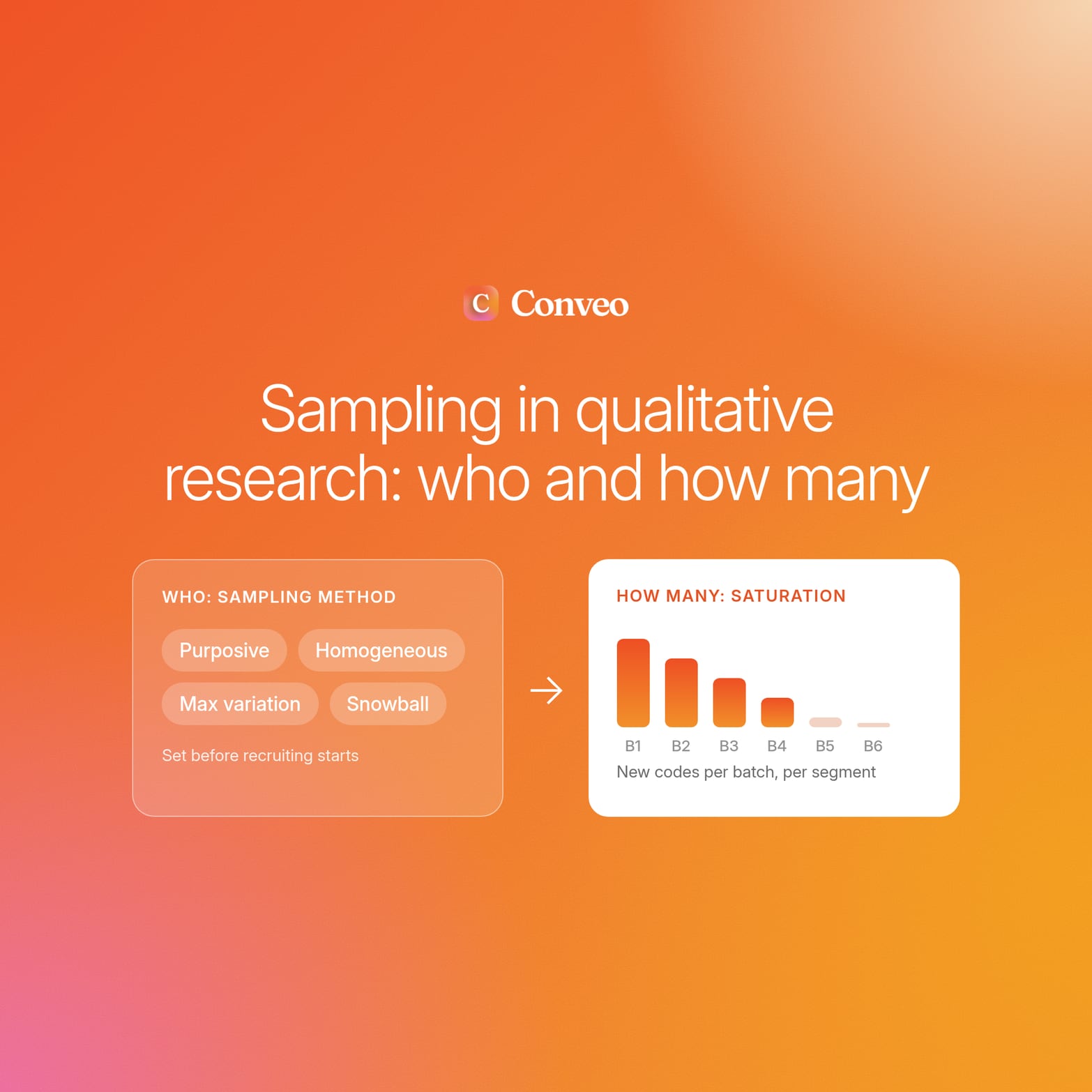
Qualitative sampling involves two decisions. The sampling strategy decides who is in the study: which experiences, characteristics, and segments the question requires. Saturation decides how many conversations that strategy needs before new interviews stop adding themes.
Teams often treat both as one choice made at the proposal stage. The first belongs to research design and happens before recruiting; the second can only be made once the team starts to collect data. Any sampling technique sets the conditions for the stopping call, but it cannot make the call.
Strategy and analysis approach also shape each other:
| Analysis approach | How it shapes the sample |
|---|---|
| Grounded theory | Grounded theory researchers use theoretical sampling, a theory-based approach that picks each new participant to test categories as they emerge, and continue until theoretical saturation |
| Narrative research | Researchers often go deep with a handful of people |
| Discourse analysis | Samples texts and recorded conversations as well as people |
| Ethnography | Studies cultural phenomena in context. Ethnographies that capture cultural practices often recruit through participant observation: the researcher observes a setting and interviews members as access opens up |
| Thematic or framework analysis | Fixed purposive segments push the analysis toward thematic or framework comparison |
Decide which of the kinds of qualitative research the study uses before choosing a sampling method.
The method chosen up front determines which segments will each need their own stopping call.
4 types of sampling methods in qualitative research, and when each fits
No sampling method is universally best. Fit depends on the research question, the segments the study must cover, and how reachable potential participants are. The risk under each method deserves more planning time than the label: it is cheaper to contain at design than to explain at debrief.
1. Purposive sampling in qualitative research
Purposive sampling in qualitative research means deliberately selecting study participants who hold the experience the research question requires. Purposeful sampling is an interchangeable term for the same approach. It fits most applied research studies, including concept tests and discovery interviews, where the question already names the people who matter.
The main risk is selection bias: the sample reflects the researcher's assumptions about who matters. Write inclusion and exclusion criteria from the study's conceptual framework before recruiting starts, and hold to them when fieldwork gets slow.
2. Homogeneous sampling
Homogeneous sampling selects participants who share a defining characteristic so the researcher can gain detailed insights into that group. It fits questions about a single cohort: first-time buyers, lapsed subscribers, university students, or clinicians in one specialty. Because participants share context, homogeneous groups often reach saturation around 12 interviews.
The risk is limited transferability in qualitative research: findings describe the cohort and may not hold beyond it, yet stakeholders often read them as general. Declare the cohort boundary in the report, so readers know which groups the findings leave out.
3. Maximum variation sampling
Maximum variation sampling deliberately spans the widest range of relevant characteristics to surface patterns that hold across differences. It fits early discovery and multi-market work, where the researcher needs a comprehensive understanding of which themes are shared and which belong to one group.
The risk is thin coverage. Spread a sample across eight characteristics and each subgroup may get two or three conversations, too few to separate a pattern from an individual. Define segments upfront and recruit 5 to 15 per segment, enough to detect patterns in human behavior before comparing across them.
4. Snowball sampling
Snowball sampling asks participants to refer others who fit the study criteria. It suits hard-to-reach groups that no panel or list covers well: specialist practitioners, enthusiasts in a niche category, or members of an ethnic group or community that trusts peers more than recruiters. In these groups, people who can provide valuable insights often know each other mainly through referrals, so referrals help identify individuals a screener would miss.
The risk is clustering. Referral chains stay within one network, so participants can share opinions and characteristics. Start from several unconnected seeds and cap the referrals each seed can generate.
The method sets who is in the room, and each segment still needs its own stopping call.
How to choose a sampling strategy for the study you are running
Most guidance on sampling strategies in qualitative research lists definitions and stops short of mapping a strategy to the study a team is running this quarter. The table below is that decision framework for five common study types.
| Study type | Recommended strategy | Typical sample starting point | Main risk |
|---|---|---|---|
| Concept testing | Purposive, by target segment | 5 to 15 per segment | Sample tilts toward likely adopters |
| Ad testing | Purposive, by audience segment | 5 to 15 per segment | Reactions reflect one audience only |
| Brand tracking | Purposive, matched across waves | 10 to 30 per wave | Sample composition drifts between waves |
| Product discovery | Maximum variation across user types | 10 to 30 per study | Thin coverage of each subgroup |
| Longitudinal program | Homogeneous cohort, held across waves | Around 12 per cohort | Cohort attrition between waves |
Segmentation, market count, and wave-based design multiply the sample. A round of concept testing across three segments in four markets has 12 cells, and each needs its own saturation call. A theme can also look saturated in translation when local participants would have described it differently.
In practice, teams budget one total interview count and split it evenly across cells, so some saturate early, and others never get close. Budget per cell instead, with room to add a batch where codes are still emerging.
Choose the strategy from the decision a particular study must inform, then size each cell by evidence.
How many interviews is enough, and how to test saturation
Data saturation in qualitative research is the point where new interviews no longer produce new data worth coding: new themes, codes, or meaningful nuance. It is a property of the qualitative data, observed during analysis. Quantitative approaches fix sample size with a power calculation before fieldwork; qualitative research methods have no equivalent formula.
Three planning ranges help set budget and recruitment:
Well-scoped study: 10 to 30 interviews.
Homogeneous sample with narrow aims: 9 to 17 interviews, per Hennink and Kaiser's systematic review of 23 studies that assessed saturation.
Early theme emergence: most themes present by interview 12 in a 60-interview study, per Guest, Bunce, and Johnson.
Treat all three as planning priors. The data drive the stopping call.
Five signals that saturation is close
Five operational signals show saturation is close:
Themes repeat without adding new nuance.
New transcripts produce no new codes.
Participants describe the experience in convergent language.
Responses become predictable, and the predictions hold.
Negative cases, the participants who contradict a theme, stop appearing.
No single signal settles the question. Qualitative researchers look for several holding at once, across more than one batch. The signals are also only actionable if theme detection runs during data collection, which makes this a question about the research process.
How to spot false saturation
Convergence can be false. When probing stays shallow, answers converge because the questions stayed at surface level, while the topic itself may be far from exhausted.
Hennink, Kaiser, and Marconi found code saturation at nine interviews, but meaning saturation at 16 to 24. Before trusting convergence, check that follow-ups:
Asked why
Asked for a specific, recent instance
Tested contradictions
In semi-structured interviews, shallow probing usually traces back to a discussion guide that asks for opinions where it should ask for recent, specific behavior.
Running a mid-study saturation checkpoint
A mid-study checkpoint turns the signals into a decision:
Run 8 to 10 interviews in the first segment.
Review the running codebook for emerging themes and new codes from the latest batch.
Add a batch if new codes still appear, and stop if they have flattened and probes went deep.
Repeat the checkpoint for each segment.
A running codebook, updated as each transcript arrives, makes the decision auditable. Set the coding rules before conducting interviews so new codes get counted the same way in every batch.
It also changes the conversation with stakeholders: the researcher shows the batch where new codes stopped, so the number no longer rests on a proposal written months earlier.
Whichever sampling method a study uses, sample size is a saturation-driven decision made with the data in hand.
Why the stopping call is hard to test with manual workflows
Saturation goes untested for operational reasons. Qualitative researchers know how to test it; the workflow makes it expensive to test.
The problem is where coding sits in the chain. Recruitment closes before scheduling starts, sessions run at the pace of the moderator's calendar, and coding comes last. Across a study that runs several weeks, the one step that could show saturation happens after the window to add interviews has passed.
In a representative scenario, a researcher at interview 14 of 15 notices one segment still producing new codes. Adding five interviews means reopening recruitment, rebooking sessions, and finding hours of extra coding time. Those interviews rarely happen.
Each common approach handles the stopping decision soundly but at a cost.
| Approach | What it does well | Tradeoff for the stopping call |
|---|---|---|
| Agency-led interviews | Experienced moderation and synthesis | The contract usually fixes the interview count before fieldwork, so the budget line sets the stopping point |
| Manual in-house coding | Close control of the codebook | Every added interview adds coding hours someone must find |
| Focus groups (6 to 10 participants per group) | Language discovery: group discussions show how people talk about a category together | Group dynamics can distort individual signals, a weaker fit when sampling for individual decision drivers |
Focus group size, typically 6 to 10 participants, also limits how many individual decision drivers each session can separate. The same holds for other qualitative methods: each remains the right call on the right question.
Documentation adds a second gap: without a record of when each theme first appeared, you can't audit a saturation claim, regardless of which method produced it.
When adding conversations is expensive, cost sets the sample size.
Keeping sampling rigorous and traceable
A defensible sample is a documented one. Reviewers increasingly expect every finding to trace back to a real person who said it. Four practices cover most of what they ask, and each costs little when set up before fieldwork starts.
Write inclusion and exclusion criteria before fieldwork. Criteria written afterward tend to describe whoever showed up.
Log every screen-out with its reason. The log shows the sample was filtered by criteria.
Set quality controls at recruitment. Apply behavioral screening, quality scoring, and the same screening logic in every language.
Keep one saturation log per segment. Each log records when themes first appeared and when new codes stopped.
In participant recruitment in qualitative research, source is a trade-off with no single right answer. Panel partners reach audiences the team cannot access directly, and a bring-your-own list gives control over a known one.
Linking each theme to verbatim quotes and the video clips behind them changes how findings get presented. Reviewers watch the moment a participant said it and check the summary themselves.
A sample survives review when every choice behind it has a written reason.
How researchers test the saturation call inside the decision window
Conveo is Consumer Understanding Infrastructure. For a sampling plan, it changes one thing: researchers add conversations until new themes stop appearing, while the decision is still open.
The researcher still designs the study, writes the discussion guide, defines the segments, and interprets the findings. Conveo handles the operational work that makes an extra batch practical:
Asynchronous video interviews. Participants complete AI-moderated video interviews on their own time, so researchers can add a batch without calendar coordination.
Probing on what participants say. Conveo's AI research assistant asks follow-up questions when an answer is vague or leaves a gap, building on what the participant said earlier. Those follow-ups are where deep insights come from, and video also captures hesitation and tone shifts, parts of the human experience that text-only qualitative data collection misses.
Theme-level evidence. Each theme links to the participants behind it, with video clips and verbatim quotes stakeholders can audit, so the researcher's saturation log points to real moments.
Flexible recruitment. Researchers recruit through 8 integrated panel providers or their own list. Screener questions qualify participants before the interview starts, including AI screening of open-text answers.
Quotas per segment. Researchers define segments from screener answers and set a target per segment. Conveo stops recruiting a segment once it's full and keeps filling the ones that still need people, with a live view of each cell.
Recurring themes and facets are recognized across studies in a searchable insight library, so the next wave builds on what earlier ones established.
For programs that run in waves, Conveo StoryLines brings Continuous Consumer Understanding: continuous, AI-moderated insights programs that run in waves, for example every two weeks or monthly. Teams see the market move as it happens, with a fresh stopping call each wave.
Because video interviews run in parallel, findings arrive while the decision is still open, and a second checkpoint in the same segment becomes realistic.
Procurement reviewers ask how the team will collect information, where data is stored, who can access it, and how it gets deleted. Conveo is SOC 2 Type II and ISO 27001:2022 certified, GDPR compliant, with EU hosting (Belgium) and SSO.
The researcher chooses the qualitative research sampling method. What changes is whether the stopping call can be tested within the time the decision allows. The launch behind it then rests on evidence a reviewer can audit.
Frequently asked questions
How many interviews are enough for a qualitative study?
Plan for 10 to 30 interviews in a well-scoped qualitative research study, or around 12 for a homogeneous cohort, then test saturation in the data. Hennink and Kaiser's systematic review of 23 studies that assessed saturation found that the empirical tests reached it within 9 to 17 interviews for narrow aims. Treat that range as a budgeting prior: the stopping call comes from the data.
Does saturation transfer across segments and markets?
No. Test it separately in each cell of the design. A theme that stabilized among US first-time buyers says nothing about German repeat buyers, and every wave needs a fresh check because the market moves between waves.
How do you prove saturation to a stakeholder?
Keep a saturation log per segment recording when each theme first appeared, how often it recurred, and the batch where new codes stopped. Paired with a running codebook, it lets a reviewer check the stopping call directly.
What is the difference between code saturation and meaning saturation?
Code saturation is the point where no new codes appear. Meaning saturation is reached when each code is understood across its different aspects and edge cases, and it usually requires more interviews: Hennink, Kaiser, and Marconi found code saturation at nine interviews and meaning saturation at 16 to 24. Grounded theory adds a third standard, theoretical saturation, where every category is fully developed. Shallow probing can produce code saturation while meaning and theoretical saturation stay out of reach.
Is purposive sampling the same as convenience sampling?
No. Purposive sampling selects participants based on criteria set before recruitment. Convenience sampling takes whoever is reachable, such as university students near the research team, which is what a purposive plan becomes when criteria get relaxed mid-fieldwork.

About the author
Hendrik Van Hove
Founder & CPO
Hendrik is Conveo’s Chief Product Officer and co-founder. He's extremely passionate about technology and the real positive impact it can bring. Before Conveo, he ran AI strategy projects at McKinsey for the Fortune 2000, working with boards and every function from marketing, to sales to insights.
More by Hendrik →Qualitative insights at the speed of your business.
Conveo runs AI-moderated video interviews and structures everything they say.