In this article
TL;DR
Fashion market research is the practice of understanding consumer behavior across the season: how consumers respond to trends, their fit experience, and repeat purchase.
Most fashion industry research chases trend signals, while fit and repeat purchase, where margin sits, surface only after returns data lands post-shipment.
Keeping traceable shopper conversations running through the season surfaces those signals while the next range is still open.
In fashion market research, the pattern is familiar: a range ships, returns data lands weeks later, and fit failed while repeat purchase never came. Fashion market research is the practice of understanding what consumers want, how garments fit and perform on their bodies, and whether they come back.
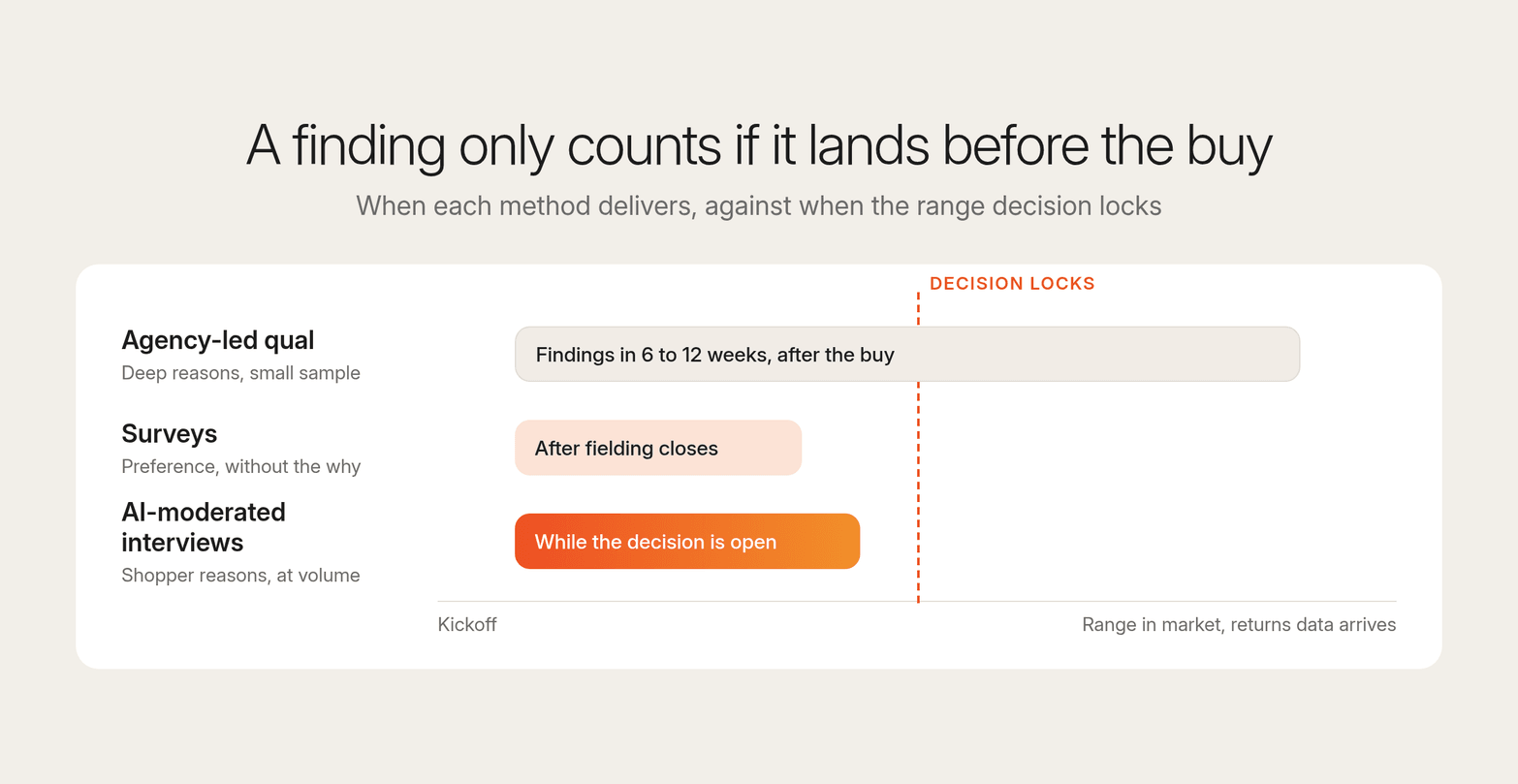
Most fashion research chases emerging trends and under-examines fit and repeat purchase, where margin lives. The mechanism is timing: agency-led qualitative research often takes 6 to 12 weeks. By the time the shopper's reasons come back, the buy is already placed.
This article is for insights and CMI leads at fashion, luxury, and beauty brands who need fit and repeat-purchase evidence before the next range commits. It gives you a way to choose the right method for each fashion decision. It also shows how to keep shopper conversations running through the season, so findings become actionable insights while the range is still open.
What fashion market research needs to answer
Fashion market research is the structured study of consumer behavior across trend response, fit experience, and repeat purchase. Teams use it to inform assortment, price points, brand strategy, and campaign decisions.
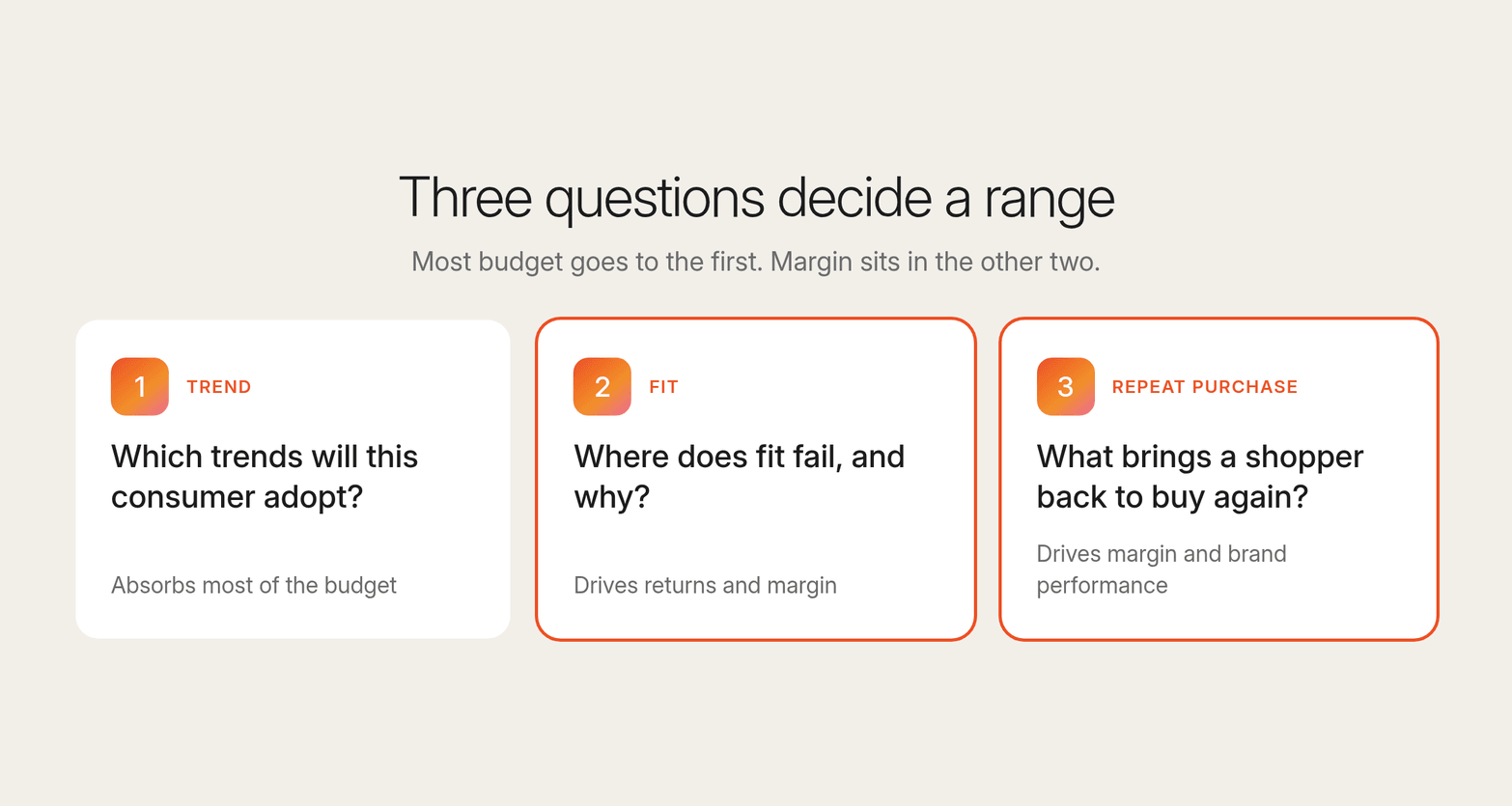
Done well, it answers three questions: which trends this consumer will adopt, where fit fails and why, and what brings a shopper back to buy again. Trend questions absorb most of the budget in fashion industry market research. A silhouette gaining popularity on social media shows what is visible, which is a different question from what your consumers will wear. Fashion borrows from retail market research, but fit and returns make it its own problem. Fit and repeat questions get less attention, yet they drive returns, margin, and brand performance.
In a representative scenario, a team ships a spring range and watches return rates climb as online shopping orders come back through the first weeks of the season. The returns dashboard shows which sizes came back. It contains no shopper language explaining why the garment didn't work.
That language is the answer that matters. A shopper who says the waist sat right but the rise cut in when she sat down has told the design team what to change. A five-point fit scale in online surveys cannot capture that sentence. Research that covers only trends answers one of three questions that determine a range's commercial success.
Where agency research and surveys fall short for fashion
Agency-led qualitative research, surveys, and continuous AI-moderated interviews each handle fit and repeat-purchase signals differently in fashion brand market research.
Agency-led depth interviews and focus groups give your team rich, nuanced consumer insights, often from researchers with extensive category experience. The constraint is timing: on cycles that often take 6 to 12 weeks, findings land after assortment, campaign, and roadmap decisions are locked.
Online surveys let your team quantify consumer preferences at scale. For example, a survey result might read, "62% would choose free returns over a lower price." That number misses the hesitation, the contradictions, and the exact language shoppers use to justify the choice.
AI-moderated research gives your team adaptive probing at volume. When a participant calls a jacket "interesting," or pauses, your team's AI research assistant follows up to find the credibility or value gap a fixed script skips. Interviews run in parallel across markets and time zones, in 50+ languages.
| Approach | What it surfaces on fit and repeat purchase | When the finding arrives |
|---|---|---|
| Agency-led qualitative research | Deep reasons from a small sample | Often 6 to 12 weeks after kickoff |
| Surveys | Preference and incidence, without the why | Shortly after fielding closes |
| AI-moderated interviews | Shopper reasons in their own words, at volume; best paired with a follow-up survey to size how widely a finding holds | While the decision is still open |
In fashion marketing research, choose the method by when the decision locks and what evidence it needs. A finding that lands after the buy is placed cannot change the business outcome.
A decision framework: which method for which fashion decision
The right method for a fashion decision, from a fit fix to product innovation, depends on the decision type, not on the method your team used last time.
| Decision type | Question to answer | Best-fit method | Why |
|---|---|---|---|
| Assortment and fit | Where does this garment fail on real bodies? | AI-moderated interviews with garment-specific probing | Captures fit language at the volume a range needs |
| Repricing or pricing | Where does the price anchor sit, and why? | Price questions and interviews in one study (Conveo price testing, research preview) | Van Westendorp or Gabor-Granger questions size the threshold; AI follow-ups explain the anchor |
| Brand repositioning or new category entry | Does the brand have permission to stretch into new product categories? | Depth interviews and ongoing programs | Brand perception and competitive positioning shift over time and need repeated reads |
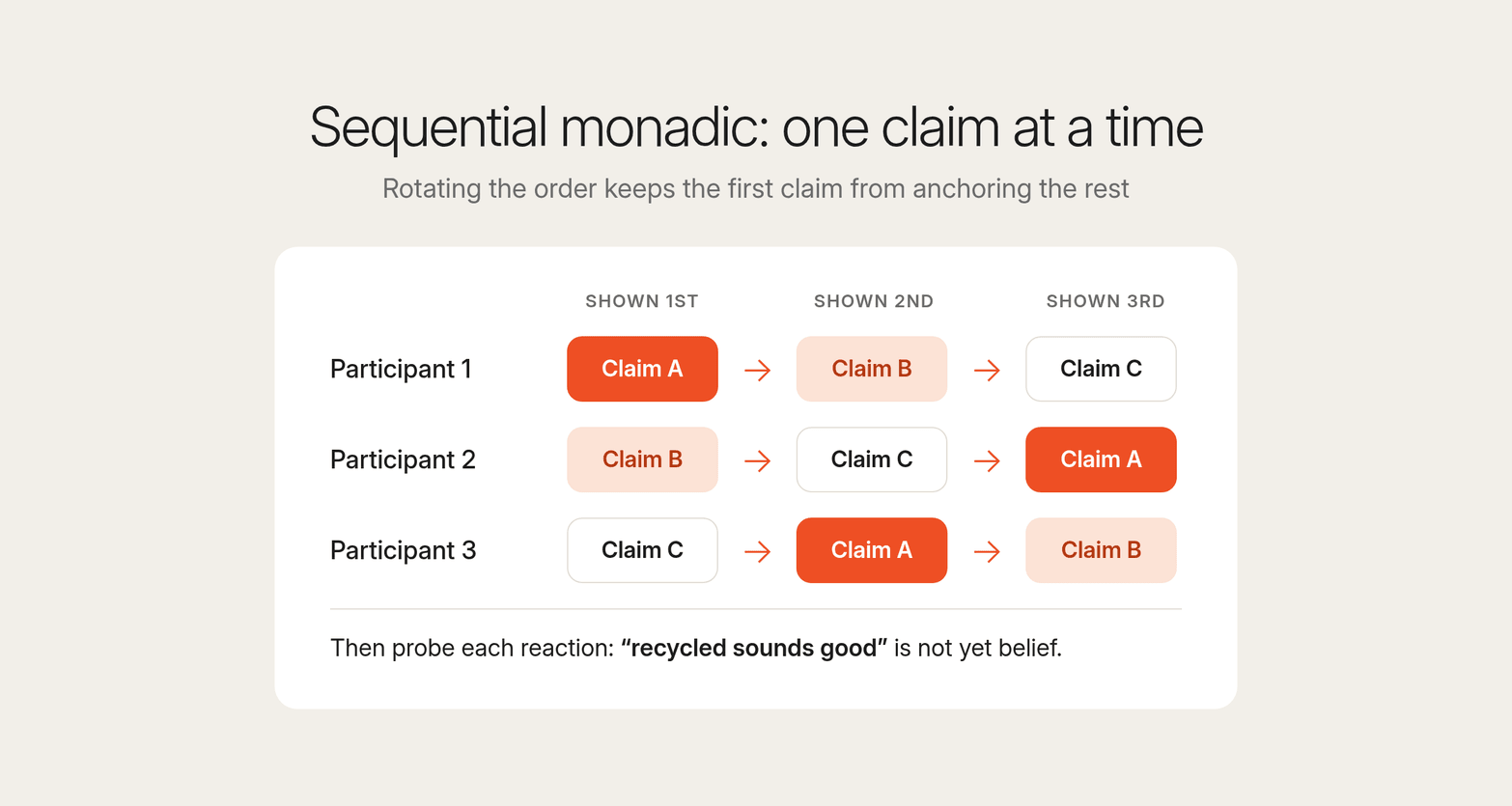
| Sustainability or claims messaging | Which claim do shoppers believe? | Sequential monadic concept testing | Isolates each claim's credibility without anchoring |
Sequential monadic testing is one of several concept testing methods: it shows each concept or message to the participant one at a time. Rotating the order across participants prevents the first concept from anchoring reactions to the rest.
Syndicated reports and secondary sources help with market sizing and trend context, including market growth and retail sales. They also feed competitive intelligence on where leading players are gaining share. They cannot explain why your own shoppers return or do not.
Match the method to the decision, and treat surveys, interviews, and ongoing programs as complementary.
How to do fashion market research that surfaces fit and repeat purchase
A five-step fashion market research process helps your team gain insights on fit and repeat purchase alongside any existing research.
Define behavioral segments before recruiting. Use decision criteria such as price-anchored versus speed-driven shoppers, or solo deciders versus consensus builders, since age groups, income, and region often explain less about brand choice than decision criteria do.
Recruit 5 to 15 participants per segment. That range surfaces repeatable patterns when segments are defined upfront using sampling methods in qualitative research, with participants from Conveo's integrated panel network or your own customer list.
Start with baseline behavior. Ask where consumers discover new pieces, what they bought last time, what worked, and what failed, before showing any new concept or stimulus.
Ask fit and return questions in the shopper's own words. Ask where the garment didn't suit them, what they did next, and what would make them buy the same item again.
End with an "advise the brand" close. Ask "Which concept should launch, and what is the risk if the weakest one launches?" to draw out concrete brand-risk language.
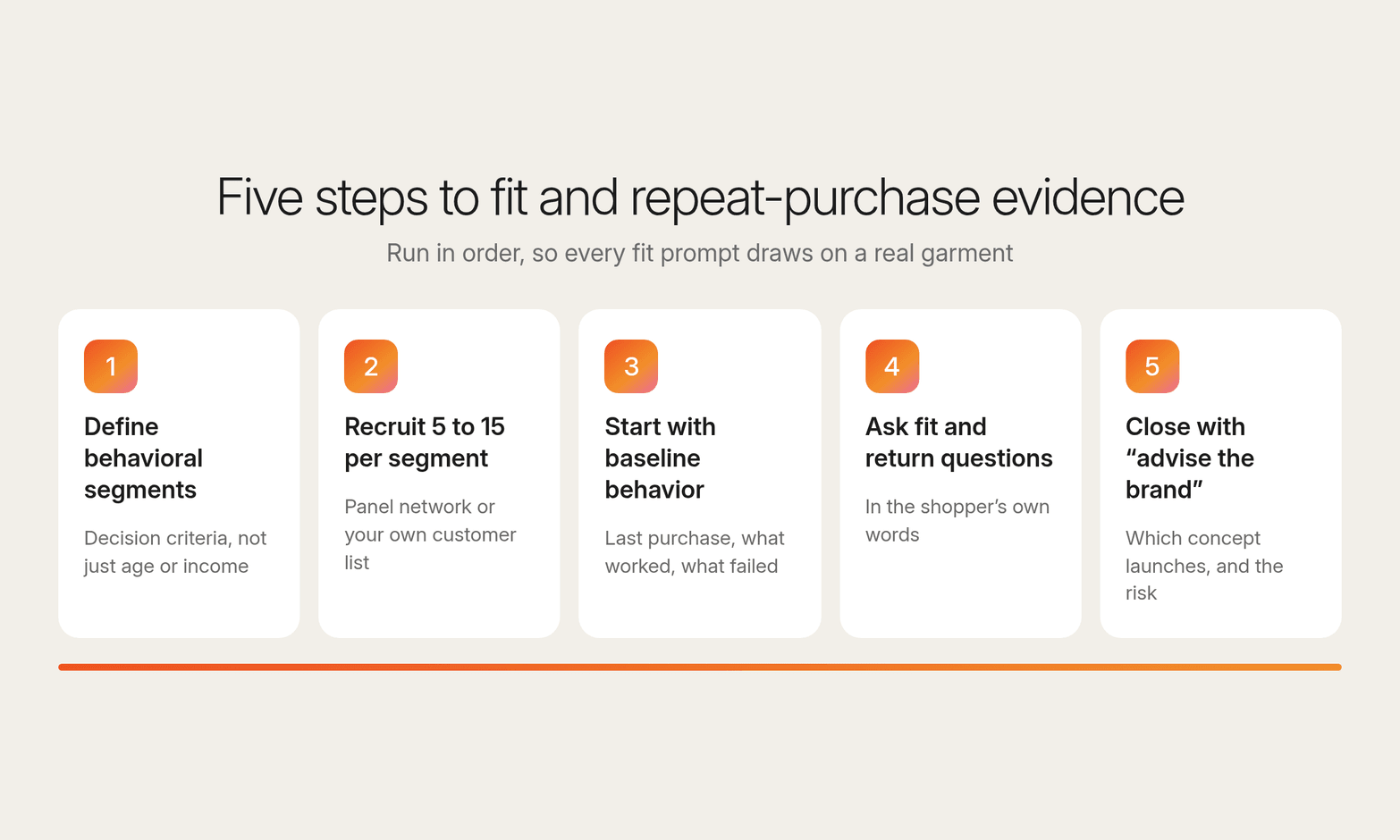
The order of the five steps matters. Baseline questions anchor participants in real purchases and daily routines, so later fit and return prompts draw on a specific garment. The closing question puts participants in an advisor's seat, where they name the risks a brand team needs to hear.
Surveys still have a role in this process. Once interviews surface a fit issue or a repeat-purchase driver, a questionnaire sizes how widely it holds across your customer base. The FAQ below covers what belongs in one.
Run in this order, the five steps give fit and repeat purchase the same structured attention trend questions already receive in any market research project.
Why fit and repeat-purchase signals need an always-on program
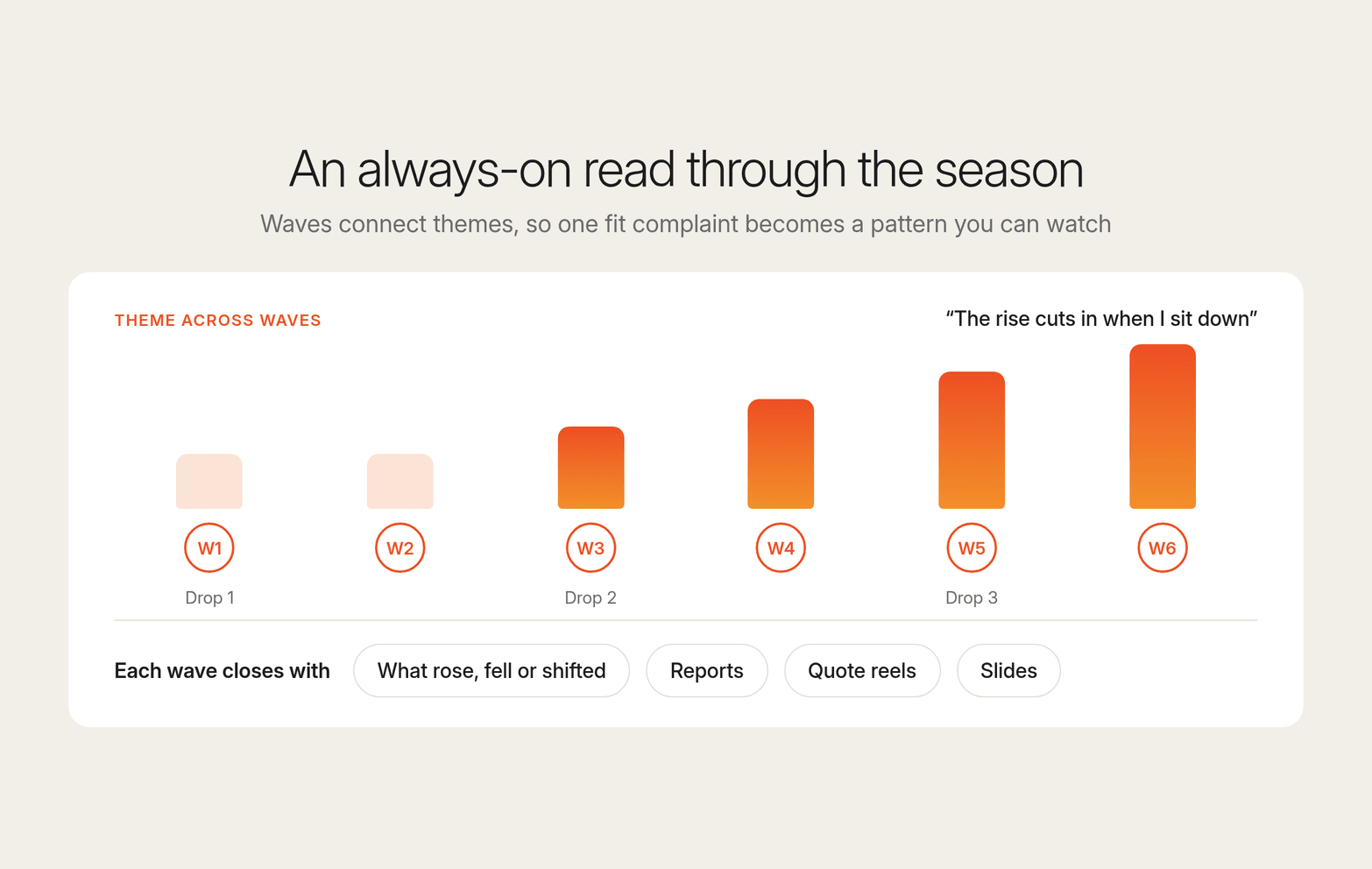
A single wave of research tells you what happened once. Whether a fit problem or a repeat-purchase driver is a pattern only shows up when conversations keep running between launches, as consumer expectations shift.
Conveo StoryLines is a continuous, wave-based AI-moderated research program built for Continuous Consumer Understanding. Your team runs traceable video conversations with shoppers in waves through the season, so each drop gets a read and shifts in consumer trends surface between launches. When each wave closes, StoryLines flags what rose, fell, or shifted and sends the team reports, quote reels, and slides. Three things make that read usable:
Themes connected across waves. StoryLines connects themes across waves, so a fit complaint from the first wave becomes a pattern your team can watch develop.
Findings you can audit. Each theme links to the participants behind it, with video clips and verbatim quotes stakeholders can audit. Your merchandisers and e-commerce teams can see the shopper explain the problem.
Researchers in control. Your researchers design the discussion guide and keep control of hypotheses and synthesis, while the AI research assistant handles fielding and follow-up probing.
Surveys still play a role once you've established a signal. They show how widely a fit issue or repeat-purchase driver holds across your full customer base, so qualitative and quantitative reads reinforce each other.
Timing changes what the evidence can influence. With waves running through the season, findings reach the range review while the next range is still open, which helps the brand stay relevant between seasons.
With a continuous read, returns data confirms what your team already heard from shoppers. The same conversations also point to growth opportunities for the next range.
Testing stimulus and claims across fashion, luxury, and beauty
Claims testing in fashion market research shows whether consumers believe what your brand says before a campaign carries it. Sustainability claims carry the most risk in sustainable fashion research because vague claims can read as greenwashing.
Run each claim through a sequential monadic structure, then probe the reaction. A participant who says "recycled sounds good" hasn't yet said whether she believes it, and the follow-up question reveals the credibility gap. In native Conveo interviews, your team can see that hesitation in the findings, because Conveo's multimodal analysis reads tone and facial cues alongside speech.
Ninth Seat saw the same unfiltered reaction in a live unboxing study:
"Consumers did a live unboxing for us: seeing it for the first time, giving us their first reactions. They don't have time to rationalize. It's all emotive, in that moment."
Dafydd Jones, Associate Director, Ninth Seat
Luxury market research adds nuance. Affluent consumers judge luxury goods on craftsmanship, scarcity, and service, and rarely reduce those judgments to a rating. High-net-worth individuals often weigh enduring value over price points, so luxury brands need interviews that probe what a piece is worth to a client over time.
The same discipline carries into beauty market research, where claims such as "clean" face scrutiny. In cosmetics market research, shade ranges add their own fit question: they either match a shopper's skin or send the product back. Across skin care and color cosmetics, participants judge claims such as visible results from an anti-aging serum against their own beauty routines.
Test every claim in the shopper's own words before the campaign commits to it.
Frequently asked questions
What belongs in a fashion market research questionnaire?
A fashion market research questionnaire is the quantitative half of [mixed methods research](/insights/mixed-methods-research): it sizes patterns interviews have already surfaced. Include questions on product discovery, last purchase, fit outcome by garment type and channel (stores or online platforms), return reasons, and likelihood to rebuy the same item. Write answer options from shopper language heard in interviews, so the scale reflects how consumers describe fit.
How do you choose between fashion market research companies?
Choose fashion market research companies based on how quickly their findings arrive and how traceable they are. Ask whether each insight links back to a verbatim quote or video from a real participant. Check whether findings from one study carry into the next, or start from zero each season.
Can AI-moderated interviews match the depth of a human moderator?
They can, when senior researchers design the guide and interpret the findings. Conveo's AI research assistant asks follow-up questions when an answer is vague or leaves a gap, building on what the participant said earlier. The AI research assistant handles fielding and follow-up probing at volume, while researchers keep control of hypotheses and synthesis.
How often should fashion brands run fit and repeat-purchase research?
Fashion brands should run fit and repeat-purchase research continuously through the season, whether the line is apparel or beauty products. A wave-based program that checks in after each drop catches a fit problem while the next range is still open, well before a post-season study could confirm what returns data already showed.
What's the difference between trend research and fit research?
Trend research asks which styles and themes a shopper will adopt next. Fit research asks why a specific garment worked or failed on a real body, how that shaped the customer experience, and whether the shopper will buy that item again. Both drive assortment decisions, but fit and repeat-purchase findings connect more directly to margin and returns.

About the author
Dieter De Mesmaeker
Co-Founder & CEO
Dieter is CEO and co-founder of Conveo. Before starting the company, he founded DataCamp and scaled it into one of the leading edtech platforms in the world.
More by Dieter →Qualitative insights at the speed of your business.
Conveo runs AI-moderated video interviews and structures everything they say.