In this article
TL;DR
Channel investment decisions get locked before anyone understands why consumers moved between channels. The insight arrives after the decision has closed.
Behavioral data shows what happened and where. It rarely explains why consumers switched, or what the channel that got no credit actually did.
The framework that closes the gap asks consumers to narrate the full path themselves, as one account.
Teams at multi-market CPG, retail, and DTC brands use Conveo to run journey-level qualitative research across 8 integrated panel providers plus your own lists, with every finding traceable to the person who said it.
The payoff: channel investment decisions grounded in how consumers actually move between channels, sourced directly from the people who made the switch.
Media mix gets set. Store-versus-digital allocation gets signed off. Retail media budgets and marketing efforts get committed for two quarters. In most insights functions, it all closes before anyone can say why customers actually moved across multiple channels last season.
That is the failure mode worth naming. Omnichannel evidence exists, but it lands after the decision it was meant to inform, which turns it into a post-mortem. Closing that lag is a methods problem before it is a budget problem, and it requires a deep understanding of channel-switching logic and customer needs. Understanding why the customer journey matters before that meeting is what separates the two.
What is an omnichannel customer journey?
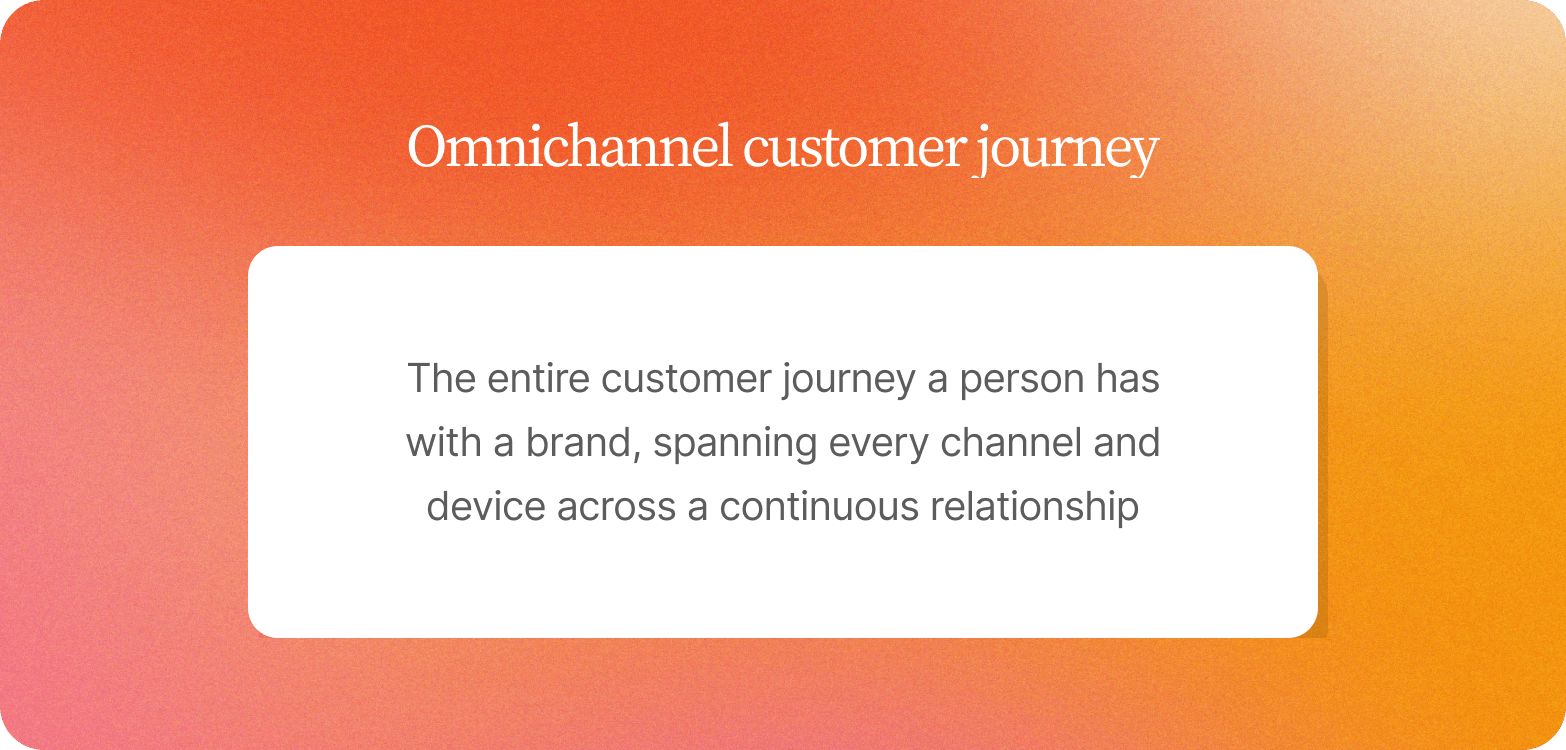
An omnichannel customer journey is the entire customer journey a person has with a brand, spanning every channel and device across a continuous relationship. Customer interactions build on each other: a visit to a brick-and-mortar store shapes how someone reads a retargeted ad, which in turn colors what they tell the customer service team on a support call.
Multichannel is different: several channels running independently, each covering one of the places customers interact with a brand. Multichannel is presence across multiple touchpoints. Omnichannel is coherence.
Analytics tools tell you what someone clicked. They rarely explain customer behavior, only where it happened.
Why channel-level analytics create partial customer views
Three systems produce the partial view, and each fails differently:
Channel analytics. Platforms like Google Analytics log sessions, point-of-sale records transactions, and the customer service team logs support calls. Each system is collecting data in its own silo, and none share a common identifier, so the performance data never resolves into one customer's perspective. A shopper who searched for a skincare product on search engines, read a few online reviews, bought it in-store, then called support appears as three partial strangers. Marketing sees a lost conversion, store operations a context-free transaction, the support team a complaint with no purchase history. The fragmentation is structural, and no amount of customer data cleanup fixes it.
Workshop-based journey mapping. Gathering stakeholders to reconstruct the path feels rigorous, and the output looks authoritative. Then someone asks, "who said this?" and no one can cite a participant. The map records internal consensus, and it ages badly, because offers and channel behaviors shift long before the next workshop gets convened. The fix is to attach evidence to each journey stage, which the next section covers.
Survey-based path reconstruction. Closed questions are bounded by the customer touchpoints a researcher thought to list. If "checked Reddit reviews" is not an option, the behavior goes unrecorded, and the resulting picture misses real customer concerns.
All three miss the handoff itself: the pain points that pushed someone from cart to store, and the logic that made the switch feel sensible.
How to build an evidence-backed omnichannel touchpoint inventory
Most customer journey touchpoint inventories fail the same audit: ask where a key touchpoint came from, and the answer is a workshop. An inventory that holds up needs participants, per segment, on the record.
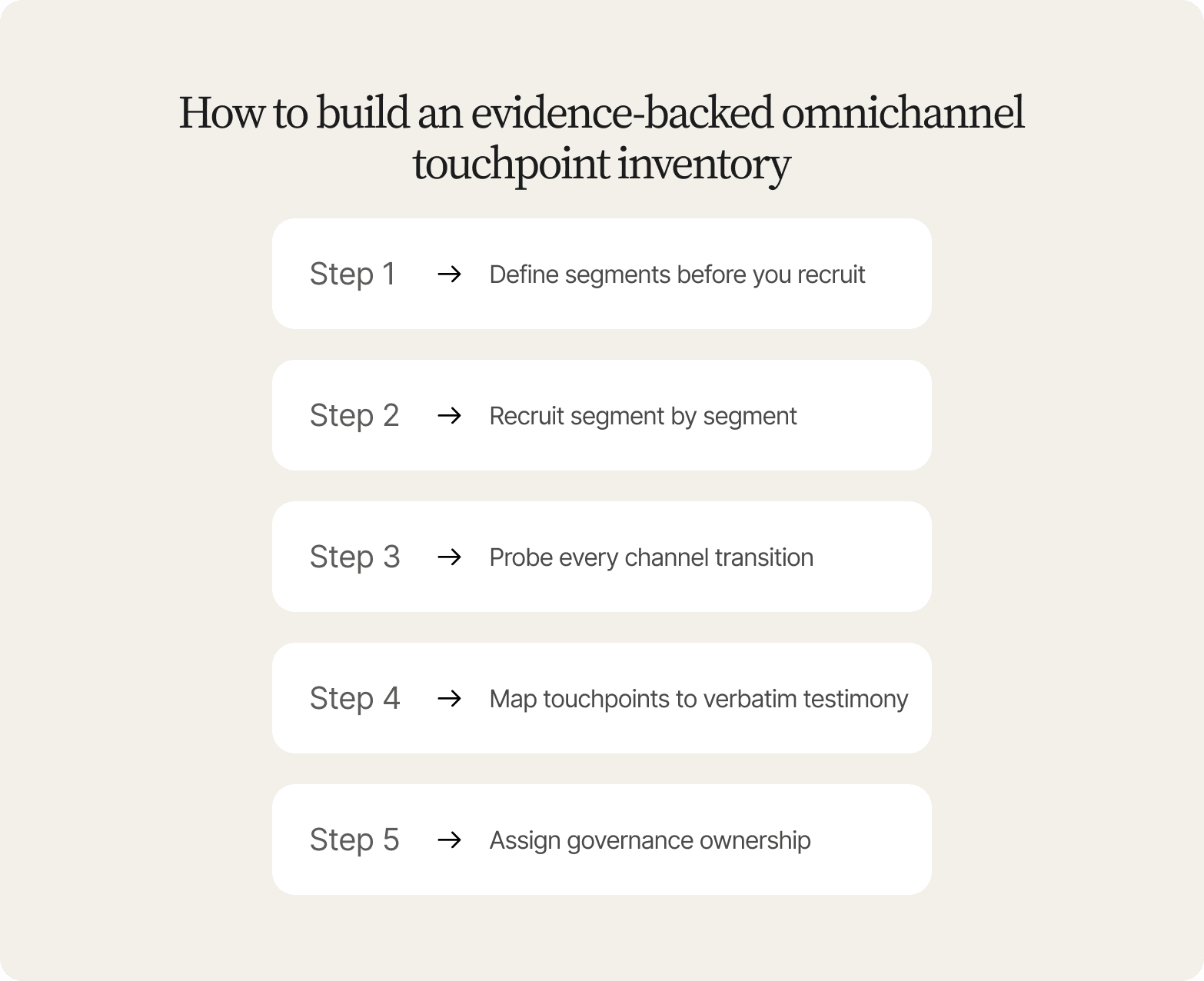
Define segments before you recruit. Identify two to four behaviorally distinct segments defined by actual behavior. A 45-year-old who researches online then buys in-store is a different segment from one who does the reverse. Write a behavioral hypothesis for each, grounded in customer needs and channel habits.
Recruit segment by segment. Screeners should surface actual channel behavior. Ask where they met the category, what they did next, and which channel resolved their doubt. That exposes the stated-versus-actual gap before fieldwork opens and starts to identify points in the journey worth probing further.
Probe every channel transition. Ask participants to walk through their last purchase episode, the full buying process, in sequence. Using an AI research assistant, researchers follow each transition as it surfaces: what prompted the switch, what customer expectations they brought in, and what they found. Sessions run asynchronously, so interviews run in parallel across markets and time zones.
Map touchpoints to verbatim testimony. Every touchpoint should carry a verbatim quote and, where video exists, a timestamped clip. Anything unanchored sits in a "hypothesized" column until evidence arrives.
Assign governance ownership. Each row carries its segment, the last validation date, and the owner who flags when channel behavior shifts.
The result is a journey map annotated with quotes and clips that a decision can cite.
Research methods for diagnosing omnichannel journeys
Using the wrong method can give teams data that describes customer behavior without explaining it. Four methods map to four diagnostic problems, and our qualitative research methods overview goes deeper on each.
| Method | Diagnostic problem | What it surfaces |
|---|---|---|
| Depth interviews | Channel-switching logic | Why a switch made sense at that moment |
| Diary studies | Temporal patterns | Triggers that unfold across days or weeks |
| Shop-alongs | In-store to digital handoffs | Where the physical experience fails to close the decision |
| Call review | Escalation patterns | Friction bad enough to need a human |
Depth interviews for channel-switching logic. A participant says they compared prices online before going to the physical store. The useful question is why that made sense then. Working through an AI research assistant, researchers follow a word like "comparison" in grocery, or "routine" in a DTC subscription, to the decision logic underneath. Every answer traces to a timestamped clip and verbatim quote.
Diary studies for temporal patterns. A shopper might browse on a mobile device, abandon a cart, get a retargeting email, and buy in-store a week later. Diary studies capture that sequence as it unfolds, surfacing triggers no single session reconstructs from memory.
Shop-alongs for in-store to digital handoffs. The moment a shopper reaches for their phone in an aisle is often where the costliest friction sits. Shop-alongs catch where the physical experience fails to close the decision, and where customer engagement with a screen quietly replaces a conversation with staff. A small fix at that moment is often the difference between a positive customer experience and a lost sale.
Call review for escalation patterns. Post-purchase support contacts signal a breakdown the customer could not resolve alone, and they carry customer feedback the survey never captured. Reviewing those calls against journey data shows where friction gets bad enough to need a human.
Operational model for continuous omnichannel understanding
Journey maps are usually produced once and filed. Six months later, a promotion has changed purchase triggers, and the map still describes the customer who was fielded then. A happy customer during one wave might be gone by the next. A customer journey strategy that holds up runs on cadence, and two cadences work together:
Wave-based refresh (structural). A standing study runs across the core segments, for example, every two weeks or monthly per market. This is what Conveo StoryLines is for: a continuous wave-based AI-moderated research program that streamlines the process of turning fieldwork into decisions. Conveo runs signal detection across the wave time series and surfaces what moved, with the quote reel and supporting evidence. Teams review where friction has shifted across journey stages and update the map accordingly.
Triggered pulse (event-driven). When a channel change or competitor move surfaces mid-cycle, an insights lead commissions a pulse: one segment, one stage, one question. Findings arrive while the channel decision is still open.
Three things make the model hold up:
Behavioral segmentation criteria set before recruitment. Screeners built around triggers, channel habits, workarounds, and risk signals. Two subscribers of different ages who both lapse and reactivate within 90 days are one segment here, and understanding that pattern matters for customer retention across the customer lifecycle.
Asynchronous sessions that remove scheduling bottlenecks. Grocery shoppers, foodservice buyers, and DTC subscribers complete interviews in parallel, each on their own schedule.
A searchable insight library that makes learnings reusable. Clips, themes, and quotes stay accessible across studies, so the team checks what is known before commissioning fieldwork, which helps retain customers by fixing what already broke.
Name one owner, usually the insights lead, accountable for keeping the map current and feeding every wave into the library, because the customer journey continues well past the point most teams stop measuring it.
Multi-market considerations for omnichannel journeys
A journey map built for US ecommerce businesses does not transfer to UK retail, German DTC, or Latin American mobile commerce. Teams either run separate studies per market, which is hard to sustain, or assume the strongest market's journey travels, which it rarely does.
Three differences matter most:
Channel norms. WhatsApp is a primary commerce and support channel across Latin America, and doubles as the main social media platform for customer communications in several markets. WeChat shapes how consumers research products in China, and how brands run digital marketing campaigns there. Phone calls remain the expected channel for high-consideration purchases in Japan.
Fulfillment expectations. Same-day delivery is the baseline in dense urban markets. Click-and-collect drives suburban conversion in the UK. Extended return windows signal trust in Northern Europe.
Compliance. EU participants require GDPR compliant data handling, and procurement in Germany or the Netherlands asks where data sits before approving fieldwork. Conveo is SOC 2 Type II certified, GDPR compliant, and EU-hosted (Belgium).
The fix is structural. Build market-specific channel probes into the guide before fieldwork opens, so each market is designed in from the start. Researchers run those variants in parallel using an AI research assistant that works in 50+ languages, so "convenience" in German keeps its full weight. Findings stay distinct per market, compared only where behavior genuinely is comparable, which is where the competitive advantage of market-specific evidence shows up.
Omnichannel journey research in practice: 3 segment-specific examples
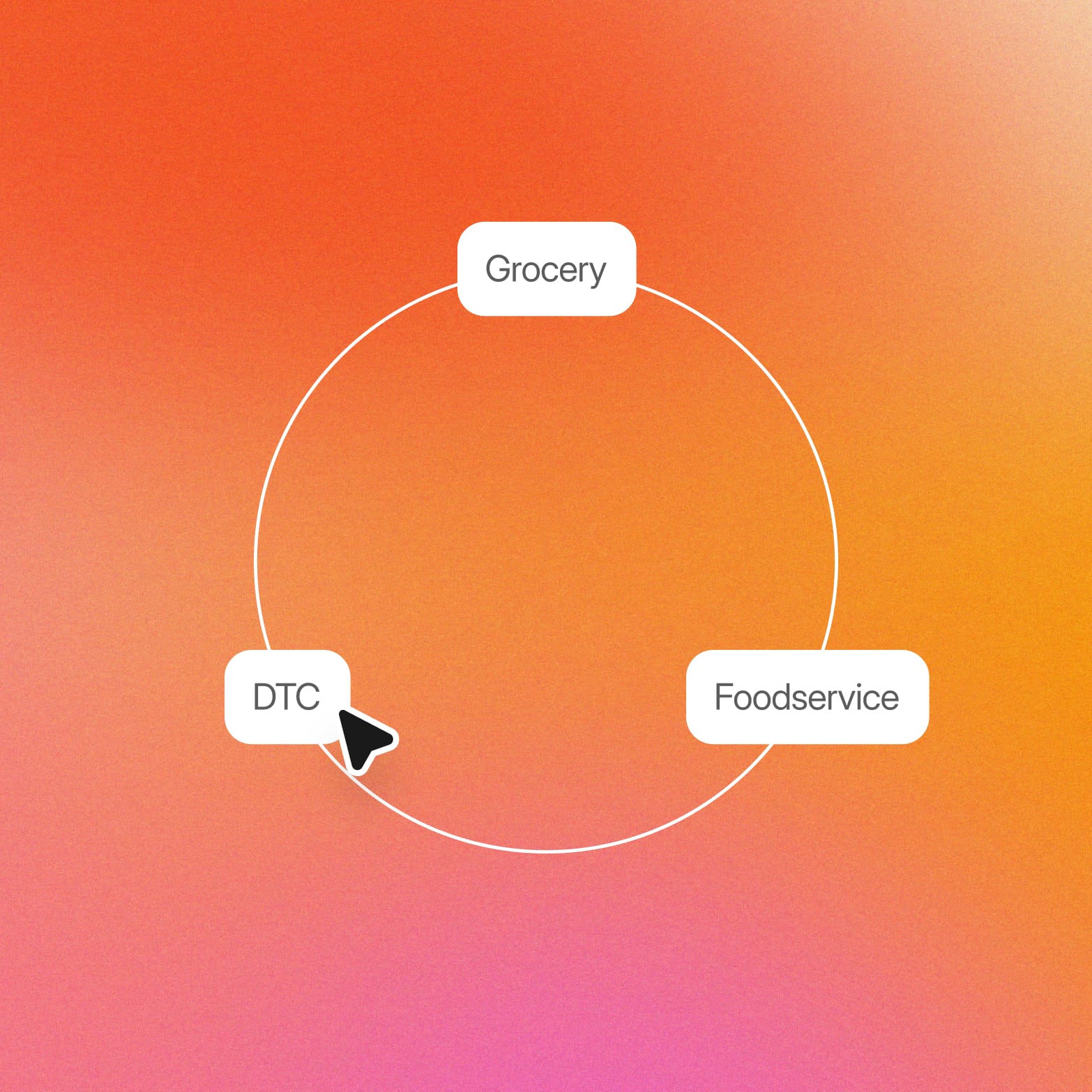
The gap gets concrete when grocery, foodservice, and DTC participants run in the same study week. Their journeys differ as much in decision logic as in channel, and in how customers feel about the brand at each step.
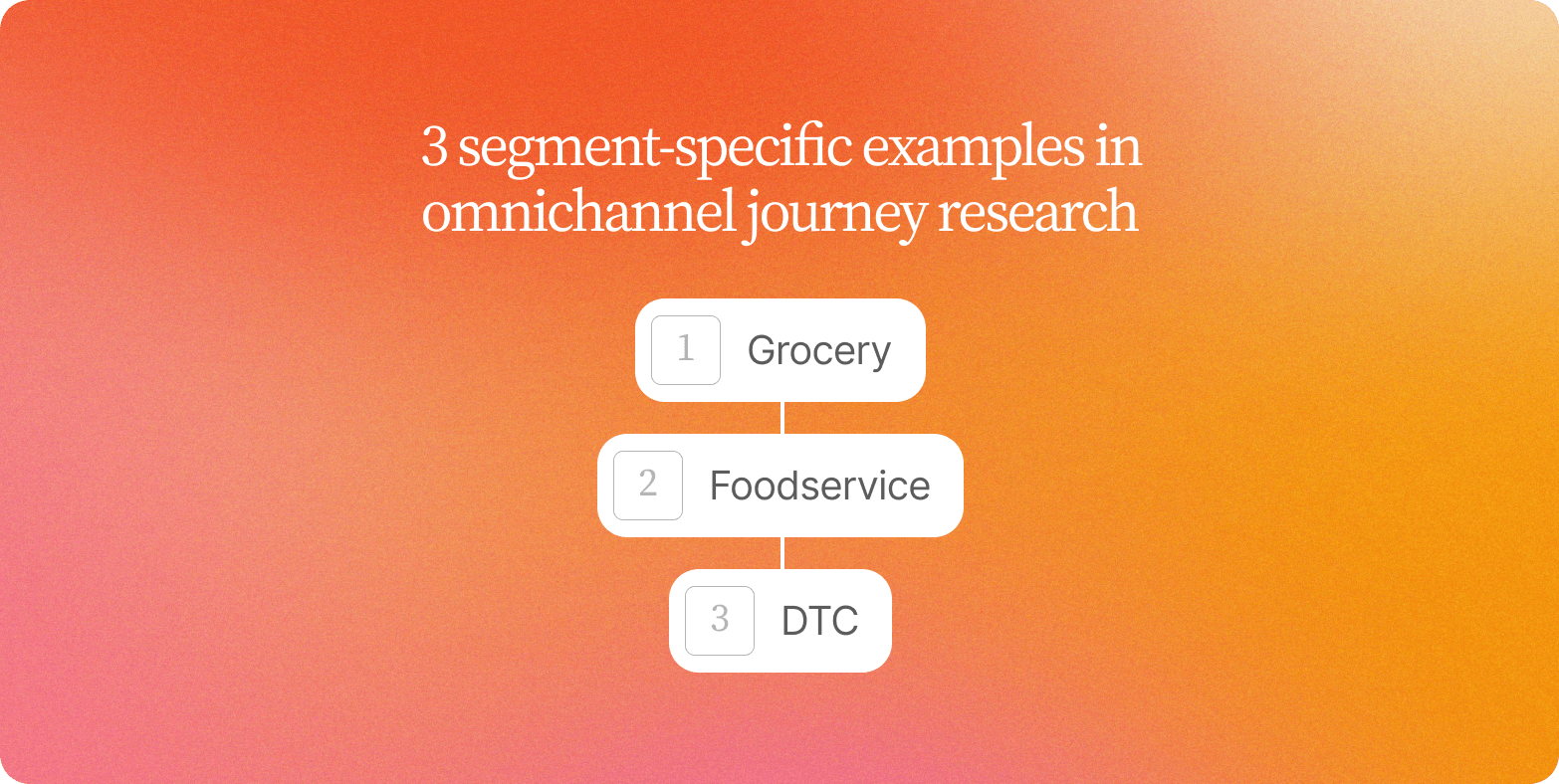
1. Grocery
"I saw it on Instagram, but I wasn't going to buy something I'd never tasted. I waited until I saw it on the shelf, then I grabbed it." Digital trigger, physical conversion, and a reminder that her digital customer journey didn't end where the click did. Social media posts sparked the initial interest, but they didn't close the sale. Messaging built for a click-to-cart path misses her.
2. Foodservice
"I don't care about the brand story. I need to know pack size, lead time, and whether the rep will actually pick up the phone." Retail brand equity does not transfer.
3. DTC
"I bought it because the unboxing looked good on TikTok and the 30-day return felt safe." Discovery and risk removal are the whole digital journey, inside one channel, because for this kind of digital customer, the store visit never happens at all.
Running behavioral screeners, a research team fields all three segments at once, so the differences surface side by side. The contrast is the finding.
Why Conveo fits evidence-backed omnichannel journey research
The goal is to explain the behavior sitting underneath customer satisfaction scores, with evidence a media mix decision can use.
Channel decisions do not wait for fieldwork. Conveo, Consumer Understanding Infrastructure for insights teams at multi-market CPG, retail, and DTC brands, holds a live account of how consumers move between channels, from initial awareness through the onboarding process and into repeat purchase, so the evidence exists before the media mix question comes up.
"Every marketing decision we make now starts with what consumers actually told us on Conveo."
Louis Chalabi, Founder & CMO, Edgard & Cooper
Rigor makes that account usable. Participants narrate the whole path once, in their own words, and when the consumer speaks without a script in front of them, the account holds more of the consumer's perspective than a survey ever captures. Researchers probe each transition through an AI research assistant that adapts to the participant's language in real time.
See it in action in How AI-Moderated Interviews Actually Work:
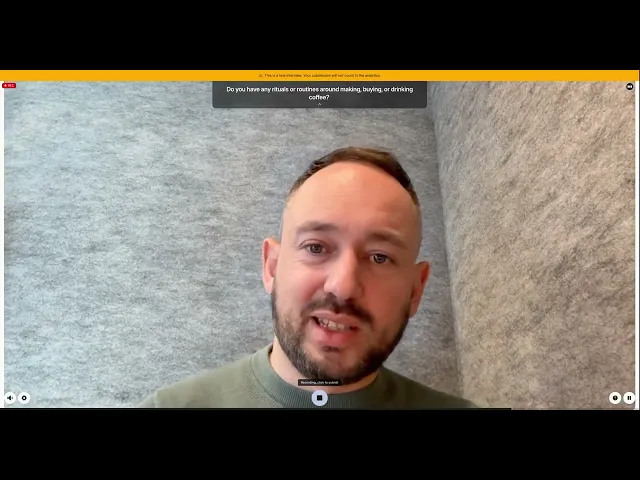
Pauses before a price question and tone shifts on a failed reorder stay visible in the recording, timestamped against the verbatim. "Who said this?" gets answered with a clip. Teams report that participants open up more than they do with a human moderator on the line, and responses run noticeably longer than static surveys typically produce.
The value compounds after the study closes. Every clip, quote, and theme flows into a searchable insight library, so journey learnings connect across waves and stay usable long after the deck is presented. That's what turns a single sale into brand loyalty and lifetime value.
For European procurement, Conveo is SOC 2 Type II certified, GDPR compliant, EU-hosted (Belgium), and delivers findings while the channel decision is still open. The real change is journey research at a granularity most teams could not run before at this scale.
Who this is not for:
A team commissioning one single-market study with no ongoing cadence will not see the compounding benefit.
A team whose questions don't need segment-level recruitment.
A team optimizing purely for customer loyalty at the expense of acquisition; a retention-specific study fits better there.
A team that just needs a one-time deliverable; a project engagement fits better than a standing program.
See the full capability set on the Conveo product page.
Frequently asked questions
How many participants do you need per segment for omnichannel journey research?
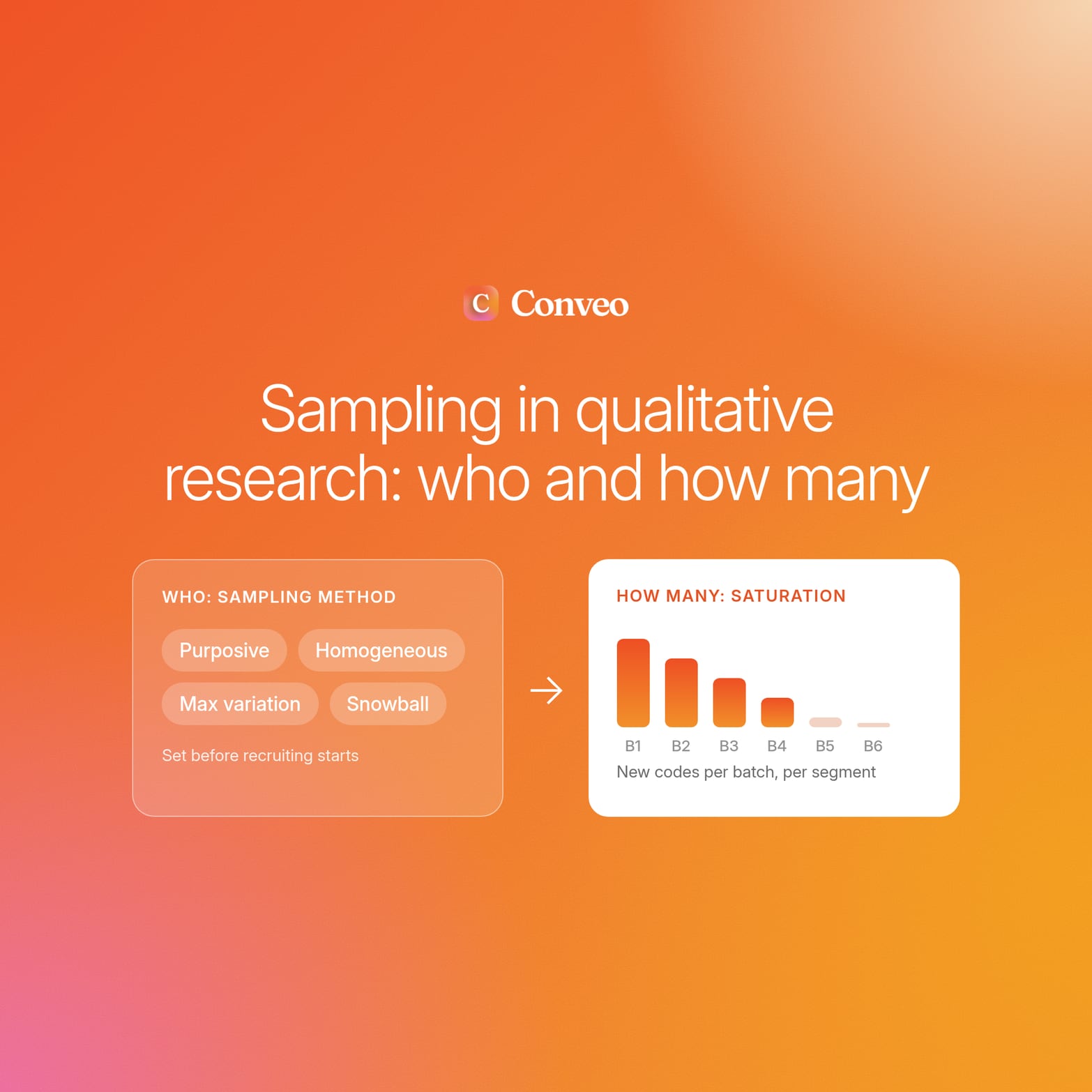
Most journey studies reach saturation at 5 to 15 participants per behaviorally distinct segment, if you define segments before recruitment against real customer needs. Ten participants who all switched channels mid-purchase tell you more than 200 mixed ones.
How often should you update a customer journey map?
Faster than most research cycles allow. A map built six months ago may describe a customer who has moved on. Teams running wave-based programs, for example every two weeks or monthly per market, report their maps stay current because new evidence connects to prior findings.
How do you get honest feedback about where a journey broke down?
Participants tend to be more candid when they are not sitting across from a human moderator, and teams report the resulting customer feedback runs noticeably deeper than what a live interview usually surfaces. That matters here, because the friction under discussion is often the brand's own checkout or support.
What research methods work best for understanding the ecommerce customer journey?
Structured questions establish the pattern; qualitative probing explains it. Pair closed questions that size the behavior with AI-moderated probing that follows the participant's experience, so the number and the reason come from one session.
How do you identify friction points in an omnichannel journey?
Friction rarely shows in quantitative data until it has cost conversion. Participants describe these pain points earlier in the buying process than any dashboard does: confusion at checkout, a hesitation signaling unmet expectations, a workaround they never mentioned. Ask them to narrate the sequence, then probe every channel change.

About the author
Dieter De Mesmaeker
Co-Founder & CEO
Dieter is CEO and co-founder of Conveo. Before starting the company, he founded DataCamp and scaled it into one of the leading edtech platforms in the world.
More by Dieter →Qualitative insights at the speed of your business.
Conveo runs AI-moderated video interviews and structures everything they say.