
TL;DR
Best for teams choosing between methods: Content analysis and thematic analysis are not interchangeable, and knowing the key differences up front saves weeks of rework. Content analysis applies predetermined categories to count how often something occurs. Thematic analysis identifies recurring patterns across responses without locking in codes upfront.
Best for prevalence monitoring: Use content analysis when tracking known categories at scale: brand attribute mentions, VoC complaint types, sentiment distribution across a defined taxonomy. The output is countable and comparable across waves.
Best for exploratory discovery: Use thematic analysis when the goal is to understand meaning, not to measure frequency. Concept testing, early-stage positioning research, and in-home usage studies typically call for thematic approaches because the most important finding is often one you did not anticipate.
The workflow reality most teams underestimate: After roughly 20 interviews, teams are looking at 300 or more pages of raw data. In practice, manual coding before any finding reaches a stakeholder takes two to three weeks. That timeline breaks most in-flight decisions.
The resolution: AI-assisted first-pass coding surfaces recurring patterns before manual tagging begins. Researcher effort shifts from tagging every line to validating and interpreting what the platform has already organized, which is where research judgment actually matters.
Who this article is for: Research operations managers, CMI teams, and insights leads deciding how to structure qualitative data analysis workflows across multiple studies and teams.
Qualitative research is in the middle of a structural shift. Teams that once treated qual as a slow, small-sample complement to surveys now run hundreds of video conversations in parallel, surfacing patterns across markets in days and delivering stakeholder-ready evidence before the decision window closes.
But that potential breaks down at the point of analysis. Choosing between content analysis and thematic analysis is one of those qualitative analysis decisions researchers make quickly and regret slowly. The choice looks methodological on the surface, but it's really a question of research intent: what kind of answer does your stakeholder need, and what kind of evidence will they trust? Get it wrong before a single interview is coded, and the analysis produces research findings that cannot be aggregated, defended, or acted on.
The most visible symptom is intercoder disagreement. Two analysts review the same excerpt and one labels it "price concern" while the other calls it "value perception." Both are defensible in isolation, but when those labels roll up into a finding that informs a pricing decision, the inconsistency makes the data unusable.
Scale makes it worse. Manual coding in Word or spreadsheets is manageable at 10 interviews; at 20, it starts to strain. Beyond that, teams either shrink the sample or accept a multi-week synthesis cycle that runs past the decision window it was meant to inform. It's a workflow problem that starts with an unclear analytical approach to qualitative data analysis.
This article gives research teams a practical decision framework for choosing between content analysis and thematic analysis based on research intent, data type, and business use case, not just definitions.
What Is Qualitative Content Analysis?
Content analysis is a deductive research method, and one of the more systematic approaches available for qualitative content analysis. Researchers begin with a fixed set of categories, then systematically apply those categories to textual data or transcripts to classify and count how often each one appears. The starting point is always the codebook: a predetermined framework built from theory, prior research, or specific business objectives, developed before a single transcript is read.
The workflow follows a consistent sequence:
Define the codebook. Categories are set before analysis begins and are built from theory, prior research, or business objectives.
Apply each code. Coders work through transcripts or recordings, tagging content against the fixed categories.
Count frequency. Each code's occurrence is tallied across the dataset.
Report prevalence. Results are broken out by segment, market, or time period.
Because it counts and categorizes rather than interprets, content analysis borrows some of the quantitative nature of statistical analysis: it produces frequencies and cross-tabs that sit closer to descriptive statistics than to open-ended qualitative interpretation. The output is structured and comparable across waves, making content analysis well-suited to studies that need to track the same variables over time.
The core questions content analysis answers are: "How often does X appear?" and "Which categories dominate across the entire data set?" Those are precise, useful questions in the right context. Brand tracking studies are a strong example. If a research team is monitoring how customers describe a brand across quarterly waves, content analysis lets them measure whether mentions of "quality," "price," or "service" are increasing or declining, and whether those shifts vary by segment. That kind of structured, repeatable measurement is exactly what the method is built for, and it's one of the key characteristics that separates content analysis from other qualitative methods.
Where content analysis reaches its boundary is discovery. Because the codebook is fixed before analysis begins, the method counts what researchers already know to look for; it does not surface new patterns or reveal why participants feel a certain way.
Thematic analysis builds categories inductively from the data, while content analysis applies categories the researcher brings. Neither is superior in the abstract; they answer different questions, and understanding both thematic analysis and content analysis as complementary tools, rather than competing ones, is usually the better starting point.
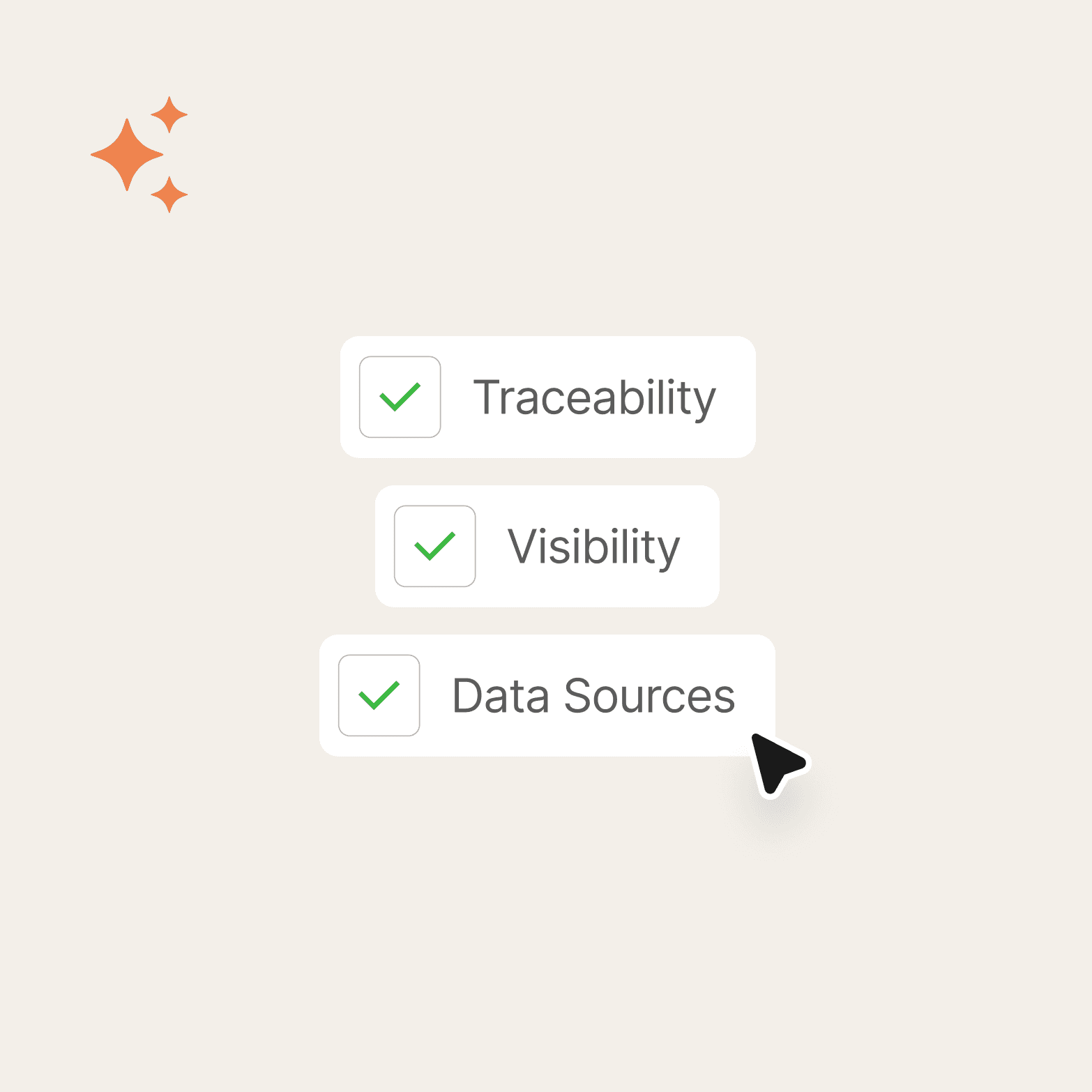
Traceability matters regardless of method. When a coded excerpt needs to be verified or shared with stakeholders, reconnecting it to the exact moment in the recording should not require manual detective work. Speaker labels and timestamps embedded in the data, with a source link from code to clip, remove that friction entirely.
What Is Thematic Analysis?
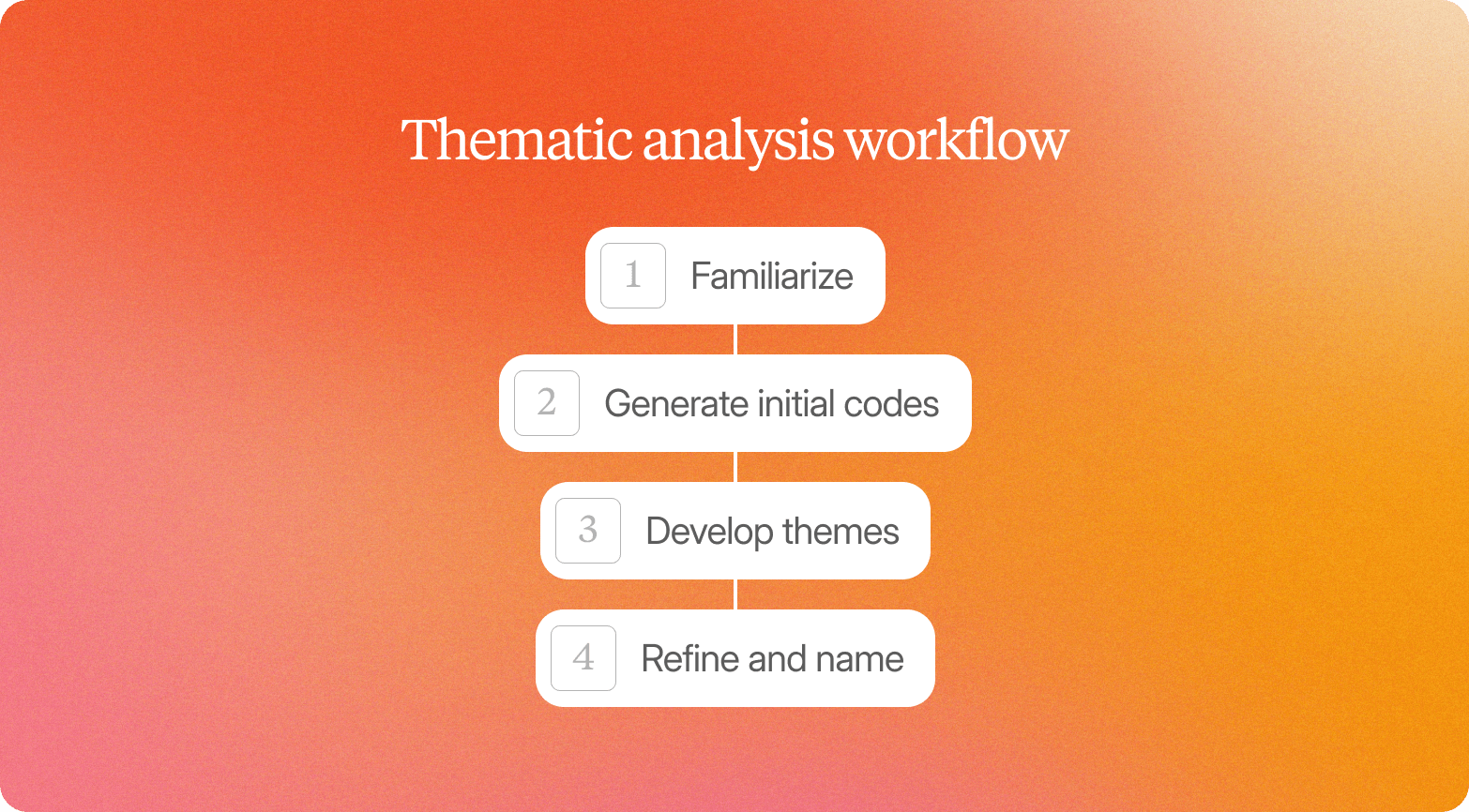
Thematic analysis is an inductive, foundational method for identifying recurring patterns in qualitative data, and it's the method most researchers reach for when they need to analyze it without a preset lens. Unlike deductive approaches that apply a predetermined framework to the material, thematic analysis lets the themes emerge from the data itself, analytically examining narrative materials rather than sorting them into pre-built bins. This distinction matters in practice: content analysis typically counts the frequency of predefined categories, while thematic analysis builds meaning from what participants actually say, unprompted.
The workflow follows a deliberate sequence, and much of the data preparation happens up front:
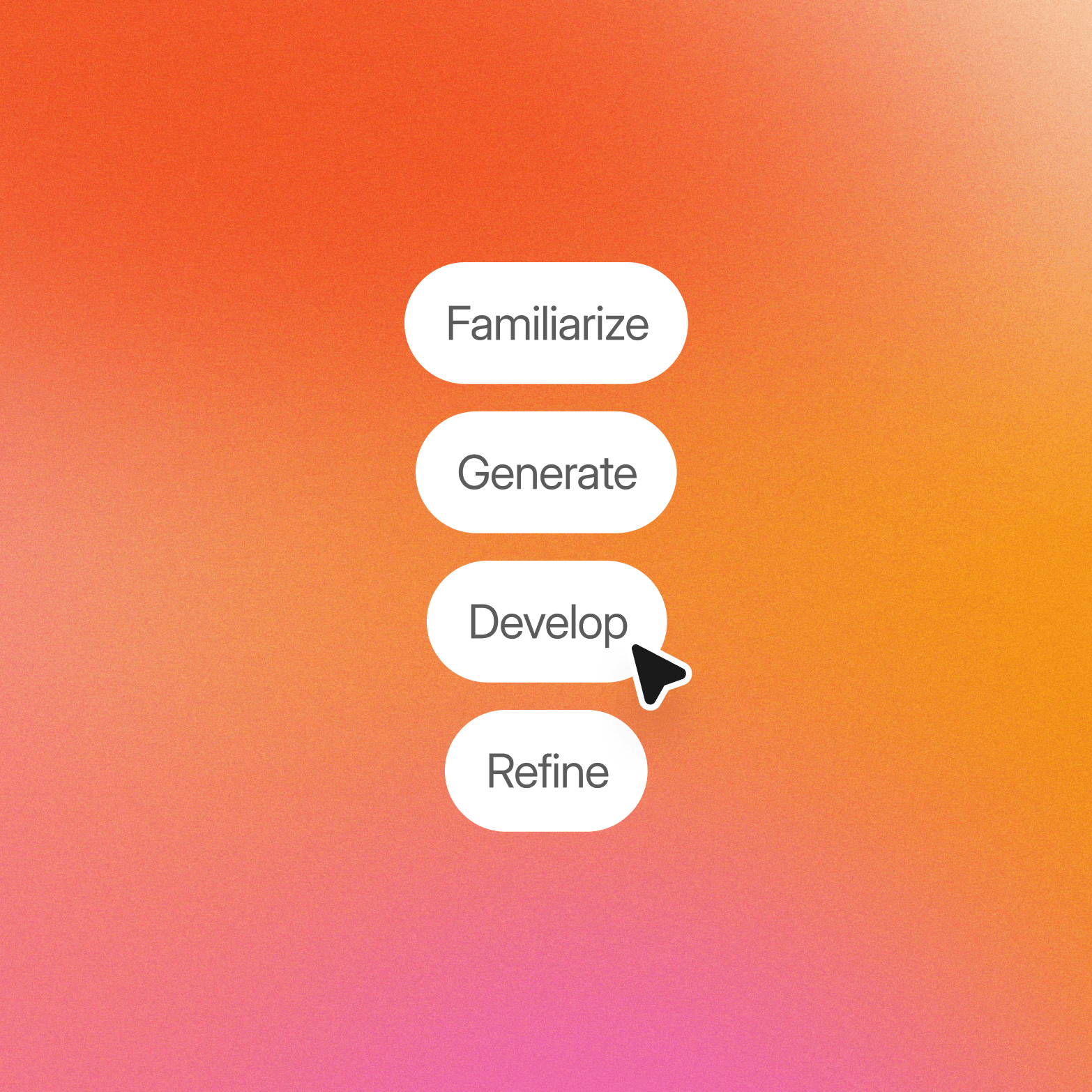
Familiarize. Researchers read transcripts or watch recordings multiple times before generating initial codes.
Generate initial codes. Codes emerge from the raw data itself, not from a preset list.
Develop themes. Codes are grouped into candidate themes and reviewed against the full dataset.
Refine and name. Themes are sharpened and named with enough precision to be defensible in a stakeholder presentation.
The codebook is not written before data collection. It develops through the analysis itself, which is what makes the method inductive and, for complex phenomena that resist a simple checklist, often the more honest choice thematic analysis focuses on.
The questions thematic analysis answers are specific: what patterns emerge across participants, and what is the underlying meaning behind them in context? Analysts work to identify patterns and name key themes with sufficient precision for a stakeholder to act on them.
A concept testing study is a clear example. When researchers explore how consumers interpret a new product idea, thematic analysis surfaces the associations participants reach for unprompted: the comparisons they make, the hesitations they voice, the language they use before they know what language the brand wants them to use, and even the culture they're drawing on to make sense of something new. That unfiltered signal is often more useful than any prompted response, and it's where researcher interpretation, not just coding rules, does the real work.
Rigor in thematic analysis is not optional. Credible analysis requires negative case analysis: actively searching for participants who contradict the dominant theme, rather than building a narrative from responses that confirm it. Elevating a pattern to a theme because two participants expressed it is a methodological failure, not a finding; patterns become defensible when they hold across eight to ten participants with meaningful variation. This is also where thematic analysis draws on existing theories and prior theory development in the field, rather than inventing interpretive standards from scratch each time.
Video adds a layer of interpretation that transcripts cannot provide, which is part of why thematic analysis focuses on more than just what people say. A participant who says "the price is fine" while pausing, looking away, or tightening their expression is not saying the price is fine. Reading that hesitation means researchers must evaluate language and tone together to interpret patterns accurately; that hesitation changes how the theme is coded and how confidently it can be reported.
Content Analysis vs Thematic Analysis: Key Differences
Most guides stop at definitions and never explain how to build a defensible codebook or when manual coding becomes unmanageable. The table below addresses both gaps directly, laying out the key differences between content analysis and thematic analysis in practice, not in theory.
Content Analysis vs. Thematic Analysis: Six Dimensions That Actually Affect How You Work
Dimension | Content Analysis | Thematic Analysis |
Research question fit | Monitoring prevalence of known categories across a dataset | Exploring meaning and discovering emergent patterns from participant language |
Coding approach | Deductive: apply predetermined codes built before data collection | Inductive: codes emerge from the data as the analyst reads and re-reads transcripts |
Codebook structure | Fixed before analysis begins; codes are defined, exemplified, and locked | Iteratively developed during analysis; codes evolve as understanding deepens |
Sample size tolerance | Manageable up to roughly 20 interviews with manual coding before volume overwhelms the process | Same threshold, but requires deeper familiarization per transcript, making the ceiling feel lower in practice |
Output format | Frequency counts and prevalence by segment, often presented as percentages or cross-tabs | Narrative themes supported by representative quotes and, where video is available, timestamped evidence |
When manual coding becomes unmanageable | Beyond 15 to 20 interviews (300+ pages of transcripts), teams are forced to shrink samples or accept two-to-three-week analysis cycles | Same breaking point, but the interpretive depth required per transcript makes the burden heavier per document |
The choice between content analysis and thematic analysis determines the entire shape of your analysis workflow, from how you build your codebook to how long synthesis realistically takes. Most teams don't choose thematic or content analysis in a vacuum; the broader context of the research question and how the findings will be used downstream should drive the decision.
The Traceability Problem Most Teams Discover Too Late
Both methods share a structural vulnerability: what happens when two analysts label the same excerpt differently. In content analysis, disagreement on a predetermined code undermines the frequency counts that give the method its credibility. In thematic analysis, divergent coding creates competing interpretations that can't be aggregated. Either way, the findings become impossible to defend to stakeholders who demand audit trails. The problem isn't that analysts disagree; it's that there's no structured mechanism to surface and resolve those disagreements before the analysis is presented.
Where AI-Assisted Coding Changes the Dynamic
The resolution is not to add a second coder and hope for consensus. It's changing the point at which pattern recognition happens. AI-assisted first-pass coding surfaces recurring patterns across all sessions before an analyst opens a single document, identifying which excerpts cluster together and which codes are applied inconsistently. That shifts the analyst's role from tagging transcripts one by one to validating patterns already visible across the full dataset. The work becomes more rigorous, not less, because human judgment is applied where it has the most leverage, and the platform's search functionality allows an analyst to pull every instance of a theme across hundreds of sessions in seconds, rather than manually scrolling through raw data.
"The AI doesn't just summarize, it surfaces patterns I wouldn't have spotted reading transcripts"
— CMI Lead, Edgard & Cooper
Worked Example: The Same Dataset, Two Coding Approaches
A Content Analysis Versus Thematic Analysis Example: Same Data Analysis Different Decisions
In a representative scenario, a CPG brand conducts 15 video interviews to explore consumer reactions to a new packaging design. The recordings are rich: participants hold the pack, comment on its look, and talk through their purchase thinking in real time, generating visual data that a text transcript alone can't fully capture. What the team does next with that data, and how carefully they approach analyzing data rather than just collecting it, determines whether they walk away with a frequency count or a business decision.
The content analysis approach starts with a predetermined codebook: Visual Appeal, Sustainability Perception, Price Perception, Brand Fit, Purchase Intent. Analysts apply those codes to transcripts and count occurrences. The output reads clearly: visual appeal mentioned by 12 of 15 participants (80%), sustainability by 9 of 15 (60%), price by 6 of 15 (40%). The report leads with "visual appeal dominates consumer response, followed by sustainability concerns."
Content analysis delivered a defensible frequency summary in five days, including codebook development, transcript coding, and count verification. For a stakeholder who needs to know which topics appear frequently, that output is useful. But it doesn't tell the brand team whether to proceed with the packaging, nor does it transform qualitative data into a decision on its own.
The thematic analysis approach starts differently. Analysts spend time with the actual recordings before touching a codebook. Initial codes emerge from what participants say and how they say it, without predetermined categories shaping what gets noticed. Three themes develop through iterative review, and together they draw conclusions the count alone couldn't reach:
"Premium signals create hesitation." The sleek new design reads as expensive, and participants who like the look still pull back at the shelf because they assume the price has risen.
"Sustainability as table stakes." Nine participants mention it, but none describe it as a reason to choose. It is expected, not motivating.
"Disconnect between brand heritage and modern aesthetic." Older, loyal consumers feel the redesign belongs to a different brand, and their language carries a quiet sense of loss rather than excitement.
These overarching categories, not the raw mention counts, are what themes represent when the analysis is done well.
Thematic analysis took 10 days: familiarization with recordings, iterative theme development, and deliberate review of cases that did not fit the emerging patterns. The report presents three themes, with supporting video clips and verbatim quotes that convey hesitation, contradiction, and emotional context that the transcript alone would flatten.
Here is where the video format becomes decisive. Content analysis coded a participant's statement, "the price is fine," as neutral-to-positive sentiment. But the recording shows a pause, a slight frown, and a tone the team described as reluctant acceptance rather than genuine comfort. Certain words carried different weight depending on how they were delivered, and, read on the page alone, such words would have been coded as simple agreement.
Thematic analysis, working from the full video session, captures that hesitation as part of the "premium signals create hesitation" theme. Content analysis, working from the transcript, misses it entirely.
The contrast in outputs is direct: content analysis tells you what was mentioned and how often. Thematic analysis tells you what it means and why it matters for the packaging decision. One output supports a frequency report; the other supports a go-or-no-go conversation with the innovation team and delivers the kind of new insights that a count alone can't produce.
In practice, teams rarely have 10 days to spare for full thematic analysis when a launch timeline is pressing. Conveo, a video-first AI research platform, surfaces both frequency patterns and emergent themes in the first analytical pass, including tonal and behavioral signals from video that transcripts would miss. Analysts validate and refine rather than generating everything from scratch, compressing the timeline without collapsing interpretive rigor.
When to Use Content Analysis
Content analysis belongs in your research workflow when the question is quantitative rather than interpretive: not "what does this mean to customers?" but "how often does this appear, and where?" It fits best when your codebook is already stable, and your goal is to track prevalence over time, across segments, or at touchpoints. Four business scenarios where this plays out consistently:
Brand tracking studies monitoring how often specific attributes, such as "trustworthy," "premium," or "innovative," appear across quarterly interview waves
Voice of customer programs categorizing support tickets, post-purchase feedback, or NPS verbatims by issue type to identify volume shifts over time
Competitive analysis counting feature mentions, sentiment tags, or brand associations across app store reviews or third-party research panels
Regulatory and compliance research requiring systematic, auditable classification of communication content against defined criteria
The limitation is equally real. Content analysis cannot discover new patterns or explain why participants feel a certain way. If a new complaint category is emerging in your data, it will miss it unless someone already thought to add it to the codebook.
There is also a traceability problem that compounds in enterprise settings. Static slide-deck reporting severs the link between a coded category and the conversation that produced it, so stakeholders hesitate to act on the finding.
Conveo addresses this directly. Every coded category ties back to the original video clip and verbatim quote, so stakeholders can audit the evidence rather than accept a summary.
When to Use Thematic Analysis
Thematic analysis earns its place when the research question is fundamentally interpretive. If your team needs to explore what something means to a participant rather than count how often it appears, thematic analysis is the right framework, and often the more natural choice than a fixed count. The same applies when findings need to hold up under stakeholder scrutiny: not "most participants mentioned price" but "here is what price sensitivity actually signals about their decision-making."
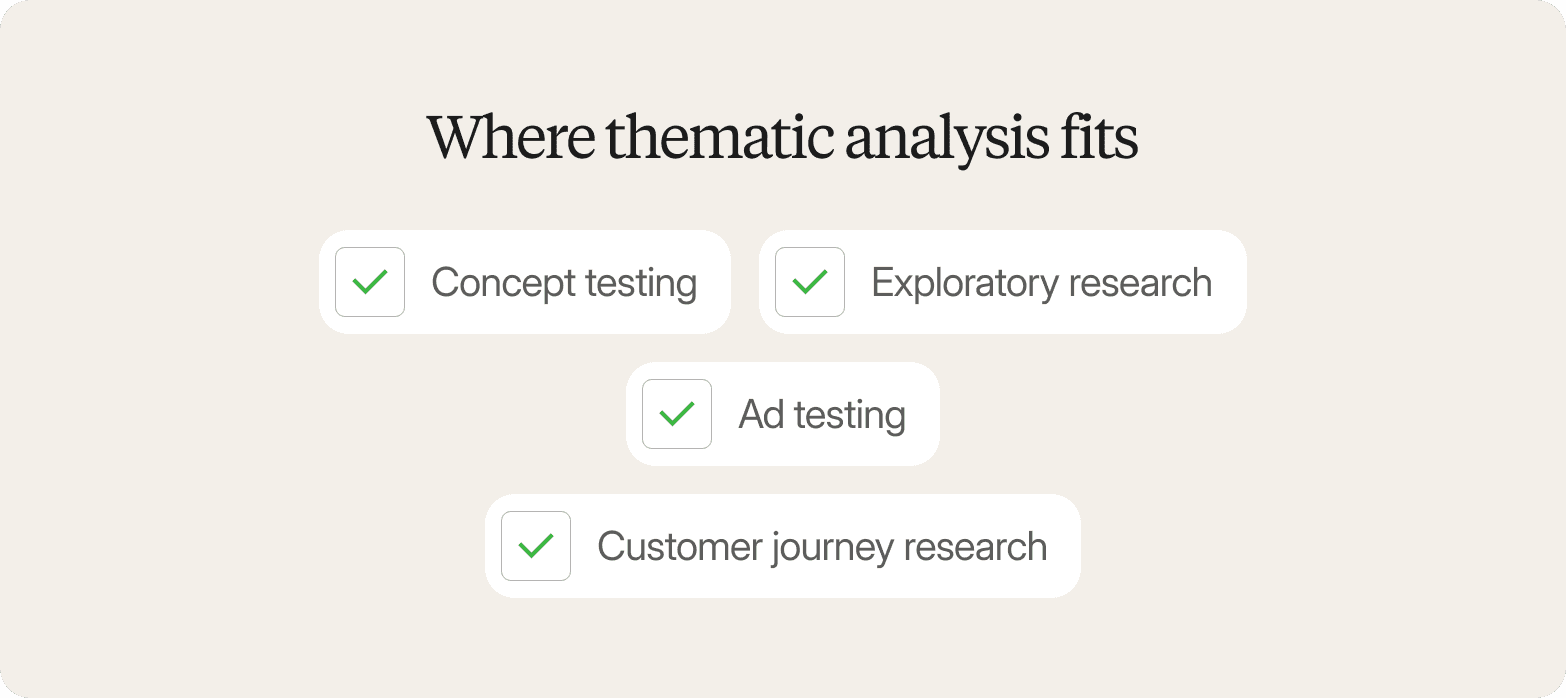
Four business scenarios where thematic analysis fits particularly well:
Concept testing. When consumers encounter a new product idea, their interpretation matters as much as their preference. Thematic analysis surfaces how they construct meaning from the concept, not whether they like it.
Exploratory research. Identifying unmet needs or unarticulated pain points requires following the data where it leads. Thematic analysis accommodates emergent findings that a predefined coding scheme would miss.
Ad testing. Emotional responses and message takeaways are rarely literal. Thematic analysis reveals the underlying associations a campaign triggers, which is where the real creative risk lives.
Customer journey research. Experience themes rarely align with the stages your team mapped out in advance. Thematic analysis identifies the patterns that structure the journey from the participant's perspective, often by pulling personal stories from what would otherwise look like a routine feedback log.
One rigor requirement separates credible thematic analysis from pattern-matching: negative case analysis. Actively seeking participants whose responses contradict the dominant theme prevents overstating findings and protects credibility when stakeholders push back. Skipping this step is where many AI-assisted analyses introduce systematic bias.
Compared to approaches built around predefined categories, thematic analysis requires deeper familiarization, iterative theme development, and explicit validation, which takes longer but produces insight that explains behavior rather than just describing it. Video familiarization further sharpens that process: a participant's hesitation before answering a pricing question, or a shift in tone when a competitor is mentioned, carries interpretive weight that a transcript strips away.
Conveo's AI-assisted first-pass coding changes the economics of thematic analysis without compromising its rigor. Recurring patterns surface across sessions before an analyst opens a single document, shifting effort from initial tagging to validation and refinement, and compressing multi-week analysis cycles to days.
Can You Combine Content Analysis and Thematic Analysis?
Yes, teams can combine both methods, and in practice, the hybrid approach often produces stronger evidence than either method alone. Thematic analysis handles discovery. Content analysis handles measurement. Used in sequence, they answer both "what do customers think?" and "how widely does each theme appear across our markets?" and allow a team to analyze qualitative data from multiple angles without running two separate studies.
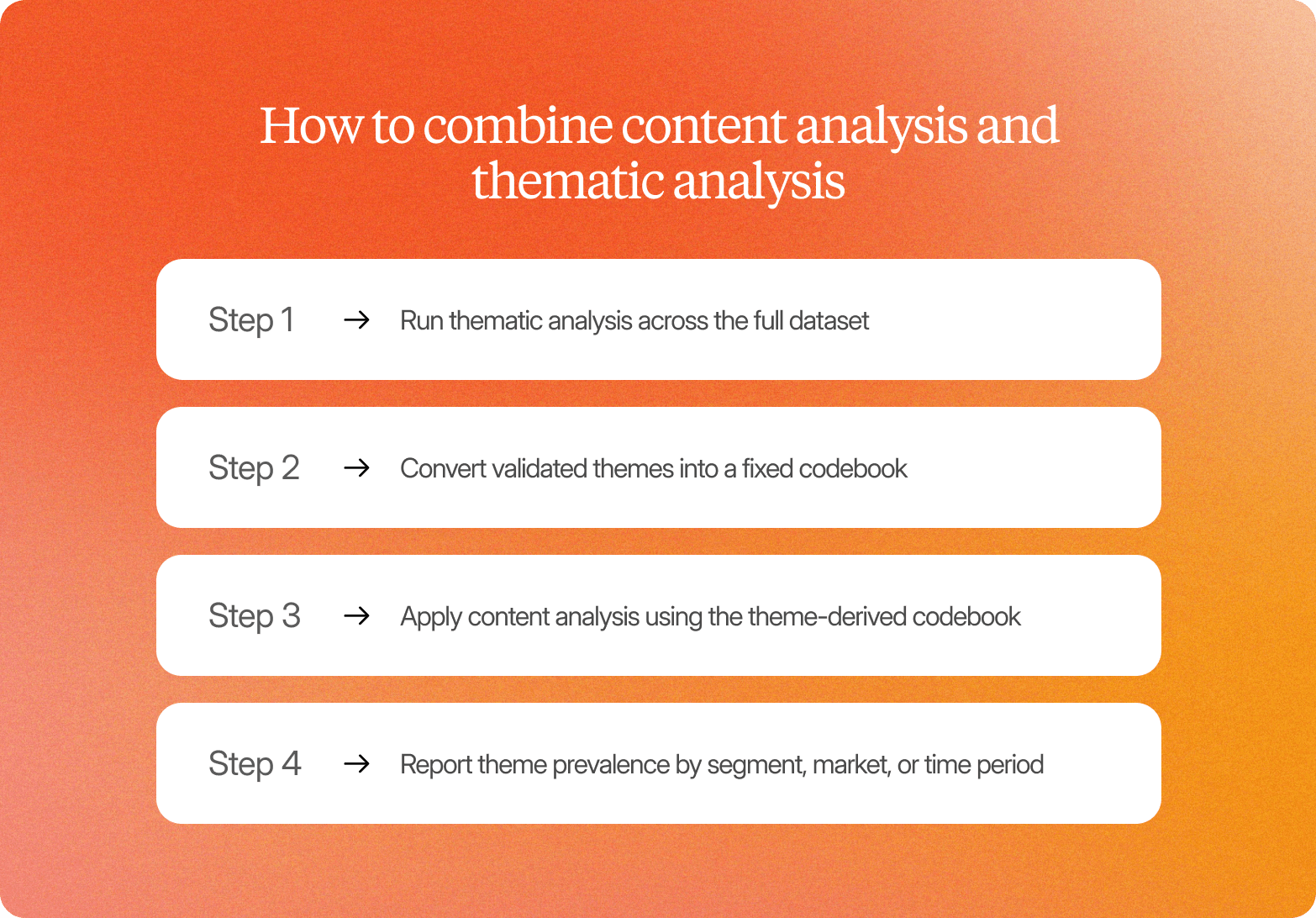
The hybrid workflow follows four steps:
Run thematic analysis across the full dataset. Researchers read through transcripts without a fixed codebook, allowing patterns to emerge from the data. The goal is to identify emergent themes, not to count them.
Convert validated themes into a fixed codebook. Once themes are confirmed, each one becomes a discrete code with a clear definition. This is the bridge between the two methods, and it's where thematic analysis and content analysis actually meet.
Apply content analysis using the theme-derived codebook. Coders systematically work through all transcripts, marking where each theme appears. This pass is structured and replicable.
Report theme prevalence by segment, market, or time period. The output is quantified: not "sustainability skepticism exists" but "sustainability skepticism appears in 65% of European interviews and 20% of US interviews."
In a representative scenario, a global CPG brand conducts exploratory interviews in three markets and uses thematic analysis to surface four packaging concerns: sustainability skepticism, premium perception misalignment, shelf visibility concerns, and portion size confusion. Those four themes serve as a codebook. The team then applies content analysis to 50 additional interviews across six markets, producing prevalence data by region. The result is a finding that can go directly into a regional strategy brief, not a synthesis deck.
The hybrid approach fits when teams need both discovery and prevalence: when you don't yet know which themes matter, but once you do, you need to know how much they matter across different populations. The constraint has always been time, since running both methods in sequence historically doubled the synthesis timeline.
Conveo changes that calculation. Once a theme-derived codebook exists, Conveo can apply it across hundreds of transcripts in hours rather than days, completing the content analysis pass without a second round of manual coding.
5 Common Mistakes When Choosing Between Content Analysis and Thematic Analysis
Researchers often default to whichever method feels familiar, rather than the one that fits the research question. That mismatch produces findings that look rigorous but don't actually answer what the business needed to know.
Applying a fixed codebook when the question requires exploration.
A team conducts concept-testing interviews and codes responses against a predetermined framework developed for a prior study. The codebook captures what they expected to find but misses the emergent signal: participants repeatedly reference a competitor's failed product launch when describing their hesitation. Because that association wasn't in the codebook, it never surfaces.
Using thematic analysis when the question requires prevalence monitoring.
A VoC team tasked with tracking support ticket sentiment spends three weeks developing an inductive theme structure. The result is rich, but it can't be compared to last quarter's data because the themes shifted. A fixed codebook would have delivered faster, comparable outputs without sacrificing the tracking function the business needed.
Skipping codebook alignment between analysts.
Without a shared, clearly defined codebook, two analysts reviewing the same excerpt will label it differently: "price concern" versus "value perception." Both are defensible in isolation, but together they make the dataset impossible to aggregate or present to a skeptical stakeholder.
Ignoring the sample size threshold for manual coding.
Manual coding becomes unmanageable beyond roughly 15 to 20 interviews. Teams either shrink the sample or accept multi-week analysis cycles that outlast the decision window the research was meant to inform.
Reporting themes without traceability.
Thematic findings that can't be tied to verbatim quotes and specific moments in the data are easy to challenge. Stakeholders who weren't in the room will hesitate to act on a theme they can't audit.
Conveo keeps the analyst in control of the judgment calls that matter: splitting or collapsing themes, removing false positives, and deciding when a pattern is strong enough to report. Every theme it surfaces links directly to video clips and verbatim quotes, so stakeholders can follow the evidence from the finding back to the original conversation rather than taking the analyst's word for it.
How AI-Assisted Coding Changes the Content Analysis vs Thematic Analysis Decision
The traditional choice between content analysis and thematic analysis appears to be a methodological decision. In practice, it is often a capacity decision: after roughly 20 interviews, a team is sitting on 300 or more pages of transcripts, and manual coding takes two to three weeks before a single finding reaches a stakeholder. By then, the decision it was meant to inform has often already been made.
Conveo changes where that effort goes. Analysts receive a first-pass coding layer across all sessions before opening a single document, whether they're applying a fixed codebook or building themes inductively. The job shifts from tagging to validation: reviewing what's been flagged and applying judgment to what the data actually means.
How Conveo Connects Content Analysis and Thematic Analysis to Faster, Defensible Findings
The decision between content analysis and thematic analysis should be driven by the research question, not by how many transcripts an analyst can realistically code before the decision window closes.
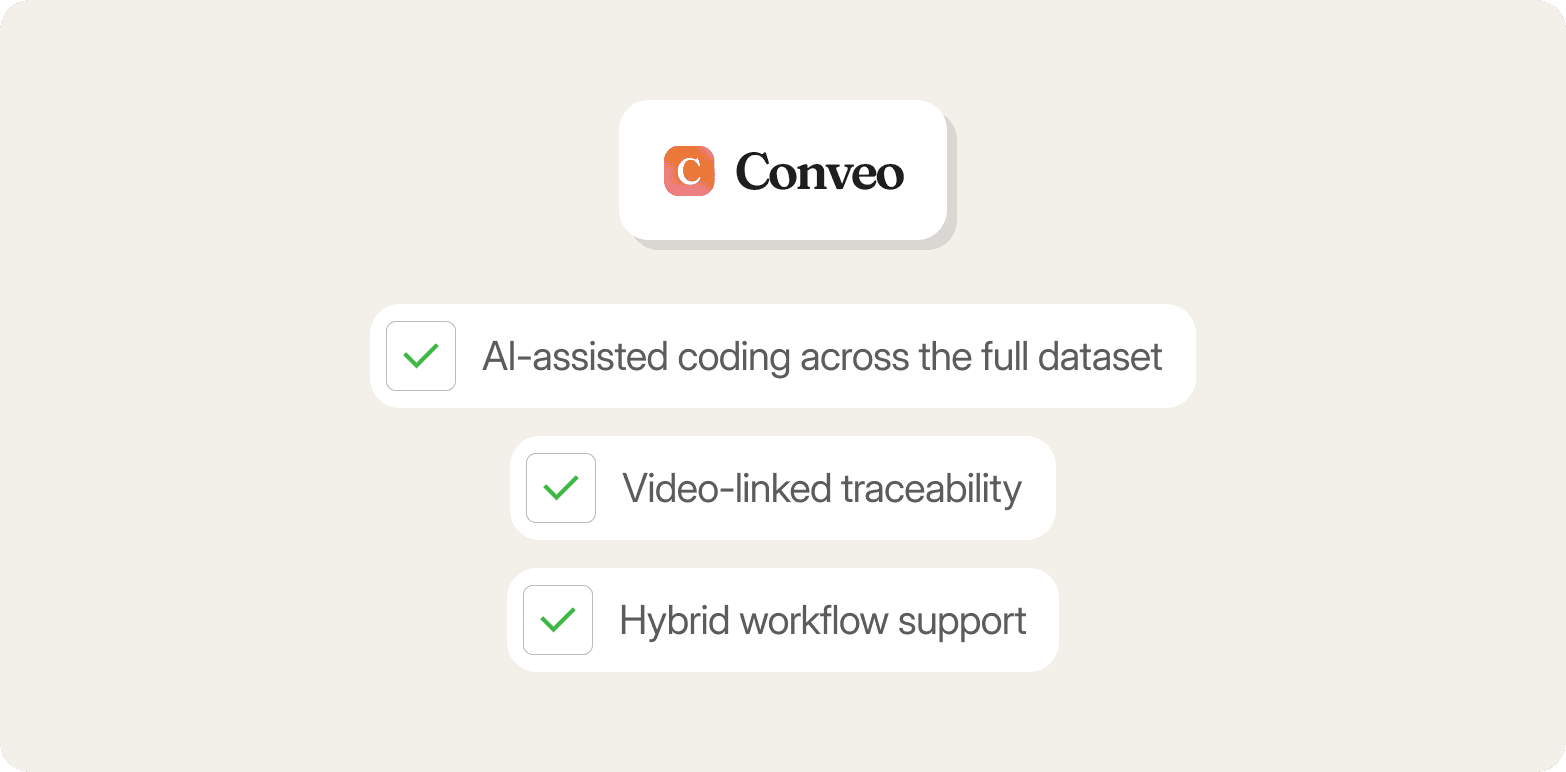
Three Conveo capabilities matter most here:
AI-assisted coding across the full dataset. Recurring patterns surface before manual tagging begins, whether you're applying a fixed codebook or building one inductively.
Video-linked traceability. Every coded excerpt ties back to the exact moment in the original recording, so stakeholders can audit the evidence rather than accept a summary.
Hybrid workflow support. Teams can run thematic analysis for discovery, convert validated themes into a codebook, and apply content analysis across additional sessions within a single project timeline.
Frequently Asked Questions
What is the main difference between content analysis and thematic analysis?
When should I use content analysis instead of thematic analysis?
Can you combine content analysis and thematic analysis in one study?
How many interviews can you realistically code manually?
What is negative case analysis and why does it matter?