
TL;DR
These are the key takeaways on transferability in qualitative research:
Transferability is the degree to which research findings from one study context can reasonably inform decisions in another research context, such as a different market, segment, or time period, and it's a core marker of research trustworthiness and relevance.
It breaks down in practice because most teams don't document the conditions of their research process (participant profiles, cultural context, boundary conditions) that enabled their findings to apply beyond the original setting.
Detailed descriptions, known as thick description, are the primary mechanism: a detailed account of sampling logic, participant characteristics, interview conditions, and study boundaries.
Transferability operates across three dimensions: applicability (does the research context match?), resonance (do the qualitative insights feel true here?), and theoretical engagement (do they connect to broader theoretical frameworks?).
A four-step assessment framework (compare participants, evaluate context, assess evidence depth, identify boundary conditions) provides teams with a repeatable way to determine whether findings from a single study generalize to other contexts.
Structured, searchable research infrastructure turns transferability from a one-off judgment into a compounding organizational capability with real-world applications across future research.
Most insights teams still operate as if every study is an island: research findings live in slide decks, and the conditions of the research process that made a study valid never make it into the final report.
The cost shows up in a recurring failure. A stakeholder asks "does this apply to our German market?" and the answer is a scramble through old files rather than a confident, traceable response. That credibility gap is a transferability problem, and it's exactly why transferability matters to any qualitative researcher trying to make research insights useful beyond a single study. Transferability in qualitative research refers to the degree to which research findings from one research context can reasonably inform decisions in another: a different geography, segment, or point in the purchase journey.
The timeline problem raises the stakes further. Traditional qualitative studies take roughly six weeks from brief to delivery. By the time findings arrive, the decision they were meant to inform has often already been made. Findings that might have been transferable with proper documentation instead get treated as stale, and the insights team spends more time defending the research than acting on it.
This article covers what transferability means, why it breaks down in practice, how to document research context, and what real-world applications look like across research programs.
What Is Transferability in Qualitative Research?
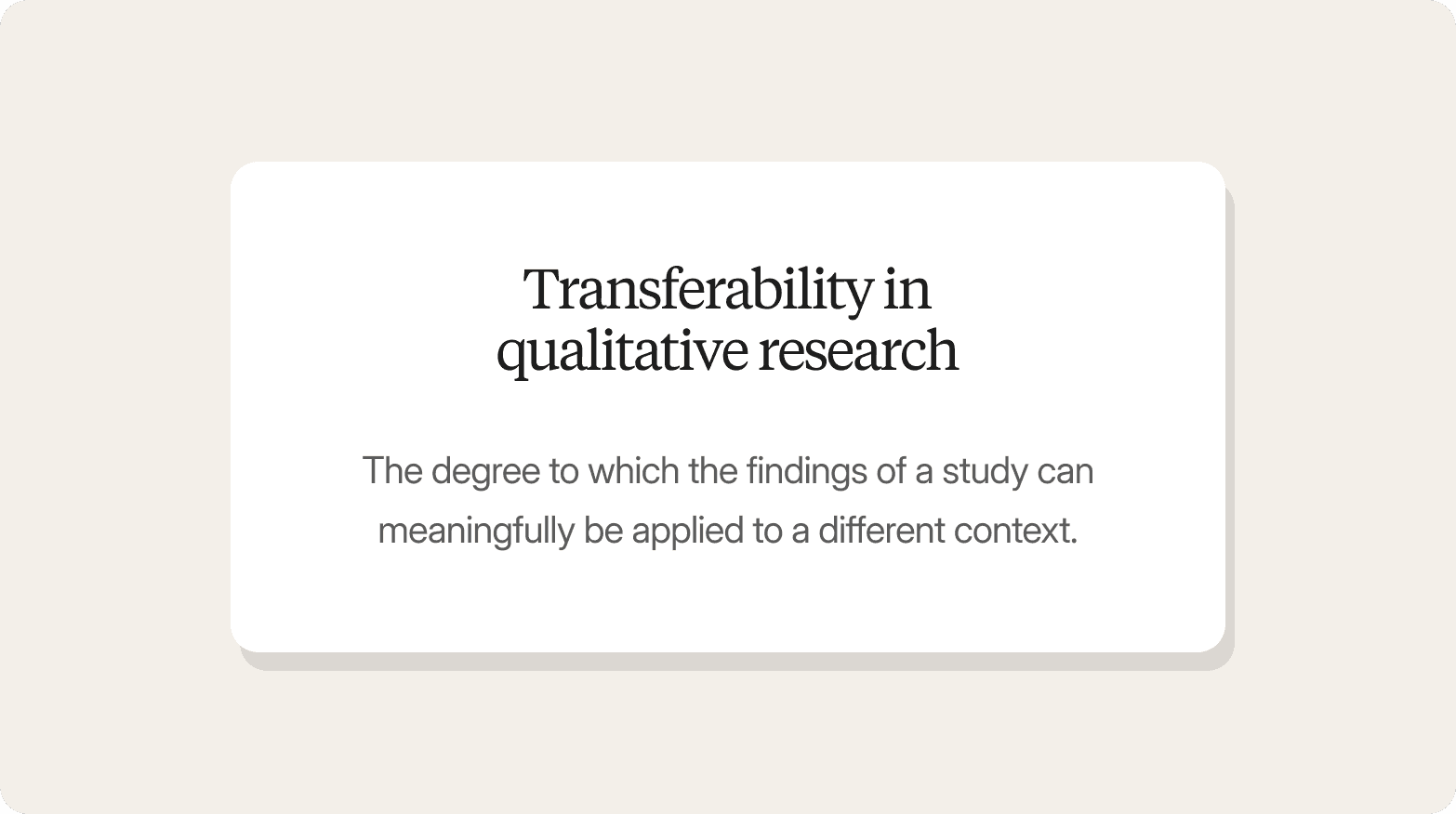
Transferability in qualitative research is the degree to which the findings of a study can meaningfully be applied to a different context. It's the qualitative equivalent of generalizability, but the logic works differently:
Quantitative studies rely on generalizability, often called external validity: a large, randomly sampled dataset supports claims about a population because the math holds.
Qualitative methods don't work that way. Sample sizes are small by design, and the goal is depth of understanding from the qualitative data collected, not distributional representation.
Neither approach claims universal applicability. No single study, qualitative or quantitative, can claim its findings apply everywhere; the question is always whether findings fit a specific context.
Instead of a researcher claiming findings apply broadly, the reader evaluates whether the research setting is similar enough to their own situation to make the study's findings relevant. A study on how UK Gen Z consumers talk about sustainability in food purchasing may transfer well to German Gen Z audiences with similar category involvement, but transfer poorly to US Boomer shoppers with different value systems and purchase drivers.
This is where Lincoln and Guba's trustworthiness framework is useful: transferability is one of four criteria proposed as qualitative alternatives to quantitative validity standards, alongside credibility, dependability, and confirmability. Transferability is the outward-facing criterion that governs how research findings apply and travel beyond the original study.
The qualitative researcher's job isn't to declare transferability. It's to document the research context (participant profiles, setting, time period, research conditions) with sufficient precision for a knowledge user to make an informed judgment about fit in other contexts. That documentation is called thick description, and it's the primary mechanism through which transferability is either enabled or foreclosed.
Why Transferability Breaks in Practice
Most qualitative research fails at transferability not because researchers make poor judgments, but because the conditions that would make transferability auditable are rarely built into the study from the start.
Discussion guides are written, participants are recruited, data are collected through interviews or focus groups, and findings are synthesized. What rarely gets documented with the same rigor:
Participant selection rationale: why this group, and not another
Contextual factors: the cultural and situational conditions that shaped responses
Boundary conditions: the limits on how far research findings apply
When those elements live in a moderator's head rather than in structured documentation, transferability becomes a judgment call rather than an evidence review. Researcher bias also compounds this gap: without a documented trail of decisions, it's hard for other researchers to distinguish a genuine pattern in the qualitative data from one shaped by how a session was run.
Consider a brand team that runs concept testing in the US and gets strong findings. Six months later, the same concept is being evaluated for launch in the UK and Germany. But the original study didn't document cultural context, framing assumptions, or the audience characteristics that shaped responses. There's no audit trail, so the team starts over rather than auditing the first study, spending budget and time on work that partially replicates what's already been done, instead of building on existing qualitative insights.
This is an infrastructure problem, not a competence problem. When study notes and researcher decisions are scattered across email threads and spreadsheets, transferability breaks at every handoff. A video-first AI research platform like Conveo addresses this by tying every finding to its source conversation from the start, so documentation of the research setting is built in rather than assembled after the fact.
Stakeholder trust compounds the problem, too: when findings can't be traced to specific conversations, stakeholders distrust the evidence chain rather than the researcher. Surveys don't resolve this either; they scale, but strip out the rich contextual details transferability requires. Knowing that 67% of UK respondents rated a concept favorably tells you nothing about why German respondents rated it differently, and it offers little in the way of research insights a team can act on with confidence.
The Role of Thick Description
Transferability doesn't rest on sample size. It rests on whether a reader can inspect a study's conditions closely enough to judge fit, and that depends on the quality of documentation, known as thick description: detailed descriptions of context, participant characteristics, setting, and researcher decisions surrounding a finding. Transparency helps readers do this work themselves rather than take a researcher's conclusions on faith, and it gives other researchers a sufficiently detailed account to replicate or extend the analysis.
Thick description should cover:
Sampling logic: why participants were selected, and what was deliberately excluded
Participant demographics and psychographics: role, industry, company stage, geography, prior experience
Interview setting and format: synchronous or asynchronous, platform, session length
Cultural and temporal context: market or social contexts and external events present during fieldwork
Boundary conditions: what the study wasn't designed to address
The difference between thin and thick documentation is substantive, not stylistic. Thin: "We interviewed 10 customers." Thick: "We interviewed 10 SaaS product managers at Series B startups in North America, recruited via LinkedIn, interviewed asynchronously over five days in March 2026."
Rich contextual details don't guarantee transferability; they enable the reader to judge whether their specific context matches closely enough to act on the findings. That judgment still requires the reader's own situational knowledge.
Two things help close that gap:
Member checking. Researchers confirm interpretations with participants, adding another layer of confidence to the analysis, though most teams still rely on direct observations and researcher judgment.
Default-on documentation. When a platform like Conveo automatically preserves timestamped video, participant metadata, and screener criteria alongside every interview, that documentation is captured by default rather than reconstructed after the fact, giving teams multiple perspectives on the same data collection without re-running a study.
Dimensions of Transferability
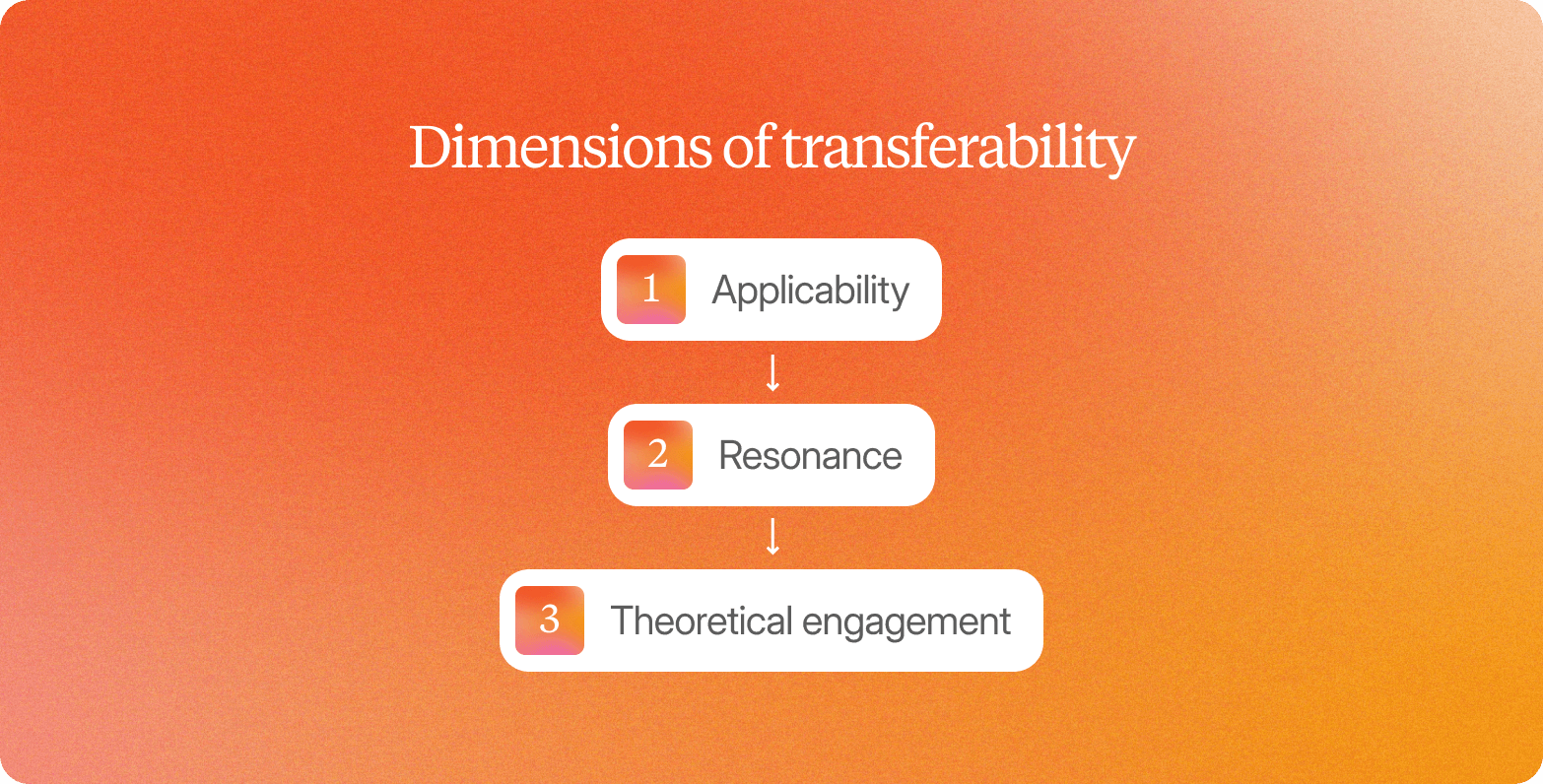
Transferability operates across three dimensions, each a lens rather than a gate, and each one a factor that can independently influence transferability.
Applicability compares the original study's participant characteristics, market conditions, and time period against the new setting. The closer those variables align, the stronger the case for direct application to other settings.
Resonance is the gut-check: do the qualitative insights align with what stakeholders already observe or suspect in the new context? Resonance doesn't confirm findings, but it signals shared underlying dynamics.
Theoretical engagement asks whether findings connect to established theoretical frameworks or patterns documented across industries, which gives them more weight when applied to new contexts and helps identify themes that recur across studies.
For example, a study of subscription fatigue among US streaming users may have high applicability to UK users (similar market maturity), moderate resonance (similar reported frustrations), and strong theoretical engagement (connects to broader "subscription overload" patterns). All three pointing in the same direction gives a grounded basis for acting rather than commissioning a new study, and it's a good illustration of how research findings apply differently depending on which factors are present.
How to Document Context for Transferability
Most qual studies fail on documentation, not rigor. Findings move into a deck, screener criteria get buried in email, and recordings sit in a folder no one can find six months later.
At the study level, documentation should capture participant screener criteria, recruitment method, market, date range, sample size, and inclusion or exclusion logic. At the session level, every recording should carry timestamps, and every verbatim quote used in data analysis should link back to its source clip. This kind of systematic data collection adds upfront effort to the research process but eliminates the need to re-run studies when transferability questions arise, and it's what turns a single study into a set of transferable insights the wider team can reuse.
Without a structured repository, cross-study comparison defaults to memory and manual search, so most teams either commission a new study or apply prior findings without checking. Conveo addresses this by tying every finding to timestamped video clips and verbatim quotes, and its searchable insight library lets teams pull prior evidence by market, participant profile, or theme without rebuilding from scratch, and to identify themes that already exist in the qualitative data.
For example, a team running concept testing in Q1 for the US market will later need to know whether the findings transfer to Germany. With a searchable insight library, they query prior German interviews, compare participant characteristics with the Q1 sample, and identify which themes hold and which are market-specific, making the decision to commission targeted rather than reflexive new research.
Transferability Across Markets and Segments
Multi-market research carries a hidden cost: non-comparability. When findings from Germany can't be confidently weighed against findings from the US because recruitment methods differed or context was inconsistently documented, research doesn't compound; it accumulates.
Transferability isn't primarily a translation problem. Underneath language barriers lie differences in cultural interpretation and inconsistent probing depth across moderators and markets. Three mechanisms keep multi-market research comparable:
Parallel, asynchronous delivery. When AI-moderated video interviews run simultaneously across markets, the research's structural conditions remain consistent, and comparable evidence arrives at the same time rather than sequentially.
Automated transcription and translation. Support across 20+ languages removes a step that typically adds days to multi-market timelines.
Adaptive AI probing. Follow-up questions based on what a participant actually said keep response depth comparable across markets.
In a representative scenario, a CPG brand conducted packaging research in the US and the UK simultaneously using asynchronous video interviews. US participants prioritized sustainability claims while UK participants prioritized ingredient transparency. Because both markets were documented systematically, the brand localized packaging without re-running the study, catching multi-market terminology issues before launch.
Transferability and Stakeholder Trust
Stakeholders challenge findings not because they distrust research, but because they can't trace a claim back to a specific conversation. Transferability requires confirmability: an unbroken chain from conclusion back to supporting data.
Traditional qual outputs make that chain hard to reconstruct. A summary deck with selected quotes tells stakeholders what the researcher concluded, not the moment a participant hesitated or the pattern that appeared across a dozen sessions. Timestamped video clips function as evidence in a way cherry-picked quotes can't.
For example, a product team presenting a US usability study to justify changes to the European roadmap might face the question: "How do we know this applies to Europe?" If the team can pull up timestamped clips showing similar friction from prior UK and German studies, the debate will close in minutes. Platforms built on avatar-based or synthetic participants can't offer this: there's no real conversation to return to.
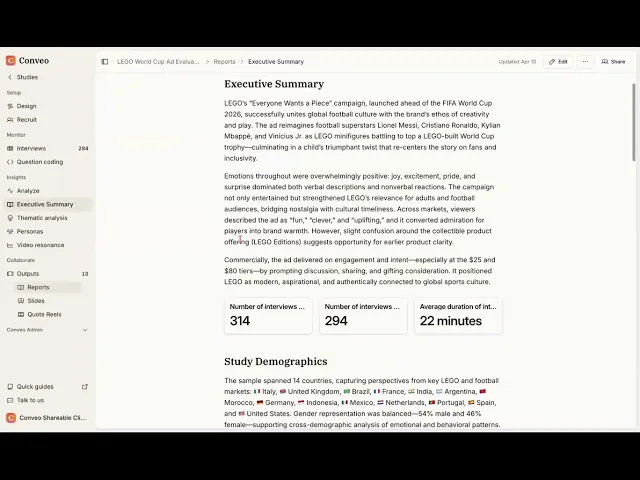
Watch the walkthrough: How Conveo Reports Are Built for Decision Makers →
4 Common Transferability Mistakes
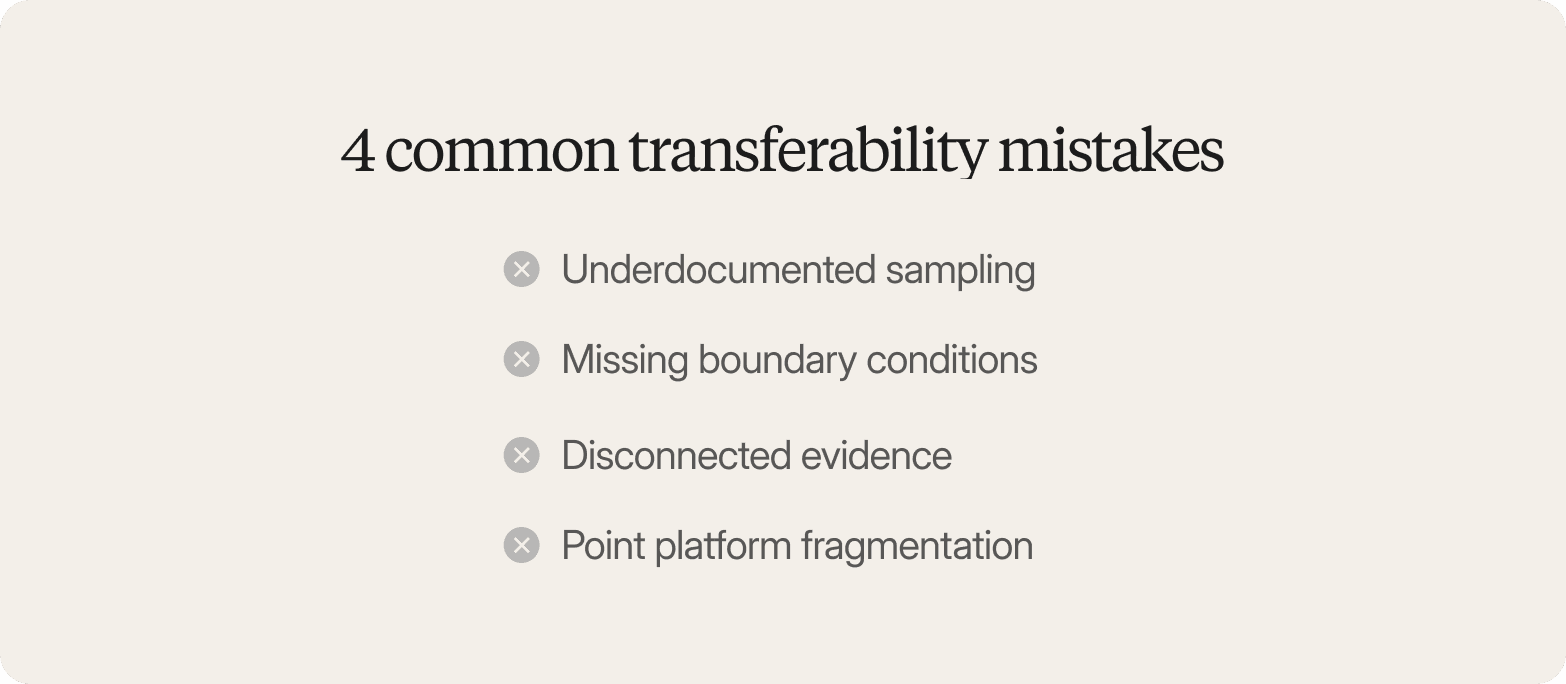
Four patterns consistently break transferability before stakeholders get a chance to apply findings to their own specific circumstances:
Underdocumented sampling. When sampling decisions aren't recorded, readers can't judge whether the participant group matches their specific context.
Missing boundary conditions. Without explicit statements about where findings don't apply, they get stretched into similar contexts they were never meant to address, undermining external validity claims down the line.
Disconnected evidence. Findings summarized without links to source material create a credibility gap; every theme should connect back to the observations that produced it.
Point platform fragmentation. Stitching together separate tools for recruitment, interviewing, transcription, and analysis opens documentation gaps at every handoff. Conveo's end-to-end workflow keeps documentation intact throughout the research cycle, so future research can build on what's already been learned rather than member-checking every prior study from scratch.
Transferability Assessment Framework
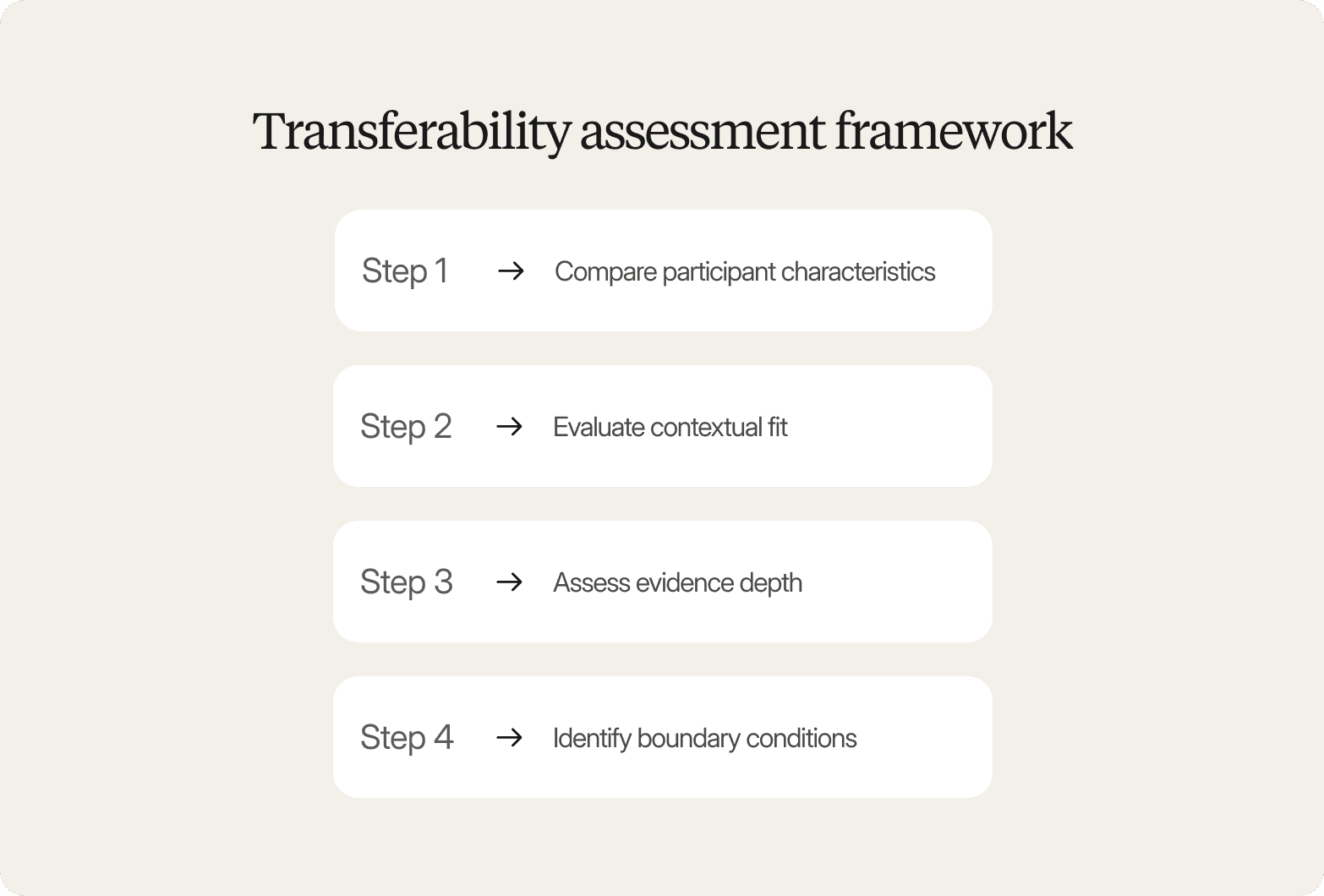
A four-step framework gives teams a repeatable way to judge whether findings transfer. It doesn't eliminate judgment, it structures it.
Compare participant characteristics. Do demographics, psychographics, and behaviors match between the original study and the new context?
Evaluate contextual fit. Do market conditions, cultural norms, and time periods align?
Assess evidence depth. Are findings supported by thick description, multiple data sources, careful data analysis, and traceable quotes?
Identify boundary conditions. Did the original study state what contexts the findings do NOT apply to?
For example, a team assessing whether Q1 US onboarding research applies to Q3 European users might find: participant characteristics mostly match; contextual fit is moderate (GDPR compliance adds friction); evidence depth is strong (timestamped clips and verbatim quotes); and boundary conditions were documented (self-serve onboarding only). Conclusion: findings partially transfer, so the team runs a targeted follow-up on GDPR-specific friction rather than starting from zero.
Conveo's searchable insight library is built for exactly this kind of check, letting teams search prior studies by theme, participant profile, or market segment and retrieve sourced clips alongside the original context.
Transferability in Continuous Research and Enterprise Governance
Tracking change over time
Periodic research programs expose a related problem: the inability to track whether anything actually changed. Every single study lives in its own deck, and researchers can't easily compare incoming responses against prior findings to detect drift. A searchable insight library changes this: teams can query prior findings by theme or persona to understand the baseline before a new study is completed. In one scenario, a SaaS team running quarterly NPS interviews confirms via the library that a "cluttered product" theme is intensifying, and escalates UI simplification to the roadmap accordingly.
"Powerful if you can just look back and just ask AI about the past"
— Hikaru Maeda, ASICS
Governance for cross-market comparison
Enterprise multi-market programs add a governance layer. Whether findings from different markets can be compared without legal exposure comes down to:
Data residency: where participant data is stored and processed
Consent: how participant consent is captured and documented per market
Security certifications: what compliance standards the platform carries
Conveo carries SOC 2 certification, GDPR compliance, and optional EU data hosting, so cross-market findings stay defensible.
How Conveo Makes Qualitative Findings Transferable
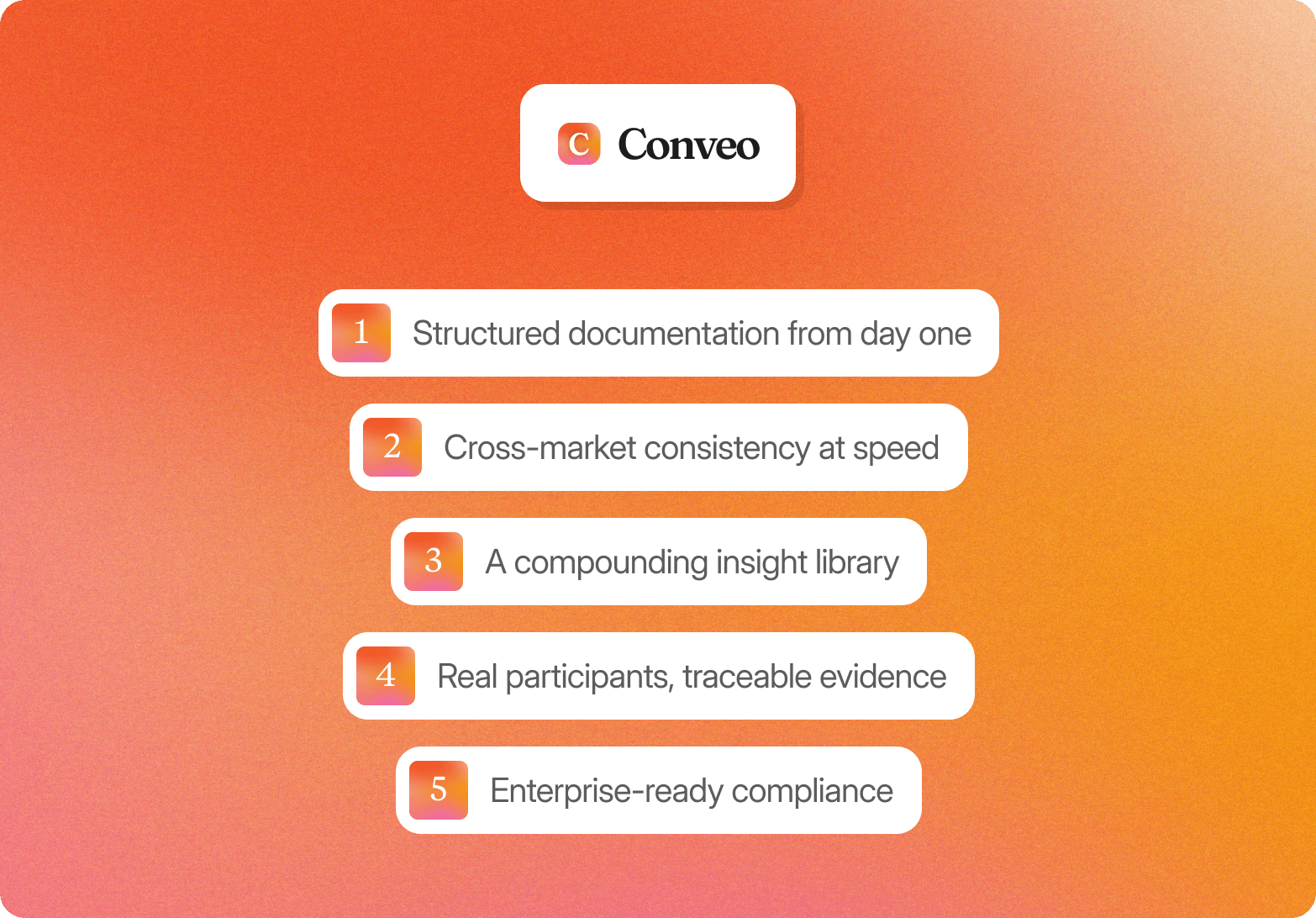
The transferability challenges above share a common root: research infrastructure that fragments context and produces findings that can't be traced to their source. Conveo addresses each by design, with real-world applications across teams working in different settings and markets:
Structured documentation from day one: every interview automatically preserves timestamped video, transcripts, participant metadata, and screener criteria.
Cross-market consistency at speed: AI-moderated interviews run simultaneously across markets in 20+ languages, with adaptive probing that maintains comparable depth.
A compounding insight library: every study feeds a searchable repository of transferable insights organized by theme, participant profile, and market segment.
Real participants, traceable evidence: every finding links back to a specific person and moment, supporting defensible cross-study claims.
Enterprise-ready compliance: SOC 2, GDPR, optional EU data hosting, and SSO mean governance and research quality travel together.
Frequently Asked Questions
What is transferability in qualitative research?
Can you give an example of transferability in qualitative research?
What is confirmability, and why does it matter for enterprise teams?
What's the difference between transferability and generalizability?