
TL;DR
Voice of the customer (VOC) is a structured system for understanding what customers were trying to do, what happened, and why. It sets a higher bar than a survey or a feedback channel typically meets.
The gap: Most teams have a survey. Few have a VOC program that can turn customer input into actionable insights on questions it wasn't designed to answer.
What this covers: A working definition of voice of customer, its scope, and a framework for evaluating program depth as part of a broader customer strategy.
Best for: Insights and CMI teams whose current VOC program cannot explain why a metric moved.
The outcome: A clearer standard for what continuous customer understanding actually requires, and where most programs fall short.
By the time most VOC findings reach a decision-maker, the decision has already been made. A product roadmap ships, a campaign launches, positioning gets locked, and the research that was meant to inform those calls lands afterward as confirmation of a decision already made. That lag is the real failure mode. Most teams already have an answer ready when someone asks what voice of customer is: they point to their NPS tracker, their post-purchase survey, or the support ticket queue where customer complaints accumulate. The program exists. Customer data gets logged. The scores are reported. The dashboard is green.
Then a product decision lands on the table, someone asks why satisfaction dropped in the 35-to-44 segment last quarter, and the data says nothing. Across most organizations, VOC, customer feedback, and customer experience measurement get used as interchangeable labels, and customer sentiment tracking gets mistaken for customer insights. Satisfaction scores and support volume get filed under "customer understanding" without the structured discussion guides or decision-focused interview design needed to surface real customer pain points. The result: a research program that looks complete until someone needs it to answer a real question.
This article covers the voice of customer definition precisely: what it includes, what it excludes, and how it differs from satisfaction measurement. It also covers what a research-grade program requires to keep pace with shifting customer expectations, so teams can honestly assess whether what they have today is a VOC program or a feedback-collection habit wearing its name.
Voice of customer definition
Voice of customer (VOC) is a structured system for understanding what customers were trying to do, what happened across their customer interactions, and why they chose that path.
What is voice of customer, in practice? It is a repeatable process for collecting, analyzing, and acting on customer feedback and customer data in a way that reconstructs behavior and decision-making.
This is where VOC separates from satisfaction measurement. Net Promoter Score (NPS), customer satisfaction score (CSAT), and customer effort score (CES) capture sentiment at a single moment: a score on a scale, a thumbs up or down. They tell you that something went wrong; the NPS and CSAT section below covers what they leave out. A declining NPS score is only a signal.
VOC closes that gap by building structured probing into the research design that goes beyond surface-level customer preferences. The questions move past "how satisfied were you?" to "what were you trying to do, what did you try first, and what made you stop?" That distinction determines whether findings can drive a product decision or only confirm that one is needed, and helps a team genuinely understand customer motivation.
What VOC is not: clearing up the confusion
Three terms get used interchangeably with voice of customer, and the confusion costs research teams credibility when they present findings to stakeholders.
Customer support "voice" is a separate thing from a VOC program
In telephony and contact center contexts, "voice" refers to call routing, IVR systems, and inbound channel management across customer support interactions. That is infrastructure for handling volume.
NPS and CSAT measure sentiment at a single moment
A score tells you that something went wrong. It does not tell you what the customer was trying to accomplish, what happened during that attempt, or why they made the choices they did. Satisfaction measurement captures customer opinions at a glance.
Fragmented feedback channels fall short of a VOC program too
Online reviews, support tickets, feedback forms, and ad hoc surveys each capture a slice of customer experience. Without a structured approach connecting signals across those channels, consistent themes stay buried in raw data, and more volume just means more raw data to dig through.
Method | Primary use | What it measures | What it cannot answer | Typical timeline |
|---|---|---|---|---|
VOC research | Understanding behavior and decision drivers | Motivations, unmet needs, language | Why churn happened, what messaging broke | Days to weeks, can run continuously |
CX analytics | Tracking experience quality | CSAT, NPS, effort scores | Root cause, decision context | Real-time to weekly |
Satisfaction surveys | Measuring sentiment at a moment | Ratings, agree/disagree | The why behind the number | Days to weeks |
Exploring meaning and context | Attitudes, beliefs, behavior | Statistical prevalence | Weeks to months | |
Focus groups | Testing early concepts and reactions in a group setting | Shared attitudes, social influence on opinion | Individual decision paths, private motivations | Days to weeks |
Telephony / IVR | Contact center routing and volume | Call type, resolution rate | Customer intent, unmet needs | Real-time |
Method descriptions reflect general category usage. Individual platforms vary in capability.
The 3 artifacts of a research-grade VOC program
A usable voice of customer program rests on three artifacts that make findings repeatable, comparable, and defensible across every study a team runs, no matter which stage of the customer journey it examines. A single interview or a quarterly report can't carry that load on its own.
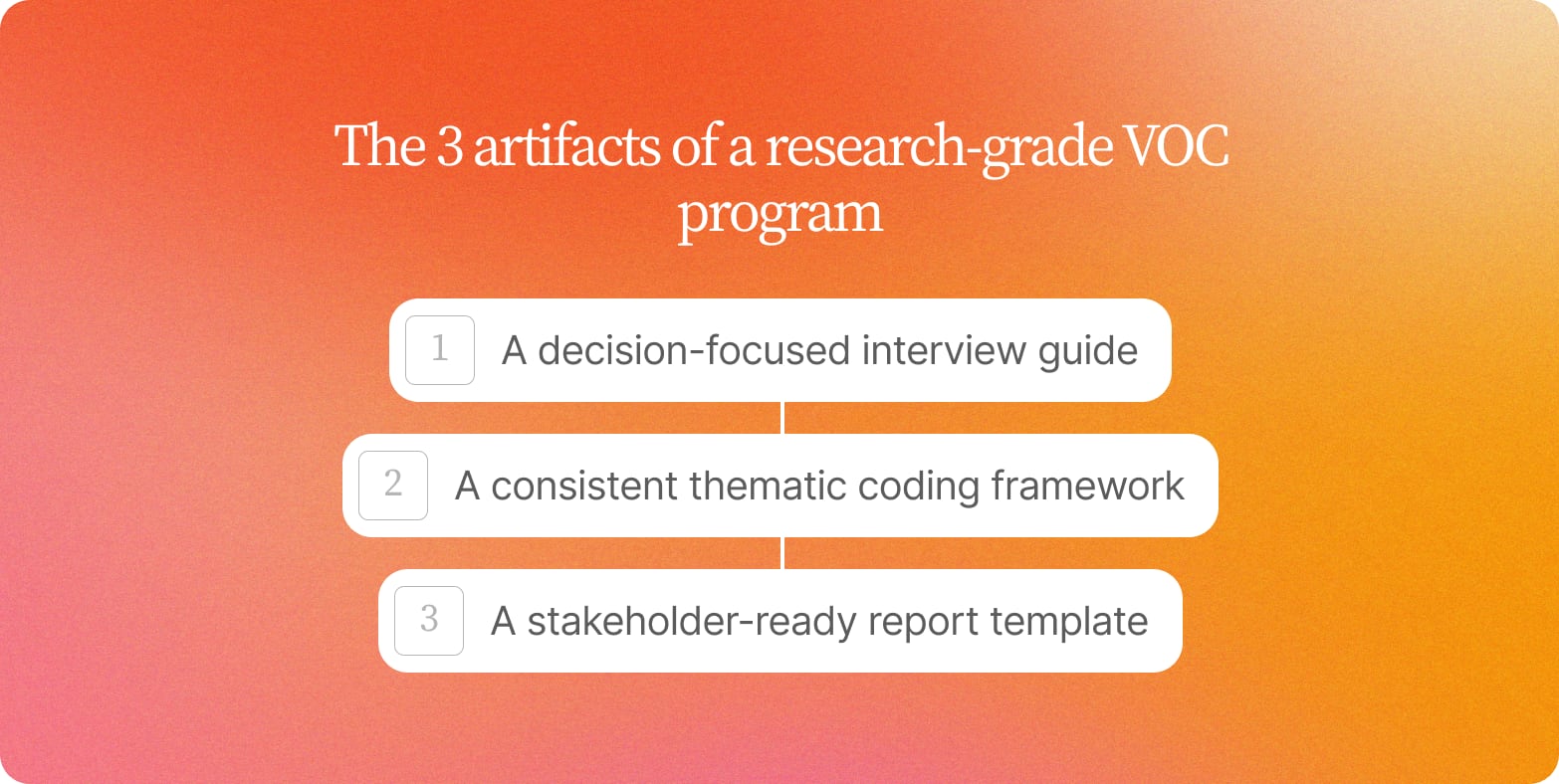
1. A decision-focused interview guide
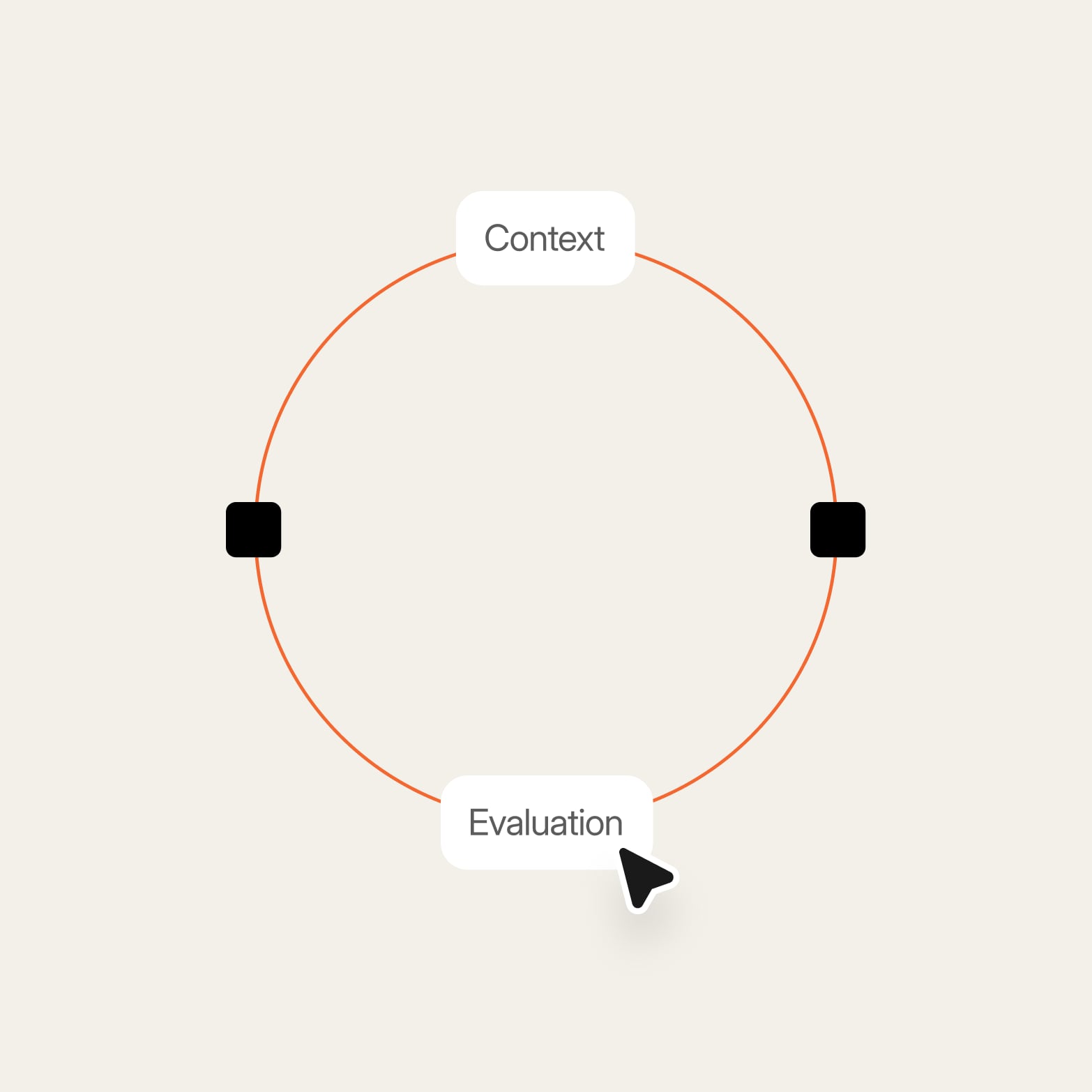
Before writing a single question, name the business decision on the table: "Should we change the pack?" or "Which positioning should we take to market?" Starting from "what do customers think?" produces ambient opinions that feel insightful but don't guide action. A decision-useful guide follows a specific order: context setting, experience reconstruction, evaluation, then implications, capturing structured customer input at each step and mapping it to the specific customer touchpoints under review. That sequence matters because walking a participant through a specific recent episode before asking for opinions produces observable behavior and real decision drivers you can act on.
2. A consistent thematic coding framework
VOC's value compounds when themes stay comparable across studies, quarter after quarter. Use consistent question wording and a shared taxonomy to analyze customer feedback the same way every time, supported by sentiment analysis and natural language processing, so a theme like "reasons for support contact" means the same thing in Q1 as it does in Q4, providing valuable insights teams can act on quarter over quarter. Without that consistency, teams do archaeology on their own data every time a new study lands.
3. A stakeholder-ready report template
Research-grade reporting links every theme to verbatim quotes, participant IDs, and timestamps, with video clips attached where available, and ideally cross-referenced against CRM data and existing feedback data. That traceability lets a CMO or product lead verify a claim directly. Findings that cannot be sourced back to a real person who said them don't survive the first stakeholder challenge.
How VOC differs from satisfaction surveys
Satisfaction surveys and voice of customer programs serve different jobs. A survey measures sentiment at a point in time: it tells you scores dropped, a segment is unhappy, or NPS moved three points in the wrong direction. A VOC program reconstructs behavior and customer perceptions. It asks why a customer made the choice they did, then probes until the answer is specific enough to act on.
The difference is probing logic. Research-grade voice of customer questions keep going past the first response and follow the thread: what happened before that, what made you decide, what would have changed your mind. Without that layered structure, teams collect quotes that feel useful but never build a deeper understanding of customer desires, and they can't synthesize them into a recommendation a stakeholder can approve.
A sentiment score says customers are dissatisfied. A traceable VOC finding says which moment in the customer journey broke trust, in whose words, with the video timestamp to prove it.
Dimension | Survey-based feedback | Voice of customer program |
|---|---|---|
Question design | Measures sentiment (NPS/CSAT/CES) | Reconstructs behavior, decision drivers, and customer preferences |
Output type | Satisfaction score | Traceable explanation with verbatim quotes |
Traceability | Aggregated, anonymous | Linked to participant IDs, timestamps, video clips |
Decision utility | "Are customers happy?" | "Why did this happen? What should we change?" |
Voice of customer programs produce actionable insights you can defend in a stakeholder meeting. Survey scores produce a number that requires a separate study to explain.
VOC sources and when to use each
Each VOC source answers a different kind of question, and choosing the wrong one for the decision at hand wastes research time. Teams typically gather customer feedback across support tickets, reviews, surveys, focus groups, and interviews depending on the decision they're trying to make.
Support tickets surface what is already broken and where customer concerns concentrate, often logged directly as CRM data from customer service interactions. Best for diagnosing friction at specific customer touchpoints or spotting where customers are dropping off, though they tell you what went wrong, rarely why it felt wrong.
Online reviews reveal unprompted sentiment at scale. Good for competitive positioning and messaging validation, and can surface a competitive advantage worth reinforcing in market, but the signal is unstructured and skewed toward strong reactions.
Customer surveys measure the size of a problem, offering an efficient way to collect customer feedback at scale through periodic feedback requests, but rarely produce the explanatory depth needed to act with confidence.
Focus groups surface shared reactions and social dynamics around a concept or message. Good for early-stage reaction testing, though a group setting can suppress dissenting views and make it hard to isolate individual decision paths.
AI-moderated video interviews answer the why behind any of the above. When a support spike, a review pattern, or a survey score demands explanation, customer interviews are where the real diagnostic work happens, often analyzed using natural language processing to surface themes at scale. (See how Conveo's AI research assistant works for the full breakdown.)
VOC input | Best decision moment |
|---|---|
Support tickets | Redesign onboarding, reduce churn |
Reviews | Validate or reframe messaging |
Surveys | Prioritize roadmap, size a problem |
Focus groups | Test early concepts, gauge group reaction |
AI-moderated interviews | Explain any of the above |
Capturing the why behind every finding
Most voice of customer programs stop at collection. A participant says something negative about a new pack design, the team logs it as one of many customer complaints or customer pain points, and the deck gets a quote. What it rarely gets is the episode behind the quote: what the person was trying to do, what they expected, where the experience broke from that expectation, and what they concluded.
The difference is interview structure. A guide that moves through four layers (context, specific episode reconstruction, evaluation of that episode, and implications for behavior) produces findings that hold up in a stakeholder meeting because they trace back to something observable. Asking for opinions before that reconstruction is complete produces generalized customer input that reads well but can't function as evidence. "The new pack felt confusing" is a quote. "I picked up the bottle expecting the original recipe because the color looked the same, so I almost didn't notice it was the new formula" is a finding.
Conveo built its AI research assistant to apply this structure adaptively. When a participant gives a vague response, it probes the specific moment behind it. That adaptive layer converts good quotes into defensible, decision-ready findings that can inform broader customer strategy and deeper behavioral understanding, and teams report a synthesis cycle that finishes in days.
The black box problem: why traceability matters
Every VOC program eventually faces the same challenge in a stakeholder review: someone asks, "Where did this come from?" If the answer is a summary slide with no visible path back to the source, credibility collapses fast. An unsourced AI-generated theme and a fabricated one look identical on paper, especially when neither traces back to the raw feedback describing a real customer pain point. That is the black box problem, and it is why generic AI summaries without source links create as much risk as they resolve.
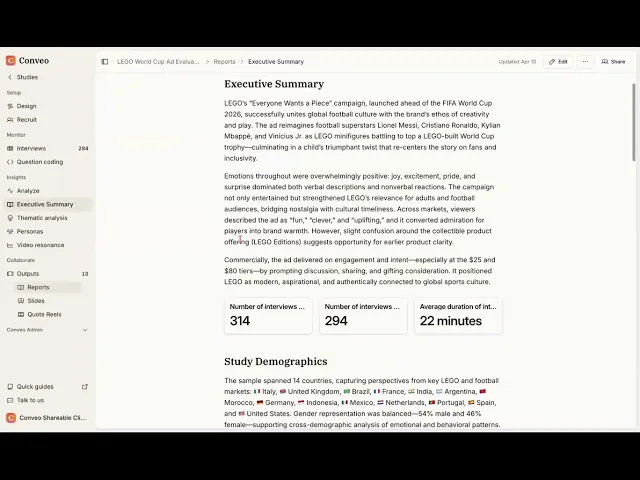
A research-grade VOC practice closes that gap by making every finding traceable. Each theme links back to the verbatim quote, the participant, and the moment, with the session recording available. Stakeholders can follow a claim from the synthesis layer back to the exact moment a real person said it. That path from finding to source is what separates credible, valuable feedback from ambient feedback data that no one can verify or act on with confidence.
See it in action in Reading a Conveo Report:
Traceability determines whether findings actually change decisions, which is why stakeholders should regularly review the source material behind a theme as well as the summary, as part of a broader continuous improvement discipline.
Continuous understanding vs. periodic measurement
Most VOC programs are built around a feedback schedule: a quarterly tracker, an annual deep-dive, a concept test commissioned when the brief is ready. That cadence made sense when research infrastructure was slow and expensive. It makes less sense when the decisions it is meant to inform move in days.
Traditional agency-led qualitative research typically takes weeks from brief to findings. By the time synthesis lands in a deck, the product decision has shipped, the campaign has launched, or the positioning has already been locked. The research confirms what the team suspected. It rarely changes what happens next.
The structural shift is building a practice that can answer questions it was not designed around:
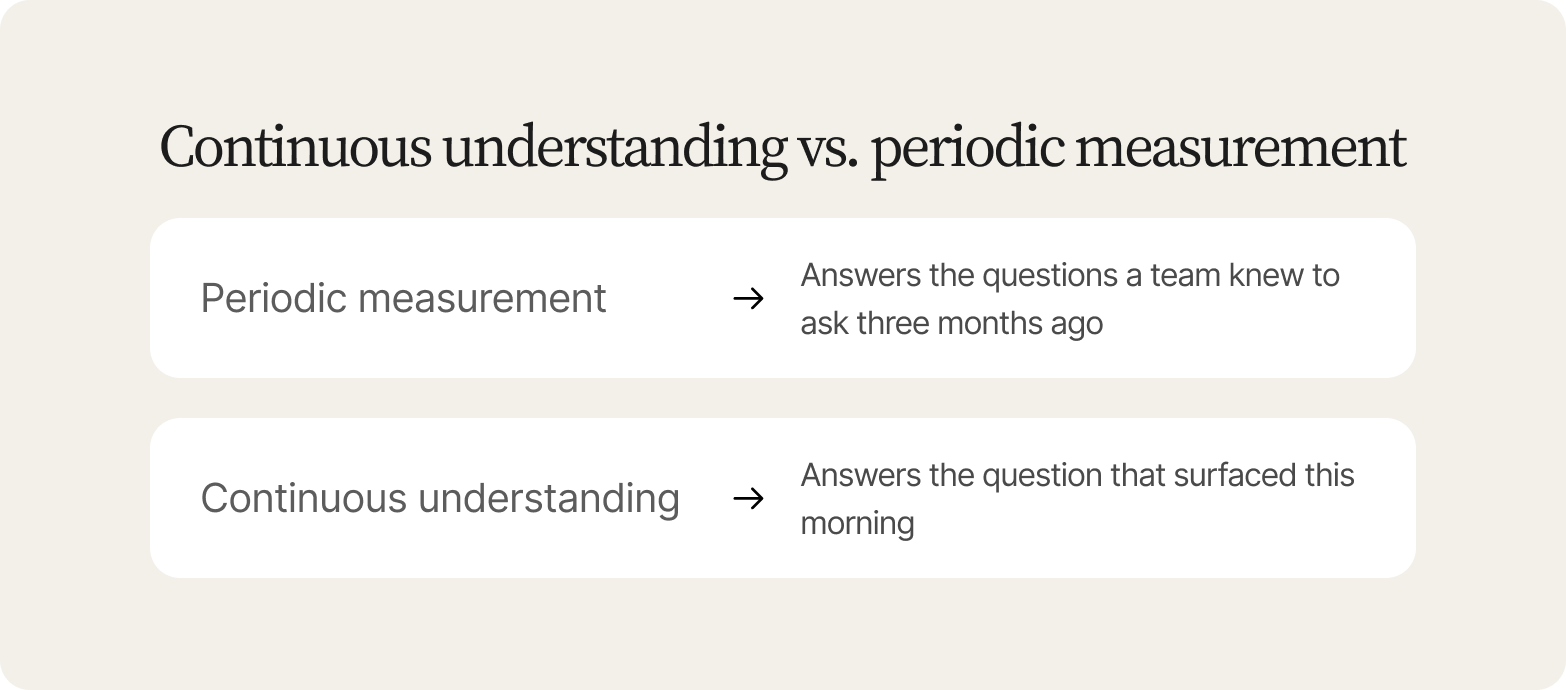
Periodic measurement answers the questions a team knew to ask three months ago.
Continuous understanding answers the question that surfaced this morning.
Conveo StoryLines is an AI-moderated research program run in waves, for example every two weeks or monthly, that shows how consumer understanding shifts over time. That cadence enables continuous improvement across every wave.
Teams that build toward continuous understanding stop waiting for the next quarterly study and start tying research directly to business outcomes and business growth, including what it actually takes to retain customers. Understanding is available when the decision is, and valuable insights don't sit in a deck until the next quarterly review. The byproduct is a more customer-centric culture across the business.
"Even if you're doing dozens of in-depth interviews, multiple focus groups, you get those interesting nuggets and insights. But then you take them to the client and there's always a sense of: is this really a trend? It's very hard to validate, and very hard to demonstrate the difference between an important trend and a one-off anomaly."
— Fergus Navaratnam-Blair, VP Trends and Futures, NRG
What business questions should a VOC program answer?
Four questions separate a research-grade voice of customer program, tied to real business outcomes, from one that generates reports no one acts on.
Why are customers churning, and what would improve customer retention and customer loyalty? The useful diagnostic goes beyond "what do customers think of us?" to specifics: unclear on-pack claims, pricing perception, unresolved friction that could reduce customer complaints, or a gap between what was promised and what was delivered.
What do customers believe an offer is, versus what they actually need? This is where customer perceptions, customer expectations, and positioning diverge in practice, and no amount of media spend closes a sharp gap.
What were customers trying to accomplish when they contacted support? Reconstructing that decision path across customer support interactions reveals friction points in the customer journey the product roadmap never sees.
Which attributes would actually change purchase behavior, and which are merely "nice to have"? Stated preference and actual purchase drivers rarely match, and building long-term brand value depends on knowing the difference. Confusing the two builds an innovation pipeline on wishful thinking and gives up a competitive advantage a sharper read of the data would have delivered.
Where Conveo fits in a research-grade VOC program
1. Always-on by design
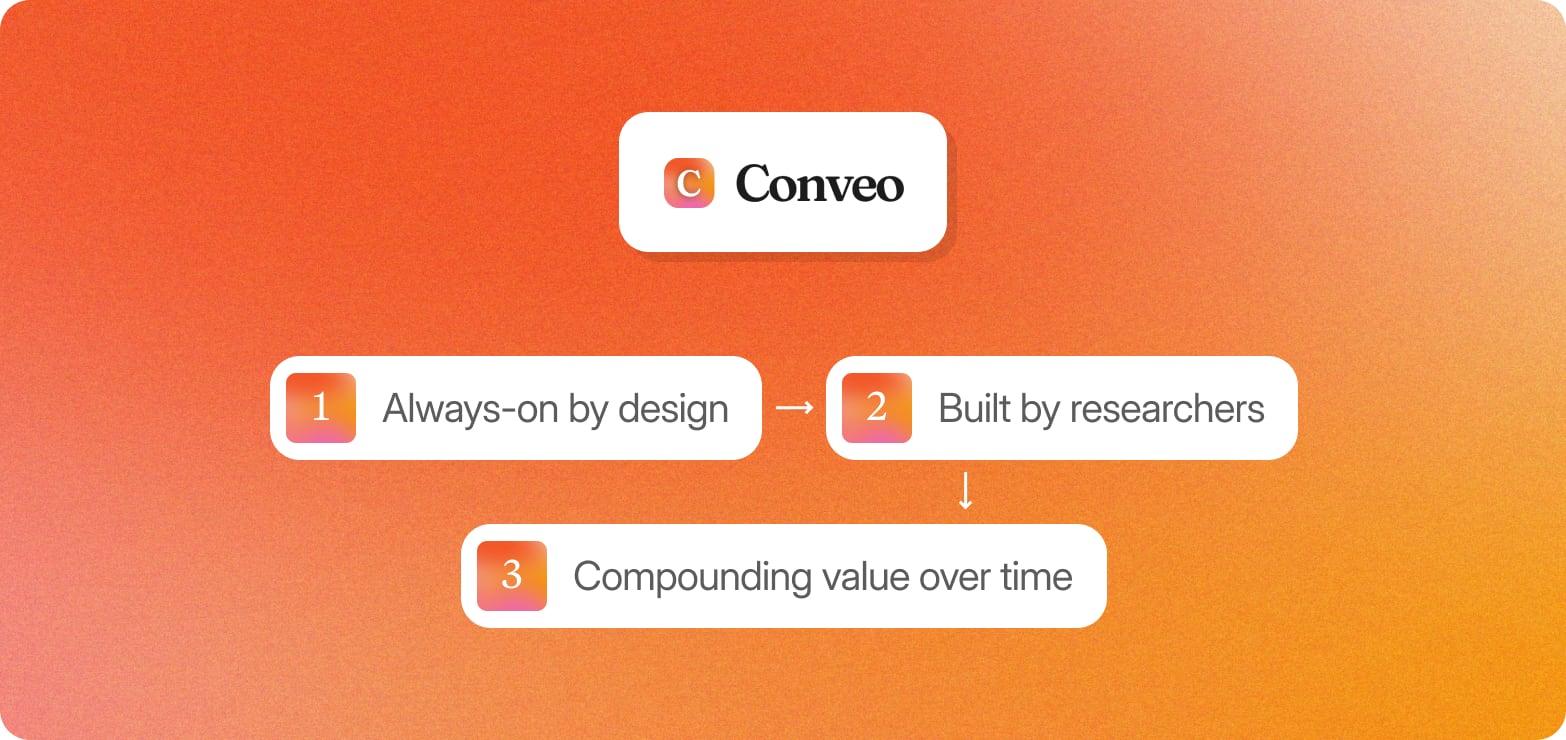
A research-grade VOC program needs to run continuously across segments and markets. Conveo is built around that always-on requirement: teams run AI-moderated interviews on demand as questions come up, and findings accumulate in a searchable insight library, strengthening consumer relationships along the way, so a question raised this quarter can be checked against what was learned in the last three studies before a new one is even fielded.
2. Built by researchers
That always-on continuity only holds value if the underlying research is trustworthy. Conveo is built by researchers, which shows up in specifics that matter for a stakeholder review:
Decision-focused interview guides
Behavioral screening at recruitment
An AI research assistant that probes adaptively
Every finding traces back to a verbatim quote, a participant, and a timestamp drawn from existing customers or recruited panelists, so VOC data can be checked, verified, and trusted, and used to improve customer satisfaction concretely.
3. Compounding value over time
Because studies build on a shared taxonomy and a persistent insight library, each new wave builds directly on the last, which is what separates a real VOC strategy from a one-off project. Teams that collect VOC data this way can treat it as a direct input to roadmap decisions.
For teams under European or procurement scrutiny, Conveo is SOC 2 Type II certified and GDPR compliant, with EU hosting in Belgium. Building a research-grade voice of customer program comes down to structure that holds up and a consumer-centric culture that treats findings as a standing input to decisions, so insights arrive while the decision is still open.
Frequently asked questions
What does an AI-moderated voice of customer program actually do?
What's the difference between "voice of customer" and just running customer satisfaction surveys?
How do you tell if you actually have a VOC program versus a bunch of disconnected feedback channels?
How does an AI research assistant differ from a human moderator?
How long does it take to get VOC insights that can influence a decision?
Can AI-moderated research match the rigor of traditional qual?