In this article
TL;DR
Decision-lag risk: Untraceable evidence stalls or reverses decisions when stakeholders challenge a claim, and no one can produce the source within 30 seconds.
Multimodal evidence storage: Every insight links to a timestamped source and a participant ID. Video, audio, and transcript travel together so proof is one click away.
Coded themes with linked clips: Themes connect directly to supporting verbatims and video clips.
Persistent, searchable research repository: Findings accumulate across studies rather than resetting with each project. Teams search past work and get sourced answers.
Enterprise governance baseline: SOC 2 Type II certified, GDPR compliant, EU hosting (Belgium).
Six weeks into a packaging concept test, a Research Operations Manager presents findings to the brand team. A stakeholder pushes back on the headline claim and asks for the verbatim quote behind it. She cannot produce it in under 30 seconds. The quote exists somewhere, but she cannot remember which transcript file contains it, which folder the project is in, or whether the recording was ever tagged to the finding at all. It is study 22 of roughly 30 her team will run this year, and none of the other 21 are any easier to search.
That is a decision-lag risk. A challenged claim without traceable proof stalls or reverses an already made decision. The conversation shifts from what to do next to whether the finding can be trusted at all, and decision-making stops being about evidence and starts being about who argues loudest.
Governed qualitative storage is the practice of keeping every piece of qualitative evidence linked to its source: video clips, verbatim quotes, transcripts, and field notes, all traceable back to the exact participant, session, and moment they came from. The underlying structure is where most teams come unstuck. Qualitative consumer input typically accumulates across disconnected locations after data collection ends: transcripts exported from one platform, recordings saved to a shared drive, synthesis notes living in a slide deck, field observations in a separate document. Nothing links a finding back to the participant who produced it.
That dependency is fragile. When a researcher who ran the study leaves the meeting, changes roles, or moves on entirely, the claim becomes unverifiable. The finding may well be accurate, but it is untraceable, which carries the same weight in a compliance review or a stakeholder challenge. None of this changes if the same study also produced quantitative data: a quantitative analysis of the survey scores that accompanied the packaging test would sit safely in a BI dashboard, but the qualitative evidence behind the "why" is exactly what tends to get lost.
The resolution is structural. A governed insight library, effectively a research repository for the entire research process, stores video clips, verbatim quotes, transcripts, and field notes with full traceability: every insight linked to a participant ID, a session timestamp, and the study context in which it was collected. In a governed system, the Research Operations Manager from the packaging test pulls up the clip in time for the stakeholder to finish the question.
Why most qualitative storage systems fail
Most qualitative storage systems break in one of three places. Evidence and insight live in separate locations, so the finding exists, but the proof behind it does not travel with it. Retrieval depends on memory rather than metadata, so the person who ran the study becomes the only reliable index. And when that researcher leaves the room, or the organization, claims become unverifiable because there is no traceable path back to what was actually said.
Transcripts end up in one folder, recordings in another, and summary decks in a third. When a stakeholder asks who said something and in response to which question, the evidence chain has to be reconstructed from memory. That reconstruction takes time you do not have, and it introduces exactly the kind of uncertainty that stalls decisions.
Storing qualitative consumer input across disconnected locations creates a structural gap in the evidence chain, making every downstream claim harder to defend. This is one of the common challenges enterprise research teams run into as programs scale past a handful of studies a year. It is also a different problem from storing support tickets or CRM notes, which usually already sit in a centralized system by default; qualitative research evidence rarely gets that same default treatment, so centralizing has to be deliberate.
Field notes from ethnography and in-store observation are especially exposed here. Because they are unstructured data, gathered as raw, in-the-moment note-taking, they rarely make it into a searchable system. They stay in personal notebooks, voice memos, or partial debriefs that no one else can access. The richest contextual data from a shop-along or an in-home visit often disappears the moment the researcher who conducted it moves on to the next project.
The decision cost is concrete. When a stakeholder cannot click from a finding to the exact verbatim quote or the video moment that produced it, the conversation shifts. It stops being about what to do and starts being about whether to trust the finding at all. That is exactly what happened in study 22: without the clip on hand, the packaging claim got shelved for a quarter while the brand team re-litigated a decision the research had already answered. In practice, that doubt rarely resolves in favor of the research. It resolves in favor of whoever has the loudest opinion in the room.
Shared drive vs. governed research repository, at a glance
| Shared drive or folders | Governed research repository | |
|---|---|---|
| Where evidence lives | Scattered across transcripts, recordings, and decks | One searchable library, linked by participant and session |
| Retrieval method | Memory of who ran the study and where they saved it | Search by theme, audience, or market |
| Traceability | Findings and source evidence live separately | Every insight linked to a participant ID and timestamped clip |
| Access control | Ad hoc folder permissions | Role-based access with an audit trail |
| Retention | Indefinite by default, or undocumented | Defined retention schedules, applied consistently |
| Regional hosting | Wherever the file happened to get saved | Meets GDPR residency requirements by design |
| Reuse across studies | Starts from zero each time | Compounds: past findings inform new discussion guides and screeners |
The 3 structural requirements for governed qualitative storage
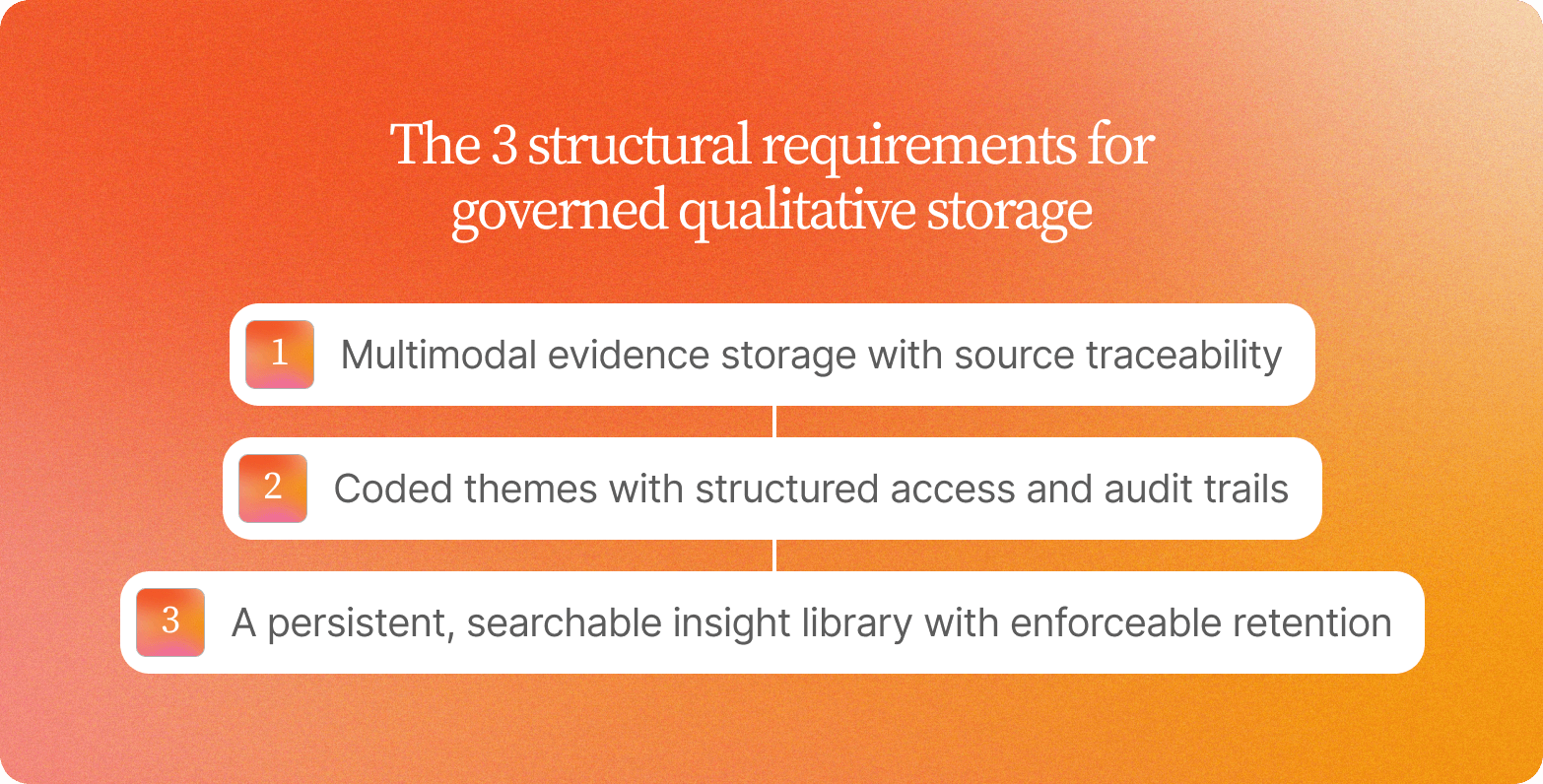
Effective storage is about maintaining the evidence chain from finding to source, so that any claim in a stakeholder report can be traced back to the exact participant who said it, in the session where they said it. Whether teams rely on focus groups, usability sessions, case studies, grounded theory, narrative analysis, or open-ended surveys, the qualitative research methods behind a study don't change the storage requirement: evidence and source have to travel together.
Discussion guides built on open-ended questions generate exactly the kind of nuanced, hard-to-tag open-ended responses that scattered storage loses fastest, which is why the requirement below matters more as programs scale.
Multimodal evidence storage with source traceability
Best practices for storing qualitative consumer input require keeping video clips, verbatim quotes, transcripts, and field notes in a single location so that tone, hesitation, and the surrounding context are never lost to a text-only file. Unlike numerical data, which loses nothing important when it is reduced to a spreadsheet cell, qualitative evidence loses meaning the moment it is separated from its source. When these elements are separated across different systems, the meaning that lives between the words disappears at the moment it is needed most.
Every finding must link to a specific participant, session, and timestamp. Aggregate summaries without source anchors cannot be audited. In a governed enterprise environment, an unverifiable insight carries the same risk as no insight at all, no matter how rich insights sound in a synthesis deck.
Each stored finding should be traceable to a participant ID, the original question or prompt, and a timestamped clip, so any claim can be audited in under 30 seconds during a stakeholder review. That traceability is what separates governed qualitative storage from a shared folder of notes.
In usability and concept testing, this means storing task failures and participant reactions, along with the raw user feedback and open-ended feedback participants gave, alongside the exact video segment where a user got stuck or reworded a claim. A written note that says "participant struggled with the checkout flow" carries far less weight than the 40-second clip that shows the pause, the reread, and the visible frustration; the video gives stakeholders real examples instead of a paraphrase.
The operational benefit is direct: stakeholders can move from a finding such as "feature confusion" to the precise moment a participant struggled, preserving the tone and hesitation that no transcript can reproduce, and giving product design decisions a level of evidence that summary slides never do.
Coded themes with structured access and audit trails
Qualitative data only becomes retrievable at scale when it is coded with decision-relevant labels from the start. That coding process, whether teams call it systematic coding, thematic analysis, or a lighter form of content analysis, gives the archive a structure that memory cannot provide. This is the point where storage and qualitative analysis meet: coding is the analysis step, but the archive is what makes that analysis reusable later. Themes like "feature confusion," "price sensitivity," or "skepticism about claim" turn raw data, textual data, and open text responses into common themes a researcher can actually retrieve. Without that layer, a researcher looking for past evidence on pricing reactions has no path in except recalling which project touched on it.
The coding layer only holds if insight and source travel together. A theme stored without its supporting clips and verbatims becomes an assertion with no traceable origin. Storing both means any qualitative researchers on the team can retrieve a coded theme and immediately verify what research participants actually said, in their own words.
Research data contains PII, competitive intelligence, and pre-decisional information. Governed storage requires role-based access, SSO integration, and a retrievable log of who accessed what and when. Without it, the platform cannot clear a security review.
This matters most for persona and segmentation work built on customer and human behavior observed in the field, rather than attributes assigned in a workshop. Attributes traced to specific participant language are what keep the record honest. Storing a segmentation claim only when it links back to a named clip and verbatim matches the analysis keeps the analysis defensible.
For Research Operations Managers, standardizing workflows across multiple teams requires consistent coding taxonomies and calibration protocols to ensure comparability across multi-market and multi-wave studies. Conveo's approach treats coded themes as first-class stored objects with full audit trails, so governance standards hold across every study in the library.
The operational result is that retrieval becomes a search query rather than a memory exercise. Any of the qualitative researchers on a team can locate relevant evidence from prior studies, analyze it within minutes, and answer stakeholders' questions without having run the original project or re-recruiting the same research participants.
A persistent, searchable insight library with enforceable retention
The third structural requirement is a persistent, searchable insight library, a true research repository: one that accumulates outputs across every study rather than resetting when a project closes, and a deck gets filed somewhere no one revisits.
GDPR compliance requires that PII can be deleted on demand and that retention periods are documented and applied consistently. A library that accumulates data without a deletion mechanism becomes a compliance liability.
Storing qualitative research data effectively means centralizing more than interview recordings. Observational artifacts, including environment photos, workflow context notes, and behavioral evidence captured during in-home or shop-along studies, need to live alongside the interviews they informed. When a researcher needs to revisit a behavioral pattern six months later, the evidence should be retrievable in seconds, not recollected from scratch through a new round of fieldwork.
The practical test: if archived participants were tagged by behavioral-segment criteria rather than demographics, a researcher building a new screener could pull prior profiles directly from the library and use them as a credible starting point. That is the difference between a library and a folder, and it's the difference between gut instinct and a system built to gather feedback that actually compounds.
The compounding advantage builds from there. Every study stored correctly makes the next one faster: past findings inform new discussion guides, prior screeners reduce recruitment guesswork, and accumulated hypotheses mean teams enter fieldwork with sharper questions and new ideas rather than starting from zero.
4 enterprise governance requirements for qualitative storage
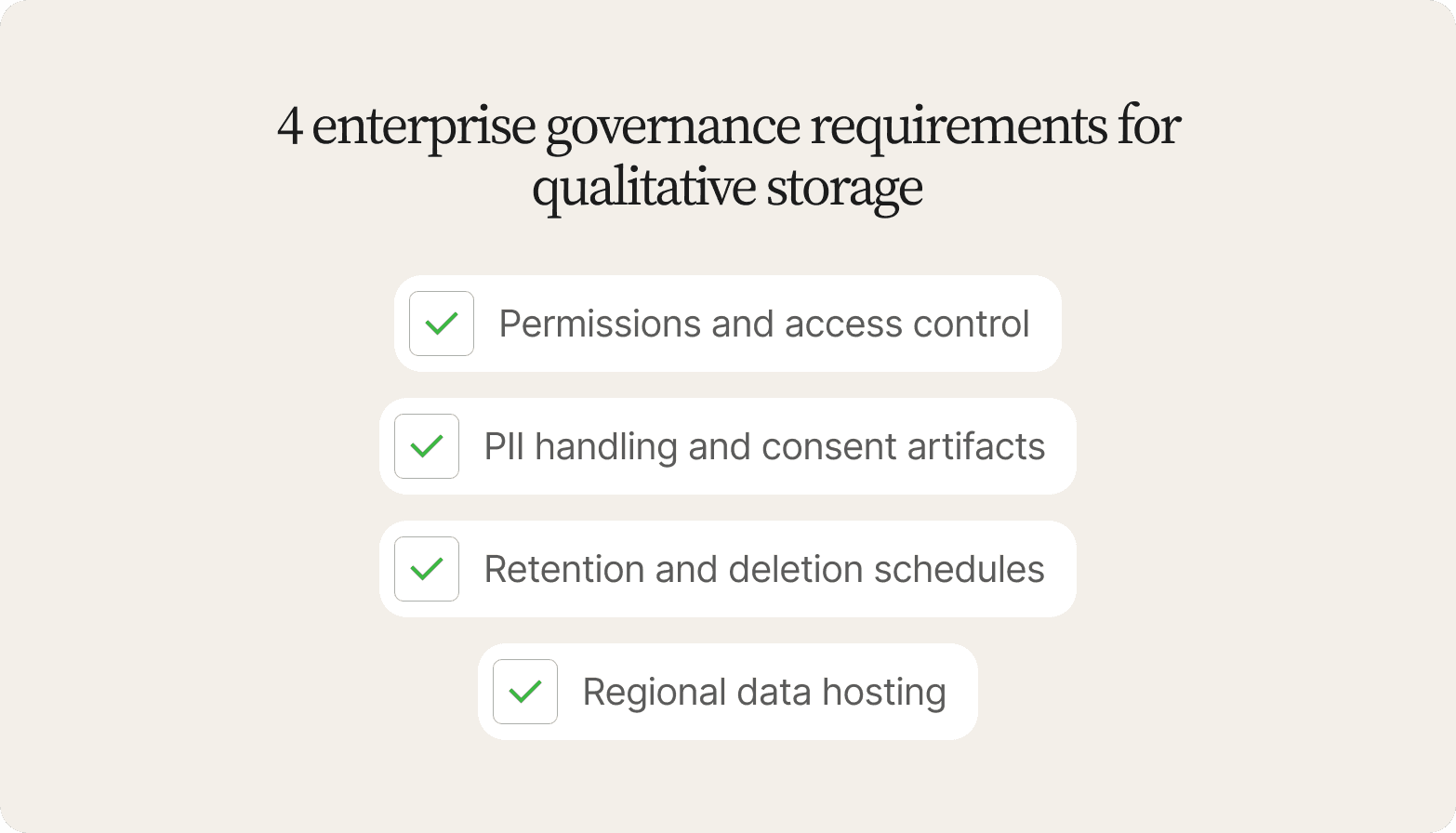
The best practices for storing qualitative consumer input go well beyond folder permissions and shared drives. Enterprise-grade storage requires a formal execution plan covering roles, access tiers, consent documentation, retention schedules, and the regional data hosting that multi-market programs legally require. Each of those four requirements is distinct, and skipping any one of them creates a gap that surfaces during legal review or procurement audit.
Permissions and access control
Not every stakeholder needs the same view of a study. Researchers working in the platform need full transcript and clip access to do their analysis. Product managers need themed findings with supporting clips they can share in a presentation to inform product design and roadmap decisions. Legal needs an audit trail showing who accessed which sessions, and when.
Role-based permissions handle all three without creating separate storage environments or manual export workflows. In practice, the access model that works for a small group of five researchers rarely scales to a cross-functional organization of fifty stakeholders without a formal permissions layer.
Retrieval speed for authorized users depends on getting that structure right from the start, and it's part of why the right storage tools matter as much as the research itself.
PII handling and consent artifacts
Storing qualitative data means storing video recordings of real people, which requires more than just the recordings themselves. Consent forms, participant agreements, and anonymization protocols need to live alongside the evidence so that compliance can be audited without reconstruction. Legal teams already do this for policy documents and contracts, retaining them according to a documented schedule; qualitative evidence requires the same discipline.
Each stored session should link directly to the consent artifact that authorized its use. If a legal review requires confirmation that a specific participant agreed to a specific use of their recording, that link needs to be retrievable in minutes, not hours.
Teams that store sessions without attached consent records often discover the gap only when they need it most, at exactly the moment it matters most to answer questions quickly.
Retention and deletion schedules
GDPR and enterprise data policies both require that qualitative consumer input in research programs be stored for defined retention periods rather than accumulated indefinitely. The retention period should match the business use case.
Brand tracking data used to inform annual strategy may warrant a three-year retention window. Concept testing recordings collected to evaluate a specific product idea may have no business justification beyond six months after the decision closes.
Automated deletion workflows matter here because manual processes do not scale across hundreds of studies per year, and data retained beyond its purpose becomes a compliance liability rather than an asset.
Regional data hosting
Global research programs that span Europe require EU hosting (Belgium) to meet GDPR residency requirements. Enterprise procurement in regulated markets treats this as a requirement.
A platform that stores session recordings and transcripts in a single geography outside the EU creates a data transfer problem that legal teams flag before the contract is signed.
Centralizing qualitative inputs in a regionally hosted, searchable research repository also prevents the alternative: separate, non-searchable repositories by market that fragment the institutional knowledge the research was meant to build. Note that Conveo's AI-moderated interviews support 50+ languages, which means moderation and analysis work across markets while the underlying data stays compliant with regional hosting requirements.
The governance baseline for enterprise qualitative storage is SOC 2 Type II certified, GDPR compliant, EU hosting (Belgium). Without all three, adoption stalls at the procurement stage regardless of how strong the research output is.
Curious how this looks for your own studies? Book a demo to see Conveo's governance baseline in practice: permissions, audit trails, and regional hosting, all handled inside one insight library.
Practical implementation: From scattered files to governed library
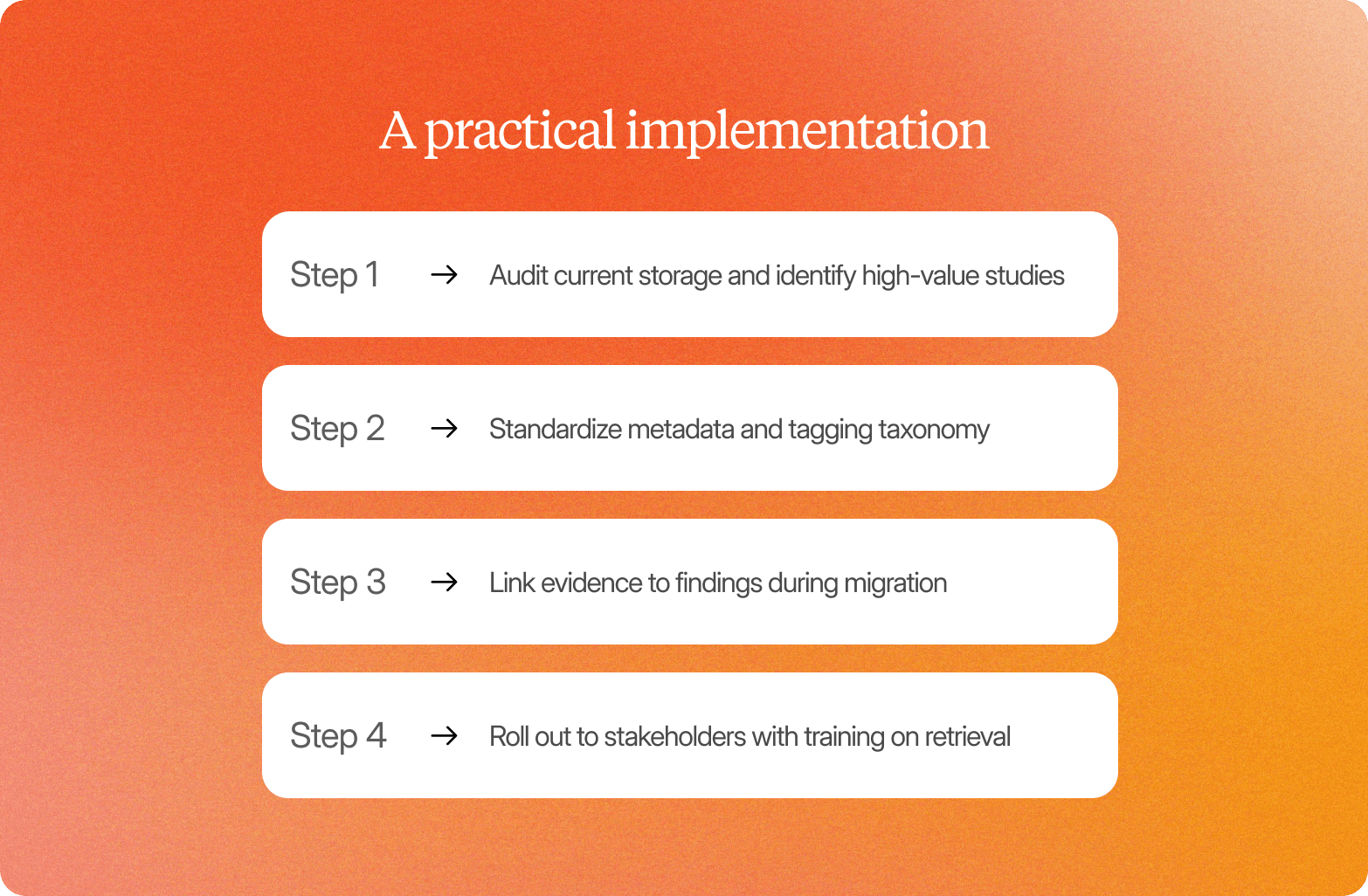
Most enterprise research teams do not start with a clean slate. Years of qualitative work, including the 21 studies that came before study 22, sit across shared drives, Notion pages, project folders, and individual hard drives, organized by whoever ran the study at the time. Getting that into a governed library is a sequencing problem that surfaces some of the most common challenges teams face when a research program finally scales.
The four steps below provide teams with a rollout order that maintains rigor without requiring a complete overhaul before anything is usable.
Step 1: Audit current storage and identify high-value studies
Before migrating a single file, inventory what exists by study type, date, and decision impact. The goal is a shortlist: the 10 to 15 studies that are still widely referenced in stakeholder conversations or that actively inform a product roadmap or brand positioning decision.
Those are the ones that belong in the library first. Migrating everything at once creates a backlog that stalls adoption and pulls researchers away from active work.
Starting with the studies people already reach for quickly proves the system's value, which earns the organizational investment to continue.
Step 2: Standardize metadata and tagging taxonomy
Before any files are moved, define the retrieval taxonomy that will govern the library. This means agreeing on the dimensions teams will tag across: themes, audience segments, markets, study wave, method, and the decision use case each study was commissioned to inform.
The taxonomy should be decision-relevant. A tag structure built for retrieval will look different from one built for archival completeness, and confusing the two is a common reason libraries become unsearchable six months after launch.
Consistent tagging prevents duplicate research and enables compounding reuse across studies, giving every study a common format that any qualitative researcher can navigate without having to ask the person who ran it.
Step 3: Link evidence to findings during migration
This is where most migrations fail. Storing qualitative research data in a library is straightforward. Storing it so that every theme travels with its supporting clips and verbatims requires manual linking, which teams routinely skip.
When they do, the migrated library becomes a slightly better-organized version of the scattered files it replaced: summaries without sources, findings without evidence, themes without the participant voices that generated them.
The discipline of keeping insight and source together during migration is what makes the library trustworthy enough to cite in a board deck or a product review.
Step 4: Roll out to stakeholders with training on retrieval
Adoption depends on stakeholders experiencing faster retrieval than the system they used before. That means the first rollout should target high-frequency use cases: persona validation, claim verification, competitive context.
Train stakeholders to search by theme, audience, or market rather than by study name or date, since most users do not remember a study's name. They remember the research questions it answered.
Retrieval by decision context is what converts occasional users into researchers who check the library, gather feedback from it, and ask new research questions before commissioning new work.
The operational baseline worth building toward is approximately 30 studies per year. At that volume, folder-based storage stops working. The library needs to be built for high-volume retrieval from the start: search across tags, linked evidence at the finding level, and a structure that holds up as the study count compounds rather than one that works for the first 20 entries and collapses at 50.
How Conveo stores qualitative evidence for enterprise teams
Unlike generic qualitative data analysis software built for a single project, Conveo's structured repository stores transcripts, timestamped video clips, coded insights, and observational field notes in a single searchable location, so evidence from every study remains available for future use without reanalysis. Behavioral artifacts, including photos of in-store activity and environment notes captured during ethnographies or IHUTs, are organized alongside interview transcripts within the same structure.
When a related study launches six months later, teams retrieve context rather than reconstructing it from memory.
Every stored finding traces back to a participant ID, the original discussion guide question, and a timestamped clip. That chain of custody matters during stakeholder reviews, where a challenged claim can be audited in under 30 seconds: from the synthesis card to the coded theme, to the 30-second clip where a participant's voice shifted or their hesitation made the point better than any transcript could. It's the difference between study 22 stalling for a quarter and the same claim getting resolved before the meeting ends.
Text alone loses that. Research teams working in Conveo treat visual evidence as a first-class stored object, so tone and non-verbal cues are preserved alongside the words, giving stakeholders participant perspectives that a paraphrase can't carry.
Regarding compliance, Conveo is SOC 2 Type II certified, GDPR compliant, EU hosting (Belgium). That combination is uncommon among newer AI-powered tools in the research space, and it matters directly to governance-ready storage because rich insights are only as good as the governance wrapped around them. For Research Operations Managers navigating procurement reviews, these features are the conditions under which qualitative data can legally and operationally be retained at enterprise scale.
In practice, highlight reels work well for fast stakeholder consumption. Research teams store them as pointers to underlying clips and full transcripts. A claim in a reel, say, "feature confusion at onboarding," links directly to the session where a specific participant struggled, preserving the context that makes the finding defensible.
Watch the walkthrough: Reading a Conveo Report
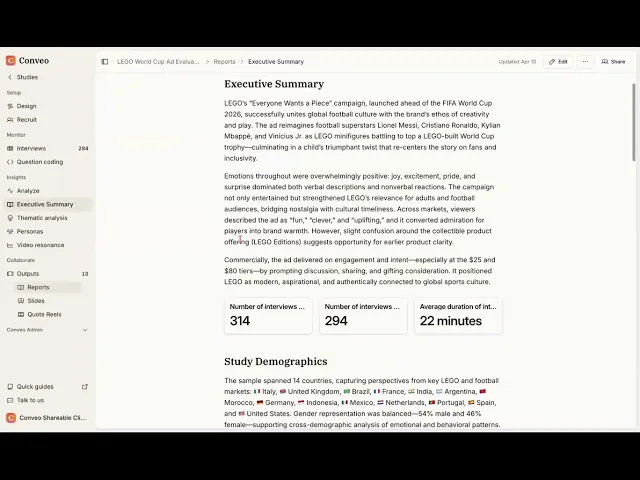
Any stakeholder can follow that chain and make sense of the evidence without involving the research team.
"Fast exec summary was perfect, job done"
Matt Harris, Research & Insights Lead, EMEA, Canva
The compounding advantage is cumulative. Conveo's searchable insight library doubles as a research repository, where findings connect across projects, and nothing is researched twice, even when analyzing thousands of hours of interview footage across studies. Past findings inform new discussion guides, screeners, and hypotheses. A theme that emerged in a concept test informs the next brand equity wave.
Research teams building in that library find that every study makes the next one faster, with the evidence already there: organized, traceable, searchable, and valuable well beyond the study it came from.
Frequently Asked Questions
What is a research repository?
A research repository is a centralized, searchable system for storing qualitative evidence, video clips, verbatim quotes, transcripts, and field notes, along with the coded themes and findings derived from them. Unlike a shared drive, a governed repository keeps every finding linked to its source, so it can be retrieved by theme, audience, or market instead of by memory.
How long should qualitative field notes and recordings be retained?
Retention periods should match business use rather than default to indefinite storage. Brand tracking data informing annual strategy may warrant three years. Concept testing recordings tied to a specific product decision may have no justification beyond six months after the decision closes. Document the rationale for each retention window and apply deletion schedules consistently across study types.
Who should have clip-level access versus themed-findings access?
Researchers conducting analysis need full transcript and clip access. Stakeholders consuming outputs typically need themed findings with supporting clips they can share in presentations. Legal and compliance teams need audit trails showing who accessed which sessions and when. Role-based permissions let all three operate without separate storage environments or manual export workflows.
How should retention periods differ by study type?
Longitudinal programs and brand trackers that inform ongoing strategy require longer retention windows, often two to three years. One-off concept tests or usability studies tied to specific product decisions can often be deleted six to twelve months after the decision closes. The key is documenting retention rationale at study design, not deciding retroactively when storage fills up.
What does traceability mean in a stakeholder review?
Traceability means any finding can be traced back to the exact participant who said it, the session in which they said it, and the timestamp of the relevant moment. When a stakeholder challenges a claim, the supporting verbatim or video clip can be retrieved in under 30 seconds. Without that chain, findings are assertions rather than evidence.
How does a governed library differ from a shared drive?
A shared drive stores files. A governed library, or research repository, stores findings linked to sources, with consistent tagging, role-based access, audit trails, and enforceable retention. The difference matters when a researcher needs to retrieve a behavioral pattern from 18 months ago, or when legal requires confirmation that a specific participant consented to a specific use. A shared drive cannot answer either question reliably.
About the author
Ivayana Abdi
Research Impact Lead
Ivayana has worked in market research since 2017, most recently as group manager of research operations and logistics at Culturati, and trained at RIVA and the Burke Institute. She joined Conveo for the hybrid researcher model: agile with new methods, fluent in the traditional ones, and able to combine the two for clients who want to try new things.
Meet Ivayana on film →Qualitative insights at the speed of your business.
Conveo runs AI-moderated video interviews and structures everything they say.