In this article
TL;DR
Business intelligence in healthcare shows teams that a metric moved, but can’t give you the context to decide how to act.
Traditional qualitative research is commissioned one project at a time, often delivering insights too late for decision-making.
AI-moderated interviews can provide answers in days rather than weeks, helping teams investigate the reasons behind a BI signal while it’s still relevant.
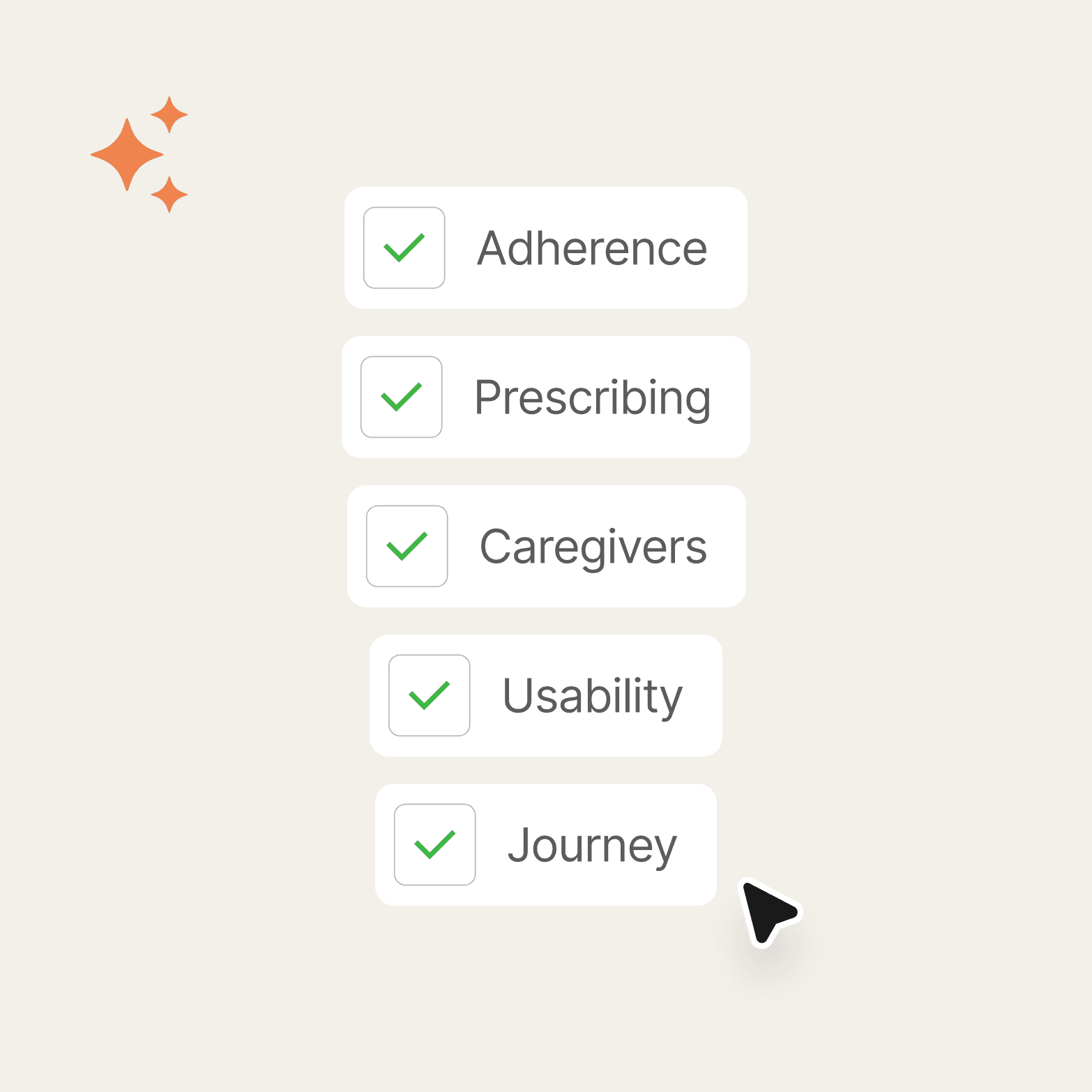
This article covers five use cases where BI signals need qualitative context: patient adherence, clinician adoption, caregiver experience, EHR usability, and the patient journey.
Conveo runs AI-moderated interviews, with every insight traceable to a real participant and their original interview.
A 40% drop in medication adherence at 90 days is easy to spot in a business intelligence dashboard. What the dashboard can’t tell you is why patients are dropping off. Are they struggling with cost? Are they experiencing side effects? Or do they not fully understand their treatment?
Traditional qualitative research can answer those questions, but it usually takes weeks to complete. AI-moderated interviews give healthcare teams a faster way to investigate the root cause of a BI signal. An AI moderator conducts asynchronous video interviews, asking core questions and following up on individual answers to uncover the reasons behind them.
Together, BI and qualitative research give teams both sides of the picture: what changed and why. This article examines five healthcare use cases in which that combination can help teams understand patient and consumer behavior.
What Healthcare Business Intelligence Is (And What It Can’t Answer)
Business intelligence in healthcare involves collecting and analyzing data to monitor performance. Teams use those insights to guide decisions about patient care and hospital or clinic operations. Healthcare data typically comes from three places:
Electronic health records (EHR). Patient records show how care is delivered and whether outcomes are improving, such as medication adherence rates or how consistently a treatment protocol is followed.
Claims and billing data. Financial data on healthcare services and their costs show how patients are accessing care, such as referral volumes and where out-of-pocket costs are rising.
Operational data. Data from day-to-day operations show how health systems and services are running, such as appointment-scheduling gaps and wait times.
Healthcare business intelligence tools reliably show movement in key metrics, for example a 15% fall in specialist referrals or a patient satisfaction score dropping 10 points. They turn raw clinical and operational data into a dashboard a research operations team or a clinical lead can read. Some tools also use predictive analytics or machine learning to flag issues before a trend fully appears in the numbers.
However, they can’t surface the reason behind the change. A referral decline might reflect physicians' loss of confidence in a treatment, while a drop in satisfaction could stem from new communication guidelines. Business intelligence (BI) shows the outcome of those experiences, but not the experiences themselves.
The Cost of the Understanding Gap in Healthcare Decisions
When a BI signal raises a consumer insight question it can't answer, teams are left with two options: act on an assumption or wait for research that may not arrive before a decision has to be made.
Take a 15% drop in specialist referrals. Without knowing what’s driving the decline, the team can:
Act on an assumption. If the team assumes physicians have lost confidence in the treatment, it might change its clinical messaging or outreach strategy. If the real issue is something else, those changes won’t address the cause of the decline. The team then has to work out why the intervention failed, spending more time and resources investigating a problem it misdiagnosed.
Wait for traditional research. Recruiting participants, conducting interviews, and analyzing the results can take weeks. While the research is underway, referrals may continue to fall, and the team has no evidence to guide a response. By the time the findings arrive, the team may have lost valuable time to address the decline and improve clinical outcomes.
Pairing operations and health data with qualitative healthcare research gives teams a way to move from changes in the data to an understanding of what’s driving them. The following use cases show what that looks like across different healthcare questions.
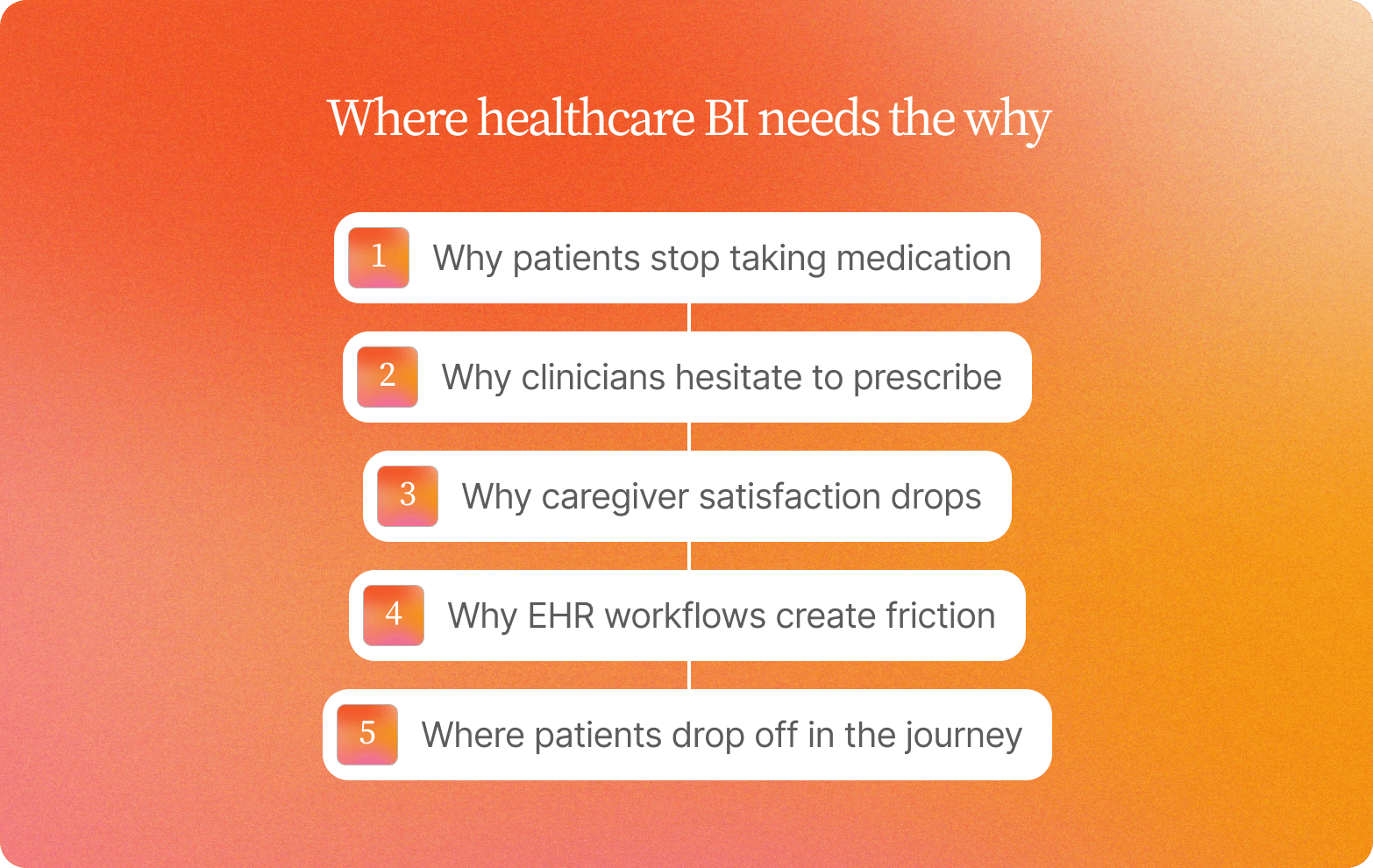
Use Case 1: Why Patients Stop Taking Their Medication
Patient data can show that adherence drops at a specific point, for example, the share of patients still refilling a prescription falling sharply around day 60. Asynchronous video interviews with patients at that point can help teams understand what is contributing to the drop-off while there’s still time to act on that group of patients.
Interviews with that group might find that a recent increase in medication costs prevented some patients from refilling their prescriptions. Because the interview findings come back in days, the team can flag that same group of patients for direct outreach. For example, patient support might call them with a copay assistance option or a lower-cost alternative.
The team can then check the next group reaching day 60 to see whether the refill rate changes and whether the price issue continues to affect patients.
Use Case 2: Why Clinicians Hesitate to Prescribe a Treatment
A treatment's prescribing rate can remain flat even after most clinicians become aware of it. In-depth interviews with clinicians who are aware of the treatment but have not adopted it can help the team understand what is holding them back.
If the barrier is workflow friction, for example, a prior authorization process that eats too much time between visits, the fix is a simpler ordering process. If it's patient-selection anxiety, clinicians need clearer guidance on who the treatment suits. Commercial teams can address the real objection in the intelligence data rather than run a generic awareness campaign for a problem that was never about awareness.
This approach works best as a recurring wave because the reasons clinicians hesitate can change over time. Running the same interviews again next quarter shows whether the barrier the team addressed has eased and identifies what is holding back clinicians who have not yet adopted the treatment.
Use Case 3: Why Caregiver Satisfaction Drops
Caregiver satisfaction scores can indicate that the experience is getting worse, but they can't capture what managing that care feels like day-to-day. A survey might flag a problem with insurance or support without capturing how it lands on someone already juggling appointments, medication, work, and caregiving.
Video interviews give you additional context. A caregiver describing a denied prior authorization might explain that they paid out of pocket because no one warned them the treatment might not be covered. On video, that story carries more than the words: a pause before they answer, a flat tone when they mention checking their bank balance, or visible relief when they talk about a nurse who finally helped them sort it out. Those signals show emotions a satisfaction score can't identify and a text response often flattens.
Patient intelligence research can help teams decide where support would make the biggest difference. That might mean clearer coverage information, better coordination, or more proactive outreach.
Use Case 4: Why Clinicians Struggle With an EHR Workflow
EHR usage data can show where clinicians abandon a workflow or take longer than expected to complete a task. AI-moderated video and voice interviews can help product teams investigate what’s happening at that point in the workflow and what makes the task harder than it should be.
For example, usage data might show that clinicians frequently leave a documentation workflow incomplete. Interviews could reveal that the form asks for information clinicians have already entered elsewhere, forcing them to repeat the same work.
These findings give the product team specific problems to address rather than a general signal that the workflow is difficult. The team can then track workflow completion and time-to-task after a change to see whether the friction has decreased.
Use Case 5: Where Patients Drop Off in the Care Journey
BI can show where patients drop out of a care pathway, such as failing to schedule a follow-up. By asking patients to walk through their experience across each touchpoint, from their conversation with the care team to the information they receive afterward, interviews can identify where the journey starts to break down.
The research might show a pattern of patients leaving an appointment believing they understand what to do next, only to become confused when they try to follow the discharge instructions at home.
The team can then change the part of the journey that is causing the problem, such as revising discharge materials or adding transportation support. BI can show whether more patients complete that step after the change, while follow-up interviews can help explain why patients who still drop out do so.
How to Evaluate a Consumer Understanding Platform for Healthcare
Sound research matters in any industry, but the stakes are higher in healthcare. The insights teams act on can shape decisions that directly affect patient outcomes, making it especially important to have confidence in both the research methodology and the evidence behind the findings. Teams also need to consider how a platform handles sensitive patient data.
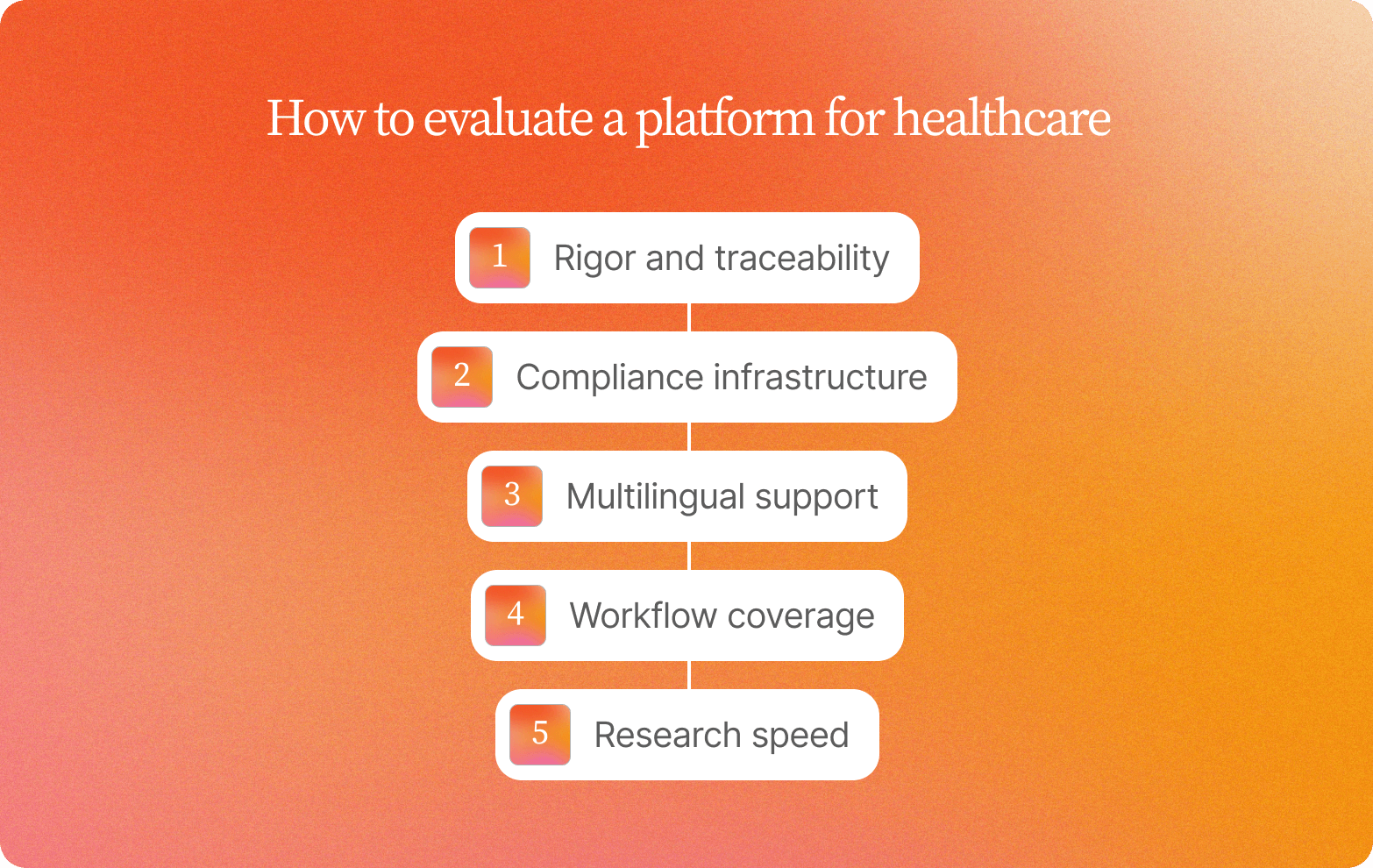
The checklist below covers the key criteria to consider when evaluating a consumer understanding platform for the healthcare industry:
| Selection criteria | What to evaluate | Why it matters |
|---|---|---|
| Rigor and traceability | Can every finding be traced back to a real participant through timestamped video and verbatim quotes? | Stakeholders can check the evidence behind findings that inform clinical or commercial decisions. |
| Compliance infrastructure | Does the platform provide the controls your organization requires around data access, hosting, and retention? | These requirements can determine whether a platform passes procurement and security review. |
| Multilingual support | Can teams conduct research across 50+ languages without creating a separate localization process for each market? | Teams can run consistent research across markets without slowing the process down for translation and localization. |
| Workflow coverage | Can the platform support the process from study design through stakeholder-ready reporting? | Teams can run research consistently without stitching together separate tools for different parts of the workflow. |
| Research speed | Can the platform gather qualitative evidence within the timeframe needed to inform a decision? | Teams have time to investigate an important BI signal and respond while the decision is still relevant. |
For healthcare teams, these criteria determine whether a platform can support an ongoing consumer understanding program alongside systems like BI and ERP tools already used to monitor and manage the business. The goal is to build a reliable way to investigate the people behind the patterns those systems reveal.
Some of these criteria also require closer scrutiny during the evaluation process, particularly when the research needs to withstand scrutiny from clinical or governance stakeholders.
Regulatory Compliance Checklist: What You Need for Complex Healthcare Data
Before a healthcare research platform can be adopted, procurement and security teams need to verify how it handles, stores, and protects sensitive data.
Compliance infrastructure covers how research data is handled, stored, and retained. Check for GDPR compliance documentation, EU regional data hosting options where required, and client-configurable retention policies with automated deletion.
Security controls protect that data from unauthorized access. Look for SOC 2 certification, role-based access control, and a full audit trail showing who accessed what data and when.
Together, these controls give procurement teams the documentation and safeguards they need to assess whether a platform meets their organization's requirements. Verifying them early can also prevent a platform from getting through the research evaluation only to stall during security or procurement review.
Evidence Traceability: Can Stakeholders Check the Findings?
Clinical governance runs on evidence stakeholders can check for themselves. Every insight you gather should link back to a timestamped video clip and quote from a real participant.
That traceability is also what makes the research hold up under scrutiny. If a finding seems surprising or is challenged in a governance review, the team needs to go back to the original clip and verify it, rather than defending a summary they can't independently verify. Platforms that skip this step hand back conclusions nobody downstream can check, no matter how fast they move.
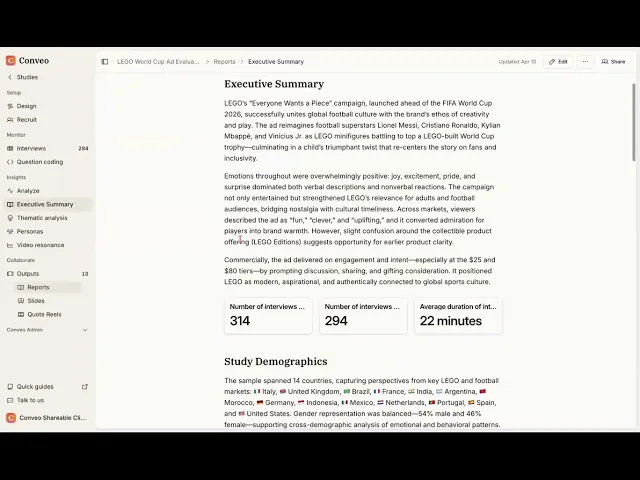
See the evidence: How a Conveo Report Reaches a Decision-Maker
Research Speed: Can You Get Answers in Time to Act?
AI-moderated interviews can shorten the fielding process, allowing you to complete hundreds of interviews simultaneously and get results back within days. That can help teams quickly get the context behind a BI signal to inform the decision in front of them.
Speed, however, only adds value if the research remains rigorous and the findings can be verified. It should support the case for a platform, alongside the compliance and evidence standards that determine whether teams can trust and use the results.
Rolling It Out: Pairing Healthcare BI Tools with Qualitative Evidence
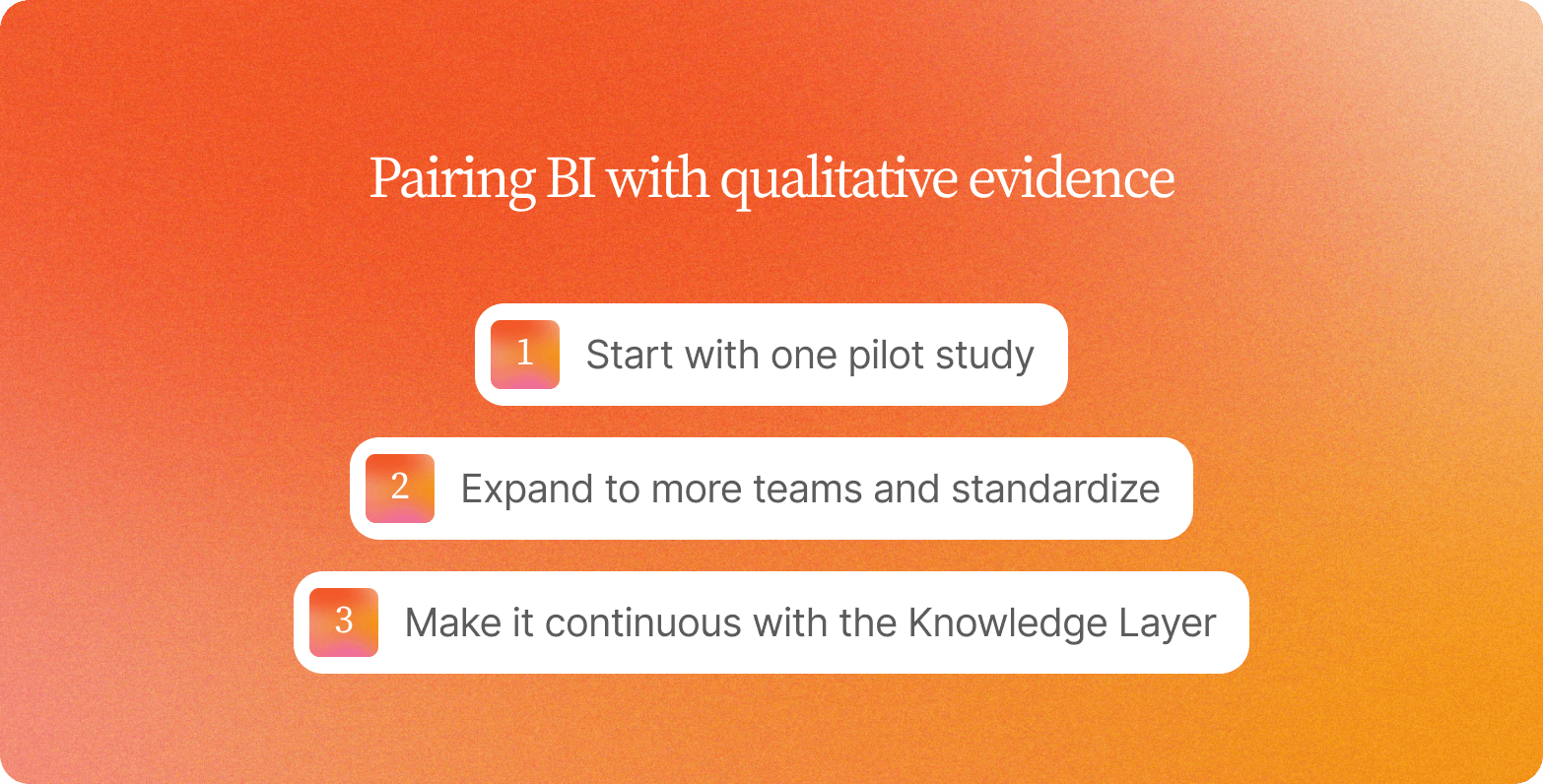
Adding qualitative evidence alongside BI requires teams to decide where it fits into existing workflows and how to manage it as more people start using it. A phased rollout gives teams a chance to answer those questions with one real use case before expanding the approach across the organization. Here’s what that might look like.
Phase 1: Start With One Pilot Study
The first 30 to 60 days should focus on one important question already evident in the data, such as a drop-off in adherence. This gives the team enough time to run a single qualitative study and determine whether the findings provide useful context for a real decision.
Starting with a high-stakes question means a successful pilot does double duty: it proves the method works and builds the case for scaling it, rather than just testing the tool in isolation. The goal of the pilot is to confirm that the findings meet clinical governance standards and that the platform itself passes a security review before anything scales.
Phase 2: Expand to More Teams and Standardize the Process
Over the following 90 to 180 days, expand to 3 to 5 use cases across different teams. That timeframe reflects the real workload: each use case still needs its own recruitment, interviews, and analysis, and now they're running across teams that weren't involved in the pilot and don't yet have a shared process to plug into.
Spreading across different functions early is important because a pilot that succeeds in one team doesn't automatically convince the others. Commercial, clinical, and product each need to see a use case that speaks to their own decisions before they'll trust the method.
This is also where the team builds study templates and consent protocols rather than rebuilding them for each new use case. Standardizing now, while the number of concurrent studies is still small, is what makes each additional study faster to launch than the last. It's also where stakeholders who weren't close to the pilot learn to verify evidence traceability, meaning they can trace a claim back to the clip or quote behind it, rather than taking a summary on faith, as the pilot team could after watching the process firsthand.
Phase 3: Make It Continuous With the Knowledge Layer
At full scale, qualitative programs run continuously alongside BI monitoring, rather than getting commissioned each time a new signal appears. Conveo's knowledge layer connects findings from every study a team has run, recognizing when the same patient cohort or clinician segment appears again in a different study. It flags what's changed since the last study touched that group, so the team isn't left to go looking for it themselves.
That means when a new BI pattern shows up, the team can check whether it's new or something they've already investigated before running anything else. Letting teams run their own studies safely matters at this stage too. Those same teams should be able to run studies inside the rules the expansion phase set up, without every study routing back through a central research team as a bottleneck.
Conveo StoryLines handles that continuous research: it conducts interviews in waves, and at the close of each wave it performs signal detection on the results, turns what it finds into insights, and automatically delivers reports and quote reels. A one-off study analyzes a picture. StoryLines analyzes a video, where each wave is a frame, and the knowledge layer is what keeps every frame connected to the ones that came before it.
"I don't think it's the case anymore that doing research has to be this big investment in time and money, but mainly time, this chore that slows everything down. I think it can be a resource that you can just and should just tap into constantly and frequently as you're making decisions."
Matt Harris, Research & Insights Lead EMEA, Canva
Why Healthcare Business Intelligence Solutions Fail
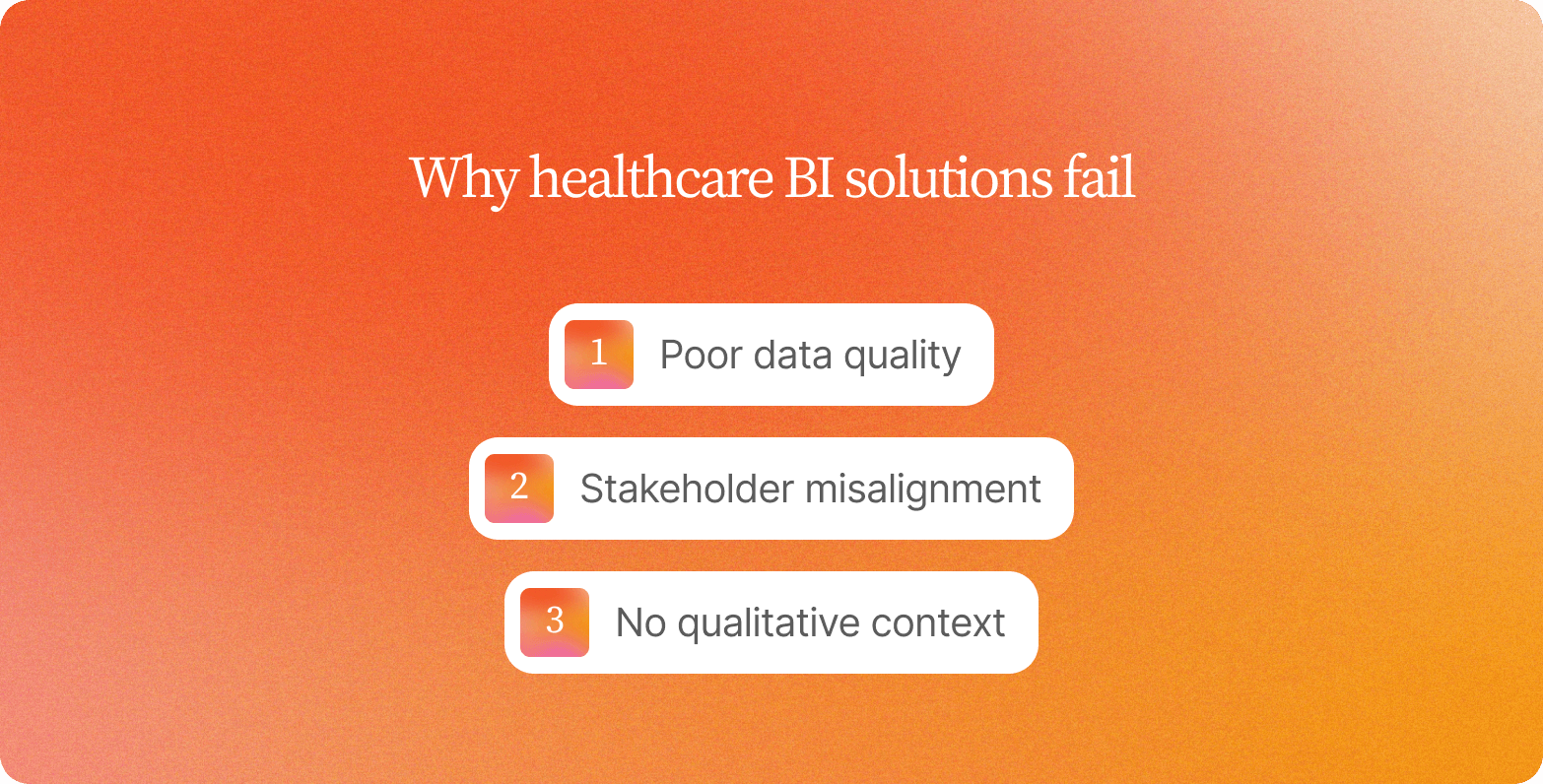
Healthcare BI projects can stall even when the underlying technology works as intended. Often the real problem sits somewhere the dashboard itself can't fix, whether that's earlier in the data collection method or later in how someone is supposed to act on it. The table below breaks down where these problems tend to start and how to fix each one.
| Problem | Why it matters | How to fix it |
|---|---|---|
| Poor data quality | Legacy systems, data silos, and inconsistent coding can make the numbers unreliable. Healthcare professionals may spend time debating whether a signal is real before they can respond to it. | Set clear data standards and consistent coding rules before building dashboards or layering additional research onto the data. |
| Stakeholder misalignment | BI teams can build dashboards that answer technically valid questions but don’t support the decisions stakeholders need to make. The result is a dashboard that sees little use. | Involve the people who will use the dashboard when defining the questions and decisions it needs to support. |
| No qualitative context | Teams can see that a metric has changed without understanding what caused it, leaving them without a clear action to take. | Pair BI monitoring with qualitative research that investigates the experiences behind important signals and provides the context needed to respond. |
Addressing these issues can support healthcare BI adoption by making dashboards more reliable and more relevant to the decisions teams need to make.
How Conveo Delivers the Why Behind Healthcare Data Signals
You can already see where patients drop off or where satisfaction declines from your business intelligence software. Connecting those signals to qualitative evidence helps you understand what's happening in the experiences behind the data, so you can decide where to intervene.
Conveo supports that approach by giving you a way to build patient and clinician understanding alongside your existing healthcare BI systems. Here’s how:
Skip the step of commissioning a new study. The research runs continuously, so when a metric moves, you can investigate the experiences behind it without starting the research process from scratch.
Give stakeholders evidence they can check. Conveo was built by researchers, and every finding traces back to the real interview it came from, through video and verbatim evidence. That gives clinical and commercial stakeholders a way to inspect the evidence behind a finding when a decision needs to hold up under scrutiny.
Build on what you've already learned. The knowledge layer connects findings across your studies and surfaces when a pattern in patient, caregiver, or clinician research has shown up before. As your programs continue, that body of evidence makes it easier to investigate new BI signals rather than researching the same question again.
Meet enterprise procurement requirements from the start. Conveo is SOC 2-certified, GDPR-compliant, and offers regional data hosting, giving you the compliance infrastructure and data security that procurement expects.
Get evidence in time to inform the decision. AI-moderated research shortens the time it takes to gather qualitative evidence, so you can investigate the reasons behind a changing metric while the decision is still in front of you.
The result is a more complete view of what's happening across the healthcare experience. BI identifies the pattern. Qualitative evidence explains it. Together, they give you a stronger basis for deciding what to do next.
"The companies that win from here are the ones who have the greatest understanding of their consumers and apply that understanding for the key decisions in their business."
Matt Harris, Research & Insights Lead EMEA, Canva
Frequently Asked Questions
What is the healthcare business intelligence definition?
Business intelligence in healthcare turns data from across an organization into information teams can use to monitor performance and make decisions. It can bring together data from sources such as electronic health records, claims, and billing systems to show where performance is changing or where a problem may need attention.
What are examples of business intelligence in the healthcare industry?
Healthcare BI software uses data visualization and interactive dashboards to show where changes are occurring, so the team knows where to investigate. Healthcare organizations might use that data analysis to spot a fall in prescription refills, a change in clinician prescribing, or an increase in patients dropping out of a care pathway.
What is the role of business intelligence in healthcare?
Healthcare and business intelligence are connected through the data organizations use to understand how care is delivered and where performance is changing. BI's role is to show teams what is happening across a population. It can reveal when a metric moves, a trend emerges, or an unusual pattern appears, helping teams identify where they need to investigate further. Qualitative research can then help explain the experiences behind that pattern.
Why is business intelligence important in healthcare?
Business intelligence for the healthcare industry helps organizations spot patterns across large numbers of patients and identify problems that may not be visible on a case-by-case basis. This gives teams data-driven insights into where attention is needed and can help them respond before a problem becomes more widespread. The goal may be to improve patient outcomes and population health or support better financial performance.
What types of business intelligence are used in healthcare?
The use of business intelligence in healthcare depends on their existing systems. Some centralize information in a data warehouse and add a reporting layer, while others build analytics directly into clinical or operational systems. The approach to business intelligence and healthcare matters less than whether teams can access reliable data and use it to answer the decisions they need to make.
What is the difference between business intelligence and analytics in healthcare?
Business intelligence for healthcare generally focuses on showing what has happened or what is happening, while healthcare analytics can also be used to predict what may happen next. In practice, both help healthcare institutions understand patterns in the clinical data and decide where to investigate further.

About the author
Emmie Yurchuk
Research Impact Lead
Emmie is from Toronto and has lived in Antwerp for seven years. She came from research and agency consulting and was in client calls from day one, in a room of clients in Switzerland by day seven, and giving analysis training by day twelve. Relationships are the part of the job she cares about most.
Meet Emmie on film →Qualitative insights at the speed of your business.
Conveo runs AI-moderated video interviews and structures everything they say.