In this article
TL;DR
Customer journey optimization means finding where customers get stuck at each touchpoint and fixing the problems that cost you sales or repeat purchases.
Analytics show where customers drop off, and customer interviews explain why, so you need both to choose the right fix.
Without customer evidence, teams fix what they assume is wrong, or whatever looks biggest on a dashboard.
This guide is for insights and CMI teams at consumer brands. It compares four approaches to customer journey optimization and shows how to build evidence stakeholders can check.
A customer journey runs across many touchpoints, from the first ad someone sees to the moment they decide whether to buy again, and a problem at any one of them can lose you the sale. But finding those problems is only half of the solution. Without knowing why customers struggle at each touchpoint, teams can spend their time and budget on fixes that don’t work.
This article covers different methods to optimize your customer journey and the common mistakes to avoid. It also shows how to gather customer evidence you can act on, from choosing which customers to interview to keeping findings current as customer needs change.
What is customer journey optimization?
Customer journey optimization is the process of analyzing data from customer interactions, or touchpoints, across the entire customer lifecycle and taking action to improve them. Here’s what that can look like in practice:
Interviews with new skincare customers show they expected faster results because the ad promised them, so you rewrite the product page to match the ad.
Analytics show shoppers switching back and forth between pack sizes before leaving, and follow-up interviews reveal they can’t tell which size suits them, so you add a simple comparison chart.
Checkout data shows most people abandon their cart at the final step, where delivery costs first appear, so you show those costs on the product page.
While customer journey optimization involves looking at individual customer interactions, the ultimate goal is to reduce overall friction to improve satisfaction and drive customer loyalty.
To make customer journey optimization as effective as possible, you need direct evidence from customers, including quantitative and qualitative data. Without evidence, teams end up guessing why customers struggle and spend time fixing the wrong thing.
In customer journey analysis, numbers like checkout drop-off show where customers get stuck, and interviews explain why, so you can choose the fix that genuinely solves the problem.
Different approaches to customer journey optimization
There are different ways to approach customer journey optimization, depending on how much time and research budget your team has. Here are the main four.
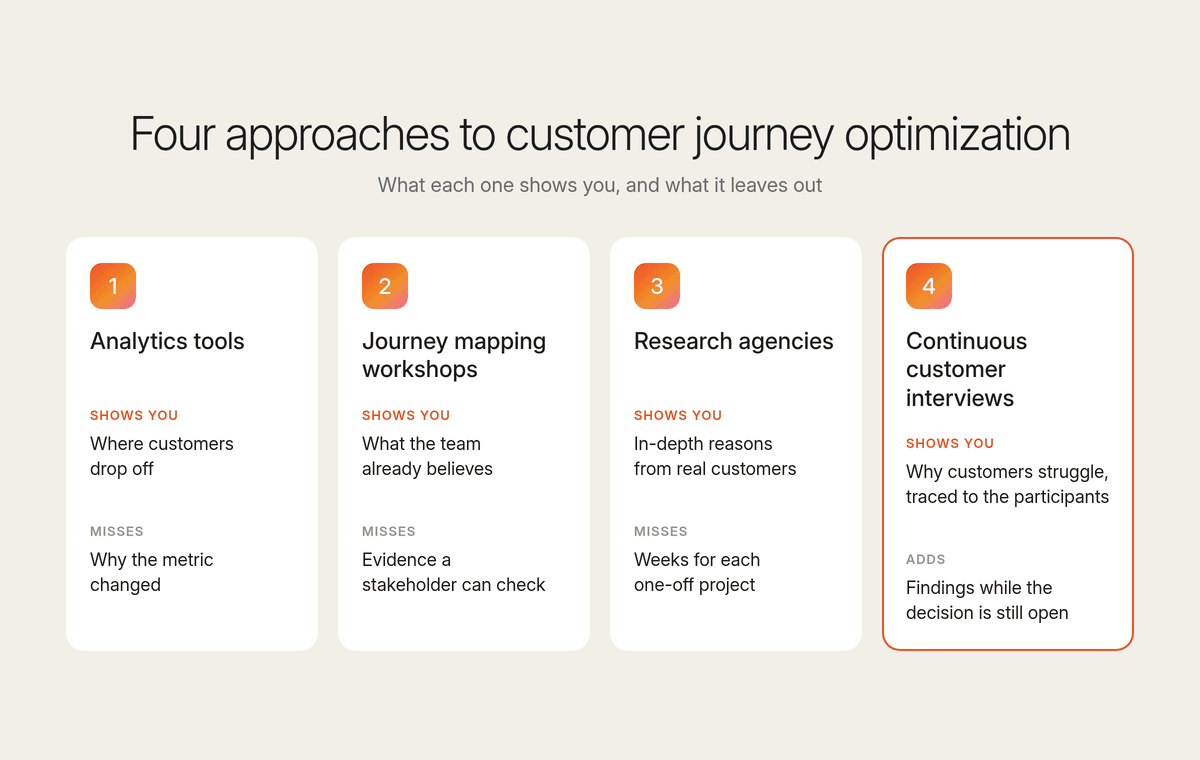
1. Analytics tools: good for spotting where customers drop off
Analytics tools show you when metrics drop, making it easy to spot areas of the customer journey that need attention. They’re often the first port of call for teams wanting to optimize the customer journey because they’re tools they already have.
For example, Google Analytics might show fewer shoppers reaching checkout after a site redesign, or subscription data might show more people canceling after their third delivery.
Analytics tools hit a limit when teams want to find out why those metrics changed. A spike in cancellations could mean subscribers didn’t like the product or that they simply had too much at home. Without knowing which, a backlog built on analytics alone puts the biggest numbers first, whether or not they’re the problems costing you customers.
2. Journey mapping workshops: quick to run, based on what the team already believes
Journey mapping workshops get people from different teams agreeing on what the customer journey looks like, mapping each stage from first hearing about the brand to buying again.
During the customer journey mapping process, people draw on what they’ve seen or heard in their own roles. For example, someone from customer support might mention that customers keep asking about delivery times, prompting discussion about how to improve them.
Those anecdotes are useful, but they’re secondhand and hard to check. When a stakeholder asks how many customers had the problem, or which customer said it, there’s often no answer, so the priorities are hard to defend.
3. Research agencies: in-depth findings with extended timelines
Research agencies interview real customers about their journey, so you find out why people struggle at a touchpoint and how it affects the customer experience. You brief the agency on the part of the journey you want to understand, and they recruit participants and run the interviews before delivering a report with recommendations.
These types of research projects often provide useful findings, but can take weeks to complete. By the time the report lands, you may have already had to decide what action to take. Each project is also a one-off, so checking whether anything has changed means commissioning a new project.
4. Continuous customer interviews: evidence you can trace to the participants behind it
Continuous customer interviews let you talk to customers about their journey whenever a question comes up, so you find out why they struggle at a touchpoint before you decide what to fix. Teams run these as AI-moderated video or voice interviews, as they don’t require scheduling human moderators for every session.
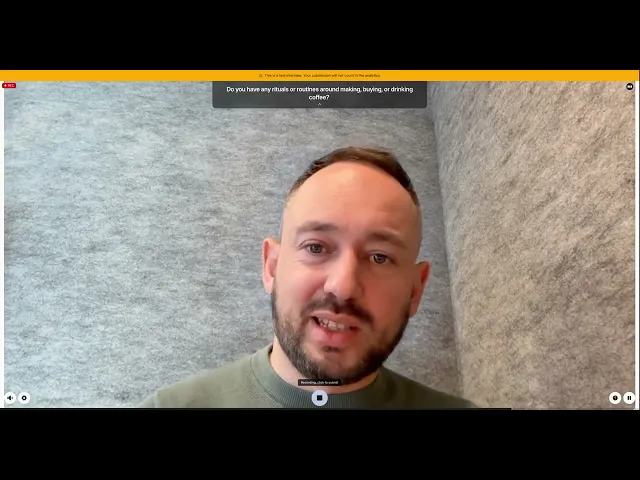
On Conveo, every theme links back to the participants behind it, with the video clip and quote, so anyone reviewing a finding can check where it came from. Conveo’s AI research assistant asks follow-up questions when an answer is vague or leaves a gap, building on what the customer said earlier.
See how Conveo links every journey problem to the customer evidence behind it. Start for free.
4 common customer journey optimization mistakes and how to avoid them
Whichever approach you choose, there are some common pitfalls to be aware of that can undermine your optimization efforts. Here’s what to look out for.
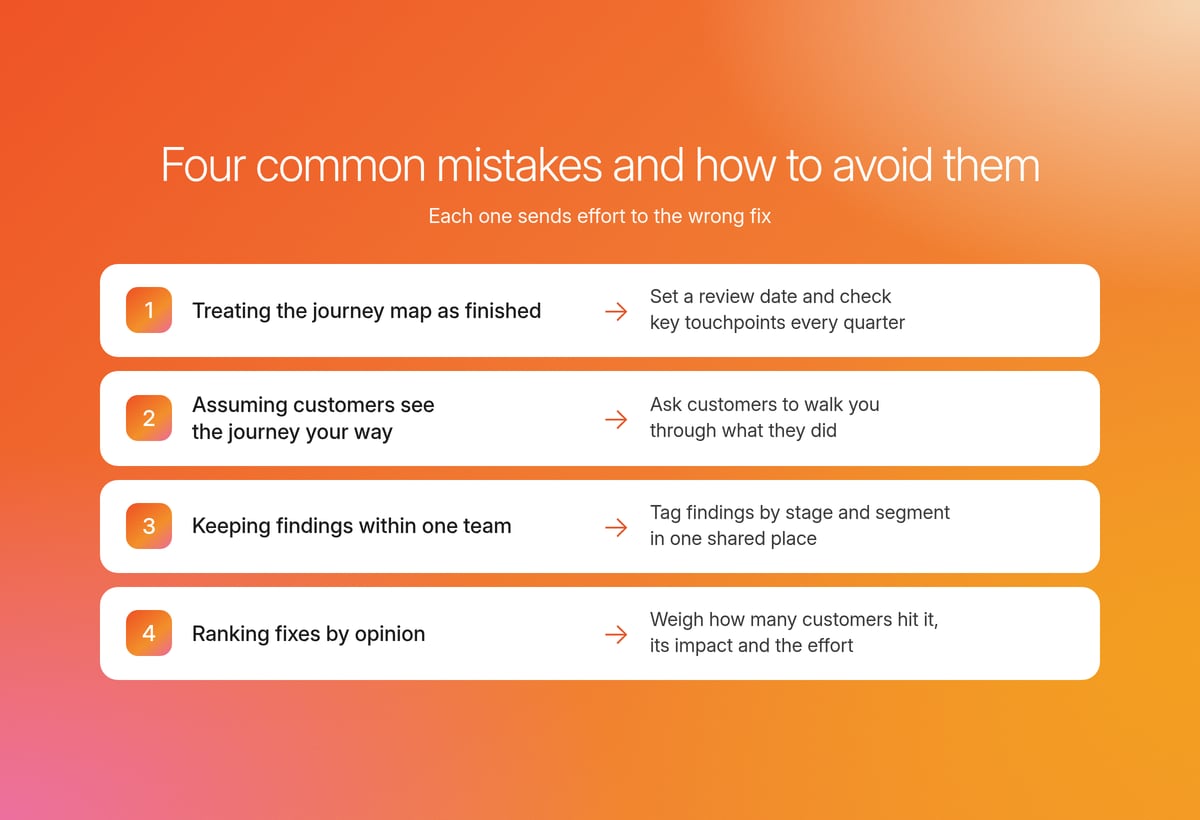
1. Treating the journey map as a finished product
A customer journey map captures how customers interact with a business at a particular point in time. But customer behavior changes as businesses update their products, adjust prices, introduce new processes, and face new competitors.
A map created a year ago might no longer reflect the problems customers encounter today. Set a date to review the map, and revisit it sooner after any change that could affect customers. Between reviews, watch for shifts in repeat purchases and cancellations, and check the main touchpoints with customers at least once a quarter.
2. Assuming customers see the journey the way your team does
Steps that may seem obvious to someone who works with a product every day can prove confusing or frustrating for customers. When teams build journey maps around their own experiences, they risk recording assumptions about customer behavior as established facts.
Before you change a touchpoint, check your team’s assumptions with customers. Ask them to walk you through what they did, and note the moments where what happened wasn’t what they expected. Where their account differs from the map, correct the map first, then decide whether the problem needs a fix or more research.
3. Keeping customer journey findings within one team
Each team collects its own customer evidence, from support complaints to email engagement data. When these findings stay in separate systems or reports, teams can miss connections between problems and struggle to agree on what needs attention.
Keep journey findings in one shared, searchable place, such as customer insights software. Tag them by journey stage and customer segment, so any team can find the evidence without requesting a report. A regular review where teams agree who owns each recurring problem stops issues falling between teams.
4. Ranking fixes by opinion
Without customer evidence, priorities tend to follow the most senior opinion or whichever metric looks most dramatic on a dashboard. This can potentially push common but minor issues ahead of rarer problems that have a greater effect on customer satisfaction.
For every potential fix, use analytics to see how many customers hit the problem and interviews to find out whether it makes them abandon a purchase or cancel. Weigh that against the effort to fix it, and record the evidence behind each decision so stakeholders can see why one problem comes first.
Build customer journey evidence stakeholders can check
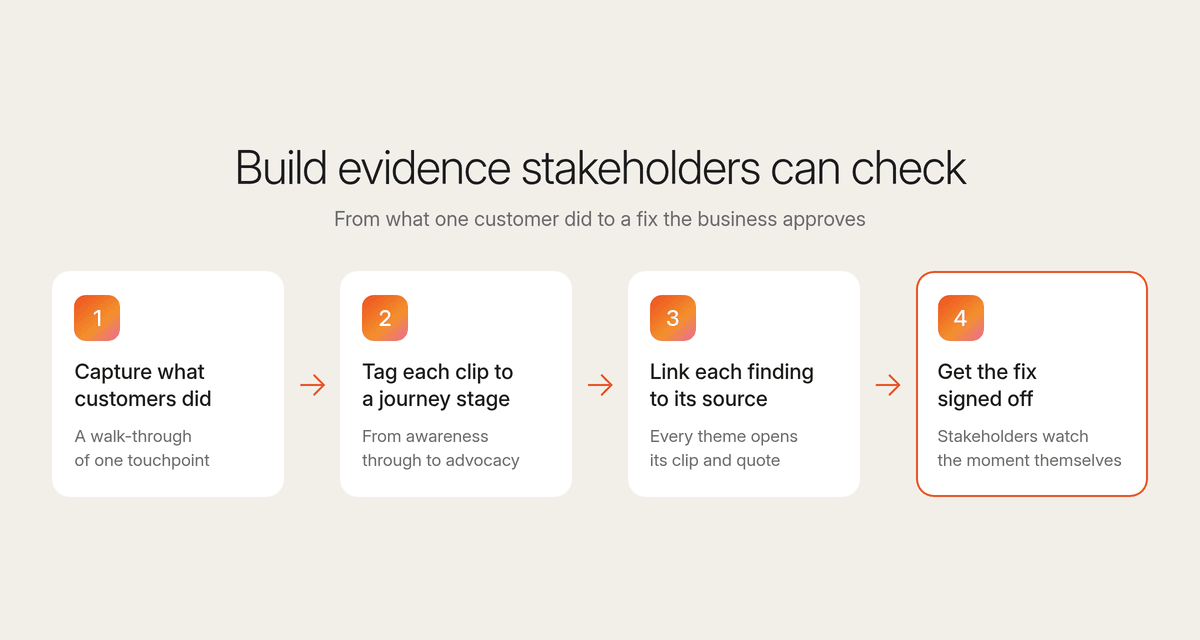
When putting together a plan for customer journey optimization, having evidence of your findings that stakeholders can check makes it far easier to get fixes approved. Here’s how to build it:
Capture what customers actually did. Ask customers to walk through a touchpoint step by step. Workarounds, like a shopper screenshotting their basket to compare prices somewhere else, show where the journey is failing them. So do moments where what customers say doesn’t match what they did.
Tag each clip to a journey stage. Label every clip and quote with the stage where the problem happened, from awareness through to advocacy. Over time, the tags show which stages cause the most trouble.
Link every finding to the customer behind it. When stakeholders ask whether they can trust AI analysis, show them the source. On Conveo, each theme links to the video clip and quote it came from, so stakeholders can watch the moment for themselves. Researchers can inspect and correct the analysis before it reaches a report, and it picks up tone of voice and, on video, facial expression as well as what was said.
Building evidence into your process from the start means that you can move from findings to fixes quicker, as everyone is confident you’re working on the right things.
How to choose which customers to interview
Interviews are essential for finding out why customers struggle at a touchpoint, but you can’t talk to everyone who hit a problem. A smaller, representative group can give you enough valuable insights to make a plan of action without drowning in research.
Say you run a skincare brand, and your online store data shows that most first-time buyers never place a second order. That could be thousands of customers a year.
You might start by splitting the group by the actions they took. You could look at order history to group customers who bought once and never came back from customers who reordered a few times and then stopped. The two groups dropped off at different points in the journey, so they may have quite different reasons. You would interview them separately so those reasons don’t get blended together.
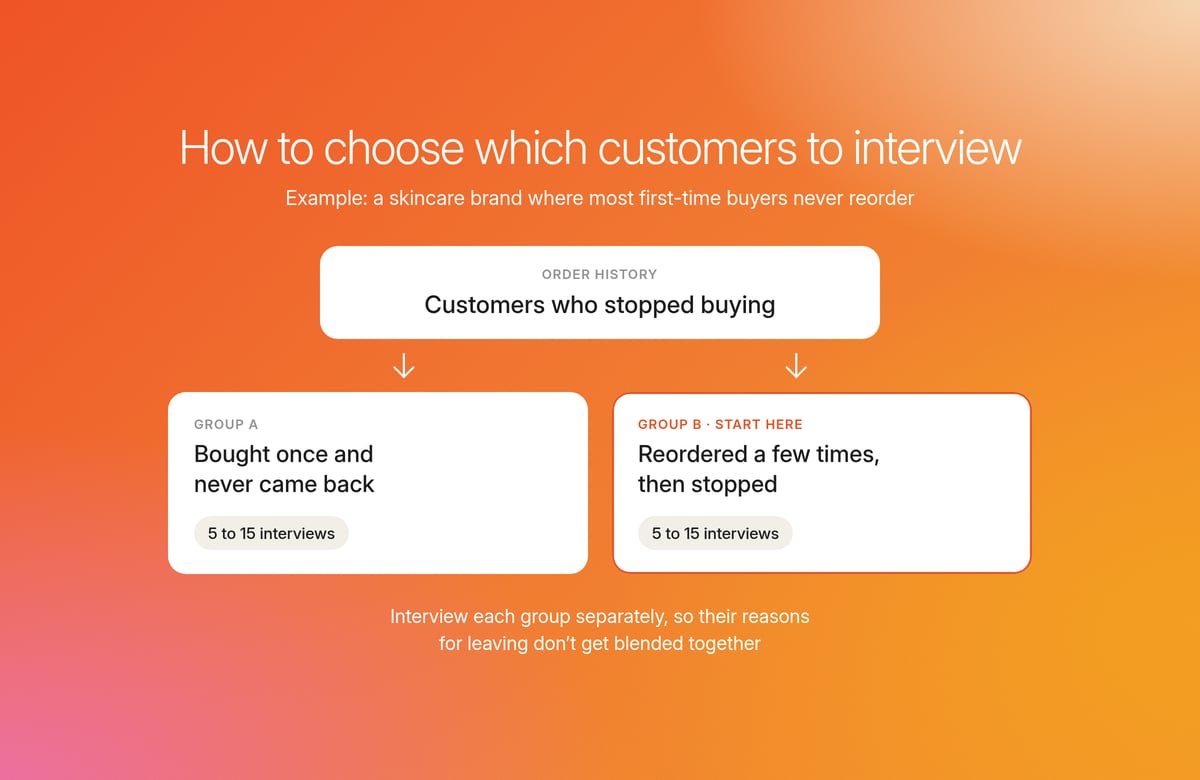
Aim for five to 15 people per group for interviews, starting with the customer segments you can least afford to lose. In this example, that could be customers who used to reorder regularly. In each interview, you would ask customers to walk you through their last order and what happened after it, so you hear in their own words what made them stop buying.
With Conveo, you can invite customers from your own lists who’ve agreed to be contacted for research, or recruit through eight panel partners, using screener questions to find consumers who match your needs.
Optimizing customer journeys across markets and languages
If your brand sells in more than one country, the same customer journey touchpoints can cause different problems in each market, and customer expectations can vary wildly.
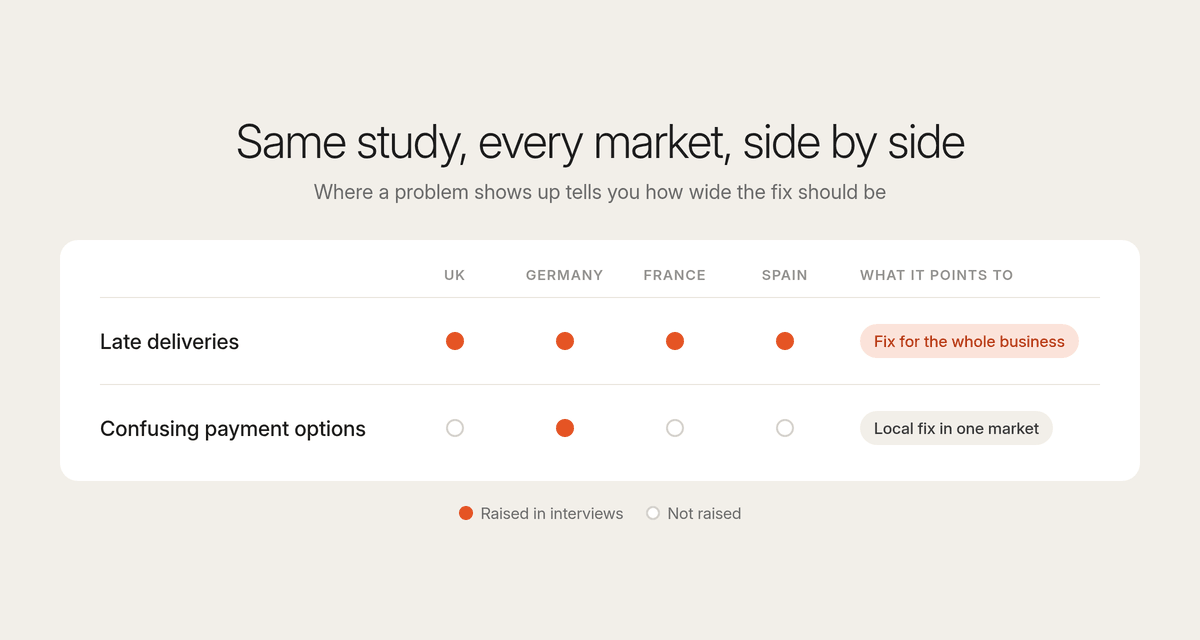
To compare markets fairly, run the same study in each one, but customers explain what went wrong most clearly in their own language. Interviewing only in English would leave out shoppers who don’t speak it. Conveo runs AI-moderated interviews in 50+ languages, so you don’t need a separate local agency or translator for each country.
Watch Hendrik, Conveo co-founder and CPO, show how language settings work in a multi-market study:
With journey insights from each market side by side, you can tell which fixes belong everywhere and which specific touchpoints need a local fix. A complaint about late deliveries that comes up in every market points to a change for the whole business, while confusion about payment options in one country needs a fix in that market only.
How to make each round of customer journey research build on the last
Customer needs and expectations shift over time, so a fix that worked last year can stop working, and new customer pain points appear. When findings from individual studies are siloed, those changes are hard to spot.
On Conveo, every study goes into a searchable insight library. Recurring themes are recognized across studies, so each new round of research starts from what customers have already told you about the entire journey.
For questions that come back regularly, such as how customers feel about delivery, Conveo StoryLines runs interviews in waves, for example every two weeks or monthly. After each wave, Conveo compares the new results with earlier waves and flags what changed. That shows you whether a fix is still working, and catches new problems at key moments in the journey.
Base customer journey optimization on evidence you can check with Conveo
To optimize the customer journey, you need to know why customers struggle at each touchpoint, and stakeholders need to see the evidence before they approve a fix.
Conveo gives insights teams that evidence from real consumers and keeps it current as the journey changes. Here’s how it supports customer journey optimization:
Interviews run whenever a journey question comes up, so each decision about what to fix is based on what customers are saying now.
Each finding comes with the clips and quotes from the customers who raised it, so stakeholders can watch the moment for themselves before they approve next steps.
Every study goes into a searchable insight library, so findings from different teams and rounds of research sit in one place, and the next study starts from what’s already known.
Conveo is SOC 2 Type II and ISO 27001:2022 certified, GDPR compliant, with EU hosting in Belgium.
Participants can answer in 50+ languages, and findings arrive while the decision about what to fix is still open.
More than 400 enterprises, including Google, AB InBev and Canva, use Conveo to understand their consumers.
"The pace, responsiveness, and research expertise of the Conveo team, on top of the top AI-moderated qual platform, have been invaluable to us in scaling brand advertising internationally."
Matt Harris, Research & Insights Lead, EMEA, Canva
Frequently asked questions
What should be in a customer journey optimization template?
A customer journey optimization template lists each of the customer journey stages, from initial awareness to buying again, with the touchpoints customers use at each one. For every touchpoint, note the pain points you’ve found and the evidence behind them, such as customer feedback or conversion rates. Adding the planned fix and a success metric lets you check later whether the change worked.
What’s a good framework for customer journey optimization?
Most frameworks follow the same loop: map the journey from the customer’s perspective, then fix problems and measure the results. The step teams tend to rush is deciding what to fix first. Rank each problem by how many customers it affects and how much it changes their actions, so the problems that hurt customer retention get fixed first.
Is there a certification for customer journey optimization?
There’s no single, widely recognized certification for customer journey optimization. Customer experience (CX) certifications often cover journey mapping and journey management, and courses in customer research teach you how to understand customer behavior and spot where people struggle.
What’s the difference between a customer journey map and customer journey optimization?
A customer journey map is a visual representation of how customers interact with your brand, from first hearing about it to buying again. Customer journey optimization is the work of deciding which problems on that map to fix and in what order, using customer data and feedback.
What are the 5 stages of the customer journey?
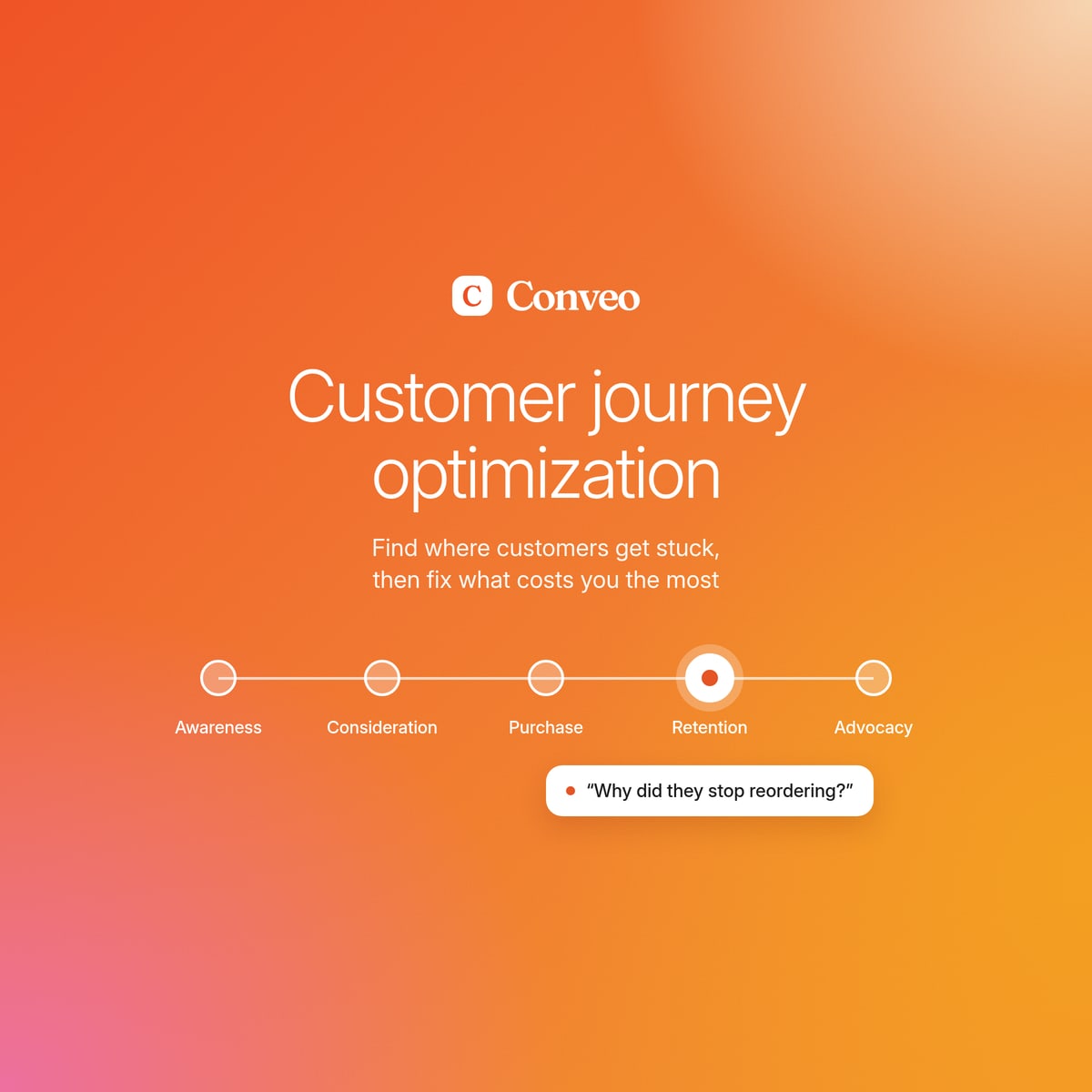
Most models use five customer journey stages: awareness, consideration, purchase, retention and advocacy. A potential customer hears about the brand, compares options and buys, then either keeps buying or drifts away, and loyal customers go on to recommend it. Mapping the customer touchpoints at each stage shows where people get stuck along the entire customer journey.
What is the McKinsey customer journey framework?
McKinsey’s consumer decision journey, published in 2009, swaps the traditional purchase funnel for a loop. Consumers start with a few brands in mind, add and drop brands as they compare, and buy, and the experience after purchase decides whether they stay loyal or start searching again. For customer journey management, the main lesson is that brand loyalty is won or lost after the sale.

About the author
Dieter De Mesmaeker
Co-Founder & CEO
Dieter is CEO and co-founder of Conveo. Before starting the company, he founded DataCamp and scaled it into one of the leading edtech platforms in the world.
More by Dieter →