In this article
TL;DR
Research that arrives after the decision closes might as well never have happened. Velocity and hit rate on emerging market trends now decide who stays competitive.
Market intelligence insights fail stakeholder scrutiny whenever someone asks "who actually said this?" and the answer is a percentage rather than a traceable participant.
Always-on customer understanding closes the gap between what teams know and when they need to know it, turning ongoing monitoring of customer behavior into usable intelligence.
Every finding should trace back to a real person who said it on video, with verbatim quotes and timestamps that stakeholders can verify.
A compounding insight library means that nothing gets researched twice, and past findings remain usable for new decisions.
The goal is key insights that are also actionable: specific enough to act on immediately, and traceable enough that no one has to argue about whether they're real.
The research that was supposed to inform your market positioning arrives after the campaign brief was already locked. Intelligence that arrives after the decision closes is already history, a record of a market shift nobody could act on in time.
That is the operational reality for most insights teams running market intelligence research in a business environment where category leadership turns over every fiscal year. Velocity and hit rate now decide who stays competitive, and neither survives a research process that works in quarterly batches. Timing is only part of the problem. A CMI director presents a conclusion: customers are switching because the category feels commoditized, and market share is eroding as a result. The room asks who said that. The answer is a demographic aggregate, a percentage of 18-to-34-year-old urban shoppers, not a person with a name and a reason. At that point, the insight loses the room. Decisions revert to the opinions of whoever argues most confidently, which is exactly the outcome research was supposed to prevent. Get it wrong here, and the cost lands where it matters most: revenue growth stalls, financial health metrics slide, and investment risk builds on initiatives nobody rechecked.
Quantitative data captures the shape of the problem. A survey might show that 62% of your target segment now prioritizes convenience, a signal about consumer preferences that still doesn't explain why. Those numbers are real, and they matter. But a survey cannot capture the hesitation before a participant answered, the contradiction that emerged two questions later, or the workaround they built because your product almost solved their problem. That is often where the actual answer lives.
Traceable evidence resolves this and enables informed business decisions to be made faster than the market moves. When every finding connects back to a real participant, a recorded conversation, a verbatim quote with video, the question "who actually said this?" has a direct answer. That traceability is also what turns research into competitive advantage rather than documentation nobody trusts.
What Makes Market Intelligence Insights Actionable
Not every market intelligence insight is actionable, and not every customer insight survives a stakeholder meeting. Most fail before they reach a decision, not because the data is wrong, but because the person presenting it cannot answer the question that follows: "How do you know?" A percentage from a survey report is a claim without a witness. When a stakeholder pushes back, there is nothing to return to. The interpretation becomes the argument.
Teams that gather market intelligence data from a single source, one survey platform or one workshop exercise, are usually the ones stuck defending assumptions instead of evidence. Effective market intelligence insights don't just report what happened; they explain why, with evidence to back them up. Actionable market intelligence insights are defined by a different standard: every claim survives scrutiny because it traces back to a real person who said something specific, in their own words, on video.
Credible market intelligence also blends internal data, CRM records, support tickets, and win-loss notes with external data, such as competitor moves and category commentary, while maintaining the evidentiary trail. Survey-based intelligence reports what people said in aggregate. It cannot show you the pause before someone answered, the hedged phrasing that signals doubt, or the workaround a participant described unprompted. Video-backed research preserves those signals. A transcript captures the words; the recording captures the weight behind them. When a theme surfaces from 40 conversations, a stakeholder can click into the three clips that best represent it and hear the pattern rather than trust the summary.
"Super valuable... ahead of where most of your competitors are... quite a special way to analyze this data"
Matt Harris, Research & Insights Lead, EMEA, Canva
That traceability also solves a problem most organizations do not name directly: findings die in decks. A study runs, and six months later a different team commissions a study that partially overlaps with work already done. This is where a compounding insight library changes the calculus, and where teams that integrate market intelligence into positioning and product decisions, rather than filing it after a single presentation, get the compounding benefit. Market intelligence is only useful when stakeholders trust it enough to act on it without relitigating the source. Learn how to structure segments before recruitment so findings map cleanly across studies.
Why Traditional Market Intelligence Programs Fail the "Who Said This?" Test
The deeper problem shows up in the output itself. Traditional market analysis and most market intelligence reports organize findings by demographic splits: age bands, income tiers, job titles, and household composition. Those categories are easy to tabulate, but they do not explain why target customers choose your brand over a competitor last Tuesday.
A persona built on demographic averages tells you who your customer is on paper. It does not tell you what they believe, what they distrust, or what would make them switch. That gap between demographic description and behavioral explanation is where positioning work, and the pricing strategies built on top of it, breaks down.
The workshop stage makes it worse. Psychographic traits meant to explain customer behavior get assigned scores during internal sessions: "7/10 tech-savvy," "values authenticity," "motivated by status." Those scales feel precise until a senior stakeholder asks where the number came from. With no participant evidence behind it, no verbatim, no clip, the trait gets dismissed as copywriter intuition. The positioning territory fails not because the insight was wrong, but because it cannot be defended.
What changes the dynamic is capturing the full signal from the conversation, not just the words. AI-moderated interviews, where an AI moderator conducts depth interviews via voice and video, adapting its probing based on what participants actually say rather than following a rigid script, preserve the hesitation before a price reaction and the shift in register when a competitor is mentioned. Those signals are what transcript-only approaches miss, and they are what makes a psychographic trait defensible rather than dismissable. The traceability standard should apply across all market intelligence activities a team runs, from a single interview to a company-wide StoryLines program.
Teams that embed traceable participant evidence directly into positioning territories and message hierarchies stop having opinion contests in creative reviews. When a claim about customer motivation links back to a specific person who said it on video, the debate shifts from "do we believe this?" to "what do we do with it?"
How AI-Moderated Interviews Turn Market Signals Into Defensible Intelligence
The depth of a market intelligence program depends less on how many questions you ask and more on whether participants have room to answer honestly. Conveo's AI moderator follows what participants actually say, not a predetermined script. When someone hesitates, contradicts themselves, or surfaces an unexpected concern, the moderator probes that thread rather than moving to the next question, capturing friction that surveys flatten into a rating scale.
See it in action: How AI-Moderated Video Interviews Actually Work
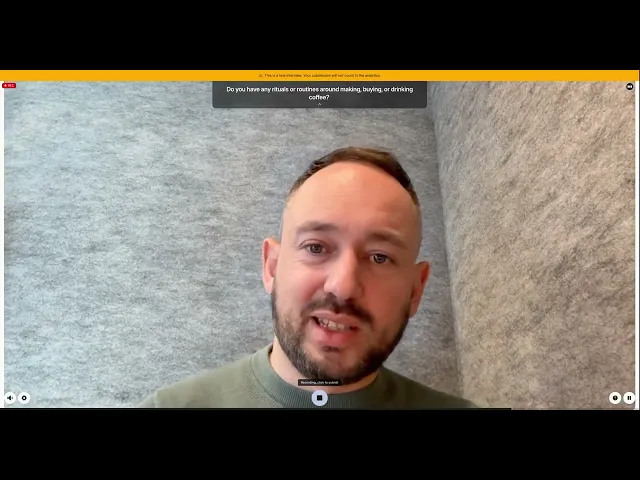
Scale changes what becomes researchable. Running 10 to 1,000 conversations simultaneously means an insights team no longer has to choose which target market gets studied this quarter. Multi-market research has historically required weeks of localization work and the coordination of briefings across agencies in different regions. Conveo's AI moderator conducts interviews in 50+ languages, with automated transcription and translation running in parallel with fieldwork, so thematic synthesis starts while the last interviews are still in the field. The same evidence layer applies when a team is evaluating market entry into new markets, not just refreshing personas in markets it already serves.
That same interview structure is also how teams identify trends while they're still forming: emerging trends, technology adoption patterns, and reactions to emerging technologies surface in real conversations rather than in a competitor's launch or an analyst note confirming the shift after the fact. That is what lets a team anticipate market shifts rather than react to them once competitors have already done so.
The evidence layer is what converts findings from opinion into something stakeholders can stand behind. Every theme Conveo surfaces links directly to timestamped video clips from the participants who expressed it. When a brand director challenges an interpretation, they can verify the claim with a single click. That traceability is what makes market intelligence insights defensible in a stakeholder meeting, well beyond just credible to the researcher who ran the study.
The Compounding Insight Library: Why Nothing Should Be Researched Twice
Most teams know their personas are out of date. They built them 18 months ago; the market has moved, and the research to refresh them is sitting months out on an agency timeline. So decisions keep getting made on intelligence everyone privately doubts.
Conveo's searchable insight library solves this: a repository where every past clip, theme, and verbatim quote stays organized, indexed, and retrievable. When a researcher investigating Gen Z price sensitivity in a specific market segment can surface what the innovation team learned in Q1, the organization stops paying to learn the same things twice.
The architecture of that library matters as much as its existence. Before a team can collect data at all, segment definitions need to be behavioral and established before recruiting begins, not constructed after analysis to fit a narrative. When the taxonomy is built around how people actually make decisions, insights from different studies map cleanly onto one another, and the library becomes a source of growth opportunities that the next study doesn't have to rediscover from scratch.
That traceability changes how market intelligence insights function inside the business. Findings become embedded in positioning territories, message hierarchies, and creative briefs because the answer is retrievable and sourced to a real person who said it on video, rather than to a supporting document attached after the fact.
Market Intelligence Insights vs. Market Research: What's the Difference?
Market intelligence insights are the continuous, always-on read of customers, competitors, and the broader competitive landscape that supports strategic decision-making across functions, well beyond just the team that commissioned a study. While market research answers a specific question at a specific moment, market intelligence builds a comprehensive understanding of the market that becomes more useful with every additional data point.
Market research is episodic: a question surfaces, a study gets commissioned, a report lands, and the findings age in a deck. Market intelligence is longitudinal, so a team running it doesn't start from zero when a new question arrives. This is exactly the gap that Conveo StoryLines, Continuous Consumer Understanding, is designed to close by running continuous programs in chapters and waves, so teams maintain an always-on evidence layer rather than a one-off answer.
Neither frame makes market research obsolete. A well-designed study, whether a depth interview series, an ethnography, or a concept test, is still the most rigorous way to investigate a specific question. The problem is when it's the only mechanism a team has. The strongest market intelligence programs treat primary qualitative research as the engine that explains the numbers behind the quantitative tracking.
Comparison Table: Traditional Market Intelligence Workflows vs. AI-Moderated Research
Traditional market intelligence workflows are strong on quantitative signals but consistently weak in providing qualitative explanations for why those signals are moving. The table below maps that gap across the dimensions that matter most for market intelligence insights.
| Dimension | Traditional Workflow | AI-Moderated Research (Conveo) |
|---|---|---|
| Continuous coverage | Periodic studies with gaps between waves | Always-on programs with findings that compound over time |
| Evidence traceability | Demographic aggregates, no participant clips | Every theme linked to timestamped video evidence |
| Multi-market execution | Sequential localization, weeks of coordination | Parallel interviews in 50+ languages, automated transcription |
| Stakeholder credibility | Insights fail scrutiny when you cannot answer "who said this?" | Stakeholders verify claims in one click |
| Research capacity | Limited by agency headcount and budget cycles | Expanded capacity to run studies that were previously impractical |
| Deep ethnographic immersion | Established strength: trained human researchers excel at extended in-context observation over hours or days | Best suited for structured depth interviews; long-form ethnographies still benefit from human moderation |
Note: "Always-on programs" reflects teams using continuous research models; cadence and design vary by category velocity and organizational needs.
How to Evaluate Market Intelligence Platforms for Credibility
Before you shortlist any market intelligence platform, demand evidence of rigor, not just speed or scale. Business leaders don't need more demos; they need evidence they can stand behind in a board meeting, and decision-makers who skip this step end up defending assumptions rather than evidence. This overlaps with business intelligence dashboards that track pipeline, churn, and revenue in real time, but market intelligence software and tools are meant to explain the why behind those numbers, not just display them.
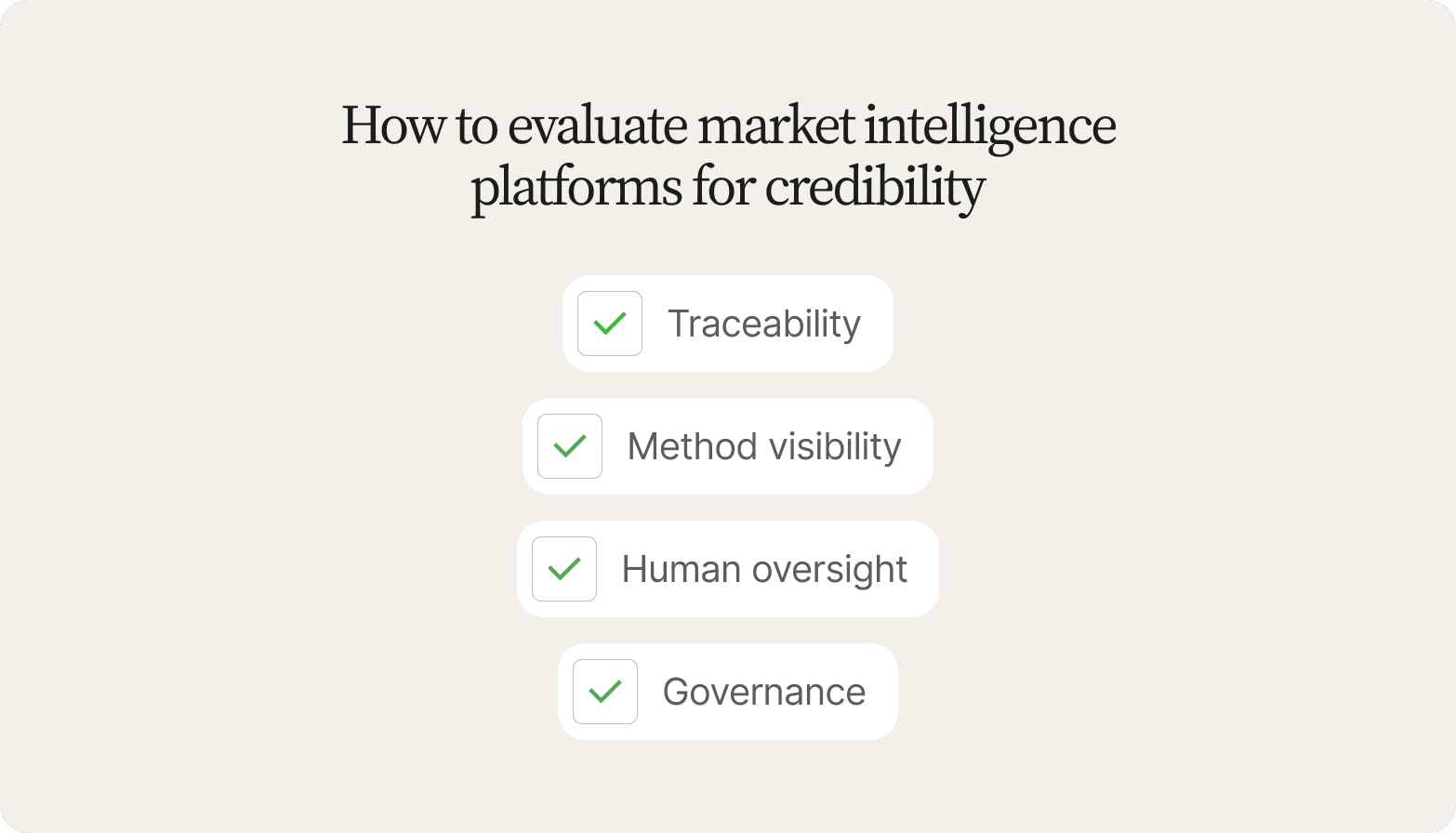
Four credibility signals separate trustworthy platforms from ones that will create problems at the stakeholder presentation.
Traceability
Every claim should link to a real participant clip or a verbatim quote, rather than just a demographic aggregate. If a platform cannot show you the source video or transcript behind a finding, the finding is not defensible.
Method visibility
The data collection method, discussion guide, sampling criteria, and synthesis process should be auditable rather than a black box. Intelligence quality depends on whether the path from raw data to the conclusion is visible, not just on whether the conclusion sounds right.
Human oversight
AI should handle the operational work: transcription, translation, thematic tagging across large volumes of customer interactions. Researchers must still design the study and interpret what the findings mean in business context.
Governance
SOC 2 and GDPR compliance, European hosting, and primary infrastructure in Belgium reduce the legal and procurement friction that stalls rollouts at large organizations. These are baseline requirements, not differentiators.
Synthetic AI personas, generated from behavioral data rather than real conversations, replace the discipline of analyzing data tied to actual people with pattern-matching that replicates the same problem as a poorly run workshop: confident claims with no traceable human evidence to back them up. When a finding cannot be verified against a real person who actually said it, the credibility of everything built on that finding becomes fragile.
How Conveo Closes the "Who Said This?" Gap
Go back to the CMI director from the opening of this article, presenting a conclusion to a room that immediately asks "who said that?" Every argument in between- the workshop scores nobody can defend, the survey percentage that isn't an insight, the four credibility signals above- points at the same fix: evidence that traces to a real person, not a demographic aggregate standing in for one.
That's what Conveo is built to close. Every theme links back to the video conversation that produced it, so the answer to "who said that?" is a specific participant with a timestamp, not a slide. Human oversight stays intact too: researchers still design the study, Conveo's AI moderator just makes sure a hesitation or contradiction gets followed up on instead of flattened into a rating scale, the same failure mode that sank the "7/10 tech-savvy" persona trait earlier in this piece.
The compounding side matters just as much as any single study, and it's where the competitive edge actually sits. With StoryLines running continuous programs in chapters and waves, teams get an always-on read of their market. The searchable insight library makes the Gen Z price-sensitivity example from earlier possible in practice, so the next researcher doesn't have to relearn what another team has already found.
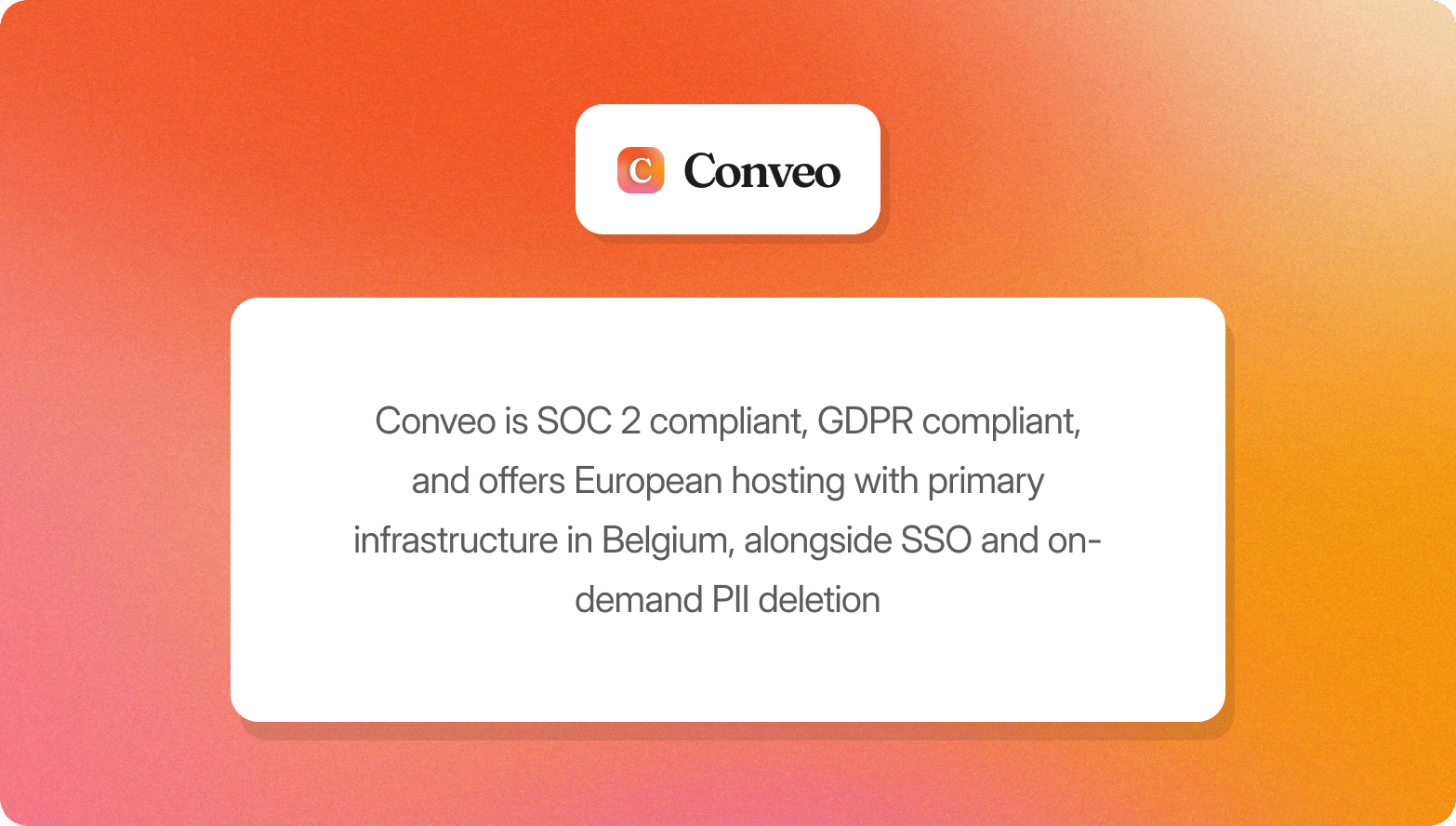
Procurement approval still comes down to governance. Conveo is SOC 2 compliant, GDPR compliant, and offers European hosting with primary infrastructure in Belgium, alongside SSO and on-demand PII deletion- the signal that lets research operations and legal teams sign off before fieldwork starts.
"The pace, responsiveness, and research expertise of the Conveo team, on top of the top AI-moderated qual platform, has been invaluable to us in scaling brand advertising internationally"
Matt Harris, Research & Insights Lead, EMEA, Canva
Frequently Asked Questions
What are market intelligence insights examples?
A strong example: "Enterprise buyers delay purchase decisions when they cannot verify ROI claims with peer references," supported by timestamped video clips of CFOs describing the objection in their own words. A weak example: "62% prefer convenience," a survey result that doesn't explain what "convenience" means to those participants. The difference is traceability: the moment someone asks "who actually said this?" and the answer is a percentage rather than a participant clip, the insight loses its power.
What is a market intelligence report?
A market intelligence report summarizes findings from continuous monitoring of customers, competitors, and category trends, typically delivered on a monthly or quarterly cycle. Unlike static industry reports that summarize an entire category at a glance, this kind of report is supposed to stay traceable to the individual participants behind it. Searchable insight libraries with embedded video clips solve the structural problem of a static PDF breaking the evidence trail.
How do you generate market intelligence insights from qualitative research?
Segment definitions should be behavioral and set before recruiting, not after, so findings map to real decision patterns rather than post-hoc storytelling. AI moderation that captures voice, video, and tone preserves contradictions and workarounds that a rigid script would never surface, and linking every theme to timestamped video clips lets stakeholders verify claims directly.
What is the difference between market intelligence and competitive intelligence?
Market intelligence is the continuous gathering and synthesis of understanding across customers, competitors, industry trends, and market dynamics. Competitive intelligence, sometimes called competitor intelligence, is a subset: a focused reading of competitive dynamics, what direct and indirect competitors are doing with positioning, competitor offerings, pricing, and go-to-market moves. It sits alongside related disciplines such as customer insights and product intelligence as another input to the full picture.
How often should market intelligence be refreshed?
At minimum annually, and more often in fast-moving categories, since persona and segment insights become unreliable within roughly six months of collection. Conveo StoryLines, Continuous Consumer Understanding, changes that calculus with always-on programs tracked across waves: quarterly refreshes for high-velocity categories like consumer tech and DTC, annual for slower-moving B2B markets, and continuous programs for brand health and product decisions.
Can AI replace human researchers in market intelligence?
AI handles the operational work: transcription, translation, thematic tagging, scheduling, and synthesis. Researchers design the study, write the discussion guide, and interpret what the findings mean for the business. Human oversight is the layer that separates research-grade intelligence from synthetic personas or survey summaries.

About the author
Alex de Hemptinne
Business Impact Lead
Alex is a Business Impact Lead at Conveo, partnering with enterprise teams to embed AI-led research into their workflows. From the first study to full-scale rollout, she helps customers shift from project-based research to continuous customer intelligence.
Meet Alex on film →Qualitative insights at the speed of your business.
Conveo runs AI-moderated video interviews and structures everything they say.