
TL;DR
A quantitative interview is a structured research conversation in which every participant answers the same questions in the same order, using standardized response formats, so that answers can be aggregated and compared across the sample. Conveo runs interviews like this at survey scale and reaches stakeholders in days, with every finding traceable to source.
A quantitative interview can produce aggregable, comparable data when designed correctly, but most researchers treat structured interviews like questionnaires and end up with shallow outputs that explain nothing.
This guide provides a framework for determining when a quantitative interview must remain structured, when it must remain qualitative, and how to combine both without sacrificing rigor.
For Research Ops teams, applying the right structure compresses the interview-to-insight cycle and produces participant-level evidence that stakeholders can audit and trace back to source.
Most teams using quantitative interviews are running them the wrong way. They treat the structured interview like a longer survey: a fixed script, closed-ended questions, and responses coded into a spreadsheet before the conversation ends. The result looks rigorous but produces the same shallow answers a well-designed survey would have delivered in a third of the time.
The core tension is familiar. Surveys are fast but miss the "why." Traditional qualitative interviews deliver depth too slowly to influence decisions already in motion. Quantitative interviews offer a middle path: structured, comparable data from real conversations rather than checkbox responses.
This article explains what quantitative interviews are, when they outperform surveys or qualitative methods, and how modern research teams can run them more quickly without sacrificing the rigor that makes findings credible.
What "Quantitative Interview" Actually Means
The phrase "quantitative interview" means two different things depending on where you sit, and this guide covers one of them specifically.
If you're preparing for a quant finance interview, the kind that tests statistical modeling, derivatives pricing, or algorithmic thinking, this article isn't the right resource. A quick search for "quant finance interview prep" will point you toward materials built for that path.
If you're a researcher or insights professional asking whether a quantitative interview is even the right method for your study, you're in the right place. This guide covers how quantitative interviews work as a research design choice: when they make sense, where they fall short, and how they compare to qualitative alternatives.
What Is a Quantitative Interview in Market Research?
Can interviews be quantitative? Yes, and the distinction matters more than most content on this topic suggests.
The goal is not to explore meaning but to produce data that can be aggregated, compared across participants, and analyzed statistically. What makes an interview quantitative is not the medium, but the design: closed-ended questions, controlled wording, and consistent administration that removes researcher interpretation from data collection.
The interview process for a quantitative study differs from that of an exploratory qualitative study from the first design step. Survey research and structured interviewing overlap heavily, which is why survey research applies many of the same principles: fixed wording, consistent sequencing, and closed-ended response formats. Unlike qualitative interviews, where a qualitative researcher develops new questions based on what a participant just said, a quantitative interviewer follows a fixed script so every interviewee responds to identical stimuli. Survey interviews and quantitative interviews are often used interchangeably in casual conversation, but the presence of a human or AI administrator, rather than a self-completed form, is what actually separates the two.
Quantitative interviewing differs from self-administered surveys in one important way. An interviewer, human- or AI-moderated, administers questions in real time or via structured asynchronous prompts. That presence ensures participants understand each question before answering, reduces item nonresponse, and improves completion rates. An email survey has no mechanism to catch a confused respondent. A structured quantitative interview does.
These quantitative interview techniques fall within the broader set of quantitative research methods used in social research, including telephone interviews, in-person interviews, and self-administered questionnaires.
Quantitative Interview Techniques and Question Formats
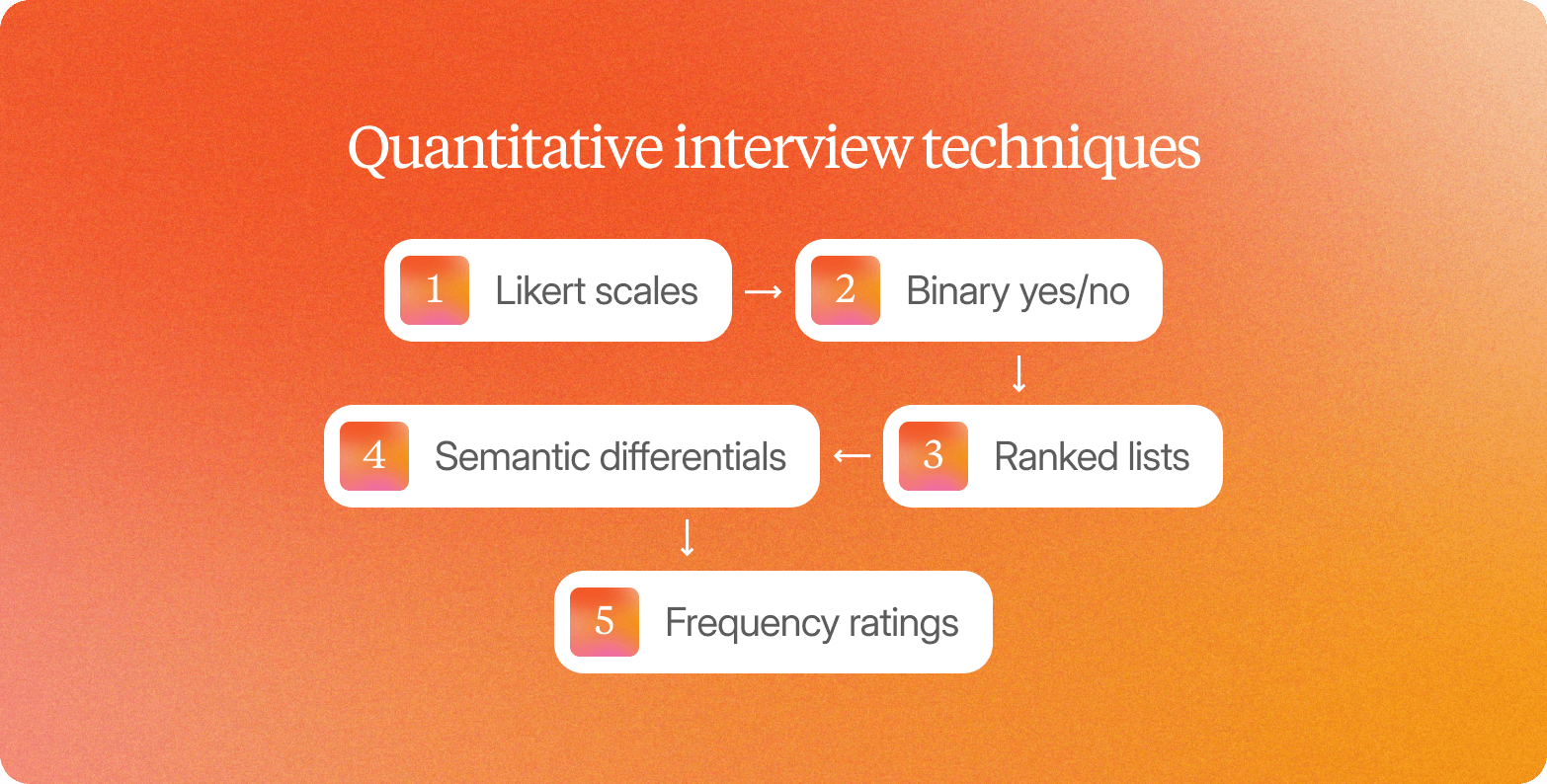
The question formats used in quantitative interview techniques are designed for measurement, not exploration:
Likert scales: "On a scale of 1 to 5, how satisfied are you with the onboarding process?"
Binary yes/no: "Did you use this feature in the past 30 days?"
Ranked lists: "Rank these three packaging options from most to least appealing."
Semantic differentials: Rating a brand on a scale between opposing adjective pairs, such as "traditional" and "modern."
Frequency ratings: "How often do you purchase in this category: daily, weekly, monthly, or less often?"
Quantitative interviewing spans several modes of administration, from traditional landline telephone interviews to in-person interviews and now to asynchronous video-based formats. Telephone participants and face-to-face participants may behave differently: phone interview participants cannot see a moderator's expression, while face-to-face participants may answer in a more socially desirable manner, underreporting strong opinions or hesitating to express dissatisfaction directly to a moderator sitting across from them. This is one source of interviewer effect, the tendency for responses to shift based on who is asking and how.
Well-designed studies minimize interviewer effect by standardizing tone, pacing, and wording so that noticeable differences reflect real differences among participants rather than variation due to the person asking. Standardized administration is a bias control, not a procedural formality: when wording, sequence, or response options vary across participants, the data becomes incomparable, and rigorous design treats every deviation as a data quality problem.
Quantitative interviews are the right method when you need measurable patterns across a sample but cannot rely on self-administration to guarantee comprehension, particularly in multi-market studies, with lower-literacy populations, or when question complexity requires guided completion.
When Interviews Can Be Quantitative (and When They Can't)
Interviews can be quantitative, but only under specific, controllable conditions. The answer matters because teams routinely misclassify their data, either by inferring statistical patterns from qualitative conversations or by discarding interview data that is sufficiently structured to support frequency analysis.
Quantitative-valid interview design requires all of the following:
Identical question wording was administered to every participant, following a fixed interview schedule with no deviations.
Closed-ended or scaled response formats (Likert, binary, multiple-choice) rather than open-ended prompts.
Consistent question order across all sessions, as response context shifts with varying sequencing.
Sufficient sample size for the statistical comparison being made. Pattern frequency claims drawn from 12 interviews are not quantitative findings.
Scripted moderation or structured AI-moderated prompts that eliminate interviewer-introduced variance.
Standardized interviews tend to outperform ad hoc scripts because every interviewee responds to the same stimulus, which makes cross-participant comparisons valid in the first place.
When these conditions hold, a structured interview is, functionally, a survey delivered conversationally, since it's the protocol, not the medium, that is standardized enough to support comparison across participants.
Conditions that invalidate quantitative claims:
Open-ended probing that varies by participant, because adaptive follow-up questions change what each person is actually responding to.
Small samples used to make frequency or prevalence claims ("most participants said...").
Leading questions or inconsistent question ordering that introduces systematic bias.
Uncontrolled moderator effects, where different interviewers elicit different responses to nominally identical questions.
Design boundary to hold:
When the research question is "how many" or "how often," use a tightly scripted protocol that approximates a survey. When the question is "why" or "in what context," adaptive probing is not just acceptable, it is necessary. Forcing a structured script onto an exploratory question produces data that is neither statistically valid nor contextually rich.
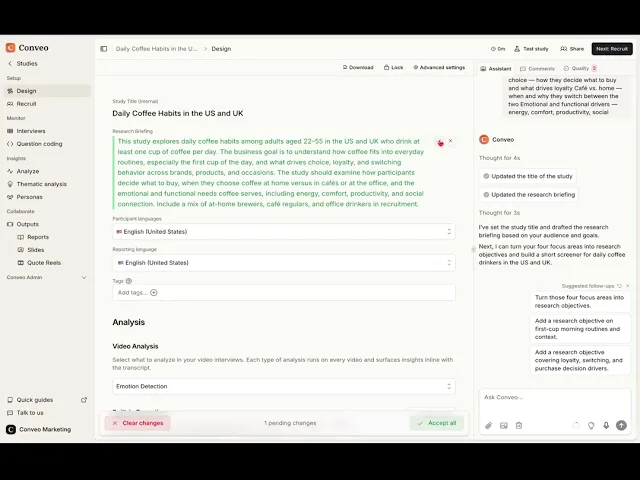
Conveo's AI-moderated interview design supports both modes. Structured prompts can be locked to produce comparable, codeable responses across hundreds of participants. Adaptive probing can be enabled when the research objective requires depth. The choice belongs to the researcher and should be a deliberate one made before the study launches.
Quantitative vs. Qualitative vs. Mixed-Method Interviews
Most enterprise research teams treat the choice among quantitative methods, qualitative exploration, and mixed-methods interviews as a methodological question. It is actually a decision question: what do you need to know, and what will you do with the answer?
Semi-structured interviews sit between the two poles, using a core set of questions posed to every participant alongside room for open-ended questions when a topic warrants it, a design closer to focus groups than to a locked survey instrument.
The table below maps each approach to what it actually produces and where it breaks down.
Quantitative Interviews | Qualitative Interviews | Mixed-Method Interviews | |
What You Learn | Frequency distributions, benchmarkable ratings, measurable patterns across segments | Behavioral context, emergent themes, the reasoning behind decisions | Both: measurable patterns with explanatory depth attached |
Typical Outputs | Scored ratings, ranking data, statistical comparisons | Thematic clusters, verbatim quotes, video evidence, sentiment arcs | Structured ratings plus adaptive follow-up probing; layered findings |
Risks / Biases | Limited explanatory power; tells you what, not why; social desirability in closed formats | Not generalizable at scale; synthesis is time-intensive without AI support | Requires thoughtful design to integrate both layers without one undermining the other |
Best Use Cases | Brand tracking, satisfaction benchmarking, concept ranking across large samples | Concept exploration, messaging development, journey diagnosis, packaging research | Concept testing where you need both a preference signal and the reasoning behind it |
Time / Cost Range | Lower per-participant cost; higher sample size requirements | Higher per-participant depth; traditionally limited by moderator capacity | Moderate to high; compressed significantly when AI moderation handles adaptive probing |
Speed versus depth is a false choice. Quantitative interviews scale but leave the "why" unanswered; qualitative interviews surface the "why" but have historically required agency timelines to run at any meaningful volume. Mixed-method interviews resolve that tension, provided the platform running them can adapt in real time rather than follow a rigid script.
Discover how to build and launch a study in Conveo:
Common Mistakes: Treating Structured Interviews Like Survey Questionnaires
The mistake isn't a lack of research skill. It's a workflow problem: when teams lift survey questions directly into an interview script without adapting them for conversation, the format creates the failure.
A survey question like "Rate your satisfaction with onboarding, 1 to 5" is designed to aggregate. In a quantitative interview, the same question produces the same result: a number. The participant says "3" and stops. Without a structured follow-up built into the guide, the interviewer either improvises inconsistently or moves on. Either way, the "3" is uninterpretable. Two participants who both say "3" may mean entirely different things, and the transcript gives you no way to distinguish them.
Survey question | Interview without adaptation | Interview with adaptive follow-up |
"Rate your satisfaction with onboarding, 1 to 5." | "I'd say a 3." | "What made it a 3 rather than a 4 or 5 for you?" → "The setup took longer than I expected and I wasn't sure who to ask for help." |
The data quality consequences compound quickly:
Shallow, open-ended responses cannot be reliably coded into themes.
Numeric ratings without behavioral context cannot support decisions. Knowing that 42% of participants rated onboarding poorly is useful, but knowing what specifically broke their confidence during setup is what actually changes the product.
Cross-participant comparisons break down entirely when probing varies across interviewers, because the variance reflects interviewer behavior rather than participant experience.
Interviews may run long when participants complete each question thoughtfully rather than defaulting to the first answer that comes to mind, and participants' responses to a single question and answer option pair rarely tell the whole story on their own.
Structured interviews require questions designed for conversation: open-ended prompts, pre-planned probes, and deliberate sequencing that builds toward the behavioral context your analysis actually needs.
When You Need Real Conversation Depth (Not Just Structured Data)
Some research questions cannot be answered with a scale from one to ten. When a team is mapping a customer journey, testing a concept before committing to production, or trying to understand why a segment behaves in ways the data does not explain, numeric outputs create a specific failure mode: stakeholders read the ratings, then ask "but why?" and the data has no answer. That gap is where decisions stall or get made on instinct anyway.
"It picks up on the nuances a survey never could"
— CMI Lead, Edgard & Cooper
The mechanism that closes it is adaptive probing. When a participant gives a vague response or rates something unexpectedly, a follow-up question triggered by that specific answer produces the explanatory context a structured quantitative interview never could. The difference between "I rated it a four" and "I rated it a four because the packaging made me assume it was for a different occasion" is the difference between a data point and a decision input.
The practical objection is timing: interviews have historically taken weeks to field, well outside most decision windows. Asynchronous AI-moderated video interviews close that gap, moving teams from study launch to usable findings in 3 to 5 days, down from 6 to 12 weeks (more on how below).
Conveo's AI moderator is built for exactly this workflow: structured questions establish a quantitative baseline, and adaptive probing follows up on unexpected or underdeveloped answers in real time across every session simultaneously.
Practical Guidance: Conducting Quantitative Interviews That Hold Up
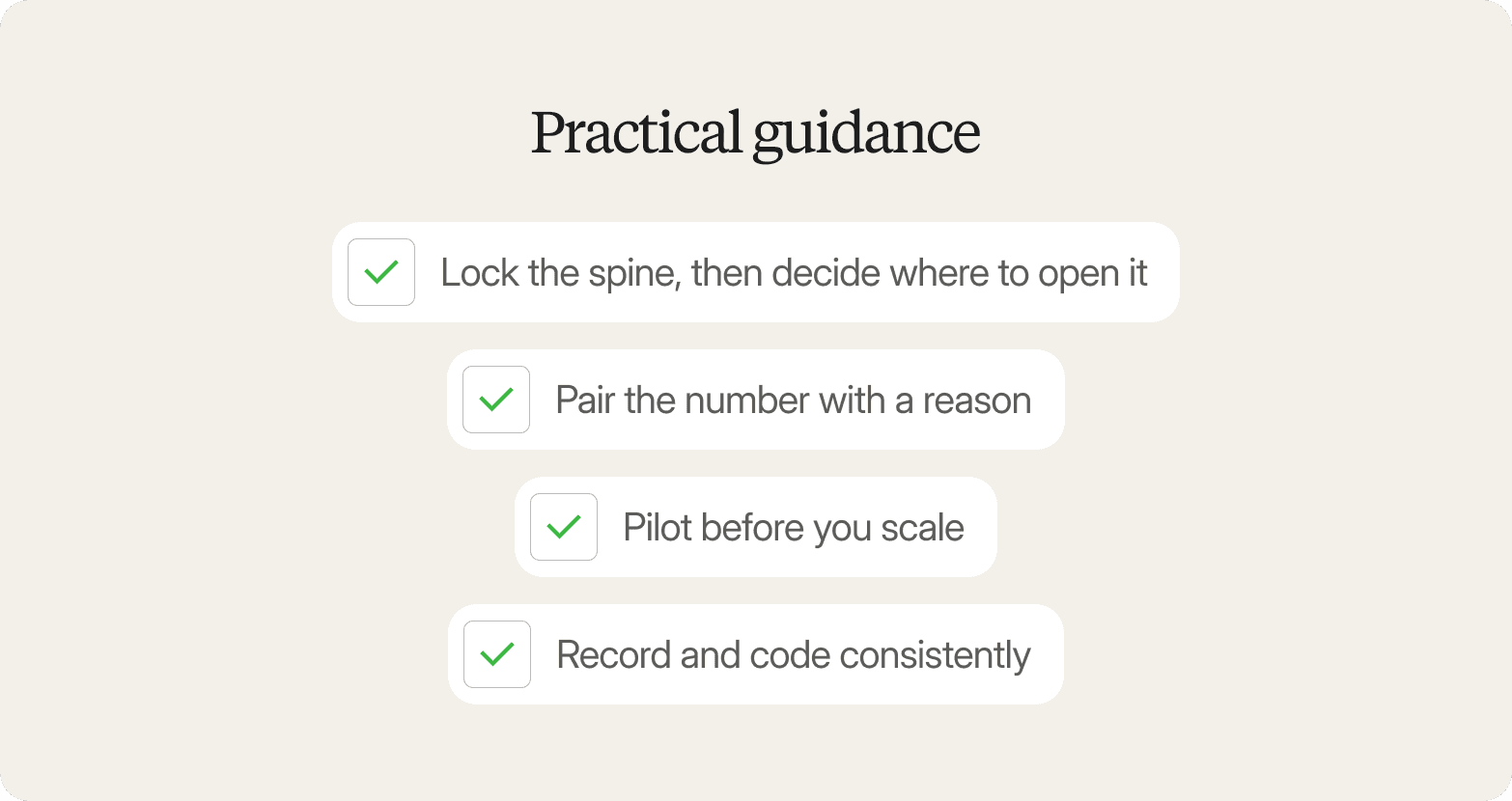
Four moves separate a structured interview that produces decision-grade data from one that produces an uninterpretable spreadsheet:
Lock the spine, then decide where to open it. Fix the wording, order, and response scales for every comparable question before launch. In advance, mark the specific questions where adaptive follow-up is allowed, so that probing is a design choice rather than an improvisation.
Pair the number with a reason. Attach a pre-planned probe to each rating question ("What made it a 3 rather than a 4?"). The rating stays comparable; the probe surfaces why the sentiment sits where it does.
Pilot before you scale. Run a small pilot to catch ambiguous wording, acquiescence bias, and dead-end options. Even careful design cannot eliminate every possible interview effect, and ambiguity that survives to full fielding contaminates the whole sample.
Record and code consistently. Teams that record quantitative interviews, whether via audio, video, or structured notes, build a coding process that survives scrutiny only when the same coder or rubric handles every transcript; an inconsistently applied rubric reintroduces the bias structured questions were meant to remove. Taking notes on unscripted reactions or tone can supplement recorded answers without turning the session into an open-ended interview.
Research shows that a quantitative interview is only as credible as its sample. A researcher who wishes to generalize findings to the general population needs a genuinely representative sample, not a convenience sample of easy-to-reach participants.
The purpose of gathering data this way is not the conversation itself but what happens afterward: collecting data from hundreds of participants and using it to identify patterns that a single interview could never capture. That is what separates a quantitative interview data set from an anecdote.
Considerations and Limitations
A quantitative interview is not the right instrument for every question, and it carries real constraints worth naming up front.
Sample size discipline is non-negotiable. Frequency and prevalence claims drawn from small samples aren't quantitative findings, no matter how the data is formatted.
Standardization can mask nuance. The same wording that makes responses comparable can flatten meaningful differences between participants. Mixed-method probing mitigates this, but only when designed deliberately.
A large sample doesn't fix a badly worded question. Quantitative data collected at scale is only as useful as the instrument behind it.
Key Points
A quantitative interview is defined by its design, standardized wording, order, and response formats, not by its medium.
Interviews are validly quantitative only when wording, sequencing, sample size, and moderation are controlled; adaptive probing invalidates statistical comparison.
The speed-versus-depth trade-off is a false choice: mixed-methods interviews capture measurable patterns and explanatory context in a single session.
Asynchronous AI-moderated video interviews remove the sequential bottleneck, moving teams from study launch to usable findings in 3 to 5 days, down from 6 to 12 weeks.
How to Run Quantitative Interviews at Scale Without Sequential Bottlenecks
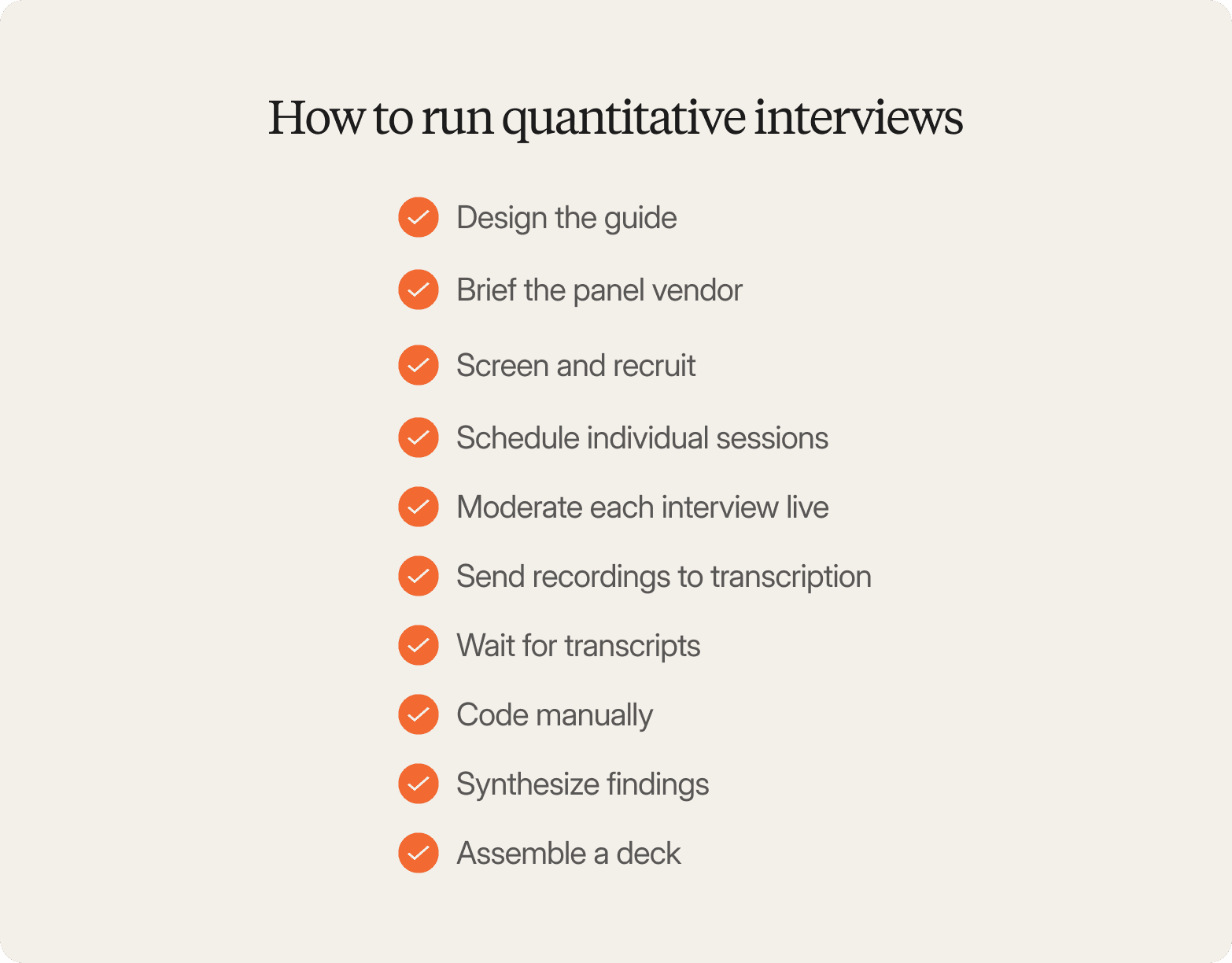
The traditional interview workflow is a sequential chain, and every link adds time:
Design the guide
Brief the panel vendor
Screen and recruit
Schedule individual sessions
Moderate each interview live
Send recordings to transcription
Wait for transcripts
Code manually
Synthesize findings
Assemble a deck
By the time that chain completes, the product decision has shipped, the campaign has launched, or the budget has been allocated. Manual moderation is the throughput ceiling: one moderator can run one interview at a time, which means study volume is permanently constrained by headcount.
Asynchronous AI-moderated video interviews fix this through parallelism: participants receive a link and complete their interview on their own schedule, across time zones, without a researcher present. Conveo's AI moderator probes adaptively based on each participant's responses, following up on vague answers and hesitation rather than advancing to the next scripted question. Because sessions run independently, 10 interviews and 500 interviews require the same setup effort.
Automated transcription and thematic coding remove the second ceiling. As recordings land, the platform transcribes, translates, and codes each session in real time, with support for 50+ languages and recruitment reach across 50+ markets. Thematic clusters surface as data accumulates rather than after a researcher spends two weeks reading transcripts, and every study compounds the effect: findings feed a searchable insight library that each new project builds on.
For Research Ops teams, the more pressing argument is consolidation. A fragmented stack, separate vendors for recruitment, scheduling, transcription, analysis, and reporting, creates a compliance burden as much as workflow friction: each vendor means its own security questionnaire, data processing agreement, and renewal cycle. Adding another point solution is a legitimate concern, but it's the wrong frame for evaluating an end-to-end platform.
Conveo covers the full workflow in a single platform: study setup, AI-moderated video interviewing, automated transcription and thematic coding, and stakeholder-ready reporting. SOC 2 certification, GDPR compliance, and EU regional data hosting are built in, not added on as afterthoughts. That means one security review, one contract, one data residency conversation. The vendor count goes down, not up.
Frequently Asked Questions
Can interviews be quantitative?
What is the difference between a quantitative interview and a survey?
What are examples of quantitative research interview questions?
When should I use qualitative instead of quantitative interviews?
What is a mixed-method interview?