In this article
TL;DR
Best for: Insights and CMI teams that need behavioral depth at a scale and pace sequential fieldwork cannot deliver.
By the time traditional ethnographic research delivers findings, the product or campaign decision it was meant to inform has often already closed. That delay is a constraint of how this qualitative research methodology is traditionally executed, not a flaw in the method itself.
Ethnographic-style video interviews close that gap. Participants show their routines and environments on camera, surfacing behavioral signals and makeshift fixes in their own words, from their own spaces.
AI moderation runs those conversations across 10 to 1,000 participants simultaneously, with adaptive probing that follows what each person actually says.
Teams report compressing timelines from weeks to days, without losing the contextual richness that makes ethnographic findings credible.
The result is a workflow that delivers both depth and scale, still producing the deeper understanding that makes ethnography worth doing in the first place.
Ethnography is among the most revealing methods available to insights teams, and also among the most operationally demanding. Traditional ethnographic fieldwork requires a researcher to observe participants in their natural environment, often across multiple sessions per person, before any pattern becomes visible. Conducting ethnographic fieldwork this way, one participant at a time, creates a bottleneck that most research functions cannot staff or fund on a recurring basis, especially for a team running five or more studies a year.
The problem compounds across markets. An ethnographic program spanning three regions means coordinating local moderators, travel logistics, and vendor relationships in parallel. By the time multi-market fieldwork delivers findings, the product or campaign decision it was meant to inform has often already closed. Research that arrives after the decision might as well never have happened.
An ethnographic approach does not require boots-on-the-ground observation to surface behavioral signals. When participants record themselves in context, showing routines, workarounds, and environments on camera, teams capture the same category of evidence at scale, without sequential scheduling. What becomes possible when that capability runs continuously is a different kind of research function: one that enters every planning cycle already knowing how consumers actually live with the category in everyday life, not one that commissions a study to find out. The payoff is deeper understanding delivered on a planning cycle's timeline, not a fieldwork calendar's.
What is ethnographic research?
Ethnography is a qualitative research methodology built on one core premise: behavior observed in context is more revealing than behavior recalled in a room. Borrowed from anthropological studies and adopted widely across the social and behavioral sciences, the ethnographic approach places researchers inside the environments where real decisions happen – kitchens, living rooms, retail aisles, digital spaces – rather than asking participants to reconstruct those moments from memory in a lab or focus group facility. The central aim is straightforward: understand behavior on its own terms, in the social setting where it naturally occurs.
For enterprise research teams, the practical definition is this: ethnographic research is any method that prioritizes observed behavior over stated preference. That distinction matters because there is a persistent gap between what consumers say they do and what they actually do. Ethnographers treat that gap as a social phenomenon in its own right, shaped by the norms of the cultural group being studied and the everyday practices that group has never had reason to question. A CPG brand might hear in a focus group that price is the main barrier to repurchase. An in-home visit reveals the real reason: the packaging is awkward to store, so the product gets buried and forgotten.
That gap is where ethnographic research earns its place in the enterprise toolkit. It surfaces the social practices, belief systems, and social arrangements that surveys cannot reach and that even well-run depth interviews can miss, because participants are not always able to articulate what they have never consciously noticed. Ethnography's promise, at its best, is holistic insights into behavior in context, not just an isolated data point.
The method carries several distinct traditions, each marking a stage of theoretical development that continues to shape how ethnographic methodology gets applied in commercial research today:
Early urban sociology. Ethnography's roots trace to early 20th-century sociology, including the Chicago School's studies of city communities, before anthropology later formalized participant observation as a discipline in its own right.
Critical ethnography. Extended the approach to examine power and inequality within the setting under study.
Feminist ethnography. Shaped by feminist ethnographers, centers the researcher's own positionality alongside the participant's lived experience.
Each tradition contributed new theoretical concepts and methodological development. Despite the reinvention, ethnography remains a mainstay across the social sciences a century after its earliest studies.
3 core ethnographic methods
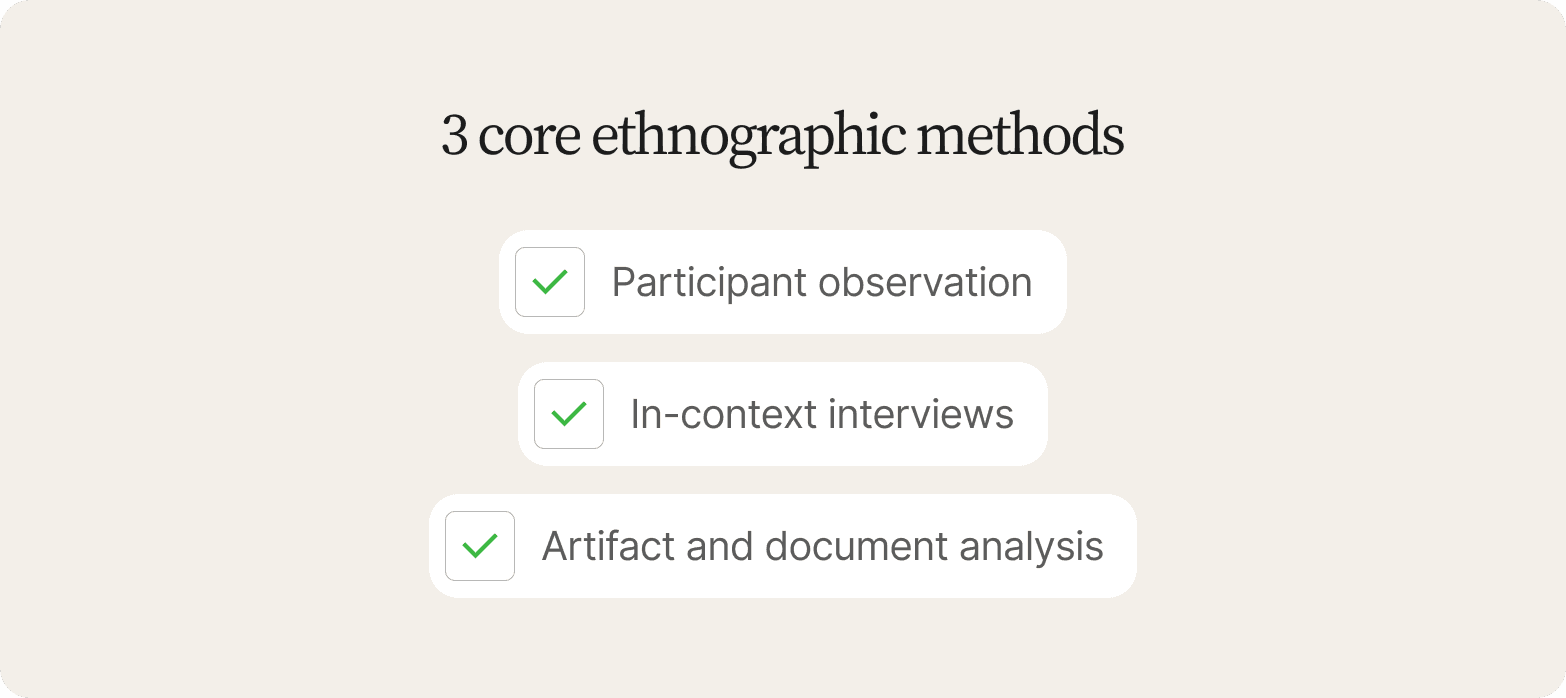
Three methods form the operational core of any enterprise ethnographic study, and together they define the key features of ethnography qualitative research: participant observation, in-context interviews, and artifact analysis. Understanding what each one captures, and where its limits sit, determines whether your study design will hold up under stakeholder scrutiny.
Participant observation places the researcher inside the context being studied: a kitchen during a meal prep routine, a bathroom cabinet review, a shopping trip. Depending on the study's goals, the researcher can range from a passive observer to a more active participant in the social interactions being studied. The goal is to see what participants do, not only what they say they do. In enterprise insights work, this is where the gap between claimed behavior and actual behavior becomes visible. A consumer who describes themselves as a careful label reader may not open a single panel during a recorded shop-along. That discrepancy is the finding. It's worth noting that a researcher's presence can itself change what gets observed – a limitation covered later in this article.
In-context interviews run alongside or immediately after observation, while the experience is still live. The question "why did you do that just now?" surfaces reasoning that a post-hoc focus group cannot recover. In practice, these conversations generate the verbatim that grounds thematic analysis and gives stakeholders the direct voice evidence they need to trust a finding.
Artifact and document analysis rounds out the picture and is where most of the formal data collection happens outside direct observation. Receipts, pantry inventories, phone screenshots, loyalty app histories: these materials reveal purchase patterns, brand relationships, and cultural norms that participants often cannot articulate unprompted. For CPG and FMCG teams in particular, artifact review frequently surfaces competitive context that no screener question would have caught.
Each method feeds the others. Observation generates hypotheses, interviews test them in the moment, and artifacts either corroborate or complicate what the conversation produced. Together, they follow a small set of ethnographic principles that hold regardless of format: observe before asking, prioritize context over recall, and treat every piece of qualitative data as evidence to be traced back to its source, not summarized away.
When to use ethnographic research (and when not to)
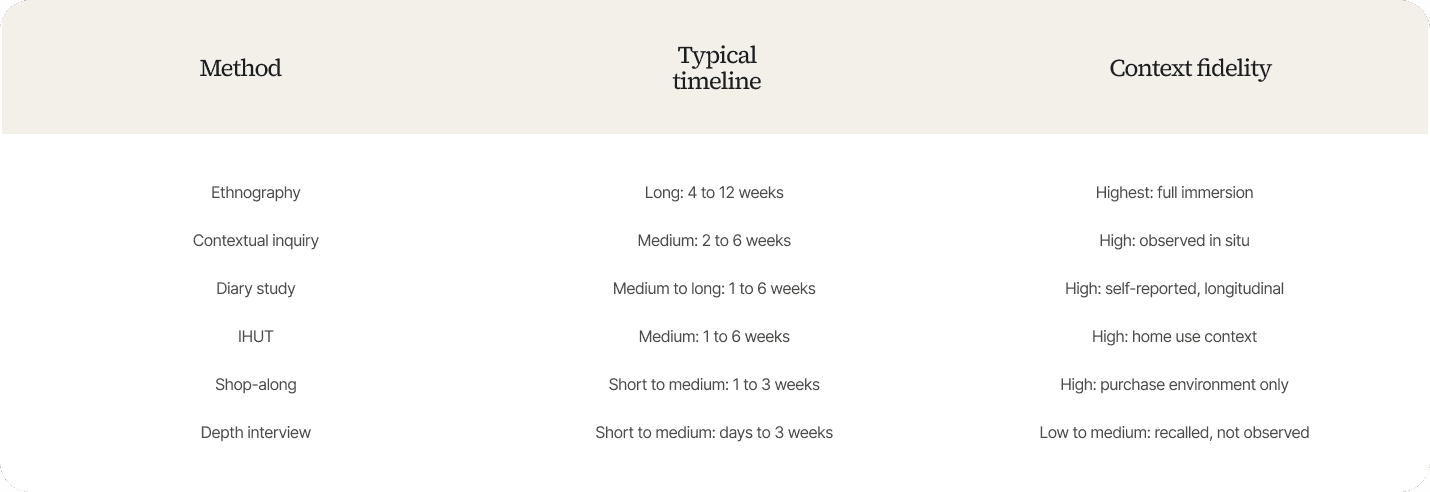
Choosing the right ethnographic approach often comes down to four practical questions: how quickly does the decision need to move, how much real-world context does the question require, how many participants justify the budget, and what physical or behavioral artifacts need to be captured? The table below maps those dimensions across ethnography and the five other methods it is most commonly weighed against in social research.
| Method | Decision window | Context need | Typical sample size | Artifact requirements |
|---|---|---|---|---|
| Ethnography | Long: 4 to 12+ weeks | Highest: full immersion in natural environment | 6 to 15 participants | Field notes, photos, video, observed behaviors |
| Contextual inquiry | Medium: 2 to 6 weeks | High: researcher observes and questions in situ | 8 to 15 participants | Session recordings, task observations, verbal protocols |
| Diary study | Medium to long: 1 to 6 weeks | High: self-reported, longitudinal, in natural setting | 15 to 30 participants | Participant-submitted photos, videos, written entries |
| Depth interview | Short to medium: days to 3 weeks | Low to medium: recalled experience, not observed | 15 to 30 participants | Interview recordings, transcripts |
| Shop-along | Short to medium: 1 to 3 weeks | High: purchase environment only | 8 to 20 participants | In-store observations, shelf interaction video |
| IHUT | Medium: 1 to 6 weeks | High: home use context, product in routine | 15 to 50 participants | Usage diaries, product photos, pre/post interviews |
How to read this table. Decision window reflects the realistic elapsed time from briefing to findings, not fieldwork duration alone. Context need indicates how much the method depends on observing behavior where it actually happens, as opposed to asking participants to recall it. Artifact requirements affect both logistics and cost: methods requiring physical presence or participant-submitted media carry higher coordination overhead.
Ethnographic design earns its place when the question cannot be answered by asking people what they do, because they either cannot accurately recall it or behave differently when observed outside their natural setting. Compared with other qualitative studies that lean on self-report, ethnography trades breadth for depth in exchange for a more holistic understanding of behavior in context. For questions with a compressed decision window, a depth interview or AI-moderated video interview will almost always be the more defensible choice.
How to conduct ethnographic research in a compressed timeline
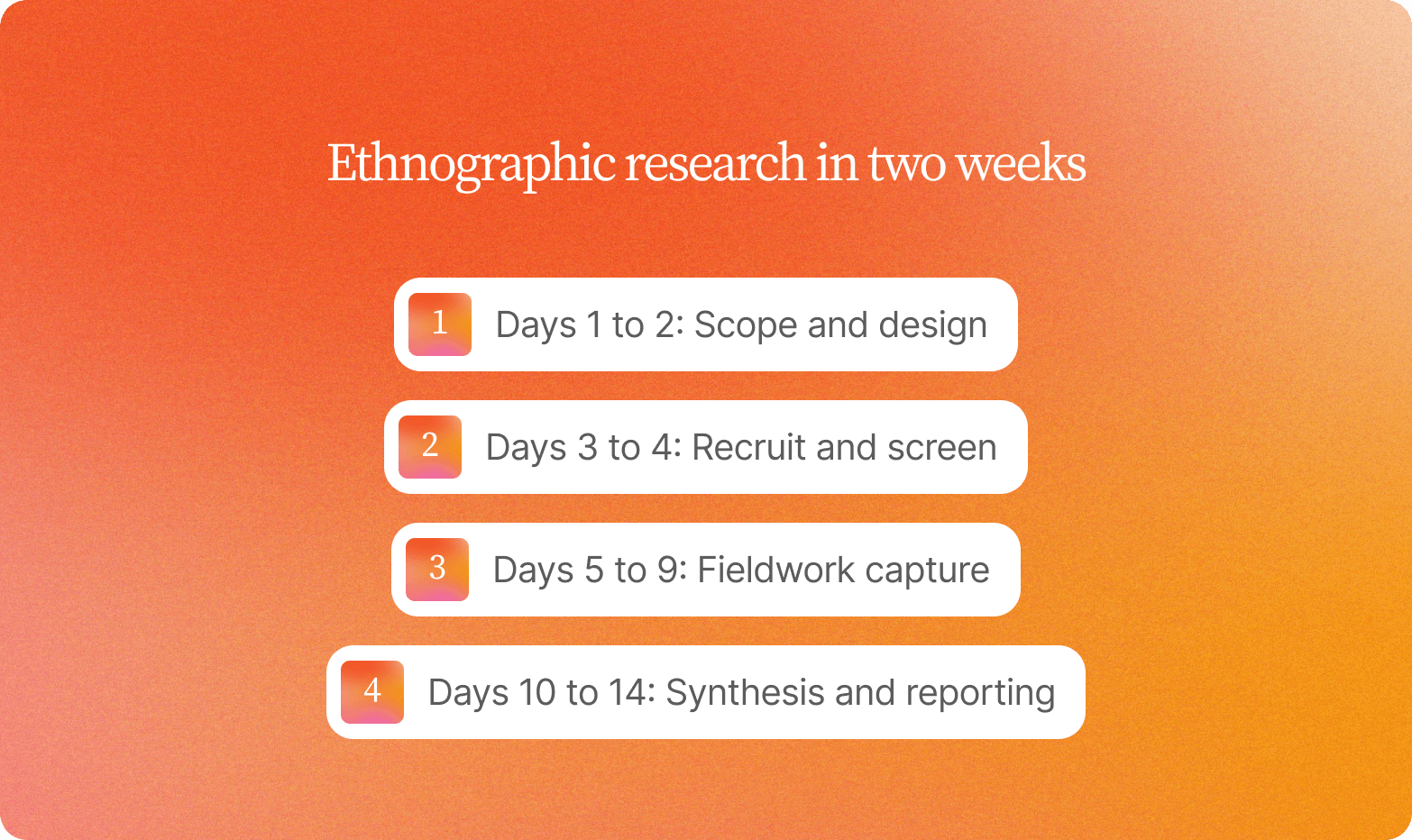
This kind of compressed fieldwork is sometimes called rapid ethnography: a scaled-down version of the traditional research process, designed to fit decision windows measured in days rather than months. Conducting ethnographic fieldwork this way still moves through four phases.
Days 1 to 2: Scope and design
Define the behavioral question precisely before anything else. What are you trying to observe? A morning routine, a purchase decision, a product usage moment? Narrow the context to one or two specific behaviors. Write a discussion guide that opens with a show-me prompt ("Walk me through how you actually do this") before any direct questions. Set capture standards at this stage: which moments need video, which need participants to narrate in real time, and what environmental context matters.
Days 3 to 4: Recruit and screen
Source research participants through Conveo's integrated panel network or bring your own list via CSV or WhatsApp. Traditional ethnography spends real time negotiating access to a community or setting before observation can even start; here, a behavioral screener replaces that step with structured recruitment, confirming that study participants actually perform the behavior you need to observe, not just claim to. The level of participation depends on the study's goals, ranging from passive observation to a fuller, more active role. Aim for 12 to 20 participants for ethnographic-style depth, then confirm participation and send session links.
Days 5 to 9: Fieldwork capture
Because sessions run asynchronously, participants complete them on their own schedule, in their own environments. They show their refrigerator, their skincare shelf, their workaround fix, without a researcher on the call coordinating times across time zones. Conveo's digital tools handle the moderation: the AI moderator probes on what participants actually show and say, and if someone mentions a habit that contradicts the expected behavior, the follow-up surfaces it. Collecting data this way, on camera and in real environments, preserves the behavioral signal, including hesitation, improvised fixes, and environmental context that a survey response cannot carry.
Days 10 to 14: Synthesis and reporting
Multimodal analysis across speech, tone, and facial cues runs as sessions close, and thematic coding turns that raw qualitative data analysis into behavioral patterns across participants. The researcher's job at this stage is interpretation in context: not just tagging what happened, but writing ethnography that delivers a thick description – a detailed account of what a behavior means for the product, the packaging, or the positioning decision, not just a log of what occurred. Findings compile into stakeholder-ready research reports with verbatim quotes and video clips as evidence, traceable to the specific person who said or showed it, and structured so the next team can test hypotheses against them without starting from zero.
Maintaining rigor and traceability in ethnographic analysis
Stakeholder scrutiny is where ethnographic findings most often lose credibility. A theme labeled "participants showed frustration with the packaging" means nothing to a brand director who wasn't in the room and can't verify what "frustration" looked like. Research published in international journals of qualitative research has documented this credibility gap for decades: the value of ethnographic work depends entirely on whether the write-up preserves the evidence trail back to the observation.
The audit trail runs in three layers:
Raw observation. Timestamped video captures the moment a participant pauses at a price point, shifts tone when a competitor brand appears, or reaches for a workaround they've clearly used before. These are behavioral signals that a transcript flattens into silence. Conveo's multimodal analysis surfaces them, reading speech, tone, and facial cues together so the hesitation before an answer carries the same analytical weight as the answer itself. All of it – video, audio, field notes – is unstructured data until qualitative analysis gives it shape.
Thematic coding. Links directly back to those moments, turning that audiovisual media into evidence a stakeholder can actually check. Every theme connects to the specific clips and verbatim quotes that generated it. A stakeholder questioning a finding can follow the chain from claim to participant, from participant to timestamp, from timestamp to the exact frame where the behavior occurred.
Reflexivity. Sits in the method record. Built by researchers, the analysis framework documents where interpretation is happening and why, keeping the researcher's judgment visible rather than buried.
The result is findings that survive the room, because every insight traces to a real person who said or showed it on camera.
Enterprise governance for in-context research
Running in-context research at scale means collecting data – video recordings, verbal responses, and behavioral data – from real research participants, often across multiple markets simultaneously. Before procurement or legal signs off on that kind of program, three questions come up in every security review: where does the data live, who can access it, and what happens when a participant invokes their right to deletion.
Conveo clears the standard checklist as a baseline, not a custom arrangement:
Compliance. SOC 2 compliant and GDPR compliant, with European hosting and primary infrastructure in Belgium available by default.
Consent. Built into the participant workflow, so every session begins with explicit informed consent before recording starts.
Data retention. Client-configurable retention with automated PII deletion, so a data subject request doesn't require a manual engineering ticket.
Access control. SSO keeps stakeholder access controlled through existing identity infrastructure, so findings reach the right internal audiences without creating ungoverned data sprawl.
For research operations teams evaluating platform governance, these are pass/fail criteria before any methodology conversation begins.
5 ethnographic research examples
In the following representative scenarios, teams use ethnographic-style video interviews to surface behavioral signals that surveys and recall-based interviews consistently miss.
Campaign underperformance
A CPG brand investigating why a campaign underperformed commissions ethnographic-style video interviews rather than a post-campaign survey. Participants walk through their kitchen routines on camera, and the AI moderator probes the moments where the brand's messaging does not match the actual usage occasion. The behavioral signals buried in those unscripted pauses and workarounds explain the gap far more precisely than any rating scale would.
Concept testing
Instead of asking participants whether they like a new format, teams watch them interact with it at home and hear the hesitations that follow. The AI moderator follows what participants actually say, not a rigid script, surfacing friction that may not emerge in a moderated group setting where social dynamics influence responses.
"Real conversations, real emotions, that's what makes Conveo different from every survey tool."
CMI Lead, Edgard & Cooper
Multi-market product validation
Rather than coordinating local moderators across six countries sequentially, teams run AI-moderated video interviews across 50+ languages simultaneously. A study that would have taken weeks of staggered fieldwork compresses to days, with findings arriving in a consistent structure across every market.
Behavioral workaround studies
When participants show, on camera, the makeshift fixes they have built around a product's limitations, that footage becomes the evidence brief that no survey could produce.
Health services and health care
Ethnography has long been used in health services and health care research to understand how patients and caregivers actually navigate a treatment plan or product, revealing gaps between prescribed behavior and real-world adherence. The same logic applies to consumer brands: participants show, on camera, how a product actually fits into their social life, not how they describe it in a survey.
Advantages and limitations of ethnographic research
| Advantage | Why it matters |
|---|---|
| Behavior observed in context | Captures what people actually do, not what they say they do |
| Uncovers unarticulated needs | Participants reveal friction points they would never surface in a survey or interview |
| Rich, naturalistic data | Tone, environment, and routine all become evidence |
| High ecological validity | Findings reflect real-world conditions, not lab or screen-based proxies |
| Flexible inquiry | Researchers can follow unexpected threads as they emerge |
| Limitation | Practical implication |
|---|---|
| Time-intensive fieldwork | Traditional studies run weeks to months, not days |
| Small sample sizes | Depth comes at the cost of breadth; findings are directional, not statistically representative |
| Observer effect | Participant behavior can shift when a researcher is present |
| Researcher bias risk | Interpretation depends heavily on the individual analyst's lens |
| High cost per participant | In-home and in-context access requires significant logistical investment |
| Difficult to scale across markets | Running ethnographies in 10 countries simultaneously is rarely feasible with traditional methods |
The observer effect above is really about a researcher's presence: participant behavior can shift the moment someone knows they're being watched, a limitation ethnographic methodology has never fully solved, whether the observer is a person in the room or a camera capturing the session. Every row in both tables ultimately reduces to one tradeoff: how much qualitative data you need, and how fast you need it.
Running ethnographic-style research without the fieldwork bottleneck with Conveo
Research that arrives after the decision has already closed might as well never have happened. Ethnographic research has always produced the most credible behavioral evidence available to insights teams. The constraint is logistics: sequential fieldwork, local moderator coordination, and synthesis timelines that stretch weeks past the decision they were meant to inform.
Always-on consumer understanding
Rather than commissioning a single ethnographic study once a year, teams run AI-moderated video interviews continuously through Conveo StoryLines, entering every planning cycle with behavioral understanding already in hand, drawn from an approach as rooted in the behavioral sciences as it is in marketing research. Participants record in their own environments, on their own schedules, showing the routines and workarounds that structured questionnaires never reach.
Research rigor
Built by researchers, Conveo's AI moderator probes based on what participants actually say, not a rigid script, surfacing the contextual reasoning that in-person ethnography produces at a fraction of the fieldwork overhead. Every finding traces to a timestamped video clip and verbatim quote, auditable in one click.
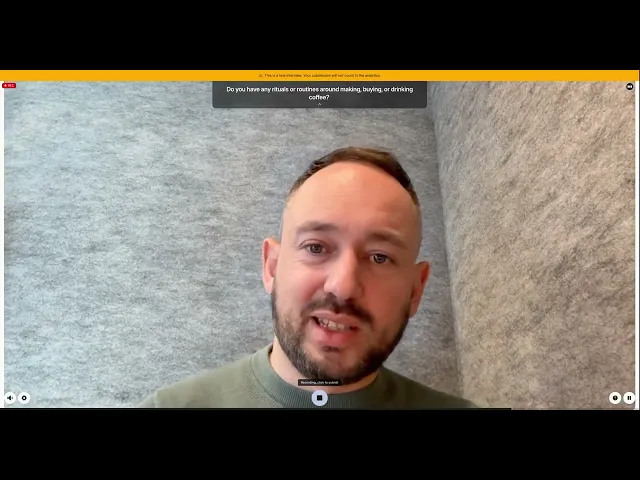
See it in action: How AI-Moderated Video Interviews Actually Work
Compounding understanding
Clips, quotes, and behavioral themes flow into the Knowledge Layer, Conveo's searchable insight library, rather than a one-off deck. When the next study launches, prior behavioral findings are already in context. Nothing gets researched twice, and the understanding builds with every wave.
Frequently Asked Questions
Is ethnographic research qualitative or quantitative?
Ethnographic research is a qualitative method focused on depth, context, and understanding behavior in natural environments rather than statistical generalization. Qualitative methods, such as ethnography, explore the "why" and "how" through observation and immersion, while quantitative methods measure the "what" and "how many" through structured surveys and statistical analysis. Ethnography reveals hesitation, contradictions, tone shifts, and workarounds, along with the gap between what people say they do and what they actually do, in ways quantitative methods aren't built to capture.
What is ethnographic qualitative research?
Ethnographic qualitative research is the study of people in their natural environments through observation, immersion, and in-depth interviews to understand behavior, culture, and context. It prioritizes depth over breadth, seeking to understand the "why" behind behavior rather than measuring frequency or prevalence. Full ethnographic observation, done the traditional way, demands weeks of sequential fieldwork per participant, making it prohibitively slow and expensive for recurring validation – which is why ethnographic-style video interviews exist: to preserve that behavioral depth while removing the fieldwork constraints.
What is ethnography in research?
Ethnographic research is a qualitative method in which researchers study people in their natural environment to understand how they live, behave, and make decisions. Rather than asking direct questions in isolation, it prioritizes observed behavior over self-reported recall, capturing the gap between what people say they do and what they actually do. In a commercial context, ethnographic research surfaces motivations and cultural dynamics that surveys and focus groups typically miss.
What are the key characteristics of ethnographic research?
Ethnographic research is defined by a few consistent key features: It takes place in the participant's own setting rather than a lab or facility. It runs over time rather than in a single session. It orients toward the "why" behind behavior, not just the "what." These characteristics distinguish ethnographic methods from more controlled approaches like structured interviews or quantitative surveys.
What are the main steps of ethnographic research?
Ethnographic research typically follows five steps: Define the research question and identify the community to study. Gain access and informed consent before conducting research on-site. Collect data through field observations with detailed notes. Run in-depth interviews to probe what the observations surface. Analyze the data to identify patterns and themes before reporting findings. Collecting data this way – observation first, interviews second – is what separates ethnography from an interview-only study.
What are the advantages of ethnographic research?
The primary advantage of ethnographic research is contextual authenticity. Researchers see behavior as it naturally occurs, which produces richer, more credible findings than recall-based methods. It also strengthens qualitative analysis more broadly by grounding themes in observed behavior rather than self-report, and it surfaces unexpected insights that no pre-written discussion guide would have thought to ask about.

About the author
Anna Sharp
Client Growth Manager
Anna got into market research by asking the CEO of one of the largest agencies in the world out for a juice. Eight years on she is an ethnographer who backs methods she believes in. She runs studies with media and consumer clients, including the one that went from a Friday-morning brief to a finished project by Saturday.
Meet Anna on film →Qualitative insights at the speed of your business.
Conveo runs AI-moderated video interviews and structures everything they say.