In this article
TL;DR
The traditional standard is 6 to 10 focus group participants: enough to surface disagreement without letting the loudest group members dominate.
The hard part is getting 6 to 10 people in the same place at the same time; that adds 2 to 3 weeks before a single question is asked.
Smaller groups (4 to 6), sometimes run as mini focus groups, suit sensitive topics; larger formats (co-creation workshops) work when breakout activities redistribute airtime.
Asynchronous AI-moderated one-to-one interviews remove the scheduling constraint and eliminate group conformity pressure, a different tool for a different job, not a replacement for every use of a focus group.
Asynchronous one-to-one interviews are a complement to live focus groups, not a wholesale replacement; the right research method depends on the research question, not on which one is easier to schedule.
How many people should be in a focus group? The traditional answer is 6 to 10 participants: enough to generate a genuine focus group discussion without the room becoming unmanageable. Fewer than six risks a narrow spread of viewpoints; more than ten tends to amplify whoever speaks loudest, pushing quieter perspectives to the margins.
The practical problem is the logistics behind the number. Coordinating 6 to 10 people, whether in person or via video, for an online focus group typically adds 2 to 3 weeks of scheduling friction before a single question is asked. That friction forces a tradeoff most teams can't afford: recruit fast and accept whoever's available, or recruit right and wait.
That tradeoff is exactly what asynchronous AI-moderated one-to-one interviews were built to remove. Teams field individual sessions across 48 to 72 hours, each participant responding on their own schedule. The result is a wider range of views, more honest and complete, without the dominant-voice problem that plagues live group settings. It's a different way to collect data for qualitative research, not a verdict that focus groups are obsolete.
Focus group size at a glance
| Group size | Best for | Watch out for |
|---|---|---|
| Fewer than 4 (individual interviews) | Sensitive topics, deep individual reasoning, B2B or high-stakes decisions | Thin viewpoint diversity if group interaction is the goal |
| 4 to 6 (mini focus groups) | Specialized audiences, extended airtime per person | Fewer perspectives than a full group |
| 6 to 10 (standard) | Balanced discussion and viewpoint diversity | 2 to 3 weeks of scheduling friction |
| More than 10 | Co-creation and idea-generation workshops with breakout activities | Dominant voices crowd out quieter participants |
| Asynchronous one-to-one (any scale) | Fast, individual reactions without social influence | No live group interaction |
The standard focus group size: 6 to 10 participants
The industry standard is 6 to 10 participants: the smallest number that reliably surfaces disagreement and the largest that still gives every group member room to speak. Group size plays an important role here regardless of the specific topic, since the talk-time math holds whether the session covers pricing, packaging, or a new feature concept.
In a 90-minute session with 8 participants, the math on speaking time looks like this:
~60 usable minutes for discussion after introductions and transitions
~10 minutes per participant, assuming equal distribution, which never actually happens
In practice, two or three participants tend to carry more of the conversation, compressing the quieter voices further
At the upper limit, groups larger than 10 amplify that problem: dominant participants steer the room, and minority views get crowded out. At the lower limit, groups smaller than 6 reduce the viewpoint diversity that makes qualitative research useful, and a single outlier can skew perceived consensus.
What this range doesn't advertise is its coordination cost. Getting 6 to 10 pre-screened potential participants into the same room or onto the same call at the same time requires recruitment lead time, scheduling rounds, and no-show buffers. The 6-to-10 standard is both a methodological choice and a logistical constraint.
Why traditional focus group sizing creates scheduling friction
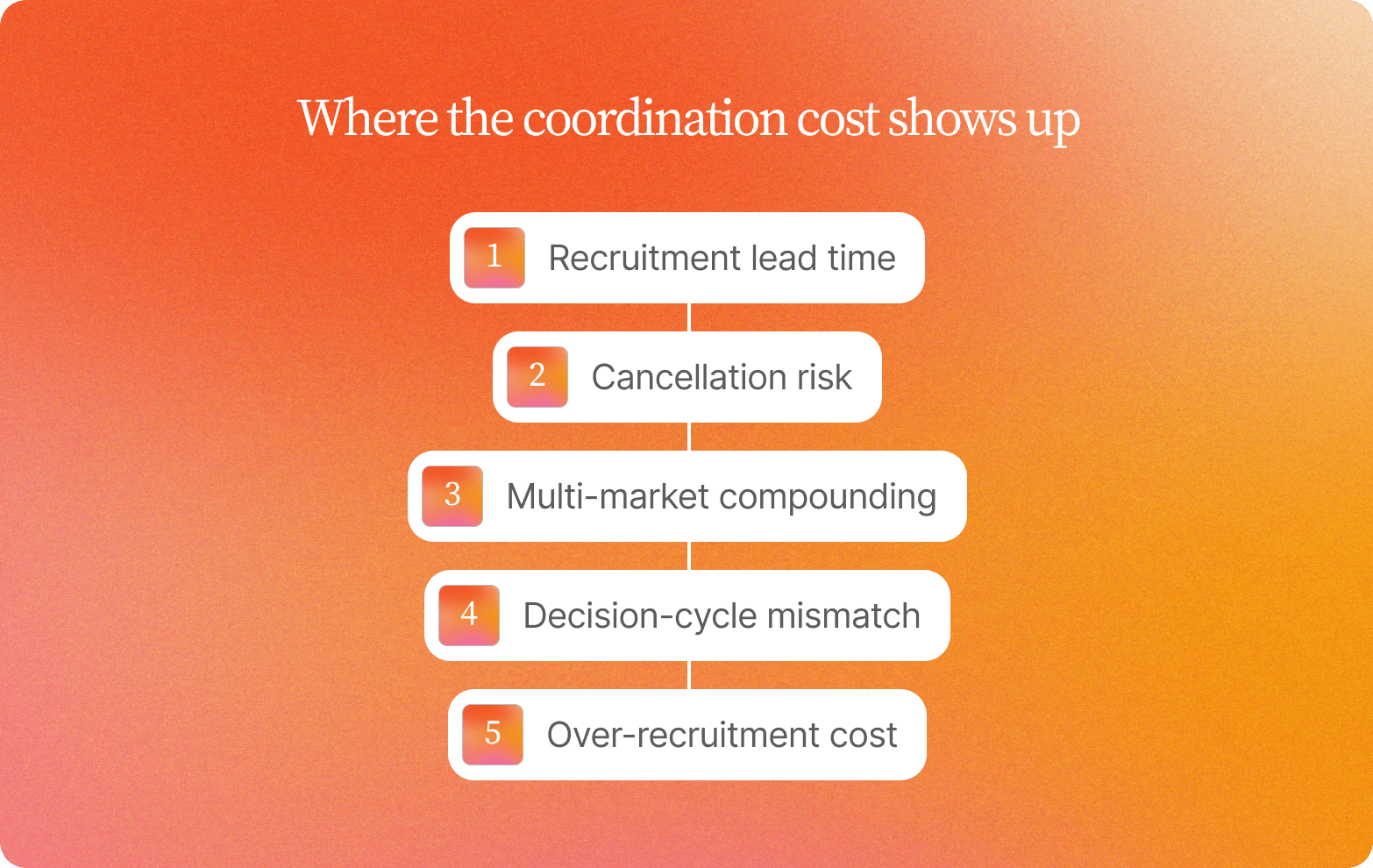
Finding a shared availability window across 6 to 10 participants and a moderator is a coordination project, not a scheduling task. That coordination cost shows up in a few distinct ways:
Recruitment lead time. Filling a standard focus group takes 2 to 3 weeks before a session can run, accounting for outreach, screening, confirmation, and calendar alignment across people with no obligation to prioritize a research timeline.
Cancellation risk. One participant dropping out the day before can mean rescheduling the entire session; a single late cancellation can add a week or more, particularly with narrow screener criteria.
Multi-market compounding. A program spanning three to five geographies runs three to five separate scheduling problems, each with its own moderator availability and time zone constraints, multiplying overhead rather than adding to it.
Decision-cycle mismatch. Campaigns and product sprints move on 2 to 3-week cycles. A focus group program that takes six weeks to field means teams often decide first and use research to confirm it afterward, after the decision has already closed.
Over-recruitment cost. To reliably seat 8 participants, teams typically recruit 10 to 12, building in a 20 to 30% no-show buffer that increases incentive costs and extends the outreach window.
For Consumer Insights Managers and Market Research Managers, this poses a genuine dilemma: the 6-to-10 range reflects real guidance on group dynamics, not an arbitrary convention. The constraint is the requirement that everyone show up in the same place at the same time, a structural dependency that turns a sound group size into a calendar problem limiting how often teams can run focus group research at all. It's worth weighing other methods against that calendar cost before defaulting to a live session.
When to use fewer than 6 participants
Smaller groups of four to six, often called mini focus groups, are used under specific conditions: sensitive or highly personal topics, or topics requiring extended individual airtime. Healthcare decision-making, financial planning, and B2B purchase processes fit this profile: participants navigating a major diagnosis or a six-figure procurement need time to articulate experiences that don't compress into a two-minute turn.
The tradeoff is viewpoint diversity. A group of five covers fewer perspectives than a group of eight, so teams often run multiple focus groups to compensate, extending the calendar and cost accordingly.
If the goal is individual depth rather than group interaction, one-to-one interviews, sometimes called in-depth interviews or individual interviews, remove the social dynamic entirely while preserving the ability to probe based on what a participant actually says. Asynchronous AI-moderated interviews take this further: the AI moderator asks follow-up questions based on what was said rather than advancing through a fixed script, producing responses 3 to 4x longer than static survey formats, with participants 68% more open when a human moderator is present.
Smaller traditional focus groups still hold a clear advantage in complex, multi-stage live discussions where participants build on each other's ideas in real time, and where the social construction of opinion is itself the research object.
When to use more than 10 participants
Groups larger than 10 are rare in traditional focus groups for a structural reason: talk-time per person drops below the threshold for meaningful contribution, and the dominant-voice problem intensifies. When 12 people share a 90-minute session, the quietest participants rarely surface views that differ from whoever set the early tone.
There's one legitimate exception: large-group workshops and co-creation sessions, where the goal is generating new ideas rather than individual depth, can accommodate more participants when breakout activities redistribute airtime. If every participant works in a sub-group of four, the effective group size is four, not twenty.
For teams that need to reach a larger population without extending the calendar, asynchronous AI-moderated one-to-one interviews are a more reliable path than running one focus group after another. Participants respond on their own schedule, removing the "same place, same time" constraint, so running 50 or 100 interviews takes roughly the same calendar time as running one, typically completing in 48 to 72 hours.
"With Conveo, we can run 100 interviews at once: speed is everything in FMCG"
CMO & Founder, Edgard & Cooper
Speed is only half the benefit. One-to-one interviews eliminate social influence: each participant reacts without first hearing what everyone else thinks, so the data reflects genuine individual responses rather than a consensus shaped by whoever spoke first. That is the dominant-voice problem solved at the design level, not managed by a skilled moderator after the fact.
How group dynamics influence optimal size
Every live focus group carries a structural bias that size makes worse. When one or two participants speak with confidence early on, quieter voices recalibrate. They don't necessarily change their minds, but they change what they say out loud, contributing less to the discussion the study was designed to capture. Research on conformity, a staple of social science research, consistently shows individuals are more likely to align their stated preferences with the group majority than when responding on their own, and that effect strengthens as group size grows.
This matters most when teams need clean individual reactions: first impressions of a concept, honest responses to a price point, unmediated reactions to a message frame. A group of eight is a social system where the first opinion shapes every one that follows.
Skilled moderators can work against this by redirecting dominant voices, inviting quieter participants to respond first, and using projective techniques to create distance. But these require experience, add cost, and don't scale.
Watch the honest comparison: AI Moderation Actually Works
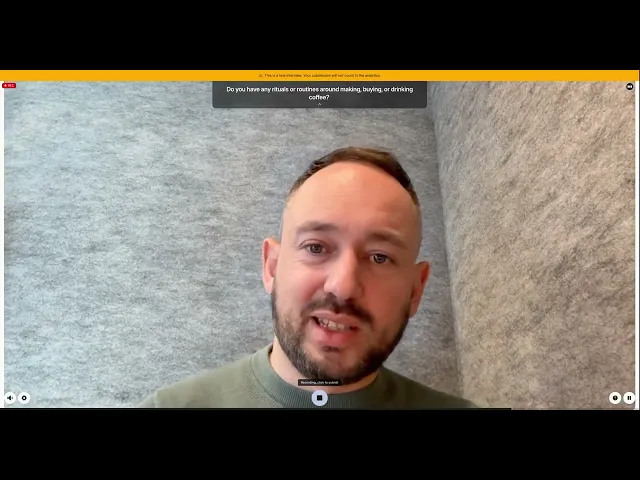
Asynchronous AI-moderated one-to-one video interviews remove the conformity variable entirely, since each participant responds without hearing anyone else's answer first. There's no emerging consensus to calibrate against and no social cost to disagreeing, because there's no room. Participants in this format are 68% more open than with a human moderator. The video record also preserves what text cannot: body language, the hesitation before an answer, the shift in tone when a price is mentioned. When a stakeholder asks who said this, timestamped clips and verbatim quotes provide a traceable answer a group transcript can't.
Group dynamics aren't always noise to be eliminated, though. Traditional focus groups remain the right choice when the goal is to observe how people influence each other in real time: co-creation sessions or ethnographic work, where the social negotiation of meaning is itself the finding.
Recruitment implications: No-shows and over-recruiting
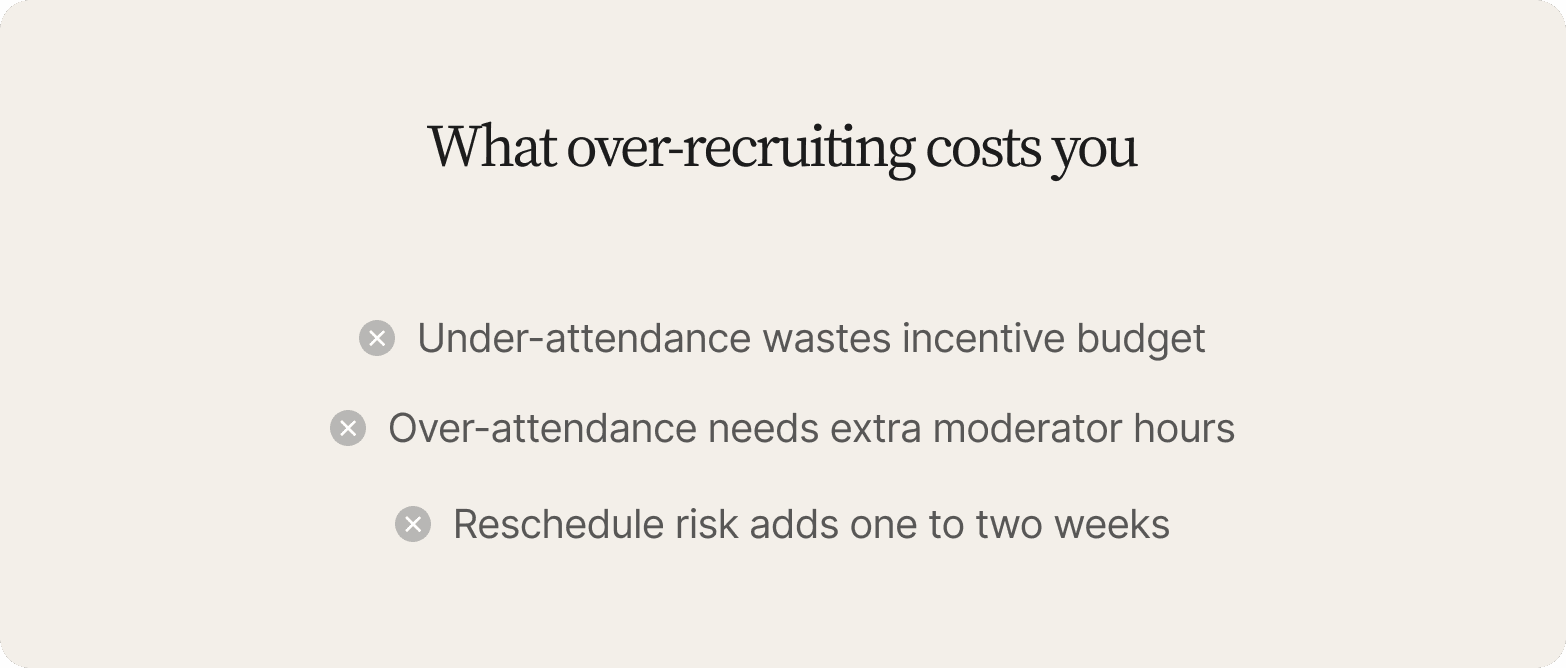
Planning for a live focus group means planning for people who won't show up. To seat eight participants, teams typically recruit 10 to 12 potential participants, over-recruiting by 20 to 30% for expected attrition. That buffer creates costs on both sides:
Under-attendance. Incentive budgets are calculated on recruited participants, not confirmed ones, so the buffer is a sunk cost even when it isn't needed.
Over-attendance. When attendance exceeds expectations, teams must turn participants away or split into multiple focus groups, which require extra moderator hours.
Reschedule risk. When too many cancel, the session falls below viable size, forcing a full reschedule that typically adds one to two weeks to the timeline.
Asynchronous AI-moderated interviews change the underlying logic. Because participants respond on their own schedule, a late completion or dropout doesn't affect anyone else's session, and teams recruit the exact number a study requires with no attrition buffer. For global programs, the benefit compounds: coordinating live sessions across time zones limits who can realistically be recruited, while asynchronous studies run across 50+ markets without requiring anyone to show up at the same moment.
Focus groups vs. asynchronous one-to-one interviews: Matching the method to the question
Getting 6 to 10 participants into the same room or video call at the same time is where most focus group timelines break down. Recruitment alone takes one to two weeks for a study's target audience, and harder-to-reach segments take longer.
Asynchronous AI-moderated one-to-one video interviews, also described as one-on-one interviews, remove the requirement that everyone show up at once. Participants respond on their own schedule, so fielding can open the same day a study launches and close within 48 to 72 hours. Because sessions run in parallel rather than sequentially, teams can speak with far more participants than one focus group allows without extending the calendar.
The mechanism matters as much as the timeline. An AI moderator that follows what participants actually say, asking follow-up questions rather than working through a rigid script, changes what the data looks like. When a participant hesitates before a pricing question or shifts tone at a competitor's name, the moderator probes that moment directly, eliciting responses 3 to 4x longer than static surveys and capturing hesitation and contradiction that a scripted guide would skip past.
Every session produces timestamped clips and verbatim quotes. Stakeholders who ask "who said this?" before acting on a recommendation get a direct answer: a specific participant, at a specific moment, in their own words. Each study also compounds: every interview stays searchable, so the next question starts from what consumers already said.
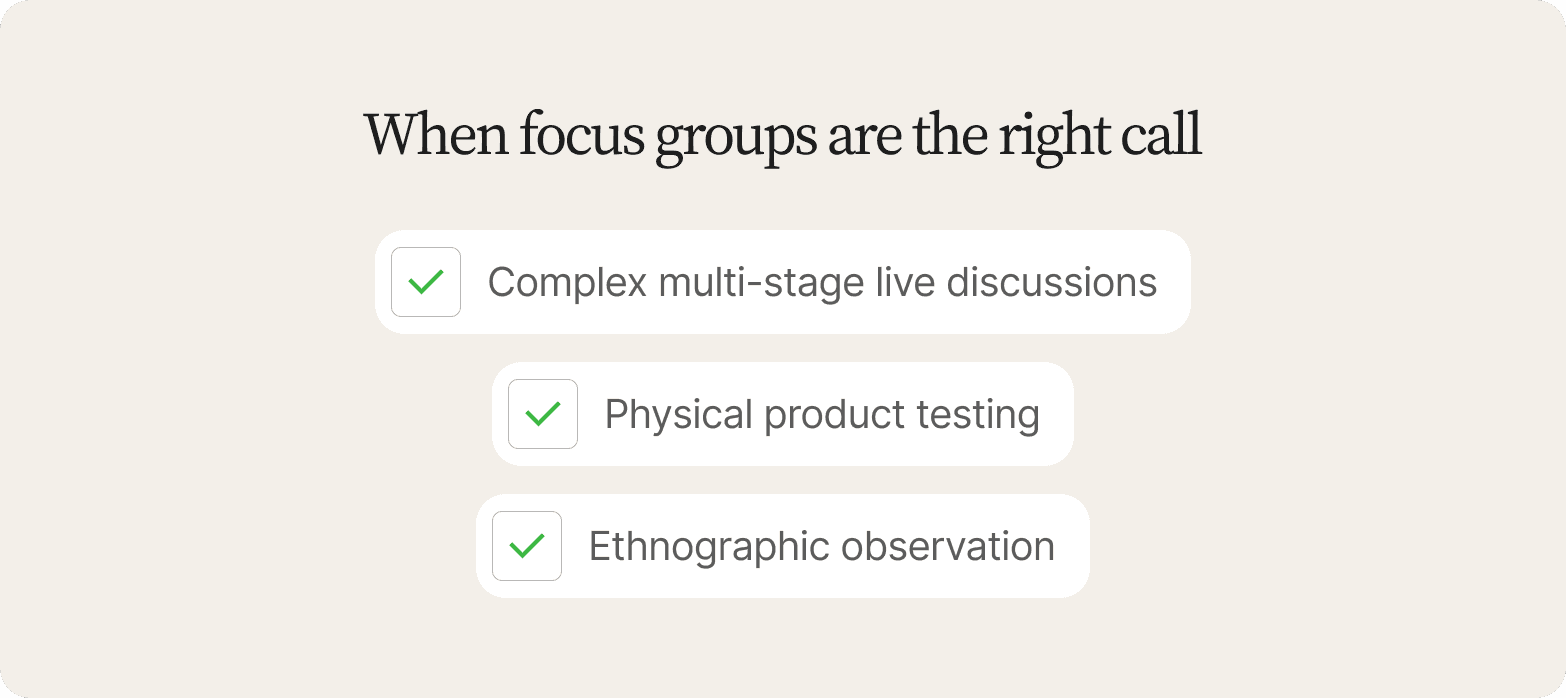
None of this makes traditional focus groups the wrong choice. Complex multi-stage live discussions, physical product testing, and ethnographic observation, where the environment itself is part of the data, are situations in which in-the-moment group judgment is hard to replicate asynchronously. Asynchronous one-to-one interviews are best understood as complementary to live focus groups, not a replacement for them. The choice comes down to whether the question calls for group interaction or clean individual responses, timed to match how decisions are made.
Frequently Asked Questions
How many people should be in a focus group?
The standard range is 6 to 10 participants: large enough to generate genuine group dynamics and a range of perspectives, but small enough that every group member gets meaningful talk time. Groups smaller than 4 risk thin coverage; groups larger than 10 tend to produce a handful of dominant voices and a silent majority.
When does a smaller focus group work better than a larger one?
Smaller groups of 4 to 6, sometimes structured as mini-focus groups, are worth considering when the topic is sensitive, the participant profile is highly specialized, or depth of individual response matters more than breadth. A group of senior procurement leaders discussing internal budget processes would often yield more candid material in a smaller setting than a standard group of eight, since each participant has more time and the moderator can follow threads more closely with more pointed focus group questions.
What is the difference between a focus group and a one-to-one depth interview?
A focus group captures group dynamics: social proof, peer reactions, and shifts in opinions as participants hear each other's views. A depth interview, also called an in-depth interview, captures individual reasoning without social influence, the right choice for personal decision-making or sensitive behavior. Neither method is superior; it depends on whether the group dynamic is a feature or a confound for the research question.
How do asynchronous AI-moderated interviews compare to traditional focus groups at scale?
Traditional focus groups are constrained by scheduling: one or two sessions per day, in one location, with one moderator. Asynchronous AI-moderated interviews remove that ceiling, enabling 10 to 1,000 conversations to run simultaneously across 50+ languages without the coordination overhead of live group interviews. The trade-off is that real-time group dynamics are lost, so a facilitated focus group remains the right call for studies in which social interaction is part of the research design.
How many focus groups do you need to run to reach saturation?
Most researchers, drawing on decades of academic research across the social sciences, recommend running at least three groups before drawing conclusions, adding sessions until new themes no longer emerge. Running multiple focus groups also helps identify group-specific outliers: a finding consistent across three groups is more defensible than a single-session result.
How many focus groups should I run across multiple audience segments?
The standard guidance is 3 to 4 focus groups per audience segment to achieve thematic saturation. That multiplies fast: a program spanning three to five segments requires 9 to 20 groups, with timelines of six weeks or longer once recruitment, scheduling, moderation, and analysis are accounted for. Asynchronous one-to-one interviews change that arithmetic, since conversations run in parallel across all segments, closing in 48 to 72 hours, with sample sizes larger than a traditional format supports.
About the author
Meg Gerli
Research Impact Lead
Meg studied at Stanford and spent six and a half years on the insights and research team at Nike before joining Conveo. She scopes studies with US enterprise teams: sample sizes, panel feasibility, and the trade-off between depth and speed, with the reasoning behind every recommendation.
Meet Meg on film →Qualitative insights at the speed of your business.
Conveo runs AI-moderated video interviews and structures everything they say.